Sílvia Filipa Martins, PharmD
Researcher, Centro de Investigação Interdisciplinar Egas Moniz (CiiEM), Instituto Superior de Ciências da Saúde Egas Moniz (ISCSEM), Campus Universitário, Quinta da Granja, Monte da Caparica, 2829-511 Caparica, Portugal, tel. (+351) 212 946 700, fax (+351) 212 946 868,
JW Foppe van Mil, PharmD, PhD
Pharmacy Practice Consultant, Van Mil Consultancy, Margrietlaan 1, 9471 CT Zuidlaren, Netherlands, fax 31 50 4090732, [email protected]
Filipa Alves da Costa, PharmD, PhD
The organizational framework of community pharmacies in Europe
Introduction
According to the World Health Organization (WHO), people-centred and integrated health services are critical for reaching universal health coverage. A prerequisite for good health is
access to preventive and curative health care.1
This issue of access to care is still governed by many old lessons. It can be expressed in the five Á’s’: affordability (ability to pay for care), availability of care, ability to reach care
(geographically), accommodation (adapted to the organizational needs of the client), and
acceptability (from the clients perspective).2 Access to care implies enough health care
professionals to cover the population served. Equity, another dimension of access to care, indicates that care must be available to all, regardless of their geographical location or social,
economic and demographic situation.
Recently, more emphasis has been put on primary care, as disease prevention is essential to
ensure better health, and to a decreased use of more expensive secondary and tertiary care.3
Community pharmacy is unquestionably an important part of primary care for various reasons. First, preventive and curative medicine often require the use of medicines, and these
are in most countries typically (or exclusively) available from the pharmacy (traditional approach: product-based). Secondly, medicines may ideally (and increasingly) be delivered to the patient by employing clinical pharmacy principles for appropriate and rational use
(intermediate approach: essential service). In some European regions, forms of preventive care are practiced by community pharmacy, including screening activities, and health
promotion campaigns (current approach: service development). Lastly, community pharmacies are easily accessibility, and often are the first point of contact between a care
Revised Manuscript
provider and the patient. Because community pharmacy is part of primary care, the principles
of access and equity are also valid for this sector of healthcare. Over the past decades, the pharmacy profession has developed, with pharmaceutical care putting an increasing focus on
the patient certainly in Europe. 4
Access to medicines especially by rural populations in some European countries has been a concern tackled in sparsely populated regions by the creation of legislation directed at the
opening of new pharmacies ensuring equitable distribution.5 In some European countries such as Switzerland and the Netherlands, medical doctors may dispense medicines from their
practice. 6,7
It is interesting to note that community pharmacy practice is changing in the European Union and affiliated countries. These changes are facilitated (but also sometimes hindered) by
national and European legislation, and active pharmacist or pharmacy organizations. Having a good overview of the health care systems in various European countries may help explaining
and anticipating these changes.
Between 2005 and 2007 a series of papers were published in the Annals of Pharmacotherapy, on the new pharmaceutical care related roles of pharmacy.8,9,10,11,12,13,14 In view of the rapid
structural changes in Europe, a new overview seems necessary.
The objectives are to list and compare health care and community pharmacy structure in Europe; and to discuss the facilitators and barriers that can be found in health care systems for
the implementation of new community pharmacy services. Additionally, to better understand eventual differences arising, it was also intended to explore education and training of
Method
A cross-sectional observational study was conducted with a structured questionnaire. Data were collected using an online platform available between March and April 2013. A purposive sample of 31 representative individuals from 25 European countries was invited to
participate. Respondents were selected based on their experience and visible contribution in pharmacy practice activities in their country and internationally, or by their engagement in political or scientific activities. To identify potential but less ‘visible’ respondents, a snowball
sampling technique was used.
Based on literature, a survey was specifically developed for this study. A series of articles
entitled "Pharmacy around the world", published in the Annals of Pharmacotherapy from 2005 to 2007, which characterized various aspects of the health systems, particularly the
operating characteristics and regulation of community pharmacies in the country, and
described care related services was central to the development of the survey tool.8
The survey comprised five main sections:
1. Description of the health care system (e.g. main provider, funding, etc.)
2. Description of community pharmacies (e.g. regulation in place) 3. Available products pharmacies and elsewhere
4. Education and training of pharmacists and other auxiliary staff 5. Services available through community pharmacies
At the end, there was an open section where respondents were asked to mention relevant legal
This survey was pre-tested by asking expert opinion on the content, format and wording used;
three experts were involved practicing in different settings and representing a range of specialties. The final version can be found as electronic supplementary material to this paper. The information collected by the survey was then enriched and triangulated through an additional literature search, direct contact by email with pharmacists’ bodies, including the
Pharmaceutical Group of the European Union in Brussels (PGEU), and clarification of some
answers from respondents. The respondent from Iceland also referred to a report from the Boston Consulting Group (2011) where part of the data could be found.15
Survey data were collected in the "Google docs" platform, which allows extraction by Microsoft Excel, version 2012. This database was then imported into the Statistical Package for Social Sciences (SPSS) version 19, for analysis.
Results
Data were collected between March and April 2013. Contact persons in 25 European countries were approached (Belgium, Bosnia, Croatia, Czech Republic, Denmark, England,
Finland, Germany, Hungary, Iceland, Ireland, Italy, Malta, Northern Ireland, Norway, Poland, Portugal, Scotland, Serbia, Slovenia, Spain, Sweden, Switzerland, The Netherlands, and
Wales). Of these, 17 contact persons responded to the survey and two additional countries were reached using a snowballing technique (Bulgaria and Macedonia). Responses obtained represent 19 countries and respondents worked either in professional associations representing
community pharmacies or pharmacists or in the pharmacy practice department of universities (See table 1). The response rate in the study was 70.4%. However, if one considers that the
Health Care System
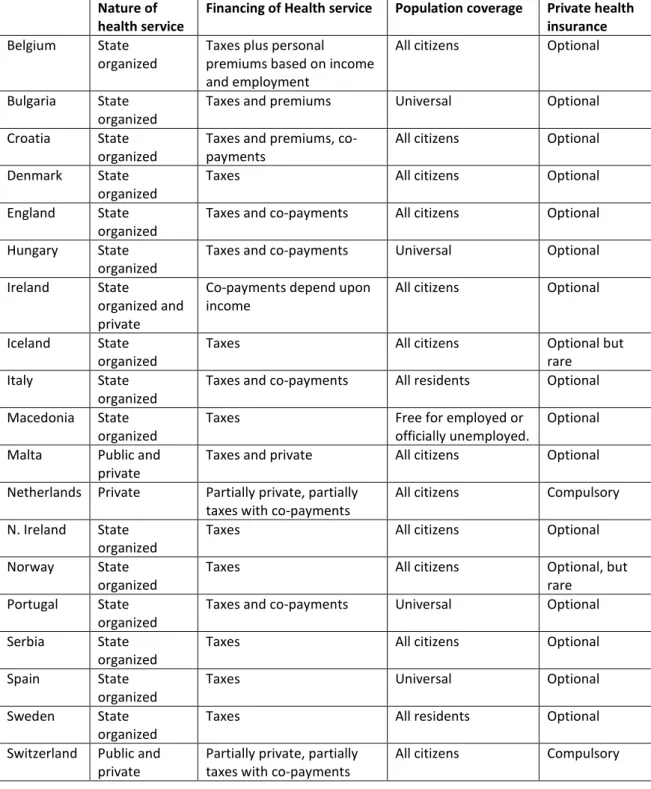
Table 1 summarizes some features of the healthcare systems of European countries, including the predominance of the public or private sector, funding, coverage and accessibility for
citizens.
For the purpose of this paper, we have referred to “State organised”, which does not
necessarily mean public. Public means organised so that the health care is accessible for
everyone. State organised means that the state has organised the health care structure, but not necessarily the access. In the UK National Health Service’ (NHS) the healthcare organization, with different models of organisations across England, Scotland, Wales and Northern Ireland, funding is through direct taxation.
Many professionals are state employees, and most health care institutions are state-owned, which may include hospitals, local health centers and tertiary care units. However, community pharmacy is often private, or corporately owned, with services being State remunerated or paid out of pocket by the patient.
In the ‘Public System’, the state (or a state insurance) organizes and pays for healthcare
services, but healthcare professionals are not necessarily state employed, and healthcare
institutions are largely private. In the ‘Private System’, the state organizes and controls care, but citizens must be privately insured and the insurance companies pay for the care to the private institutions and care providers. There may be a state contribution directly to the
insurance companies.
services and goods. In the Netherlands and Switzerland there is no state health insurance, but
having a private health insurance is mandatory. In Ireland there is a mixed system, depending on the income of the citizen.
Population coverage has been reported as ‘universal’, meaning for everyone in a country
without limitations, as ‘all citizens’, meaning for every person living in a country and having the nationality of the country, and ‘all residents’, meaning all people who live officially in a
country (but may have a different nationality).
Please insert Table 1 here
Community Pharmacy
The regulation of community pharmacies ownership varies across Europe. In 3 of the 19
countries in the sample, ownership is restricted to pharmacists (Denmark and Italy, multiple pharmacies; Spain, restricted to one). In most countries, ownership is open to any individual
or entity, but there can be limitations. In, for instance, Portugal and Sweden, producers of medicinal products or Market Authorization Holders (MAH), and prescribers of medicinal products cannot own a pharmacy. The most common situation is the possible ownership of
multiple pharmacies by any individual/entity (n=16).
In almost all the European countries surveyed, explicit criteria exist for the founding of new
pharmacies. Ten countries (England, Portugal, Spain, Croatia, Malta, Italy, Belgium, Hungary, Denmark, Serbia) have criteria based on distance between pharmacies or number of people served. In Norway and Sweden a permit from the authorities is required before one can
open a pharmacy, but the criteria for this permit focus more on solvency and the business model16. Macedonia, Iceland, and Ireland indicated that there are criteria, but which criteria
Belgium there currently is a moratorium on the opening of new pharmacies. No answer on
this aspect was received from Bulgaria.
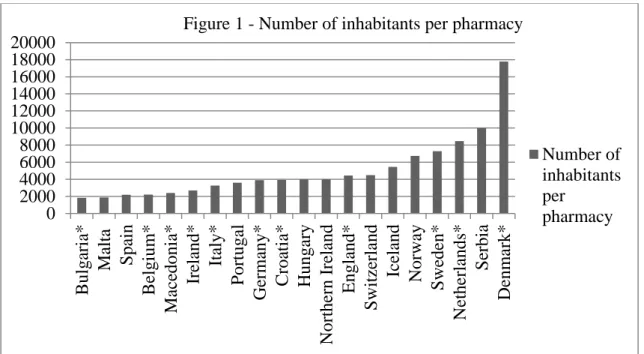
The number of inhabitants per pharmacy was not reported by all. Therefore, data were supplemented with information from the PGEU from 2013. Denmark is the country with the
greatest number of inhabitants per pharmacy (25.000) as opposed to Bulgaria (1750) (see figure 1). One should consider, however, that one pharmacy in Denmark may have several
outlets.
Please insert Figure 1 here
Quality Management
A quality management system (QMS) is a set of policies, processes and procedures required for planning, implementing and performing tasks in community pharmacies, which may lead,
after an independent audit, to the accreditation of the pharmacy. Quality Management System for community pharmacies were reported to be available in 15 of the 19 responding countries. Countries reporting not to have a QMS for pharmacy were England, Macedonia, Ireland and
Malta.
Some countries indicated to have guidelines for the provision of pharmaceutical care in the
pharmacy, such as the Netherlands, Hungary and Serbia. Examples in these countries include guidelines for diabetes, hypertension, dyslipidemia, obesity, asthma, chronic obstructive pulmonary disease (COPD), rhinitis, upper respiratory tract treatment (over-the counter, ahead
referred to as OTC), dermatology (OTC and on prescription), gastro-intestinal tract disorders, benign prostate hyperplasia (BHP), pregnancy, back pain and geriatric medication
Products available at the pharmacy
There are various categories of medicines available in pharmacies. The category of Prescription Only Medicines (POM), defined as a medicine which can only be sold through a
pharmacy and for which a prescription is required, exists in all responding countries.
Over-the-counter medicines, commonly known as OTC, are also available in all countries, but with some differences regarding the subcategories these include.
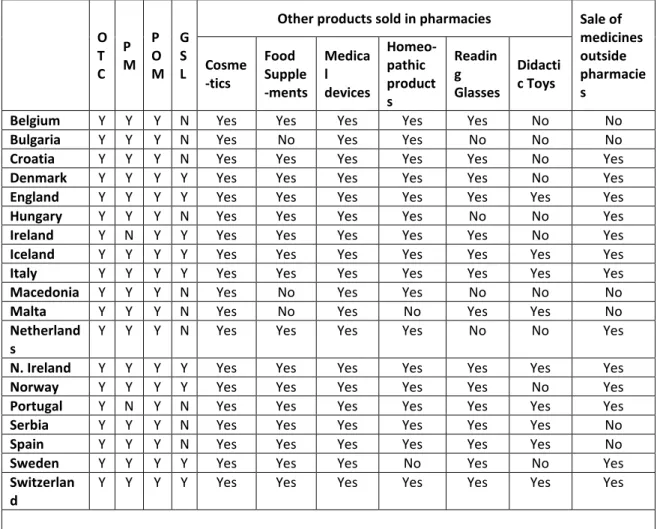
Pharmacy Medicines (PM), defined as medicines only to be sold in pharmacies but without a prescription and under the (distant) supervision of a pharmacist, exist in all 19 responding European countries, except for Ireland and Portugal. In the latter country, however, a dispatch
has been published that this category will be introduced soon, but the list is not ready yet. The non-prescription medicines may now be displayed and advertised, but cannot be purchased as
a self-service good since they must be placed behind the counter in a reserved area where only the pharmaceutical team can reach (this is true in pharmacies and in non-prescription
medicines outlets, which may be in a specific area inside a supermarket or a petrol station.
The category General Sales List (GSL) refers to medicines that are supposed to be relatively safe and can be sold in pharmacies, supermarkets and other places by non-pharmacist staff,
and is available in 9 out of 19 countries (Table 2). In Macedonia, Spain, Bulgaria, Malta, Belgium and Serbia, medicines in general cannot be purchased outside of OTC points of sale,
representing 31.6% of the participating countries.
Other products that may be found in all European pharmacies are cosmetics, food supplements and medical devices. In most countries (17 out of 19), homeopathic products
may also be available, reading glasses in 14 out of 19 countries and didactic toys in 7 out of the 19 responding countries (Table 2).
Education and training of pharmacists
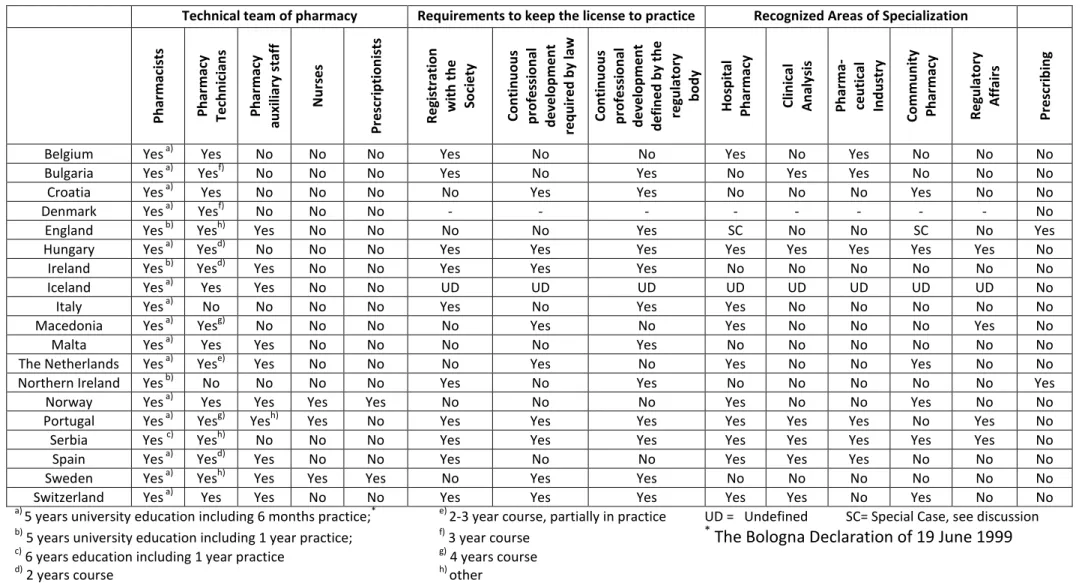
In Northern Ireland and Italy only pharmacists may practice in pharmacy. However, in most countries the team is composed by pharmacists and pharmacy technicians. In Norway, it additionally includes assistants and nurses. In Sweden, there are also prescriptionists (Table
3). The required qualifications for each team member are also described in Table 3. Please note that the requirements for technicians are usually expressed in years of education at a high
school/college level, and often include practice work. Auxiliary staff preparation varies from short education to training on-the-job.
Licenses
The registration of pharmacists in most countries depends on Societies. In a few countries, the pharmacist societies are also the regulatory bodies, meaning that they control the licenses to
practice and check the premises. However, this survey focused on their activity within a community pharmacy. These are generally subject to laws imposed by the national regulatory bodies (equivalent to EMA). Also, as small and medium sized companies that employ
personnel, they may additionally be subject to the general work laws.
Requirements for license renewal are requirements imposed by the competent bodies, which
may include a minimum number of continuous professional development (CPD) credits (or hours), or an exam, to demonstrate competence in practice or others. The type of requirements varies widely and may include the simple registration with the Society, continuous
professional development required by law and continuous professional development defined by the Pharmaceutical Society (or equivalent), where the latter may have various possible
formats (Table 3). Additionally, there are several possible specializations in pharmacy, according to the sector of practice, and their recognition by the Pharmaceutical Societies (or
There are some exceptions where the boundaries between the Pharmaceutical Society and the
Department of Health are different from most European countries. Since 2010, the registration of pharmacists in Great Britain is with the General Pharmaceutical Council (GPhC), the regulator for registered pharmacists, pharmacy technicians and pharmacy premises. In Northern Ireland, registration is with the Pharmaceutical Society of Northern Ireland, which also has a forum to support and develop professional activities: functions that are undertaken across Great Britain by the Royal Pharmaceutical Society (RPS). Pharmacy premises in hospital are regulated by the Care Quality Commission which regulates all hospital premises.
Requirements for maintenance on the register in Great Britain include recording a minimum number of continuous professional development (CPD) entries. This is currently being reviewed by the GPhC as the revalidation of other health professionals is implemented, nominally called Continuing fitness to practice (CFtP). The support, development and recognition afforded by the RPS is widely regarded as a quality mechanism to demonstrate continuing fitness to practice, especially regarding the blend of self and peer assessment of advanced practice. Mechanisms to recognise specialisms and specialization and are also being developed in GB and across the UK.
Please insert table 3 here
Services available in community pharmacy
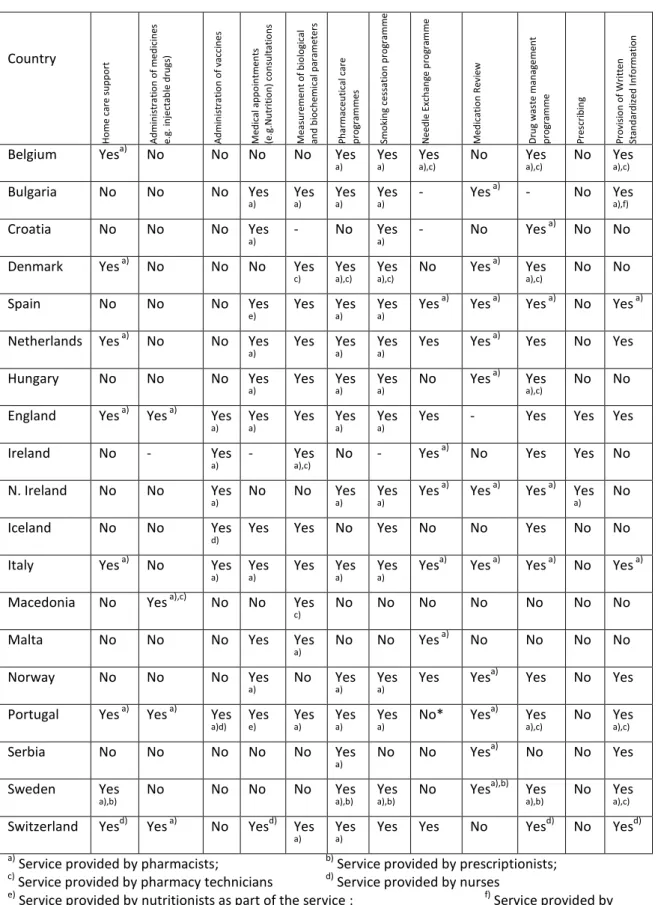
Dispensing of medicines was universal across all the countries. Apart from this, the services more widely available in European pharmacies are smoking cessation programmes (93.8%, n
care programmes (77.8%, n = 14). The least implemented services mentioned were drug
administration (26.3%, n = 5) and prescription services (26.3%, n = 5) (Table 4).
Please insert Table 4 here
In 47% of the participating countries there is some sort of remuneration for pharmaceutical
services, namely in Belgium, Denmark, England, Hungary, Ireland, Netherlands, Northern Ireland, Portugal, and Switzerland.
Discussion
The results of this study indicate that health care and pharmacy seem to be converging into
one format, in which public funding is complemented by private funding (in the form of co-payments of supplement insurances). Many new rules or laws are implemented by decisions made in the EU. Member countries must follow such directives, and thus the systems in EU
countries converge. Privatization of healthcare only seems to be complete in the Netherlands and Switzerland, although some form of state-funding and control still exists.
Community pharmacy ownership is no longer protected in most countries and currently there are only three countries where only pharmacists can own pharmacies, different to what was observed in Europe a decade ago. Interesting to note that in a few countries, physicians can
own a pharmacy, although it seems to be discouraged if not absolutely necessary. Among countries where ownership is open to non-pharmacists, there are some where restrictions to
ownership exist. In Portugal, for example, pharmacies may not be owned by pharmaceutical companies, wholesalers or medical doctors. In Sweden, medical doctors explicitly cannot own
The number of inhabitants served by pharmacies also seems to be converging, although it is
still possible to observe a split between northern European countries and all others, with the first having larger pharmacies covering a larger number of inhabitants. There were only two countries that reported to have no demographic criteria for the establishment of new
pharmacies (Switzerland and the Netherlands), a finding consistent with PGEU data (PGEU, 2010).
The results about QMS for countries belonging to the United Kingdom should be carefully read as in these countries, pharmacists have had to be accredited. This accreditation enables
the provision of specific services, which may be commissioned, i.e., requested by primary care doctors13.
The technical staff of pharmacies comprises pharmacists in all countries and technicians in all
except two countries (Italy and Northern Ireland). The inclusion of other categories is less clear, where in Sweden we may find prescriptionists, in Norway nurses, and in 6 countries (31.6%) auxiliary technicians. The prescriptionist is an individual with functions of medicines’ dispensing, with an equivalent role to the pharmacist, although with a lower
qualification, as the course is 3-years.17
As described in Directive 2005/36/EC of the European Parliament and of the Council of 7 September 2005 on the recognition of professional qualifications, training the pharmacist is at least 5 years, with a minimum of 4 years of theoretical and 6 months of practical training in
community pharmacy or hospital pharmacy, consistent with the information collected in the study18.
may be seen as areas of specialization, such as the consultant pharmacists within hospital or
pharmacists with special interests within community.
Services implemented in community pharmacies across Europe are perhaps the domain of the survey where most variation was found. While some countries seem to be quite conservative
and offer few services, others are even expanding to services traditionally embraced by other health care professions, such as immunization in Portugal or prescribing in England, Northern
Ireland and Ireland. Indeed, this aspect is interesting and may possibly be related to various aspects, namely the accessibility of care in its traditional format, mostly in primary care19,
which also includes the appropriate workforce to meet societal needs, but also eventually lobbying activities. However, the survey did not directly explore for the link between health care services available and arising community pharmacy services.
The pharmaceutical services most widely disseminated in Europe, were dispensing (100.0%; n=19), smoking cessation (93.8%; n=15), and drug waste management programmes (81.3%; n=13), which is similar to the findings reported by Kanavos et al20. These authors also studied
17 European countries and reported that these two services were available in all countries. The two services, however, clearly fall under the health promotion category. This indicates the relevance of the pharmacist’s role within the public health arena, but it also indicates that
pharmacy (or pharmacist) specific services other than dispensing are more difficult to
implement.
Pharmaceutical care was the third more commonly reported service, indicated by 77.8% of the participating countries (n =14). However, one did not explore what components of
assessed, a term that may encompass many clinical fields21, and these are two important
limitations. It is important to reflect on the validity of the reported level of service provision, as it is much higher than what has been reported elsewhere15. In fact, the reported figure for this study is quite surprising given that pharmaceutical care services demand much more
investment from the pharmacy human resources as it requires close patient monitoring, documentation, interaction with physicians and other members of the health care team.
In only 47% of the responding countries there is remuneration (by the state or insurance) for pharmaceutical services. In other countries, the patient may be asked to pay (all or part of) the
costs of the service. But this has not been explored in this study. Sometimes the implementation of some services on a larger scale becomes limited due to lack of remuneration, a barrier also to pharmaceutical care services previously identified.2223
This study, like many studies in Europe, suffers from the fact that not all Europeans speak the same language. This means that questions are sometimes not understood correctly, or in the same manner, which may influence answers obtained. The research team have tried to deal
with this by contacting respondents whenever such difficulties were obvious, and asking for additional explanations.
This study also illustrates the difficulty to obtain information about community pharmacy in two big countries, France and Germany. In these two countries, the national bodies have limited information on the details of real practice and key data. Only the regional organisations detain this information. Hence, information about these countries is relatively hard to obtain, and validation of information is extra complicated.
Detailed information on remunerated services was lacking on this study, and this should be an
interesting area to be further researched in the future, with particular interest in enhanced services, such as medication review and pharmaceutical care.
Conclusion
In general, all citizens have access to health care in European countries. The general features of community pharmacy across Europe are quite homogeneous, regarding products available
and even regulations in place. The wider variability was found for services available in community pharmacies.
Acknowledgements
The authors would like to thank respondents to the survey by providing data on their country and by their availability to check data originating and constant availability to clarify authors. We specially thank Pharmaceutical Care Network Europe for providing the initial platform
that resulted in this study.
Declaration of Conflicting Interests
The Authors declare that there is no conflict of interests.
Funding Acknowledgement
References
1 World Health Organisation. Health Systems Service Delivery. In ‘Health Systems’.
Available from: http://www.who.int/healthsystems/topics/delivery/en/
2 Penchansky R, Thomas JW. The concept of access: definition and relationship to consumer
satisfaction. Med Care 1981;19:127-40.
3 Goodman RA, Bunnell R, Posner SF. What is "Community Health"? Examining the
Meaning of an Evolving Field in Public Health. Prev Med 2014; 67:28-61.
4 van Mil JWF, Schulz M. A review of Pharmaceutical Care in Community Pharmacy in
Europe. Harvard Health Policy Review 2006; 7(1):155-68.
5 Vogler S, Arts D, Sandberger K. Impact of pharmacy deregulation and regulation in
European countries. Summary Report. Vienna, 2012. Gesundheit Österreich, Vienna.
6 Guignard E, Bugnon O. Pharmaceutical Care in Community Pharmacies: Practice and
Research in Switzerland. Ann Pharmacother 2006; 40:512-7.
7 Deuning CM. Number of GPs with a pharmacy per municipality (Aantal apotheekhoudende
huisartsen per gemeente 2014). In: Volksgezondheid Toekomst Verkenning, Nationale Atlas
Volksgezondheid. Bilthoven: RIVM,
http://www.zorgatlas.nl/zorg/eerstelijnszorg/farmaceutische-zorg/aantal-apotheekhoudende-huisartsen-per-gemeente-2009/
8 Farris KB, Fernandez-Llimos F, Benrimoj SI. Pharmaceutical Care in Community
Pharmacies: Practice and Research from Around the World. Ann Pharmacother. 2005;
39:1539-41.
9 Gastelurrutia MA, Faus MJ, and Fernández-Llimós F. Providing Patient Care in Community
Pharmacies in Spain. Ann Pharmacother 2005;39:2105-10.
10 Costa S, Santos C, and Silveira J. Community Pharmacy Services in Portugal. Ann
11 Westerlund LOT, Björk T. Pharmaceutical Care in Community Pharmacies: Practice and
Research in Sweden. Ann Pharmacother 2006; 40:1162-9.
12 Van Mil JWF. Pharmaceutical Care in Community Pharmacy: Practice and Research in the
Netherlands. Ann Pharmacother 2005;39:1720-5.
13 Noyce PR. Providing Patient Care through Community Pharmacies in the UK: Policy,
Practice, and Research. Ann Pharmacother 2007;41:861-8.
14 Herborg H, Sorensen E.W, and Frokjaer B. Pharmaceutical care in community pharmacies:
practice and research in Denmark. Ann Pharmacother 2007; 41 (4):681-689.
15 The Boston Consulting Group. Health Care System reform and short term savings
opportunities, Iceland Health Care System project. Available from:
http://www.velferdarraduneyti.is/media/ritogskyrslur2011/IIceland_HCS-Final_report-_Long_version.pdf
16 Swedish Law on sales of medicinal products (SFS 2009:366)
17 Westerlund L.O.T. and Björk H.T. Pharmaceutical Care in Community Pharmacies:
Practice and Research in Sweden. Ann Pharmacother 2006;40:1162-9.
18 Directive 2005/36/EC of the European Parliament and of the Council of 7 September 2005
on the recognition of professional qualifications. Official Journal of the European Union. 2005.
19Augusto GF. Cuts in Portugal’s NHS could compromise care. Lancet. 2012; 379:400.
20 Kanavos P, Schurer W, Vogler S. atahe Pharmaceutical distribution chain in the European
Union: Structure and impact on pharmaceutical prices. London/Vienna. 2011.
21 Allemann SS, van Mil JW, Botermann L, Berger K, Griese N, Hersberger KE.
22Hughes, CM, Hawwa, AF, Scullin, C, Anderson, C, Bernsten; CB, Bjornsdottir, I, Cordina,
MA, Costa, FA, et al. Provision of pharmaceutical care by community pharmacists: a comparison across Europe. Pharm World Sci. 2010; 32(4):472-87.
23Chan P, Grindrod K, Bougher D, et al. A systematic review of remuneration systems for
Fig. 1 Average number of people served per pharmacy (* = numbers according to PGEU)1
1
PGEU (2011). PGEU database 2011. 0
2000 4000 6000 8000 10000 12000 14000 16000 18000 20000
B
ulgar
ia*
Malta Spa
in
Be
lgium
*
Mac
edonia* Ireland* Ita
ly*
P
or
tugal
Ge
rma
ny*
Croa
tia*
Hunga
ry
Nor
the
rn I
re
land
Engla
nd*
S
wit
ze
rla
nd
Ic
eland
N
or
w
ay
S
we
de
n*
Ne
the
rland
s*
S
erbia
De
nm
ark*
Figure 1 - Number of inhabitants per pharmacy
Number of inhabitants per
pharmacy
Figure 1
Table 1 Basic financial characteristic of health care systems in a number of European
countries
Nature of health service
Financing of Health service Population coverage Private health insurance
Belgium State
organized
Taxes plus personal premiums based on income and employment
All citizens Optional
Bulgaria State
organized
Taxes and premiums Universal Optional
Croatia State
organized
Taxes and premiums, co-payments
All citizens Optional
Denmark State
organized
Taxes All citizens Optional
England State
organized
Taxes and co-payments All citizens Optional
Hungary State
organized
Taxes and co-payments Universal Optional
Ireland State
organized and private
Co-payments depend upon income
All citizens Optional
Iceland State
organized
Taxes All citizens Optional but
rare
Italy State
organized
Taxes and co-payments All residents Optional
Macedonia State organized
Taxes Free for employed or
officially unemployed.
Optional
Malta Public and
private
Taxes and private All citizens Optional
Netherlands Private Partially private, partially taxes with co-payments
All citizens Compulsory
N. Ireland State organized
Taxes All citizens Optional
Norway State
organized
Taxes All citizens Optional, but
rare
Portugal State
organized
Taxes and co-payments Universal Optional
Serbia State
organized
Taxes All citizens Optional
Spain State
organized
Taxes Universal Optional
Sweden State
organized
Taxes All residents Optional
Switzerland Public and private
Partially private, partially taxes with co-payments
All citizens Compulsory
table 1
Table 2 Products sold in pharmacies
O T C
P M
P O M
G S L
Other products sold in pharmacies Sale of
medicines outside pharmacie s
Cosme -tics
Food Supple -ments
Medica l devices
Homeo-pathic product s
Readin g Glasses
Didacti c Toys
Belgium Y Y Y N Yes Yes Yes Yes Yes No No
Bulgaria Y Y Y N Yes No Yes Yes No No No
Croatia Y Y Y N Yes Yes Yes Yes Yes No Yes
Denmark Y Y Y Y Yes Yes Yes Yes Yes No Yes
England Y Y Y Y Yes Yes Yes Yes Yes Yes Yes
Hungary Y Y Y N Yes Yes Yes Yes No No Yes
Ireland Y N Y Y Yes Yes Yes Yes Yes No Yes
Iceland Y Y Y Y Yes Yes Yes Yes Yes Yes Yes
Italy Y Y Y Y Yes Yes Yes Yes Yes Yes Yes
Macedonia Y Y Y N Yes No Yes Yes No No No
Malta Y Y Y N Yes No Yes No Yes Yes No
Netherland s
Y Y Y N Yes Yes Yes Yes No No Yes
N. Ireland Y Y Y Y Yes Yes Yes Yes Yes Yes Yes
Norway Y Y Y Y Yes Yes Yes Yes Yes No Yes
Portugal Y N Y N Yes Yes Yes Yes Yes Yes Yes
Serbia Y Y Y N Yes Yes Yes Yes Yes Yes No
Spain Y Y Y N Yes Yes Yes Yes Yes Yes No
Sweden Y Y Y Y Yes Yes Yes No Yes No Yes
Switzerlan d
Y Y Y Y Yes Yes Yes Yes Yes Yes Yes
Y = Yes N=No
table 2
Table 3: Staff working in a pharmacy, with required qualifications and Type of Licenses and licensing for pharmacists
a)
5 years university education including 6 months practice;* e) 2-3 year course, partially in practice UD = Undefined SC= Special Case, see discussion b)
5 years university education including 1 year practice; f) 3 year course * The Bologna Declaration of 19 June 1999
c)
6 years education including 1 year practice g) 4 years course
d)
2 years course h) other
Technical team of pharmacy Requirements to keep the license to practice Recognized Areas of Specialization
P h a rm a ci st s P h a rm a cy T e ch n ic ia n s P h a rm a cy a u x il ia ry s ta ff N u rs e s P re sc ri p ti o n is ts R e g is tr a ti o n w it h t h e S o ci e ty C o n ti n u o u s p ro fe ss io n a l d e v e lo p m e n t re q u ir e d b y l a w C o n ti n u o u s p ro fe ss io n a l d e v e lo p m e n t d e fi n e d b y t h e re g u la to ry b o d y H o sp it a l P h a rm a cy C li n ic a l A n a ly si s P h a rm a -ce u ti ca l In d u st ry C o m m u n it y P h a rm a cy R e g u la to ry A ff a ir s P re sc ri b in g
Belgium Yes a) Yes No No No Yes No No Yes No Yes No No No
Bulgaria Yes a) Yesf) No No No Yes No Yes No Yes Yes No No No
Croatia Yes a) Yes No No No No Yes Yes No No No Yes No No
Denmark Yes a) Yesf) No No No - - - No
England Yes b) Yesh) Yes No No No No Yes SC No No SC No Yes
Hungary Yes a) Yesd) No No No Yes Yes Yes Yes Yes Yes Yes Yes No
Ireland Yes b) Yesd) Yes No No Yes Yes Yes No No No No No No
Iceland Yes a) Yes Yes No No UD UD UD UD UD UD UD UD No
Italy Yes a) No No No No Yes No Yes Yes No No No No No
Macedonia Yes a) Yesg) No No No No Yes No Yes No No No Yes No
Malta Yes a) Yes Yes No No No No Yes No No No No No No
The Netherlands Yes a) Yese) Yes No No No Yes No Yes No No Yes No No
Northern Ireland Yes b) No No No No Yes No Yes No No No No No Yes
Norway Yes a) Yes Yes Yes Yes No No No Yes No No Yes No No
Portugal Yes a) Yesg) Yesh) Yes No Yes Yes Yes Yes Yes Yes No Yes No
Serbia Yes c) Yesh) No No No Yes Yes Yes Yes Yes Yes Yes Yes No
Spain Yes a) Yesd) Yes No No Yes No No Yes Yes Yes No No No
Sweden Yes a) Yesh) Yes Yes Yes No Yes Yes No No No No No No
Switzerland Yes a) Yes Yes No No Yes Yes Yes Yes Yes No Yes No No
table 3
Table 4 Services available in community pharmacies in Europe Country Ho m e c a re s u p p o rt A d m in is tr a ti o n o f m e d ic in e s e .g . in je ct a b le d ru g s) A d m in is tr a ti o n o f v a cc in e s M e d ic a l ap p o in tm e n ts (e .g .N u tr it io n ) co n su lt a ti o n s M e a su re m e n t o f b io lo g ic a l a n d b io ch e m ic a l p a ra m e te rs P h a rm a ce u ti ca l ca re p ro g ra m m e s S m o k in g c e ss a ti o n p ro g ra m m e N e e d le E xc h a n g e p ro g ra m m e M e d ic a ti o n R e v ie w D ru g w a st e m a n a g e m e n t p ro g ra m m e P re sc ri b in g P ro v is io n o f W ri tt e n S ta n d a rd ize d I n fo rm a ti o n
Belgium Yesa) No No No No Yes
a)
Yes a)
Yes a),c)
No Yes
a),c)
No Yes
a),c)
Bulgaria No No No Yes
a) Yes a) Yes a) Yes a)
- Yes a) - No Yes
a),f)
Croatia No No No Yes
a)
- No Yes
a)
- No Yes a) No No
Denmark Yes a) No No No Yes
c)
Yes a),c)
Yes a),c)
No Yes a) Yes
a),c)
No No
Spain No No No Yes
e)
Yes Yes a)
Yes a)
Yes a) Yes a) Yes a) No Yes a)
Netherlands Yes a) No No Yes
a)
Yes Yes a)
Yes a)
Yes Yes a) Yes No Yes
Hungary No No No Yes
a)
Yes Yes a)
Yes a)
No Yes a) Yes
a),c)
No No
England Yes a) Yes a) Yes
a)
Yes a)
Yes Yes a)
Yes a)
Yes - Yes Yes Yes
Ireland No - Yes
a)
- Yes
a),c)
No - Yes a) No Yes Yes No
N. Ireland No No Yes
a)
No No Yes
a)
Yes a)
Yes a) Yes a) Yes a) Yes a)
No
Iceland No No Yes
d)
Yes Yes No Yes No No Yes No No
Italy Yes a) No Yes
a)
Yes a)
Yes Yes a)
Yes a)
Yesa) Yes a) Yes a) No Yes a)
Macedonia No Yes a),c) No No Yes
c)
No No No No No No No
Malta No No No Yes Yes
a)
No No Yes a) No No No No
Norway No No No Yes
a)
No Yes a)
Yes a)
Yes Yesa) Yes No Yes
Portugal Yes a) Yes a) Yes a)d) Yes e) Yes a) Yes a) Yes a)
No* Yesa) Yes
a),c)
No Yes
a),c)
Serbia No No No No No Yes
a)
No No Yesa) No No Yes
Sweden Yes
a),b)
No No No No Yes
a),b) Yes a),b)
No Yesa),b) Yes a),b)
No Yes
a),c)
Switzerland Yesd) Yes a) No Yesd) Yes a)
Yes a)
Yes Yes No Yesd) No Yesd)
a)
Service provided by pharmacists; b) Service provided by prescriptionists; c)
Service provided by pharmacy technicians d) Service provided by nurses e)
Service provided by nutritionists as part of the service ; f) Service provided by other professional;
*) yes, since 1993; suspended during 2014, expected to restart in 2015
table 4