Brazilian Congress, 2014 elections and governability
challenges
*Fabiano Santos
Universidade do Estado do Rio de Janeiro, Brazil
Júlio Canello
PhD Candidate, Universidade do Estado do Rio de Janeiro, Brazil
This research note examines the results of the 2014 elections focusing on the National Congress. Its main objective is to ponder over common claims and predictions regarding the future of Brazilian politics. Beyond agreements and alliances involved in the electoral dispute, President Dilma Rousseff once again shall face the political challenges and dilemmas of Brazilian presidentialism, namely, how to create and manage government coalitions capable of implementing a coherent political program with a fragmented and heterogeneous Congress. The critical examination of the current hypotheses on the latest elections, especially concerning parliamentary fragmentation and a shift towards the right-wing, will serve as a compass attempting to formulate possible answers to such a fundamental problem in Brazilian politics.
Keywords: Elections; national congress; parties; Rousseff administration; coalition.
he following text is a research paper and as such, it does not intend
to formulate a closed theoretical argument, thereby developing
testable hypotheses; moreover, it does not claim to produce an empirical analysis
(*) http://dx.doi.org/10.1590/1981-38212014000200005
For replication, see http://bpsr.org.br/files/arquivos/Banco_Dados_Santos_Canello.htm. This research note is the result of continuous analysis of the 2014 electoral results for the federal legislature with the support of the Center for Congressional Studies (Núcleo de Estudos sobre o Congresso - NECON) at IESP-UERJ. We are grateful to BPSR's anonymous reviewers for their comments and suggestions.
116 (2015) 9 (1) 115 – 134
of propositions. Its purpose is only to describe, in a minimally analytical form, the
electoral results of 2014, focusing on the dispute for the seats of the National
Congress. Although it is not our intention to promote a critical report of the
literature, from this reading, it is possible to ponder over the claims and
predictions of the columnists and analysts of Brazilian politics regarding the
factors that will characterize the political process of the country, starting in 2015.
Essentially, our objective is to discuss the following more general question: beyond
the agreements and alliances that involved the electoral dispute, President Dilma
Rousseff once again will face the usual political challenge of Brazilian
presidentialism, i.e., to create and manage government coalitions capable of
implementing a coherent program with a fragmented and heterogeneous Congress.
Provisional answers to this issue will be formulated through a critical exam of the
current hypotheses about the last elections in Brazil, including themes such as the
increase in fragmentation, the supposed expansion of conservatives in the
Legislative branch combined with a reduction of the left, and the supposed
reduction of the potential government coalition.
This paper is subdivided into two other sections, followed by brief
conclusions. First, we will describe the Congress elected in 2014 in terms of party
seats, compare it with its composition before elections, and evaluate the changes in
the size of the government coalition. We will then discuss the evolution of the
parliament in terms of its ideological profile, considering the argument about the
expansion of right-wing parties and their recent evolution in the legislative branch.
Finally, we will briefly debate a few governability challenges the President faces
and evaluate scenarios in terms of legislative agenda.
Electoral results and the new Congress
One of the fundamental aspects of governability in the next term will be
the political atmosphere that the President finds in the National Congress. What
kind of support will be possible? Where will she face resistance? And relative to
which policies? In this paper, we consider it possible to project future scenarios on
the basis of the recently elected Chamber of Deputies and Federal Senate by
depends on the decisions made by the Electoral Justice1 and on the political
dynamics at the beginning of 2015 regarding the composition of the ministries and
state secretariats (which could change the numerical composition of the federal
legislative branch), the parties are already showing the size of their representation
for the next term.
In general terms, the balance of party seats seems to have been a surprise
for a good part of the pre-election analyses. The results of the ballot boxes diverged
from at least two projections—the one published by the Inter-Parliamentary
Advisory Department (DIAP) and the estimates published by the Center for
Congressional Studies (NECON)2.In particular, the expansion of the PSDB and the
PRB and the reduction of the PT were at the limit of or even exceeded expectations.
With 28 parties represented in the National Congress starting in 2015 (in 2014,
there were 22 parties), the political scenario in the context of executive-legislative
relations presents a significant potential for change. Although Rousseff was
re-elected, the dialogue with Congress should undergo relevant changes during the
next term, which makes it essential to first know the size of the partisan forces
represented in the legislature.
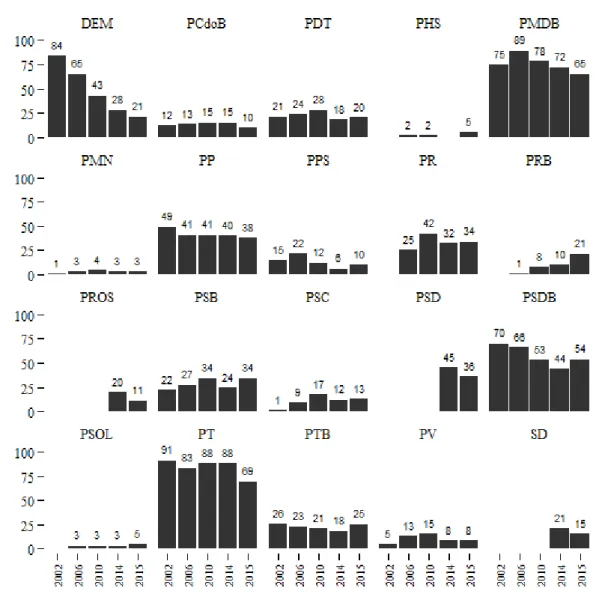
Figure 1 shows the evolution of the main parties in the Chamber of
Deputies since 2002. A short-term comparison of 2014 and 2015 legislatures
highlights a significant reduction in the PT seats, the continued shrinking
tendencies in the PMDB and DEM, and the expansion of PSB and PSDB, both of
which were leveraged by presidential candidacies. By the time this paper was
written, the PT has the biggest number of seats (69 deputies), followed by the
PMDB (65) and PSDB (54). A significant part of the governing party's losses comes
from a lower number of votes obtained in São Paulo and the lack of success in
1 Although 277 candidates running for federal deputy had their registries rejected, they
could still run for the election while awaiting appeal. In these cases, the votes were registered, but not totaled in the count, being considered null. Therefore, for this research paper, we used data made available by the Supreme Electoral Court (TSE) on January 26, 2015.
2 We calculated a "success rate" for each projection considering the percentage of parties
whose number of seats fell between the minimum and maximum margins of each study.
The NECON models—http://necon.iesp.uerj.br/images/pdf/nota.pdf—showed between
118 (2015) 9 (1) 115 – 134
other states such as Pernambuco, where no PT representative was elected. Despite
that, the PT was victorious in important electoral colleges such as Minas Gerais and
Bahia due to the fact that it was impelled by the performance of the gubernatorial
candidates. Although the PSDB obtained 10 more seats than what it had held in
2014, the general result is similar to that of 2010 when it obtained 53 seats after
having experienced a downward trend.
Figure 01. Parties in the Chamber of Deputies - 2002–2015
Source: SANTOS_CANELLO_CHAMBER_DATABASE.
The expansion of the PSB seems remarkable in the short-term, but once
again, it is merely a recovery of the seats already obtained in 2010, after a tendency
for expansion present since 2002. Mid-sized parties such as the PDT, PP, and PR
their participation in the Chamber of Deputies. If the expansion of the PR in 2010
elections was connected to a greater presence of evangelical candidates, several
"religious" deputies were situated, as of 2014, in the PRB—the party that
proportionally increased its seats the most—as well as in the PSC. This year, the
race resulted in the reduction of the parliamentary representation of new parties,
(PSD, PROS, and Solidariedade), except for the PEN. Such results could indicate a
suspicion toward the short-term electoral efficacy of the creation of these parties.
However, in the cases of the PSD and PROS, the numbers are far from representing
political failure. In fact, it is sufficient to consider that the social democrats elected
the fourth largest number of seats and, as well as the PROS, has established a
relevant leadership in the cabinet. Beyond what the graph shows, the growth of
smaller parties (with fewer than 10 deputies) stands out, such as the PSOL, PHS,
PTN, PRP, PSDC, PTC, PRTB, and PSL.
The general picture and the evolution of the Chamber of Deputies can also
be summarized through some indicators of the political system fragmentation,
such as the effective number of parties (ENP) and party fractionalization. Both are
consistent in showing the persistent growth tendency in the dispersion of the
Brazilian party system. The country has gone from an ENP of 8.42 in 2003 to 13.22
in 2015, which is one of the highest values in the world. The fractionalization index
reaches the mark of 0.924, which represents the probability of randomly choosing
two federal deputies from different parties.
In the graph below, the dashed line shows the values obtained from all
parties. The solid line shows the results aggregating the parties with up to 15
deputies in either a leftist or rightist block. In this way, the difference between the
two numbers represents the impact of small parties on fragmentation. In other
words, there is not only a tendency toward more division among the most powerful
party forces but also a significant increase in the number of small parties3.
3 This indicator has its results influenced by the form in which the proportion of seats is
120 –
Figure 02. Party fractionalization. Chamber of Deputies -
-Source: SANTOS_CANELLO_FRAG _DATABASE.
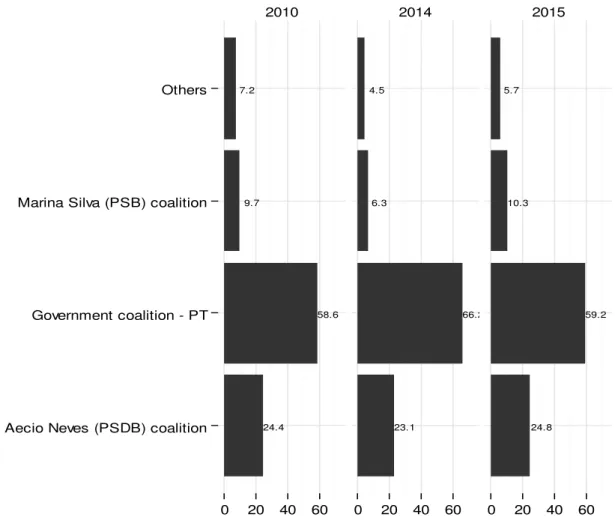
From the government perspective, the parties constituting the current set with participation in cabinet positions obtained approximately % of the seats, which is less than % above the number of seats in , but almost % below this number in . On the other hand, when compared with the situation before elections, the opposition has expanded, whether it was in the parties that compose the support coalition of the candidate Aécio Neves or in the members of the coalition that supported Marina Silva in the first round. )n addition, other parties not in those coalitions, either on the right or left, as in the case of the PSOL, acted as opposition to the PT government. The total potential opposition should reach from the current . % to . %.
)n this context, without the participation of PSB or of other currently non-aligned parties, Rousseff's second term will have difficulties in obtaining % majority necessary to approve constitutional amendments in the Chamber of Deputies. )n this case, the President will need to prepare for the opposition's unwillingness to approve reforms and policies that demand changes in the Constitution. )n any case, Rousseff is likely to have a nominal majority government coalition sufficient to approve ordinary legislation and provisional measures as
Although the PSB recovered the seats it had lost during the legislature, the Rede Sustentabilidade—Marina Silva's group—only elected two federal deputies, which happened through other parties: Miro Teixeira PROS-RJ and Eliziane Gama PPS-MA .
0.882
0.892
0.904
0.913
0.925
0.88
0.889 0.9
0.908 0.91
0.88 0.90 0.92 0.94
long as it remains cohesive.
Figure 03. Government coalition in the Chamber of Deputies - 2010, 2014 and 2015 (%)
Source: SANTOS_CANELLO_CHAMBER_DATABASE.
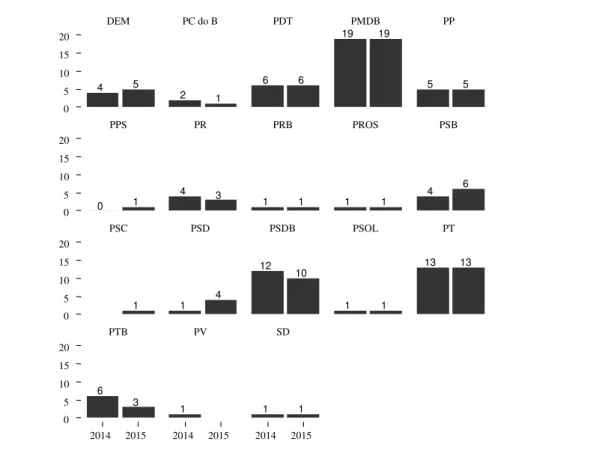
The scenario in the Senate shows some distinctions5. The PTB and PSDB
reduced their representation, whereas the PSB, DEM, and PSD expanded theirs.
Three of the eight senators who contested for re-election were not successful, two
of whom were veterans—Eduardo Suplicy (PT-SP) and Pedro Simon (PMDB-RS).
PMDB won most of the seats disputed in this election with five senators, followed
5 The numbers of effective seats in 2015 may vary due to the senators' alternates. Our
count considered the results after the second round and the following possibilities: Hélio José da Silva Lima (PSD) may be in place of Rodrigo Rollemberg (PSB-DF), elected governor; Pedro Taques (PDT), elected governor of Mato Grosso, may be replaced by José Antonio Medeiros (PPS); Eduardo Amorim (PSC), defeated in Sergipe, may return to his Senate seat, as well as Garibaldi Alves Filho (PMDB-RN), and Marta Suplicy (PT-SP), who occupied cabinet positions.
2010 2014 2015
24.4
58.6 9.7
7.2
23.1
66.2 6.3
4.5
24.8
59.2 10.3
5.7
Aecio Neves (PSDB) coalition Government coalition - PT Marina Silva (PSB) coalition Others
122 (2015) 9 (1) 115 – 134
by the PDT and PSDB with four each. Although the PMDB continued to hold the
largest number of seats, important candidates of this party who were allied with
ex-president José Sarney were not re-elected, such as the ex-minister of tourism,
Gastão Vieira (MA) and the ex-senator Gilvam Borges (AP). In its turn, PSB
expansion resulted from the three seats obtained in this election in Rio de Janeiro,
Pernambuco, and Maranhão.
Figure 04. Parties in the Senate - 2014–2015
Source: SANTOS_CANELLO_SENATE_DATABASE.
Depending on the dynamics of substitutions, the parties in government
coalition will slightly increase their presence in the Senate, especially the PSD,
which is one of the most distant partners from the ideological or programmatic
point of view relative to the government. Among the potential opposition6 groups,
the PSDB support coalition gives some space to the group that allied itself to the
PSB, reaching almost 10%. Despite the fact that the PSDB members (Tucanos)
6 The seat attributed to PPS is available due to the replacement of senator Pedro Taques
(PDT), who is elected governor of Mato Grosso. However, José Antonio Medeiros (PPS) and
Paulo Pereira Fiúza Filho (PV), are still disputing a vacancy in the judicial branch.
4 5 2 1 6 6 19 19 5 5 0 1 4 3
1 1 1 1
4 6 1 1 4 12 10 1 1 13 13 6 3
1 1 1
DEM PC do B PDT PMDB PP
PPS PR PRB PROS PSB
PSC PSD PSDB PSOL PT
PTB PV SD
0 5 10 15 20 0 5 10 15 20 0 5 10 15 20 0 5 10 15 20
maintained the same position numerically, important names such as José Serra,
Antonio Anastasia, and Tasso Jereissati have become members of the Senate, which
will also include the democrat Ronaldo Caiado, a former federal deputy. If the
parties in the government coalition are maintained, the President is likely to have
the support of more than 60%—a position numerically more advantageous when
compared to the Chamber of Deputies—but she may find a more critical opposition
qualitatively.
In the Chamber of Deputies, there is a noticeable increase in the
participation of small parties, which gives rise to parliamentary partisan
fragmentation and a slight decrease in the number of parties that form the
government coalition, which is smaller in comparison with the number of current
seats, but very similar in size to the results from 2010. In the Senate, the main
result was the slight expansion of the government coalition (not by the PT, but by
an ideologically distant supporter, the PSD) and a small exchange in the field of
opposition. In contrast to 2010, under PT's leadership, the coalition obtained a
better numerical and proportional performance in the Senate, which also must
serve as an important space for the opposition. Overall, these elections seem to
indicate that the group currently in the opposition stopped the downward trend
shown in previous races, except for the continuing decline of DEM in the Chamber
of Deputies.
The ideological setup
Apart from the number of seats for each party, an important second
dimension of our analysis is the ideological setup of Congress's new composition.
In this research paper, our focus is descriptive and centered around the
conjunctural debate. With such a defined scope, we will neither deal with the
theoretical controversy related to the content of the distinct ideological fields nor
will we deepen the methodological question about the measurement of political
preferences and their multidimensionality7. Using the usual simplification of the
spectrum into three positions—left, center, and right—and classifying the parties
7 The literature about ideological classification is vast even for Brazil. In terms of the most
124 (2015) 9 (1) 115 – 134
in those terms, we will evaluate, even if imprecisely, the ideological configuration of
the Congress and its dynamics over time.
After the election results were declared, part of the media soon highlighted
the conservative swing of the legislative branch elected for 2015. Along this line,
the first surveys prepared by the DIAP indicated a drop in the syndicalist seats
(from 83 to 46 representatives) and stability in the evangelical seats (from 78 to 74
deputies). In the same way, agribusiness parliamentary members now have a
greater presence according to estimates by the Agribusiness Parliamentary Front,
obtaining 51% of the Chamber of Deputies. The expressive number of votes for
rightist candidates such as Jair Bolsonaro (PP-RJ), Luiz Carlos Heinze (PP-RS),
Celso Russomano (PRB-SP), and Cel. Alberto Fraga (DEM-DF) combined with the
exit of center-left parliamentary members who acted as articulators and the
reduction of the PT, especially in São Paulo, gave rise to reports about this being the
most conservative Congress elected since 1964.
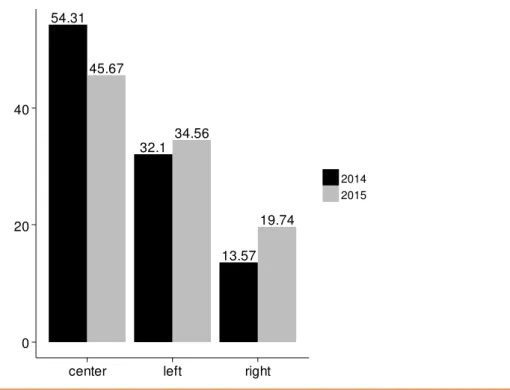
Figure 05. Ideological distribution. Chamber of Deputies - 2014–2015 (%)
Source: SANTOS_CANELLO_CHAMBER_DATABASE. 40.3 34.7 25.4 24 22.122.6 2.8 9.8
4.7 4.8 4.8 4.1
Figure 06. Ideological distribution. Senate - 2014–2015 (%)
Source: SANTOS_CANELLO_SENATE_DATABASE.
In this context, without the participation of PSB or of other currently
non-aligned parties, Rousseff's second term will have difficulties in obtaining 60%
majority necessary to approve constitutional amendments in the Chamber of
Deputies. In this case, the President will need to prepare for the opposition's
unwillingness to approve reforms and policies that demand changes in the
Constitution. In any case, Rousseff is likely to have a nominal majority government
coalition sufficient to approve ordinary legislation and provisional measures as
long as it remains cohesive.
In short-term comparison, the decrease in the number of major leftist
parties is highlighted together with a small increase in the major rightist parties as
well as the fragmentation of the center in which large and mid-sized parties gave
space to small ones. In both scenarios, approximately 40% of the Chamber of
Deputies was situated at the center of the spectrum. The other two groups
practically divide the remaining 60%.The center lost space in the Senate, with a
timid expansion of the left and a more significant expansion of the right. In general
terms, it is possible to infer a certain general shift toward the right starting in 2015.
54.31
45.67
32.1 34.56
13.57 19.74
0 20 40
center left right
126 (2015) 9 (1) 115 – 134
Therefore, it is initially possible to recognize an advance in the conservative
representation, especially when considering the profile of the parliament members
who compose these parties and the composition of "thematic blocks" such as
agribusiness, evangelicals, business interests, and others.
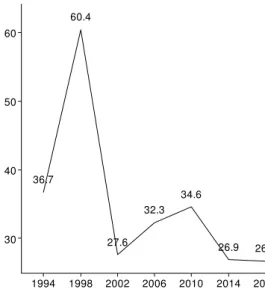
However, a slightly longer time series puts on suspicion some arguments
about the magnitude of the right-wing expansion. In the Chamber of Deputies, the
percentage that the right-wing achieved in last elections is significantly smaller
than that obtained in the 2010 and has not even achieved the proportion seen at
the end of the legislature finished in 2014. Thus, from the parties' point of view and
in the simplification of ideological positions proposed here, it is confirmed that the
right is stable in the Chamber of Deputies. In addition, the expansion of centrist
parties with fewer than 15 seats indicates that the fragmentation of the political
system has been concentrated in this field, which could be a partial effect of
changes in the electoral strategies, including the PT, when it accepts center-right
parties as allies.
Figure 07. The right-wing in the Chamber of Deputies - 1994–2015 (%)
Source: SANTOS_CANELLO_CHAMBER_DATABASE.
The remaining doubt is more qualitative than quantitative. What would be
the profile of this right and how would it differ from previous periods? Beyond the
number of members of parliament, would its preferences be more intense than
those in the past? Would there be channels able to confer more political voice and
legislative resources to such a group? Would it be restricted to acting politically 36.7
60.4
27.6 32.3
34.6
26.9 26.7 30
40 50 60
with media groups and through social media or would it be capable of advancing
some concrete agenda in the legislative branch? Will the right-wing stop being
simply a potential veto player using obstructionist tactics in the floor and
committees sending negative signals to the government support coalition and start
having more initiative in proposing and forwarding policies? Even if it is possible to
answer positively to some of these questions, it cannot be ignored that the left
remains powerful and, through government coalition, interacts strongly with the
center. In other words, just as some leftists policies will face difficulties in
Congress, the proposals coming from the right, if not really welcomed in the
heterogeneous center, should be hindered by the forces of the left and center-left.
In the narratives about what characterizes the current so-called right-wing
sectors in Brazil, it is possible to distinguish two dimensions in the political space:
the behavioral and the economic. At first glance, one could say that a growing
portion of this group has its discursive profile connected to the behavioral
dimension. The significant number of votes for candidates from the public safety
and evangelical "blocks" would indicate the strengthening of the right, especially in
the debate over customs. However, this claim assumes, implicitly or explicitly, that
not only would such opinion groups have had less strength in the last
congressional term but also that they would have had little representation in the
longer past. This may not be true, and should be empirically verified. An example of
this problem lies in the presumption that evangelical congressmen of today—just
by professing a specific faith—are necessarily more conservative than the
traditional Catholics in the mid-90s on issues like abortion and same-sex marriage.
For now, with no information from a longer historical series and without a more
precise classification of congressional members' attitudes relative to behavioral
themes, it is not possible to present firm conclusions on the subject. Future
research will be able to investigate the objective changes in the Brazilian
parliament in terms of ideology and positioning on relevant themes based on
behavioral and attitudinal data, analyzing surveys, legislative initiatives,
parliamentary amendments, speeches, and voting patterns.
The alignment between the behavioral and economic right in its
parliamentary performance and in the composition of the government is also not
128 (2015) 9 (1) 115 – 134
support for greater state participation in the economy. According to a possible
interpretation, the advances of social policies in recent years, which were not
accompanied by an even more liberalizing "cultural" agenda, have been possible
highly due to this type of coexistence . The result would have been the formation of
center-left coalitions in terms of economic and social policies, but whose members
of the center (or even of the right) had reservations about adhering to left-Wing
projects in the behavioral realm8. Therefore, one hypothesis for the next term is
that there will be a realignment between conservatives, fine-tuning these two
dimensions so as to make the advance of agendas perceived as progressive even
more difficult.
From the point of view of conditions for governability, it is worthwhile to
use an additional classification to examine the probable behavior of the center and
other parties to the left and right, whose parliamentary performance is not always
consistent with an ideologically informed program. For the lack of a better term,
we will call "clientelist" or "fisiológico" (physiological) the small and mid-sized
parties who, apart from showing little ideological consistency (either to the left or
to the right) also see their electoral success significantly linked to their degree of
access to localized public resources and tend to be governists9 (Borges, 2010).
Joining this group with the PMDB (with a history of governism and centrist
location in the ideological spectrum) we can measure a type of "flexible center" in
the Congress.
In the Chamber of Deputies, the flexible center retains approximately
53%–54% of the seats in 2015 and 2014, with a reduction in the participation of
the PMDB in favor of mid-sized clientelist parties. However, in the Senate, the
group remains stable, with approximately 47% of the seats. It is important to note
that this group is not only at the center of the spectrum, but that it also forms a
majority or a quasi-majority all by itself.
8 The presence of parties with strong religious militancy in government coalition, such as
the PR and the PRB, illustrates this interpretation.
9 Included in this category were: PROS, PRB, PR, PSD, SD, PP, PTB, PSC, PEN, PTC, PMN, PSL,
Figure 08. Flexible center. Chamber of Deputies - 2014–2015 (%)
Source: SANTOS_CANELLO_CHAMBER_DATABASE.
What we call flexible center is a group that is important to the President in
obtaining parliamentary support and forming the government. Simplifying the
political preferences in a unidimensional spectrum and presuming reasonable
levels of party discipline, the electoral results highlight that none of the candidates
for the Presidency would obtain more than 30% of the Congress without the
support of this powerful (although heterogeneous) group. Except in the case of a
minority government that seeks to advance its agenda with ad hoc coalitions,
President Rousseff, in her second term will need to negotiate with this center and
use her toolbox (see RAILE, PEREIRA, and POWER, 2011) to obtain and cultivate a
minimally effective and politically sustainable parliamentary base. In this way, the
truth is that if we consider solely the ideological distribution in partisan terms,
there are no drastic changes. In general terms, the Congress remains ideologically
divided with a center that is important and pivotal, but heterogeneous in its
preferences and practices. It is in this center, seduced by the poles, where the
median resides and where the possibility of forwarding the political agenda will be
defined.
40.3 42.3 14
12.7
clientelist PMDB
0 10 20 30 40 50
130 (2015) 9 (1) 115 – 134
Without a systematic investigation of the short and long-term evolution of
the political preferences of interest groups and lobbies within the parliament, the
simple shift to the right that occurred in 2014 elections does not authorize
adamant conclusions. It is a fact that the left stopped expanding, which could result
in difficulties to advance more progressive policies, but the impacts of this electoral
fact in the political agenda and in Executive–Legislative relations are still not clear.
The polarization in the discourse, with emphasis on behavioral components, is not
automatically reflected in the party composition of Congress relevant to any and all
themes. For now, the center is not empty, but full of divisions in different
dimensions of the political debate, which results in potentially diverse and
apparently contradictory legislative coalitions.
Would there be any similarities in the evolution of the partisan forces of
the current scenario with periods of instability and pre-crisis such as the one that
took hold of the country in 1964? Yes, but with fundamental differences. The
center, for example, is still strong. However, one cannot dismiss the possibility that
the most dramatic aspect for the polarization of political debate is not the
trajectory of the left over the last 20 years or that the right may have grown in the
last elections. It is a delicate combination of a right wing with no parliamentary
majority, but with more intense preferences and with different political practices,
both potentially relevant factors in the next term. In the end, the future of the
center and its performance in a more fragmented Congress will define the possible
limits of the polarization or to the search of conciliatory agendas.
Final words around governability challenges: the usual and the uncertain
With a very narrow10 victory facing a fragmented and heterogeneous
Congress, combined with an economic environment of uncertainty and many
demands from pressure groups and organized sectors of the civil society, the
second term of President Rousseff (PT) will be more challenging than her first.
What are the possibilities and obstacles to governability for the next presidential
term? How will the correlation of political forces and the institutional environment
10 The difference between the candidates Dilma Rousseff and Aécio Neves in the second
round was 3% of the nominal votes, the smallest ever in the Republic.
contribute or limit the ways the government's agenda is implemented? By way of a
conclusion, we present a few points that we consider decisive in the advancement
of the political process starting in 2015.
The first aspect to be considered is the composition of the federal
Legislative branch as of 2015. As observed, the Chamber of Deputies will have 28
parties, with its greater fractionalization resulting from an increase in the presence
of small parties. The government coalition (PT, PMDB, PSD, PP, PR, PROS, PDT, PC
do B, and PRB) reduced its nominal size, going from the current 339 seats to 304,
with eight deputies less than 60% quorum necessary to approve constitutional
amendments. However, in the Senate, the government still retains, at least
nominally, the relevant majorities. In general (and under a quantitative bias), the
government lost support among the federal deputies and maintained a certain
stability with the senators. Nevertheless, the nominal size of government coalitions
is not very meaningful, seeing that it is influenced by the discipline and cohesion of
the parties in the coalition, the heterogeneity of these groups in their preferences
around policies, and by the quality, articulation, and intensity of the opposition.
In Brazil, ever since the government of Fernando Henrique Cardoso, it has
become a recurrent practice to form over-sized coalitions. In addition to that, after
Lula's victory in 2002, the creation of disconnected cabinets has become more
widespread, in the sense that the parties that comprise the government are not
ideologically adjacent to one another. As a consequence during the PT terms, the
left versus right cleavage gave way to the government versus the opposition.
Furthermore, most Congressmen themselves tend to believe that a stable and
efficient government base should correspond to 60% of the legislature, so that a
wide and ideologically diverse coalition would function as a type of "insurance
policy" for the Executive Branch (POWER, 2011), to be capable of using distinct
tools to manage the support.
In this context, a hesitant coalition may present unfavorable results in the
legislative process such as: comparatively less support on roll calls of interest to
the government, opinions more distant from those preferred by the President in
the congressional reports, and — by strategic anticipation — a reduction in the
number of Executive proposals presented to the Congress. It is interesting to note
132 (2015) 9 (1) 115 – 134
administration had the lowest rate of support in the Chamber of Deputies' roll calls
(45.5%) and the smallest absolute number of proposals presented and approved,
although it achieved the highest percentage of success (65%)11.In other words,
seeing that in general terms, the performance of the government with the
Legislature was worse under Rousseff than under Lula, what would the conditions
be for governability in the second term with a reduced and dubious support
coalition in the Chamber of Deputies, with economic results that are inappropriate
or questionable, with the ongoing Petrobrás investigations, and with an
unfavorable standing in a significant portion of the media?
As for Executive–Legislative relations, the rules of the game have not
changed in institutional terms; therefore, the possible differences in the results of
the political process for Rousseff's second term should be evaluated on the basis of
political variables related to the size and profile of the forces in parliament and
their relationships as well as to contextual factors, especially economic indicators,
public opinion, and the performance of controlling institutions, with the growing
importance of the Judicial branch. Although party fragmentation has grown with
the important influence of small parties, this is not the factor that will create major
difficulties for the second term. For better or worse, Congress has been populated
by various parties for a long time and also to favor their own interests, the small
and mid-size parties have generally participated in parliamentary blocks and
negotiated positions and policies with the government.
From an unusual perspective, this fragmentation can be interpreted as
strategic to the government, whether from an electoral point of view (proportional
coalitions) or even in the parliamentary sphere (formation of ad hoc legislative
coalitions for specific themes). In this field, the open question is pertinent to the
costs of obtaining and cultivating this support, which can vary according to the
partner for each agenda. Participating in the government is related to the resources
(political appointments and policies) that the Executive Branch can offer in a
credible manner and to the strategies of parties themselves in the medium and
11 On the performance of Rousseff 's first term with the Chamber of Deputies, see the
partial research note by Santos and Canello, 2013, as well as the article in the newspaper O
Globo and in the blog Na Base dos Dados
(http://oglobo.globo.com/blogs/base-
long-terms, either when considering the municipal elections of 2016 or the
presidential and congressional races of 2018. The worsening of some indicators of
the relationship with Congress seen when comparing Rousseff to Lula imposes
important exceptions to the effectiveness of the strategies adopted in the first term,
such as the centralization in the Presidency, without much previous negotiation
about legislative agenda. In general, government formation, to obtain a
parliamentary majority, the allocation of cabinet positions, and budget control
represent the usual in coalition management. The scenario in the legislative branch
is more restrictive when compared with the situation during the last 12 years. It
demands greater political ability from the government in negotiations with its
coalition and in facing the opposition.
The uncertainty for governability in the second term largely extends
beyond the parliamentary arena and stems from important contextual variables
such as economic and fiscal performance, the impact of the Operação Lava Jato
(Petrobrás) investigations and lastly, the predisposition of the government in
negotiating and communicating its arguments to the sectors that compose public
opinion. Despite the fact that the anticipation of ministerial reform in the economic
area for 2014 and the first measures of fiscal and budgetary contention in 2015
seek to offer positive signs to the market, it is still not entirely clear what the
government's methodology will be in its relationship with Congress and what the
negotiation of its agenda will be like with members who will participate in its
support coalition.
Translated by Cabo Verde Submitted in December 2014
Accepted in February 2015
References
BORGES, Mariana (2010), Do parlamento ao eleitoral: do clientelismo à ideologia. Master Dissertation. Instituto Universitário de Pesquisas do Rio de Janeiro (IUPERJ). Rio de Janeiro.
134 (2015) 9 (1) 115 – 134
536:bancada-sindical-perde-forca-na-camara-dos-deputados&catid=59:noticias&Itemid=392. Access in December 10, 2014.
LUCAS, Kevin and SAMUELS, David (2011), A "coerência" ideológica do sistema partidário brasileiro, 1990-2009. In: POWER, Timothy J. e ZUCCO JR., Cesar. O Congresso por ele mesmo: autopercepções da classe política brasileira. Belo Horizonte: Editora UFMG, 319 p.
POWER, Timothy J. (2011), O Presidencialismo de Coalizão na visão dos Parlamentares brasileiros. In: POWER, Timothy J. and ZUCCO JR., Cesar. O Congresso por ele mesmo: autopercepções da classe política brasileira. Belo Horizonte: Editora UFMG, 319p.
POWER, Timothy J. and ZUCCO Jr., Cesar (2012), Elite Preferences in a Consolidating Democracy: The Brazilian Legislative Surveys, 1900-2009. Latin American Politics and Society, Vol. 54, Nº 04, pp. 01-27.
RAILE, Eric D.; PEREIRA, Carlos and POWER, Timothy J. (2011), The Executive Toolbox: Building Legislative Support in a Multiparty Presidential Regime. Political Research Quarterly. Vol. 64, Nº 02, pp. 323-334.
SANTOS, Fabiano e CANELLO, Júlio (2013), O governo Dilma na Câmara dos Deputados: comparando partidos e coalizões nos mandatos petistas. Nota de
Pesquisa. Available at:
http://necon.iesp.uerj.br/images/pdf/artigos/boletim%20necon%202013.pd f. Access in December 10, 2014.
SANTOS, Wanderley Guilherme dos (2007), Governabilidade e Democracia Natural. Rio de Janeiro. Editora da FGV, 166 p.
VASCONCELLOS, Fábio (2014), Desempenho de Dilma no Congresso até agora supera os governos Lula. O Globo, blog Na base dos Dados. Available at: http://oglobo.globo.com/blogs/base-dados/posts/2014/11/10/desempenho-de-dilma-no-congresso-ate-agora-supera-os-governos-lula-554324.asp. Acces in December 10, 2014.
ZUCCO, Cesar (2009), Ideology or What? Legislative Behavior in Multiparty Presidential Settings. The Journal of Politics. Vol. 71, Nº 03, pp. 1076-1092.
ZUCCO, Cesar and LAUDERDALE, Ben (2011), Distinguishing Between Influences on Brazilian Legislative Behavior. Legislative Studies Quarterly. Vol. 36, Nº 03, pp. 363-396.