Study o f the e ffe cts o f ß-m yrce ne
o n rat fe rtility and ge ne ral re pro ductive
pe rfo rm ance
1Laboratório de Toxicologia Ambiental, Escola Nacional de Saúde Pública,
FIO CRUZ, Rio de Janeiro, RJ, Brasil
2Institut fuer Toxikologie und Embryopharmakologie, Freie Universitaet Berlin,
Berlin, Germany F.J.R. Paumgartten1,
R.R. De-Carvalho1,
C.A.M. Souza1,
K. Madi1 and
I. Chahoud2
Abstract
ß-Myrcene (MYR) is a monoterpene found in the oils of a variety of aromatic plants including lemongrass, verbena, hop, bay, and others. MYR and essential oils containing this terpenoid compound are used in cosmetics, household products, and as flavoring food additives. This study was undertaken to investigate the effects of MYR on fertility and general reproductive performance in the rat. MYR (0, 100, 300 and 500 mg/kg) in peanut oil was given by gavage to male Wistar rats (15 per dose group) for 91 days prior to mating and during the mating period, as well as to females (45 per dose group) continuously for 21 days before mating, during mating and pregnancy, and through-out the period of lactation up to postnatal day 21. On day 21 of pregnancy one-third of the females of each group were submitted to cesarean section. Resorption, implantation, as well as dead and live fetuses were counted. All fetuses were examined for external malfor-mations, weighed, and cleared and stained with Alizarin Red S for skeleton evaluation. The remaining dams were allowed to give birth to their offspring. The progeny was examined at birth and subsequently up to postnatal day 21. Mortality, weight gain and physical signs of postnatal development were evaluated. Except for an increase in liver and kidney weights, no other sign of toxicity was noted in male and female rats exposed to MYR. MYR did not affect the mating index (proportion of females impregnated by males) or the pregnancy index (ratio of pregnant to sperm-positive females). No sign of maternal toxicity and no increase in externally visible malformations were observed at any dose level. Only at the highest dose tested (500 mg/kg) did MYR induce an increase in the resorption rate and a higher frequency of fetal skeleton anomalies. No adverse effect of MYR on postnatal weight gain was noted but days of appearance of primary coat, incisor eruption and eye opening were slightly delayed in the exposed offspring. On the basis of the data presented in this paper the no-observed-adverse-effect level (NOAEL) for toxic effects on fertil-ity and general reproductive performance can be set at 300 mg of ß-myrcene/kg body weight by the oral route.
Co rre spo nde nce
F.J.R. Paumgartten Laboratório de Toxicologia Ambiental, ENSP, FIO CRUZ Av. Brasil, 4365
21045-900 Rio de Janeiro, RJ Brasil
Research supported by CNPq and PAPES-FIO CRUZ. F.J.R. Paumgartten is the recipient of a CNPq fellowship.
Received December 2, 1997 Accepted April 22, 1998
Ke y wo rds
•ß-Myrcene
•Monoterpenes
•Essential oils
•Reproductive toxicity
•Fertility
•Embryofetal toxicity
Intro ductio n
ß-Myrcene (7-methyl-3-methylene-1,6-octadiene) (MYR) is an acyclic monoter-pene found in a large variety of plants in-cluding lemongrass, verbena, hop, bay, and others (1,2). ß-Myrcene and essential oils containing this terpenoid compound are widely used as a fragrance in cosmetics, as a scent in household products, and as a flavor-ing additive in food and alcoholic beverages (3). Furthermore, it was reported that ß-myrcene is an analgesic substance and the active principle of lemongrass (Cymbopogon citratus Stapf) abafado, an infusion made with the pan covered in order to prevent the loss of volatile constituents (4). Lemongrass abafado is widely used in Brazilian folk medicine as a sedative and as a remedy for gastrointestinal disorders (5).
The importance of human exposure to ß-myrcene, the widespread use of plants as well as essential oils containing large a-mounts of this monoterpene (e.g. lemon-grass oil), and the relative paucity of data about its health risks prompted us to perform a rather comprehensive study of its repro-ductive toxicity.
The metabolism of ß-myrcene was stud-ied in the rabbit (6) and in the rat (7), and has been shown to induce liver monooxygenases (8,9). The acute toxicity of ß-myrcene was reported to be low (10) and this monoter-pene was shown to have no genotoxic activ-ity in vitro (11) or in vivo (12). No evidence that ß-myrcene is a teratogenic substance was found (13) and the no-observed-ad-verse-effect level (NOAEL) for peri- and post-natal developmental toxicity in the rat was set at 0.25 g ß-myrcene/kg body weight (14). The aim of the present study was to in-vestigate the effects of ß-myrcene on rat fertility and general reproductive perfor-mance. This is segment I study, part of a more comprehensive evaluation of the re-productive toxicity of ß-myrcene designed in three segments as recommended by the
guidelines of the Food and Drug Administra-tion, and of the Organization for Economic Cooperation and Development (OECD).
Mate rial and Me tho ds
Anim als
Male and female Wistar rats (Bor: spf, TNO; Fa. Winkelmann, Borchen, Germany) were kept under spf conditions at a constant 12-h light-dark cycle (lights on from 9:00 to 21:00 h), at a room temperature of 21 ± 1oC
and 50 ± 5% relative humidity. The animals received a standard pelleted diet (Altromin 1324, Lage, Germany) and tap water ad libitum during the experiment. All rats were adapted to the conditions of our animal quar-ters for three weeks before starting the ex-periment.
Mating pro ce dure
Males were housed individually in a Macrolon type 3 cage with wood shavings as bedding. Three virgin females were placed inside the cage of one male for 2 h each day (7:00 to 9:00 h) and vaginal smears were evaluated for sperm. The first 24-h period following the mating procedure was called day 0 of pregnancy if sperm were detected in the smear. The mating procedure was re-peated every working day until all three fe-males became sperm-positive or, alterna-tively, for fifteen mating sessions extending over three weeks.
Tre atme nt
during the mating period, and during preg-nancy and lactation until day 21 after partu-rition.
Three experimental groups (15 males and 45 females per group) were treated by ga-vage with ß-myrcene (100, 300 and 500 mg/ kg body weight) dissolved in peanut oil (phar-maceutical grade). The control group re-ceived a similar treatment but with vehicle only (peanut oil, 2.5 ml/kg body weight).
Evaluatio n o f the animals
All Fo-males and -females were
evalu-ated for weight development, mortality, and signs of toxicity. Pregnant females were also observed for weight gain, signs of abortion, dystocia and prolonged duration of preg-nancy. All males were sacrificed by decapi-tation and autopsied at the end of the mating period. All major organs were inspected mac-roscopically and weighed. Livers and one of the two testes were fixed in a 10% neutral buffered formalin solution for routine histo-logical processing and light microscopic evaluation of sections stained with hema-toxylin-eosin. The number of spermatozoa in the remaining testis and cauda epididymis was counted as described elsewhere (15). The following indices were used: mating index = [No. of sperm-positive females ÷ No. of mated females] x 100; pregnancy index = [No. of pregnant females ÷ No. of sperm-positive females] x 100.
Ce sare an se ctio n
On day 21 of pregnancy one-third of the females in each group were anesthetized by ethyl ether inhalation and killed by decapita-tion. The gravid uterus was weighed with its contents. Resorption as well as living and dead fetuses were counted. The number of implantation sites was determined by the method of Salewski (16). All living fetuses were immediately weighed, numbered with a marker pen, examined for externally
vis-ible malformations and fixed in a 5% forma-lin solution. All fetuses were examined for skeletal anomalies after clearing with potas-sium hydroxide and staining with Alizarin Red S (17).
Po stnatal de ve lo pme nt o f the o ffspring
All the remaining pregnant females were allowed to give birth to their offspring. From pregnancy day 20 on the dams cages were inspected for births and the day of birth was designated as postnatal day 1. As soon as possible after birth the numbers of viable and dead newborns were recorded, and the pups were sexed and weighed. Any newborn death on postnatal day 1 was considered to be a stillbirth. The weight gain of the pups was recorded on postnatal days 6, 11, 16 and 21. Each pup was examined for signs of physical development and the days on which developmental landmarks appeared were re-corded as follows: a) incisor eruption: the first sign of eruption through the gums of both lower incisors; b) fur development: the first detection of downy hair; c) eye opening: total separation of the upper and lower eye-lids and complete opening of both eyes.
At weaning (postnatal day 21) all moth-ers were anesthetized with ethyl ether, killed by decapitation and subjected to postmor-tem examination.
Statistical analysis
Re sults
Bo dy we ight change s and to xicity
to the pare ntal ge ne ratio n
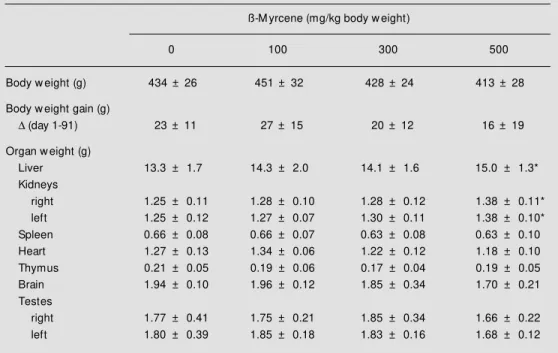
No deaths were induced and no other signs of toxicity were apparent in male rats treated orally with ß-myrcene (100, 300 and 500 mg/kg body weight) for 91 days prior to mating and during the mating period. There were no statistically significant differences in body weight gain between the control and the MYR-treated male rats (Table 1). Except for a slight increase in both absolute and relative weights of liver and kidneys of males exposed to the highest dose tested (Table 1), no other treatment-related abnormality was noted in MYR-treated rats at autopsy. Light microscopy evaluation of sections stained with hematoxylin and eosin revealed no morphological alterations in the liver or tes-ticular tissue of male rats exposed to ß-myrcene. Moreover, no effect of MYR
treat-ment was found either on the number of spermatids in the testis or on the number of spermatozoa in the cauda epididymis (data not shown).
Similarly, no adverse effects on body weight gain and no other signs of toxicity were observed in MYR-treated female rats during the premating (21 days) and mating periods.
O utco m e o f fe rtility te sts
ß-Myrcene did not present any adverse effect on fertility indices at the dose range tested. As can be seen in Table 2, the propor-tion of females impregnated by male rats (mating index), and the ratio of pregnant to sperm-positive females (pregnancy index) did not differ between control and MYR-treated groups. Thus, no indication was found that MYR administered orally at doses as high as 500 mg/kg could impair male or female fertility.
Table 1 - Body w eight gain and organ w eight changes in male rats treated orally w ith ß-myrcene (0, 100, 300 and 500 mg/kg body w eight) for 91 days prior to mating.
Values are reported as means ± SD. Data w ere analyzed by ANOVA and the Student t-test. * P<0.05 compared to controls.
ß-M yrcene (mg/kg body w eight)
0 100 300 500
Body w eight (g) 434 ± 26 451 ± 32 428 ± 24 413 ± 28
Body w eight gain (g)
∆ (day 1-91) 23 ± 11 27 ± 15 20 ± 12 16 ± 19
Organ w eight (g)
Liver 13.3 ± 1.7 14.3 ± 2.0 14.1 ± 1.6 15.0 ± 1.3*
Kidneys
right 1.25 ± 0.11 1.28 ± 0.10 1.28 ± 0.12 1.38 ± 0.11* left 1.25 ± 0.12 1.27 ± 0.07 1.30 ± 0.11 1.38 ± 0.10* Spleen 0.66 ± 0.08 0.66 ± 0.07 0.63 ± 0.08 0.63 ± 0.10
Heart 1.27 ± 0.13 1.34 ± 0.06 1.22 ± 0.12 1.18 ± 0.10
Thymus 0.21 ± 0.05 0.19 ± 0.06 0.17 ± 0.04 0.19 ± 0.05
Brain 1.94 ± 0.10 1.96 ± 0.12 1.85 ± 0.34 1.70 ± 0.21
Testes
Evaluatio n o f e mbryo -fe to to xic e ffe cts
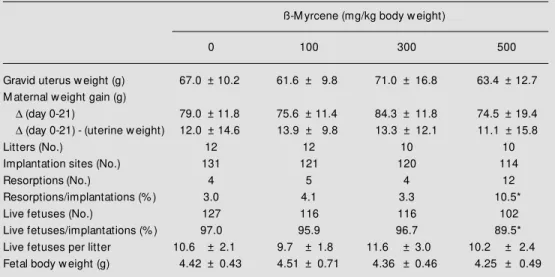
No adverse effect of MYR on pregnancy weight gain was noted at any dose level (Table 3). Except for a slight increase in the weights of liver and kidneys in the MYR-treated females, no other sign of toxicity to the maternal organism was observed. The body weight of MYR-treated fetuses did not differ from that of the control group at any dose level (Table 3). However, at the highest dose tested (500 mg/kg), MYR produced a slight increase in the resorption rate and a parallel decrease in the ratio of live fetuses per implantation site (Table 3).
The effects of prenatal exposure to MYR on the occurrence of fetal skeleton abnor-malities are shown in Table 4. No differ-ences between control and treated groups were observed at doses up to 300 mg of MYR per kg body weight, but the frequency of skeletal malformations was increased at 500 mg/kg. Nonetheless, the higher inci-dence of skeletal abnormalities observed at this dose level seems to have been due, to a
large extent, to an increase in the occurrence of anomalies such as fused os zygomatic, dislocated sternum (non-aligned sternebrae) and lumbar extra ribs, the spontaneous fre-quencies of which are high in our rat strain. Anyhow, the higher incidence of skeletal abnormalities as well as the embryolethal effect clearly indicated that a dose as high as 500 mg MYR/kg is embryotoxic to rats.
Table 2 - Outcome of fertility tests in rats continuously exposed to ß-myrcene (0, 100, 300 and 500 mg/kg) during the premating period.
M ating index = [(No. of sperm-positive females) ÷ (No. of mated females)] x 100; Pregnancy index = [(No. of pregnant females) ÷ (No. of sperm-positive females)] x 100. There w ere no statistical differences betw een treated and untreated rats (chi-square test).
Outcome ß-M yrcene (mg/kg body w eight)
0 100 300 500
M ated females (No.) 45 45 45 45
M ated males (No.) 15 15 15 15
Sperm-positive females (No.) 44 39 37 41 Pregnant females (No.) 33 29 29 32
M ating index (% ) 98 87 82 91
Pregnancy index (% ) 75 74 78 78
Table 3 - Effects of ß-myrcene (0, 100, 300 and 500 mg/kg) administered by gavage during the premating, mating and gestation periods on parameters evaluated at the time of cesarean section performed on pregnancy day 21 for fetal body w eight.
Proportions w ere analyzed by the chi-square test. Live fetuses per litter, uterus w eight, maternal w eight gain and fetal body w eightare reported as means ± SD and w ere analyzed by one-w ay analysis of variance. M ean litter w eight w as taken as the unit of analysis for fetal body w eight.
ß-M yrcene (mg/kg body w eight)
0 100 300 500
Gravid uterus w eight (g) 67.0 ± 10.2 61.6 ± 9.8 71.0 ± 16.8 63.4 ± 12.7 M aternal w eight gain (g)
∆ (day 0-21) 79.0 ± 11.8 75.6 ± 11.4 84.3 ± 11.8 74.5 ± 19.4 ∆ (day 0-21) - (uterine w eight) 12.0 ± 14.6 13.9 ± 9.8 13.3 ± 12.1 11.1 ± 15.8
Litters (No.) 12 12 10 10
Implantation sites (No.) 131 121 120 114
Resorptions(No.) 4 5 4 12
Resorptions/implantations (% ) 3.0 4.1 3.3 10.5*
Live fetuses (No.) 127 116 116 102
Live fetuses/implantations (% ) 97.0 95.9 96.7 89.5*
Pe rinatal to xicity and po stnatal
de ve lo pme nt o f the e xpo se d o ffspring
As shown in Table 5, duration of preg-nancy was not affected by treatment with MYR at any dose level. No adverse effect of MYR on labor was noted in this experiment, and pup mortality in the treated groups was not above that observed in the vehicle-con-trol group on the first day of life (stillbirths)
or throughout lactation, i.e. from postnatal day 2 through day 21 (Table 5). Further-more, no differences between control and MYR-treated groups were found with regard to maternal or offspring weight changes dur-ing the lactation period (Tables 5 and 6). In spite of the absence of MYR-induced effects on offspring body weight development, ex-posure to this monoterpene seemed to have caused a slight retardation in the appearance
Table 4 - Occurrence of skeletal abnormalities in fetuses from dams treated orally w ith ß-myrcene (0, 100, 300 and 500 mg/kg) during the premating, mating and pregnancy periods.
* P<0.05 compared to controls (chi-square test). Abbreviations: o.c. not ossified = ossification centre not ossified; incpl. ossif. = incomplete ossification; irreg. ossif. = irregular ossification; dumbbell = dumbbell shaped; bicent. = bicentric; part. = partial; sym. = symmetrical.
ß-M yrcene (mg/kg body w eight)
0 100 300 500
Fetuses examined (No.) 127 116 116 102
Fetuses w ith skeleton abnormalities (% ) 35.4 27.5 35.3 64.7* Fetuses w ith anomalies in (% )
Forelimbs 2.36 8.62 2.58 1.96
finger (o.c. not ossif.) 2.36 7.75 1.72 0.98
humerus (bent) 0 0 0 0.98
Skull 9.44 11.2 12.0 15.6
os interparietalis (incpl. ossif.) 3.93 1.72 5.17 4.90 os parietalis (incpl. ossif.) 2.36 1.72 0.86 1.96 os supraoccipitalis (irreg. ossif.) 0.78 0 0 0
(incpl. ossif.) 0 0 1.72 0
os zygomatic (fused) 5.51 1.72 6.03 8.82
p.j. os maxill. (incpl. ossif.) 0.78 0 0 0
(bone hole) 0 0 0 1.96
Sternum 10.2 6.89 6.03 16.6
(bent) 2.36 0 0 2.94
(dislocated) 3.14 5.17 3.44 9.80
ossif. centre 1/2 (fused) 0.78 0 0.86 0.98
ossif. centre 2 (irreg. shaped) 0 0 0.86 0.98
ossif. centre 2 (narrow ) 0 0 0 0.98
ossif. centre 5 (additional) 3.14 0 0 0.98
ossif. centre 5 (incpl. ossif.) 0.78 0 0 0
ossif. centre 5 (narrow ) 0 0 0 1.96
ossif. centre 5 /6 (additional) 0 1.72 0.86 0
Thorax 15.7 6.03 13.7 21.5
Ribs (extra lumbar) 12.5 4.31 12.9 19.6
(w avy) 3.14 1.72 0.86 3.92
Vertebral column 8.66 5.17 10.3 27.4
(bent) 0 3.44 0.86 13.7
Lumbar vertebra (additional) 0 0.86 0 0.98
Thoracic vertebra
(o.c. bicent., part.) 3.93 4.31 7.75 9.80
(o.c. bicent., sym.) 0.78 0 1.72 0.98
Table 5 - Duration of pregnancy, number of stillbirths, postnatal mortality and w eight gain of offspring of rats treated orally w ith ß-myrcene (0, 100, 300 and 500 mg/kg body w eight) during pregnancy and lactation.
Data w ere analyzed by the chi-square test (proportions), Kruskal-Wallis (duration of pregnancy) and ANOVA (body w eight and litter size). % of stillbirths = [No. of stillbirths/total of pups born] x 100; % of pups dead = [No. of pups dead/No. of viable pups on day 1] x 100. * P<0.05 compared to control group.
ß-M yrcene (mg/kg body w eight)
0 100 300 500
Duration of pregnancy (days) 23.0 ± 0.5 23.1 ± 0.5 23.0 ± 0.4 23.0 ± 0.4
Total of pups born 173 146 176 174
Viable pups on day 1 161 133 174 159
Stillbirths (% ) 12 (6.9) 13 (8.9) 2 (1.1)* 15 (8.6)
Viable pups on day 21 143 122 166 132
Pups dead betw een postnatal
days 2 and 21 (% ) 18 (11.1) 11 (8.3) 8 (4.6)* 27 (17.0) Postnatal w eight gain (g)
day 1
body w eight 6.0 ± 0.9 5.5 ± 0.8 5.3 ± 0.6 5.4 ± 0.7
litter size 8.1 ± 2.4 8.3 ± 4.3 9.2 ± 3.0 8.0 ± 2.9
day 7
body w eight 11.9 ± 2.0 10.6 ± 2.3 10.7 ± 1.5 10.3 ± 1.9
litter size 7.5 ± 2.7 8.1 ± 4.3 8.8 ± 3.0 7.4 ± 2.8
day 14
body w eight 22.0 ± 3.9 20.0 ± 4.4 20.0 ± 4.4 20.0 ± 4.0
litter size 7.5 ± 2.7 8.1 ± 3.6 8.7 ± 3.0 7.4 ± 2.8
day 21
body w eight 34.0 ± 7.2 31.0 ± 11.0 31.0 ± 6.6 32.0 ± 11.0
litter size 7.5 ± 2.7 8.1 ± 3.6 8.7 ± 3.0 7.4 ± 2.8
Table 6 - Weight development of female rats treated orally w ith ß-myrcene (0, 100, 300 and 500 mg/kg body w eight) during pregnancyand lactation.
Values are reported as means ± SD. Data w ere analyzed by ANOVA and the Student t-test and no significant differences w ere detected. Dams submitted to cesarean section on pregnancy day 21 w ere not included. Days of pregnancy and days of lactation are indicated by subscriptsP and L,respectively.
ß-M yrcene (mg/kg body w eight)
0 100 300 500
No. 21 17 19 22
Days of pregnancyand lactation period
1P 220 ± 10 222 ± 10 223 ± 13 224 ± 12
6P 234 ± 10 237 ± 10 239 ± 13 234 ± 15
10P 246 ± 22 243 ± 11 250 ± 14 246 ± 14
15P 261 ± 15 259 ± 11 268 ± 17 257 ± 14
21P 304 ± 15 298 ± 16 307 ± 17 288 ± 21
1L 225 ± 20 224 ± 12 224 ± 18 219 ± 17
7L 244 ± 17 241 ± 11 249 ± 18 239 ± 20
14L 257 ± 17 254 ± 16 269 ± 16 253 ± 20
21L 260 ± 14 260 ± 22 271 ± 16 260 ± 16
Weight gain (g)
∆ (1P-1L) 4.4 ± 19 - 0.4 ± 13 - 0.3 ± 10 4.0 ± 17
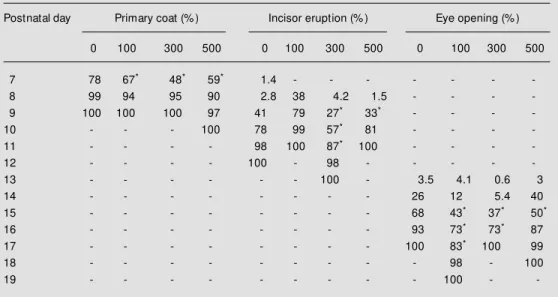
of incisor eruption, primary coat and eye opening (Table 7). This effect was not dose-related and the MYR-induced delay was more evident with incisor eruption (300 mg/kg) and eye opening (100 and 300 mg/kg). Ex-cept for this minor effect on physical matu-ration, no other indication was found that MYR at doses up to 500 mg/kg impaired the postnatal development of the treated off-spring.
D iscussio n
Except for a slight increase in the abso-lute and relative weights of liver and kid-neys, no other effects were noted in male rats continuously exposed to ß-myrcene for 91 days prior to mating and during the mating period. Since ß-myrcene has proved to be an inducer of hepatic monooxygenases (8), liver enlargement probably resulted from the marked hypertrophy of the endoplasmic reticulum due to the induction of microso-mal enzyme synthesis in treated animicroso-mals (18). On the other hand, the mechanism under-lying the ß-myrcene-induced enlargement of kidneys is still far from being entirely
under-stood. ß-Myrcene was reported to cause a sex-specific hyaline droplet nephropathy in male rats very similar to that produced by d-limonene, a monocyclic monoterpene (19). d-Limonene-induced hyaline nephropathy was shown to be due to an epoxide metabo-lite (d-limonene-1,2-oxide) that binds to an α2µ-globulin thereby preventing its
lysoso-mal degradation and leading to an accumula-tion of this low molecular weight protein in the cytoplasm (hyaline droplets) of the proxi-mal tubule cells (20). In the case of MYR-induced kidney damage the α2µ-globulin
ligand is still unknown, but it should be noted that microsomal oxidation of MYR olefinic bonds seems to yield epoxide me-tabolites structurally similar to d-lim-onene1,2-oxide (21). Anyhow, since the hya-line droplet nephropathy is sex-specific (i.e. female rats do not produce α2µ-globulin),
and the increase in kidney weight was noted in both males and females, the renal enlarge-ment cannot be attributed only to the accu-mulation of hyaline droplets. One possible explanation for the kidney enlargement would be an induction of renal microsomal enzyme synthesis by MYR and d-limonene.
Table 7 - Physical signs of postnatal development of offspring of rats treated orally w ith ß-myrcene (0, 100, 300 and 500 mg/kg body w eight).
* P<0.05 compared to controls (chi-square test).
Postnatal day Primary coat (% ) Incisor eruption (% ) Eye opening (% )
0 100 300 500 0 100 300 500 0 100 300 500
7 78 67* 48* 59* 1.4 - - - - - -
-8 99 94 95 90 2.8 38 4.2 1.5 - - -
-9 100 100 100 97 41 79 27* 33* - - -
-10 - - - 100 78 99 57* 81 - - -
-11 - - - - 98 100 87* 100 - - -
-12 - - - - 100 - 98 - - - -
-13 - - - 100 - 3.5 4.1 0.6 3
14 - - - 26 12 5.4 40
15 - - - 68 43* 37* 50*
16 - - - 93 73* 73* 87
17 - - - 100 83* 100 99
18 - - - 98 - 100
-Data from the present study suggest that continuous exposure of male rats to ß-myrcene for 91 days prior to mating and during the mating period did not cause any histological changes in the testis and did not impair male fertility. Since ß-myrcene is a highly lipophilic substance that reaches a rather high concentration in the testes (Webb J, Chahoud I and Paumgartten FJR, unpub-lished results), it seems unlikely that the absence of adverse effects on male fertility is due to an insufficient exposure of male germ cells to this monoterpene. The results also suggest that female fertility was not affected by continuous exposure to ß-myrcene for 21 days prior to mating and during the mating period. The percentages of MYR-treated fe-males that copulated (mating index) and were impregnated by males (pregnancy index) did not differ from those obtained for the ve-hicle-control group at any dose level. In addition, MYR had no detectable effect on the frequency of pre-implantation losses since no difference in the number of implantation sites per dam was found when treated ani-mals were compared to the controls. Thus, apparently no adverse effect on reproductive function was caused by MYR from gameto-genesis up to implantation of the blastocyst in the maternal uterus.
Notwithstanding the absence of adverse effects on female fertility in the present study, MYR, at doses as high as 1.0 and 1.5 g/kg, was shown to impair female offspring fertil-ity in a segment III-designed study in rats (14). It should be emphasized, however, that not only the doses, but also the periods of exposure to MYR were quite different in the two studies. While in the present experiment only adult females were treated with MYR, in the segment III study female offspring were exposed while still in utero, from preg-nancy day 15 on and throughout lactation. Therefore, the absence of adverse effects on female fertility in the present study might have been due either to the lower dose levels tested, or to the different period of exposure,
or to both. In any case, MYR-induced im-pairment of female fertility in the segment III study was apparent only at very high doses when a pronounced perinatal mortality oc-curred as well (14).
Except for liver and kidney enlargement, no indication of MYR-induced maternal ef-fects was found at any dose level and no embryotoxic effects were detected at doses lower than 500 mg/kg body weight. On the other hand, a slight increase in the resorption rate and a higher incidence of skeletal abnor-malities indicated that, in the present study, 500 mg MYR/kg was an embryotoxic dose. Absence of signs of maternal toxicity at 500 mg MYR/kg was also found in segment II-(13) as well as in segment III-designed stud-ies in rats (14). Nonetheless, in the segment II study MYR-induced embryotoxic effects were observed only at a higher and mater-nally toxic dose (13). Since in the segment II study MYR was administered during the second week (pregnancy days 6 to 15) whereas in the present study treatment con-tinued throughout pregnancy, the highest susceptibility of the embryos in the latter may have been due to a longer exposure to this monoterpene. It should also be pointed out that, in the present study, most of the skeletal abnormalities whose incidence was increased in MYR-treated animals were anomalies which occurred at a high frequency in the historical group as well as in the vehicle-control group. Under these circum-stances, the toxicological significance of the fetal skeleton findings seems to be minor.
open-ing) and 300 mg/kg (eye openopen-ing) than at the highest dose tested (500 mg/kg). Since this slight effect was not related to the dose and was not accompanied by any other indica-tion that postnatal development was impaired in the treated animals, it was not taken into account for setting the present study-derived NOAEL .
Contrasting with the absence of toxicity in the present experiment, an increased pup mortality on the first day of life and during the first week of lactation, as well as a re-duced pup birth weight, were found after treatment with 500 mg MYR/kg in the seg-ment III study (14). A possible explanation for this discrepancy is the development of tolerance to the toxic effects of ß-myrcene, since in the segment III study treatment be-gan on pregnancy day 15, whereas in the present study administration of this mono-terpene to the females started 21 days before mating. The induction of liver microsomal
enzymes by MYR (8) and the observed cross-tolerance with pentobarbital effects (9) are findings that give additional support to this interpretation.
On the basis of the data presented in this paper the NOAEL for the toxic effects of ß-myrcene on fertility and general reproduc-tive performance can be set at 300 mg/kg body weight by the oral route. This dose is about the same NOAEL as found in a seg-ment-III-designed study and approximately half the NOAEL obtained for MYR-induced embryotoxicity (segment II) in the rat. Al-though no quantitative data on human expo-sure to ß-myrcene are available, it seems very unlikely that dose levels comparable to this experimentally derived NOAEL could be attained when humans are exposed to this olefinic monoterpene through the use of MYR-containing essential oils or folk medi-cine potions.
Re fe re nce s
1. Günther E & Althausen D (1949). ß-myrcene. In:GüntherE (Editor), The Es-sential Oils. The Constituents of EsEs-sential Oils. Vol. II. D. Van Nostrand Co., New York, 8-10.
2. Sim onsen JL & Ow en LN (1953). M yrcene. In: Simonsen JL (Editor), The Terpenes. The Simpler Acyclic and M ono-cyclic Terpenes and their Derivatives. Vol. I. 2nd edn. Cambridge University Press, Cambridge, 12-19.
3. Leung AY (1980). Encyclopedia of Com-mon Natural Ingredients Used in Food, Drugs and Cosmetics. John Wiley & Sons, New York.
4. Lorenzet t i BB, Souza GEP, Sart i SJ, Santos-Filho D & Ferreira SH (1991). M yrcene mimics the peripheral analgesic activity of lemongrass tea. Journal of Eth-nopharmacology, 34: 43-48.
5. Carlini EA, Contar JDP, Silva-Filho AR, Silveira-Filho NG, Frochtengartten M L & Bueno OFA (1986). Pharmacology of lem-ongrass (Cymbopogon citratus Stapf.). I. Effects of teas prepared from the leaves
on laboratory animals. Journal of Ethno-pharmacology, 17: 37-64.
6. Ishida T, Asakaw a Y, Takem oto T & Aratani T (1981). Terpenoids biotransfor-mation in mammals. III. Biotransforma-tion of α-pinene, ß-pinene, pinane, 3-carene, carane, myrcene, and p-cymene in rabbits. Journal of Pharmaceutical Sci-ences, 70: 406-415.
7. M adyastha KM & Srivatsan V (1987). M e-tabolism of ß-myrcene in vivo and in vitro: its effects on rat liver microsomal en-zymes. Xenobiotica, 17: 539-549. 8. De-Oliveira ACAX, Ribeiro-Pinto LF, Otto
SS, Gonçalves A & Paumgartten FJR (1997). Induct ion of liver m onooxy-genases by ß-myrcene. Toxicology, 124: 135-140.
9. Freitas JCBR, Presgrave OAF, Fíngola FF, M enezes M AC & Paum gart t en FJR (1993). Effect of ß-myrcene on pentobar-bital sleeping time. Brazilian Journal of M edical and Biological Research, 26: 519-523.
10. Paumgartten FJR, Delgado IF, Alves EN,
Nogueira ACM A, De-Farias RC & Neubert D (1990). Single dose toxicity study of ß-myrcene, a natural analgesic substance. Brazilian Journal of M edical and Biological Research, 23: 873-877.
11. Kauderer B, Zamith H, Paumgartten FJR & Speit G (1991). Evaluation of the mu-tagenicity of ß-myrcene in mammalian cells in vitro. Environmental and M olecu-lar M utagenesis, 18: 28-34.
12. Zam it h HPS, Vidal M NP, Speit G & Paum gartten FJR (1993). Absence of genotoxic activity of ß-myrcene in the in vivo cytogenetic bone marrow assay. Bra-zilian Journal of M edical and Biological Research, 26: 93-98.
13. Delgado IF, Carvalho RR, Nogueira ACM A, M at t os AP, Figueiredo LH, Oliveira SHP, Chahoud I & Paumgartten FJR (1993). St udy on t he em bryo-foetotoxicity of ß-myrcene in the rat. Food and Chemical Toxicology, 31: 31-35. 14. Delgado IF, Nogueira ACM A, Souza CAM ,
Peri- and postnatal developmental toxicity of ß-myrcene in the rat. Food and Chemi-cal Toxicology, 31: 623-628.
15. Dalsenter PR, Faqi AS, Webb J, M erker H-J & Chahoud I (1997). Reproductive tox-icity and toxicokinetics of lindane in the male offspring of rats exposed during lac-tation. Human and Experimental Toxicol-ogy, 16: 146-153.
16. Salew ski E (1964). Färbemethoden zum makroskopischen Nachw eis von Implan-t aImplan-t ionssImplan-t ellen am UImplan-t erus der RaImplan-t Implan-t e. Naunyn-Schmiedeberg’s Archiv für expe-rimentelle Pathologie und Pharmakologie, 247: 367.
17. Daw son AB (1926). A note on the staining of the skeleton of cleared specimens w ith Alizarin Red S. Stain Technology, 1: 123-124.
18. M iyai K (1979). Ultrastructural basis for liver injury. In: Farber E & Fischer M M (Editors), Liver Normal Function and Dis-ease. Part A: Toxic Injury of the Liver. Vol. I. M arcel Dekker Inc., New York, 59-154. 19. Paiva RO, M adi K, Araujo IB, Souza CAM ,
Kuriyama SN, Faccini A & Paumgartten FJR (1997). Beta-mirceno causa nefro-patia tubular hialina em ratos machos. Pro-ceedings of XII Reunião Anual da Federação das Sociedades de Biologia
Ex-perimental, FESBE, 27-30 August 1997, Caxambu, M G, Brazil, 378 (Abstract). 20. Lehman-M cKeeman LD, Rodriguez PA,
Takigiku R, Caudill D & Fey M L (1989). D-limonene-induced male rat-specific neph-rotoxicity: evaluation of the association betw een d-limonene and alpha 2µ-globu-lin. Toxicology and Applied Pharmacolo-gy, 99: 250-259.