Antinociceptive effect of intrathecal
neostigmine evaluated in rats by
two different pain models
Departamento de Farmacologia, Faculdade de Medicina de Ribeirão Preto, Universidade de São Paulo, Ribeirão Preto, SP, Brasil
W.A. Prado and A.S. Gonçalves
Abstract
The analgesic efficacy of cholinergic agonists and anticholinesterase agents has been widely recognized. The analgesic effect obtained by activating cholinergic mechanisms, however, seems to depend on the experimental pain model utilized for its evaluation. The antinocicep-tive effect of intraspinal neostigmine was examined in rats submitted concurrently to the tail flick and formalin tests. Neostigmine (8.25 and 16.5 nmol) produced a dose-dependent antinociceptive effect in the tail flick test (a model of phasic pain) and reduced the first phase (phasic pain) of the animal response to formalin also in a dose-dependent manner. The second phase (tonic pain) of the response to formalin, however, was slightly reduced after a longer period of time only by the higher dose of the anticholinesterase. The effect of neostigmine was not significantly different when the drug was in-jected into rats submitted exclusively to the tail flick test. The second phase of the animal response to formalin was slightly reduced by neostigmine (8.25 nmol) and strongly inhibited by the higher dose of the anticholinesterase when injection was made after the first phase. We conclude that phasic and tonic pain can both be controlled by high doses of neostigmine. In addition, we show that inhibition by a lower dose of neostigmine of the formalin-induced phasic pain did not prevent the subsequent occurrence of tonic pain produced by the irritant.
Correspondence
W.A. Prado
Departamento de Farmacologia Faculdade de Medicina de Ribeirão Preto
14049-900 Ribeirão Preto, SP Brasil
E-mail: [email protected]
Research supported by FAPESP. A.S. Gonçalves was the recipient of a FAPESP fellowship (No. 95/9402-4).
Received June 4, 1997 Accepted August 25, 1997
Key words •Antinociception
•Neostigmine
•Cholinergic antinociception
Introduction
The antinociceptive effects of cholinergic agonists and anticholinesterase agents have been demonstrated in several animal species (see Ref. 1). At least in rats (2-5) and cats (2), cholinergic antinociception seems to be medi-ated by spinal muscarinic receptors. The in-trinsic mechanism involved in cholinergic an-tinociception is not known, but there is evi-dence for the existence of spinal cholinergic
spinal dorsal horn are associated with local neuronal systems.
Neostigmine is a potent anticholinester-ase agent known to produce antinociception in the rat following intraventricular adminis-tration (13). The intraspinal adminisadminis-tration of neostigmine produces long-lasting anal-gesia in laboratory animals (1) and volun-teers (14,15), and permits the management of both postoperative (16) and cancer pain (17). The antinociceptive effect of manipu-lating the central cholinergic system, how-ever, seems to depend on the animal species and/or algesimetric assay utilized (see Ref. 1). Intraspinal neostigmine effectively con-trols vaginal and abdominal incision pain, but not visceral pain, in patients submitted to laparotomy for tubal ligation and vagino-plasty (18). Therefore, it is possible that somatic but not visceral pain can be ad-equately controlled by medullary cholinergic mechanisms.
Therefore, in the present study we exam-ined the antinociceptive effects of intraspi-nal neostigmine on rats submitted to the tail flick and formalin tests. The tail flick test involves a medullary reflex response to short-lasting phasic pain (19), while the formalin test is characterized by short-lasting phasic pain followed by long-lasting tonic pain in-volving peripheral and medullary mecha-nisms of sensitization (20,21). We demon-strate here that intraspinal neostigmine ef-fectively inhibits the animal response to pha-sic pain in both tests but only slightly re-duces the response to tonic pain in the for-malin test.
Material and Methods
Subjects and surgery
The experiments were carried out on male Wistar rats (250-300 g) housed two to a cage with free access to food and water and main-tained at an average room temperature of 22oC on a 12-h light-dark cycle before and
after surgery. The proposals of the Commit-tee for Research and Ethical Issue of IASP (22) were followed throughout the experi-ments. Each animal was anesthetized with sodium thiopentone (50 mg/kg, ip) and an intrathecal (it) catheter was implanted using a method described elsewhere (23). The cath-eter was a polyethylene tube (9 cm long, OD = 0.4 mm, dead-space = 8.5 µl) inserted through the dura overlying the atlanto-oc-cipital junction into the subarachnoid space, until the tip lay in the lumbo-sacral region. A 20-mm length of a 23-gauge stainless steel tube was introduced into the free tip of the catheter, and the assembly was fixed to the skull with 3 steel screws and dental cement. At the end of these procedures, penicillin (50 mg/kg, im) was administered and the animal was allowed to recover for at least one week before the experiments. Animals exhibiting motor abnormalities during the postopera-tive resting period were not used in these studies.
Tail flick test
The animal was placed in a glass tube for about 15 s, with the tail lying across a nichrome wire coil which was heated by the passage of electric current. The coil temper-ature was increased from room tempertemper-ature (average room temperature = 23oC), and the
Formalin test
Formalin (5%, 50 µl) was injected subcu-taneously into the plantar surface of the right hind paw. The animal was then placed inside an acrylic-walled cylinder measuring 50 cm in diameter and 40 cm in height with a mirror positioned on the opposite side to allow unhindered observation of the forma-lin-injected paw, and the behavioral changes were continuously recorded with a video-camera. The sum of the time spent licking plus elevating the injected paw from the cylinder floor (pain intensity score) was de-termined at 2-min intervals throughout the first 10-min period after formalin adminis-tration, and then for up to 60 min at 10-min intervals.
Intrathecal injection and examination of the catheter position
A polyethylene tube filled with drug-free saline or saline containing neostigmine was used for it administration. A small air bubble was retained within the liquid column in the catheter. A shift of 10 cm in the bubble position corresponded to a volume of 8.33 µl, which was taken as the volume of injec-tion throughout the experiments. After in-jection of saline or neostigmine the catheter was flushed with a further injection of 8.33 µl of drug-free saline.
At the end of the experiment, Fast green (2 µl) was injected it to label the site of injection. Only rats whose injection site was on the dorsomedial or dorsolateral side of the spinal cord were considered for further analysis.
Data analysis
The results obtained with the tail flick test are reported as graphs of averaged index of antinociception against time of readings. Graphs of averaged time of paw elevation against time of readings were used for the
formalin test analysis. Statistical analysis was done using MANOVA with repeated measures to compare the experimental groups over the time. The factors analyzed were treatments, time and treatment x time inter-action. In the case of significant treatment x time interactions one-way ANOVA fol-lowed by the Duncan test was performed at each time. The analysis was performed with the software package SPSS/PC+, version 3.0, and the level of significance was set at P<0.05.
Drug
The drug used was neostigmine bromide (Sigma Chemical Co., St. Louis, MO) di-luted in saline. Doses used in the tests are referred to as salt.
Results
Effect of neostigmine administered before formalin
In this set of experiments the animal was initially submitted to the tail flick test for recording of baseline tail flick latencies. Neostigmine was injected intrathecally and formalin was then injected subcutaneously. The animal was then placed inside the acrylic-walled cylinder from where it was taken at 10-min intervals to allow tail flick latency recording. A period of up to 30 s elapsed between the two drug administrations.
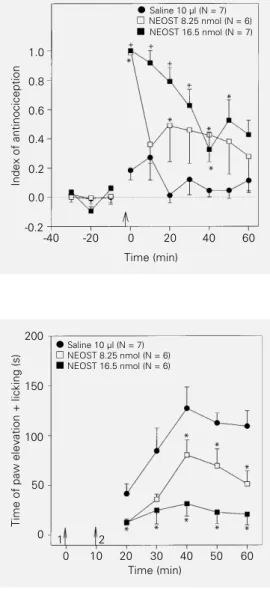
The intrathecal administration of neo-stigmine (8.25 and 16.5 nmol) produced a dose-dependent antinociception in the tail flick test (Figure 1). The curves in Figure 1 were significantly different regarding treat-ments (F2,17 = 16.88; P<0.001). The effect of
the higher dose of neostigmine was signifi-cantly different from control during all times from 0 to 50 min.
index, i.e., a period of phasic pain (0-10 min) followed by a period of tonic pain (10-60 min) that was similar to that previously re-ported (24,25). Intrathecal neostigmine pro-duced a dose-dependent inhibition of the animal response to formalin (Figure 2). MANOVA applied to the curves in the first phase of the response to formalin revealed significant differences between the 3 treat-ments (F2,17 = 7.75; P = 0.004) and
signifi-cant treatment x time interactions (F8,68 =
2.2; P = 0.038). The effect of the higher dose of neostigmine was significantly different from the other treatments at time 4 min, and
different from control at times 6 and 10 min. The smaller dose produced an effect differ-ent from control at 4 min only (ANOVA followed by the Duncan test). MANOVA applied to the curves in the second phase of the response to formalin showed significant differences between the 3 treatments (F2,17 =
4.40; P = 0.029), but the treatment x time interactions were nonsignificant (F10,85 =
1.34; P = 0.22).
Effect of neostigmine on the tail flick test in the absence of formalin
Neostigmine (8.25 and 16.5 nmol, it) also produced a dose-dependent antinoci-ception in rats not treated with formalin (Figure 3). The curves in Figure 3 were significantly different regarding treatments (F2,13 = 11.78; P = 0.001) and treatment x
time interactions (F18,117 = 3.37; P<0.001).
The effect of the higher dose of neostigmine was significantly different from the effect of the other treatments at times 0 to 30 min, and different from control at times 40 and 50 min. The smaller dose produced effects dif-ferent from control at times 0, 20 and 40 min. The control curves in Figures 1 and 3 were not significantly different (F1,11 = 1.92;
P = 0.194) and did not show significant treatment x time interactions (F9,99 = 1.87; P
= 0.065). The curves obtained with the higher dose of neostigmine in the presence and absence of formalin were also not signifi-cantly different (F1,10 = 1.79; P = 0.211) but
showed significant treatment x time interac-tion (F9,90 = 2.18; P = 0.031). The effect of
neostigmine in the absence of formalin was significantly stronger than in the presence of formalin at time t = 0 only (F1,11 = 8.78; P =
0.0142). The effects of the smaller dose of neostigmine were significantly less intense in formalin-treated rats (F1,9 = 7.24; P =
0.025). Significant treatment x time interac-tions were observed for the two curves (F9,81
= 2.57; P = 0.012) and the effects were significantly different at times 0 and 50 min.
Index of antinociception
1.0
0.8
0.6
0.4
0.0
-0.2
-0.4
-40 -20 0 20 40 60
Time (min) $Saline 10 µl (N = 7)
-NEOST 8.25 nmol (N = 6)
!NEOST 16.5 nmol (N = 7)
Figure 1 - Time course of the effects of intraspinal neostig-mine (NEOST) in the rat tail flick test. All animals received intra-plantar formalin (5%, 50 µl) 30 s after neostigmine. Neostigmine was injected at the time indi-cated by the arrow. Data are re-ported as means ± SD for 6 or 7 animals per group. *P<0.05 compared to control (saline) (Duncan test).
* *
* *
*
*
0 10 20 30 40 60
Time (min) $Saline 10 µl (N = 7)
-NEOST 8.25 nmol (N = 6)
!NEOST 16.5 nmol (N = 7)
50
Time of paw elevation + licking (s)
200
150
100
50
0 2 1 Figure 2 - Time course of the
effects of intraspinal neostig-mine (NEOST) in the rat formalin test. Neostigmine was injected at the time indicated by arrow 1. Intraplantar formalin (5%, 50 µl) was administered at the time in-dicated by arrow 2. Data are re-ported as means ± SD for 6 or 7 animals per group. *P<0.05 compared to control (saline);
+P<0.05 compared to control
and 8.25 nmol NEOST (Duncan test).
*
* *
+
Effect of neostigmine administered after the first phase of the response to formalin
The intrathecal administration of neo-stigmine (8.25 and 16.5 nmol) 10 min after the subcutaneous administration of formalin significantly reduced the second phase of the response to formalin (Figure 4). The curves were significantly different regarding treatments (F2,16 = 12.89; P<0.001) and
showed significant treatment x time interac-tions (F8,64 = 2.12; P = 0.046). The effect of
the smaller dose of neostigmine was signifi-cantly different from control at times 40 to 60 min, while the higher dose of neostigmine completely abolished the response to forma-lin.
When the data in Figures 2 and 4 were compared, no significant difference was de-tected between the effects of neostigmine (8.25 nmol) in the second phase of the re-sponse to formalin, injected before or 10 min after this irritant. The curves did not differ regarding treatments (F1,10 = 1.79; P = 0.21)
nor did they show significant treatment x time interactions (F4,40 = 1.15; P = 0.348).
Different results were obtained with the higher dose of neostigmine. The curves were significantly different regarding treatments (F1,11 = 7.35; P = 0.02) and showed
signifi-cant treatment x time interactions (F4,44 =
5.33; P = 0.001). However, significant dif-ferences were found at times t = 50 and 60 min only. When the pain intensity score during the 40 min of observation of the second phase of the response to formalin was summed, a significant difference was also found only between the groups treated with the higher dose of neostigmine (Figure 5).
Discussion
The present results using two different pain models confirm that intraspinal neo-stigmine produces a dose-dependent antino-ciceptive effect in rats. The peak effect of intraspinal neostigmine was higher and
oc-Time (min)
Index of antinociception
1.0
0.8
0.6
0.2
0.0 0.4
-0.2
-40 -20 0 20 40 60
+
*
* *
*
Time (min) $Saline 10 µl (N = 7)
-NEOST 8.25 nmol (N = 6)
!NEOST 16.5 nmol (N = 6)
* *
*
Figure 3 - Time course of the effects of intraspinal neostig-mine (NEOST) in the rat tail flick test. Neostigmine was injected at the time indicated by the ar-row. Data are reported as means ± SD for 6 or 7 animals per group. *P<0.05 compared to control (saline); +P<0.05
com-pared to control and 8.25 nmol NEOST (Duncan test).
Figure 4 - Time course of the effects of intraspinal neostig-mine (NEOST) on the second phase of the response of rats to intraplantar administration of for-malin (5%, 50 µl). Neostigmine and formalin were injected at the times indicated by arrows 1 and 2, respectively. Data are re-ported as means ± SD for 6 or 7 rats per group. *P<0.05 com-pared to control (saline) (Duncan test).
* * * *
0 10 20 30 40 50 60
2 1
Time of paw elevation + licking (s)
200
150
100
50
0 *
Figure 5 - Comparative effects of intraspinal neostigmine ad-ministered to rats 30 s before or 10 min after intraplantar injec-tion of formalin (5%, 50 µl) on the total time of paw elevation plus licking. Bars represent the means ± SD of 6 or 7 rats per group. *P<0.05 compared to the group pre-treated with neostig-mine (unpaired t-test). Neostigmine before formalin
Neostigmine after formalin
*
Time of paw elevation + licking (s)
600
500
300
200
0 400
100
Saline Neostigmine 8.25 nmol
Neostigmine 16.5 nmol
*
+
+
+
$Saline 10 µl (N = 7)
-NEOST 8.25 nmol (N = 6)
curred earlier in animals submitted exclu-sively to the tail flick test than in animals concurrently submitted to the formalin test. The effects obtained in these experiments, however, were significantly different only at times 0 and 50 min. The threshold for the tail withdrawal reflex to noxious heating of the skin was demonstrated to be significantly reduced during the tonic phase of the re-sponse to intraplantar formalin (26). Thus, in the case of concomitant application of both tests, hyperalgesia in the tail skin would be expected to require a higher dose of neo-stigmine to obtain a clear antinociceptive effect. However, the control curves obtained under the two experimental conditions did not differ significantly. Therefore, the for-malin-induced hyperalgesia in the tail skin was not demonstrated under our experimen-tal conditions.
Previous administration of neostigmine significantly inhibited the first phase of the response to formalin but produced only a slight reduction of the second phase which was significantly different from the control only at later readings. The administration of neostigmine subsequent to the first phase of the response to formalin also reduced the tonic pain in a dose-dependent manner. In this case, the higher dose of neostigmine was fully effective throughout the period of ob-servation while the smaller dose was effec-tive only at the later readings. Comparison of the curves obtained in the two experimental situations revealed significant differences only for the curves obtained with the smaller dose of neostigmine.
Behavioral (24,25) and electrophysiologi-cal studies (27) have shown that previous administration of morphine or the µ-opioid agonist DAMGO inhibits both components of the response to formalin. The effective-ness of DAMGO, however, is significantly lower when it is administered after the completion of the phasic component (27). Physiological and pharmacological studies have indicated that the two phases of the
response to formalin are different. The spi-nal control of phasic noxious inputs utilizes descending mechanisms which are different from those that control tonic noxious inputs (28). Intrathecal injection of NMDA, AMPA, and NK-1 antagonists has little influence on the first phase but all eliminate or strongly reduce the second phase reactions to forma-lin (29-31). The neurotransmitter involved in each type of pain also seems to be differ-ent (32). Substance P seems to be respon-sible for the nociceptive inputs originated by transitory stimuli as in the case of the tail flick reflex and in the first component of the response to formalin. Excitatory amino ac-ids such as glutamate and somatostatin seem to be responsible for the spinal entry of long-lasting noxious inputs, as observed in the second phase of the response to formalin or during inflammatory processes (33).
In our experiments, the neostigmine-in-duced inhibition of the first component of the response to formalin reduced but did not prevent the occurrence of tonic pain. The neostigmine-induced inhibition of the tail withdrawal reflex confirms its effectiveness against phasic pain. In addition, the results resemble the clinical observation that neo-stigmine is effective against somatic postop-erative pain but is less useful to control visceral postoperative pain in human beings (18). The observation that the higher dose of neostigmine is fully effective when adminis-tered after formalin, however, suggests that the use of a high intraspinal dose of neostig-mine would be an alternative to improve its effectiveness in the management of postop-erative pain. Attempts to increase the dosage of intraspinal neostigmine, however, have resulted in higher incidence of nausea, vom-iting and defecation (18,34) which limit its clinical usefulness.
Acknowledgments
References
1. Green PG & Kitchen I (1986). Antinocicep-tion opioids and the cholinergic system. Progress in Neurobiology, 26: 119-146. 2. Yaksh TL, Dirksen R & Harty GJ (1985).
Antinociceptive effects of intrathecally in-jected cholinomimetic drugs in the rat and cat. European Journal of Pharmacology, 117: 81-88.
3. Gillberg PG, Gordh Jr T, Hartvig P, Pettersson J & Post C (1989). Characteri-sation of the antinociception induced by intrathecally administered carbachol. Pharmacology and Toxicology, 64: 340-343.
4. Smith MD, Nha JY & Buccafusco JJ (1989). Antinociceptive effects of spinal cholinergic stimulation: interaction with substance P. Life Sciences, 45: 1255-1261.
5. Zhuo M & Gebhart GF (1991). Tonic cho-linergic inhibition of spinal mechanical transmission. Pain, 46: 211-222. 6. McIntosh FC (1941). The distribution of
acetylcholine in the peripheral and the central nervous system. Journal of Physi-ology, 99: 436-442.
7. Feldberg W & Vogt M (1948). Acetylcho-line synthesis in different regions of the central nervous system. Journal of Physi-ology, 107: 372-381.
8. Kasa P, Mann SP & Hebb CO (1970). Lo-calization of cholinacetyltransferase. Na-ture, 226: 812-816.
9. Roessmann U & Friede RL (1967). The segmental distribution of acetylcholines-terase in the cat spinal cord. Journal of Anatomy, 101: 27-32.
10. Gillberg PG, d’Argy R & Aquilonius SM (1988). Autoradiographic distribution of [3H]acetylcholine binding sites in the
cer-vical spinal cord of man and some other species. Neuroscience Letters, 90: 197-202.
11. Bouchenafa O & Livingston A (1991). The autoradiographic binding of [3H]
quinucli-dinyl benzylate to muscarinic receptors in the spinal cord of the sheep. Journal of Veterinary Pharmacology and Therapeu-tics, 14: 345-350.
12. Sherriff FE, Henderson Z & Morrison JF (1991). Further evidence for the absence of a descending cholinergic projection to the spinal cord in the rat. Neuroscience Letters, 128: 52-56.
13. Pedigo NW, Dewey WL & Harris LS (1975). Determination and characterisa-tion of the antinociceptive activity of intra-ventricularly administered acetylcholine in mice. Journal of Pharmacology and Ex-perimental Therapeutics, 193: 845-852. 14. Hood DD & Eisenach JC (1994). Phase I
safety assessment of spinal neostigmine in volunteers. Anesthesiology, 81: 26 (Ab-stract).
15. Hood DD & Eisenach JC (1994). Side ef-fects and analgesia from spinal neostig-mine through a Whitacre needle. Anes-thesiology, 81: 27 (Abstract).
16. Lauretti GL, Reis MP, Prado WA & Klamt JG (1996). Dose-response study of intra-thecal morphine versus intraintra-thecal neo-stigmine, their combination, or placebo for postoperative analgesia in patients un-dergoing anterior and posterior vagino-plasty. Anesthesia and Analgesia, 82: 1182-1187.
17. Klamt JG, Reis MP, Barbieri Neto J & Prado WA (1996). Analgesic effect of sub-arachnoid neostigmine in two patients with cancer pain. Pain, 66: 389-391. 18. Lauretti GL & Lima IC (1996). The effects
of intrathecal neostigmine on somatic and visceral pain: improvement by association with a peripheral anticholinergic. Anes-thesia and Analgesia, 82: 617-620. 19. Wood PL (1984). Analgesics:
Neuro-chemical, Behavioural and Clinical Per-spectives. Raven Press, New York, 175-189.
20. Dubuisson D & Dennis SG (1977). The formalin test: a quantitative study of the analgesic effects of morphine, meperi-dine, and brain stimulation in rats and cats. Pain, 4: 161-174.
21. Shibata M, Ohkubo T, Takahashi H & Inoki R (1989). Modified formalin test: charac-teristic biphasic pain response. Pain, 38: 347-352.
22. Zimmermann M (1983). Ethical guidelines for investigation of experimental pain in conscious animals. Pain, 16: 109-110. 23. Yaksh TL & Rudy TA (1976). Chronic
cath-eterization of the spinal subarachnoid space. Physiology and Behavior, 17: 1031-1036.
24. Wheeler-Aceto H & Cowan A (1991). Stan-dardization of the rat paw formalin test for the evaluation of analgesics. Psychophar-macology, 104: 35-44.
25. Malmberg AB & Yaksh TL (1993). Phar-macology of the spinal action of ketorolac, morphine, ST-91, U50488, and LPIA on the formalin test and an isobolographic analysis of the NSAID interaction. Anes-thesiology, 79: 270-281.
26. Wiertelak EP, Furness LE, Watkins LR & Maier SF (1994). Illness-induced hyperal-gesia is mediated by a spinal NMDA-nitric oxide cascade. Brain Research, 664: 9-16. 27. Dickenson AH & Sullivan AF (1987). Pe-ripheral origins and central modulation of subcutaneous formalin-induced activity of rat dorsal horn neurones. Neuroscience Letters, 83: 207-211.
28. Ryan SM, Watkins LR, Mayer DJ & Maier SF (1985). Spinal pain suppression mecha-nisms may differ for phasic and tonic pain. Brain Research, 334: 172-175.
29. Haley JE, Sullivan AF & Dickenson AH (1990). Evidence for spinal N -methyl-D-aspartate receptor involvement in pro-longed chemical nociception in rat. Brain Research, 518: 218-226.
30. Coderre TJ & Melzack R (1992). The con-tribution of excitatory amino acids to cen-tral sensitization and persistent nocicep-tion after formalin-induced tissue injury. Journal of Neuroscience, 12: 3665-3675. 31. Malmberg AB & Yaksh TL (1992).
Hyper-algesia mediated by spinal glutamate or substance P receptor blocked by spinal cyclooxygenase inhibition. Science, 257: 1276-1279.
32. Ohkubo T, Shibata M, Takahashi H & Inoki R (1990). Roles of substance P and soma-tostatin in transmission of nociceptive in-formation induced by formalin in spinal cord. Journal of Pharmacology and Exper-imental Therapeutics, 252: 1261-1268. 33. Coderre TJ & Melzack R (1991). Central
neural mediators of secondary hyperalge-sia following heat injury in rats: neuropep-tides and excitatory amino acids. Neuro-science Letters, 131: 71-74.