COMMUNICATIVE EVOLUTION IN TWINS
WITH LANGUAGE DELAY
Evolução comunicativa em gemelares com atraso
no desenvolvimento da linguagem
Mariana Germano Gejão(1), Ana Paola Nicolielo(2), Bianca Rodrigues Lopes Gonçalves(3),
Luciana Paula Maximino(4), Simone Aparecida Lopes-Herrera(5)
(1) Department of Speech-Language Pathology and Audiology,
Bauru School of Dentistry, University of São Paulo, Bauru, SP, Brazil.
(2) Department of Speech-Language Pathology and Audiology,
Bauru School of Dentistry, University of São Paulo, Bauru,
development, behavioral problems and dificulty
in the children-parents interaction1-4. High rates of
language dificulty in twins are due to the occur
-rence of the same risk factors for dificulties in the communicative development present in non twins (prematurity, low weight, among others) and also
to social factors such as less individualized inter-action5,6. Due to these risk factors, twin children more
often receive a specialized professional monitoring,
which can provide an easier acknowledgement of
INTRODUCTION
Language disorders are often described in
multiples, as well as delays in motor and cognitive
ABSTRACT
The theme of this study is the communicative behavior of twins with language disorders before and after speech therapy. Data from two pairs of male twins with a diagnosis of language delay were analyzed (monozygotic – S1/S2, dizygotic – S3/S4). Data were collected in assessments made pre and post speech-language audiology intervention through: semi-structured interviews with the parents,
observation of communicative behavior, and language and development scale test. The
speech-language audiology intervention lasted for 34 months for S1/S2 (from two years and ive months to ive years and three months) and 17 months for S3/S4 (from three years and seven months to ive years and four months). More severe pre, peri and post natal complications with a greater psychomotor and communicative impairment were observed in the pre speech-language audiology intervention assessment. S3/S4 showed less severe pre, peri and post natal complications and development delay occurring only in language. The age of the children in post intervention assessment was similar, however, the pair S1/S2 showed a more damaged global and communicative development, even having received a longer speech-language audiology intervention. S3 showed a performance approximate to the typical development and S4 had dificulties just concerning phonology and pragmatics. The experiences of twins, differentiated as to interpersonal circumstances, lead to atypical language development, due to the reduced objective need of linguistic interaction. The post natal complications in S1/S2 exacerbated the delay in child development, encompassing the communicative development.
KEYWORDS: Child Language; Language Development; Twins; Speech, Language and Hearing
to carry out the post intervention assessment at this
age was due to the fact that in this is the age children with a typical language development are expected to be able to show good speech intelligibility as well as narrate facts and stories experienced12.
For the analysis of the pre and post
speech-language audiology intervention assessment, we
considered the information regarding the clinical history, the baseline assessments (carried out to guide the intervention planning and to serve as clinical evolution comparison and routinely used as
an assessment protocol in the clinic where these
children attended speech therapy) and the child
development monitoring, including the following
instruments:
Observation of communicative behavior: assessment of communicative abilities and functions12;
Gesell and Amatruda Behavior Developmental Scale13: assessment of the motor, adaptive,
linguistic, personal and social development;
ABFW Infantile Language Test – part A
(phonology) 14: assessment of the acquisition and
development of the phonologic system.
The speech-language audiology intervention
was carried out to stimulate all the aspects of language (pragmatics, phonology, morph syntax
and semantics). Each therapy session lasted 50
minutes and happened twice a week, individually. The Modiied Cycles Model was used for the study focusing speciically on the development of the
phonologic system15.
After the post speech-language audiology inter-vention assessment, the four children continued
attending speech therapy twice a week, in the same
institution, in order to continue the intervention
on the linguistic aspects which were still showing
disorders.
RESULTS
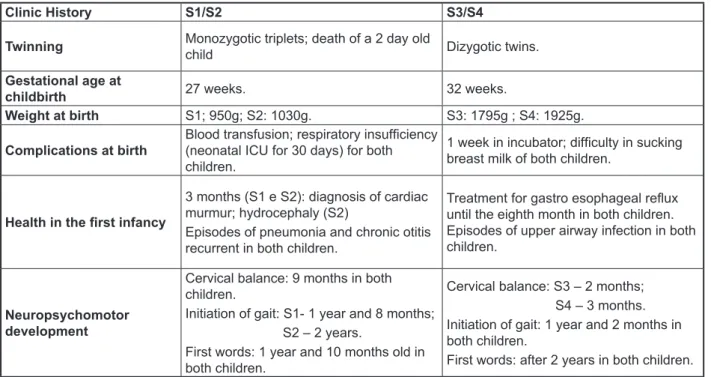
Figure 1 presents data obtained with interview carried out with parents in order to raise clinical
history.
The results of the pre speech-language audiology intervention assessment are in Figure 2 and 3.
of phonological disorders may suffer genetic inlu -ences, although it is not possible to discharge the environmental factors8.
The speech-language pathologist can contribute
to the guidance and support of the twin children
families as to the development, aiming at promoting
the twin children health and preventing possible
development disorders9. Thus, these children
speech-language pathology monitoring and the research on cognitive language6 development
become important.
The child linguistic performance in the beginning of the speech therapy may be a predictor of her future linguistic abilities10, and the early acknowledgment
and monitoring of children with a risk for disorders
in the language development offer a possibility to block the development of the pathology11.
Having exposed that, the purposes of this study were to describe the communicative behavior before
and after speech-language audiology intervention in
two pairs of twins and to relate the indings with pre,
peri and post natal factors.
CLINICAL CASES PRESENTATION
This study was approved by the Research
Ethics Committee of its home institution (Protocol 013/2012). The free and informed consent terms
were signed at the time of the children language
assessment.
This is a retrospective study carried out by means of the analysis of medical charts data of
twins who attended the Children Language Clinic at
that institution.
In order to carry out the study, data regarding
before and after speech-language audiology
inter-vention of two pairs of male twins (S1/S2, S3/S4) diagnosed with Language Delay were analyzed.
S1/S2 were two years and ive months old and S3/S4 were three years and ive months old in
the pre speech-language audiology intervention assessment. The post speech-language audiology
intervention assessment was carried out after an intervention period of 34 months for S1/S2 (ive
years and three months old) and after 17 months for
Signiicant evolutions in the communicative It´s appropriate to mention now that it was not
Pre intervention
assessment S1 S2 S3/S4
Age 2 years and 5 months 3 years and 7 months
Observation of the
Communicative Behavior
Infrequent communicative intention.
Jargon and indicative gestures.
Absence of verbal shift start. Communicative function: instrumental and protest. Understanding of simple orders related to immediate context.
Infrequent communicative intention.
Jargon and indicative gestures without intention of communicating.
Absence of verbal shift start. Communicative function: instrumental and protest.
Impaired understanding of simple orders related to immediate context.
• Use of oral language related to
indicative gestures.
• Echolalia, jargon, isolated
words with phonologic processes.
• Verbal shift start, but they did
not keep the conversation topic.
• Interactive, naming, protest
and heuristic communicative function.
• Understanding of simple orders
related to immediate context.
• S3: better expressive
vocabulary.
Figure 2 - Data of the Observation of the Communicative Behavior in the pre speech-language audiology intervention assessment
Clinic History S1/S2 S3/S4
Twinning Monozygotic triplets; death of a 2 day old
child Dizygotic twins.
Gestational age at
childbirth 27 weeks. 32 weeks.
Weight at birth S1; 950g; S2: 1030g. S3: 1795g ; S4: 1925g.
Complications at birth
Blood transfusion; respiratory insuficiency (neonatal ICU for 30 days) for both children.
1 week in incubator; dificulty in sucking breast milk of both children.
Health in the irst infancy
3 months (S1 e S2): diagnosis of cardiac murmur; hydrocephaly (S2)
Episodes of pneumonia and chronic otitis recurrent in both children.
Treatment for gastro esophageal relux until the eighth month in both children. Episodes of upper airway infection in both children.
Neuropsychomotor development
Cervical balance: 9 months in both children.
Initiation of gait: S1- 1 year and 8 months; S2 – 2 years.
First words: 1 year and 10 months old in both children.
Cervical balance: S3 – 2 months; S4 – 3 months. Initiation of gait: 1 year and 2 months in both children.
First words: after 2 years in both children.
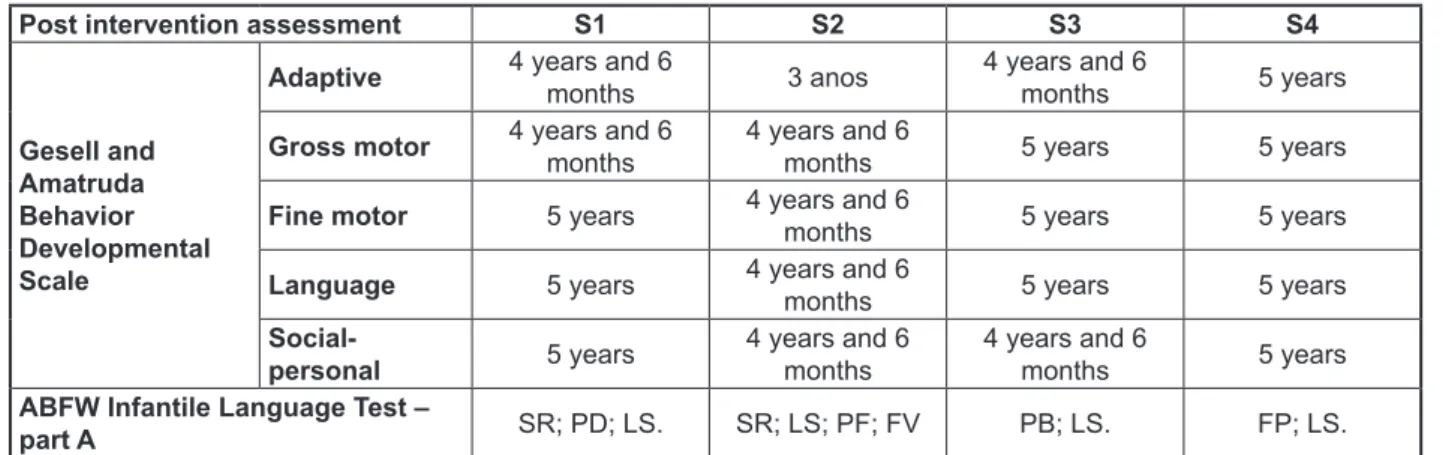
The performance age of four years and six
months for S3 e S4 in the Gesell and Amatruda Behavior Developmental Scale does not represent delay in development, according to the rules of this procedure.
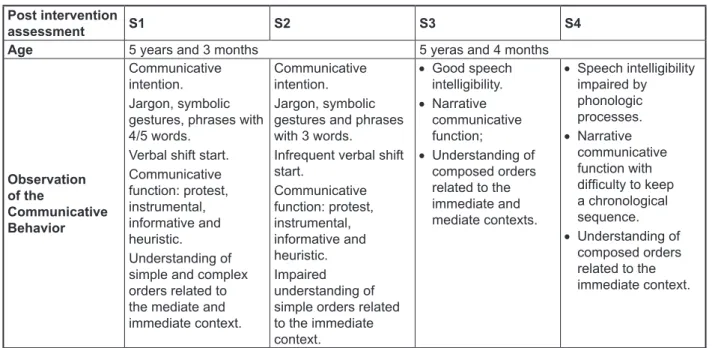
The results showing this communicative evolution, as well as the most signiicant evolution
for S3 e S4 are in Figures 4 and 5.
Pre intervention assessment S1 S2 S3 and S4
Gesell and
Amatruda Behavior Developmental Scale
Adaptive 10 months 9 months 2 years and 6 months
3 years and 6 months 3 years 3 years 2 years and 6 months
Gross motor 10 months 9 months
Fine motor 10 months 11 months
Language 9 months 8 months
Social-personal 10 months 10 months
ABFW Infantile Language Test – part
A (unexpected phonologic processes for
the age)
Not carried out due to restricted orality.
SR; CR; FP; PB; LS; A. S3: also showed SA
and PD.
Subtitle: SR: syllable reduction; CH: consonant harmony; FP: fricative plosivation; PB: palatal backing; LS: liquid simpliication; A: affrication; AS: syllable addition; PD: plosive devoicing.
Figure 3 - Data of global and phonologic development in the pre speech-language audiology intervention assessment
Post intervention
assessment S1 S2 S3 S4
Age 5 years and 3 months 5 yeras and 4 months
Observation of the
Communicative Behavior
Communicative intention. Jargon, symbolic gestures, phrases with 4/5 words.
Verbal shift start. Communicative function: protest, instrumental, informative and heuristic.
Understanding of simple and complex orders related to the mediate and immediate context.
Communicative intention. Jargon, symbolic gestures and phrases with 3 words.
Infrequent verbal shift start.
Communicative function: protest, instrumental, informative and heuristic. Impaired understanding of simple orders related to the immediate context.
• Good speech
intelligibility.
• Narrative
communicative function;
• Understanding of
composed orders related to the immediate and mediate contexts.
• Speech intelligibility
impaired by phonologic processes.
• Narrative
communicative function with dificulty to keep a chronological sequence.
• Understanding of
composed orders related to the immediate context.
delay in the neuropsychomotor development).
A study which monitored families of twins since
pregnancy16, verifying the infantile development,
observed a differentiated language development,
one of them was more eficient in the oral language.
Another study3 which looked at parents’ reports
did not indicate any disorders in age acquisition, but it indicated disorders in the acquisition quality
since parents reported dificulty in understanding
the children language, besides considering it often
simpliied.
The communicative proile of S1/S2 was already composed of jargon and indicative gestures by the
age of 2 years and 5 months. Outlining the
commu-nicative proile of children with a typical language
development, a study17 veriied that it is possible to
check from the age of two the beginning and the maintenance of talks with short shifts.
Although the communicative development of S2
had been lower than the development observed for
S1, they both had similar global development in the pre language therapy assessment (Figure 3), and
the language was the ability with the greater loss. Doing the same comparison between S3 and S4, the same performance is veriied for the brothers, what allows us to consider delay in the adaptive, ine
DISCUSSION
Differences as to the pre, peri and post natal
complications between the pairs of twins are veriied
by the analysis of the data regarding their clinic
history (Figure 1). The twins S1/S2 had greater complications when compared to the S2/S3, what
indicates a bigger delay in the neuropsychomotor
development, besides of the presence of the irst words in lower age. The intercurrences happening during the childbirth and the irst infancy are frequent in twins and are considered risk factors to
the child development5,6. Prematurity and low weight
at birth are some of the biological risk factors which inluence the child development11. Monitoring the
language development of twins from birth to the 26th
month, a study did not verify any disorders in the
beginning of the language, but it veriied disorders
in the language quality since the family reported
dificulty in understanding the children speech, reporting the speech as very simpliied3.
The communicative proile (Figure 2) of S1/S2
in the pre speech-language audiology intervention
assessment was not similar to the proile observed for the S3/S4; however, we must take into account the age difference between the pairs. Between S3 and
S4, the difference in the communicative standard is
Post intervention assessment S1 S2 S3 S4
Gesell and Amatruda Behavior Developmental Scale
Adaptive 4 years and 6
months 3 anos
4 years and 6
months 5 years
Gross motor 4 years and 6
months
4 years and 6
months 5 years 5 years
Fine motor 5 years 4 years and 6
months 5 years 5 years
Language 5 years 4 years and 6
months 5 years 5 years
Social-personal 5 years
4 years and 6 months
4 years and 6
months 5 years
ABFW Infantile Language Test –
part A SR; PD; LS. SR; LS; PF; FV PB; LS. FP; LS.
Subtitle: SR: syllable reduction; PD: plosive devoicing; LS: liquid simpliication; PP: palatal backing; FP: palatal fronting; VF: velar fronting.
between twin brothers’ phonologic systems, which was not veriied in this study neither in the pre inter -vention nor in the post inter-vention assessments.
Exploring the predictors of the therapy time for speciic disorders of language development, a
study10 veriied that the initial performances of the
children in pragmatic and vocabulary assessments
are signiicant measures for therapeutic prognosis. This may be veriied in this study if we compare the pairs of twins.
A study with twins7 observed a genetic inluence
increase in the language development between
the beginning and the middle of childhood. The authors stated there possibly is activation of genes
not speciically related to language, but to social
factors as, in this phase, children have a broader
social demand, mainly with the beginning of school, what directly inluences their communicative devel -opment. The communicative evolution observed
in the pairs of twins in this study (S1/S2 e S3/S4)
is due to the years of speech-language audiology
intervention; however, it may be related to this genetic factor as well. The genetic contribution in
the manifestation of language and speech disorders
in twins was also related, as well as their evolution in
the speech-language audiology intervention in the report of a case study8.
In the global development reassessment (Figure 5), we veriied a signiicant improve of S4 compared to the others, S1/S2 were able to approximate
their performances in abilities of the global
devel-opment to the twins S3/S4, except for the language.
Language delays are common in multiples, as
well as discrepancies in other areas of childhood
development4.
The analyses of the acquisition and development of the phonologic post language-speech audiology
intervention (Figure 5) shows evolution in this aspect for S3/S4, who showed only two phonologic processes not expected for the age. At this time, it was possible to carry out this assessment for S1/S2, who showed unexpected phonologic processes for
the age14, with a greater loss for S2, characterizing,
in a certain way, their evolution.
We highlight the intervention was aimed at working with language in all its aspects. However, during the intervention process, it was possible to
observe an improvement in many linguistic
compo-nents, but to a lower degree in the phonologic, what impaired the intelligibility of the pairs of twins’
speech and lead this study to a bigger focus in the acquisition and development of the phonologic
system. As a consequence, it was aimed to offer a
better communicative and interaction quality since
even with the structuring of simple phrases, but The comparison between the developments
of the pairs of twins showed a bigger deicit in the global development of S1 and S2. Children who
live surrounded by biological and psychic risks in
their irst years of life are more likely to developing problems which can affect their development11.
Furthermore, studies6,18 indicate prematurity as
having a predictive value for delay in the motor and
cognitive development. Although the two pairs of twins were born premature, S1/S2 were extreme
premature (being born in the 27th gestation week).
It´s considered premature, all infants born before the period of 37 gestation weeks. It´s is extreme
premature, all infants born before 29 gestation
weeks and having a very low weight (<1500g)18.
Due to the immaturity of the organic systems and to
the environment of the neonatal Intensive Care Unit,
the birth of a premature is accompanied by many complications and health conditions of the baby,
what increases the risk of disorders in the infantile
development6,18. The quality of social interactions
may minimize the impact of factors such as the prematurity in the infantile development18.
Children with neuropsychomotor development delay will have more dificulties to act independently while taking part in dialogic and social interactions, what inluences their language development4.
The analyses of the acquisition and development of the phonologic system pre language-speech
audiology intervention (Figure 3) were only possible for S3/S4 as S1/S2 did not show an oral language
sample enough for the assessment and could not
name the images neither repeat the words of the
test14. Only the unexpected phonologic processes
for the age of S3/S4 were described, some of them,
such as consonantal harmony, syllable reduction and fricative plosivation are observed in children in the beginning of the phonologic system acquisition
since the expected age of stopping the use of these processes is two years and six months according to
this study assessment procedure14.
With the language-speech audiology
inter-vention, a communicative standard evolution was observed mainly for the pairs of twins S3/S4, who
in the post intervention assessment (Figure 4)
showed narration of facts and stories, the greater
language impairment happened in the phonologic aspect. Even having attended speech therapy for
a longer period, S1/S2 showed a less signiicant
communicative evolution, they could not perform a
narrative at the age of ive years and three months. We highlight the pairs of twins practically were the
same chronologic age (only a month difference) in the post intervention assessment. A study8 with
phonologic intervention in twins veriied evolution
for the premature aiming at the prevention of
malfor-mations and identiication of atypical development
predictor variables18.
CONCLUSION
The pairs of twins showed impairment in the global
and communicative development in the pre speech-language audiology intervention assessment,
and there was an evolution of the communicative
abilities and of the child global development after a long period of intervention.
Although the period of speech-language
audiology intervention had been longer for the twins with bigger pre, peri and post natal complications
(S1/S2), their performances in the pre and post speech-language audiology intervention
assess-ments procedures were more impaired when
compared to S3/S4. So, the interference in the child development occasioned by genetic and environ-mental factors became clear.
with intelligibility in production, it is possible achieve communicative eficiency.
Generally speaking, in twins situations, the siblings differently experience interpersonal circum
-stances, which do not cause an objective need of linguistic intervention with other interlocutors, what may, therefore, inluence in the language
development, leading to an atypical process of the
development. The proximity of the twins and the way their families face the twin situation may lead to
disorders in the identity and singularity formation of each child and, thus, the language acquisition can
occur in a disordered way or the language quality may be disordered, one example is the so called secret language of the twins3,4.
By the results exposed, it was veriied that the complications experienced for S1/S2 implicate in
the perception of delay in language development
in earlier age, as well as in the need of a longer
period of speech-language audiology intervention.
The same can be veriied in another study4, whose
indings highlighted the need for follow up programs
RESUMO
Este estudo tem como tema o comportamento comunicativo de gêmeos com alteração de linguagem pré e pós intervenção fonoaudiológica. Foram analisados dados de dois pares de gêmeos do sexo
masculino (S1/S2 monozigóticos; S3/S4 dizigóticos), com diagnóstico de Atraso de Linguagem. Os
dados foram coletados na avaliação pré e pós intervenção fonoaudiológica, por meio de: entrevista semi-estruturada com os pais; observação do comportamento comunicativo; e teste de linguagem e escala de desenvolvimento. A intervenção fonoaudiológica teve duração de 34 meses para S1/S2
(de dois anos e cinco meses a cinco anos e três meses) e 17 meses para S3/S4 (de três anos e sete
meses a cinco anos e quatro meses). Na avaliação pré intervenção fonoaudiológica de S1/S2 foram
observadas intercorrências pré, peri e /pós natais mais graves, com maior comprometimento neurop-sicomotor e comunicativo. S3/S4 apresentaram intercorrências pré, peri e pós natais menos graves
e o atraso no desenvolvimento ocorreu apenas para a linguagem. A idade das crianças na avaliação pós intervenção foi semelhante, porém, o par S1/S2 apresentou desempenho comunicativo e global com maior prejuízo, mesmo tendo recebido maior tempo de intervenção fonoaudiológica. S3 apresen
-tou desempenho aproximado ao desenvolvimento típico e S4 diiculdades apenas quanto à fonologia e pragmática. As experiências de gemelares, diferenciadas em meio a circunstâncias interpessoais, acarretam desenvolvimento de linguagem atípico, devido à menor necessidade objetiva de interação linguística. As intercorrências pós natais em S1/S2 agravaram o atraso no desenvolvimento infantil,
englobando o desenvolvimento comunicativo.
9. Barbetta NL, Panhoca I, Zanolli ML. Aspectos
fonoaudiológicos o pediátricos na linguagem de gêmeos monozigóticos. Rev Paul Pediatr. 2008;26(3):265-70.
10. Puglisi ML, Gândara GP, Gusti E, Gouvêa MA, Bei-Lopes DM. É possível predizer o tempo de terapia das alterações especíicas
do desenvolvimento de linguagem? J Soc Bras Fonoaudiol. 2012; 24(1):57-61.
11. Oliveira LD, Flores MR, Souza APR. Fatores
de risco psíquico ao desenvolvimento infantil: implicações para a fonoaudiologia. Rev CEFAC.
2012; 14(2):333-42.
12. Zorzi JL, Hage SRV. Protocolo de Observação
Comportamental. São José dos Campos:Pulso; 2004.
13. Knoblock H, Passamanick B. Gesell e Amatruda: psicologia do desenvolvimento do lactente e da
criança pequena: bases neuropsicológicas e
comportamentais. São Paulo: Editora Ateneu; 2000.
14. Andrade CRF, Béi-Lopes DM, Fernandes FDM,
Wertzner HF. ABFW – Teste de linguagem infantil:
nas áreas de fonologia, vocabulário, luência e pragmática. Carapicuíba, São Paulo: Pró-Fono,
2004.
15. Tyler A, Edwards ML, Saxman J. Clinical application of two phonologically based treatment
procedures. J Speech Hear Disord. 1987; 52:393-409.
16. Barbetta NL, Panhoca I, Zanolli ML. Sobre
o desenvolvimento da linguagem de gêmeos monozigóticos. Rev CEFAC. 2009;11(Supl2):154-60.
17. Sandri MA, Meneghetti SL, Gomes E. Peril Comunicativo de crianças entre 1 e 3 anos com
desenvolvimento normal de linguagem. Rev CEFAC. 2009;11(1):34-41.
18. Formiga CKMR, Linhares MBM. Avaliação do desenvolvimento inicial de crianças nascidas
pré-termo. Rev Esc Enferm USP. 2009;43(2):472-80.
REFERENCES
1. Mogford K. Desenvolvimento de linguagem em
gêmeos. In: Bishop D, Mogfors K, organizadores. Desenvolvimento da linguagem em circunstâncias excepcionais. Rio de Janeiro: Revinter; 2002. p.
99-122.
2. Sutcliffe AG, Derom C. Follow-up of twins:
health, behavior, speech, language outcomes and implications for parents. Early Hum Dev. 2006; 82(6):379-86.
3. Barbetta NL, Panhoca I, Zanolli ML. Gêmeos monozigóticos – revelações no discurso familiar.
Rev Soc Bras Fonoaudiol. 2008;13(3):267-71. 4. Ferreira AT, Silva MM, Silva L, Merighi LBM, Miranda AM, De-Vitto LPM, Lamônica DAC. Desempenho Comunicativo em trigêmeos prematuros. Rev CEFAC. 2008;10(1):15-21.
5. DeThorne LS, Hart SA, Petrill SA, Deater-Beckard K, Thompson LA, Schatschneider C, et al.
Children’s history of speech-language dificulties: genetic inluences and associations with
reading-related measures. J Speech Lang Hear Res. 2006;49(6):1280–93.
6. Flabiano FC, Bühler KECB, Limongi SCO. Desenvolvimento cognitivo e de linguagem
expressiva em um par de gêmeos dizigótico: inluência da síndrome de Down e da prematuridade associada ao muito baixo peso. Rer Soc Bras de
Fonoaudiol. 2009;14(2):267-74.
7. Hayiou-Yhomas ME, Dale PS, Plomin R. The etiology of variation in language skills changes
with development: a longitudinal twin study of
language from 2 to 12 years. Development Science. 2012;15(2):233-49.
8. Weber DE, Varews MA, Mota HE, Keske-Soares
M. Desenvolvimento do sistema fonológico de gêmeos monozigóticos com desvio fonológico:
correlação a fatores genéticos e ambientais. Rev
CEFAC. 2007;9(1):32-9.
Received on: February 01, 2013 Accepted on: April 26, 2013
Mailing address:
Mariana Germano Gejão
Alameda Dr. Octávio Pinheiro Brizolla, 9-75, Vila Universitária. Bauru – SP
CEP: 17012-901