Nor-isoprenoids profile during port wine ageing—influence
of some technological parameters
António César Silva Ferreira, Paula Guedes de Pinho
∗Escola Superior de Biotecnologia, Universidade Católica Portuguesa, Rua Dr. Bernardino de Almeida, 4200-072 Porto, Portugal
Abstract
Nor-isoprenoid compounds, such as-damascenone,-ionone, 2,2,6-trimethylcyclohexanone (TCH), 1,1,6-trimethyl-1,2-dihydronaphtha-lene (TDN) and vitispirane were determined in 14 young port wines and 45 old port wines. As between the two groups of wines levels of these compounds are quite different, an experimental protocol was performed in order to determine which technological parameter (dissolved O2, free SO2levels, pH and time/temperature) was related with the formation/consumption of these molecules. The five nor-isoprenoids were equally affected by the selected parameters and a similar profile with time was observed. The synergistic effects of increasing temperature and lowering pH had the largest impact. For samples treated with high oxygen regimes (saturation), the levels of all considered nor-isoprenoids decreased after a certain concentration of oxygen consumed (e.g. 10 mg l−1).
Nevertheless, during barrel port wine ageing, corresponding to the 45 wines, two different behaviours can be observed: TDN, vitispirane and TCH increase significantly whilst a decrease of levels of-ionone and-damascenone with port barrel ageing was observed. It was also calculated that “over 40 year” old port wines have, respectively, 15, 5 and 3 times higher levels of TDN, vitispirane and TCH than the young ports. For these three compounds the respective rates of formation are higher than those of degradation, which suggests a higher number or higher concentration of precursors than those involved for the megastigame C13 nor-isoprenoids-damascenone and-ionone.
Keywords: Port wines; Ageing; Volatile nor-isoprenoid compounds;-Damascenone; -Ionone; 2,2,6-Trimethylcyclohexanone; 1,1,6-Trimethyl-1,2-dihydronaphthalene; Vitispirane
Introduction
Nor-isoprenoids are substances that could come from
the direct degradation of carotenoid molecules such as
-carotene, lutein, neoxanthin and violaxanthin [1–3] and
also from the hydrolysis of glucoside molecules [4–6].
Some nor-isoprenoids have been identified in wine, such as -damascenone, -ionone, 1,1,6-trimethyl-1,2-dihydrona-phthalene (TDN) and vitispirane. All these molecules have an important sensorial impact on wine aroma as they have very low olfactory perception thresholds. Some studies have been published concerning the volatile composition
of port wine [2,3,5–8]. Although, there is little
informa-tion concerning the levels of nor-isoprenoids in ports,
recently some authors [4] have reported the presence of
2,2,6-trimethylcyclohexanone (TCH), responsible for the “rock-rose-like” aroma in port wines.
∗Corresponding author. Fax:+351-2-5580088.
E-mail address: [email protected] (P. Guedes de Pinho).
It is interesting to note that port wines, especially for bot-tle aged (“vintage category”) develop “floral” and “violet” notes, which could be related to the presence of some of these specific molecules. As port wines have a short period of fermentation, as it is interrupted by brandy addition, some constituents in grape material can be found in the respective
wines. This is the case of carotenoid molecules such as
-carotene, lutein, neoxanthin and violaxanthin, which were
reported for the first time in young port wines [7]. Thus,
considering on one hand the presence of free carotenoid molecules in port wines and for another hand, the long age-ing period that ports could be submitted, with or without oxygen presence (barrel aged ports or “vintage” ports, re-spectively), it seems to be interesting to determine, firstly the contents of nor-isoprenoids in different categories of ports and also their evolution during ageing.
Hence, the aim of this work was to relate changes in the composition of nor-isoprenoids during port wine ageing and to determine among technological
parame-ters such as dissolved O2, pH and temperature which
have the highest impact on formation/degradation of these compounds.
For this reason an experimental protocol was established in order to analyse the effect of some parameters which are believed to be important in the aromatic modification of port wines, namely temperature, oxygen concentration, pH and
SO2concentration.
Materials andmethods Material
The wines used in this study were: Wine Group 1—young port wines, from one particular vintage (1999), from five dif-ferent cultivars of Vitis vinifera varieties (Touriga Nacional, Touriga Francesa, Tinta Roriz, Tinto Cão and Tinta Bar-roca) from two different sub regions of the Douro Region (Cima Corgo and Douro Superior). Winemaking procedures depended on the producers. Wine Group 2—10, 20, 30 and over 40-year-old tawny port. These wines were blended and barrel aged. Wine Group 3—red port wine from 1999 vin-tage (8 l), with pH 3.74, an amount of dissolved oxygen of 4.2 ml, with an instantaneous potential of 222 mV and a free
SO2level of 17 mg l−1, was prepared in order to analyse the
effect of parameters which are believed to be important in the aromatic modification of port wines, namely: temperature,
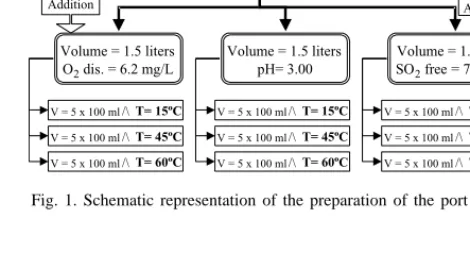
oxygen concentration, pH and SO2 concentration (Fig. 1).
To test the effect of pH, one of the portions was adjusted to pH 3.0 by adding tartaric acid. To test the effect of high concentrations of oxygen (oxidative environment) and the effect of an exogenous antioxidant, a portion of wine at pH
3.0 was, saturated with oxygen (6.2 mg l−1) by air bubbling,
and finally to the last portion of wine at pH 3.0, free SO2was
adjusted to 74 mg l−1by adding potassium metabisulphite.
As shown inFig. 1, the four portions, each 1.5 l, were
di-vided into sets of 100 ml and were stored in sealed vessels.
One part of each experiment was kept at 15◦C, another at
45◦C and the last one at 60◦C. The samples were analysed
Port Wine • Volume = 8 Liters • pH = 3.74 • [O2] dissolved = 4.2 mg/L • Emv =222 mV • SO2 free =17 mg/L Volume = 5 liters pH= 3.00 Volume = 1.5 liters pH= 3.74 Volume = 1.5 liters O2 dis. = 6.2 mg/L Volume = 1.5 liters pH= 3.00 Volume = 1.5 liters SO2free = 74 mg/L Tartaric Acid O2 Addition V = 5 x 100 ml /\ T= 15ºC V = 5 x 100 ml /\ T= 45ºC V = 5 x 100 ml /\ T= 60ºC V = 5 x 100 ml /\ T= 15ºC V = 5 x 100 ml /\ T= 45ºC V = 5 x 100 ml /\ T= 60ºC V = 5 x 100 ml /\ T= 15ºC V = 5 x 100 ml /\ T= 45ºC V = 5 x 100 ml /\ T= 60ºC V = 5 x 100 ml /\ T= 15ºC V = 5 x 100 ml /\ T= 45ºC V = 5 x 100 ml /\ T= 60ºC SO2 Addition
Fig. 1. Schematic representation of the preparation of the port wine samples (Wine Group 3).
at 0, 17, 32, 47 and 59 days of storage time. The samples ini-tially saturated with oxygen were re-saturated at each sam-pling stage. This experiment was performed in duplicate.
Analyticaldeterminations
To 50 ml of white wine were added 50l of octan-3-ol in
hydroalcoholic solution (1/1 v/v) at 466 mg l−1as internal
standard and 5 g of anhydrous sodium sulphate. The wine
was extracted twice with 5 ml of CH2Cl2(Merck). The two
organic phases obtained were blended and dried over anhy-drous sodium sulphate. Four millilitres of this organic ex-tract was concentrated until 1/10 under a nitrogen stream
with a 20 l min−1gas flow[8].
Ga schromatography/mass spectrometry (GC/MS)
Extracts were analysed using a Varian CP-3800 gas chromatograph equipped with a Varian Saturn 2000 mass selective detector and Saturn GC/MS workstation software version 5.51. The column used was STABILWAX-DA
(60 m× 0.25 mm, 0.25 m) fused silica (Restek). The
in-jector port was heated to 220◦C. The split vent was opened
after 30 s. The carrier gas was helium C-60 (Gasin,
Portu-gal), at 1 ml min−1, constant flow. The oven temperature was
40◦C (for 1 min), then increased at 2◦C min−1 to 220◦C
and held for 30 min. All mass spectra were acquired in the electron impact (EI) mode. The ion trap detector was set as follows: the transfer line, manifold and trap temperatures
were, respectively, 230, 45 and 170◦C. The mass range was
m/z 33–350, with a scan rate of 6 s−1. The emission current
was 50A, and the electron multiplier was set in relative
mode to the autotune procedure. The maximum ionisation
time was 25,000s, with an ionisation storage level of m/z
35. The injection volume was 1l and the analysis was
performed in full scan mode. Identification was achieved from comparisons of mass spectra obtained from the sam-ple with those from pure standards injected in the same conditions; by comparing the Kovats indices and the mass spectra present in the NIST 98 MS Library Database or in
the literature. The Kovats index is calculated according to the literature[9].
Other analytical measurements
Measurements of redox potential, free SO2concentration,
and chromatic index were made[10]. The concentration of
dissolved oxygen was measured using a “WTW 340 Oxygen Probe”.
Standards
The following molecules were purchased from Sigma–
Aldrich: 3-octanol (20296-29-1) (99%),-ionone
(14901-07-6) (96%) and 2,2,6-trimethylcyclohexanone (T7.573-6)
(98%). The -damascenone was kindly supplied by
Fir-menich (Switzerland).
1,1,6-Trimethyl-1,2-dihydrona-phthalene was synthesised according to[11]. The degree of
purity obtained was <30%, due to the presence of
1,1,6-trimethyl-1,2,3,4-tetrahydronaphthalene (TTN) sufficient to use for GC/MS identification. Vitispirane was identified by Kovats index and mass spectrum according to the literature [9].
Statistical methods
An analysis of variance (ANOVA) using ExcelTM
soft-ware from windows 95 v. 7.0. was applied to the experi-mental data; the results were considered significant if the
associated P-value was<0.05.
Results and discussion
The five compounds: -ionone, -damascenone,
2,2,6-trimethylcyclohexanone, vitispirane and 1,1,6-trimethyl-1,2-naphthalene, were selected as they were the major
nor-isoprenoids found in wines[12–16].
The quantification of these compounds in young and aged port wines show two different evolution trends with time of
storage. The levels on C-13 nor-isoprenoids-ionone and
-damascenone decreases and the concentration of TCH, vitispirane and TDN increases with ageing (Table 1).
It must be stressed that vintage port wines (bottle aged wines), develop “floral” and “violet” notes which could be related to the presence of C13 nor-isoprenoids. Conversely for old barrel aged port of equivalent age these descriptors are not found. This fact could be related to the different oxygen contents.
In order to gather more information concerning the for-mer behaviour, an experimental protocol (Fig. 1) was
im-plemented as described inSection 2.
1,1,6-Trimethyl-1,2-dihydronaphthalene
It has already been shown that TDN is formed during
bottle storage [12]. It has also been demonstrated that
TDN is a very important key odourant related to the
typi-cal aroma of oxidation-spoiled white wines[17,18]. Some
works have shown that TDN is a direct degradation
prod-uct of-carotene[19]. Other authors[20]propose another
precursor involving megastigme-4,7-dien-3,6,9-triol linked
to a sugar molecule. Finally, Winterhalter[21]proposes
an-other precursor which exists in grapes linked to a sugar, the 2,6,10,10-tetramethyl-1-oxaspiro[4,5]dec-6-ene-2,8-diol. According to this author TDN is not present in grapes, but
is formed during ageing, and levels near 200g l−1 can
be found in some old aged Riesling wines [21]. Results
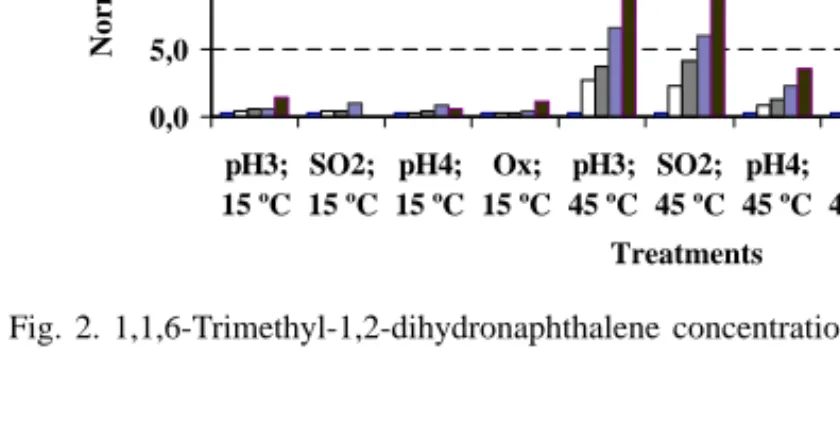
obtained from the protocol experiment showed that pH and temperature are the most important parameters in the formation of TDN (Fig. 2). The behaviour of TDN related to oxygen is quite interesting. These results corroborate
some others obtained for a white wine degradation [17].
Nevertheless, old port wines, aged over 40 years in barrels, have levels of TDN 15 times higher than young port wines and 4.6 times than that of 10-year-old port wines (Table 1). It seems that oxygen promotes its formation, and higher
levels of O2increases its rate of degradation. In barrel aged
wines, the number and/or the quantities of precursors have much greater influence on the formation of TDN than the presence of oxygen.
Wines with low pH are more sensitive to the formation of TDN (Fig. 2). In fact, Riesling wines coming from cold regions with low pH, have higher levels of TDN than the same wines produced on the south of Europe, for example [14], which confirm the presence of a TDN precursor linked to a sugar molecule which is broken down preferentially at low pH.
Vitispirane
This compound was identified in wine by Simpson et al. [16]. TDN vitispirane has as precursor a megastigme com-pound (megastigme-4,7-dien-3,6,9-triol), which is linked to a sugar molecule. The olfaction descriptor of vitispirane
is “camphor” or “eucalyptus”[22]. Some previous studies
show that for ruby port wines the presence of vitispirane can
attain the perception threshold (800g l-1), consequently it
participates in wine aroma [23]. Old port wines, between
10 years old and over 40 years old, have two to five times higher vitispirane levels than young port wines. The varia-tion in the vitispirane concentravaria-tion during the
experimen-tal period is shown in Fig. 3. As mentioned for TDN, the
pH and temperature are the two factors that have the great-est influence on its formation. During the first days of this study, the rate of formation was higher than later in the study, which can be confirmed from other authors’ work [16]. Samples submitted to an oxygen treatment increased their levels during the first days of the experimental proto-col, however after 24 days levels on vitispirane decreased; this same behaviour occurred for TDN. Extremely high
lev-els of O2 saturation could dramatically increase vitispirane
Table 1
Concentration (g l−1) of some nor-isoprenoid compounds in young and old port wines
Port wine -Damascenone -Ionone TCH Vitispiranea TDNa
Youngb Max 13.4 1.4 0.8 0.8 1.9 Third quartile 11.3 0.9 0.7 0.5 0.5 Median of 14 wines 7.4 0.6 0.5 0.4 0.3 First quartile 5.6 0.5 0.3 0.3 0.2 Min 4.5 0.3 0.2 0.2 0.1 10-year-old Max 3.9 0.3 1.1 1.2 2.3 Third quartile 3.5 0.3 1.0 1.0 1.5 Median of 12 wines 3.1 0.2 0.9 0.8 0.9 First quartile 2.6 0.2 0.9 0.6 0.5 Min 1.3 nd 0.8 0.5 0.3 20-year-old Max 5.1 0.4 1.6 1.7 3.9 Third quartile 4.3 0.3 1.3 1.7 2.9 Median of 10 wines 3.7 0.2 1.2 1.2 2.3 First quartile 2.6 0.1 1.1 1.0 1.9 Min 1.8 nd 0.7 0.8 1.3 30-year-old Max 4.8 0.4 2.2 3.0 5.2 Third quartile 3.9 0.3 1.6 1.7 3.5 Median of 12 wines 2.9 0.3 1.5 1.3 2.9 First quartile 2.5 0.2 1.2 1.0 2.0 Min 1.9 nd 1.0 0.7 1.3
Over 40 years old
Max 5.0 0.7 2.7 2.3 7.7
Third quartile 4.3 0.4 2.0 2.3 5.3
Median of 9 wines 3.8 0.4 1.4 1.9 4.9
First quartile 3.3 0.3 1.2 1.5 3.7
Min 3.0 nd 1.1 1.4 1.5
Max: maximum value, Min: minimum value, TCH: trimethylcyclohexanone, TDN: 1,1,6-trimethylnaphthalene, nd: not detected.
a Compound area/internal standard area.
b Wines from 1999 vintage, five different cultivars, two different subregions, with different winemaking procedures.
The relationship between TDN and vitispirane is not linear but logarithmic (Fig. 4). This observation suggested similar formation conditions but arising from different precursors
as reported[20–23]. TDN is formed simultaneously with
vi-tispirane, the relative rate of formation of TDN being higher than that of vitispirane.
1,1,6-Trimethyl-1,2-dihydronaphthalene 0,0 5,0 10,0 15,0 20,0 25,0 pH3; 15 ºC SO2; 15 ºC pH4; 15 ºC Ox; 15 ºC pH3; 45 ºC SO2; 45 ºC pH4; 45 ºC Ox; 45 ºC pH3; 60 ºC SO2; 60 ºC pH4; 60 ºC Ox; 60 ºC Treatments Normalised Area
0 days 10 days 24 days 39 days 54 days
Fig. 2. 1,1,6-Trimethyl-1,2-dihydronaphthalene concentration in samples after 54 days storage. 2,2,6-Trimethylcyclohexanone
The nor-isoprenoids with no-megastigme structure such as the dihydroactinolide (C11) and the 2,2,6-trimethylcyclo-hexanone (C9) can be formed by thermal degradation of -carotene[2]. Temperature is the major factor that affects
Vitispirane 0,0 1,0 2,0 3,0 4,0 pH3; 15 ºC SO2; 15 ºC pH4; 15 ºC Ox; 15 ºC pH3; 45 ºC SO2; 45 ºC pH4; 45 ºC Ox; 45 ºC pH3; 60 ºC SO2; 60 ºC pH4; 60 ºC Ox; 60 ºC Treatments Normalised Area
0 days 10 days 24 days 39 days 54 days
T= 10 days
Fig. 3. Vitispirane concentration in samples after 54 days storage.
Vitispirane = f (1,1,6-Trimethyl-1,2-dihydronaphthalene) 0,0 0,5 1,0 1,5 2,0 2,5 3,0 0,0 5,0 10,0 15,0 20,0 25,0 30,0
1,1,6-Trimethyl-1,2-dihydronaphthalene (nor. Area)
vitispirane (normalised area)
Fig. 4. Relationship between vitispirane and TDN, concentrations.
the increases in levels of this substance. TCH was
identi-fied in tea and in wine samples[15,24], on wine it
partic-ipates on the “rock-rose-like” aroma. As occurs with other nor-isoprenoids no-megastigme such as TDN the acidic pH favours its formation. The ANOVA procedure showed sig-nificant differences for TCH concentrations due to pH
treat-2,2,6-trimethyl-2-cyclohexanone 0,0 0,1 0,1 0,2 0,2 0,3 pH3; 15 ºC SO2; 15 ºC pH4; 15 ºC Ox; 15 ºC pH3; 45 ºC SO2; 45 ºC pH4; 45 ºC Ox; 45 ºC pH3; 60 ºC SO2; 60 ºC pH4; 60 ºC Ox; 60 ºC Treatments [C] ug/L
0 days 10 days 24 days 39 days 54 days
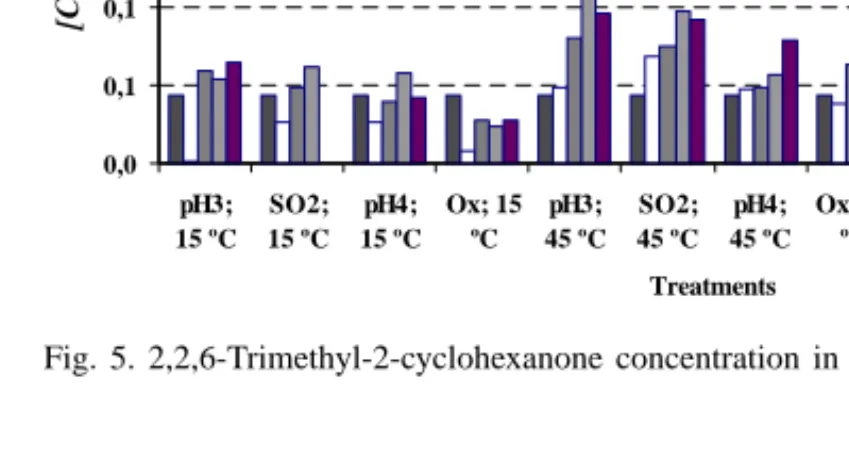
Fig. 5. 2,2,6-Trimethyl-2-cyclohexanone concentration in samples after 54 days storage.
ment. Among the four treatments for samples stored at 45◦C,
the P-value= 0.0230 at the 95% level, for samples stored at
60◦C, the P-value= 0.044 at the 95% level. At those
tem-perature the amount of this compound in the samples at low pH increases clearly with time The saturation of samples with oxygen does not have an important impact (Fig. 5). In
fact in old port wines levels can reach 2.7g l−1, compared
with an average of 0.5g l−1in young port wines (Fig. 6).
(2,6,6-Trimethyl-1-cyclohexen-1-yl)-3-buten-2-one (β-ionone)
This ketone has a very low perception threshold,
4.5g l−1 [25] and can participate in the wine aroma. Its
descriptor is “violet”. -Ionone can be formed directly
by -carotene degradation [2] or by its sugar precursor
hydrolysis [13]. Young port wines have higher contents
on -ionone than old barrel aged port wines. As shown
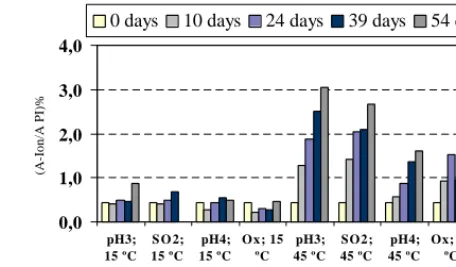
in Fig. 7, all treatments at 15◦C had no impact on the
-ionone concentration. The ANOVA procedure showed no
significant differences for -ionone concentrations among
the four treatments for samples stored at 15◦C. However,
treatments at 45 and 60◦C led to increases in its levels.
0.0 0.5 1.0 1.5 2.0 2.5 3.0 3.5
Young 5 (14 wines) 10 Anos (14 wines) 20 Anos (10 wines) 30 Anos (12 wines) 40 Anos (9 wines)
Categorie
[C] µ
g
/l
1st quartile Max min median 3rd quartile
2,2,6-Trimethyl-2-cyclohexanone
Fig. 6. Box plot representing the variation of TCH concentration in the analysed port wines.
-Ionona 0,0 1,0 2,0 3,0 4,0 pH3; 15 ºC S O 2; 15 ºC pH4; 15 ºC Ox; 15 ºC pH3; 45 ºC SO2; 45 ºC pH4; 45 ºC Ox; 45 ºC pH3; 60 ºC S O 2; 60 ºC pH4; 60 ºC Ox; 60 ºC Treatments (A-Ion/A PI)%
0 days 10 days 24 days 39 days 54 days
Fig. 7.-Ionone concentration in samples after 54 days of storage.
as well as higher temperatures which increase the rate of
formation of-ionone, as can be seen if, the results at pH
3 at 45 and 60◦C are compared. Finally, levels of-ionone
decreased with oxygen treatment after 39 days. Oxygen can
be considered an important factor in the -ionone
degra-dation. Conversely, the presence of SO2 retards its
degra-dation. Kanasawud and Crouzet [2] report that -ionone
can lead to the formation of 2,2,6-trimethylcyclohexanone.
However, according to results presented inFig. 8, there is a
concomitant formation of these two molecules with a high dependence between them.
(2,6,6-Trimethyl-1,3-cyclohexadien-1-yl)-2-buten-1-one (β-damascenone)
Among nor-isoprenoids, -damascenone is one of the
most important substances with a low perception olfac-tion threshold. The origin of this compound on wine is not well established; there are two main pathways
pos-sible, via acid hydrolysis [3,6] and direct degradation of
neoxanthin [26]. Results shown in Fig. 9 confirm these
two possible origins of-damascenone. Higher levels were
found for pH 3.0 treatment and for temperatures 45 and
60◦C. At these temperatures the amount of this compound
in the samples at pH 3 increases clearly with time. The low pH favours the acid hydrolysis, whereas higher
tem--Ionone = f (2,2,6-trimethylcyclohexanone) r = 0.7896 0,0 1,0 2,0 3,0 4,0 0,00 0,05 0,10 0,15 0,20 0,25
2,6,6-trimethylcyclohexanone (normalised area)
β
-Ionona (ug/L
)
Fig. 8. Relationship between-ionone and 2,2,6-trimethylcyclohexanone concentrations.
-damascenone 0,0 2,0 4,0 6,0 8,0 pH3; 15 ºC SO2; 15 ºC pH4; 15 ºC Ox; 15 ºC pH3; 45 ºC SO2; 45 ºC pH4; 45 ºC Ox; 45 ºC pH3; 60 ºC SO2; 60 ºC pH4; 60 ºC Ox; 60 ºC Treatments [C] ug/L
0 days 10 days 24 days 39 days 54 days
Fig. 9.-Damascenone concentration in samples after 54 days storage.
0.0 2.5 5.0 7.5 10.0 12.5 15.0
Young 5 (14 wines) 10 Anos (14 wines) 20 Anos (10 wines) 30 Anos (12 wines) 40 Anos (9 wines) Categorie
[C] µ
g
/l
1st quartile Max min median 3rd quartile
β
-Damascenone
Fig. 10. Box plot representing the variation of-damascenone concentration in the analysed port wines.
peratures favour the direct degradation of neoxanthin. As
occurs for other nor-isoprenoids -damascenone increased
in samples saturated with oxygen for the first days of the
study, after which there was a decrease. SO2 affects the
rate of formation of-damascenone. This can be observed
by comparing the sample at pH 3.0 with SO2 at 45 and
60◦C. The comparison between young and old port wines
(Fig. 10) show that levels of this compound decreased with ageing.
Conclusions
Some old port wines develop aromas which can be related
to the presence of some nor-isoprenoids, such as-ionone
and-damascenone for old vintage wines, and vitispirane,
2,2,6-trimethylcyclohexanone and TDN for old barrel aged wines. Old port wines, aged over 40 years in barrels have levels of TDN 15 times higher than young port wines and 4.6 times higher than 10-year-old port wines.
It was demonstrated that TDN, vitispirane and TCH present in very low levels in the initial wine are formed during the experimental period, preferentially at low pH
values and high temperatures (≥45◦C). Samples submitted
to oxygen treatment had an increase in vitispirane concen-tration during the beginning of the study, however, after 24 days the levels decreased; this same behaviour occurs for
TDN. Extremely high levels of O2saturation can drastically
promote vitispirane and TDN degradation.
The presence of free sulphur dioxide decreased levels of TDN formed and avoided the oxidative degradation of vitispirane. High concentrations of dissolved oxygen
(6 mg l−1), which signify very drastic wine oxidation, had
little influence on the formation of these molecules but pro-moted its degradation. It was verified that levels of TDN and vitispirane have a logarithmic dependence, which could predict the existence of different precursors.
The decreasing of -ionone concentration is dependent
on the oxygen content. The use of SO2 and the absence of
O2can avoid its degradation during ageing.
As occurs for other nor-isoprenoids the damascenone con-centration increased in samples saturated with oxygen dur-ing first days of the study, after which there is a decrease.
SO2 affects the rate of formation of-damascenone. The
comparison between young and old port wines shows that this compound decreased with barrel ageing.
Acknowledgements
The work was suported by a MCT/FCT/POCTI/AGR/ 42598/2001 project.
References
[1] C.R. Mordi, J.C. Walton, G.W. Burton, L. Hughes, K.U. Ingold, D.A. Lindsay, Exploratory study of-carotene auto oxidation, Tetrahedron Lett. 32–33 (1991) 4203.
[2] P. Kanasawud, J.C. Crouzet, Mechanism of formation of volatile com-pounds by thermal degradation of carotenoids in aqueous medium, J. Agric. Food Chem. 38 (1990) 237.
[3] P. Winterhalter, in: R. Teranishi, G. Takeoka, M. Guntert (Eds.), Flavour Precursors—Thermal and Enzymatic Conversion, ACS se-ries, vol. 490, 1993, p. 98.
[4] Y.Z. Gunata, C.L. Bayonove, R.L. Baumes, R.E. Cordonnier, The aroma of grapes. I. Extraction and determination of free and gly-cosodically bound fractions of some grape aroma components, J. Chromatogr. 331 (1985) 83.
[5] R. Stephano, S. Bottero, R. Pigello, D. Borsa, G. Bazzo, L. Corno, Glycosylated aroma precursors in red winemaking grape cv., Enotec-nico 34 (1988) 63.
[6] G.K. Skouroumounis, R.A. Massy-Westropp, M.A. Sefton, P.J. Williams, Precursors of damascenone in fruit juices, Tetrahedron Lett. 33 (1992) 3533.
[7] P. Guedes de Pinho, A.C. Ferreira, J. Gomez Benitez, M. Mendes Pinto, T. Hogg, Determination of carotenoid profiles in grapes, J. Agric. Food Chem. 49 (2001) 5484.
[8] A.C. Silva Ferreira, Caracterisation du Vieillissement du Vin de Porto. Approche Chimique et Statistique. Role Aromatique du Sotolon., These de Doctorat de L’Université Victor Segalen Bordeaux II, 1998, p. 593.
[9] H. Van Den Dool, P.D. Kratz, A generalization of the retention index system including linear temperature programmed gas–liquid partition chromatography, J. Chromatogr. 11 (1963) 463.
[10] J. Ribereau-Gayon, E. Peynaud, P. Ribereau-Gayon, P. Sudraud, Traité d’Oenologie, Sciences et Techniques du Vin, Tome 1, Analyse et contrˆole des vins, Dunod, Paris, 1976.
[11] R. Schneider, A. Razungles, C. Augier, R. Baume, Monoterpenic and nor-isoprenoidic glycoconjugates of Vitis vinifera L., cv. Melon B. as precursors of odorants in Muscadet wines, J. Chromatogr. A 936 (2001) 145.
[12] R.F. Simpson, (a) Aroma and compositional changes in wine with oxidation, storage and ageing, Vitis 17 (1978) 274.
[13] Y. Kotseridis, Eude de l’arome des vins de Merlot et Cabernet-Sauvignon de la region Bordelaise, These de Doctorat de L’Université Victor Segalen Bordeaux II, 1999, p. 652.
[14] R.F. Simpson, Aroma composition of bottle aged wine, Vitis 18, 148–154.
[15] V. Freitas, P. Ramalho, Z. Azevedo, A. Macedo, Identification of some volatile descriptors of the rock-rose like aroma of fortified red wines from Douro Demarcated Region, J. Agric. Food Chem. 47 (1999) 4327.
[16] R.F. Simpson, C.R. Strauss, P.J. Williams, Vitispirane: a C13 spiro-ether in the aroma volatiles of grapes juice, wines and distilled grape spirits, Chem. Ind. 6 (1977) 633.
[17] A.C. Silva Ferreira, P. Guedes de Pinho, P. Rodrigues, T. Hogg, Kinetics of oxidative degradation of white wines and how they are effected by selected technological parameters, J. Agric. Food Chem. 50 (2002) 5919.
[18] A.C. Silva Ferreira, T. Hogg, P. Guedes de Pinho, Identification of key-odorants related to the typical aroma of oxidation-spoiled white wines, J. Agric. Food Chem. 51 (2003) 1373.
[19] K.E. Murray, J.E. Shipton, F.B. Whitfield, The chemistry of food flavour. I. Volatile constituents of passion fruit Passiflora edulis, Aust. J. Chem. 25 (1972) 1921–1933.
[20] C.R. Strauss, E. Dimitriadis, B. Wilson, P.J. Williams, Studies on the hydrolysis of two megastigma-3,6,9-triols rationalizing the origins of some volatile C13 nor-isoprenoids of Vitis vinifera grapes, J. Agric. Food Chem. 34 (1986) 145.
[21] P. Winterhalter, 1,1,6-trimethyl-1,2-dihydronaftalene (TDN) forma-tion in wine. 1. Studies on the hydrolysis of 2,6,10,10-tetramethyl-1-oxaspiro[4.5]dec-6-ene-2,8-diol rationalising the origin of TDN and related C13 nor-isoprenoides in Riesling wine, J. Agric. Food Chem. 39 (1991) 1825.
[22] A. Rapp, H. Mandery, New progress in vine and wine research, Experientia 42 (1986) 873.
[23] A.A. Williams, M.J. Lewis, H.V. May, The volatile flavour compo-nents of commercial port wines, J. Sci. Food Agric. 343 (1983) 11. [24] M. Shimoda, H. Shigematsu, H. Shiratsuchi, Y. Osajima, Compara-tion of the odour concentrates by SDE and adsorptive column method from Green Tea infusion, J. Agric. Food Chem. 43 (1995) 1616. [25] P.X. Etievant, Wine, in: H. Maarse (Ed.), Volatile Compounds in
Food and Beverages, TNO-CIVO Food Analysis Institute, Zeist, The Netherlands, 1991, pp. 483–546.
[26] G.K. Skouroumounis, R.A. Massy-Estropp, M.A. Sefton, P.J. Williams, Synthesis of glucosides related to grape and wine aroma precursors, J. Agric. Food Chem. 43 (1995) 974.