Promotion of rights and behavioural adequacy of students in school:
Effects of a Transactional Analysis Programme
*Feliciano H. Veiga
Resumo
Este estudo pretendia investigar os efeitos da utilização de um Programa de Intervenção pela Análise Transacional, por professores, nos direitos e adequação comportamental dos alunos na escola. Um grupo de professores interessado neste estudo, no qual participaram alunos do 8º ano de escolaridade, foi treinado especificamente para o efeito. Foram utilizados os seguintes instrumentos de avaliação: o Children’s Rights Scale (Hart et al., 1996), e o School Disruption Professed by Students Scale (Veiga, 1996). Estas escalas foram administradas antes e depois da intervenção, a qual durou cerca de 18 semanas escolares. lied before and after the intervention. The intervention lasted around 18 school weeks. O Programa de Intervenção pela Análise Transacional foi administrado ao grupo experimental, enquanto o grupo de controlo continuou a ser objecto do tipo de relação professor-aluno praticado até à data. A análise dos resultados revelou diferenças estatisticamente significativas entre a situação pré-teste e pós-teste no grupo experimental, não se tendo verificado o mesmo no grupo de controlo. As diferenças entre o grupo de controlo e o grupo experimental passaram de não-significativas, na situação de pré-teste, a estatisticamente significativas e favoráveis ao grupo experimental, na situação pós-teste. O estudo desenvolvido realça os benefícios para os alunos do grupo experimental, cujos direitos aumentam e que melhoram a sua adequação comportamental na escola.
Palavras-chave: Direitos dos alunos; comportamento escolar; indisciplina; violência na escola; Análise Transacional.
Abstract
This study aimed to investigate the effects of teachers’ use of an Transactional Analysis Intervention Programme, on rights and behavioural adequacy of students in school. Specific formation was given to a group of teachers interested in the study, in which 8th grade students participated. The following evaluation instruments were used: the Children’s Rights Scale (Hart et al., 1996), and the School Disruption Professed by Students Scale (Veiga, 1996). These scales were applied before and after the intervention. The intervention lasted around 18 school weeks. The Transactional Analysis Intervention Programme was applied to the experimental group, and the control group continued to be the object of the type of teacher-student relationship practiced so far. The analysis of the results revealed statistically significant differences in the experimental group between the pretest and posttest situation, while this did not occur in the control group. The differences between the control group and the experimental group went from non-significant, in the pretest situation, to statistically significant and favorable for the experimental group, in the posttest situation. The study carried out stresses benefits for the students of the experimental group, who increase their rights and improve their behavioural adequacy in school.
The first part of this study presents a review of empirical studies on young people’s rights in the school, and on indiscipline; an Transactional Analysis Intervention Programme (TAIP) is also presented. The second part approaches the specific study of the effects of teachers’ use of an Transactional Analysis Intervention Programme (TAIP), on rights and behavioural adequacy of students in school. Studies regarding young people’s rights in the school and in the family have attracted much
* Veiga, F. H. (2004). Promotion of rights and behavioural adequacy of students in school: Effects of a Transactional Analysis Programme. Paper presented at the "XXVth International School Psychology Colloquium — News: School Psychology: Whose needs? Whose benefit?, in Exeter, 27- 31 July 2004.
attention in several countries (Hart, Pavlovic & Zeidner; Irving 2001; Jacobsen & Schlegel; 2001; Pavlovic, 2001; Tereseviciene & Jonyniene, 2001; Veiga, 1999; 2001). However, there are still no studies that go beyond the external observation and evaluation of the reality and aim to promote the subjects’ human rights in practice.
Research on youth indiscipline and violence in school has become increasingly important in several countries (Veiga, 1999; 2001). However, there are few studies that — go beyond the external observation and evaluation of reality aim — to promote students’ rights in everyday life, thus improving their behaviour in school. In fact, many of the problems in education are in the know-how of matters (Elliott, 1993). Some studies concerning the human rights are presented.
Human rights
The literature on this topic denotes a notorious lack of studies of an experimental nature concerning the promotion of human rights; most of all we find studies of a differential nature. Following is a brief summary of these differential studies. A study in Portugal (Veiga, 1999; 2001) proceeded to analyse young people’s representations about the existence and importance of their psychosocial rights in the school and at home. The sample consisted of 294 7th-9th grade students of both sexes and from several parts of the country. The Children’s Rights Scale — CRS (Hart et al, 1996) was used for evaluation —, as well as questions about the following independent variables: (1) family variables (parents’ qualifications, parents’ support, family self-concept, family cohesion, friendship between brothers and sisters, residential area); (2) personal variables (age, gender, religion, trust in one’s abilities, and desired profession); and (3) school variables (school achievement, school grade, teachers’ support, violence in school). The results showed that great importance was attributed to rights, but at the same time their existence could be increased, especially at school. The analysis of these results showed significant relations between the representations of rights and the above-mentioned independent variables. These relationships stress the need for change in the school and family contexts in the direction of a stronger valuation of human rights, most of all in sub-groups of subjects with worse living conditions. In this study (Veiga, 1999; 2001), the presence of significant correlations between the existence of school rights and students’ school achievement was found. So the promotion of rights is expected to contribute to improve students’ school achievement. Despite the existence of several studies of a differential nature that include many suggestions concerning intervention, the lack of studies of an experimental nature directed towards the promotion of rights is remarkable.
One study on citizenship rights (Benavente, Mendes & Schmidt, 1997) stands out. There is also an important study about the right to education, aiming primarily at (re)thinking about education in the light of its quality as a human right (Monteiro, 1995). Another publication (Monteiro, 1998) develops the following themes more thoroughly: the revolution of human rights, the source of the right to education, the ethics of human rights and the right to education, as well as human rights and the right to education in the Portuguese constitutions. In terms of scientific research, apart from these studies there is a lack of specific studies on the conditions of personal and social realisation (Alves-Pinto, 1995; Jordan & Goodey, 1996; Teixeira, 1994). Studies concerning indiscipline and violence in schools are followed.
Indiscipline and violence
In a study on indiscipline (school disruption) and adolescents’ self-concept (Veiga, 1995), the results show a higher self-concept among students who are less indisciplined, whose socio-economic level (SEL) is medium-high, and who live on the coast. Indiscipline is less frequent in the female, rural and medium-high SEL groups. The data suggest a new cognitive and social perspective of adolescence — regarded as a time of balanced changes that require the support of teachers and parents —, as opposed to the traditional theories, which look upon adolescence as a time of rebellion and generation conflicts; they also suggest changing the contexts which discriminate students according to the group they belong to. In a study carried out on request of the Ministry of Education, about violence in Portuguese schools (Costa & Vale, 1998), with a sample of 4925 8th-11th grade students from 142 schools, 42% of the students were reported to having heard a teacher being insulted, 3,5% saw a teacher being physically assaulted, 4,3% saw teachers’ materials being destroyed and 1,4% saw a teacher being threatened with a weapon. On the whole, only 66% of the sample referred they felt "more or less" safe in school.
Some studies (Neighbors et al., 1992) found significant differences between the school performance of adolescents with divorced parents and those with non-divorced parents, the latter revealing a better performance. Other studies (Tschann et al., 1989; Veiga, 2000) discovered that, when divorced parents have a close relationship with their children, these have more socio-academic adaptation skills. In a review of the literature concerning children’s perspectives about divorce and remarriage, Hetherington et al. (1989) found that long-term effects are more related to the type of parental support they perceive than to the divorce or remarriage per se. A study with 206 4th grade boys (Capaldi, 1989) showed that those who had already experienced two or more parental transitions present a greater risk of poor adaptation and future delinquency, especially when parental supervision was scarce. In a study with 50 4th and 5th grade students with divorced parents, no differences were found in terms of behaviour in class between these subjects and their peers with non-divorced parents (Noble, 1985).
Other studies have approached the implementation and evaluation of prevention and intervention programs regarding indiscipline and violence in schools (Jaffe et al., 1992), aimed at either the school-community level (Cowie et al., 1992; Jones et al., 1992; Marohn, 1992; Shapiro et al., 1987), the classroom (Berkovitz, 1987; Gordon, 1989; Shapiro et al., 1987), or at the students themselves who have fallen victim to violent acts (Arora, 1987; Cowie et al., 1992; Knox, 1992; Whitney et al., 1992). Other authors list important general recommendations (Cowie et al., 1992; Kikkawa, 1987), such as: promoting effective human relations between teachers and students; increasing co-operation among teachers and between these and the family members of students (be they victims or aggressors); giving strong visibility to students’ achievement; and promoting both aggressors’ and victims’ assertiveness.
Another study (Antunes, 1995) reported that adolescents’ adaptation to school is significantly correlated to the perception of support, whether the family’s or the teachers’. The explanation for the lack of aggressiveness in adolescents who perceive family support may concern the social support they receive — as they have more family support, these adolescents are more protected from possible adversities and, consequently, they do not reveal a tendency towards school violence.
The results of a study on indiscipline and violence as a function of family variables (Veiga, 2000) stress the idea that future indiscipline and violence prevention
programs aimed at adolescents in school should focus on strengthening the sources of support, particularly that supplied by parents and brothers and sisters, but also by teachers. Through their counseling and aid, psychologists (educational and others) can help students’ parents pay more attention to the support their children expect from them, especially as regards showing interest in the way their studies are going, considering them intelligent people cut out for success, and welcoming their friends. This type of work is in the reach of teachers, particularly of class directors, during the contacts they should plan with parents, especially those of students who are more aggressive and lack motivation.
The studies reviewed point to a significant relation between adolescents’ indiscipline in school and paternal violence (Truscott, 1992), family aggression (Carlson, 1990; Wells, 1987), drug abuse (Kingery et al., 1992; Valois et al., 1993), a low academic self-esteem (Truscott, 1992; Valois et al., 1993), the rejection felt by ethnic or religious minorities (Prewitt, 1988), teachers’ academic over-exigency (Prewitt, 1988) and, finally, situations of tension between teachers and students’ parents (Berkovitz, 1987).
While the above mentioned study on violence in our country (Costa & Vale, 1998) reveals part of the current situation in our schools, other, information also astounds us. Hence the need to elaborate a Transactional Analyses Intervention Program on behavioural adequacy and rights of students in school.
The Transactional Analysis Intervention Program (TAIP)
The intervention program we used was based on Transactional Analysis, taking several authors as reference (Aguilar, 1999; Ames, 1993; Berne, 1996; Ernst, 1987; Freed & Freed, 1980; Krausz, 1991; Veiga, 2001; Wolfgang & Glickman, 1996). Transactional analysts have been developing their current in several countries and producing a set of important works by applying their principles and techniques to different fields (Aguilar, 1999; Detry, 1985). Some authors (Ernst, 1987; Harris, 1996) propose that Transactional Analysis (TA) be taught to teachers and pupils in general, for it facilitates the categorization of verbalizations, and behavioral analysis and correction. In this study, our teacher education program included thematic aspects such as the following:
• assumptions and principles of TA;
• human personality - Parent, Adult, Child (PAC); • psychological transactions; PAC observation;
• psychological games that enhance assertive behavior; • strategies that promote the reduction of inadequate behavior.
Assumptions of TA. The individual is regarded as influencing his own future, whatever has happened to him in the past. Throughout his development, he undergoes different ways of valuing himself and others, and his self-concept may be structured in different manners or “life positions”. Another conceptual specificity of this model concerns behavioral causality. Transactional Analysis considers that the causes of human behavior lie not only in the past, but also in the capacity to evaluate probabilities (Harris, 1996). In terms of motivational energy, human behavior seeks to attain situations that satisfy the need for something that the transactional language calls “strokes”.
Human Personality according to TA. Our personality – the ego – consists of three states (PAC): the Parent, the Adult and the Child (Fig. 1). When working ideally, these states of our personality are collaboratively linked but do not interfere with each other. However, our psychological balance may be altered by dynamics of contamination or exclusion.
Parent
Adult
Child
Figure 1. Diagram of the structure of personality
Psychological transactions. Transactional analysts see disciplinary problems in terms of transactions that occur among pupils or among people at school. The teacher education program we elaborated took into account the different types of transactions that exist: parallel or complementary, crossed and double.
PAC observation. By facilitating a new manner of dialogue, Transactional Analysis stresses how important it is that the teacher analyses the messages contained within interpersonal communication. Understanding which ego state is in command was one of the aspects included in the teacher education program, and it included oral signs, physical evidence and the analysis of feelings (Veiga, 2001).
Psychological games. One concept that is greatly used by Transactional Analysis theorists is that of “psychological game”. In our program, teachers learned about the games that enhance inadequate behavior (games by the pupil and games by the teacher) and about strategies that promote the reduction of this kind of behavior, such as self-control, analyzing transactions, psychological flexibility, the adequate use of “strokes”, “OK” expectations, contracts and the importance of participating.
The aim of TA intervention is to promote the development of a more valid and positive dimension of the Parent and of the Child, thus empowering pupils to act more as Adult. Reaching this goal is a good way of providing the pupil with assertive skills (the capacity to acknowledge and affirm one’s rights without harming those of others) as well as a better behavioral adaptation in school, by preventing indiscipline.
Besides these dimensions, the program also included the following communicational competencies: communicational congruency; self-control; and collaborative learning situations. Other essential competencies that teachers trained were not to criticize a student negatively (especially in public), to repeat information until he/she understood, to ask the student questions when it seems he/she knows how to answer, give time to think, give time to answer, and develop support skills.
The general objective of this study was to analyse the effects of the TAIP used by teachers on 8th grade students, namely as regards rights and school transgression. The methodology adopted shall now be presented.
Methodology
As for the methodology used in the present study, the information on subjects, instruments and procedures are as follows.
Subjects. This study involved 38 8th grade students. Two classes of a Lisbon school, one consisting of the experimental group (with 17 students) and the other of the control group (21 students), were taught by a teacher who, upon having been trained in TAIP, participated in this study under the supervision of the researcher. The groups were considered to be matched both in terms of (in)disciplined behaviour, and this was verified in the results of the Children’s Rights Scale (CRS), which presented no significant differences in the pre-test situation. Data concerning seven subjects could not be considered at the end of the study due to absences.
Study questions. Specifically, the following questions of study were stated: Is it
possible to promote 8th-grade students’ behavioural adequacy in school through a Transactional Analyses Intervention Program (TAIP)? Does teacher training in the Transactional Analyses Intervention Program (TAIP) contribute significantly to the promotion of students’ representations about their rights at school? It must be stressed that, due to a great lack of previous studies, the results which are now being presented can only be seen as belonging to the exploratory type.
Instruments and procedure. The following evaluation instruments were used: the
Children’s Rights Scale (CRS), by Hart et al. (1996), and the School Disruption Professed by Students Scale (Veiga, 1995; 1999; 2001). The scales present good internal consistency coefficients ("alpha" indexes) for different groups. The scales were applied before and after carrying out the experiment (intervention). The TAIP was applied to the experimental group, while the control group kept up the type of teacher-student relation it had known so far. The intervention took place after Christmas and carried on until the end of the school year. The study had two phases: training in TAIP; and intervention in the experimental class (with the researcher’s support, meetings to analyse and discuss cases, share experiences to respond to students’ specific needs, and re-elaborate strategies if necessary). This study has a longitudinal nature and is a quasi-experimental research model, namely of the O1 X O2 // O3-O4 type, with records before (O1) and after (O2) the application (X) in the experimental and control classes (O3, before; and O4, after).
Results
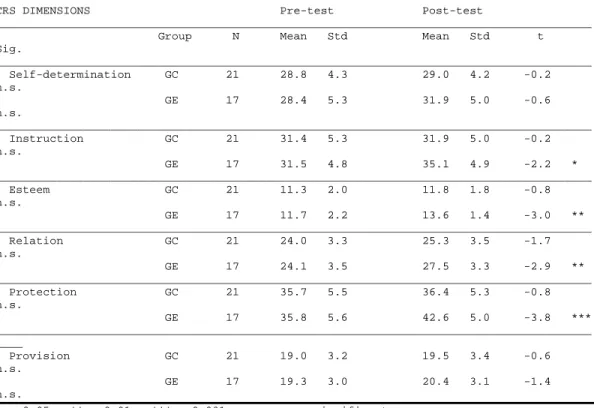
Table 1 and 2 present the results of the analyses undertaken. They show the presence of significant differences in the experimental group between the pre-test and the post-test situations; these differences did not take place in the control group. The differences between the control group and the experimental group went from being non-significant, in the pre-test situation, to being statistically significant and favorable for the experimental group, in the post-test situation.
This study (Table 1) stresses the efficacy of the use of the Transactional Analyses Intervention Program (TAIP), with very significant effects in terms of the reduction of transgression-distraction (T = 3.0; g.l. = 26; p<.01) and violence (T = 2.0; g.l. = 26; p<.05). Table 2 indicates the differences between the CRS averages, in the pre-test and post-test situations, for the control group (GC) and for the experimental group (GE). Two of the six dimensions of rights did not vary with the intervention that took place: self-determination and provision. The results highlight the presence of statistically
significant differences in the experimental group, between the pre-test and post-test situation, in the dimensions protection (T = -3.8; g.l. = 26; p<.001), relation (T = -2.9; g.l. = 26; p<.01), esteem (T = -3.0; g.l. = 26; p<.01) and instruction (T = -2.2; g.l. = 26; p<.05). This did not happen in the control group. Analyses carried out showed that the differences between the control group and the experimental group went from non-significant in the pre-test situation to statistically non-significant and favourable for the experimental group in the post-test situation. This study stresses the benefits for the students, with an increase in their rights in the dimensions of protection, relation, esteem and instruction. The increase of instruction was small, but statistically significant.
Table 1. Differences between EDEP averages, in the pre and post-test situations, for the control group (GC) and for the experimental group (GE)
EDEP DIMENSIONS Pre-test Post-test
________________________________________________________________________________________ Group N Mean Std Mean Std t Sig. ________________________________________________________________________________________ Transgression-distraction GC 21 17.3 4.8 17.6 5.2 n.s. GE 17 17.8 5.0 13.0 4.2 3.0 ** ________________________________________________________________________________________ Violence GC 21 11.6 5.1 11.8 4.7 n.s. GE 17 11.5 4.8 8.6 3.4 2.0 * * p<.05; ** p<.01; *** p<.001; n.s. = no significant
Table 2. Differences between CRS averages, in the pre and post-test situations, for the control group (GC) and for the experimental group (GE)
CRS DIMENSIONS Pre-test Post-test
________________________________________________________________________________________ Group N Mean Std Mean Std t Sig. ________________________________________________________________________________________ Self-determination GC 21 28.8 4.3 29.0 4.2 -0.2 n.s. GE 17 28.4 5.3 31.9 5.0 -0.6 n.s. ________________________________________________________________________________________ Instruction GC 21 31.4 5.3 31.9 5.0 -0.2 n.s. GE 17 31.5 4.8 35.1 4.9 -2.2 * ________________________________________________________________________________________ Esteem GC 21 11.3 2.0 11.8 1.8 -0.8 n.s. GE 17 11.7 2.2 13.6 1.4 -3.0 ** ________________________________________________________________________________________ Relation GC 21 24.0 3.3 25.3 3.5 -1.7 n.s. GE 17 24.1 3.5 27.5 3.3 -2.9 ** ________________________________________________________________________________________ Protection GC 21 35.7 5.5 36.4 5.3 -0.8 n.s. GE 17 35.8 5.6 42.6 5.0 -3.8 *** ________________________________________________________________________________________ ____ Provision GC 21 19.0 3.2 19.5 3.4 -0.6 n.s. GE 17 19.3 3.0 20.4 3.1 -1.4 n.s. * p<0.05; ** p<0.01; *** p<0.001; n.s. = no significant
Final remarks
Putting into practice certain intervention competencies was rather difficult, particularly as regards the psychological transactions comings of the Adult.
The teacher involved reported that often he would find himself using the TAIP in other situations of human interaction, at home and with people in general. Although school achievement was not initially considered an object of study, it also underwent an improvement in the experimental group compared to the control group. It is likely that a longer-lasting intervention would have yielded more significant effects concerning the increase of the rights dimensions under consideration, and the reduction of unsuitable school behaviour. Finally, the participating teacher’s satisfaction with the use of the above mentioned strategies led to the implementation of the program he had used with other teachers.
Besides the results that were presented, other observations regard the positive effect of the TAIP, stressing the following occurrences: teachers’ satisfaction with the work carried out; increase of students’ satisfaction with the teachers; feeling of belonging to the school, and of joy; and improvement in the good classroom atmosphere.
Further research might consider studying the effect that teacher training in TAIP may have on the involved teachers’ professional development, resorting to the structured observation in loco. Another suggestion for further intervention and in-depth studies is the degree of importance attributed to observations of a qualitative nature, in a process of on-going evaluation of the events recorded by teacher and the experiences lived by students.
References
Aguilar, L. (1999). Análise Transaccional: Guia Prático de Autoconhecimento. Lisboa: Edições Fim de Século.
Alves-Pinto, C. (1995). Sociologia da escola. Lisboa: McGraw-Hill.
Ames, C., et al. (1993). Parent Involvement: The Relationship between School-to-Home Communication and Parents' Perceptions and Beliefs. Report 15. Publications, Center on Families, Communities, Schools & Children's Learning, Johns Hopkins University.
Antunes, M. C. (1995). O apoio social e o conceito de si próprio na adolescência. Porto: Faculdade de Psicologia e de Ciências da Educação (Dessertação de mestrado).
Arora, C. M., & Thompson, D. A. (1987). Defining bullying for a secondary school. Educational and Child Psychology, Vol. 4(3 4), 110-120.
Benavente, A., Mendes, H., & Schmidt, L. (1997). Direitos dos cidadãos em Portugal: Conhecimentos e opiniões. Sociologia - Problemas e Práticas, 24, 71-114.
Berkovitz, I. H. (1987). Aggression, adolescence, and schools. Adolescent Psychiatry, Vol. 14, 483-499. Berne, E. (1996). Games people play. New York: Grove Press.
Capaldi, D. M. (1989). The relation of parenting transitions to boys' adjustment problems. Comunicação apresentada no congresso bianual da Society for Research in Child Development, Kansas. Carlson, B. E. (1990). Adolescent observers of marital violence. Journal of Family Violence, Vol. 5(4),
285-299.
Costa, E., & Vale, F. (1998). A violência nas escolas. Lisboa: IIE.
Cowie, H., Boulton, M. J., & Smith, P. K. (1992). Bullying: Pupil relationships. London: Kogan Page. Detry, B. (1985). Olhar sobre... A análise transaccional. Jornal de Psicologia, 4, 4, 10-13.
Elliott, J. (1993). El cambio educativo desde la investigación-acción. Madrid: Ediciones Morata.
Ernst, K. (1987). Estudantes OK: Análise transaccional dos problemas na escola. Rio de Janeiro: Artenova.
Freed, A., & Freed, M. (1980). Crianças OK. Rio de Janeiro: Artenova.
Gordon, T. (1989). Teaching children self-discipline at home and at school: New ways for parents and teachers to build self-control, self-esteem, and self-reliance. New York: Times Books.
Graham, L. P., et al. (1995). Effective Communication in Special Education Student Teaching. Paper presented at the Annual International Convention of the Council for Exceptional Children (73rd, Indianapolis, IN, April 5-9, 1995).
Harris, T. A. (1996). I'm OK - You're OK. New York: Harper and Row.
Hart, S. N., Pavlovic, Z. & Zeidner; M. (2001). The ISPA Cross-National Children’s Rights Research Project. School Psychology International, Vol. 22(2), pp. 99-129.
Hart, S. N., Zneider, M., & Pavlovic, Z. (1996). Children’s rights: Cross national research on perspectives of children and their teachers. In M. John (Ed.), Children in charge: The child´ right to a fair hearing (pp. 38-58). London: Jessica Kingsley Publishers.
Hetherington, E. et al. (1989). Marital transitions: A child's perspective. American Psychologist, 44, 2, 303-312.
Irving, K. (2001). Australian Students´ Perceptions of the Importance and Existence of their Rights. School Psychology International, Vol. 22(2), pp. 224-240.
Jacobsen, E. & Schlegel, I. (2001). Students´ Perceptions of their Rights in Denmark. School Psychology International, Vol. 22(2), pp. 174-189.
Jaffe, P. G., Suderman, M. et al. (1992). An evaluation of a secondary school primary prevention program on violence in intimate relationships. Violence and Victims, Vol. 7(2), 129-146.
Jones,N., & Jones, E. (1992). Learning to behave: Curriculum and whole school management approaches to discipline. London: Kogan Page.
Jordan, L. & Goodey, C. (1996). Human Rights and School Change: The Newham Story Centre for Studies on Inclusive Education, Bristol (England). Centre for Studies on Inclusive Education, 1 Redland Close, Elm Lane, Bristol BS6 6UE, England, United Kingdom (6. 50 British pounds), pp. 42.
Kikkawa, M. (1987). Teachers' opinions and treatments for bully/victim problems among students in junior and senior high schools: Results of a fact-finding survey. Journal of Human Development, Vol. 23, 25-30.
Kingery, P. M., Pruitt, B. E., & Hurley, R. S. (1992). Violence and illegal drug use among adolescents: Evidence from the U.S. National Adolescent Student Health Survey. International Journal of the Addictions, Vol. 27(12) , 1445-1464.
Knox, J. (1992). Bullying in schools: Communicating with the victim. Support for Learning, Vol. 7(4), 159-162.
Krausz, R. (1991). Homens e organizações: Adversários ou colaboradores. S. Paulo: Nobel.
Marohn, R. C. (1992). Management of the assaultive adolescent. Special section: Treatment and service systems for adolescents. Hospital and Community Psychiatry, Vol. 43(6), 622-624.
Monteiro, A. R. (1995). O Direito à Educação. Lisboa: Departamento de Educação da Faculdade de Ciências da Universidade de Lisboa (Tese de doutoramento).
Neighbors, B. et al. (1992). Is parental divorce a critical stressor for young adolescents? Grade point average as a case in point. Adolescence, 27, 107, 639-646.
Noble, B. (1985). Children of divorce: A correlational study of understanding of divorce, attribution style, and classroom behavior. Georgia: EDRS, Reports Research
Pavlovic, Z. (2001). Cross-cultural Study on the Rights of the Child in Slovenia: The First Ten Years. School Psychology International, Vol. 22(2), pp. 130-151.
Prewitt, P. W. (1988). Dealing with bullying among Japanese students: Current approaches to the problem. School Psychology International, Vol. 9(3), 189-195.
Shapiro, E. S., & Derr, T. F. (1987). School interventions for aggression. Special issue: School-based affective and social interventions. Special Services in the Schools, Vol. 3(3-4), 5-19.
Teixeira, M. (1994). O Professor e a Escola. Lisboa: McGraw-Hill.
Tereseviciene, M. & Jonyniene, Z. (2001). Students´ Perceptions of their Rights in Lithuania. School Psychology International, Vol. 22(2), pp. 152- 173.
Truscott, D. (1992). Intergenerational transmission of violent behavior in adolescent males. Aggressive Behavior, Vol. 18(5), 327-335.
Tschann, J. et al. (1989). Family process and children's functioning during divorce. Journal of Marriage and the Family, 51, 2, 431-444.
UNESCO (1998). Taking action for human rights in the twenty-first century. Paris: Unesco.
Vale, F., & Costa, E. (1994). A violência dos jovens contextualizada nas escolas. Inovação, Vol. 7, 3, pp. 255-288.
Valente, M. O. et al., (1992). Competências comunicacionais do professor e o pensamento reflexivo dos alunos. Revista de Educação, Vol. II, 2, pp. 65-71.
Valois, R. F., Vincent, M. et al. (1993). Adolescent risk behaviors and the potential for violence: A look at what's coming to campus. Journal of American College Health, Vol. 41(4), 141-147.
Veiga, F. H. (1995). Transgressão e autoconceito dos jovens na escola (2ª Edição). Lisboa: Editora Fim de Século.
Veiga, F. H. (1996). Autoconceito e rendimento dos jovens em matemática e ciências. Revista de Educação, V(2), 41-53.
Veiga, F. H. (1999). Indisciplina e violência na escola: Práticas comunicacionais para professores e pais. Coimbra: Almedina.
Veiga, F. H. (1999). Percepções dos Alunos Portugueses acerca dos seus Direitos na Escola e na Família. Revista de Educação, Vol. VIII, nº 2, pp. 187-199.
Veiga, F. H. (2000). Violência dos Jovens nas Escolas em Função da Família. In A. M. Fontaine (Ed.), Parceria Família-Escola e Desenvolvimento da Criança / Partenariado Familia-Escuela y Desarrolho de los Niños. Porto: Edições ASA.
Veiga, F. H. (2001). Indisciplina e violência na escola: Práticas comunicacionais para professores e pais (2ª Edição). Coimbra: Almedina.
Veiga, F. H. (2001). Students´ Perceptions of their Rights in Portugal. School Psychology International, Vol. 22(2), pp. 174-189.
Veiga, F. H. (2002). Psicologia da Educação: Relatório da disciplina (apresentado como parte das provas de associado, com agregação, em educação). Lisboa: Universidade de Lisboa, Biblioteca da Reitoria.
Veiga, F. H. (2004). Indisciplina e violência na escola: Abordagens psico-educacionais. In F. Neto (Ed.), Psicologia Social Aplicada. Lisboa: Universidade Aberta.
Wells, M. G. (1987). Adolescent violence against parents: An assessment. Family Therapy, Vol. 14(2), 125-133.
Whitney, I., Nabuzoka, D., & Smith, P. K. (1992). Bullying in schools: Mainstream and special needs. Support for Learning, Vol. 7(1), 3-7.
Wolfgang, C. H., & Glickman, C. D. (1996). Solving discipline problems: Strategies for classroom teachers. Boston: Allyn & Bacon.