v
Marine palaeo-ecological and depositional processes on
the shallow-waters of the Azores archipelago: the
mobile Ostracoda (Crustacea) and the sessile Bryozoa
as case-studies
byRicardo Piazza Meireles
A dissertation submitted to the University of the Azores in accordance with the requirements for award of degree of Doctor of Philosophy in the Department of
Biology.
University of the Azores May 2013
Advisors _____________________________________ Dr. Sérgio P. Ávila
vi
© Ricardo Piazza Meireles All Rights Reserved, 2013
First page designer by Suellen Cecilio & Ricardo Meireles.
vii
Author's Declaration
I declare that the work in this dissertation was carried out in accordance with the requirements of the University's Regulations and Code of Practice for Research Degree Programmes and that it has not been submitted for any other academic award. Except where indicated by specific reference in the text, the work is the result of the candidate's own independent research performed at the University of the Azores, Department of Biology, between January 2010 and May 2013.
Work done in collaboration with, or with the assistance of, others, is indicated as such. Any views expressed in the dissertation are those of the author and not necessarily those of the University.
viii
Very special thanks to my partner
Suellen and to my family who always
supported
me,
unconditionally.
ix
Table of Contents
AUTHOR'S DECLARATION vii
DEDICATORY viii
CHAPTER 1 GENERAL INTRODUCTION 01
CHAPTER 2 METHODS USED TO STUDY THE RECENT AND THE FOSSIL RECORDS
12
CHAPTER 3
SCIENTIFIC CURATION OF THE AZORES FOSSIL AND RECENT COLLECTIONS: BRYOZOA AND OSTRACODA
17
CHAPTER 4
LATE MIOCENE MARINE OSTRACODS FROM
SANTA MARIA ISLAND, AZORES (NE
ATLANTIC): SYSTEMATICS, PALAEOECOLOGY AND PALAEOBIOGEOGRAPHY
58
CHAPTER 5
THE HOLOCENE TO RECENT OSTRACODS OF THE AZORES (NE ATLANTIC): SYSTEMATICS, ECOLOGY AND BIOGEOGRAPHY
87
CHAPTER 6
THE SHALLOW MARINE OSTRACODS
COMMUNITIES OF THE AZORES (MID-NORTH
ATLANTIC): TAPHONOMY AND
PALAEO-ECOLOGY
137
CHAPTER 7
DEPOSITIONAL PROCESSES ON OCEANIC
ISLAND SHELVES – EVIDENCE FROM STORM-GENERATED NEOGENE DEPOSITS FROM THE MID-NORTH ATLANTIC
x FINAL CONSIDERATIONS 195 REFERENCES 204 SUMMARY 220 RESUMO DA TESE 222 AUTHORS ADDRESSES 223 PUBLICATIONS 225 TECHNICAL VISITS 226 ACKNOWLEDGEMENTS 227
1
CHAPTER 1
2 1. THE AZORES ARCHIPELAGO
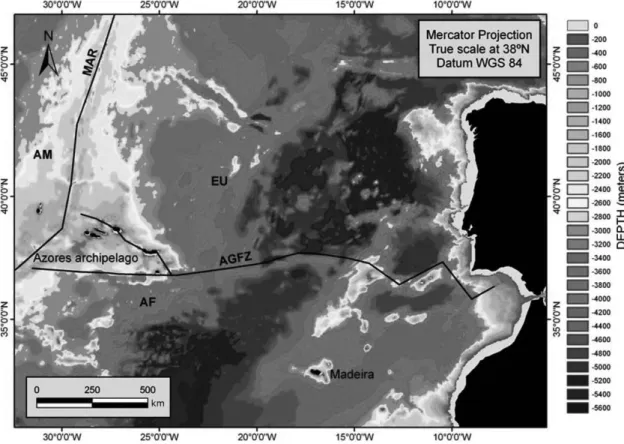
Located in the mid-North Atlantic (25° – 32° W and 37° - 40° N), about 1,500 km from the shores of mainland Portugal – is a group of very young oceanic islands, featuring youthful volcanic landforms that are generally devoid of exposed marine volcanic and sedimentary sequences (Serralheiro et al., 2003) (Fig. 1).
Figure 1. Geographical and tectonic setting of the Eurasia-Africa-North America plate boundary
(modified from Argus et al., 1989). AM=American plate; AF= African (Nubian) plate; AGFZ= Azores Gibraltar Fracture Zone; EU= Eurasian plate; MAR= Mid-Atlantic ridge. Bathymetry of the area Azores-Gibraltar from GEBCO (IOC IHO & BODC, 2003) (after Quartau, 2007).
The islands emerge from the Azores volcanic plateau (Fig. 2), which is a first-order morphological feature in the Atlantic basin. It has an overall triangular shape corresponding to a surface area of approximately 400,000 km2 of elevated oceanic crust, roughly underlined by the 2,000 m isobath (Lourenço et al., 1998). The plateau is mainly constructed of alkaline basalt volcanism. Geochemistry and petrology suggest a hotspot origin for this volcanism (White et al., 1976). The plateau crosses to the west the Mid-Atlantic Ridge (MAR) and is limited to the south by the East Azores fracture
3
Zone (EAFZ). The western group of islands (Flores and Corvo) lie on the American plate, while the islands of the central (Terceira, Graciosa, S. Jorge, Pico and Faial) and eastern groups (S. Miguel, Santa Maria and Formigas) lie on the Azores plateau (Quartau, 2007).
Figure 2. Tectonic setting of the Azores archipelago (after Luis et al., 1994).
Discovered by the Portuguese navigators in 1427, the Azores seem to have been previously known, according to old maps; after more than one century of biodiversity inventory, we still lack an estimate of the number of species occurring in the Azores (Borges et al., 2010).
In what regards the shallow marine groups, in particular the Ostracoda and Bryozoa fauna, the data are scarce. Meireles et al.(2012) were the first to publish on the
Miocene marine ostracods from the Azores (Chapter 4) and this thesis (Chapters 5 and
6) presents the first account on the systematics, palaeo-ecology and taphonomics processes of the marine ostracods from these islands. Several papers were published reporting Bryozoa from the Azores: Jullien (1882), Jullien & Calvet (1903), Calvet (1931), Hondt (1975), Harmelin (1977, 1978, 1988), Harmelin & Aristegui (1988), Zabala, Maluquer & Harmelin (1993), Reverter-Gil & Fernández-Pulpeiro (2007), Berning & Kuklinski (2008), Amat & Tempera (2009) and Costa et al. (2010).
4
The lack of information about these groups in the Azores and the convenience of studying benthic species with contrasting “ways of life” (the sessile Bryozoa and the mobile Ostracoda) provided the trigger for the description and subsequent interpretations of the marine palaeo-ecological and depositional processes presented in this thesis. This work is the results of efforts between January 2010 to May 2013, and aims to study the fossil and Recent Ostracoda and Bryozoa of the Azores from a systematical, sedimentological, palaeontological, taphonomical, palaeo-ecological and palaeo-biogeographicals points of view. I hope with this thesis to fuel and encourage further research in the fields of Marine Biology-Zoology / Oceanography / Geology of the archipelago.
1.1. OSTRACODA
Ostracods are small crustaceans ranging in length from 0.08 to 3 mm, or more. Their entire body is encased in a bivalve, calcified carapace which can be smooth to variously ornamented. The two valves are joined by a dorsal hinge opposed by closing muscle. The body is unsegmented and has a reduced number of limbs. The head is larger than both the thorax and abdomen combined. It bears five paired appendages: first and second antennae, mandibles, and the first and second maxillae. Commonly, two additional thoracopods are also present. The second maxillae and the two thoracopods are often used as walking or cleaning legs. The abdomen terminates in a pair of furcae. Between the last thoracopods and the furcae there may be a pair of large
male copulatory organs (Keyser, 1988). The general schematic classification is show in
Fig. 3. Some 65,000 living and fossil species have been described, grouped into several orders. This group may not be monophyletic; ostracod taxa are grouped into a Class based on gross morphology (Horne et al., 2002).
Although several authors have recently attempted to unify terminology pertaining ostracod limbs and their chaetotaxy (see Namiotko et al., 2011 for an overview), there is still lack of consensus on this matter in the literature and many confusion exists about limb homologies with other crustacean taxa and even within Ostracoda. Here we adopted the terminology of the general limb morphology after
Horne et al. (2002).
Ostracods have a short compact body with no true segmentation as often recognizable in other crustaceans. A faint constriction of the body usually just in front
5
of the centre marks the indistinct boundary between two main parts, the anterior head (cephalon) and the posterior trunk (consisting of the reduced thorax and the rudimentary
abdomen) (Namiotko et al., 2011). The later portion shows in a few taxa some external
traces of segmentation, suggesting 4-7 (subclass Myodocopa) or 10-11 (subclass Podocopa) barely discernible postcephalic segments (Horne et al., 2002).
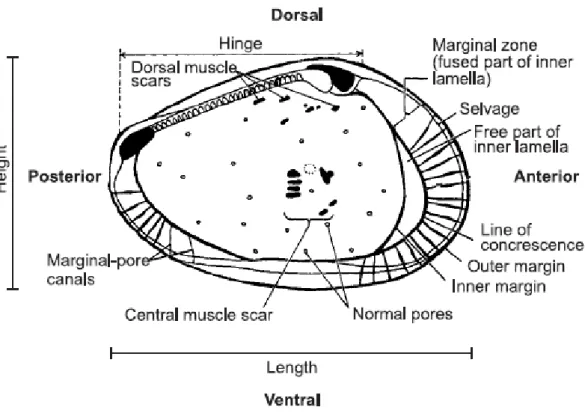
Figure 3. The internal features of a podocopida left valve (modified from Van Morkhoven, 1962).
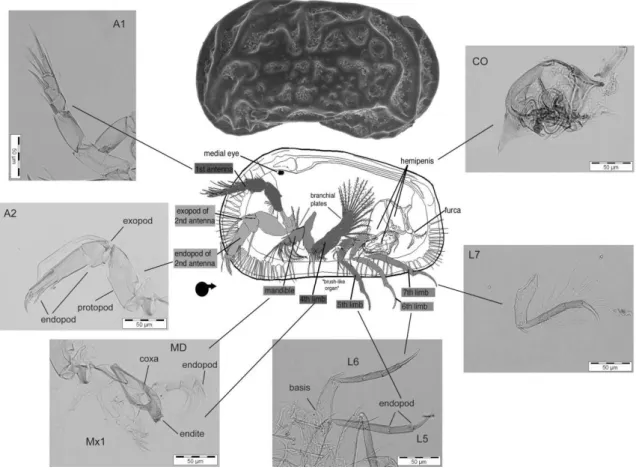
Ostracod limbs (or appendages), except the antennule (or first antenna), are considered to derive from a generalized ancestral crustacean appendage composed of a basal protopod on which distally two rami are carried: an inner endopod (commonly larger) and an outer exopod (often strongly reduced). Adult ostracods possess up to eight pairs of functionally specialized limbs, including male copulatory appendages (Horne et al., 2002) (Fig. 4).
6
Figure 4. Central ostracod schematic drawing (male Podocopida) adapted from Horne et al. (2002). Morphology of a male of Callistocythere insularis sp. nov. (Azores archipelago), as an example of a leptocytheridean ostracod (Podocopida; Leptocytheridae). Left valve in external view: A1 – antennule, A2 – antenna, MD – mandible, Mx1 – maxillula, L5 – fifth limb (walking leg), L6 – sixth limb (walking leg), L7 – seventh leg (cleaning and walking leg), CO – copulatory organ (hemipenis).
1.2. BRYOZOA
Bryozoa is the name of a phylum for which Ectoprocta is generally regarded as a synonym, these names being used by zoologists according to personal preference. Entoprocta (synonym Calyssozoa) is likewise regarded as an independent phylum. A minority regards Ectoprocta and Entoprocta as subphyla within the Bryozoa, while others maintain Ectoprocta and Entoprocta as phyla (Margulis & Schwartz, 1999) but
link them under Bryozoa as a name of convenience (Ryland, 1970).The phylum
contains some 20,000 described species, one-fifth of them living. These are distributed among three classes and a somewhat variable number of orders. This phylum consists of sessile aquatic invertebrates (also called Polyzoa) which form colonies of zooids. Each zooid, in its basic form, has a lophophore of ciliated tentacles situated distally on an introvert, a looped gut with the mouth inside the lophophore and the anus outside, a coelomic body cavity, and (commonly) a protective exoskeleton. The colonies are
7
variable in size and habit (Figs. 5, 6 and 7). Some are known as lace corals and others as sea mats, but the only general name is bryozoans (sea mosses) (Ryland, 1970).
Bryozoans are a paradoxical group of creatures. They are common aquatic animals, but few people other than professional zoologists recognize them. Their protean colony shape generally guarantees that they will be taken for hydroids, corals, or even seaweeds – anything but what they actually are. They are fascinating scientifically, but relatively few specialists study them. Even their precise relationships with other animal phyla are controversial (Nielsen, 1995). Yet their potential for yielding new discoveries, theories, and products is considerable, and anyone who starts researching their biology will certainly be rewarded. Bryozoans are a greatly understudied group, full of unsolved mysteries (Gordon et al., 2009).
Worldwide, approximately 6,000 living species and 15,000 fossil species have been recognised, and it is likely that several thousand unknown species have yet to be discovered and described. Bushy bryozoans used to be called moss animals, and flat encrusting ones, sea mats, but hardly anyone now uses these names. ‘Lace corals’ is a good descriptor for those species whose colonies look like ruffs and chalices of coloured lace, but bryozoans are coelomate animals unrelated to true cnidarian corals. No common names adequately apply to all the species, so the technical name Bryozoa (Greek for ‘moss animals’) is probably the best to use (Gordon et al., 2009).
In Azorean waters, bryozoan colonies range in size from microscopic to the size of footballs or cabbage heads. Bryozoans on wharf-piles, vessel hulls, pontoons, small rocks, and shells form small to moderate-sized encrustations or bushy colonies. The colony may be minute, of not more than a single feeding zooid and its immediate buds, or substantial, forming masses 1 m in circumference, festoons 0.5 m in length, or
patches 0.25 m2 in area. Commonly the colonies form incrustations not more than a few
square centimeters in area, small twiggy bushes up to about 3 cm in height, or soft masses up to about 10 cm in the largest dimension. In many colonies much of the bulk consists of the zooid exoskeletons, termed zooecia, which may persist long after the death of the organism and account for the abundance of fossilized bryozoan remains.
The bryozoan body design is that of a colony of tiny individuals (zooids), each of which is somewhat box- or tube-shaped, with an opening at one end for feeding tentacles to emerge. Each zooid is generally about half a millimeter long but some may be smaller or very much larger. Most marine bryozoan zooids live inside a hard calcareous box, usually attached to other identical boxes to form a colony. Colony size
8
ranges from microscopic to more than a metre in diameter (Smith & Gordon, 2011) (Fig. 6).
Figure 5. Zooid structure in Callopora lineata (Hayward & Ryland, 1979).
Figure 6. Scanning electron micrograph of zooid skeletons of Schizomavella cornuta (Heller, 1867)
9
Many bryozoans display polymorphism, having certain zooids adapted in particular ways to perform specialized functions, such as protection, cleaning the surface, anchoring the colony, or sheltering the embryo. The evolution of nonfeeding polymorphs is dependent upon some form of intercommunication between zooids (Ryland, 1970).
Figure 7. Zooid structure in the anascan cheilostome, Membranipora membranacea (Linnaeus, 1767)
10 1.3. THESIS OUTLINE
In this thesis I aimed to 1) undertake a taxonomic revision of the Fossil and Recent shallow (from the intertidal down to 100 m depth) Ostracoda and of the Recent shallow Bryozoa of the Azores; 2) describe the zonation of the Recent species of Ostracoda on the Azorean shores; 3) use the above-mentioned studies to compare with the palaeo-ecological studies that were done on the fossiliferous Late-Miocene-Early-Pliocene of the Santa Maria Island’s outcrops; 4) establish the palaeo-biogeographical relationships of the Recent and fossil ostracods; 5) produce a Reference Collection of the Bryozoa and Ostracoda which will be deposited at the Departament of Biology, Universtity of the Azores, in order to provide additional tools for identifying the more conspicuous species of Bryozoa and Ostracoda from the Azores.
In Chapter 2, I assess the methods used to study the Recent and fossil records done on this thesis. Adaptations and suggestions to future works about these groups are also reported.
Chapter 3 is dedicated to the Scientific Curation of Collections. The
identification processes and the methods used for the curation of the samples studied on this thesis (including holotypes, paratypes and topotypes specimens) are discussed. It includes the most recent and updated checklist of the benthic Bryozoa and Ostracods (Recent and fossil) of the Azores.
Chapter 4 reports the late Miocene-early Pliocene fossil ostracods from Santa
Maria Island, and discusses the geological/micropalaeontological technics used to describe these fossils, as well as the importance of this palaeontological record.
In Chapter 5, I assess the systematics and biogeographical relationships of the
Recent shallow-water marine ostracods of the archipelago. A systematic review is provided and the first biogeographical study of this class is done for the Azores. The importance of providing additional tools for identifying the more conspicuous species of Ostracoda from the Azores is also discussed.
Chapter 6 presents a study about the taphonomy and palaeoecology of the
Quaternary shallow-water marine ostracods of the Azores.
Chapter 7 shows and discusses the research results about Ponta do Castelo
locality as an outstanding outcrop for the explanation of the depositional processes of sedimentary bodies (containing fossils) on oceanic island shelves. This study proposes a general depositional model of sedimentation applicable to the insular shelves of reefless oceanic volcanic islands worldwide.
11
Figure 8 was designed to provide a fast view of the thesis outline. In this figure it is possible to see the thesis publications, other author publications (not directly related with the main theme of this thesis), scientific campaigns, and technical visits to museums, as well as the workshops, advanced courses and conferences in which the author participated, between January 2010 and May 2013.
12
CHAPTER 2
13 1. Field Techniques
In general, there are six aspects on sedimentary rocks to consider in the field, which should be recorded in as much detail as possible. These are: 1) the lithology, that is the composition and/or mineralogy of the sediment; 2) the texture, referring to the features and arrangements of the grains in the sediment, of which the most important aspect to examine in the field is the grain-size; 3) the sedimentary structures present on bedding surfaces and within beds, some of which record the palaeocurrents which deposited the rock; 4) the colour of the sediments; 5) the geometry and relationships of the beds or rock units, and their lateral and vertical changes; and 6) the nature, distribution and preservation of fossils contained within the sedimentary rocks (Tucker, 2003).
The various attributes of a sedimentary rock combine to define a facies, which is the product of a particular depositional environment or depositional process in that environment. Facies identification and facies analysis are the next steps after the field data have been collected. Nowadays, there is much interest in the broaderscale aspects of sedimentary successions: the geometric arrangements of rock units, the lateral and vertical variation in such features as lithology and grain-size, the packaging and stacking patterns of units, and the presence of cycles and rhythms in the succession. These features reflect the longer-term, larger-scale controls on deposition, primarily relative sea level change, accommodation (the space available for sediments), tectonics, sediment supply/production, and climate. A general scheme for the study of sedimentary rocks in the field is given in Tucker (2003).
2. Petrography
Sample preparations for various analytical steps were made in the laboratories of the Centro de Vulcanologia e Avaliação de Riscos Geológicos (CVARG), University of the Azores. The details of these materials are showed in Chapters 4 and 7.
A preliminary washing with deionized water for a couple of days allowed removing salt, loose debris and organic matter from the bulk samples. After drying in an oven overnight (60°C), cleaned fragments were impregnated in epoxy in vacuum conditions. With this operation, open pores and fractures were sealed, increasing the resistance of samples which are naturally fragile.
Samples were then trimmed off with a diamond blade and grinded with coarse silica carbide abrasive powder (grit 220 or 400) to obtain a flat side, suitable for optical
14
observations. The flat side was then grinded by the use of progressively thinner abrasives (up to grit 600) in order to produce a homogeneous and scratch-free surface.
Optical observations were made by the use of a stereoscopy binocular Nikon SMZ1000 equipped with a Nikon Coolpix 995 digital camera (3.34 Mpixel).
The thin sections for petrographic studies were prepared by using a Logitech PM5 semi-automated station. This machine allows the contemporaneous preparation of 6 samples with a jig (sample holder) equipped with a very precise system for thickness control.
Samples were lapped up to grit 800 and then cleaned in an ultrasonic bath. Each sample was studied using an Olympus BX52 polarizing microscopy, equipped with a DP25 digital camera (10 Mpixel). Digital imaging allowed the capture of multiple images to assemble maps.
Modal counting of components in three selected thin sections was performed with a semiautomated digital stepper, by counting a total number of 1.500 points.
3. Carbonate Microinvertebrates (Ostracoda; Bryozoa and Foraminifera): Collection, Preparation and Preservation.
The work of the micropalaeontologist in the field usually consists in collecting not fossils but samples of rock, which he believes may contain the fossils in sufficient number and in satisfactory preservation (Glaessne, 1948). Experience is essential in collecting microsamples.
The usual samples taken for micropalaeontological analysis are 200 to 250 grams. The most important precaution to be exercised during sample collection is to avoid contamination. Hammers, chisels and shovels should be cleaned before each sample is taken. In general, the less the treatment necessary to free the fossils from the matrix the better (see Jones, 1956 for an overview). Least amount of crushing, boiling and sieving should be used in order to ensure minimum breakage of specimens.
The fossils are separated from the disintegrated material by Hydrogen peroxide (H2O2, vol. 30%) and washing. The fine grade of rock particles, smaller than the
microfossils, is passed through fine sieves and discarded. This can be done by means of screening. A set of sieves with 40, 80 and 200 mesh to the inch is sufficient, for practical purposes. A jet of water under pressure is directed upon the sample and the sieves may be shaken. Much care has to be taken to clean the used screens with brushes and a strong jet of water before placing another sample on them.
15
All equipment must be kept thoroughly clean to prevent contamination; sieves are used can be made by dipping them in a solution of methylene blue after washing each sample. For more detail about the micropalaeontological techniques see Van Morkhoven (1962).
The final stage of separation involves removing the microfossils from the dried residue composed of mineral grains, fine rock fragments and microfossils. The most common practice is to pick individual specimens from the various screened fractions of the residue with a fine camel's -hair brush, and to mount them on a gummed micropalaeontological slide. Skill in using the moistened and pointed brush for picking up the specimens under the microscope can be acquired only with practice.
Moisten the brush in a small dish of water. Make it pointed and place in a hovering position over the field of' the microscope. The moistened brush is lowered over the specimen desired and allowed to touch the surface, to which the specimen will adhere. Then it is transferred to the slide.
Many types of micropalaeontological slides have been developed for specific uses. The faunal slide has 48, 60 or 100 divisions for mounting a representative fauna (see Chapter 3 for more information).
4. Living Bryozoa and Ostracoda: techniques of sampling and soft-parts preparation
Bryozoans’ are sessile organisms and sampling, in general, was done during SCUBA dive and/or snorkel activity. When collecting bryozoans it is desirable to keep the specimens intact. Hard, brittle substrata, such as stone, require a hammer and cold chisel. The review about the Bryozoa checklist, presented in Chapter 3 (Table 1) was revised by Dennis Gordon (2013, personal communication), after a technical visit to the National Institute of Water & Atmospheric Research (NIWA), in Wellington (New Zealand).
Ostracods are mobile organisms and require a more specific method. For the
Ostracoda sampling we used the method adapted by Keyser (2012; personal
communication), after a technical course in the University of Hamburg (Germany). The Ostracoda checklist, presented in Chapter 3 (Table 2) was reviewed by Gliozzi & Faranda (2011) and by Keyser (2012).
For the sampling, it was necessary: a bucket, several nets of 80µm mesh size, sieves for coarse material and sample glasses. The sieves for the coarse material, which
16
we do not want to have in our samples, must fit in the opening of the collection net. One can use other sieves, especially when the material is very coarse, or when we need other fractions.
During collection on the surface or in deeper waters (by SCUBA diving) the net should only be about two to five centimeters in the ground. The reason is that ostracods are not deeper than 2-4 cm burrying into the sediment. The net should be moved in waves over the ground, into the sediment out of the sediment and again into the sediment. The reason for this is to gather also the animals who might swim away.
The collected material is thoroughly washed in the net in the water to reduce the amount of very fine particles like clay or mud but to keep the ostracods which are held back by the net. To reduce the amount of the sample even more it is placed in the bucket and filled up with water.
In the laboratory it is best to work on the ostracods as quick as possible, for when they are still living and moving around, they are easier to spot. The sample is put into a Petri dish and look through it under the binoculars. All living ostracods you can pick out are collected with a pipette and transfered into another dish and then into 70% alcohol. When they are in the alcohol, they can stay there for a long time. The samples in seawater will very soon get spoiled and will stink terribly. If you do not have time to pick the living animals immediately, you can put the whole sample in alcohol and pick the ostracods later.
For the studies on the soft parts of the living ostracods we used the methodology by Namiotko et al. (2011). A set of materials are necessary for dissection and slide-preparation of ostracods: dissecting needles, pipettes, forceps, fine brushes, an embryo dish, nail varnish, mounting medium (Hydro-Matrix®), an aluminium holder for a glass slide and/or cover slips, a three-well embryo slide, a micropalaeontological slide, self-adhesive paper labels, a standard glass slide, depression glass slide, cover slips and a small Petri dish.
17
CHAPTER 3
SCIENTIFIC CURATION OF THE AZORES FOSSIL AND RECENT COLLECTIONS: BRYOZOA AND OSTRACODA
18 INTRODUCTION
This chapter allows users to search for information about individual fossil and Recent BRYOZOA and OSTRACODA collections housed at the Department of Biology of the University of the Azores. The information given is about collections rather than individual specimens and is intended to act as a “taster” so that more detailed enquiries can be made to the curator if necessary. For each collection, there is a list of taxa identified, associated with the sample number. The build-up of the collections was based in the Collection & Curations course accomplished in the NHM (Natural History Museum) in London (Giles Miller, 2010; personal communication).
The Ostracoda checklist was supervised by Elsa Gliozzi (Università Roma Tre – 2011)
and Dietmar Keyser (Hamburg University – 2012). The Bryozoa checklist was
supervised by Dennis Gordon (NIWA – 2013).
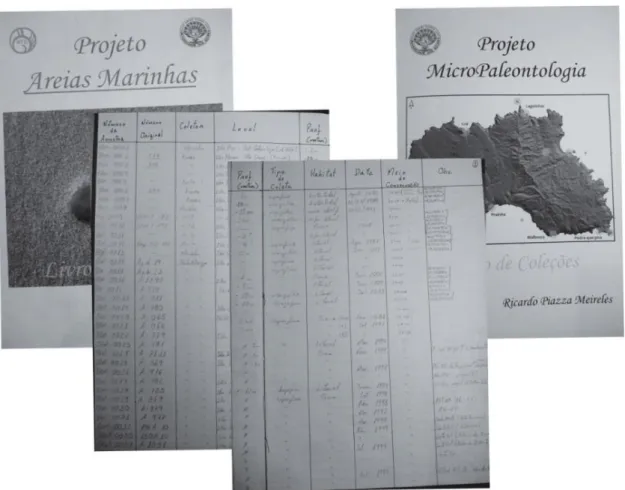
The raw documentation of the material is based on laboratory books, papers published and work in progress, checklists, tables and SEM photos, which provide information about the processing techniques applied to each sample and the data when
the work was completed (Fig. 1). For more information about Scientific Curator please
consult Brunton (1979), Brunton et al. (1984), Fothergill (2005) and Beagrie (2006).
19
All material was curated and catalogued and the major part of the collection is now available as a searchable database on the Department of Biology, University of the Azores (DBUA, Ponta Delgada, Portugal), the Bryozoa under prefix “DB/BRY nº” and the Ostracoda under prefix “DB/OS nº”. The Ostracoda are stored in micropalaeontological slides (Figs 3 and 4) and the Bryozoa (Fig. 4) are kept in bottles at the DBUA; both collections are available for further studies.
Figure 3. Micropalaeontological slides used to held the individual specimens of Ostracoda and Bryozoa.
Figure 4. Bottles used to held the specimens of Bryozoa.
The residues for every slide were kept and stored for future reference. These are a vital addition to the slide collection. Occasionally, if the residue was very small a stored reserve was not possible; consequently there are a few gaps in the run of sample numbers. The residues are held in wood drawers (Fig. 5).
20
Figure 5. Residue containers used to fossil and Recent dry sediments.
These represent the biggest catalogue of the Bryozoa and Ostracoda Collections. In the future all collections will be accessible online in the MPB website (http://www.mpb.uac.pt/) (Fig. 2).
21
THE BRYOZOA & OSTRACODA COLLECTIONS
1- Bryozoa and Ostracoda checklist of the Azores (Tables 1 and 2).
2- Bryozoa and Ostracoda (Recent and fossil) collection (Tables 3 and 4).
3- Slides; large bottles and residues from some different locations and depths around the Azores archipelago (Figs 3; 4 and 5).
4- SEM photos, soft-parts drawers and digital collection records database.
DONATIONS OF THE COLLECTIONS
Part of the material will be donated for other Institutions/Museums, and new reference numbers (for this secondary collection) will be proposed:
1º - Ostracoda Collection (Recente and Fossil) – paratypes – Natural History Museum, London; to Dr. Giles Muller.
2º - Ostracoda Collection (Recent and fossil) – partypes - Zoological Institute and Museum, University of Hamburg, Germany; to Dr. Dietmar Keyser.
3º - Ostracoda Collection (fossil) – paratypes - Dipartimento di Scienze Geologiche, Università Roma Tre, Italy; to Dra. Elsa Gliozzi.
4º - Ostracoda Collection (Recent and fossil) – paratypes – Universidade de Lisboa, Portugal; to Dra. Ana Cristina Cabral.
22
TABLE 1. CHECKLIST OF THE RECENT MARINE BRYOZOANS OF THE AZORES ARCHIPELAGO *
PHYLUM BRYOZOA
CLASS GYMNOLAEMATA ALLMAN, 1856
Geographical Distribution Bathymetry (m) References
ORDER CHEILOSTOMATA BUSK, 1852
SUPERFAMILY AETEOIDEA Family Aeteidae Smitt, 1868
Genus Aetea Lamouroux, 1812
Aetea anguina (Linnaeus, 1758) Azores 5 – 6 m Jullien & Calvet, 1903
Aetea truncata (Landsborough, 1852) Azores - Jullien & Calvet, 1903
Aetea sica (Couch, 1844) Azores - Jullien & Calvet, 1903
SUPERFAMILY CALLOPOROIDEA Family Calloporidae Norman, 1903
Genus Aplousina Canu & Bassler, 1927
Aplousina capriensis (Waters, 1898) Azores - Meireles & Gordon, 2013 (unpublished)
Aplousina filum (Jullien & Calvet, 1903) Azores 130 m Jullien & Calvet, 1903
23
Amphiblestrum auritum (Hincks, 1877) Azores 130 m Jullien & Calvet, 1903
Family Chaperiidae Jullien, 1888 Genus Chaperiopsis Uttley, 1949
Chaperiopsis hirsuta Reverter, Souto & Pulpeiro, 2009 Azores -
Meireles & Gordon, 2013 (unpublished)
Chaperiopsis annulus (Manzoni, 1870) Azores - Jullien & Calvet, 1903
Family Farciminariidae Busk, 1852 Genus Farciminellum Harmer, 1926
Farciminellum alice (Jullien & Calvet, 1903) Azores 578 – 3293 m Calvet, 1931
SUPERFAMILY FLUSTROIDEA Family Flustridae Fleming, 1828
Genus Gregarinidra Barroso, 1949
Gregarinidra gregaria (Heller, 1867) Azores - Meireles & Gordon, 2013 (unpublished)
Genus Columnella Levinsen, 1914
Columnella magna (Busk, 1884) Azores and Argentina 1240 – 1732 m Calvet, 1931
SUPERFAMILY BUGULOIDEA Family Bugulidae Gray, 1848
Genus Bugula Oken, 1815
Bugula dentata (Lamouroux, 1816) Azores - Meireles & Gordon, 2013 (unpublished)
Bugula neritina Linnaeus, 1758 Azores - Meireles & Gordon, 2013 (unpublished)
24
Bugula stolonifera Ryland, 1960 Azores - Tempera et al., 2010
Genus Bicellariella Levinsen, 1909
Bicellariella ciliata (Linnaeus, 1758) Azores - Meireles & Gordon, 2013 (unpublished)
Bicellariella sp. ? Azores 845 – 2460 m Calvet, 1931
Family Beaniidae Canu & Bassler, 1927 Genus Beania Johnston, 1840
Beania cylindrica (Hincks, 1886) Azores - Meireles & Gordon, 2013 (unpublished)
Beania mirabilis Johnston, 1840 Azores 130 m Jullien & Calvet, 1903
Family Candidae d'Orbigny, 1851
Genus Scrupocellaria van Beneden, 1845
Scrupocellaria maderensis Busk, 1860 Azores - Meireles & Gordon, 2013 (unpublished)
Scrupocellaria incurvata Waters, 1896 Azores - Meireles & Gordon, 2013 (unpublished)
Scrupocellaria scrupea Busk, 1852
Azores, Belgian coast, British Isles, Portugal
(WORMS, 2013) 130 m Tempera et al., 2010
Scrupocellaria hirsuta Jullien & Calvet, 1903 Azores 27 - 130 m Calvet, 1931
Scrupocellaria scruposa (Linnaeus, 1758) Azores and Cape Verde 52 – 550 m Calvet, 1931
Scrupocellaria reptans (Linnaeus, 1758) Azores 27 m Calvet, 1931
Genus Notoplites Harmer, 1923
Notoplites marsupiatus (Jullien, 1882) Azores and NW Spain 65 – 1250 m Calvet, 1931
Genus Caberea Lamouroux, 1816
25
SUPERFAMILY MICROPOROIDEA Family Microporidae Gray, 1848
Genus Micropora Gray, 1848
Micropora coriacea (Johnston, 1847) Azores 130 m Jullien & Calvet, 1903
SUPERFAMILY CELLARIOIDEA Family Cellariidae Fleming, 1828
Genus Cellaria Ellis & Solander, 1786
Cellaria salicornioides Lamouroux, 1816 Azores Meireles & Gordon, 2013 (unpublished)
Cellaria gracilis (Busk, 1852) Azores (Princess Alice seamount) 200 m Calvet, 1931
Cellaria biseriata Maplestone, 1900 Azores; cap. Blane and Sargasses sea 1732 - 3530 m Calvet, 1931
SUPERFAMILY CRIBRILINOIDEA Family Cribrilinidae Hincks, 1879
Genus Puellina Jullien, 1886
Puellina bathyalis (Harmelin & Aristegui, 1988) Azores, Canary 220 – 900 m Harmelin & Aristegui, 1988
Puellina orientalis azorensis (Harmelin, 1988) Azores, Canary 10 – 300 m Harmelin, 1988
Puellina orientalis lusitanica (Harmelin, 1988) Azores, Portugal, Mediterranean, Gibraltar 205 – 690 m Harmelin, 1988
Puellina radiata (Moll, 1803)
Azores, Madeira, Canarias; Atlantic oriental (France, Spain, Maroc), Mediterranean, Tristan
da Cunha, Florida and Pacific (Australia, China, Philippines, Bornèo, etc.)
98 – 930 m Calvet, 1931
Puellina sp. 1 Azores Meireles & Gordon, 2013 (unpublished)
Genus Membraniporella Smitt, 1873
26
Membraniporella neptuni Jullien, 1903 Azores 130 m Jullien & Calvet, 1903
Genus Figularia Jullien, 1886
Figularia figularis (Johnston, 1847) Azores 130 m Jullien & Calvet, 1903
SUPERFAMILY LEPRALIELLOIDEA (UMBONULOIDEA) Family Umbonulidae Canu, 1904
Genus Umbonula Hincks, 1880
Umbonula verrucosa (Esper, 1790) Azores 5 – 318 m Jullien & Calvet, 1903 / Tempera et al., 2010
Family Bryocryptellidae Vigneaux, 1949 Genus Porella Gray, 1848
Porella belli (Dawson, 1859) Azores 1165 m Calvet, 1931
Genus Palmiskenea Bishop & Hayward, 1989
Palmiskenea skenei (Ellis & Solander, 1786) Azores 736 m Jullien & Calvet, 1903
Family Romancheinidae Jullien, 1888 Genus Escharella Gray, 1848
Escharella laqueata (Norman, 1864) Azores 1165 m Calvet, 1931
Family Tessaradomidae Jullien, 1903 Genus Tessaradoma Norman, 1869
Tessaradoma boreale (Busk, 1860) Azores; coast of Bretagne. 224 – 1600 m
Calvet, 1931 / Meireles & Gordon, 2013 (unpublished)
SUPERFAMILY SMITTINOIDEA Family Smittinidae Levinsen, 1909
27
Genus Smittina Norman, 1903
Smittina ensifera Jullien & Calvet, 1903 Azores 130 m Jullien & Calvet, 1903
Genus Smittoidea Osburn, 1952
Smittoidea avicularia (Calvet, 1907) Azores 349 – 1360 m Meireles & Gordon, 2013 (unpublished)
Smittoidea azorensis (Jullien, 1903) Azores; Princess Alice seamount 200 – 1250 m Calvet, 1931
Smittoidea ophidiana (Waters, 1878) Azores and Canarias 69 – 540 m Calvet, 1931
Family Bitectiporidae MacGillivray, 1895 Genus Metroperiella Canu & Bassler, 1917
Metroperiella lepralioides (Calvet, 1903) Azores 130 m Jullien & Calvet, 1903
Genus Schizomavella Canu & Bassler, 1917
Schizomavella cuspidata (Hincks, 1880) Azores Meireles & Gordon, 2013 (unpublished)
Schizomavella auriculata (Hassall, 1842) Azores 95 – 130 m Jullien & Calvet, 1903
Schizomavella triaviculata (Calvet, 1903) Azores 98 – 550 m
Calvet, 1931 / Meireles & Gordon, 2013 (unpublished)
Schizomavella neptuni (Jullien, 1883)
Family Lanceoporidae Harmer, 1957
Genus Stephanotheca Reverter, Souto & Pulpeiro, 2012
Stephanotheca richardi (Calvet, 1903) Azores 130 m Jullien & Calvet, 1903
Stephanotheca fayalensis (Calvet in Jullien & Calvet, 1903) Azores 130 m Jullien & Calvet, 1903
Family Watersiporidae Vigneaux, 1949 Genus Watersipora Neviani, 1896
28
Watersipora complanata (Norman, 1864) Azores Meireles & Gordon, 2013 (unpublished)
Watersipora subtorquata (d'Orbigny, 1852) Azores Tidal - 130 – 318 m
Jullien & Calvet, 1903 / Meireles & Gordon,
2013 (unpublished)
Watersipora cucullata (Busk, 1854) Azores; Gibraltar; Cape Verde 0 – 219 m Calvet, 1931
SUPERFAMILY SCHIZOPORELLOIDEA Family Schizoporellidae Jullien, 1883
Genus Schizoporella Hincks, 1877
Schizoporella dunkeri (Reuss,1848) Azores Tempera et al., 2010
Schizoporella guttata Jullien & Calvet, 1903 Azores 130 m Jullien & Calvet, 1903
Schizoporella jullieni Jullien & Calvet, 1903 Azores 130 m Jullien & Calvet, 1903
Family Escharinidae Tilbrook, 2006
Genus Escharina Milne Edwards, 1836
Escharina vulgaris (Moll, 1803) Azores 130 m Meireles & Gordon, 2013 (unpublished)
Escharina protecta Zabala, Maluquer, Harmelin, 1993 Azores, Madeira, Mediterranean, Red Sea, ?Pacific Ocean 6 – 130 m Zabala, Maluquer, Harmelin, 1993
Family Microporellidae Hincks, 1879 Genus Microporella Hincks, 1877
Microporella ciliata (Pallas, 1766) Azores 130 m Jullien & Calvet, 1903
Microporella hastigera (Busk, 1884) Azores 130 m Jullien & Calvet, 1903
Family Calwelliidae MacGillivray, 1887 Genus Ichthyaria Busk, 1884
29
Ichthyaria picoensis Jullien & Calvet, 1903 Azores 736 m Jullien & Calvet, 1903
Family Jaculinidae Zabala, 1986
Genus Jaculina Jullien in Jullien & Calvet, 1903
Jaculina blanchardi Jullien & Calvet, 1903 Azores 318 m Jullien & Calvet, 1903
Jaculina dichotoma Calvet, 1931 Azores 1250 m Calvet, 1931
SUPERFAMILY CELLEPOROIDEA Family Celleporidae Johnston, 1838
Genus Buffonellaria Canu & Bassler, 1927
Buffonellaria acorensis Berning & Kuklinski, 2008 Azores 135 – 230 m Berning & Kuklinski, 2008
Buffonellaria nebulosa (Jullien & Calvet, 1903) Azores 130 – 318 m Jullien & Calvet, 1903
Genus Buskea Heller, 1867
Buskea dichotoma (Hincks, 1862) Azores; Canaries; Coast of Bretagne 98 - 2170 m Calvet, 1931
Genus Celleporina Gray, 1848
Celleporina decipiens Hayward, 1976 Azores Meireles & Gordon, 2013 (unpublished)
Celleporina hassallii (Johnston, 1847) Azores Meireles & Gordon, 2013 (unpublished)
Celleporina costazii (Audouin, 1826) Azores 0 - 550 m Calvet, 1931
Genus Galeopsis Jullien, 1903
Galeopsis pentagonus (d'Orbigny, 1842) Azores 130 m Jullien & Calvet, 1903
Galeopsis rabidus Jullien, 1903 Azores 318 – 736 m Jullien & Calvet, 1903
Genus Lagenipora Hincks, 1877
30
Lagenipora socialis Hincks, 1877 Azores 130 m Jullien & Calvet, 1903
Genus Osthimosia Jullien, 1888
Osthimosia parvula Jullien, 1903 Azores 845 - 1250 m Calvet, 1931
Genus Omalosecosa Canu & Bassler, 1925
Omalosecosa ramulosa (Linnaeus, 1767) Azores Jullien & Calvet, 1903
Family Phidoloporidae Gabb & Horn, 1862 Genus Stephanollona Duvergier, 1921
Stephanollona armata (Hincks, 1862) Azores Meireles & Gordon, 2013 (unpublished)
Genus Schizotheca Hincks, 1877
Schizotheca carmenae Reverter-Gil & Pulpeiro, 2007 Azores and SW Portugal (Sagres) 45 – 148 m Reverter & Pulpeiro, 2007
Genus Reteporella Busk, 1884
Reteporella septentrionalis (Harmer, 1933) Azores 20 – 1300 m Jullien & Calvet, 1903
Reteporella oceanica (Jullien & Calvet, 1903) Azores 318 - 1300 m Jullien & Calvet, 1903 / Calvet 1931
Reteporella gracilis (Jullien & Calvet, 1903) Azores 523 – 845 m Jullien & Calvet, 1903 / Calvet 1931
Reteporella tristis (Jullien & Calvet, 1903) Azores 200 – 349 m Jullien & Calvet, 1903 / Calvet 1931
Reteporella rara (Jullien & Calvet, 1903) Azores 318 m Jullien & Calvet, 1903
Reteporella producta (Busk, 1884) Azores 318 m Jullien & Calvet, 1903
Reteporella dichotoma (Hincks, 1878) Azores 318 m Jullien & Calvet, 1903
Reteporella sp. Azores Jullien & Calvet, 1903
Reteporella sp. 1 Azores Meireles & Gordon, 2013 (unpublished)
31
Genus Reptadeonella Busk, 1884
Reptadeonella violacea (Johnston, 1847) Azores Meireles & Gordon, 2013 (unpublished)
Reptadeonella insidiosa (Jullien, 1903) Azores; Cape Verde, Morroco, Guernesey, Hasting, Gulf of Gascogne 52 – 219 m Calvet, 1931
Genus Adeonellopsis MacGillivray, 1886
Adeonellopsis distoma (Busk, 1858) Azores; Madeira, Canaries, western Mediterranean and Indian Ocean 98 – 1262 m Calvet, 1931
SUPERFAMILY HIPPOTHOOIDEA Family Hippothoidae Busk, 1859
Genus Hippothoa Lamouroux, 1821
Hippothoa divaricata Lamouroux, 1821 Azores 130 m Jullien & Calvet, 1903
Hippothoa flagellum Manzoni, 1870 Azores 130 m Jullien & Calvet, 1903
Hippothoa amoena Jullien & Calvet, 1903 Azores 130 - 318 m Jullien & Calvet, 1903
Family Chorizoporidae Vigneaux, 1949 Genus Chorizopora Hincks, 1879
Chorizopora brongniartii (Audouin, 1826) Azores 130 – 1300 m Meireles & Gordon, 2013 (unpublished)
Family Trypostegidae Gordon, Tilbrook & Winston in Winston, 2005 Genus Trypostega Levinsen, 1909
Trypostega papillata (Busk, 1859) Azores Jullien & Calvet, 1903
Trypostega amaena Jullien, 1903 Azores Jullien & Calvet, 1903
Family Haplopomidae Gordon in De Blauwe, 2009 Genus Haplopoma Levinsen, 1909
Haplopoma bimucronatum (Moll, 1803) Azores Meireles & Gordon, 2013 (unpublished)
32
SUPERFAMILY SCHIZOPORELLOIDEA Family Escharinidae Tilbrook, 2006
Genus Herentia Gray, 1848
Herentia hyndmanni (Johnston, 1847) Azores 120 – 130 m Jullien & Calvet, 1903
Family Lacernidae Jullien, 1888
Genus Nimba Jullien & Calvet, 1903
Nimba praetexta Jullien & Calvet, 1903 Azores 130 – 318 m Jullien & Calvet, 1903
Genus Nimbella Jullien & Calvet, 1903
Nimbella limbata Jullien & Calvet, 1903 Azores 120 m Jullien & Calvet, 1903
ORDER CTENOSTOMATA BUSK, 1852
SUPERFAMILY ALCYONIDIOIDEA Family Pherusellidae Osburn & Soule, 1953
Genus Pherusella Soule, 1951
Pherusella tubulosa (Solander, 1786) Mediterranean, Atlantic Ocean (Dominique, Brazil, Azores, Cape verde) and Chile 91 – 318 m Calvet, 1931
SUPERFAMILY VESICULARIOIDEA Family Vesiculariidae Hincks, 1880
Genus Amathia Lamouroux, 1812
Amathia lendigera (Linnaeus, 1758) Azores 5 – 6 m Jullien & Calvet, 1903
33
Bowerbankia pusilla Jullien & Calvet, 1903 Azores Jullien & Calvet, 1903
Genus Zoobotryon Ehrenberg, 1831
Zoobotryon verticillatum (Delle Chiaje, 1822) Azores Tempera et al., 2010
ORDER CYCLOSTOMATA BUSK, 1852
SUBORDER TUBULIPORINA
Family Annectocymidae Hayward & Ryland, 1985 Genus Annectocyma Hayward & Ryland, 1985
Annectocyma major (Johnston, 1847) Azores 130 m Jullien & Calvet, 1903
Genus Entalophoroecia Harmelin, 1976
Entalophoroecia crisioides (Calvet in Jullien & Calvet, 1903) Azores 130 m Jullien & Calvet, 1903
Entalophoroecia deflexa (Couch, 1842) Azores Jullien & Calvet, 1903
Family Terviidae Canu & Bassler, 1920 Genus Tervia Jullien, 1883
Tervia irregularis (Meneghini, 1844) Azores 318 m Jullien & Calvet, 1903
Family Tubuliporidae Johnston, 1838
Genus Idmidronea Canu & Bassler, 1920
Idmidronea atlantica (Forbes in Johnston, 1847) Azores 5 - 318 m Jullien & Calvet, 1903
Idmidronea contorta (Busk, 1875) Azores 95 m Jullien & Calvet, 1903
34
Tubulipora notomala (Busk, 1875) Azores Jullien & Calvet, 1903
Tubulipora liliacea (Pallas, 1766) Azores Jullien & Calvet, 1903
Family Plagioeciidae Canu, 1918 Genus Diplosolen Canu, 1918
Diplosolen grimaldii Jullien & Calvet, 1903 Azores Jullien & Calvet, 1903
Family Mecynoeciidae Canu, 1918 Genus Mecynoecia Canu, 1918
Mecynoecia idmoneoides Calvet, 1903 Azores 318 – 736 m Jullien & Calvet, 1903
Mecynoecia sp. Azores 454 m Jullien & Calvet, 1903
SUBORDER CANCELLATA Family Horneridae Gregory, 1899
Genus Hornera Lamouroux, 1821
Hornera canui Calvet, 1911 Azores 880 - 1385 m Calvet, 1931
Family Lichenoporidae Smitt, 1867 Genus Disporella Gray, 1848
Disporella novaehollandiae (d'Orbigny, 1853) Azores Jullien & Calvet, 1903
Disporella picoensis (Calvet in Jullien & Calvet, 1903) Azores Jullien & Calvet, 1903
Disporella fimbriata (Busk, 1875)
Antartic and subantartic Atlantic to Pacific; Azores, Cape Verde, Cile and Gulf of
Gascogne
52 – 219 m Calvet, 1931
SUBORDER ARTICULINA Family Crisiidae Johnston, 1838
35
Genus Crisia Lamouroux, 1812
Crisia eburnea (Linnaeus, 1758) Azores 736 m Meireles & Gordon, 2013 (unpublished)
Crisia denticulata (Lamarck, 1816) Azores tidal Jullien & Calvet, 1903
Crisia ramosa Harmer, 1891 Azores, Mediterranean, Monaco 27 – 69 m Calvet, 1931
Family Crisinidae d'Orbigny, 1853 Genus Biidmonea Calvet, 1903
Biidmonea fayalensis Calvet in Jullien & Calvet, 1903 ? ? ?
* This checklist was development during a technical visit to Dr. Dennis Gordon (NIWA-National Institute of Water & Atmospheric Research, Wellington, New Zealand [February-July 2013]) and contains unpublished data. This table will submit to publish in a scientific journal.
36
TABLE 2. CHECKLIST OF THE RECENT AND FOSSIL MARINE OSTRACODA OF THE AZORES ARCHIPELAGO †
CLASS OSTRACODA LATREILLE, 1802
Geographical Distribution Bathymetry (m) References
ORDER PODOCOPIDA MÜLLER, 1894
Family Bairdiidae Sars, 1888
Genus Neonesidea Maddocks, 1969
Neonesidea longisetosa (Brady 1902) Azores; Carribbean; Florida 1 and 85 m Meireles et al., 2013
Neonesidea sp. 1 Azores 249 - 371 m Meireles
(unpublished)
Family Leptocytheridae Hanai, 1957 Genus Leptocythere Müller, 1927
Leptocythere pellucida (Baird, 1850). France and Britain, southern Norway and Azores; North Sea, Atlantic Coast of
the western Baltic
1 to 50 m Meireles et al., 2013
Genus Callistocythere Ruggieri, 1953
Callistocythere insularis n. sp. Azores 1 to 23 m Meireles et al., 2013
37 Genus Cyprideis Jones, 1856
Cyprideis torosa (Jones, 1850)
Azores; Widespread throughout Europe and as far north as Iceland, W and Central Asia, and N Africa.Also found in lakes in
Central Africa.
freshwater to littoral Meireles et al., 2013
Family Trachyleberididae Sylvester-Bradley, 1948 Genus Carinocythereis Ruggieri, 1956
Carinocythereis whitei (Baird, 1850) Azores; British Isles, the Atlantic coast of
France and the Mediterranean 1 to 20 m Meireles et al., 2013
Family Hemicytheridae Puri, 1953 Genus Aurila Porkorný, 1955
Aurila convexa (Baird, 1850) Azores; North Sea, France, Portugal, the
Mediterranean and Britain 1 to 54 m Meireles et al., 2013
Aurila woutersi Horne, 1986 Azores; Southern British Isles 1 to 20 m Meireles et al., 2013 Aurila prasina Barbeito-Gonzalez, 197 Azores; Lecce and S. Maria di Leuca, in
Adriatic Sea and in Naxos, Greece 1 to 20 m Meireles et al., 2013
Genus Heterocythereis Elofson, 1941
Heterocythereis albomaculata (Baird, 1938) Azores; North Sea and Atlantic 1 to 20 m Meireles et al., 2013
Genus Urocythereis Ruggieri, 1950
Urocythereis britannica Athersuch, 1977 Azores; Atlantic, the North Sea and
probably in the Mediterranean 1 to 69 m Meireles et al., 2013
Family Loxoconchidae Sars, 1925 Genus Loxoconcha Sars, 1866
Loxoconcha rhomboidea (Fischer, 1855) Azores; Europe, from N Norway to Madeira and Canary Islands, off N
Africa. Mediterranean
38
Loxoconcha cf. ochlockoneensis Puri, 1960 Azores; West coast of Florida and the Bermudas 1 to 20 m Meireles et al., 2013
Family Cytheruridae Müller, 1894
Genus Semicytherura Wagner, 1957
Semicytherura brandoni n. sp. Azores littoral Meireles et al., 2013
Semicytherura cf. cornuta (Brady, 1868) Azores; Atlantic coast of France and S
Norway littoral (~18 m) Meireles et al., 2013
Family Xestoleberididae Sars, 1928 Genus Xestoleberis Sars, 1866
Xestoleberis rubens Whittaker, 1978 Azores; North Sea and the Atlantic coast
of France 1 to 45 m Meireles et al., 2013
Xestoleberis cf. depressa Sars, 1866 Azores; North Sea, Scandinavia and also
in the Western part of the Baltic littoral Meireles et al., 2013
Xestoleberis sp. Azores littoral Meireles et al., 2013
Family Bythocytheridae Sars, 1866 Genus Sclerochilus Sars, 1866
Sclerochilus hicksi Athersuch & Horne 1987 Azores; N Atlantic, Mediterranean littoral Meireles et al., 2013
Family Paradoxostomatidae Brady & Norman, 1889 Genus Lanceostoma Schornikov & Keyser, 2004
Lanceostoma simplex n. sp Azores 1 to 20 m Meireles et al., 2013
ORDER MYODOCOPIDA SARS, 1866
39 Genus Cylindroleberis Brady, 1867
Cylindroleberis sp. Azores littoral Meireles et al., 2013
FOSSILS
ORDER PODOCOPIDA MÜLLER, 1894
Family Xestoleberididae Sars, 1928 Genus Xestoleberis Sars, 1866
Xestoleberis cf. paisi Nascimento, 1989
Meireles et al., 2012
Family Loxoconchidae Sars, 1925 Genus Loxoconcha Sars, 1866
Loxoconcha stellifera Müeller, 1894
Meireles et al., 2012
Loxoconcha rhomboidea (Fischer, 1855) Meireles et al., 2012
Family Leptocytheridae Hanai, 1957
Genus Callistocythere Ruggieri, 1953
Callistocythere oertlii Nascimento, 1989
40 Genus Leptocythere Sars, 1922
Leptocythere azorica Meireles & Faranda, 2012
Meireles et al., 2012
Family Hemicytheridae Puri, 1953
Genus Pachycaudites Uliczny, 1969
Pachycaudites cf. armilla Ciampo, 1986
Meireles et al., 2012
Genus Dameriacella Liebau, 1991
Dameriacella cf. dameriacensis (Keij, 1958)
Meireles et al., 2012
Genus Aurila Pokorný, 1955
Aurila sp.
Meireles et al., 2012
Genus Quadracythere Hornibrook, 1952
?Quadracythere sp.
Meireles et al., 2012
Genus Heliocythere Bonaduce, Ruggieri, Russo, 1988
Heliocythere magnei (Keij, 1953)
Meireles et al., 2012
Family Bairdiidae Sars, 1888
41
Neonesidea rochae Nascimento, 1989
Meireles et al., 2012
Family Candonidae Kaufmann, 1900 Genus Paracypris Sars, 1866
Paracypris sp.
Meireles et al., 2012
Family Cytherideidae Sars, 1925
Genus Cyamocytheridea Oertli, 1956
Cyamocytheridea sp.
Meireles et al., 2012
†
42
TABLE 3. THE BRYOZOA (FOSSIL AND RECENT) COLLECTION OF THE DBUA (Department of Biology of the University of the Azores).
BRYOZOA COLLECTION
Curator: Ricardo Piazza Meireles
Prefix Species Family Location Deep (m) Sample
DB/BRY 0001 Scrupocellaria sp. 1 Candidae d'Orbigny, 1851 Faial Island -30 PAM 0041
DB/BRY 0002 Scrupocellaria maderensis Busk, 1860 Candidae d'Orbigny, 1851 Faial Island -30 PAM 0041
DB/BRY 0003 Reteporella mediterranea Phidoloporidae Gabb & Horn, 1862 Faial Island -30 PAM 0041
DB/BRY 0004 Crisia eburnea Crisiidae Johnston, 1838 Faial Island -30 PAM 0041
DB/BRY 0005 # Tubuliporidae Johnston, 1838 Faial Island -30 PAM 0041
DB/BRY 0006 Celleporina hassallii (Johnston, 1847) Celleporidae Johnston, 1838 Faial Island -30 PAM 0041
DB/BRY 0007 Schizomavella cuspidata (Hincks, 1880) Bitectiporidae MacGillivray, 1895 Faial Island -30 PAM 0041
DB/BRY 0008 Watersipora subovoidea (d'Orbigny, 1852) Watersiporidae Vigneaux, 1949 Faial Island -30 PAM 0041
DB/BRY 0009 Gen. and sp. indet 5 # Faial Island -30 PAM 0041
DB/BRY 0010 Gen. and sp. indet 2 # Faial Island -30 PAM 0041
DB/BRY 0011 Beania cylindrica (Hincks, 1886) Beaniidae Canu & Bassler, 1927 Flores Island -3 PAM 0002
DB/BRY 0012 Watersipora subtorquata (d'Orbigny, 1852) Watersiporidae Vigneaux, 1949 São Miguel Island -10 PAM 0014
43
DB/BRY 0014 Caberea boryi (Audouin, 1826) Candidae d'Orbigny, 1851 São Miguel Island 0 PAM 0020
DB/BRY 0015 Escharina vulgaris (Moll, 1803) Escharinidae Tilbrook, 2006 Pico Island -46 PAM 0042
DB/BRY 0016 Gen. and sp. indet 8 # Faial Island -30 PAM 0046
DB/BRY 0017 Caberea boryi (Audouin, 1826) Candidae d'Orbigny, 1851 São Miguel Island -20 PAM 0047
DB/BRY 0018 Chorizopora brongniartii (Audouin, 1826) Chorizoporidae Vigneaux, 1949 Faial Island -30 PAM 0054
DB/BRY 0019 Bicellariella ciliata (Linnaeus, 1758) Bugulidae Gray, 1848 São Miguel Island -10 DOP-3896-BRY
DB/BRY 0020 Stephanollona armata (Hincks, 1862) Phidoloporidae Gabb & Horn, 1862 Faial Island -20 DOP-3900-BRY
DB/BRY 0021 Bugula dentata (Lamouroux, 1816) Bugulidae Gray, 1848 Corvo Island mergulho DOP-3901-BRY
DB/BRY 0022 Gregarinidra gregaria (Heller, 1867) Flustridae Fleming, 1828 Faial Island -10 / -20 DOP-3955-BRY
DB/BRY 0023 Reptadeonella violacea (Johnston, 1847) Adeonidae Busk, 1884 Faial Island -5 / -10 DOP-3959-BRY
DB/BRY 0024 # Tubuliporidae Johnston, 1838 Faial Island -10 / -15 DOP-3960-BRY
DB/BRY 0025 Watersipora complanata (Norman, 1864) Watersiporidae Vigneaux, 1949 Formigas Islet -10 DOP-3992-BRY
DB/BRY 0026 Watersipora complanata (Norman, 1864) Watersiporidae Vigneaux, 1949 Flores Island -10 / -15 DOP-4003-BRY
DB/BRY 0027 # # Faial Island -5 / -10
DOP-4011-BRY
DB/BRY 0028 Cellaria salicornioides Lamouroux, 1816 Cellariidae Fleming, 1828 Formigas Islet # DOP-4013-BRY
DB/BRY 0029 Schizomavella triaviculata (Jullien & Calvet,
1903) Bitectiporidae MacGillivray, 1895 Açores Seamount -219 / -329 E-1713-BRY
DB/BRY 0030 Schizomavella triaviculata (Jullien & Calvet,
1903) Bitectiporidae MacGillivray, 1895 Pico Island -200 E-2035-BRY
DB/BRY 0031 Anthoathecata Stylasteridae Princesa Alice
Seamount -238 E-1679-BRY
44
DB/BRY 0033 Spiralaria cf. florea Flustridae Fleming, 1828 Rainbow
(hydrothermal field) # E-2500-BRY
DB/BRY 0034 Escharina vulgaris (Moll, 1803) Escharinidae Tilbrook, 2006 Faial Island -10 DOP-3948-BRY
DB/BRY 0035 Puellina sp. Cribrilinidae Hincks, 1879 Santa Maria Island outcrop #
DB/BRY 0036 Escharina sp. Escharinidae Tilbrook, 2006 Santa Maria Island outcrop #
DB/BRY 0037 Onychocella sp. Onychocellidae Jullien, 1882 Santa Maria Island outcrop #
DB/BRY 0038 Schizotheca sp. Phidoloporidae Gabb & Horn, 1862 Santa Maria Island outcrop #
DB/BRY 0039 Cribrilina sp. Cribrilinidae Hincks, 1879 Santa Maria Island outcrop #
DB/BRY 0040 Cryptosula sp. Cryptosulidae Vigneaux, 1949 Santa Maria Island outcrop #
DB/BRY 0041 Escharina sp. Escharinidae Tilbrook, 2006 Santa Maria Island outcrop #
DB/BRY 0042 # # Santa Maria Island outcrop #
DB/BRY 0043 # # Santa Maria Island outcrop #
DB/BRY 0044 # # Santa Maria Island outcrop #
DB/BRY 0045 # # Santa Maria Island outcrop #
DB/BRY 0046 # # Santa Maria Island outcrop DBUA-F 911
DB/BRY 0047 # # Santa Maria Island outcrop DBUA-F 494
DB/BRY 0048 # # Santa Maria Island outcrop #
DB/BRY 0049 # # Santa Maria Island outcrop #
DB/BRY 0050 # # Santa Maria Island outcrop #
DB/BRY 0051 # # Santa Maria Island outcrop #
45
DB/BRY 0053 # # Santa Maria Island outcrop #
DB/BRY 0054 # # Santa Maria Island outcrop #
DB/BRY 0055 # # Santa Maria Island outcrop MP 0001
DB/BRY 0056 # # Santa Maria Island outcrop MP 0001
DB/BRY 0057 # # Santa Maria Island outcrop MP 0007
DB/BRY 0058 # # Santa Maria Island outcrop MP 0007
DB/BRY 0059 # # Santa Maria Island outcrop MP 0009
DB/BRY 0060 # # Santa Maria Island outcrop MP 0009
DB/BRY 0061 # # Santa Maria Island outcrop MP 0009
DB/BRY 0062 # # Santa Maria Island outcrop MP 0009
DB/BRY 0063 # # Santa Maria Island outcrop MP 0009
DB/BRY 0064 # # Santa Maria Island outcrop MP 0018
DB/BRY 0065 # # Santa Maria Island outcrop MP 0018
DB/BRY 0066 # # Santa Maria Island outcrop MP 0018
DB/BRY 0067 # # Santa Maria Island outcrop MP 0018
DB/BRY 0068 Tessaradoma boreale (Busk, 1860) Tessaradomidae Jullien, 1903 ? -304 DOP 2861
DB/BRY 0069 # # Açores Seamount -441 DOP 3272
DB/BRY 0070 Puellina sp. 1 Cribrilinidae Hincks, 1879 Condor Seamount -400 DOP 3257
DB/BRY 0071 Aplousina capriensis (Waters, 1898) Calloporidae Norman, 1903 Pico-Faial chanal -130 DOP 974
DB/BRY 0072 # # Formigas Islet -20 / -30 68a
46
DB/BRY 0074 # # Faial Island -23 47
DB/BRY 0075 Schizoporella dunkeri Schizoporellidae Jullien, 1883 Faial Island -10 / -12 25
DB/BRY 0076 # # Faial Island -10 / -12 27
DB/BRY 0077 # # Santa Maria Island -20 24
DB/BRY 0078 # # Formigas Islet -30 97
DB/BRY 0079 Smittoidea avicularia (Calvet, 1907) Smittinidae Levinsen, 1909 São Jorge Island -188? 2701
DB/BRY 0080 Cellaria salicornioides Lamouroux, 1816 Cellariidae Fleming, 1828 Terceira Island -354? 2918
DB/BRY 0081 Scrupocellaria maderensis Busk, 1860 Candidae d'Orbigny, 1851 38,524N/-28,585W -457 DOP # 821
DB/BRY 0082 Celleporina hassallii (Johnston, 1847) Celleporidae Johnston, 1838 Faial Island -30 PAM 0041
DB/BRY 0083 Celleporina decipiens Hayward, 1976 Celleporidae Johnston, 1839 Flores Island -20 PAM 0002
DB/BRY 0084 Cellaria salicornioides Lamouroux, 1816 Cellariidae Fleming, 1828 -- -- DOP 3125
DB/BRY 0085 Escharina vulgaris (Moll, 1803) Escharinidae Tilbrook, 2006 Pico Island -69 PAM 0055
DB/BRY 0086 Schizomavella cuspidata (Hincks, 1880) Bitectiporidae MacGillivray, 1895 Faial Island -30 PAM 0046
DB/BRY 0087 Schizomavella cuspidata (Hincks, 1880) Bitectiporidae MacGillivray, 1895 Faial Island -30 PAM 0046
DB/BRY 0088 Haplopoma bimucronatum (Moll, 1803) Haplopomidae Gordon in De Blauwe,
2009 Faial Island -30 PAM 0041
DB/BRY 0089 Chaperiopsis hirsuta Reverter-Gil, Souto &
Fernández-Pulpeiro, 2009 Chaperiidae Jullien, 1888 Faial Island -85 PAM 0043
DB/BRY 0090 Chaperiopsis hirsuta Reverter-Gil, Souto &
Fernández-Pulpeiro, 2009 Chaperiidae Jullien, 1888 Faial Island -85 PAM 0043
DB/BRY 0091 Stephanollona armata (Hincks, 1862) Phidoloporidae Gabb & Horn, 1862 Faial Island -85 PAM 0043
DB/BRY 0092 Stephanollona armata (Hincks, 1862) Phidoloporidae Gabb & Horn, 1862 Faial Island -30 PAM 0046
47
DB/BRY 0094 Reteporella sp. Phidoloporidae Gabb & Horn, 1862 -- -- DOP # 79
DB/BRY 0095 Reteporella sp. Phidoloporidae Gabb & Horn, 1862 Condor Seamount -238 / -243 DOP # 1933
DB/BRY 0096 Reteporella sp. Phidoloporidae Gabb & Horn, 1862 -- -- DOP # 19
DB/BRY 0097 Reteporella sp. Phidoloporidae Gabb & Horn, 1862 -- -- DOP # 2607
DB/BRY 0098 Reteporella sp. Phidoloporidae Gabb & Horn, 1862 Santa Maria Island -25 DOP # 2456
DB/BRY 0099 Reteporella sp. Phidoloporidae Gabb & Horn, 1862 Mar da prata -278.5 DOP # 2930
DB/BRY 0100 Reteporella sp. Phidoloporidae Gabb & Horn, 1862 São Miguel Island -67,4 / -768 DOP # 2459
DB/BRY 0101 Scrupocellaria sp. Candidae d'Orbigny, 1851 -- -- DOP # 1
DB/BRY 0102 Scrupocellaria sp. Candidae d'Orbigny, 1851 Princesa Alice
Seamount -238 / -329 DOP # 1681
DB/BRY 0103 Scrupocellaria sp. Candidae d'Orbigny, 1851 -- -- DOP # 71
DB/BRY 0104 Scrupocellaria sp. Candidae d'Orbigny, 1851 -- -- DOP # 67
DB/BRY 0105 Scrupocellaria sp. Candidae d'Orbigny, 1851 -- -- DOP # 5
DB/BRY 0106 Scrupocellaria sp. Candidae d'Orbigny, 1851 Açores Seamount -307 DOP # 1428
DB/BRY 0107 Scrupocellaria sp. Candidae d'Orbigny, 1851 DOP # 22
DB/BRY 0108 Scrupocellaria sp. Candidae d'Orbigny, 1851 38,524N/-28,585W -457 DOP # 821
DB/BRY 0109 Bugula dentata (Lamouroux, 1816) Bugulidae Gray, 1848 -- -- DOP # 17
![Figure 6. Scanning electron micrograph of zooid skeletons of Schizomavella cornuta (Heller, 1867) [=Schizomavella cuspidata (Hincks, 1880)]](https://thumb-eu.123doks.com/thumbv2/123dok_br/14985591.1007714/15.892.153.740.627.1072/figure-scanning-electron-micrograph-skeletons-schizomavella-schizomavella-cuspidata.webp)