THE RELQUAL SCALE:
A MEASURE OF RELATIONSHIP QUALITY IN EXPORT MARKET VENTURES*
Carmen Lages, Cristiana Raquel Lages and Luis Filipe Lages **
2004
* This research was funded by a research grant from the 6th European Framework Program, Specific Support Action-CoCombine. Luis Filipe Lages is grateful to “Nova Égide” and Carmen Lages to “UNIDE/ISCTE”. The authors also thank the support of UMIST (UK) for data
collection. Names are in alphabetical order reflecting author’s equal contributions to the article. ** Carmen Lages is Assistant Professor of Marketing at ISCTE Business School- Lisbon,
Av. das Forças Armadas 1649-026 Lisboa, Portugal. E-mail: [email protected]; url: http://home.iscte.pt/~chfl/; Tel. +351 21 7903000, Fax: +351.21 7903000.
Cristiana Raquel Lages is affiliated with Warwick University, Warwick Business School, Coventry, CV4 7AL, U.K. E-mail: [email protected]; Tel. +44.24.7657.3749; Fax: +44.24.7652.4650.
Luis Filipe Lages is Assistant Professor of Marketing and International Business at Universidade Nova de Lisboa, Faculdade de Economia, Campus de Campolide, 1099-032 Lisboa, Portugal. E-mail: [email protected]; url: http://docentes.fe.unl.pt/~lflages; Tel. +351.213801600; Fax: +351.213886073.
THE RELQUAL SCALE:
A MEASURE OF RELATIONSHIP QUALITY IN EXPORT MARKET VENTURES
Abstract
In this article the authors develop a new measurement scale (the RELQUAL scale) to assess the degree of relationship quality between the exporting firm and the importer. Relationship quality is presented as a high order concept. Findings reveal that a better quality of the relationship results in a greater 1) amount of information sharing, 2) communication quality, 3) long-term orientation, as well as 4) satisfaction with the relationship. The four multi-item scales show strong evidence of reliability as well as convergent, discriminant and nomological validity in a sample of British exporters. Findings also reveal that relationship quality is positively and significantly associated with export performance. Suggestions for applying the measure in future research are presented.
Keywords: Relationship Quality, Relationship Marketing, Export Marketing, Export Performance
Introduction
The relatively recent emergence of the relationship-marketing paradigm in modern marketing thought consolidates the increasing importance given by marketing academics to managing, developing and evaluating relationships (Berry, 1995; Payne et al., 1995; Sheth and Parvatiyar, 1992, 1995). Within this paradigm, the topic of relationship quality has stimulated a profuse production of scientific publications. Although previous literature has measured relationship quality between service firms and their customers (e.g., Roberts, Varki and Brodie, 2003), manufacturers/suppliers and distributors/resellers (e.g., Dorsch, Swanson, and Kelley, 1998; Kumar, Scheer and Steenkamp, 1995) and between salespeople and
firms can measure the quality of their relationship with importing firms. Indeed, as Samiee and Walters (2003: 194) state, in an international business context, “the rate of conceptual development of new frameworks has tended to go faster than empirical testing and, not surprisingly, hard data on many aspects of relationship marketing is still lacking”. Our study intends to empirically assess the quality of the relationship in an exporting context.
In an exporting setting, relationship quality refers to relationships developed beyond national boundaries. In an increasingly competitive global arena, exporting firms have to invest in relationships with their importers in order to ensure effective and profitable actions. Unlike relationships in the domestic market, relationships developed with partners in foreign markets are influenced to a higher degree by dissimilar cultural, economic and other
environmental factors. This might explain why in an international context, empirical testing of relationship marketing has been slower than conceptual development (Samiee and Walters, 2003). Our paper intends to contribute to filling this gap in the literature.
Relationship quality (before, during, and after transactions) can build or destroy exporting relationships. Hence, it is crucial to develop a measure of relationship quality in an exporting context so that both researchers and practitioners might better understand and, consequently, handle relationships more efficiently. Moreover, since many academic and managerial resources are invested in better understanding relationships, it is essential to develop ways of evaluating their quality before ultimately assessing their impact on other key variables, such as export performance.
The paper is organized as follows. First, an overview of the current literature is offered. Second, the four dimensions of the RELQUAL scale are presented. Third, the scale is tested via a field survey of British exporters. Research limitations are considered. Finally, implications for theory and managerial practice, and directions for future research are presented.
Relational Quality
In line with past research (Crosby, Evans, and Cowles, 1990; Dwyer and Oh, 1987; Kumar, Scheer, and Steenkamp, 1995), we consider that relationship quality is a higher order construct made of several distinct, though related dimensions. Unlike previous authors who studied relationship quality as perceived by the customer (e.g. Dwyer and Oh, 1987; Crosby, Evans, and Cowles, 1990; Kumar, Scheer, and Steenkamp, 1995), we look at relationship quality in the perspective of the exporting firm. Hence, we adopt the organizational behavior instead of the consumer buyer behavior approach. In this study, relationship quality is defined as the degree of appropriateness of a relationship between the exporter and importer as
evidenced by the amount of information sharing, communication quality, long-term orientation, and satisfaction with the relationship.
The theoretical context that led to relationship marketing builds on differentiating relational exchange from discrete transactions (McNeil, 1980). Our paper concerns relational exchanges. Relational exchange occurs when exchange events are guided by the context of the interaction, including past, present and (expected) future experiences, and are different from discrete transactions, which are usually short-term exchange events that are market driven (McNeil, 1980). In an international business context, Samiee and Walters (2003) argue that in real life situations there are seldom conditions for straightforward events with no relational dimensions, and defend that reality of distribution channels is better captured as a sequence of related transaction events.
The RELQUAL Scale
While building on previous research (Cannon and Homburg, 2001; Ganesan, 1994; Kumar, Stern and Achrol, 1992; Menon, Bharadwaj and Howell, 1996; Menon et al., 1999), we propose a multidimensional scale to assess relationship quality (RELQUAL), comprising
four dimensions: 1) amount of information sharing in the relationship, 2) communication quality of the relationship, 3) long-term relationship orientation, and 4) satisfaction with the relationship.
The first two constructs are included in our framework because relationships develop through information and communication. While information comprises any type of data or ideas that are open to systematic arrangement and organized presentation (i.e. information may be analyzed conceptually or be summarized), communication only occurs when people are led to experience the sharing of assumptions and perceptions about its meaning. Shared understanding is exactly what distinguishes communication from information. Next, these two constructs are explained in detail.
Amount of Information Sharing
Based on Cannon and Homburg’s (2001) work in a buyer-supplier context, we define the amount of information sharing in the exporter-importer relationship as the extent to which the exporter openly shares information that may be useful to the relationship with the
importer. In other words, the amount or frequency of information sharing refers to how long and how often the exporter and the importer openly enter into contact with each other (Farace, Monge and Russell, 1977). The proposed construct comprises three items: 1) the frequency of discussion of strategic issues, 2) the sharing of confidential information, and 3) the frequency of conversation with the importer about its business strategy. Information sharing is vital as it can strengthen relationships. By receiving information, the importer may, for example, more easily predict exporter’s future plans and adapt its own strategy in order to incur lower costs. Nevertheless, this requires that the importer use the information provided by the exporter effectively (Cannon and Homburg, 2001).
Communication Quality of the Relationship
Communication difficulties are identified as a major cause of problems among relationship parties (Mohr and Nevin, 1990). Communication is the human activity that creates and maintains relationships between the different parties involved. Although
communication frequently relies upon information of various sorts, it is not synonymous with the sending or receiving of information per se. For communication to occur people must not only exchange information, but also be able to decipher each other’s codes. In
communication, exchange is two-way in order to achieve shared understanding (Duncan and Moriarty, 1998).
The importance of researching communication is often acknowledged in the marketing literature. It is argued that “communication is the essence of organizations” (Weick, 1987: 99). Communication can be considered to be the most important element in successful interfirm exchange as “the most carefully designed relationship will crumble without good, frequent communication” (Bleeke and Ernst, 1993: 14). Highly interactive firms spend managerial and financial resources to maintain and develop communication networks within their environment, reflecting management views that these communication linkages are key and beneficial to strong relationships and to the firm’s performance (Calantone and Schatzel, 2000). On the contrary, inefficient communication may lead to conflict due to
misinterpretation and reciprocal dissatisfaction (Etgar, 1979).
The construct of communication quality was adapted from the work of Menon and colleagues (Menon, Bharadwaj and Howell, 1996; Menon et al., 1999) and assesses the extent to which there is a permanent interaction between the members of both sides of the dyad in charge of strategy. Therefore, communication quality of the relationship reflects “the nature and extent of formal and informal communications during the strategy making process” (Menon et al., 1999: 22). While formal communication between parties is likely to be
routinized, referring to communication through written form and formal meetings, informal forms of communication are more personalized (Ruekert and Walker, 1987). While formal communication tends to be planned, precise and structured, informal communication tends to be unplanned, vague and ad hoc (Anderson, Lodish and Weitz, 1987; Mohr, Fisher and Nevin, 1996). Communication quality of the relationship is considered to be an intrinsic constituent element of relationship quality since there is empirical evidence that these two concepts are associated (e.g., Roberts, Varki, and Brodie, 2003).
Long-term Relationship Orientation
Ganesan (1994) argues that long-term relationships offer important sustainable competitive advantages to firms. The underlying assumption is that long-term relationships will probably evolve cooperation, goal sharing and risk sharing, and thus each side will tend to expect that its own performance is mutually dependent on the relationship performance, and thus in addition to benefiting from own results, will benefit from joint results. Hence, based on Ganesan’s (1994) definition, in the exporting context, long-term relationship
orientation may be defined as the perception of mutual dependence of outcomes in such a way that joint relationship outcomes are expected to profit from the relationship in the long run. The construct term relationship orientation captures exporter’s desire to develop a long-term relationship with the importer namely in long-terms of long-run profitability and maintenance of the relationship, term goals, and run concessions. The difference between long-term and short-long-term oriented firms is that the first are concerned with achieving future goals and both current and future outcomes while the main concern of short-term oriented firms is current period opportunities and outcomes (Ganesan, 1994). Another dissimilarity stressed by the author is that long-term orientation is related to maximizing profits along several
Satisfaction with the Relationship
The fulfillment of achieving the desired outcomes leads to satisfaction with the partnership (Anderson and Narus, 1990). For instance, in a distribution channel’s context, the manufacturer’s role performance is positively related to dealer satisfaction with the
manufacturer (Frazier, 1983). If a channel member contributes largely to the other member goals, the second will consequently be more satisfied with the overall relationship with the first (Kumar, Stern and Achrol, 1992). Hence, meeting or exceeding the performance goals results in satisfaction with the partner, and thus satisfaction is a close proxy for perceived relationship quality (Anderson and Narus, 1990).
Satisfaction with the relationship may be defined as a positive emotional state resulting from the assessment of the exporter’s working relationship with the importer (Geyskens, Steenkamp and Kumar, 1999). While taking in consideration past experience results, another definition is provided in a B-to-C context. Satisfaction with the relationship is defined as the “cognitive and affective evaluation based on personal experience across all […] episodes within the relationship” during past interactions with the firm (Roberts, Varki, and Brodie, 2003: 175).
Our satisfaction with the relationship construct includes three items. The first item is related to the fact that a satisfied exporter considers the association with the importer to be successful. The second item assesses the extent to which the exporter is overall satisfied with the importer. Finally, the third item refers to the degree to which exporter’s expectations were achieved in terms of the results of the relationship with the importer. Satisfaction with the relationship is considered to be a key dimension of relationship quality since it has been demonstrated that more-satisfied buyers have higher-quality relationships with selling firms (Dorsch, Swanson, and Kelley, 1998) as they tend to be more knowledgeable about the roles of selling firms and more perceptive about the quality of the relationship.
Method
Unit of AnalysisIn line with the most recent export marketing research (e.g., Lages and Lages, 2004; Lages and Montgomery, 2004; Styles, 1998), a single export market venture is analyzed in this study. It is believed that by analyzing a single product, or product line, exported to a single importer in a single foreign market, it is possible to identify the degree of relationship quality in a specific relationship. As with previous research in relationship marketing (Anderson and Narus, 1990; Morgan and Hunt, 1994), an exact point in time to assess managerial perceptions of firm’s relationship quality is used. Overall, this approach of assessing a single export venture at a specific point of time is more useful for researchers wishing to develop new studies that associate the RELQUAL scale with possible antecedents and outcomes.
Survey Instrument Development
Churchill’s (1979) traditional approach to scale development was adopted. The scale resulted from a combination of exploratory qualitative in-depth interviews, a review of the export marketing literature, and survey pretests. Based on the literature review and preliminary findings, the domain of the construct was specified to include four RELQUAL categories. A set of items designed to measure each of these dimensions was developed. The original items had to undergo minor modifications, and consequently the name of the four dimensions had to be modified for purposes of clarity and specificity.
The final set of items of the RELQUAL scale was then assessed for content evaluation by academic judges and managers involved in export operations. Considerable importance was given to such aspects as the breadth of theoretical content coverage by the item,
consistency of the contents tapped by individual items under a single factor, and clarity of the meaning and comprehensibility of the item (Matsuno, Mentzer and Rentz, 2000). After
incorporating the suggestions the survey was sent out. A full listing of the 14 final items and their scale reliabilities is available in Table 1. The average internal reliability (Cronbach alpha) was .81.
*************************************** Insert Table 1 about here
***************************************
Data Collection Procedure
The research setting is the U.K. This country’s economic growth depends on the export performance of its firms, since exports correspond to more than one-quarter of the GDP. It is particularly valuable to research the degree of communication of British exporting firms with relationship parties, as the UK has a traditional deficit on net goods exports.
A sample of 1,564 British enterprises was randomly generated from a database of the British Chamber of Commerce denominated “British Exports 2000”. An incentive was stated in the cover letter: in return for a completed questionnaire, the findings would be available after the completion of the study. Confidentiality was assured. A cover letter, a questionnaire and a postage-paid business reply envelope were sent to the person responsible for exporting in each of the British firms under study. Unfortunately, due to lack of financial resources, it was not possible to send a reminder mailing.
The data were collected in 2002. Out of the 1,564 exporters, 111 replies were
received, representing a raw response rate of 7%. In order to identify the problems associated with the low raw response rate, Menon et al.’s (1999) method was used. Accordingly, we contacted 100 randomly chosen respondents to determine nondeliverable and noncompliance rates, and then assessed final response rates. The results are: 34% of the mailings were undeliverable because of incorrect address; 40% did not reach the person responsible for the export operations in the firm; and 4% of the respondents reported a corporate policy of not
responding to academic surveys. In line with Menon et al.’s (1999) method, the total of 111 usable returned questionnaires represents a 32% effective response rate, which is quite satisfactory, given that average top management survey response rates are in the range of 15%-20% (Menon, Bharadwaj and Howell, 1996).
Assessment of Non-Response Bias and Data Profile
Non-response bias was tested by assessing the differences between the early and late respondents with regard to the means of all the variables for both samples (Armstrong and Overton, 1977). Early respondents were defined as the first 75% of the returned
questionnaires, and the last 25% were considered late respondents. These proportions
approximate the actual way in which questionnaires were returned. No significant differences between the early and late respondents were found, suggesting that response bias was not a significant problem in the study. Moreover, since anonymity was guaranteed, bias associated with those who did not wish to respond for confidentiality reasons was also reduced
(Bialaszewski and Giallourakis, 1985).
The survey was addressed to the individuals who were primarily responsible for exporting operations and activities. Their job title included president, marketing director, managing director, and exporting director. Respondents were asked to indicate their degree of experience in exporting on a scale where 1=none and 5=substantial. The mean response was 3.8 (sd=.93, range 1 to 5). This reveals that although the title of the respondents may be wide-ranging, the individuals appear to have considerable knowledge in the specific exporting activities of the firm and are experienced with exporting in general. A wide range of firm sizes is represented in the sample. British exporting industry is primarily composed of SMEs. Out of the total exporting firms of the sample, 6% of British companies have more than 500 employees.
Data Analysis
As noted by Churchill (1979), in order to increase reliability and decrease measurement error it is advisable to use multi-item scales instead of single-item scales. Churchill’s (1979) approach to scale development has been expanded by Gerbing and Anderson (1988) with the use of Confirmatory Factor Analysis (CFA). CFA is performed to assess the measurement properties of the existing scales, using full-information maximum likelihood (FIML) estimation procedures in LISREL 8.3 (Jöreskog and Sörbom, 1993). CFA provides a better estimate of reliability than coefficient alpha (Steenkamp and Van Trijp, 1991). While coefficient alpha assumes that different indicators have equal factor loadings (λ) and error variances (δ), CFA takes into account the differences among the existing indicators (Styles, 1998).
Confirmatory Factor Analysis
In this model, each item is restricted to load on its pre-specified factor, with the four first order factors allowed to correlate freely. The chi-square for this model is significant (χ2=125.97, 71df, p<.05). Since the chi-square statistic is sensitive to sample size, we also assess additional fit indices: the Comparative Fit Index (CFI), the Incremental Fit Index (IFI), and the Tucker-Lewis Fit Index (TLI). The CFI, IFI, and TLI of this model are .92, .92, and .90, respectively. Hence, despite the significant chi-square, the fit indices reveal that the final structural model is fairly good in the sense of reproducing the population covariance structure, and that there is an acceptable discrepancy between the observed and predicted covariance matrices. Unidimensionality was evidenced by the large and significant standardized loadings of each item on its intended construct (average loading size was .75). As shown in Table 1, all constructs present the desirable levels of composite reliability (cf. Bagozzi, 1980). Table 1
also shows that Fornell and Larcker’s (1981) index of variance extracted was above the recommended level of .50 for all of the four constructs.
Evidence of discriminant validity is revealed by the fact that all of the construct
intercorrelations are significantly different from 1, and the shared variance among any two constructs (i.e., the square of their intercorrelation) is less than the average variance explained in the items by the construct (Fornell and Larcker, 1981; MacKenzie, Podsakoff and Rich, 2001). Additionally, evidence of discriminant validity might also be revealed by the ability of a measurement instrument not to correlate with other related constructs (Aaker, Kumar and Day, 1998). We tested discriminant validity by including in our model an established construct “degree of agreement/conflict” (α=.83; ρvc(n)=.50; ρ=.83) of the relationship marketing literature.1 This construct was adapted from Ganesan’s work (1994), and assesses the extent to which the exporter agrees with the importer with regard to specific export venture’s issues (such as, cooperative advertising, training, markdown money, full guarantee, and quantity discounts).2 Discriminant validity was revealed by non-significant correlations among the four first-order constructs and the new construct. Hence, our scale captures unique aspects of the relationship between the exporter and importer that are not captured by other relationship marketing related constructs in the field, such as, the degree of
agreement/conflict.
Nomological Validity
In order to assess nomological validity, we tested our measures with respect to some other constructs to which our construct is supposed to be theoretically related (cf. Churchill, 1995). There are well-grounded theoretical reasons to expect a positive relationship between the quality of a relationship and performance. There is a growing body of literature supporting
1 We thank an anonymous reviewer for this suggestion.
this relationship (e.g. Crosby, Evans and Cowles, 1990; Hennig-Thurau and Klee, 1997). This relationship is explained because satisfaction with the relationship is incremental in increased morale and reduced litigation (Hunt and Nevin, 1974; Lusch, 1976; Ganesan, 1994), being associated with trust and commitment of relationship parties (Geyskens, Steenkamp and Kumar, 1999; Ganesan, 1994; Rusbult et al., 1991), which naturally leads to better performance.
Hence, in the exporting context, nomological validity would be demonstrated if the scores of the measures of relationship quality between the exporter and importer were positively and significantly correlated with export performance.
In the export marketing literature researchers have been using many different measures to assess export performance, as no consensus exists about its conceptual and operational definitions (Lages and Lages, 2004; Shoham, 1998). Scales that aggregate various
performance measures into a single measure of export performance are particularly relevant, as they partially overcome the difficulty of performance measurement (Katsikeas, Leonidou, and Morgan, 2000). In order to test nomological validity of our scale we used the well-known EXPERF scale (Zou, Taylor and Osland, 1998)3. This scale is particularly pertinent since it is reliable and valid, and encompasses financial, strategic, and satisfaction dimensions.
Moreover, the EXPERF scale was specifically developed to be applied at the export venture level (our unit of analysis). In short, as stated by Diamantopoulos (1998: 4), “(t)he rigorous procedures adopted for purposes of scale construction and validation make this measure appealing for assessing the success of export ventures; this is further reinforced by the compact nature of the scale (nine items).” For this reason, we have used exactly the same three dimensions and the same 9 items. Also in our study, all of the three dimensions were shown to be reliable and valid: financial export performance (α=.80; ρvc(n)=.61; ρ=.82),
3 This paper was the Winner of the Hans B. Thorelli Award for Best Paper that Advances International
strategic export performance (α=.90; ρvc(n)=.77; ρ=.91), satisfaction with export venture (α=.90; ρvc(n) =.75; ρ=.90).
Table 2 shows the correlations coefficients between the four components of relationship quality and the three dimensions of the EXPERF scale. Given that all of the coefficients are positive and significant (at p<.05 or better) --a much greater proportion than would be anticipated by chance -- we may conclude that the quality of the exporter-importer
relationship has a positive impact on export performance and, hence, the nomological validity of the 4 proposed measures is supported (Cadogan, Diamantopoulos, and De Mortanges, 1999; Cross and Chaffin, 1982).
*************************************** Insert Table 2 about here
***************************************
Higher Order Factor
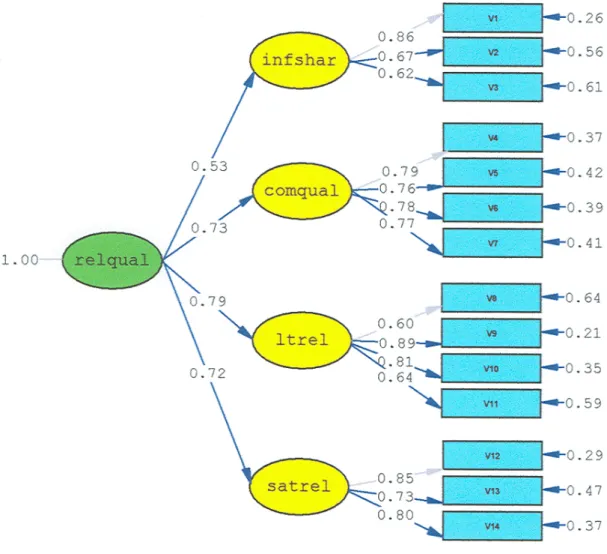
A second-order factor model of RELQUAL is also estimated. This model includes the four first-order factors of amount of information sharing in the relationship, communication quality of the relationship, long-term relationship orientation, and satisfaction with the relationship, along with their standardized coefficients, observable indicators and measurement errors.
*************************************** Insert Figure 1 about here
***************************************
Each of these first-order factors has significant (p<0.001) loadings of .53, .73, .79 and .72, respectively, on the second-order factor. Although the chi-square for the second order model is significant (χ2=126.82, 73df, p<.05), the CFI and IFI are .92, and the TLI is .90. The chi-square difference test between the first-order and second-order models is non-significant
(∆χ2= 0.85, ∆df= 2, p>.10). Overall, this suggests that the higher order model accounted for the data well. Further evidence is demonstrated by inspecting the correlations between the four constructs. All correlations are significant at p<0.001 and the coefficients are large and positive, indicating that the four scales converge on a common underlying construct
(Cadogan, Diamantopoulos, and De Mortanges, 1999).
Research Limitations
Some research limitations should be acknowledged. First, the final instrument may have created common method variance that may have inflated construct relationships. This could be particularly threatening if the respondents were aware of the conceptual framework of interest. However, they were not told the specific purpose of the study, and all of the construct items were separated and mixed so that no respondent should have been able to detect which items were associated with which factors (Jap, 2001; Lages and Jap, 2003; Lages and Lages, 2004). Additionally, if common method bias exists, a CFA containing all constructs should produce a single method factor (Podsakoff and Organ, 1986). The goodness-of-fit indices (CFI=.62, IFI=.63, TLI=.55) indicate a poor fit for the single factor model, which suggests that biasing from common method variance is unlikely.
Another possible limitation is that the data incorporate only the view of one player (the exporter) in the exporter-importer relationship, not considering views from the other side of the dyad. Nevertheless, such an approach would be particularly difficult, since the other side of the dyad is located in different foreign countries. A final limitation is associated with the small size of the sample. Consequently, the results should be regarded as suggestive rather than conclusive.
Implications and Directions for Future Research
The quality of a relationship is central to export marketing practice and research, as the latest developments demonstrate. While testing nomological validity, our empirical findings demonstrate that the quality of a relationship in an exporting context is strongly associated with different dimensions of export performance. Hence, by using the RELQUAL scale to assess the quality of a relationship, managers may better understand relationships’ main constituent elements, so that they may handle them more efficiently. By defining strategies and actions that address potential problems with relationship quality, managers might ultimately influence their firm’s performance.
The hierarchical structure of the RELQUAL scale also presents theoretical implications to the exporting and relationship marketing literatures. Although we cannot claim to have fully captured the dimensions of relationship quality, it may be argued that we are close to it because the second-order factor extracts the underlying commonality among dimensions. In addition to obtaining respondents’ evaluations of the four dimensions, the second-order factor model captures the common variance among them, reflecting an overall assessment of relationship quality with the importer.
As relationships in an international context transcend national boundaries, unlike relationships in a domestic context, they are much more affected by social, cultural and other environmental differences. Hence, it would be important to test the RELQUAL scale in other international settings in order to assess its stability across different samples and contexts. It is worth studying other types of relationship; would the same scale items hold together, for example, in a buyer-supplier or franchiser-franchisee relationship as they do in the current research? When applying it to different contexts, we encourage researchers to add new items and factors in order to continue refining the RELQUAL Scale. Future research is encouraged to develop a performance scale for the other side of the dyad --the importer--. This approach
will be particularly difficult if the other side is an individual consumer, as opposed to an organizational customer (Lages and Jap, 2003). Finally, additional research is required when analyzing the antecedents and consequences of RELQUAL. In addition to performance, it is necessary to investigate how the RELQUAL scale is related to other established constructs in the marketing field, such as trust, loyalty, commitment, cooperation, and transaction-specific investments.
In sum, this research creates the RELQUAL scale that measures relationship quality in export market ventures. At a time when researchers are challenged to present studies with practical implications (MSI, 2004), we expect that the RELQUAL scale is able to align real world constraints with methodological soundness and, consequently, contribute to further advancement of the fields of exporting and relationship marketing.
1.
TABLE 1: THE RELQUAL SCALE
CONSTRUCTS, SCALE ITEMS AND RELIABILITIES
Notes:
α = Internal reliability (Cronbach, 1951)
ρvc(n) = Variance extracted (Fornell and Larcker, 1981)
ρ= Composite reliability (Bagozzi, 1980)
Question: With regard to your exporting venture, what is your opinion concerning the following statements: α / ρvc(n) / ρ
infshar: Amount of information sharing in the relationship .75/.52/.76
(Adapted from Cannon and Homburg, 2001)
V1 This importer frequently discussed strategic issues with us.
V2 This importer openly shared confidential information with us.
V3 This importer rarely talked with us about its business strategy (R).
comqual: Communication quality of the relationship .86/.60/.86
(Adapted from Menon, Bharadwaj and Howell, 1996; Menon et al., 1999)
V4 The parties involved had continuous interaction during implementation of the
strategy.
V5 The strategy’s objectives and goals were communicated clearly to involved and
concerned parties.
V6 Team members openly communicated while implementing the strategy.
V7 There was extensive formal and informal communication during
implementation.
ltrel: Long-term relationship orientation .81/.55/.83
(Adapted from Ganesan, 1994)
V8 We believe that over the long run our relationship with the importer will be
profitable.
V9 Maintaining a long-term relationship with this importer is important to us.
V10 We focus on long-term goals in this relationship.
V11 We are willing to make sacrifices to help this importer from time to time.
satrel: Satisfaction with the relationship .83/.62/.83
(Adapted from Kumar, Stern and Achrol, 1992)
V12 Our association with this importer has been a highly successful one.
V13 This importer leaves a lot to be desired from an overall performance standpoint (R).
V14 Overall, the results of our relationship with the importer were far short of
expectations (R).
Notes:
α = Internal reliability (Cronbach, 1951);
ρvc(n) = Variance extracted (Fornell and Larcker, 1981)
ρ= Composite reliability (Bagozzi, 1980);
TABLE 2:
RELATIONSHIP QUALITY AND EXPORT PERFORMANCE
Financial Export Performance Strategic Export Performance Satisfaction with Export Venture 1. Amount of information sharing
in the relationship 0.39** (3.81) 0.30** (2.86) (2.40) 0.25* 2. Communication quality in the
relationship 0.43** (4.53) 0.23* (2.22) 0.43** (4.82) 3. Long-Term relationship orientation 0.35** (3.48) 0.24* (2.34) 0.42** (4.60) 4. Satisfaction with the relationship 0.71**
(10.74) 0.39** (4.10) (12.38) 0.73** *p<.05; ** p<.01 (two-tail test)
Notes:
• Numbers outside parentheses are the coefficients. • Numbers in parentheses are the t-values.
FIGURE 1: THE RELQUAL SCALE-
References
Aaker D. A., Kumar V., Day G. S. Marketing Research. New York: John Wiley & Sons, 1998. Anderson J. C., Narus J. A. A model of distributor firm and manufacturer firm working partnerships.
Journal of Marketing 1990; 54 (1): 42-58.
Anderson E., Lodish L., Weitz B. Resource allocation behavior in conventional channels. Journal of Marketing Research 1987; 24 (Feb): 85-97.
Anderson J. C., Narus J. A. A model of the distributor's perspective of distributor-manufacturer working relationships. Journal of Marketing 1984; 48 (Fall): 62-74.
Armstrong J., Overton T. Estimating nonresponse bias in mail surveys. Journal of Marketing Research 1977; 14 (3): 396-402.
Bagozzi R. P. Causal Models in Marketing. New York: John Wiley, 1980.
Bejou D., Wray B., Ingram T.N. Determinants of relationship quality: an artificial neural network analysis. Journal of Business Research. 1996; 36 (2), 137-43.
Berry L. L. Relationship marketing of services – growing interest, emerging perspectives. Journal of Academy of Marketing Science. 1995; 23 (4) 236-45.
Bialaszewski D., Giallourakis M. Perceived communication skills and resultant trust perceptions within the channel of distribution. Journal of the Academy of Marketing Science 1985; 13 (2): 206-217.
Bleeke J., Ernst D. Collaborating to Compete. New York: John Wiley & Sons, 1993.
Cadogan J. W., Diamantopoulos A., de Mortanges C. P. A measure of export market orientation: scale development and cross-cultural validation. Journal of International Business Studies 1999; 30 (4): 689-707.
Calantone R., Schatzel K. E. Strategic foretelling: communication-based antecedents of a firm's propensity to preannounce. Journal of Marketing 2000; 64 (1): 17-31.
Cannon J. P., Homburg C. Buyer-supplier relationships and customer firm costs. Journal of Marketing, 2001; 65 (Jan): 29-43.
Churchill G. A. Jr. A Paradigm for developing better measures of marketing constructs. Journal of Marketing Research 1979; 16 (Feb): 64-73.
Churchill G. A. Jr. Marketing Research: Methodological Foundations. Chicago: The Dryden Press, 1995.
Cronbach L. J. Coefficient alpha and the internal structure of tests. Psychometrika 1951; 16: 297-334. Crosby L.A., Evans K.R., Cowles D. Relationship quality in services selling: an interpersonal
influence perspective. Journal of Marketing 1990; 54 (3): 68-81.
Cross E. M., Chaffin W. W. Use of the binomial theorem in interpreting results of multiple tests of significance. Educational and Psychological Measurement 1982; 42: 25-34.
Diamantopoulos A. From the guest editor. Journal of International Marketing 1998; 6 (3): 3-6. Dorsch M. J., Swanson S. R., Kelley S. W. The role of relationship quality in the stratification of
vendors as perceived by customers. Journal of the Academy of Marketing Science, 1998; 26 (2): 128-142.
Duncan T., Moriarty S. E. A communication-based marketing model for managing relationships. Journal of Marketing, 1998; 62 (2): 1-13.
Dwyer F. R., Oh S. Output sector munificence effects on the internal political economy of marketing channels. Journal of Marketing Research, 1987; 24 (4): 347-58.
Etgar, M. Sources and types of intrachannel conflict. Journal of Retailing 1979; 55 (Spring): 61-78. Farace R., Monge P., Russell H. Communicating and Organizing. Reading, MA: Addison-Wesley
Publishing Company, 1977.
Fornell C.D., Larcker F. Evaluating structural equation models with unobservable variables and measurement errors. Journal of Marketing Research 1981; 18 (Feb): 39-50.
Frazier Gary L. On the measurement of interfirm power in channels of distribution. Journal of Marketing Research 1983; 20 (May): 158-166.
Ganesan Shankar. Determinants of long-term orientation in buyer-seller relationships. Journal of Marketing 1994; 58 (April): 1-19.
Gerbing D. W., Anderson J. C. An updated paradigm for scale development incorporating
Geyskens Inge, Steenkamp Jan-Benedict E. M., Kumar Nirmalya. A Meta-Analysis of Satisfaction in Marketing Channel Relationships. Journal of Marketing Research 1999; 36 (2): 223-238. Hennig-Thurau T., Klee A. The impact of customer satisfaction and relationship quality on customer
retention: a critical reassessment and model development. Psychology and Marketing 1997; 14 (8): 737-764.
Hunt Shelby, Nevin John. Power in a channel of distribution: sources and consequences. Journal of Marketing Research 1974; 11 (May): 186-193.
Jap, S. D. “Pie sharing” in complex collaboration contexts. Journal of Marketing Research, 2001; 38 (Feb): 86-99.
Jap S. D., Ganesan S. Control mechanisms and the relationship life cycle: implications for
safeguarding specific investments and developing commitment. Journal of Marketing Research 2000; 37(May): 227-245.
Jöreskog K. G., Sörbom D. LISREL 8: Structural Equation Modeling with the SIMPLIS Command Language. Hillsdale NJ: Lawrence Erlbaum Associates, 1993.
Katsikeas C. S., Leonidou L. C., Morgan N. A. Firm-level export performance assessment: review, evaluation, and development. Journal of the Academy of Marketing Science 2000; 28(4): 493-511. Kumar N., Scheer L.K., Steenkamp J. E. The effects of supplier fairness on vulnerable resellers.
Journal of Marketing Research, 1995; 32 (1), 5-65.
Kumar N., Stern Louis, Achrol Ravi. Assessing reseller performance from the perspective of the supplier. Journal of Marketing Research 1992; 29 (5): 238-253.
Lages Luis Filipe, Jap Sandy D. The relationship among past performance, marketing mix adaptation, and current export performance improvement in global marketing relationships. Proceedings of the MSI/IJRM Competition, Conference on Global Marketing 2003, Noordwijk, Netherlands:
Marketing Science Institute.
Lages L. F., Lages C. R.. The STEP scale: a measure of short-term export performance improvement. Journal of International Marketing 2004; 12 (1): 36-56.
Lages L. F., Montgomery D. B. Export performance as an antecedent of export commitment and marketing strategy adaptation: evidence from small and medium sized exporters. European Journal of Marketing 2004; in print.
Lush Robert. Sources of power: their impact on intrachannel conflict. Journal of Marketing 1976; 13 (Aug): 382-390.
MacKenzie S. B., Podsakoff P. M., Rich G. A. Transformational and transactional leadership and salesperson performance. Journal of the Academy of Marketing Science 1999; 29 (2): 115-134. Matsuno Ken, Mentzer John T., Rentz Joseph O. A refinement and validation of the MARKOR scale.
Journal of the Academy of Marketing Science 2000; 28(4): 527-539.
McNeil Ian. The New Social Contract, an Inquiry into Modern Contractual Relations. New Haven, CT: Yale University Press, 1980.
Menon A., Bharadwaj S. G., Adidam P. T., Edison S. W. Antecedents and consequences of marketing strategy making: a model and a test. Journal of Marketing 1999; 63 (Apr): 18-40.
Menon A., Bharadwaj S. G., Howell R. D. The quality and effectiveness of marketing strategy: effect of functional and dysfunctional conflict in intraorganizational relationships. Journal of the Academy of Marketing Science 1996; 24 (Fall): 299-313.
Mohr J., Nevin J. Communication strategies in marketing channels: a theoretical perspective. Journal of Marketing 1990; 50 (Oct): 35-51.
Mohr J., Fisher R., Nevin J. Collaborative communication in interfirm relationships: moderating effects of integration and control. Journal of Marketing 1996; 60 (3): 103-115.
Morgan R.M., Hunt S.D. The commitment-trust theory of relationship marketing. Journal of Marketing, 1994; 58(3): 20-38.
MSI (2004), http://www.msi.org/msi/rp0204.cfm#Overview
Payne A., Christopher M., Clark M., Peck H. Relationship marketing – key concepts. In: Relationship Marketing for Competitive Advantage: Winning and Keeping Customers, Oxford: Butterworth-Heinemann, 1995.
Pressey Andrew D., Mathews Brian P. Barriers to relationship marketing in consumer retailing. Journal of Services Marketing 2000; 4(3): 272-286.
Roberts K., Varki S., Brodie R. Measuring the quality of relationships in consumer services: an empirical study. European Journal of Marketing 2003; 37 (1/2): 169-196.
Ruekert R., Walker O. Marketing's interaction with other departments. Journal of Marketing 1987; 51 (Jan): 1-19.
Rusbult Caryl, Verette Julie, Whitney Gregory, Slovik Linda, Lipkus Isaac. Accommodation processes in close relationships: theory and preliminary empirical evidence. Journal of Personality and Social Psychology 1991; 60 (1), 53-78.
Samiee Saeed, Walters Peter G. Relationship marketing in an international context: a literature review. International Business Review 2003; 12 (2): 193-214.
Sheth Jagdish, Parvatiyar Atul. Toward a theory of business alliance formation. Scandinavian International Business Review 1992; 1 (3): 71-87.
Sheth Jagdish, Parvatiyar Atul. The evolution of relationship marketing. International Business Review 1995; 4 (4): 397-418.
Shoham A. Export performance: a conceptualization and empirical assessment. Journal of International Marketing 1998; 6(3): 59-81.
Steenkamp J. E., Van Trijp H. C. The use of LISREL in validating marketing constructs. International Journal of Research in Marketing 1991; 8(4): 283-299.
Styles C. Export performance measures in Australia and the United Kingdom. Journal of International Marketing 1998; 6 (3): 12-36.
Weick K. E. Theorizing about organizational communication. In: Jablin F. M., Putman L.L., Roberts K.H., Porter L.W. Eds. Handbook of Organization Communication, Newbury Park, CA: Sage, 1987. pp. 97-122.
Zou S., Taylor C. R., and Osland G. E. The EXPERF scale: a cross-national export performance measure. Journal of International Marketing 1998; 6 (3) 37-58.