A Work Project, presented as part of the requirements for the Award
of a Master Degree in Management from the NOVA – School of
Business and Economics.
THE MICROFOUNDATIONS OF IMPROVISATION
DIOGO LUÍS LOPES LEÃO & Nº27372
A Project carried out on the Master in Management (International)
Program, under the supervision of: Miguel Pina e Cunha
THE MICROFOUNDATIONS OF IMPROVISATION
Abstract
In the last couple of decades, improvisation has been one of the most mainstream topic in organizational research. A lot has been theorized about, but as per out knowledge, the causes of the events that lead to an improvisation decision have never been systematically studied. NOVA’s move is the object of this study, events and their resolution were collected as they were seen and described by the responsible actors.
We suggest that one of the main causes is the lack of stewardship, which manifests as lack of planning (time, people, materials), subpar prioritization and/or implementation.
Keywords: Improvisation; Event Causes; Organization Resolution; Stewardship
Table of Contents Introduction ...3 Literature Review ...5 Routines ...5 Improvisation ...8 Conflict ...10 Methodology ...12 Findings ...15 Discussion ...20 Routines ...20 Improvisation ...21 Conflict ...24 Conclusion ...25 Limitations ...26 Appendix ...27 References ...37
Introduction
In every organization, planning is a key part of the strategy to succeed. However, externalities happen and not everything is going to work out the way people think it will. People, organizations or the environment itself can have an impact in the planning and what was outlined isn’t carried out the way it was envisioned previously. It is utopic to think that the first plan designed isn’t going to be adapted and everything will be done without alterations. Therefore, improvisation comes into place. Making decisions on the spot is a vital part in every organization and no one can survive without having the right skills to adapt to new situations that will eventually emerge. In this ever changing word, being resilient is a must and that adapts not only to people but also to organizations (Hadida and Tarvainen 2014).
NOVA School is expected to change locations, from Campolide to Carcavelos. With such a big investment of close to 50€ million (16€ millions of those are part of financial support given by the European Bank of Investment), this university will expand its capacity of number of students by 700 more than what they have now, to 3200 students (“Escola de Negócios Global No Novo Campus Da Nova SBE Em Carcavelos Abre Em 2017 _ Câmara Municipal de Cascais” 2017).
The university expects to transform itself into an active in the Portuguese exports. With already around 40 nationalities, it expects its internationality to increase and therefore enhancing its overall image abroad. The big step, and one that NOVA is considering, would be to attract students in the bachelor level, increasing their competitive advantage. Although the biggest objective seen from the outside might be the higher number of international students, this campus change will also contribute to an increasing number of NOVA’s investments in education, research and innovation (“Nova School of Business and Economics Recebe 16 Milhões de Euros Para Construção de ‘campus’ - Atualidade - SAPO 24” 2017).
4 Looking at some statistics, it’s visible the increasement of internationality in NOVA. In 2017/2018 there were 2246 international applications compared to the 1802 applications registered in 2016/2017, which gives us a quick view of the focus NOVA has been putting on internationality (“The Project - Nova SBE Carcavelos Campus” 2018).
According to “Escola de negócios global no novo Campus da Nova SBE em Carcavelos abre em 2017 _ Câmara Municipal de Cascais,” (2017), Santander, Câmara de Cascais, Família Soares dos Santos, Grupo Jerónimo Martins are some of the many players that are part of this big investment.
However, with a responsibility towards the financers and the necessity of having the university ready to operate in the new location by August (beginning of the school year for students with bridging courses), there comes the need to plan and be sure to stick to it as much as possible, since there isn’t enough time to change courses of action. Even having all of this in mind, change happens and there is the need to improvise the routines that are established in NOVA in their location in Campolide.
NOVA’s move is the object of study in this project. Our first goal is to identify those events where improvisation occurred. More important than the events are the reasons for those to happen, our second goal. Finally, our third goal is to define the events (using the known theoretical framework), and to create a wealth of knowledge to work as a future resource of the organization. Improvisation of today is the routine of tomorrow (Feldman and Pentland 2003). At a detailed level, we want to answer questions like: Did the events happened because it was lack of planning or was it the implementation? Or the prioritization? Or the right people inclusion? Did the environment change and those events rose up?
In responding to the third research question, it is important to consider that even though two problems might be related (similar theme), the solution can be completely different.
This project was carried out as a process organizational research. It is considered to be an open process, since the events are sensible to time and change, with the main focus being on the unexpected problems.
Considering a problem that emerges outside of the ordinary, improvisation is carried out, and if a good solution emerges, the organization could take it as an anchor and use it (even if a few parts) for other emerging problems. However, for this to work, there needs to be a good identification process of those parts. Above all, organizations want to figure out how to learn from improvisation - organizational learning (Feldman 2000). If there is a problem, the organization should look at if they have a routine. If they do, use it, if not, improvise (Feldman and Pentland 2003).
Feldman and Pentland (2003) also state that there even might be problems that require routines to keep modifying, which are also interesting to identify and try to take them into account when studying improvisation.
This work is organized as follows. Next section, Routines, Improvisation and Conflict will be reviewed. It will be followed by a description of the methodology used, the findings and the discussion of what was found. Lastly, there will be a conclusion section, followed by the limitations and how to move forward from here.
Literature Review Routines
Feldman (2000) states that organizational routines involve people doing things, reflecting on those things and doing them differently. Routines are a source of continuous change, not just stability. Many organizations look at routines as something stable, which promotes a sense of consistency to the people enacting it, difficult to change. However, routines might change as
6
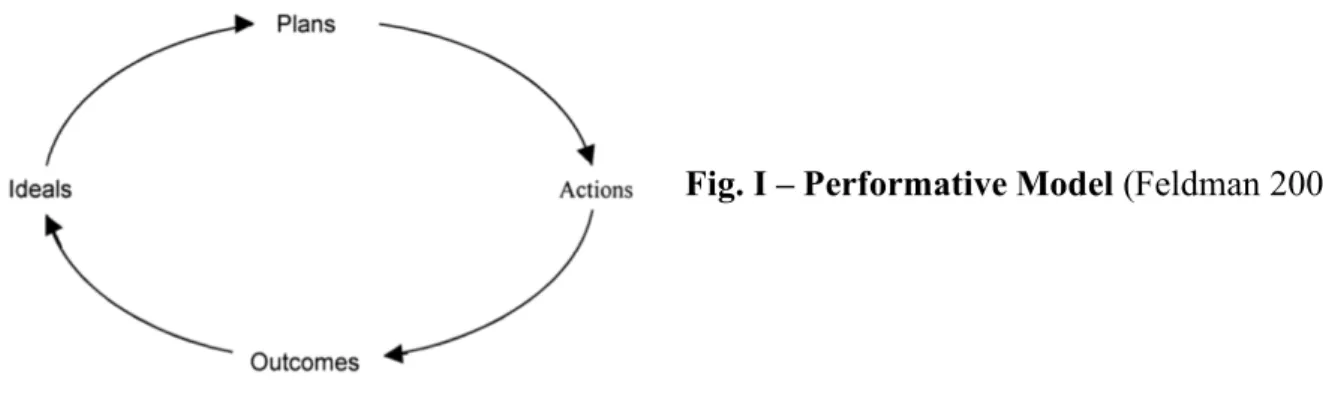
Fig. I – Performative Model (Feldman 2000)
It is stated by Feldman (2000) that variation is a common part of organizational routines, since they are effortful accomplishments, not something done mindlessly. This is also talked about by Feldman (2003), which states that stability can occur not only because of conscious efforts made by organizational participants, but also with mindless efforts, where participants have everything already mechanized and don’t evaluate what they are doing in a thought matter. This paper also states that work practices, like organization routines, are also emergent accomplishments, most times works in progress rather than finished products. It says that relevant performances create understandings of how the organization operates, which guides performances in a specific routine (Fig. II).
Fig . II – Interactions of Performances and Understandings (Feldman 2003)
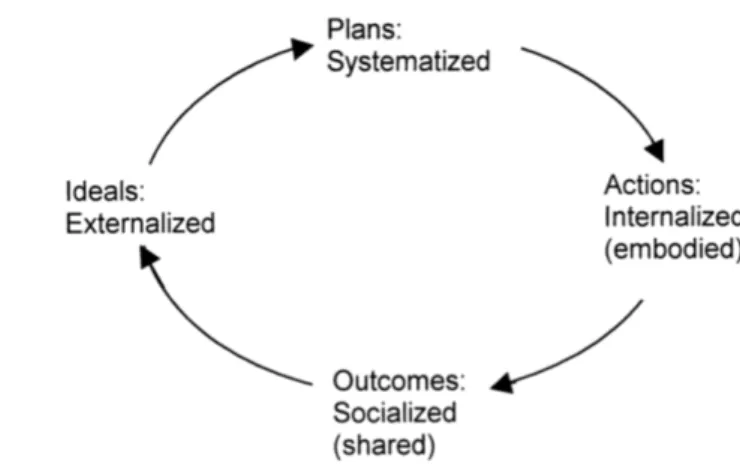
Regarding the transformation of routines, there is a performative model of “Learning in Routines” that says that actions are internalized, then outcomes shared, afterwards ideas are
externalized and finally plans are systematized (Feldman, 2000). These four elements work in a loop (Fig. III).
Fig. III – Performative Model of Learning in Routines (Feldman 2000)
According to Feldman & Pentland (2003), routines arise because they minimize cost and increase managerial control, still maximizing legitimacy of the organization, with the ostensive aspect being related with managerial interests (dominance) and the performative aspect with the interests of labor (resistance). On the one hand, they have a structure, but on the other hand, the actions bring the routine to life, and those actions create, maintain and modify the structure (ostensive part). It even goes into depth on these two topics, saying that without the ostensive part we can’t see, check or reproduce the patterns of activity, and without the performative nothing happens. However, it is easy to confuse the ostensive aspect with the whole routine. In routine formulation, a strategy is needed, in order for the routine to be in line with the organization’s objectives. According to Jarzabkowski (2005) there are two parts in taking a practice view on strategy, with both the structure and the agency taking part of it. This shows that the routine isn’t just the plan, but also the action behind it and the people enacting it, corroborating what was said in the papers mentioned above.
This is also stated by Claus Rerup (2011) when it is said that performative actions are performed by certain individuals at certain times, and because it is done over time, these actions
8 form ostensive patterns. Routines are influenced by changes in the incumbents (ideas and mistakes of them) and by the jobs themselves.
In order to dive into routines and trying to understand them, Claus Rerup (2011) states that these can be broken into parts, exposing the microfoundations of the observable actions rather than treating them as entities. These actions are what form the enacted schema, which transform intention into cognition and action.
As we can see from above, sometimes routines change as a continuum, while other times in a disruptive way. These changes may call for improvisation and can affect a routine that is not of great importance or one that affects the structure of the organization (Hadida and Tarvainen 2014).
Improvisation
Improvisation is defined, according to Cunha & Cunha (2003), as an action planned as it unfolds, which draws on the available resources. This is corroborated by Hadida & Tarvainen (2014), which state that improvisation involves dealing with the unforeseen without preparation, which is something that organizations might consider to be beneficial.
According to Feldman (2000), there are some new beginnings or major transitions that incentivize to change the way things are carried out. It is also vital do be able to manage continuous but unpredictable change, so organizations can identify change and patterns on it, so the solving of the situation by improvising is as effective as possible.
In Hadida and Tarvainen (2014) there is a comparison of improvisation within the organizations and improvisation in jazz. Here, it is reiterated that there needs to be an optimal balance between structure and flexibility. Many jazz players have certain keys that they play constantly when enter the improvisation stage, with the rest being improvisation. This means that, even though they are improvising, the players go to a small routine that is constantly
changing. Every company, when improvising, should be able to, when confronted with a new problem that cannot be solved by the current established solutions, have some pieces of solutions, so it is easier to solve the problem. In the case of big projects, many companies adopt this “jazz concept”, dividing them into smaller parts, with different teams, and responding to the different events with some small pieces of routines already in place and improvising what is needed.
In order to study strategy making and, as a consequence, improvisation, it is also important to dive into strategy as practice. According to Jarzabkowski (2005), the world needs to be understood with the actors and processes and not independent of them. This means that firms can’t just think of the strategy itself but also who makes them and the processes that makes them viable. If we think of the people, it will be easier to understand improvisation, because they are the ones doing it. In the same paper, a question appears of whether there should be a combination of practices in a certain sequence or if there are certain practices that lead to more favorable outcomes.
Shared temporal cognitions lead to a higher team performance, which is mediated by team improvised adaptation and moderated by team learning behavior (Abrantes et al. 2018). There are two different types of adaptation, improvised and preemptive and these two types of adaptation are differentiated by timing. Improvised adaptation involves making decisions in real-time (design and execution converge in time), while preemptive implies a period of time to reflect and then make the decision (design precedes execution). This was based on a paper by Cunha & Cunha (2003), which states that improvisation is a case of dialectical change because planning and action are done together in real-time. Hadida & Tarvainen (2014) also talk about this same concept, where it is said that improvisation is deciding while acting, not before.
10 When responding to a disruption, according to Abrantes et al. (2018), team adaptation consists of adjustments to relevant team processes. Higher-time pressure imposed by team improvised adaptation processes leads teams to explore more radical alternatives, further away from pre-established routines.
Cunha & Cunha (2003) dive into what leads to these changes, stating that incremental changes may lead to considerable organizational alterations in a short period of time. Emergent changes can be deliberately leveraged to benefit the organization.
According to this same paper, whenever generating a new routine in response to an unlike event, this can come from conversation or action. Either way, it will be tested in a not yet seen event, and if it works and kept into being used regularly, it will become a routine. This way, an improvisation will transform itself into a routine.
According to Hadida & Tarvainen (2014), improvisation brings, autonomy, innovation, motivation, feelings of success and overall stronger teams, which is something to strive for every time.
Conflict
Conflict leads to improvisation, and a paper from DeChurch & Marks (2001) stated that conflict was a process in which a certain party considers that their interests are being negatively affected or even opposed by another certain party. According to this paper, there can be task-related conflict and relationship conflicts, with one being task-related with the task at hand the other between the people acting it.
Mintzberg, Raisinghani, & Theoret (1976) refer decision processes as unstructured if they haven’t been encountered in similar form and for which no predetermined and certain set of responses are present in the organization. The same paper also states that decisions run along a continuum, with opportunity decisions (voluntary) in one end and crisis decisions (response
to intense pressures) at the other. This same paper states that decisions taken throughout an organization might also be classified by solutions in four ways, fully-developed, ready-made, custom-made and a combination between the last two.
In order to start fixing a conflict that might emerge from a change in the routines, DeChurch & Marks (2001) states that there are five styles of conflict management, avoiding, compromising, collaborating, competing and accommodating. According to Feldman (2003), the organization needs to be cooperative, with everyone working together, discussing the needs and arriving to a joint decision, with not many power differences, since those diminish the capacity to negotiate, and stewardship, which means that there’s a sense of responsibility.
On the same note, and according to Marks, Mathieu, & Zaccaro (2001), there needs to be a mission analysis, where all the members have a shared vision of the purpose and objectives and all of them understand the causes of previous performances so they can better prepare for future efforts and avoid any kind of conflict. After this analysis, there’s a need of specifying the goal and aligning it to strategies in order to attain it, as well as the timelines associated with goal accomplishment (Fig. IV). Before the action itself, there’s only left strategy formulation and planning, with the development of alternatives and having to take into account the changing of the environment. Inside the
planning, we have the deliberate one, which is the actual course of action, the contingency plan and the reactive strategy, which is the alteration of the existing strategy.
12
Fig. IV – Manifestation of Processes in Transition and Action Phases (Marks, Mathieu,
and Zaccaro 2001)
Abrantes et al. (2018) states what is previously said by Han and Williams (2008), and that is that there is a need to be able to cope with change for individuals to adapt.
Methodology
The campus change is a very complex and dynamic process. Given that, even with a solid plan, there are events that happen along the way that require improvisation. Since this campus change is such a big project/investment, it is necessary to be thorough and analyze every event that comes up, being it with small or big importance. In order to know when these events that open the improvisational process happen, why they happen and how organizations respond, regular meetings were scheduled with the responsible for the change.
Before the meetings, especially before the first one, there was a significant preparation to be done, since there was a first question to ask, related with the events that transpired in each meeting, with the most important preparation being related with the follow-up questions about each event. First, a question was asked, so the responsible would describe the events that had happened at that time, as well as the resources involved, relevance of them, cause and finally the resolution. As the meetings went along, the head of the campus change would add more details to the already existing events, as well as new events that might had come up in between meetings.
After five meetings, significant information was collected, and after its screening, a table was constructed (Table I) in order to systematically organize the data. In order to decide which categories to include in this data collection, we had to look at the research questions. To know
when the events that promote the improvisational processes happen we needed to include the causes, and for the reason for them to happen, we needed to know what were the resources included, as well as the relevance of those events. The resolution category was included in order to understand how the organizations deal with improvisation. After gathering the data, the events were organized into those categories and then analyzed.
Analyzing what goes on with the change from the beginning of the year and finding patterns is a key part of this project.
Unlike some of the studies held in some of the articles about improvisation, where there was experimentation first, this study is naturalistic, meaning that data that was already in place was used, analyzing it and finding patterns, which will be done in the next section and will help us answer the research questions stated above.
Findings
After the meetings were held, a table was built, with nine major events that were worth mentioning: 1) Psychologist, 2) Strategy Change in Mobility/Housing, 3) Change in Library, 4) Change in IT, 5) MBA not contemplated in the blueprint, 6) Staff Distribution, 7) Student Communication, 8) Office Changes, 9) Sustainability.
According to Mintzberg, Raisinghani & Théorêt (1976), when we are faced with a complex and new situation, the decision maker should divide the main decision into smaller parts, which was done in our case in order to be easier to find patterns.
Episode 1) Psychologist
Situation pre-event: In one of the meetings held, the responsible for the change pointed out that the architect she had been talking to had a certain vision for the building, where more light would come in. However, there needs to be a psychologist in the university, in order to help students with any problems, academic or personal. Since the issues are of a more private matter, there need to be materials that promote comfortableness and privacy.
Event: As those two realities could not exist together, an improvisation event occurred. Subevents emerge from this matter, on the one hand the architect wanted to change locations and simply put the psychologist’s office in another place. On the other hand, the head of the campus change already had laid out all the spots and couldn’t afford to keep changing them (besides that, other locations were not appropriate, either because of the size or the location). Solution: A compromise was reached by creating an opaque and sound proof partition (plasterboard). However, it is of great importance to point out that what seems to be a minor change for the people observing these events, might be major for the architect.
16 Episode 2) Strategy Change in Mobility/Housing
Situation pre-event: In the first and second meetings, the head of the campus change stated that she was looking into Housing options, speaking with Uniplaces and Cascais’ Townhall. Event: Out of this event, three subevents emerged. a) There was a survey held that concluded that 75% of the students lived in Lisbon. b) There were also meetings scheduled with CP, Mobi Cascais, Metro and Carris and even a bus that was being considered to take the students and staff from a given meeting point in Lisbon to the university. c) Another subevent, also related with Mobility, refers to the difficulty of people living in “margem sul” finding transportation and the few options available are expensive.
Solution: There was a major strategy change in Mobility/Housing. Even though Housing was still being looked into, the team decided to change strategies and put more emphasis on Mobility. Finally, there were also talks with Uniplaces and Cascais’ townhall, concluding that there were not enough houses available. The survey was the primary cause for this major switch.
b) The meetings with companies were the way to resolve the situation and to try to find a cheap and efficient way to make this transportation happen and relax the impatient students, staff and parents.
c) There were several companies that approached NOVA, but almost all of them rejected servicing individuals from “margem sul” for it being so far away, to which NOVA replied that there might be a need for a small transport for those people living in that area in case the companies want to reconsider.
Episode 3) Change in Library Situation pre-event: None.
Event: Inside this theme, there were three subevents. a) Sean Story, the head of the library, left due to personal issues. He had been with NOVA for many years, not only coordinating the library but also doing some workshops throughout the whole university.
b) A library in an university is something of huge relevance, since it is not only the place where students study and work, but also make a lot of their research for many assignments. Because of that, the materials need to be of a specific kind and a lot of discussions needed to be had with the architect related to this topic. c) A lesser important event happened when it was reported that the furniture was not appropriate for the books, since there was lack of communication between the architect and the library staff.
Solution: a), b) The resolution would be to replace Sean Story for another person with similar academic background. The second in command, would make the “bridge” between Sean Story and the new responsible. c) Make changes after the building is “delivered” to NOVA.
Episode 4) Change in IT Situation pre-event: None
Event: Carlos Paiva, the person in charge of IT, left due to personal issues. This event was of major relevance, since IT is a very important part of an university.
Solution: Even though it isn’t as important as the library, finding a new person to be encharge (recommended by former responsible) is important. That was eventually achieved and the resolution for this event was Carlos staying for one more month in order to make the transition between himself and the new responsible for the IT at NOVA.
18 Episode 5) MBA not contemplated in the blueprint
Situation pre-event: MBAs were not contemplated in the blueprint. Because NOVA and CATÓLICA have an arrangement in which the MBAs are held for 6 months in each university, the space in the new campus was not considered.
Event: In order to resolve this, there needed to be held a meeting between the MBAs and the Executives in order to have a sharing of the rooms. However, there was a problem related with the fact that the space was concessioned to the executives, which means that they pay to use it and might not agree to give some of it to the MBAs.
Solution: In order to negotiate, Paulo Bastos, a person linked with both parties, proposed to be him mediating the meeting.
Episode 6) Staff Distribution
Situation pre-event: Since this is a new location, different layout and communication system and specially an “open space” concept, the places where each employee was going to be placed were still yet to be defined.
Event: Not only did this topic relate with communication to the staff, but also the distribution of each staff member and even more specifically, the view.
Solution: The responsible for the campus change took around 50 senior staff members to the new campus and showed them a presentation with all the details. There is still a need for the architect to give the layout so it can then be given to the staff. That way, a nice atmosphere was created and there was less anxiety, since people got to know the campus change in a more “real way”.
Episode 7) Student Communication Situation pre-event: None.
Event: There have been many students calling NOVA and asking about the new campus. During the meetings, it was stated that, because this was an ongoing process and the university wasn’t informing the students, staff and parents about the whole situation and how it was going to develop until August (since there were no “closed issues”, NOVA didn’t want to mislead by giving information that might be changed).
Solution: Physical sessions were organized, as well as emails were sent in order to inform and keep everyone up to date.
Episode 8) Office Changes
Situation pre-event: Because this is a whole new campus, all the locations are going to change and there is a need to allocate each department to a designated area.
Event: There was a specific situation in which there wasn’t enough space on the admissions office for both the staff and the students to sit and wait. The cause for this to happen was, of course, the different space, but also the fact that the whole concept of the university was different, with a huge relevance given to open space.
Solution: An area was arranged in order for students with some kind of problems could reach the admissions office, but not contact with prospect students.
Episode 9) Sustainability Situation pre-event: None.
Event: In the 5th meeting held, sustainability came into conversation, with the responsible for
the campus change stating that a group of students approached her in a pedagogical council meeting and asked if they could be part of the group dealing with this issue for the new campus. This came into question because there are a lot of issues to deal and sustainability wouldn’t be given the amount of attention it needed (too many issues to solve by only a few people).
20 Solution: They were put in contact with the architects so solutions could be designed for the location of garbage cans and trees, gathering of printer paper, recycling, among others.
Discussion Routines
We will present our findings at the light of the existing literature, described at the section of routines, improvisation and conflict.
At first, the biggest assumption of the head of the campus change was that everything would go just like before, using the routines well established, this move would just follow the routine. The routines described had a clear ostensive and a performative part. On the ostensive part there was the whole plan of where the staff would sit on the new campus (specially the psychologist), the way the library and the IT would function, the strategy around mobility and housing, routine of the MBA’s, the process around how to communicate all the procedures about the change to students, the new open system process and the plan for sustainability at the new campus. The performative aspect is all about the actual routine.
Such a big change implied a first layout draft plan, where the main points are covered, but not the details, with very few people involved. With a limited staff (in order not to get distracted by the small details at first) and a big move, with a whole new layout and dynamism, time constrains arise and tasks get done just to get the plan on the move, without attention to detail. Given all this, even though improvisation is not thought of at first, it was needed really quickly, since, naturally, issues (voluntary or not) arose, either related with people (with such big changes, people are bound to leave, it’s inevitable), materials or processes.
Improvisation
Based on the events described above from the naturalistic approach, a process was conducted, in which patterns were found in order to answer the main problem questions of this paper stated above. Given what transpired during the campus change, events that opened up improvisation were mainly disruptive ones, meaning something completely new and/or big.
There is a wealth of literature covering improvisation, but has per our knowledge, the causes of the events that lead to improvisation have not yet been covered, which makes it the main contribution of this paper. The first pattern and reason is lack of stewardship. Even though this topic has been talked about in previous literature on improvisation and routines, it hasn’t been considered as the reason for improvisation. People don’t feel the responsibility for the whole organization “as their own house” (example of the MBA’s not being considered in the original layout), and they care more about personal issues, meaning that instead of wanting the best for the whole organization, they prefer to strive for own personal interests. The second pattern realized was that organizations seem to study the best alternative and carry it out without studying its viability, which means that an option might be really good but the environment makes it non-viable, leaving everyone with a big sense of confusion and stress to find a second alternative in a small time frame.
Given these events, the organization responded the way they thought was the most efficient. They use people, considering their strengths and weaknesses to try and get the most out of them (as an example of the study, Paulo Bastos was the one making the bridge between MBAs and Executives, since he was connected with both of the areas). Looking at people’s interests is also something to consider, in order for them to be motivated into doing their tasks and increase the sense of stewardship. “Picking their battles” is also something to take into account, since there are some situations where improvisation is the best course of action, but in others it might
22 management point of view, prioritizing is vital, since in an organization there are many issues to address, making it very important rank them in terms of importance and time to accomplish (even though some issues not well prioritized might arise and create a problem in the organization that requires improvisation). Having solid contingency plans is the last thing to consider in this topic, because things are bound to alter and having good and valid alternatives is a “safety net” for the organization to fall on if things change more than it can handle. There is also a very interesting phenomenon in this improvisation topic, and that is “improvising the improvisation”. Whenever we need to improvise, other issues arise and we also need to improvise those, making it a “cascade”. For example, when Sean Story left, the university had to improvise and try to fill in such knowledge and experience that was gone by hiring someone that was indicated by Sean Story himself, which made it so it also had to improvise the way the new responsible was going to be prepared to such a highly valuable and important task, and bricolage had to be used (improvise with the resources at hand), with the second in command making the “bridge” between Sean Story and the new responsible, so every type of knowledge would be transferred (even the tacit one, which is harder to do). The same can be said for IT, but this time it would be the former responsible himself, Carlos Paiva, to make that transition between him and the new responsible, Mafalda Barbosa.
We can also dive into materials and locations, not just people. Given the building the architect envisioned and had built for NOVA, there were some changes made, necessary to incorporate everyone and have as much optimization as possible, but on top of that improvisation, there were locations improvised, and for example, the psychologist’s office had to be put a partition to give privacy not only in vision but also in sound.
All of this means that the organizations needs to consider the events that make it improvise, not only because of how they take care of those events, but also how other events might come
up from that change, which might make it hard to deal with and take more time to solve, which is very valuable, especially in time constraining situations in this ever changing environment. The level of improvisation changes according to whoever is considering them. For example, we might think that altering the office of the psychologist is a minor change but the architect could think otherwise, since it would change the whole scheme of things and the building wouldn’t be the same with those new materials.
When analyzing the table: on the 1st event, the psychologist’s office was not completely
thought about before, which is why there were discussions between the architect and the responsible for the campus change related with the location and the materials; the 2nd event
was about the strategy change from housing to mobility, and here there was a poor implementation, since the survey was done too late, and no one thought about the existing options being very few and expensive; the 3rd and 4th events, related with the change in library
and IT respectively, were simply changes in the environment, impossible to be prepared for (even though in the library case, there were some materials not suited for the library, which was caused by no one considering that issue); 5th event was the MBA’s not being contemplated
in the blueprint, caused by no one thinking about that issue; the staff distribution, as well as the student communication (6th and 7th event, respectively) were next, and the problem arose from
the lack of prioritization; office changes was the 8th event, and the problem around them came
from the fact that the right people were not involved, which caused the admission’s office not to have enough space; the 9th and final event was sustainability and that low importance given
to it was due to the fact that it was something well thought about but with low prioritization. These improvisations talked about are done in real-time, with all the events happening and the responsible for the campus change having the design and execution done at the same time, not preemptively. Specially in the strategy change, after the survey, there was no time to consider
24 and the design of the new strategy of “tackling” the mobility was done at the same time as the execution, with talks with companies being done right away.
Specifically in the IT and Library change events, the “Jazz” (Hadida and Tarvainen 2014) concept can be applied, since there were a lot of past components of the routines that continued to be used, but other parts had to be improvised. The processes behind these two areas, mainly the way they were carried out in the organization, stayed the same, while the person carrying them out had to be different, with different approaches that had to be incorporated in this routine (improvised).
Conflict
In order to manage the conflict that lead to the improvisation of the events described above, the responsible for this change used accommodation to incorporate everyone’s opinions into the decision (using surveys and meetings to gather such information from students and staff members). This way, there will higher group effectiveness, as proven in the studies by DeChurch and Marks (2001), since the issues will come out in the open and be resolved much more effectively.
When resolving a conflict, even though all the decisions taken from the head of this campus change were important, with some more important than others, they were not crisis decisions and should be placed closest to the opportunity decisions. It should be emphasized that these 9 major events have different importance among them, in which the psychologist’s location is of lower importance when compared to how students and staff is going to get to the campus (mobility). Therefore, the mobility is closer to a crisis decision and the psychologist’s office is closer to an opportunity decision, but none of them are qualified to be named crisis decisions. Taken all the decisions on the events described above, 4 of them were ready-made, 3 of them were custom and 2 modified (combination between the other two).
Given all these events, everyone related with the campus change, from the architect to the staff, needs to be able to deal with change, because not everything is going to work out 100% well, and having that resiliency will bring the capability of understanding that there’s a need to change and do something different, accept it and try to bring out that change as efficiently as possible.
Conclusion
The concepts stated above are transferable, which means that the findings are applicable to a larger audience. Even though what was found is related to NOVA’s campus change, the patterns found can be generalized. Even though the sample is relatively small, with 9 main events (afterwards divided into sub-events), it is still possible to make reliable grounded theory. Given the table that was made in order to organize and analyze the events that happened during this campus change process, the main reason found for the events that had improvisation as consequence, which are related with timing as well, was the lack of stewardship, which when more detailed can be divided into: no one thought about these events; people thought of it but the implementation was subpar; there was lack of prioritization, even though there was thought about it; didn’t involve the right people, with this last reason being especially important to relate with the importance to have a psychologist present in order to train people to handle this kind of events. These are the microfoundations of improvisation, the pillars of when the events that promote it happen and why they happen.
In order to carry out this improvisation in the most efficient way possible, there can be ready-made, custom-made or modified decisions in response to differently important events.
26 After all of this, any organization should strive to learn from their experiences. Improvising is inevitable, and learning from it should be everyone’s objective.
On this work we found causes to the events that lead to improvisation as well as patterns of how the organization is able to resolve them.
Limitations
This naturalistic study only gave us the events, causes, relevance, resources and resolution, not the whole decision process and how it was carried out. We were able to understand when events that open up improvisational processes happen, as well as why and how the organization responds, but the whole process behind the improvisation wasn’t able to be taken from the meetings. Not only that but also the aftermath, meaning that, due to time constrains, there was an inability to study the developments of that improvisation in the organization and generalize it, trying to find out if and how the organizations adapts the improvisation done for future events.
It is also key to point out that only one type of organization was studied, which means that the way organizations handle events and improvise might be different considering the area in which they are inserted, how old they are, how experienced and how they are managed, among other variables. It is really difficult to generalize the situation and state that there are some patterns that an organization demonstrates, and that’s why it is important to expand the research to other types of organizations.
Appendix 1st Meeting
The first meeting was held on the 10th of January, in order to get a picture of the campus change
right from the beginning of the year until the beginning of the scholar year, in September. Even though this thesis has to be delivered on the 23th of May and defended in the beginning of June, I will continue to analyze the situation until the move to the new campus is fully completed.
When considering such a big move, there are a lot of topics to analyze.
• First one has to do with the functional change, how to adapt the school to a new physical location.
• Secondly, options of mobility for students and staff are needed to be taken into consideration. Contacts with companies are needed, either in terms of new routes or partnering with Brisa, among other ideas that are still being considered (like bikes, electric motorcycles or buses).
• Housing is another key issue that the responsible for the campus change talked about. NOVA is moving to a place where the housing offer isn’t the best and a lot of contacts with logistics are required to be sure that the students and staff have enough options to start the school year without this kind of stress.
• The last point had to do with the scheduling of the effective move. There needs to be a big coordination with several people that occupy different positions, like architects, logistics and everything digital related. The first building will be delivered in the end of February and the most important building will be made available lastly. The actual moving will start in May, but the “house cleaning” of the building NOVA occupies at the moment is already in course.
28 In terms of surprises so far, even though the process is far from completion, it was pointed out the lack of correspondence between services in the actual building and the space in the future one. The school itself has changed a whole lot and the services have expanded. Even after the allocation of the spaces to the respective services, there have been constant changes, like the location of the bus stop or the location of space of meetings with the project being very focused in open space.
2nd Meeting
On the 7th of February a second meeting was held, this time in person and with the person encharged with the campus change. She is the one talking with the engineer, architect and everyone in NOVA, may that be the director of NOVA or anyone from any department. The director asked the responsible for this change to start with this campus change on June 2017. The project itself started about 5 years ago, with very few people knowing about it and actually participating.
This meeting was mainly held to give me a more “hands-on” look at the campus change. Functional:
It was showed me the outline of the buildings, where which department was going to be, as well as all the difficulties in placing them.
The new NOVA campus was designed like a hand, where each finger represented a specific area of the university, like the residencies, bachelors, executives, masters and “24h’s”. In the “palm” there is the admissions building, with a more efficient system, but where the improvisation started already, since there was lack of space, which had to be adapted, without a lounge, which means that students will no longer be waiting inside the room and not only will the exterior part be utilized better, but there will also be a “push” for a more online approach (dividing services between quick and specialized).
One very important concept that was accentuated several times lied on “Open space”, where there was the creation of HUBS that can work as rooms for meetings or other activities (not fixed).
It is very important to mention that there were a lot of spaces that weren't being considered. The graders needed space and there were growing areas, like “Careers”. Therefore, sharing of space was a necessity, which meant that there was a need for discussion and compromise between areas.
One of the main concerns that popped up in this meeting had to do with the MBA. This degree is shared with another university in Portugal (Católica Lisbon), which means that it works six months per year at NOVA. Due to this issue, the MBA was not contemplated in the design of the new campus.
When it comes to the Executive program, even though it is an increasing area, there might be too much space, meaning that some of the rooms could be used as classrooms, but since this is a grant agreement, it is still being discussed by NOVA’s management team.
The responsible for “Pre-experience” had to be positioned in a strategic way to be with the different teams.
Even the furniture had to be thought of: for example, when it comes to the psychologist’s room, the walls had to be opaque and the furniture had to be “sound proof”.
After the rooms and furniture, the food courts were talked about. According to the responsible, there were supposed to be six restaurants, but after analyzing the students’ needs, the management decided to have only four restaurants, but added one supermarket in order for the students to have an alternative to buying from restaurants (also granted). Even a surf store is being negotiated, since the campus is near the sea and NOVA wants to promote the “Portugal lifestyle” to the international student.
30 One of the most pressing questions had to do with whether NOVA had as a big objective to call students at a bachelors’ level or just at a higher level. The head of the move promptly responded that even though that was one of the university’s biggest objectives, due to the lack of similarities between countries at a bachelors’ level, it is mostly targeted at Brazil and Mozambique (has to do with the level of preparation).
One key concept mentioned throughout the meeting had to do with trade-offs. Since there was a need to deal with so many parts, everyone needed to “meet in the middle”, which was something very difficult to attain (for example, since some offices have a “sea view”, there are different departments “fighting” for space).
Mobility:
First of all, there was the “problem” with students with scholarships. There needed to be held a meeting with SAS to solve this issue.
Besides that, there were some talks that were done with Bike, a star-up that consisted of services that include bikes.
The most important issue within mobility had to do with the different companies coming together and form an offer to NOVA of an “all-inclusive service”, so students don’t have to worry with transportation. Carris, Metro, CP and Mobi Cascais are the four companies that are yet to have a meeting members of NOVA, in order to achieve a fair deal for all parts. Besides that, it is of great importance for NOVA to have a bus service that transports staff and/or students from a certain spot in Lisbon to the “University’s door” (NOVA will have a survey to get to know which is the best zone in Lisbon for pick up).
Housing:
This, in my point of view, is the most difficult topic to deal with. Even though NOVA has been in contact with Uniplaces and the Town Hall of Cascais (prospects of residencies), it is really difficult to get something solid done in such a short notice. Plus, it was known from a study
conducted later on that around 75% of students actually live in Lisbon and prefer to, making this topic much less premising (strategy switch to Mobility)
Scheduling:
From this interview, it was clear that this topic was one of the most important when considering improvisation, since there was a plan in the beginning of when to move, and comparing it to when the effective move will be is going to be a topic to analyze carefully.
June, July and August are the three months considered for the move, and even in August there are the Summer courses, which means that it’s not really going to be three full months. This tells me that there is no room for a plan B. The move needs to be taken very carefully and well planned. Of course there will be some bumps along the way, but it’s the way NOVA deals with them that’s going to be interesting to study. Plus, the services’ building will be the last one to be “delivered”, and since that is the one that requires the most planning, it will be extra vital to have everything done so everything is aligned.
3th Meeting
In this meeting, there were some developments related with the issues posed in the previous meeting.
Functional:
There were some minor changes in this area. But even a small change means 2 weeks of planning and discussion. For example, the psychologist’s room had to be more private, and since all the windows were in glass (as thought of by the architect), there had to be discussions in order to have it changed. Everyone came to an agreement of having an opaque division instead of changing the windows (one part wanted a complete change and the other wanted for the psychologist to just move to another room).
32 Health is also an important point in an university, and it is planned to have a doctor come a few hours per week and a nurse be there 24h a day (it’s not 100% certain that 24h will be the final agreement).
Some discussions were held with the student association. They were given a spot and weren’t totally happy with it, but after a meeting with the responsible, which explained the benefits of the new place (near the beach entrance and with a big space outside for “get-togethers”), the student association was convinced.
When it comes to sports, which is also a vital part of students’ lives, the area allocated isn’t going to be ready on time for the change, but it is considered. There will be a gym, which will be granted to a company, meaning that will be paid, and it is still an unknown point how many people will actually be interested in joining.
The Town Hall has a building near where the university will be that is used for sports’ practices, like there are many in Lisbon, and all the good relationships between Cascais’ town hall and NOVA will enable an agreement for students’ to use it.
Mobility + Housing:
Both these areas were talked about together. There was a survey carried out, which concluded that 75% of the students were living in Lisbon at that moment in time. NOVA had in mind a transition in terms of housing from Lisbon to Carcavelos, but that mindset changed and mobility was now more important than even (strategy changed). Uniplaces was contacted, prices were too high and also not enough houses for everyone to go.
The strategy was still to make arrangements for more people to live in Carcavelos, but with so much time pressure, the goal of getting effective mobility was added to NOVA’s objective. Besides that, Cascais is a really expensive area, which makes it unaffordable by many students. Only now, so close to the move, are solutions being analyzed regarding mobility: there was a meeting between CP, Mobi Cascai, CP and Metro, but only the first two came to an agreement
of 60€, but there still is a need for a final agreement of CP and Metro, which are supposed to have an answer the next week. The objective is for students to buy a pass that lets them travel throughout all transportation of these four companies, paying a single fixed fee.
Besides that, Via Verde Boleias (private group of NOVA SBE) is another service “in the works”, which goes together with the bus that NOVA plans on having to pick up students and/or staff in Lisbon and dropping them off in the university.
With all of this, NOVA SBE is able to call itself a “Lisbon school”, which is a big thing when it comes to advertising itself to students, making them more interested if they are able to live in Lisbon.
Students with scholarships, like talked about before, are also an important issue to take care of. After a meeting with the director of SAS (the association) it was known that there is no subsidy of transportation, which makes it important to incorporate in “bolsas BiNOVA” (“social meal” is also something that NOVA had in agreement with at least one restaurant - it’s in the law). There is, however, the Mobility question to close up - to communicate to students (parents are worried and calling).
Scheduling:
In the beginning, many months before the previous meeting, the move of campus was supposed to take place in April. Now, it is for sure going to be in June and July. This means that a whole university has to move in only two months. That seems to be almost an impossible task to everyone, but that’s where improvisation takes place. It is now a certainty that there are going to be improvisations along the way and that the whole move won't be done in time for the Summer courses (bridging courses as well). As an “improvised” plan B, the summer courses might be taken in the current university, in Lisbon.
34 There is still one topic to be closed, and that is talking with the staff in order to distribute each person to the designated rooms. That is predicted to be very hard, since everyone will have an opinion and it’ll be very hard to manage.
When it comes to the mobility and housing, we can say that there was a strategic adaptation and not improvisation itself, since there was time to reflect and then change (there is a need to consider plan and action when we talk about improvisation). With such importance being given to mobility, there is an addition of NOVA being considered a “Lisbon School”.
Sean Story Left - Improvisation in the Library Structure
In every university there are vital services that need to perform at a high level and synergize between themselves. Services like Careers, Psychologist, Executives, MBA, Bachelors, Masters, Communications or Financial are just some of the ones that will be moving in June and July.
The Library is also a vital service, especially in an university, where students can not only get some of the books they need but also research articles or just sit down and study. The head of the Library is Sean Story, and he won’t be joining NOVA after it moves to Carcavelos (as well as the head of IT). This is considered a big deal since the responsible for a major structure of this university left, and questions like “Who will run the Library” or “Did the former responsible for the library prepare other people before leaving” need to be answered in order to make sure there’s a smooth transition.
All the structure of the library was around this person that was leaving. Right now this change didn’t have any repercussions, since he was with the architect selecting everything (like the materials), and left all indications for this change to be as smooth as possible.
Executives - Are they willing to share some of the space with MBA?
Another point that struck my interest had to do with the fact that MBA was not considered in the building in the beginning, being it shared with another Portuguese university. The fact that
the Executive building was a concessionary one, which means that they were paying to use it. However, there was no space for the MBA structure, and there might be a need for the Executives to have to share some rooms with them.
At the time of the 3rd meeting, the management hadn't made any decision.
4th Meeting
In this meeting the whole structure of the thesis was discussed. This is a naturalistic study, which means that we’re witnessing what’s happening instead of making experimentations. The objective is to follow decision processes as they evolve and find patterns (improvisations that might lead to more improvisations).
The table presented in the Table I was designed, with the criteria of events, cause, relevance, resources and resolution. The table was completed and reviewed by the responsible for NOVA’s move and it was reviewed by the responsible for the change. In a 5th smaller meeting
there were changes made in the existing table and another event, related with sustainability, was added.
The second part of the meeting was related with the developments in the campus change. The reasons for the responsible for IT and library to leave were known, well as the second in command of the library approaching the head of the campus change and telling her about the furniture not being appropriate to the library. The bus that would go from a point in Lisbon to the university was also a point of conversation, since there was still a need to know the amount of people interested in paying for it (survey was needed).
The main thing of this meeting was finding the main question for the thesis, which is: When do events that open up improvisational processes happen? Why do they happen? How does the organization respond?
36 It is also of importance to explain why this study has to be conducted and what our contribution will be.
References
Abrantes, António, Ana Passos, Miguel Cunha, and Catarina Santos. 2018. “Bringing Team Improvisation to Team Adaptation: The Combined Role of Shared Temporal Cognitions and Team Learning Behaviors Fostering Team Performance.” Business Research 84: 59–71.
Claus Rerup, Martha S. Feldman. 2011. “Routine as a Source of Change in Organizational Schema : The Role of Trial and Error Learning.” Academy of Management Journal 54 (3): 577–610. https://doi.org/10.5465/AMJ.2011.61968107.
Cunha, Miguel Pina E., and João Vieira Da Cunha. 2003. “Organizational Improvisation and Change: Two Syntheses and a Filled Gap.” Journal of Organizational Change
Management. 2003. https://doi.org/10.1108/09534810310468143.
DeChurch, Leslie A, and Michelle A Marks. 2001. “Maximizing the Benefits of Task Conflict: The Role of Conflict Management.” International Journal of Conflict Management 12 (1): 4–22. https://doi.org/10.1108/eb022847.
“Escola de Negócios Global No Novo Campus Da Nova SBE Em Carcavelos Abre Em 2017 _ Câmara Municipal de Cascais.” 2017. 2017. https://www.cascais.pt/noticia/escola-de-negocios-global-no-novo-campus-da-nova-sbe-em-carcavelos-abre-em-2017.
Feldman, Martha S. 2000. “Organizational Routines as a Source of Continuous Change.” Organization Science 11 (6): 611–29. https://doi.org/10.1287/orsc.11.6.611.12529. Feldman, Martha S., and Brian T. Pentland. 2003. “Reconceptualizing and Change.”
Adhesives Sealants Industry 48 (March): 94–118. https://doi.org/0001-8392/03/4801-0094.
Feldman, Martha S. 2003. “A Performative Perspective on Stability and Change in Organizational Routines.” Industrial and Corporate Change 12 (4): 727–52.
38 Hadida, Allègre L., and William Tarvainen. 2014. “Organizational Improvisation: A
Consolidating Review and Framework,” no. June: 1–48.
Jarzabkowski, Paula. 2005. “Strategy as Practice: An Activity-Based Approach.” Strategy as Practice: An Activity-Based Approach, no. January 2008: 1–203.
https://doi.org/10.4135/9781446215777.
Marks, M. A., J. E. Mathieu, and S. J. Zaccaro. 2001. “A Temporally Based Framework and Taxonomy of Team Processes.” Academy of Management Review 26 (3): 356–76. https://doi.org/10.5465/AMR.2001.4845785.
Mintzberg, Henry, Duru Raisinghani, and Andre Theoret. 1976. “The Structure of ‘Unstructured’ Decision Processes.” Administrative Science Quarterly. https://doi.org/10.2307/2392045.
“Nova School of Business and Economics Recebe 16 Milhões de Euros Para Construção de ‘campus’ - Atualidade - SAPO 24.” 2017. 2017.
https://ec.europa.eu/commission/news/eu16-million-build-new-campus-nova-school-business-and-economics-portugal-2017-sep-08_en.
“The Project - Nova SBE Carcavelos Campus.” 2018. 2018. http://novacampaign.pt/the-project/.