Kimotopia: The use of a serious game for learning about cancer
Kimotopia: O uso de um jogo sério para aprender sobre o câncer
DOI:10.34117/bjdv6n2-146
Recebimento dos originais: 30/12/2019 Aceitação para publicação: 13/02/2020
Juliana da Costa Feitosa
Departmant of Computing – School of Sciense - Sao Paulo State University (UNESP) Bauru, SP – Brazil
E-mail: [email protected] Marcelo Paiva Guimarães
Department of Computing – Federal University of Sao Paulo (UNIFESP) São Paulo, SP – Brazil
E-mail: [email protected] José Remo Ferreira Brega
Departmant of Computing – School of Sciense - Sao Paulo State University (UNESP) Bauru, SP – Brazil
E-mail: [email protected]
ABCTRACT
The present work is presents a serious game, called Kimotopia, developed with the intention of teaching about oncological medical treatments for children and adolescents with cancer. The methodology has been determined according to techniques and specifications that make a serious game effective for health. Based on this, the game is presented and contains features that help players in the knowledge about their condition and the necessary medical procedures. With the application of the game, satisfactory results were obtained regarding the immersion and interactivity of the game. Key words: serious game, health, learning, cancer.
RESUMO
O presente trabalho apresenta um jogo sério, chamado Kimotopia, desenvolvido com o intuito de ensinar sobre tratamentos médicos oncológicos para crianças e adolescentes com câncer. A metodologia foi determinada de acordo com técnicas e especificações que tornam um jogo sério e eficaz para a saúde. Com base nisso, o jogo é apresentado e contém recursos que ajudam os jogadores a conhecer sua condição e os procedimentos médicos necessários. Com a aplicação do jogo, foram obtidos resultados satisfatórios em relação à imersão e interatividade do jogo.
Palavras-chave: jogo sério, saúde, aprendizado, câncer.
1 INTRODUCTION
Digital games are characterized by the provision of entertainment to the user. When combined with the goal of training, simulating, assisting or teaching, this characteristic defines the approach used by so-called serious games [Winn 2009]. Serious games can be used to a variety of areas,
including to teach users about information related to a disease and at the same time can aid in the health treatment of the player [C. S. Loh 2016]. These games therefore contain aspects of learning that allow them to be educational media tools whose purpose is to teach about pathology [Deguirmendjian et al. 2016]. Moreover, simultaneously treating and teaching about a disease allows the contextualization of the player’s experience and can support their understanding of the situation [Watkins et al. 1998].
According to the study in [Carvalho and Ceccim 1997], children undergoing medical treatment are able to enjoy, learn and specialize when they are taught about the changes that occur in the body during these procedures, providing a positive and collaborative reaction. The authors of [C. S. Loh 2016] show that in order for serious games to convey educational and learning skills, the following characteristics are necessary: clear goals, repetitive tasks, and levels of difficulty that correspond to the level of the player.
When combined with Virtual Reality (VR), these games promote interaction, immersion, and a decrease in anxiety in relation to the real environment [Magora et al. 2006]. For example, the stimuli coming from the virtual environment of the games are stronger than the external stimuli generated by the hospital environment. Thus, it is possible to use VR technology to disseminate information about the disease and the medical procedures needed during treatment.
Immersion engages the player in the virtual environment. When immersion is high, it means that the player’s focus is completely on the virtual environment of the game. However, equally important as immersion is the interaction, which can be defined as the game/player relationship. Both are important features of VR and can assist in distracting the patient from ongoing medical procedures [Beale et al. 2006].
Follow-up from the health professional during treatment is essential for its effectiveness, including during the use of serious games. Moreover, there are cases in which human intervention can facilitate the immersion and interaction of the player with the virtual environment, keeping the stimuli of the virtual environment strong and aiding in the player’s understanding of the information that is presented as the game is played [Tabak et al. 2017].
The serious game Kimotopia was developed to attend children and adolescents in cancer treatment. The same was created to be applied during invasive procedures, such as blood collection. In addition to entertaining the player during treatment, the game aims to raise awareness about the disease. Thus, the game has features that contain information that is presented to the player so that the same acquires knowledge on the subject. Moreover, the idea is to influence the player to take a collaborative and optimistic attitude to cancer. The application of the game is controlled by the health professional who defines the main features of the game.
2 THEORETICAL FOUDATION
Serious games do not have fun as their primary goal. In addition to the entertainment provided, these games can be classified according to their purpose: education, training, knowledge, physical or mental exercises [Michael and Chen 2005]. They can also be developed to enable the learning of behavioral and operational skills, and the transmission of information [Yusoff et al. 2009]. The authors of [Charsky 2010] show that serious games can increase knowledge through the use of entertainment to improve business training, educational, health, public policy, and strategic communications goals.
According to [Mihajlovic et al. 2017], there are numerous applications of serious games for health, including medical rehabilitation, diagnosis and healthy habits, among others. The authors of [de Aquino Lopes et al. 2014] show that serious games can also support virtual communities and training groups by explaining concepts and engaging and motivating their players, and by being used as a means to impart knowledge or skills [Wattanasoontorn et al. 2013]. This type of game is also used to engage players in activities that require complex cognitive skills, such as problem-solving, reasoning or decision making.
The authors of [Hatzigiannakoglou 2015] present a game whose goal is to promote healthy living, especially in the matter of food. The game helps teenagers with Down Syndrome, whose healthy eating is part of the treatment. With this, awareness is allied to the nutritional treatment necessary for the users.
The learning presented by the authors of [Trombetta et al. 2017] is found, subtly, in visual elements and motivational messages, whose purpose is to provide greater understanding about the treatment and to motivate the user to carry out the activities proposed by the game.
The games when combined with Virtual Reality (VR) also promote the reduction of anxiety in relation to the real environment [Magora et al. 2006]. In this way, the stimuli coming from the virtual environment of the games are larger than the external stimuli generated by the hospital environment, for example. With this, it is possible to use VR technology in the dissemination of information and knowledge about a particular disease and the treatment and medical procedures required. Thus, through immersion, involvement, and interactivity, the player acquires an understanding of what is happening to his body and why certain activities and/or procedures are needed. An immersive system is obtained by the use of display devices, such as, e.g. the HMDs (Head-Mounted Displays) [Cruz-Neira et al. 1992]. In addition, devices related to the other senses are also of great importance to provide immersion, e.g. the sound [Begault and Trejo 2000].
The user’s interaction with the virtual environment can be defined as the ability of the computer to identify and respond to user actions, in order to promote changes in the virtual
environment [Bowman et al. 2005]. This navigation can be considered the most basic interaction that a user can exercise in a virtual environment. This navigation can occur through the use of any device, such as a mouse or HMDs [Kirner and Siscoutto 2007]. Involvement is linked to the degree of motivation present in a person to perform a given activity. In this way, the involvement may be classified as passive (such as reading a book) or active (participating in a game with a second person). Both are provided by VR in a virtual environment [Netto et al. 2002]
When the goal of teaching through entertainment is combined with the goal of maintaining interaction between the user and the virtual environment, the game can help in several ways: distraction from pain, developing an understanding of the importance of treatment, immersion in relation to the external environment, motivation for the patient in terms of overcoming the disease and the cooperation of the user with their medical procedures.
3 DEVELOPMENT OF THE METHODOLOGY
In previous studies, it has been possible to observe information on and specifications for the
generation of knowledge for children and adolescents in health treatment, including through serious games. It was necessary first to carry out joint planning with health professionals of a hospital. Important information about patients and the needs to be achieved was gathered from meetings. Thus, it was necessary to analyze the target audience to determine some characteristics of the game. In this way, because they were patients in cancer treatment, it was necessary to take care of the equipment used. The use of HMDs, for example, has been designed in a way that does not cause nausea to the player. In addition, because it is a game for application during an invasive medical procedure, it was necessary to think about alternatives so as not to harm this procedure. Therefore, it was necessary to develop the virtual environment so that it is not necessary for the player to turn his torso or neck. It is worth remembering that certain medical procedures use needles and any sudden movement can injure the patient.
The theme of the game was also determined based on the target audience. In this way, environment and character were developed according to these players. So the character Kim was thinking to be a happy boy and with physical characteristics of a real child in cancer treatment. With this, the goal was to provide the player with the idea that a child in medical treatment can be happy as a child who is not in treatment. In addition, the virtual environment aims to refer to a wooded environment, far from the reality of the hospital environment in which the players live.
The game has some characteristics determined by the health professional, like time and quantity of objects of each phase to be adapted to the level of performance of each player. Thus, each player is motivated to self-overcome every time they play the Kimotopia game. Furthermore,
the game can be adjusted according to the age of each player thus avoiding that it is tedious. Moreover, some information is collected and stored during the game to analyze the player’s individual performance. This collection is performed through a networked database with the mobile device used by the patient.
The goal is for the player not only to have fun during the medical procedure, but also to understand the importance of activities present in cancer treatment. So the idea is that the child understands how the treatment works and learn about the importance of nutrition, hygiene, and medication for your body. Thus, in-game learning i.e a combination of messages that can aid in health treatment. In [Hatzigiannakoglou 2015], a game is presented in which the goal is to help the user to achieve a healthy lifestyle, mainly in the matter of nutrition. The auxiliary game Teenagers with Down Syndrome includes security as part of the treatment. In this way, awareness is allied to the nutritional treatment necessary for the users and therefore learning is present to aid in this aspect.
Human control is of great importance, and is also used in the creation of games for children and adolescents with cancer. This technique is based on the fact that certain tasks executed by the game can fail, and it is therefore necessary that a person has control over the situation. There is also a need for human intervention to maintain gameplay, in addition to actions taken within the game. This control can be exercised by someone external to the game, meaning that the decision maker does not necessarily have to be the player within the virtual environment. For example, the study in [Tabak et al. 2017] describes how therapists can tailor each session to the specific needs of the patient. In this way, the number of objects and the time required to complete each task can be determined by health professionals. In [Roy et al. 2013], the player’s doctor can make changes based on the patient’s needs and condition, thus allowing customization of the game environment.
Based on existing technical specifications and studies, and especially those involving learning and human control, several important topics were considered in the development of the serious game Kimotopia so that it could be used as educational media tool, for example:
● The environment and character were adapted to maintain the player’s interest and familiarity with what is being taught;
● VR and visual and sound elements were used to provide immersion and interaction of the player in relation to the virtual environment, during the learning process; and
● Using a P2P (peer-to-peer) network (whose devices have been configured as server and client) so that the applicator device is configured as a server and makes settings and changes to ensure
better gameplay, as well as collecting and storing data to verify player performance against what they have learned.
Figure 1 illustrates the communication between the applicator and player devices. Information is exchanged through a client/server network, meaning that changes can be made by the health professional even before the start of the game. After these changes are made, the applicator triggers an event through the network to start the game on the player’s device. The end of the game is also determined by the network applicator by sending an event to the player’s device. In order to keep up with the gameplay, the applicator receives information from the patient’s device throughout the game, and this is also sent via the network. The use of a network allows the health professional to monitor and store the game information in a database for analysis, and thus support the child’s learning in relation to the disease and the necessary medical treatment.
Figure 1. Network layout and data collection
4 RESULTS
The Kimotopia game was developed based on the topics discussed above, with the aim of using it during invasive procedures such as the collection of blood and other medical procedures pertaining to the treatment of cancer. The game was created for use with HMDs and Bluetooth control, and can be played using only one of the player’s hands so as not to disrupt the medical procedure that will be performed simultaneously with the application of the game.
The name Kim was given to the character in the game, since it resembles the term chemotherapy, which is a treatment intended for cancer patients. For familiarization reasons, the character has no hair. In addition, the game was developed in the runner style, in which the character runs throughout the game and the goal is to change direction, jump and collect virtual objects. The game consists of three phases based on the players’ daily activities: medication, food, and hygiene.
Although these are simple activities, the goal is to inform the player about the importance of these activities during treatment. The virtual environment was developed with the intention of taking the player out of the real treatment environment, i.e. the hospital. In addition, the environment was developed to give the player a feeling of wellbeing.
Although the game consists of three phases, they were created to be brief and goal-oriented, since medical procedures are mostly completed within a few minutes. A score is assigned to the player based on the number of items collected correctly at each stage. In addition to the score, there is another parameter, health, that needs to be considered by the player and which is represented by a bar marked with a heart. Instead of the player losing points when the wrong items are collected, Kim’s health is reduced. This also occurs when cancer cells hit the character. When health reaches zero, the character becomes paler, indicating a need for recovery. It is important to note that a parameter representing life was not added to the game, so that the character does not have to die when this parameter is reset. This decision was taken due to the fact that the players are suffering from cancer, a disease that can lead to death.
The first stage of the game is the medication phase, the goal of which is to help Kim to collect as many drugs as possible while running away from cancer cells. The more tablets the player collects, the higher the score. The goal is that the player should understand the importance of medication in treatment, and that this can fight the cancer cells within the player’s body. In addition, it is necessary for the player to understand that all medication provided by the medical staff during treatment is important and therefore no remedy is dispensable. It is worth mentioning that the quantity of tablets is defined by the applicator.
The second phase involves food, and in this stage the player helps Kim to collect healthy rather than unhealthy food. The goal is to teach the child or teenager about the importance of nutrition during treatment. The third phase involves hygiene, and contains several trash cans that the character needs to avoid. The score is increased as Kim evades the trash. The goal is for the player to learn that a lack of sanitation can harm the treatment and should be avoided. In both phases, the player’s health is decremented following each collection or wrong collision, and following each correct collection, a point is added to the score.
4.1 MODULES
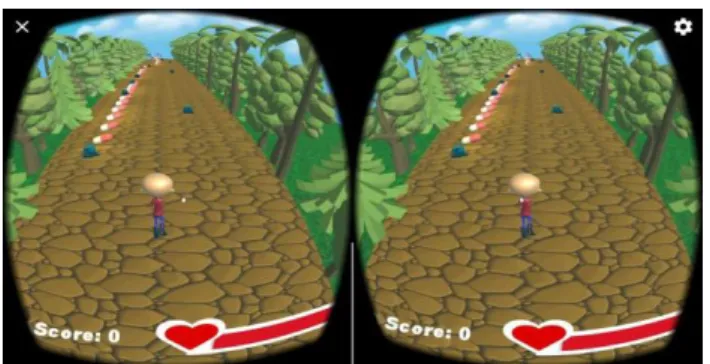
The game consists of the modules that are necessary to meet the goals. The network module is the basis of communication, and it is through this module that the exchange of information and commands takes place between the player environment and the environment of the applicator. This game module was developed for the Android platform, since it allows the use of VR, Bluetooth
control and is easy to use (Figure 2). The module has all the game and its phases, and each phase was developed with the aim of teaching the player about the importance of one of their daily activities throughout their treatment.
The control module allows the player’s performance to be monitored in order to allow changes in difficulty levels. The control can follow the game via a mobile device, and the actions performed by the player are replicated in this device so that the applicator can keep track of what is happening throughout the gameplay. It is also possible to terminate the game in cases where it should be stopped (Figure 3)
The connection between the control module and the game module is made via the network module. All commands executed by the control are sent to the game, meaning that control remains in the hands of the health professional, except for control over the character. The execution time of each phase, the number of objects of each phase and the termination of the game are determined by the applicator before the beginning of the game. In this way, the levels and difficulty are determined by the applicator, via human control exercised over the game according to the stipulated techniques for the development of the game.
Figure 2. Google Cardboard execution (left and right eyes)
For the Kimotopia game, it was necessary to program an VR module to be added to the game module. The purpose of this module is to provide interaction and immersion to the player. There is also a response module that is composed of three components (visual feedback, auditory feedback and error messages), in order to provide feedback and to assist in learning, and a profile registration module that allows the health professional to register the player before the game is played. The management and evaluation module is responsible for the file generated at the end of the game that contains relevant information about the patient. Important information about the player’s performance is obtained via this module, allowing for an analysis of the learning in relation to the theme proposed by the game.
4.2 EVALUATION
Kimotopia was applied in the first instance to children and adolescents between five and 18 years old. In order to verify the performance of the game and its usability, interviews were carried out based on a adapted survey that was derived from the Slater-Usoh-Steed (SUS) questionnaire [Slater et al. 1994]. This was composed of six questions with the goal of analyzing aspects indicating the presence in a virtual environment and the educational elements of the game. The answers to these questions were given on a scale of 1 to 7, where 1 represents low presence and 7 high presence. Most of the children and adolescents interviewed understood that during the game they were inside the virtual environment with Kim (Question 1). In addition, the majority reported that the virtual environment made them forget about the hospital environment (Question 2). Most also identified the virtual environment as a familiar place (Question 3). In addition, most of the respondents identified that the stimuli of the virtual environment were stronger than those of the real environment (Question 4).
Regarding the objects and virtual elements that appear during the different phases of the game, the vast majority reported that they resembled real situations that they had experienced (Question 5). Moreover, the children and adolescents were questioned if they felt that they were helping Kim within the virtual environment (Question 6). In Table 1 is can be observed that the interface of the game was intuitive and easy to use. The results are presented as a percentage and represent the number of respondents who answered 7 (high presence) for each question. In addition, the goals were achieved satisfactorily way in terms of educating the player in relation to the theme of the game.
Tabela 1. Evaluation results Questions Results (%) 1 55,6 2 55,6 3 55,6 4 66,7 5 44,4 6 77,8 5 CONCLUSION
Undergoing medical treatments is not easy, especially for a child or a teenager. Thus, the use of digital games for goals beyond those of mere entertainment has begun to be considered, mainly to meet the needs of these young patients. In addition to the assistance provided during medical procedures, there is a need to teach the player about the disease and the activities involved in the treatment. Through the interactivity and immersion pro- moted by the virtual environment of serious games and technological tools, learning can become a satisfactory and enjoyable experience for the patient. The use of VR technology for immersion and interactivity means that the player remains fully focused during the game.
In this way, the characteristics of the virtual environment become more stimulating than those of the real environment. The combination of VR and serious games can facilitate the dissemination of knowledge through gameplay. The Kimotopia game was developed with the aim of being an educational media tool that can aid in infantile/juvenile oncology treatment. The goal is to inform the player about the importance of the daily activities involved in medical treatment. The idea is that the patient has a positive and collaborative reaction to the necessary procedures. There is also a need to create a distraction while blood collection or examinations are performed.
The development of the control module for game control was extremely important in order to keep the child immersed in the game. Monitoring by the health professional throughout the playing time supports learning and ensures the distraction of the child. In addition, the data obtained can be used for late changes in the game that can contribute even more to supporting the treatment of the players. Based on this, it is concluded that a serious game that goes beyond entertainment can be used to aid both in medical treatments and in the learning of the player in regard to the treated disease. It was also possible to observe throughout the development of this work that the accompaniment is fundamental in guaranteeing the success of the game and the adaptation of the game to each player.
In this way, it is possible to provide the educational aspects of the game, and to increase the motivation of the user to overcome cancer.
Regarding the application, the children and adolescents understood the similarity between them and the Kim character and, so they felt motivated to overcome the disease. It was also observed that the stimuli of the virtual environment were more immersive and interactive so that players were not distracted by what occurred in the real environment. Furthermore, players understood the importance of each phase of the game and how each of them is related to their treatment.
Despite these positive results, we intend to make changes to the game according to observations made in the first stage of application. The game will then be tested again, in conjunction with the questionnaire. The collected data will be analyzed to verify whether the patient has in fact acquired the knowledge disseminated by the game. The goal is to ensure that the child learns how to fight the disease and has information about the treatment, and can use this information as motivation to collaborate with the medical staff throughout the necessary activities and procedures. The participation of the health professional in the application will also be verified to ensure that all the goals stipulated in the development of the game are achieved.
REFERENCES
Beale, I. L., Marín-Bowling, V. M., Guthrie, N., and Kato, P. M. (2006). Young cancer patients’ perceptions of a video game used to promote self care. International electronic journal of health
education, 9:202–212.
Begault, D. R. and Trejo, L. J. (2000). 3-d sound for virtual reality and multimedia. Bowman, D. A., Kruijff, E., LaViola Jr, J., and Poupyrev, I. (2005). User interfaces: Theory and practice. C. S. Loh, Y. Sheng, D. I. (2016). Serious Games Analytics: Methodologies for Performance
Measurement, Assessment, and Improvement, volume 1. Springer International Publishing.
Carvalho, P. R. A. and Ceccim, R. B. (1997). Comentando os direitos da criança e do adolescente hospitalizados. coord. Criança Hospitalizada-atenc¸a˜o integral como escuta a` vida. Porto
Alegre: Ed. da Universidade, pages 185–91.
Charsky, D. (2010). From edutainment to serious games: A change in the use of game characteristics. Games and culture, 5(2):177–198.
Cruz-Neira, C., Sandin, D. J., DeFanti, T. A., Kenyon, R. V., and Hart, J. C. (1992). The cave: audio visual experience automatic virtual environment. Communications of the ACM, 35(6):64– 72.
de Aquino Lopes, R., Junior, E. A. L., Cardoso, A., and Lopes, E. J. (2014). Recovery and coping stress supported by serious games. In 2014 IEEE 3nd International Conference on Serious
Games and Applications for Health (SeGAH), pages 1–7.
Deguirmendjian, S. C., de Miranda, F. M., and Zem-Mascarenhas, S. H. (2016). Serious game desenvolvidos na saúde: Revisão integrativa da literatura. Journal of Health Informatics, 8(3). Hatzigiannakoglou, P. (2015). Junk-food destroyer: Helping adolescents with down syndrome to
understand healthy eating through serious game. cited By 0.
Kirner, C. and Siscoutto, R. (2007). Realidade virtual e aumentada: conceitos, projeto e aplicações. In Livro do IX Symposium on Virtual and Augmented Reality, Petrópolis (RJ), Porto Alegre:
SBC.
Magora, F., Cohen, S., Shochina, M., and Dayan, E. (2006). Virtual reality immersion method of distraction to control experimental ischemic pain. IMAJ-RAMAT GAN-, 8(4):261.
Michael, D. R. and Chen, S. L. (2005). Serious games. games that educate, train, and inform (lernmaterialien): Games that educate, train, and info.
Mihajlovic, Z., Popovic, S., Brkic, K., and Cosic, K. (2017). A system for head-neck rehabilitation exercises based on serious gaming and virtual reality. Multimedia Tools and Applications, pages 1–25. cited By 0; Article in Press.
Netto, A. V., Machado, L. d. S., and Oliveira, M. d. (2002). Realidade virtual-definições, dispositivos e aplicações. Revista Eletroˆnica de Iniciação Cient´ıfica-REIC. Ano II, 2.
Roy, A. K., Soni, Y., and Dubey, S. (2013). Enhancing effectiveness of motor rehabilitation using kinect motion sensing technology. pages 298–304.
Slater, M., Usoh, M., and Steed, A. (1994). Depth of presence in virtual environments.
Presence: Teleoperators & Virtual Environments, 3(2):130–144.
Tabak, M., Cabrita, M., Schüler, T., Ho¨rst, D., Heuven, R., Kinast, B., and Thomas, A. (2017). ”dinner is ready!”: Virtual reality assisted training for chronic pain rehabilitation. pages 283–289. cited By 0.
Trombetta, M., Bazzanello Henrique, P., Brum, M., Colussi, E., De Marchi, A., and Rieder, R. (2017). Motion rehab ave 3d: A vr-based exergame for post-stroke rehabilita- tion. Computer
Methods and Programs in Biomedicine, 151:15–20. cited By 2.
Watkins, R., Leigh, D., Foshay, R., and Kaufman, R. (1998). Kirkpatrick plus: Evaluation and continuous improvement with a community focus. Educational Technology Research and
Development, 46(4):90–96.
Wattanasoontorn, V., Boada, I., Garc´ıa, R., and Sbert, M. (2013). Serious games for health.
Entertainment Computing, 4(4):231–247.
Winn, B. M. (2009). The design, play, and experience framework. In Handbook of research on
effective electronic gaming in education, pages 1010–1024. IGI Global.
Yusoff, A., Crowder, R., Gilbert, L., and Wills, G. (2009). A conceptual framework for serious games. In Advanced Learning Technologies, 2009. ICALT 2009. Ninth IEEE International