Master of Computer Science and Engineering
Bridging Vision and Language over Time
with Neural Cross-modal Embeddings
Thesis submitted in partial fulfillment of the requirements for the degree of
Doctor of Philosophy in
Computer Science
Adviser: João Miguel da Costa Magalhães, Associate Professor, Faculdade de Ciências e Tecnologia, Universidade NOVA de Lisboa
Examination Committee
Chair: Professor Nuno Manuel Robalo Correia Rapporteurs: Professor Cees Snoek
Professor Richang Hong
Members: Professor Nuno Manuel Robalo Correia Professor João Miguel da Costa Magalhães Professor Benoit Huet
Professor Ludwig Krippahl Dr. Ricardo Gamelas Sousa
The NOVA School of Science and Technology and the NOVA University of Lisbon have the right, perpetual and without geographical boundaries, to file and publish this disser-tation through printed copies reproduced on paper or on digital form, or by any other means known or that may be invented, and to disseminate through scientific reposito-ries and admit its copying and distribution for non-commercial, educational or research purposes, as long as credit is given to the author and editor.
This document was created using the (pdf)LATEX processor, based on the “novathesis” template[1], developed at the Dep. Informática of FCT-NOVA [2].
First, I would like to express my deepest gratitude to my advisor, João Magalhães. This was a truly enriching academic journey, where his guidance and utmost predisposition to discuss and pursue new ideas were key to this thesis. I am very thankful for all the support, encouragement and wise mentorship. What started as an academic relationship, I am sure now became a friendship. I also would like to thank my thesis advisory committee members, Benoit Huet and Ludwig Krippahl, for the insightful and constructive feedback provided, both on low-level and high-level aspects of the work, that contributed a lot to this thesis. Moreover, I thank Cees Snoek, Richang Hong and Ricardo Sousa, for the great and insightful comments and questions, raised on the thesis defense.
Second, I want to thank my host institution, Departamento de Informática from Universidade NOVA de Lisboa, for supporting my research and providing me all the resources needed. A special thanks to the Ph.D. program coordinator, Nuno Correia, for the precious help with all the administrative stuff. I also would like to thank the sources that funded and made this thesis possible, the CMU Portugal research project GoLocal Ref. CMUP-ERI/TIC/0046/2014, the H2020 ICT project COGNITUS with the grant agreement no687605 and the FCT project NOVA LINCS Ref. UID/CEC/04516/2019. I also gratefully acknowledge the support of NVIDIA Corporation with the donation of the GPUs used for this research.
To all the folks from P3-13 Lab, whom I shared great moments throughout these 4 years: Flávio Martins, André Mourão, Pedro Albuquerque, Rui Rodrigues, Camila Wohlmuth, Rui Madeira, Gustavo Gonçalves, Carla Viegas and Rui Nóbrega. Thank you all for the warm environment in the lab, in which we shared both stressful and relaxed moments. A special thanks to Flávio, for our great hackathons and for always being available to help me with cluster-related stuff.
To my longtime friends, Carlos Crespo and João Mirão, for their friendship, for the moments we spent together, and for all the beers. To André and Flávia for all the support and joyful moments. To Olga, Pedro, Ana, José, princess Inês, Lurdes, Beatriz and Nuno, for all the love and support. All of you supported me in ways that you cannot imagine.
To all my family, specially to my grandparents, who were always there to help me. To my parents for the education, for believing in me and giving me infinite support.
which whom I shared marvelous moments, doing our silly things.
The deepest and warm thanks to my beloved life partner, Marta Rolho. Words are not enough to express her importance. Thank you for always being there, for calming me down in the most stressful moments, and specially, for being part of my life. Without all the unconditional support, love, encouragement and friendship she provided me, I would not have finished this thesis. You are my future.
Giving computers the ability to understand multimedia content is one of the goals of Artificial Intelligence systems. While humans excel at this task, it remains a chal-lenge, requiring bridging vision and language, which inherently have heterogeneous computational representations. Cross-modal embeddings are used to tackle this chal-lenge, by learning a common space that unifies these representations. However, to grasp the semantics of an image, one must look beyond the pixels and consider its semantic and temporal context, with the latter being defined by images’ textual descriptions and time dimension, respectively. As such, external causes (e.g. emerging events) change the way humans interpret and describe the same visual element over time, leading to the evolution of visual-textual correlations.
In this thesis we investigate models that capture patterns of visual and textual interac-tions over time, by incorporating time in cross-modal embeddings: 1) in a relative man-ner, where by using pairwise temporal correlations to aid data structuring, we obtained a model that provides better visual-textual correspondences on dynamic corpora, and 2) in a diachronic manner, where the temporal dimension is fully preserved, thus capturing visual-textual correlations evolution under a principled approach that jointly models vision+language+time. Rich insights stemming from data evolution were extracted from a 20 years large-scale dataset. Additionally, towards improving the effectiveness of these embedding learning models, we proposed a novel loss function that increases the expres-siveness of the standard triplet-loss, by making it adaptive to the data at hand. With our adaptive triplet-loss, in which triplet specific constraints are inferred and scheduled, we achieved state-of-the-art performance on the standard cross-modal retrieval task. Keywords: Temporal Embeddings; Cross-modal embeddings; Multimedia understand-ing; Vision and language; Neural networks
Providenciar aos computadores a habilidade de compreender conteúdo multimédia, é um dos objectivos de sistemas de Inteligência Artificial. Enquanto que os humanos apre-sentam um desempenho notável nesta tarefa, ainda constitui um desafio que quer requer a unificação de visão e linguagem, que inerentemente têm representações computacionais heterogéneas. Embeddings Cross-modais são utilizados para atacar este desafio, apren-dendo um espaço comum que unifica estas representações. No entanto, para compreender a semântica de uma imagem, é necessário olhar além dos seus pixeis e considerar o seu contexto semântico e temporal, sendo este definido pelas legendas e dimensão temporal, respectivamente. Como tal, causas externas (e.g. eventos emergentes) alteram a forma como os humanos interpretam e descrevem o mesmo elemento visual ao longo do tempo, originando evolução das correlações visuais-textuais.
Nesta tese investigamos métodos que capturam padrões de interacção entre visão e linguagem ao longo do tempo, através da incorporação do tempo em embeddings cross-modais: 1) de forma relativa, em que utilizando correlações temporais de pares para estruturar os dados, obtivemos um modelo que melhor captura correspondências visuais-textuais em colecções dinâmicas, e 2) de uma forma diacrónica, em que a dimensão temporal é preservada, capturando a evolução de correlações visuais-textuais, seguindo uma abordagem bem fundamentada que modela conjuntamente visão+linguagem+tempo. Intuições bastante ricas, com origem na evolução dos dados, foram extraídas de um da-taset de larga escala (20 anos). Adicionalmente, para melhorar a eficácia de modelos de aprendizagem de embeddings, proposemos uma nova função de custo que aumenta a expressividade da triplet-loss standard, tornando-a adaptativa. Com a triplet-loss adap-tativa, em que restrições específicas a cada triplo são inferidas e escalonadas, obtivemos uma performance ao nível do estado da arte na tarefa de pesquisa cross-modal.
Palavras-chave: Embeddings Temporais; Embeddings Cross-modal; Compreensão de Multimedia; Visão e Linguagem; Redes Neuronais
List of Figures xvii
List of Tables xxi
Acronyms xxiii
Symbols xxv
1 Introduction 1
1.1 Bridging Vision and Language over Time . . . 1
1.1.1 Cross-modal Embeddings to Bridge Vision and Language . . . . 3
1.1.2 Going Beyond the Static Corpus Assumption . . . 4
1.1.3 Problem Framework Formal Definition . . . 5
1.1.4 Improving Neural Cross-modal Embedding Learning . . . 7
1.2 Objectives and Research Questions. . . 8
1.2.1 Scheduled learning of Adaptive Triplet Loss . . . 8
1.2.2 Temporal Cross-modal Structuring . . . 9
1.2.3 Diachronic Cross-modal Structuring . . . 10
1.3 Contributions and Impact . . . 10
1.3.1 Research Publications . . . 11
1.3.2 Multimodal Research Benchmark Datasets . . . 12
1.3.3 Industry Impact and Use-Cases . . . 13
1.4 Document Organization . . . 14
2 Related Work 15 2.1 Feature Representations for Images and Text . . . 15
2.1.1 Image Representations . . . 15
2.1.2 Text Representations . . . 19
2.2 Computationally Bridging Vision and Language . . . 21
2.2.1 Multimodal Modeling of Images and Text . . . 23
2.2.3 Cross-modal Projection Functions . . . 26
2.2.4 Neural Cross-modal Embeddings Learning . . . 29
2.2.5 Cross-modal Loss Functions and Optimization . . . 34
2.3 Modeling Temporal Evidence . . . 40
2.3.1 Capturing and Representing Temporal Clues . . . 40
2.3.2 Modeling Data Evolution . . . 42
2.4 Evaluation Metrics . . . 45
3 Scheduled Adaptive Margin for Neural Cross-Modal Embeddings 49 3.1 Cross-modal Embedding Space Structure Definition . . . 51
3.1.1 Embedding Properties . . . 52
3.2 Adaptive Embedding Learning . . . 52
3.2.1 Static Maximum-margin Formulation . . . 53
3.2.2 Limitations of Standard Triplet Loss on Neural Models . . . 53
3.2.3 Adaptive Triplet Loss Formulation . . . 55
3.3 Scheduled Activation of Adaptive Margins . . . 56
3.3.1 Scheduler Function . . . 57
3.3.2 Adaptive Margin . . . 57
3.3.3 Neural Model and Architecture . . . 59
3.4 Optimization and Triplet Sampling . . . 60
3.5 Evaluation . . . 61
3.5.1 Datasets . . . 61
3.5.2 Methodology . . . 62
3.5.3 Training and Implementation Details . . . 63
3.6 Results and Discussion . . . 63
3.6.1 Cross-modal Retrieval . . . 63
3.6.2 Scheduled Adaptive Margins Analysis . . . 66
3.6.3 Analysis of Activation Phase 𝑓𝑎 and 𝜆 Impact . . . 69
3.6.4 Qualitative Analysis . . . 70
3.7 Critical Summary . . . 71
4 Temporal Cross-modal Embeddings 77 4.1 Formulating the Temporal Embedding Space Hypothesis . . . 78
4.1.1 Modeling Relative Temporal Correlation . . . 79
4.2 Embedding Definition . . . 81
4.2.1 Temporal Cross-modal Space . . . 81
4.2.2 Time-sensitive Cross-modal Neural Projections . . . 82
4.3 Temporal Embedding Model Design and Learning . . . 84
4.3.1 Joint Temporal Triplet Ranking Loss . . . 84
4.3.2 Temporal Cross-modal Soft-Constraints . . . 86
4.3.3 Cross-modality similarity . . . 87
4.4 Temporal Soft-Smoothing Correlation Functions . . . 88
4.4.1 Recency-based Correlations . . . 88
4.4.2 Category-based Correlations . . . 88
4.4.3 Topic-based Correlations . . . 89
4.5 Neural Model and Architecture . . . 91
4.6 Evaluation . . . 91
4.6.1 Datasets . . . 92
4.6.2 Methodology . . . 94
4.6.3 Training and Implementation Details . . . 94
4.7 Experiments and Results . . . 95
4.7.1 Cross-Modal Retrieval . . . 95
4.7.2 Media temporal correlations . . . 99
4.8 Critical Summary . . . 102
5 Diachronic Cross-modal Embeddings 103 5.1 Formulating the Diachronic Embedding Space Hypothesis . . . 104
5.2 Embedding Definition . . . 106
5.2.1 Diachronic Cross-modal Space . . . 106
5.2.2 Temporal Embeddings Alignment . . . 107
5.2.3 Time-preserving Projections . . . 108
5.2.4 Embedding Properties . . . 108
5.3 Diachronic Embedding Model Design and Learning . . . 109
5.3.1 From Projections to Triplet Ranking Loss . . . 109
5.3.2 Joint Diachronic Triplet Ranking Loss. . . 110
5.3.3 Binned Structure . . . 110
5.3.4 Continuous Diachronic Structure . . . 113
5.4 Evaluation . . . 117
5.4.1 Dataset - A 20 years Flickr Images Dataset . . . 118
5.4.2 Methodology . . . 118
5.4.3 Training and Implementation Details . . . 120
5.5 Experiments and Results . . . 120
5.5.1 Time Period based Inference . . . 121
5.5.2 Semantic Dispersion over Time . . . 122
5.5.4 Assessing the Preservation of Temporal Locality Biases . . . 127
5.5.5 Cross-modal Evolution . . . 128
5.6 Critical Summary . . . 131
6 Conclusions and Future Work 133 6.1 Temporal Information on Cross-modal Embeddings . . . 133
6.2 Learning of Neural Cross-modal Embedding Models . . . 135
6.3 Limitations . . . 136
6.3.1 Adaptive Margins . . . 136
6.3.2 Temporal Cross-modal Embeddings . . . 137
6.3.3 Diachronic Cross-modal embeddings . . . 137
6.4 Future work . . . 138
6.5 Forthcoming Challenges of Multimedia Understanding . . . 140
1.1 Illustration of diachronicity in images: Image depicting the same content, wreckage, but with different temporal context, are described differently. . . 2
1.2 Illustration of Cross-Modal Embeddings approach. . . 4
1.3 Relative vs. Absolute Time dimension Modeling. . . 5
1.4 Triplet loss illustration. Hinge-loss constraints are enforced over triplets to structure the embedding space. . . 7
1.5 H2020 COGNITUS Project - Providing users a "More like being there"Experience, with User Generated Content. . . 13
2.1 Overall Architectural Scheme of Convolutional Neural networks. Adapted from [79] . . . 16
2.2 VGG-16 Convolutional Neural Network Architecture. Adapted from [30]. . 17
2.3 Inception module from GoogleNet. Adapted from [115] . . . 17
2.4 Residual learning building block. Adapted from [102]. . . 18
2.5 Illustration of Bag-of-Word Representation for Sentences. Adapted from [6]. 20
2.6 Example of a multimodal document 𝑑𝑖
comprised by an image x𝑖
𝑉 and a text
x𝑖
𝑇. Illustrates the semantic gap between images and their associated text. . 21
2.7 Contrasting between Cross-modal Learning approaches. Adapted from [91]. 24
2.8 Illustration of Cross-modal Embedding Space. . . 26
2.9 Multimodal neural architectures proposed in [88]. Both images were adapted from [88]. . . 31
2.10 Neural architecture of Deep Correlation Canonical Analysis. Adapted from [2]. 32
2.11 Neural architecture of Deep Correlation Canonical Analysis, including the modifications proposed in [133] to deal with overfitting. Adapted from [133]. 32
2.12 Neural architecture of Correspondence Cross-modal Autoencoder. Adapted from [28]. . . 33
2.13 Neural architecture of Correspondence Full-modal Autoencoder. Adapted from [28]. . . 33
2.14 Illustration of different a training batch sampling schemes with mini-batch size of 𝑏 = 6. Red edges and blue edges represent positive and negative instances, respectively. . . 39
2.15 Graphical Representation of D-LDA, for three time slices. Each time slice corresponds to an LDA model. Source [15]. . . 44
2.16 Visualization of word shifts across time, based on their similarity with other words under a diachronic word embedding. Source [41]. . . 45
3.1 Adaptive margin constraints are scheduled to be progressively enforced dur-ing the traindur-ing phase.. . . 51
3.2 SAM model architecture. The model is composed by two sub-networks cou-pled by the loss function L𝑆 𝐴𝑀. At each learning epoch 𝑡 the loss L𝑆 𝐴𝑀
imposes triplet-specific constraints, enforcing cluster formation/preserva-tion and organizing instances according to their semantic similarity. . . 55
3.3 Plot of 𝛼 (𝑡 ) with 𝑛𝑒 =50. The scheduling training enables a smooth transition
from static margins to adaptive margins. . . 57
3.4 Global average adaptive margin 𝑓𝑚 over training epochs (t) on the
NUS-WIDE-10k. The left y-axis corresponds to the 𝑓𝑚 value and the right y-axis
to the scheduling function 𝛼 (𝑡 ) value. . . 67
3.5 t-SNE projections - Scheduled Adaptive Margins between 3 categories. . . 68
3.6 Analysis of the margin values over each epoch (t), between three categories. 68
3.7 Average per-category margin for each category, at each training epoch (t). Average value of 𝑓𝑚 between every instance 𝑑
𝑖
, against all instances 𝑑𝑛
of other categories, on NUS-WIDE-10k. . . 73
3.8 Parameter Analysis (𝜆 and activation function 𝑓𝑎) on Pascal Sentences dataset. 74
3.9 t-SNE Visualization of test instances projections of the NUS-WIDE-10k dataset, on the obtained embedding space. Triangles and circles refer to image and text elements, respectively. Best viewed in color. . . 74
3.10 Results for query X in the 𝑇 ↦→ 𝐼 task. Green border for correct and red for incorrect. . . 75
3.11 Results for query X in the 𝐼 ↦→ 𝑇 task. Green border for correct and red for incorrect. . . 76
4.1 Temporal dynamics of content from the semantic categoryCrash (Tour-de-France 2016), and temporal pairwise variations with corresponding visual elements. . . 77
4.2 Temporal dynamics of semantic category Crash (TDF2016), and temporal pairwise variations with corresponding visual elements. . . 79
4.3 Temporal correlations of same-category multimodal data (on the left) follow an unknown density distribution. The temporal cross-modal embedding (on the right) captures these temporal correlations by organizing projected data accordingly, for each specific semantic category. . . 80
4.4 Temporal cross-modal embedding learning overview. Visual (blue) and tex-tual (purple) instances are mapped to a 𝐷 dimensional cross-modal space. . 82
4.5 In terms of intra-category structuring, the space is perturbed to approximate temporally correlated instances, and to separate uncorrelated ones. . . 84
4.6 Constraints violations rationale. . . 86
4.7 Words temporal relevance. Each plot depicts the mean latent-topical tempo-ral curve 𝜙𝑤, over each day, on the Edinburgh Festival dataset. Vertical lines
mark the event timespan. . . 90
4.8 Cross-modal retrieval 𝑚𝐴𝑃 results, average of 𝐼 ↦→ 𝑇 and 𝑇 ↦→ 𝐼 , per cate-gory, on EdFest2016. . . 99
4.9 Cross-modal retrieval 𝑚𝐴𝑃 results, average of 𝐼 ↦→ 𝑇 and 𝑇 ↦→ 𝐼 , per cate-gory, on TDF2016. . . 99
4.10 Precision-Scope curves for Edinburgh Festival 2016. . . 100
4.11 Precision-Scope curves for Tour-de-France 2016. . . 100
4.12 Qualitative analysis of the different temporal correlations on the EdFest2016 and TDF2016 dataset. Each plot depicts the temporal distribution of ground-truth instances, from the categoriesCastle and Crash. We use days as time granularity. . . 100
4.13 Temporal vs. Non-Temporal method. . . 101
5.1 Diachronic Cross-modal Embeddings illustration. . . 104
5.2 Diachronic cross-modal architecture overview. Visual (blue) and textual (pur-ple) instances, at an instant 𝑡𝑠𝑖
, are mapped to a 𝐷 dimensional diachronic embedding space. A shared temporal structuring layer takes the timestamp 𝑡 𝑠𝑖 as input and learns an embedding for 𝑡𝑠𝑖, that is then used to indepen-dently condition modality projections on time. A diachronic triplet ranking loss is responsible for structuring instances over time. Best viewed in color. 116
5.3 Temporal distribution of the full dataset. The x-axis shows the years while the y-axis shows the number of instances (log-scale). The red dashed vertical line delimits the cut performed due to low number of instances. . . 117
5.4 Temporal distribution of instances over eight sample categories. The dataset comprises content with high diversity in terms of temporal signatures. . . 119
5.5 Semantic dispersion over time analysis for five sampled images. The y-axis denotes the similarity magnitude where 1 is maximal and -1 is minimal. . . 123
5.6 Temporally bounded cross-modal results (mAP) of DCM-Binned [41] and DCM-Continuous. . . 127
5.7 Evolution over time for 2 query examples (query timestamps are black-filled). Instances were retrieved from before and after the query timestamp. Image queries were used to retrieve documents through their text. . . 129
5.8 Evolution over time for 4 query examples (query timestamps are black-filled). Instances were retrieved from before and after the query timestamp. Text queries were used to retrieve documents through their images. . . 130
2.1 Summary of Multimedia Understanding tasks that can be addressed using
mcross-modal embeddings. . . 23
3.1 mAP performance results across different datasets. The second half of the table concern deep-learning methods. . . 64
3.2 Comparison between SAM and CMOLRS on the Wikipedia dataset. . . 65
3.3 mAP results on the NUS-WIDE dataset. . . 66
3.4 Analysis of the scheduler and 𝑓𝑚𝑐 impact. . . 69
4.1 SocialStories dataset information regarding EdFest2016 and TDF2016 events. Seed terms/hashtags, event and crawling time spans are shown. . . 92
4.2 List of SocialStories categories for EdFest2016 and TDF2016. . . 93
4.3 Cross-modal retrieval results (𝑚𝐴𝑃 @50 and 𝑛𝐷𝐶𝐺@50) on NUS-WIDE. . . 97
4.4 Cross-modal retrieval results (𝑚𝐴𝑃 @50 and 𝑛𝐷𝐶𝐺@50) on EdFest2016. . . 97
4.5 Cross-modal retrieval results (𝑚𝐴𝑃 @50 and 𝑛𝐷𝐶𝐺@50) on TDF2016. . . . 97
5.1 List of categories of the 20 Years Flickr Images Dataset. . . 117
5.2 Media Time Period based Inference Results. . . 121
5.3 Diachronic Semantic Alignment. . . 125
BoW Bag-of-Words.
CCA Canonical Correlation Analysis. CNN Convolutional Neural Network. DCM Diachronic Cross-modal (Chapter5). IDF Inverse Document Frequency
ILSVR ImageNet Large Scale Visual Recognition Challenge. mAP Mean Average Precision.
nDCG Normalized Discounted Cumulative Gain. NLM Neural Language Model.
RELU Rectified Linear Unit.
SAM Scheduled Adaptive Margins (Chapter3). TempXNet Temporal Cross-modal Embedding (Chapter4). UHD Ultra High-Definition.
𝐶 Collection of labelled and multimodal documents (image + text). 𝑐𝑖 Semantic category or set of semantic categories of a document 𝑖.
𝐷𝑇 Textual original feature space dimension. 𝐷𝑉 Visual original feature space dimension. 𝑑𝑖 Multimodal document/instance tuple (x𝑖
𝑉,x 𝑖 𝑇, 𝑡 𝑠 𝑖 , 𝑐𝑖), comprised by an image x𝑖 𝑉, a textual description x 𝑖 𝑇, a timestamp 𝑡𝑠 𝑖
and a category label 𝑐𝑖.
S Embedding space, with dimensionality 𝐷,i.e. S ∈ 𝐷.
L Model global loss function.
𝑓𝑇 Textual projection function that maps an image vector representation to a common embedding space.
𝑇 𝑆 Time span interval.
𝑡 𝑠𝑖 Timestamp of a document 𝑖.
𝑓𝑉 Visual projection function that maps an image vector representation to a common embedding space.
x𝑖
𝑇 Vector representation of a textual description of a document 𝑖.
x𝑖
C
h
a
p
t
e
r
1
I n t r o d u c t i o n
1.1
Bridging Vision and Language over Time
Giving computers the ability to fully comprehend an image is one of the main goals of computer vision. This turns out to be a highly relevant problem with major impact in our daily lives.
It is well-known that humans excel at the task of image understanding. Just with a few glances, humans can quickly and accurately understand an image with minimum effort [27,96]. Among the several aspects responsible for this phenomenon, one is that we easily bring world knowledge (from context, shapes, objects, colors, etc.) to back up and aid our reasoning. Our general visual perception of certain physical world elements (e.g. objects, shapes), even though it can be perfected, does not change over time. Namely, after learning how a concept, object, or shape looks like (e.g. sky, chair, house, etc.), this knowledge will persist in our visual memory and is used effortless when interpreting and reasoning about images’ semantics, together with other contextual elements. The same does not apply to machines, which need to combine both visual and non-visual cues, having distinct heterogeneous computational representations. Moreover, satisfactory object recognition performance is dependent on the availability of large amounts of data.
Apart from objects and shapes, each image has a particular (non-visual) context. In order to fully understand its semantics, one must look beyond its pixels and interpret its semantic and temporal context. The context is encoded in descriptions, location, time, and other types of metadata [75]. Descriptions reflect the way humans interpret an image, from agiven instant in time. They are thus capable of providing additional information, being it either about a visual (e.g. an object present in the image) or non-visual (e.g. event
name) element. Figure1.1shows three different images with text descriptions, visually depicting the same semantic concept: wreckage from a natural disaster.
The temporal context of each image plays a key role in defining its semantics. For instance, each image from figure1.1has different descriptions, despite representing the same visual content (wreckage), thus having a different temporal context. The rationale is that while in general visual objects do not change over time, and the physics of the real world are static, textual descriptions are subject to evolution. Consequently, given a multimodal document 𝑑𝑖
, the image x𝑖
𝑉 with timestamp 𝑡𝑠 𝑖
, may have an associated text description x𝑖
𝑇. At a distinct instant 𝑡𝑠 𝑗
, an image with similar visual content, may be described differently.
(a) Destruction caused by flooding in Pakistan (Jan-2005).
(b) Wreckage of Tsunami in Aceh, Indonesia (Mar-2005).
(c) Destruction of the Earth-quake + Tsunami in Japan (Apr-2011).
Figure 1.1: Illustration of diachronicity in images: Image depicting the same content, wreckage, but with different temporal context, are described differently.
The phenomenon, of textual descriptions evolution, happens when the context of an image changes, due to some external cause, like the occurrence of an event.When changes in context are evidenced by the temporal dimension, we can say that visual-textual correla-tions evolved, and the temporal context changed. Consider the following complementary example. From the perspective of image understanding, when the visual modality is con-sidered alone, images are comparedsolely based on their visual content. The semantics of image contents are estimated from the concepts, scenes and colors, that are identified in each image. Thus, when two visually identical images, from distinct events, are com-pared, they are deemed assemantically similar. However, when the textual description is considered, if the temporal context is different, images are expected to have different textual descriptions. Models can only differentiate between such two images by considering the temporal dimension.
This temporal context changes, which in this thesis is framed as the evolution of visual-textual correlations, is grounded on:
a) The occurrence of external events, which have the capability to change the way humans interpret an image [4,26,66,80,119];
b) Word meaning/usage change across time [40,41,136].
The former a) occurs on both short and long time spans, being highly dependent on the topic. This is the example of figures 1.1band1.1c, which both depict the wreckage left by distinct tsunami events, at distinct time instants, while beingvisually similar. While some events happen at a specific time and place (as defined by McMinn et al. [80]), some events can happen multiple times, and some may not have a location (e.g. Christmas). In the later b), word meaning change occurs on long time spans, where language itself evolves and certain words are replaced. In practice both aspects a) and b) are connected, i.e. it is likely that changes in the usage of certain words, are triggered by some event.
Regardless of the type of events, given a corpus comprised by content that captures the different events that occurred, the impact of these events in visual-textual correlations is expected to be encoded in the corpus. In other words, the corpus is considered to be a mirror of what happened over the years, thus capturing visual-textual interactions’ evolution. This discussion will be further expanded in section5.4.1.
In the next section we describe the scope and research field in which this thesis is positioned. Namely, we present the starting point scenario in which the thesis hypothesis is built upon (section1.1.1). Then, we describe the research directions (section1.1.2) and formalize the scenario and general problem (section1.1.3).
1.1.1
Cross-modal Embeddings to Bridge Vision and Language
In this thesis, an image semantic and temporal context is defined by its textual description and timestamp. Namely, a textual description, for an image x𝑖
𝑉 at time instant 𝑡𝑠 𝑖
, is used to semantically describe the concepts underlying that image. These descriptions usually do not comprise a thorough enumeration of all the objects and shapes on the image, but rather higher-level terms that are responsible for giving context to the image (see Figure1.1). Therefore, even though remarkable results have been achieved in computer vision tasks – object detection [32,33,43,100,115,144,145], segmentation [43,72,73,74,
89,108,143], visual question-answering [3,76,104] – these:
a) Mostly focus on understanding images at the object-level, not at the conceptual and contextual level that humans usually refer to images;
b) Use an object recognition approach, which requires large amounts of data to obtain effective detection performance. For comprehensive image understanding and for capturing rich visual-textual correspondences, it is also not feasible to learn a single concept-detector for each possible concept;
c) Discover patterns of interactions between vision and language under a static world model assumption.
Textual Feature Space Visual Feature Space
Destruction caused by flooding in Pakistan Cross-Modal Embedding Space Tsunami Thailand left the city in
wreckage
Figure 1.2: Illustration of Cross-Modal Embeddings approach.
An alternative approach for automatic image understanding consists of directly cap-turing how two modalities, namely vision and language, are correlated. This can be done by learning how images and texts co-occur over time.
Cross-modal embeddings, illustrated in Figure1.2, are an example of such models, which leverage on multimodal machine learning [8,88] and metric learning [48,51,64,
138], to learn an embedding space that structures images and their textual descriptions based on their correlations. Similarly to word embedding models [83,94], which learn continuous vector representations for individual words, cross-modal embeddings con-sist of multimodal (image and text) continuous representations, lying on a space that is common to both modalities, thus bridging heterogeneous representations (i.e. from images and texts).
Such embeddings allow the learning of rich linear and non-linear correspondences between images and high-level (e.g. context-specific vocabulary) concepts by directly capturing patterns of visual-textual interactions from data, instead of learning visual detectors for each potential concept. In other words, visual-textual interactions are represented on a multimodal manifold.
1.1.2
Going Beyond the Static Corpus Assumption
The learning of cross-modal embeddings has been an actively researched topic, but un-der the assumption of a static world model [25,28,52,92,99,121,122,132,133]. In other words, the temporal footprint of data interactions and its impact in multimodal correla-tions has been overlooked. This thesis tackles this gap in the literature, by bringing time into the equation. We investigate models that are capable of unveiling and representing visual and textual interactions over time. While there are several ways to represent such interactions over time, we focus on two particular general approaches:
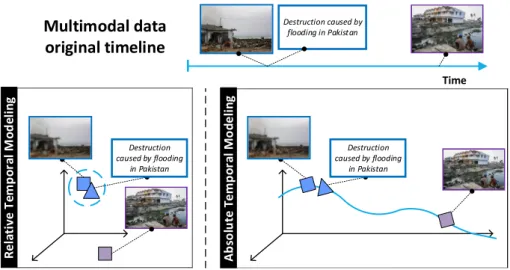
R e la ti ve T em p o ra l M o d el in g Destruction caused by flooding in Pakistan Time Destruction caused by flooding in Pakistan A b so lu te T e m p o ra l M o d e li n g Destruction caused by flooding in Pakistan Multimodal data original timeline
Figure 1.3: Relative vs. Absolute Time dimension Modeling.
a) Modeling Relative Temporal Correlation - Pairwise temporal correlations, i.e. between two elements (images and/or texts), are unveiled and used to structure data;
b) Absolute Modeling of the Temporal Dimension - The temporal dimension is fully preserved, thus enabling unveiling and modeling the evolution of patterns of in-teraction between visual and textual data.
Each approach, illustrated in Figure1.3, leads to fundamentally distinct models. In a) the temporal dimension iscompressed and encoded in data neighborhoods. After learning the common embedding space, time is discarded. In b) the space explicitly mirrors the original data timeline, with the temporal dimension being fully preserved.
1.1.3
Problem Framework Formal Definition
We start by formalizing the general problem of bridging vision and language, in which the goal is to create a common embedding space that unifies multiple modalities. This corresponds to solving theheterogeneity gap [123], in which different correlated modali-ties, with distinct computational representations must be unified. The goal is to model cross-modal relationships such that one can then compare an element from one modality with all the others, even if one modality is missing.
Without loss of generality, let 𝐶 = {𝑑𝑖} 𝑁
𝑖=1be a set of 𝑁 visual-textual instance tuples
𝑑𝑖 = (x𝑖 𝑉,x 𝑖 𝑇, 𝑡 𝑠 𝑖 , 𝑐𝑖), (1.1) where x𝑖 𝑉 ∈ ℝ 𝐷𝑉 and x𝑖 𝑇 ∈ ℝ
𝐷𝑇 are the feature representations of the image and textual
elements, respectively, 𝑡𝑠𝑖
the timestamp and 𝑐𝑖
𝐿 is the set of all semantic categories. Accordingly, 𝐷𝑉 and 𝐷𝑇 correspond to the image
and text original feature representations’ dimensionality, respectively. The corpus 𝐶 has a time span defined by 𝑇 𝑆 = [𝑡𝑠, 𝑡𝑓], where 𝑡𝑠 and 𝑡𝑓 are the first and last instants of the
corpus, respectively. Throughout this document, let ∗ ∈ {𝑉 , 𝑇 } when referring toany of the modalities (visual 𝑉 or textual 𝑇 ), to avoid notation cluttering.
This thesis focus on models that learn a common, coordinated embedding space S ⊆ ℝ𝐷
, in which the visual and textual elements are organized according to their semantic similarity and timestamp. The space, in its general form, is formally defined by the mappings: 𝑓𝑉(x𝑖 𝑉;𝜽𝑽) : ℝ 𝐷𝑉 ↦→ S | {z } Visual Projection 𝑓𝑇(x𝑖 𝑇;𝜽𝑻) : ℝ 𝐷𝑇 ↦→ S | {z } Textual Projection . (1.2)
where 𝑓𝑉 and 𝑓𝑇 correspond to visual and textual, respectively,independent functions,
mapping each modality of an instance 𝑑𝑖
, to its own 𝐷-dimensional embedding space. The two embeddings (one for each modality) are coordinated, in the sense that modalities will be indirectly aligned by enforcing similarity constraints (detailed in section2.2.3). These are illustrated in Figure1.2. Both𝜽𝑽 and𝜽𝑻 correspond to the learnable parameters of the
model underlying 𝑓𝑉 and 𝑓𝑇. Each function takes as input the original representation of
the corresponding modality (x𝑖
∗). From now on, for simplicity we will refer to a common
embedding space as twocoordinated and aligned embedding spaces.
1.1.3.1 Absolute Modeling of the Temporal Dimension In most approachesonly original vector representations (x𝑖
∗) are used to map instances.
In this thesis we seek for modality projection functions that provide time-dependent embeddings. Therefore, we introduce a continuous model in which functions 𝑓∗ take
both original representations x𝑖
∗and timestamp information 𝑡𝑠 𝑖 : 𝑓𝑉(x 𝑖 𝑉, 𝑡 𝑠 𝑖 ;𝜽𝑽) : ℝ 𝐷𝑉 × 𝑇 𝑆 ↦→ S | {z }
Time-Dependent Visual projection
𝑓𝑇(𝑥 𝑖 𝑇, 𝑡 𝑠 𝑖 ;𝜽𝑻) : ℝ 𝐷𝑇 × 𝑇 𝑆 ↦→ S | {z }
Time-Dependent Textual Projection
. (1.3)
Similarity between any two visual/textual elements can then be assessed through cosine similarity, which corresponds to the magnitude of the angle between their embed-dings. The output of 𝑓𝑉 and 𝑓𝑇 is conveniently normalized such that ℓ2( 𝑓∗(·)) = 1 and
embeddings lie in the unit hypersphere
1
. Then, a similarity function 𝑠 is defined as: 𝑠(x𝑖∗,x 𝑗 ∗) = 𝑓∗(x 𝑖 ∗;𝜽∗)∗· 𝑓∗(x 𝑗 ∗;𝜽∗)∗ (1.4)where · stands for the dot product.
1.1.4
Improving Neural Cross-modal Embedding Learning
Figure 1.4: Triplet loss illustration. Hinge-loss constraints are enforced over triplets to structure the embedding space.
The projection functions from eq.1.2are commonly materialized by a neural network. Among the available loss functions, thetriplet ranking loss [20,106] is the most widely adopted loss for neural embedding learning models and metric learning approaches. In the cross-modal embedding learning field, the trend is the same, with state-of-the-art models adopting the triplet loss [121, 124, 135] due to its high expressiveness and effectiveness. In its general formulation, triplets (x𝑎
∗,x 𝑝 ∗, 𝑥
𝑛
∗), are composed by an anchor
element x𝑎
∗(an image or text), that should be more similar to positive elements x 𝑝
∗ sharing
a category, than to negative elements x𝑛
∗ not sharing any category, by at least a margin
𝑚. Triplet constraints are expressed as
𝑠(x𝑎∗,x 𝑝 ∗) > 𝑠 (x 𝑎 ∗,x 𝑛 ∗) + 𝑚, (1.5)
which are then turned into a differentiable function (based on hinge loss function [46]) This will be detailed in section2.2.5.1. Figure1.4illustrates how triplet loss structures data in a common embedding space. Before learning, the anchor x𝑎
∗is close to x 𝑛
∗(the negative
element) and far apart from the positive element x𝑝
∗. This means that the constraint from
eq. 1.5is violated. After the learning stage, the triplet constraint is enforced such that 𝑠(x𝑎∗,x 𝑝 ∗) > 𝑠 (x 𝑎 ∗,x 𝑛
∗) + 𝑚. Note that 𝑚 is just a lower bound on the difference between
the two similarities
2
.Throughout this research, we gained deep insights w.r.t. the design and modeling of cross-modal embedding methods. As will be further elaborated in3, we posit that a
1Given that embeddings are ℓ
2normalized, similarity between projected elements can be efficiently
computed through a dot product.
fixed, constant margin 𝑚, limits the expressiveness of the loss function in structuring instances on the embedding space. Accordingly, we will investigate how to relax the static margin assumption, and design a triplet-loss formulation that overcomes static triplet-loss limitations and achieves greater expressiveness.
1.2
Objectives and Research Questions
In the previous sections we defined the scope and the domain of this thesis. We provided a brief definition of the problems that are addressed and identified the research fields in which it is positioned. Hereupon, we identify the main objective of this thesis as:
Thesis Main Objective
Investigate neural cross-modal embedding models that model visual-textual interactions over time.
Grounded on this objective, we tackled three distinct research questions that will each be detailed in the next three sections.
1.2.1
Scheduled learning of Adaptive Triplet Loss
State-of-the-art cross-modal embedding learning models adopt the triplet ranking loss formulation which enforces a fixed margin 𝑚 (see eq. 1.5). It follows that the static formulation has limited flexibility that can compromise the structuring of embedding instances. Therefore, aligned with the problematic described in section 1.1.4, we seek to investigate if by increasing triplet loss expressiveness, and consequently enabling both fine-grain and coarse-grain structuring of multimodal instances in neural cross-modal embedding learning models, one can increase the effectiveness of embedding structure. Thus, aligned with the issues previously described, we formulate our first research question:
Research Question 1 (RQ1)
How to improve neural cross-modal embedding learning models, based on the triplet-loss function, by increasing its expressiveness?
We posit that the static formulation of triplet ranking loss has limited expressive-ness w.r.t. performing coarse-grain and fine-grain embedding structuring. Namely, the standard triplet ranking loss does not:
a) Adapt triplet constraints according to the potentially different degrees of similarity, within instances of a triplet;
b) Bound the enforcing of triplet constraints to the model optimization scheme. Namely, neural models are stochastically and iteratively trained. Therefore, triplet con-straints should be enforced according to the embedding organization, at each train-ing epoch 𝑡 .
In Chapter 3, we address RQ1 and overcome these issues by replacing the static margin formulation, with an adaptive one. Namely, we formulate an adaptive maximum-margin model 𝑓𝑚(·), that infers the margin constraints during training. Our model
dynamically adapts embedding structuring constraints over triplets, by jointly using semantic similarity and embedding (semantic) category clusters enforcement rules, to obtain an effective embedding organization.
1.2.2
Temporal Cross-modal Structuring
Standard cross-modal embedding models aim at learning a common space which is struc-tured based on semantic (category) information, with the structure reflecting visual-textual correlations. In some scenarios, such as dynamic collections, temporal correla-tions within instances emerge. This is the case of events that as they unfold, visual and textual correspondences evolve accordingly [26, 119]. Our hypothesis is that incorpo-rating such correlations in the embedding structure, can provide better discriminative power, and therefore result in better embedding structuring. This leads us to formulate our second research question:
Research Question 2 (RQ2)
How can information regarding images and texts temporal correlations be incorporated in cross-modal embeddings? Does this lead to better embedding
structuring on dynamic corpora?
Towards answering this question we formulateTemporal Cross-modal Embeddings. These aim at enforcing temporal correlations within instances on the embedding space. Therefore, the temporal dimension isimplicitly encoded in this space, in a relative man-ner: temporal correlations are estimated between each pair of instances (images and/or texts). By being able to structure data not only according to their semantics but also according to their temporal correlations, we obtain a more fine-grain structuring of data that despite being semantically similar, visual-textual correspondences may drift over time.
Chapter4addresses RQ2 by investigating:
b) Different models for quantifying relative temporal correlation, and how should estimated correlations be incorporated in the embedding space.
1.2.3
Diachronic Cross-modal Structuring
As discussed in section1.1, it is natural for visual and textual patterns of interactions to change over time. Therefore, to fully understand an image, both its semantic and temporal context should be captured. This leads to the formulation of our third research question:
Research Question 3 (RQ3)
How to define and learn a diachronic cross-modal embedding space, that bridges vision and language over time, by preserving the temporal dimension, and capturing
multimodal interactions’ evolution?
To model andcapture the evolution of visual-textual correlations over time, we seek for representations that preserve the temporal dimension. Data should be seen as a timeline of multimodal instances, instead. Multimodal instances should then be structured in the embedding space over time while preserving data original timelines.
Chapter5addresses these challenges and aims to answer RQ3, by investigating: a) How should a diachronic cross-modal space be defined,i.e. how should images
and texts be structured to retain multimodal data evolution, and which properties should be enforced to obtain such structure;
b) Neural architectures that receive time as input (as prior information), and retain the time dimension;
c) Novel diachronic multimedia operations, that enable studying, under different perspectives, the evolution of correspondences between vision and language.
1.3
Contributions and Impact
This research contributes to the ultimate goal of building artificial intelligence models that are capable of bridging vision and language, while modeling their evolution over time. Namely, we exploit neural embeddings to address this problem, and contribute in two distinct and complementary directions:
a) Chapter3 - Improving the state-of-the-art in learning cross-modal neural repre-sentations, by introducing a scheduled adaptive maximum-margin approach, with
superior expressiveness in capturing and modeling correlations between visual and textual elements;
b) Chapters4and5- Bringing temporal information to neural embeddings’ structur-ing, in both a relative (time dimension is discarded) and absolute (time dimension is preserved) manner. Until now, state-of-the-art methods overlooked temporal information, by considering data as a static collection.
1.3.1
Research Publications
The research carried out in this period, resulted in the following main scientific contri-butions:
1) ACM Multimedia 2019 - Full Paper - In this paper we propose an adaptive formu-lation for the triplet loss function, and a scheduling training strategy for neural networks that achieves state-of-the-art performance. Materializes the work de-tailed in Chapter3:
D. Semedo and J. Magalhães. “Cross-Modal Subspace Learning with Scheduled Adaptive Margin Constraints.” In: Proceedings of the 27th ACM International Conference on Multimedia. MM ’19. Nice, France: ACM, 2019.
2) ECIR 2019 - Short Paper - Initial research conducted to validate the importance of temporal information for dynamic corpora, which was demonstrated in the task of keyword extraction (Chapter4):
D. Semedo and J. Magalhães. “Dynamic-Keyword Extraction from Social Me-dia.”In: European Conference on Information Retrieval. ECIR ’19. Cologne, Germany: Springer, Advances in Information Retrieval, 2019
3) ACM Multimedia 2018 - Full Paper - In this paper we propose and evaluate a Tem-poral Cross-modal Embedding. Materializes the work detailed in Chapter4:
D. Semedo and J. Magalhaes. “Temporal Cross-Media Retrieval with Soft-Smoothing.”In: Proceedings of the 26th ACM International Conference on Multime-dia. MM ’18. Seoul, Republic of Korea: ACM, 2018.
4) ACM Multimedia 2019 - Full Paper - Introduces Diachronic Cross-modal Embeddings. Provides a thorough evaluation and demonstration of its novel operations for mul-timedia understanding. Materializes the work detailed in Chapter5:
D. Semedo and J. Magalhães. “Diachronic Cross-modal Embeddings.” In: Pro-ceedings of the 27th ACM International Conference on Multimedia. MM ’19. Nice, France: ACM, 2019.
1.3.2
Multimodal Research Benchmark Datasets
During the course of this work, and to support the evaluation of the developed models, we created and contributed with two datasets to the scientific community.
Social Stories: A Corpus for Social-Media Visual Storytelling
3
- Comprises data from major real-life events, from theTwitter4
social network. We aimed for events with strong dynamics in terms of temporal variations w.r.t. its semantics, i.e., to the textual vocabulary and visual content. This dataset fills a gap in the research litera-ture, w.r.t. multimodal annotated collections with highly dynamic content. This dataset was created to support the research presented in Chapter4.All the corpus creation steps from event selection, crawling, filtering and SPAM removal protocols, and initial benchmarks on visual storytelling, are thoroughly detailed in the paper:
G. Marcelino, D. Semedo, A. Mourão et al. “A Benchmark of Visual Storytelling in Social Media.”In: Proceedings of the 2019 on International Conference on Multi-media Retrieval. ICMR ’19. Ottawa ON, Canada: ACM, 2019.
This dataset was also the main dataset of the TRECVID 2018 Social-media video storytelling linking (LNK) task [5]
5
.A 20 Years Flickr Images Dataset
6
- We constructed a new large scale weakly-labeled dataset with multimodal instances obtained from the Flickr7
social network. This dataset fills a gap in the research literature, w.r.t. long-term (spanning over 20 years), large multimodal collections. We collect documents related with topics that3https://novasearch.org/trecvid-2018-social-media-video-storytelling-linking/ 4https://www.twitter.com/
5Task web page:http://www-nlpir.nist.gov/projects/tv2018/Tasks/lnk/. 6https://novasearch.org/multimodal-diachronic-models/
show a dynamic behavior over time such as spike-based and recurring events, cov-ering long time periods. This dataset was created to support the research presented in Chapter5.
1.3.3
Industry Impact and Use-Cases
The research carried out on this thesis is relevant for use-cases that require automatic capabilities for media understanding. We list below, two use-cases which motivated this work.
1.3.3.1 COGNITUS project: Bringing User-generated Content to Professional Broadcasting
Figure 1.5: H2020 COGNITUS Project - Providing users a "More like being there"Experience, with User Generated Content.
This thesis was partially developed in the context of the COGNITUS H2020
8
project. The goal of this project was to demonstrate the value of user Ultra High-Definition (UHD) contributed content, for the creation of immersive and interactive broadcasts. To this extent, the following use-cases were covered:• Engaging the Audience as Camera Crew: Take advantage of all user cameras present at large scale events (e.g. football match), encouraging users to engage and contribute with UHD content, providing a level of coverage that professional broadcasters cannot emulate.
• “More like being there” - Covering geographically-spread events: in such events, professional broadcasters tend to prioritize collecting footage in places with the highest level of audience pull. On the other hand, the public can be at any lo-cation of the event and contribute with UHD content that can then be used by broadcasters.
In both use-cases, after the content collection stage, professional broadcasters end up with a large collection of related and semantically unstructured visual data, where each visual element has additional metadata like descriptions, timestamps, among others.
The research carried out on this thesis also aimed at addressing the two use-cases above, by enabling the automatic creation of event-plots,i.e. given an event or a topic of an event, provide the producer a timeline of synchronized user contributed content, covering the different aspects of the event/topic. Additionally, harvesting visual-textual correspondences using the models developed throughout this research, enables the pro-ducer to search and select relevant visual elements for the creation of a final broadcast for multiple sub-events of a major event, while aiming for maximal coverage and di-versity.
1.4
Document Organization
The remainder of this document is organized in five chapters, which are briefly summa-rized below:
Chapter2-Related Work: This chapter provides an overview and a critical analysis of the neural modal embeddings literature. It surveys state-of-the-art cross-modal embedding learning methods and approaches that exploit data temporal evidence;
Chapter3-Scheduled Adaptive Margin for Neural Cross-Modal Embeddings: This chap-ter formulates our proposed adaptive maximum-margin approach for representa-tion learning;
Chapter4-Temporal Cross-modal Embeddings: This chapter introduces and defines the proposed "Temporal Cross-modal Embeddings", in which temporal correlations are used to guide the learning of a temporal cross-modal embedding;
Chapter5 Diachronic Cross-modal Embeddings: This chapter formulates the "Diachronic Cross-modal Embedding space", in a model that bridges vision and language over time;
Chapter6-Conclusions and Future Work: This final chapter, starts by providing con-clusion remarks for this thesis, highlighting the major achievements, discussing limitations to the devised models and proposing future research directions to carry out the line of research started in the thesis.
C
h
a
p
t
e
r
2
R e l at e d Wo r k
In this chapter we provide an in depth analysis of the related work and research context in which this thesis is positioned. We start by discussing feature representation for images and texts. Then, we survey in detail the field of cross-modal embedding learning. State-of-the-art works are analyzed in-depth, and their common building blocks are identified. We present and discuss the aspects involved in the optimization. Then we discuss works that successfully leveraged on temporal evidence. We cover approaches that extract temporal information from collections to aid in a specific task. Additionally, we discuss models that capture data evolution. Finally, we present the evaluation metrics commonly used to assess the performance of cross-modal embedding learning methods.
2.1
Feature Representations for Images and Text
In this section we analyze methods for extracting effective image and textual representa-tions for data. It is important to ensure that the features used have a good discriminative power, to enable cross-modal embedding learning models to unveil both coarse-grain and fine-grain correlations, and effectively structure multimodal data in a common em-bedding space.
2.1.1
Image Representations
Image annotation neural network methods (also referred as deep learning methods [36]) have proved to be highly effective at learning and absorbing discriminative patterns from large collections of data [62]. This trend extends to other fields like face verification [116],
Figure 2.1: Overall Architectural Scheme of Convolutional Neural networks. Adapted from [79]
natural language processing [7], among others. An example of this phenomenon are the results achieved in the ImageNet Large Scale Visual Recognition Challenge [102] (ILSVR), consisting of classifying images with one of 1000 concepts, for which state-of-the-art algorithms, based on neural networks, have surpassed human performance [44,45].
Among the available deep learning models, Convolutional Neural Networks [36] (CNNs) have been the most widely used for image understanding. CNNs are a type of neural network suitable for images, as they are capable of automatically learn both low and high-level (hierarchical) representations by definition, by learning and applying a sequence of filters, and convolving the image through those filters. The capability of automatically learn filters, directly targeting the task for which the network is trained, potentially eliminates the need for manually selecting low-level and/or high-level fea-tures to represent each image. Figure2.1illustrates the overall architectural scheme of a CNN.
In general, given an image, these networks apply a sequence of convolutions (with the learnt filters) and pooling operations, at each layer. By definition, CNNs make some assumptions regarding the stationarity of statistics and locality of pixel dependencies, allowing for a reduction in the number of connections and consequently the number of parameters to learn [36,62]. Through depth and breadth one can control their capacity of identifying high-level data representations and relationships between the input and the output. From this reduction in the number of parameters and with current GPUs processing power, the task of training deep convolutional networks has become feasible. The motivation for building and training deeper CNNs is based on the fact that as the number of layers (depth) of the network increases, so the capacity of detecting more high-level details does, in principle.
Figure 2.2: VGG-16 Convolutional Neural Network Architecture. Adapted from [30].
Figure 2.3: Inception module from GoogleNet. Adapted from [115]
CNNs are currently state-of-the-art in image anotation, under a multi-class formula-tion problem [44,45,62,115]. Among the recent CNN models, AlexNet [62] was the pio-neer model, comprising a total of 8 layers, where 5 are convolutional and 3 are dense lay-ers. Instead of traditional non-linearities (e.g. sigmoid, tanh, etc.) the authors applied the ReLU [87] (Rectified Linear Unit). This activation function, defined as 𝑓 (𝑥) = 𝑚𝑎𝑥 (0, 𝑥), is more robust to gradient vanishing problems. The reason is that unlike the sigmoid activation function, which has a range of [0, 1], RELU has a range of [0, ∞], meaning that for large 𝑥 the gradient will not vanish. Local Normalization is applied on neuron’s outputs. The AlexNet model triggered the interest on CNN models for image annota-tion. Namely, the trend was to design and engineer models with increased depth, while retaining generalization and computational resources required for training.
VGG Net, proposed by Simonyan and Zisserman [109], was designed to be deeper (16 and 19 layers) while keeping simplicity, at the architectural level. Figure2.2depicts the architecture of the VGG network with 16 layers. Namely, filters have a fixed size across all layers (3×3), stride and padding (1), and max-pooling layers 2×2. The rationale is that smaller filters (e.g. AlexNet has 11 × 11 filters in the first layer) require less parameters,
thus allowing for having more convolutions. Following the same rationale of developing a CNN with increased depth, Szegedy et al. [115] proposed the GoogleNet, which has a depth of 22 layers. What essentially sets GoogleNet apart from the previous models, is that the architecture is not based on stacking convolutional layers, but instead on stacking Inception modules. These modules (illustrated in Figure. 2.3), instead of performing a sequence of convolutions followed by a pooling operation, perform all the mentioned operations in parallel. To restrain the volume of the output of these operations, 1 × 1 convolutions are applied before 3 × 3 and 5 × 5 convolutions, to factorize the output of the laters, and working as dimensionality reduction technique.
Figure 2.4: Residual learning building block. Adapted from [102].
As the depth of the network increases, it also becomes harder to train, either in terms of avoiding overfitting or due to vanishing/exploding gradients [12,34]. To overcome this issue, He et al. [44] pursued the idea of letting residuals pass through stacked layers, to avoid neurons’ saturation. Figure2.4depicts a residual block. These residuals are defined as identity mappings 𝑥 (layer without non-linearities), that are added to the mapping of stacked layers 𝐻 (𝑥) as 𝐹 (𝑥) = 𝐻 (𝑥) − 𝑥. To restore the original mapping, 𝑥 is added back again. Using this strategy, the authors were able to develop the ResNet-152, a significantly deeper model comprising 152-layers. The ResNet-152 model won the ILSVRC 2015 [102] competition and even surpassed human performance on the image annotation task. All Across reviewed CNN models, additional techniques are common to avoid overfitting and deal with vanishing/exploding gradients:
1. Dropout [111] - a stochastic regularization technique which essentially consists in randomly dropping neurons and their respective connections during training. The idea is to prevent neurons from co-adapting too much to data, making overfitting less likely;
2. Batch Normalization [53] - Consists of performing mini-batch normalization at intermediate nodes of the network, to cope with changes in layers’ input distribu-tions;
3. Data Augmentation: Perform primitive operations to images like translations, hor-izontal/vertical reflections, and patch cropping, to generate additional samples.
Given the high performance obtained by these methods, one can conclude that they are in fact effective at learning how to semantically discriminate images, and conse-quently, at learning good feature representations. Accordingly, most cross-modal embed-ding learning works represent images with features extracted from Convolutional neural networks, pre-trained on ImageNET [102]. The most adopted CNNs are the VGG-19 and the ResNet-50 (Residual CNN with 50 layers). The trend is to extract the penultimate layer of each of these networks. For the VGG-19 this yields a vector of dimension 4096, while for the ResNet-50 it yields a vector of dimension 2048. Lately, the ResNet-50 has be-come the CNN of election for feature extraction as it not only is more effective, but their representations also have half the number of dimensions, making image understanding systems more efficient.
2.1.2
Text Representations
The way that text is represented computationally is considerable different from images. Textual representations can be divided in two types:
• Bag-of-Words (BoW) Representations - Represents texts with the set words com-prised in the text. While these representations can preserve multiplicity (i.e. terms frequencies, etc.), any information about word ordering and grammar is lost. • Distributed vector representations - Texts are represented using real vectors that
encode semantic properties of the text. These can be obtained at the word level (word embeddings [84,94]) or at the sentence level (sentence embeddings [67]).
In the Bag-of-Words representation, texts are represented as a sparse vector x𝑇 ∈ ℝ 𝑆
where 𝑆 is the size of the dictionary (i.e. the number of unique terms). Each dimension of the vector is associated with a term. Then, the dimensions corresponding to the terms that are contained in a text are non-zero (e.g. filled with the frequency, term weight, etc.). Figure2.5illustrates this representation.
The values of non-zero dimensions, in simple BoW representations often refer to term frequency (i.e. how many times does the term appears in the text). However, a common approach is to use weights, that for example reflect term relevance. A widely know approach to find these weights is TF-IDF [78]. In this weighting scheme, a weight
Figure 2.5: Illustration of Bag-of-Word Representation for Sentences. Adapted from [6].
of a word 𝑤 in a document 𝑑 is defined as:
𝑇 𝐹 − 𝐼 𝐷𝐹 (𝑤 ) = 𝑇 𝐹 (𝑤, 𝑑) · 𝑙𝑜𝑔 𝑁 𝑑 𝑓(𝑤 ) | {z } 𝐼 𝐷 𝐹 (2.1)
where 𝑇 𝐹 (𝑤, 𝑑) denotes the frequency of the term in the document 𝑑, and 𝑑 𝑓 (𝑤 ) the document frequency,i.e. in how many documents from the whole collection, the word 𝑤 appears. This is a combination of the frequency of the word in 𝑑 and Inverse Document Frequency (IDF). IDF consists of an estimate of how much discriminative information the word provides, under the rationale that if a word is rare across documents, then it should be more important than frequent ones.
An issue of BoW representations is thecurse of dimensionality, i.e., the number of parameters required to model all the of the words of a sentence, given that realistic vo-cabularies are very large. Neural Language models (NLMs) are language models based on neural networks, that overcome this problem. Bengio et al. [13] proposed to learn distributed words representations (also known asembeddings), which are able to repre-sent an exponential number of different words, such that similar words will have close representations (according to a given distance function), allowing for better generaliza-tion over the high number of possible sentences in natural language. Word embedding models, such asword2vec based on a Skip-gram model [83],Glove [94] or the more recent ElMO [95], learn word representations that reflect the context in which individual words appear. They inherit the properties of NLMs w.r.t. distributed representations. These are trained over large corpus, what enables finding rich language regularities.
In practice, it turns out that despite the simplicity of the BoW representation, due to its sparsity property, it can have high discriminative power. Therefore, it ends up being a
Text:
Queuing for the Deep Time Light show: Opening event for Edinburgh Festival 2016
Visual Concepts:
[’Castle’, ’Sky’, ’Clouds’, ’
Out-door’, ’Vegetation’]
Figure 2.6: Example of a multimodal document 𝑑𝑖
comprised by an image x𝑖
𝑉 and a text
x𝑖
𝑇. Illustrates the semantic gap between images and their associated text.
good compromise between semantic expressiveness and efficiency. Namely, state-of-the-art works on cross-modal embedding learning, commonly adopt BoW representation for texts.
2.2
Computationally Bridging Vision and Language
One of the challenges of computer vision, is to develop artificial intelligence models that can effectively bridge vision and language information. Without loss of generality, the goal is to give computers the capability of automatically learn to associate textual information with visual information, and vice-versa.
For humans, this is quite an easy task. While top-performing deep convolutional neural networks classifiers can effectively classify images with a set of 1000 concepts [44,
45,63,109,115], humans are able to recognize a much larger and complex set of concepts. The same applies to text comprehension, where after years of language studying, humans are able to effectively read and comprehend text pieces. One of the reasons is that we easily and unconsciously bring world knowledge (shapes, objects, colors, etc.) to backup our interpretation. The rationale of such procedure may be justified by the fact that both textual and visual content are not drawn from a random distribution but rather each from acanonical distribution: same vocabulary with a set of grammatical rules (for text) and human visual perception model (for images) in which the shape of objects is consistent.
These two abilities just described, are key to our cognitive process of reasoning over an image and it’s accompanying text, towards identifying what bounds the two modalities. Then, by unconsciously performing asemantic mapping of each individual modality to a common, unified, semantic space, we comprehend how a text complements an image, and vice-versa. For example, by identifying the Castle in the image from Figure 2.6, and by reading the accompanying text, we immediately conclude that the Deep Time Show will be at the Castle.
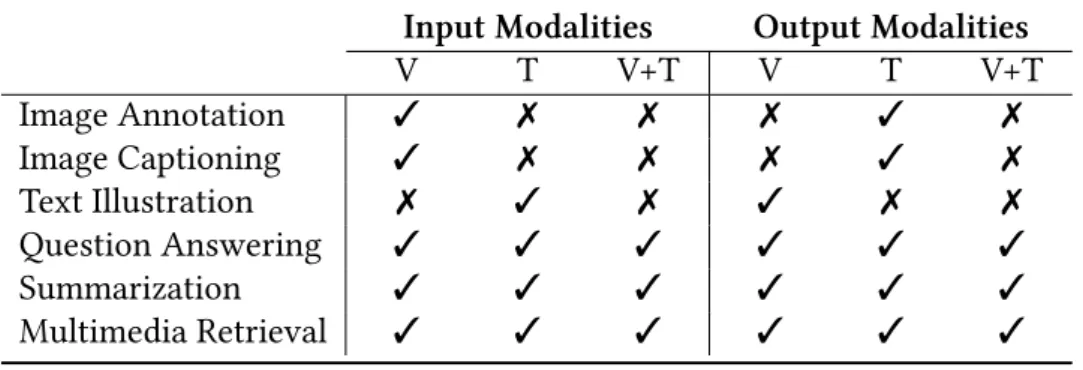
textual data, aims to computationally replicate this process. Conceptually, this problem is framed as given a set of images and their corresponding texts, the goal is to identify patterns of interactions between vision and language, through machine learning, and construct thiscommon/unified space. After obtaining this common embedding space, it can be used to address several multimedia understanding tasks. Some of these are listed in table2.1, where for each task, we represent possible input modalities and corresponding output modalities. Each of the listed tasks are described as follows:
Image Annotation - Annotate an image with one or more tags/keywords;
Image Captioning - Describe an image using natural language, i.e. one or more sen-tences.
Text Illustration - Illustrate a piece of text (sentence, paragraph, among others) with one or more image;
Question Answering - Answer either textual questions or visual question, with an im-age, a text, or both;
Summarization - Summarize a set of images and/or texts, with a reduced set of images and/or texts;
Multimedia Retrieval - Given a query image or text, retrieve related images and/or texts. At the core of each of these tasks lies the common need of learning vision and textual correlations, which is at the core idea of cross-modal embeddings.
A challenge that arises when bridging visual and textual data that must be addressed is the semantic gap. Figure 2.6 illustrates this issue, where: First, none of the visual concepts are part of the image’s text, and second, some high-level concepts, like theDeep Time Show and Edinburgh Festival, do not have a direct visual materialization. How-ever, by inspecting several multimodal documents of the Edinburgh castle, during the Edinburgh Festival (time is crucial to contextualize this example), we discover that the Deep Time Show took place at the Castle. Thus, we bridge modalities (image + text) and discover correspondences between visual elements and textual terms. Cross-modal embeddings tackle both challenges in a principled and versatile manner. Namely, they aim at closing this semantic gap by discovering and analyzing patterns of visual-textual interactions, and representing these patterns in an unified space.
The following section surveys different strategies to learn cross-modal embeddings from multimodal documents comprising images and text.

![Figure 2.1: Overall Architectural Scheme of Convolutional Neural networks. Adapted from [79]](https://thumb-eu.123doks.com/thumbv2/123dok_br/19187387.948301/42.892.141.764.149.367/figure-overall-architectural-scheme-convolutional-neural-networks-adapted.webp)
![Figure 2.5: Illustration of Bag-of-Word Representation for Sentences. Adapted from [6].](https://thumb-eu.123doks.com/thumbv2/123dok_br/19187387.948301/46.892.205.686.166.416/figure-illustration-bag-word-representation-sentences-adapted.webp)
![Figure 2.7: Contrasting between Cross-modal Learning approaches. Adapted from [91].](https://thumb-eu.123doks.com/thumbv2/123dok_br/19187387.948301/50.892.216.685.147.507/figure-contrasting-cross-modal-learning-approaches-adapted.webp)
![Figure 2.10: Neural architecture of Deep Correlation Canonical Analysis. Adapted from [2].](https://thumb-eu.123doks.com/thumbv2/123dok_br/19187387.948301/58.892.300.585.153.405/figure-neural-architecture-deep-correlation-canonical-analysis-adapted.webp)
![Figure 2.12: Neural architecture of Correspondence Cross-modal Autoencoder. Adapted from [28].](https://thumb-eu.123doks.com/thumbv2/123dok_br/19187387.948301/59.892.275.626.160.348/figure-neural-architecture-correspondence-cross-modal-autoencoder-adapted.webp)