Critical Review
ENTREPRENEURSHIP IN AFRICA: AN EXPLORATORY ANALYSIS WITH DATA FROM THE GLOBAL ENTREPRENEURISHIP MONITOR (GEM)
Renato Pereira
[email protected] [email protected] Researcher from OBSERVARE/UAL. Associate Professor at Universidade Autónoma de Lisboa (Portugal). Guest Professor at ISCTE-IUL. PhD in Management Sciences from Université Paris Dauphine.Redento Maia
Post-Doctorate from OBSERVARE/UAL. Full Professor at the Faculty of Economics, Agostinho Neto University (Angola). Doctor of Economics from Sofia University of Economics, BulgariaThis paper presents an exploratory study on entrepreneurship in Africa from data collected under the Global Entrepreneurship Monitor (GEM). Starting from a theoretical basis on the relationship between entrepreneurship and economic development, seven dimensions of study in international entrepreneurship are explored: (i) attitudes, (ii) perceived opportunities, (iii) fear of failure, (iv) entrepreneurial intentions, (v) beliefs about entrepreneurship, (vi) initial entrepreneurial activity and (vii) established business rates. Conclusions about the exploration of data and clues for future research in this area are provided.
Introduction
In a very recent research, Adusei (2016) has shown, following a number of other studies on the same problem in other geographies, that entrepreneurship in Africa is also one of the factors that has a positive impact on economic growth - one of the most challenging problems for the African continent in the last century (Ndulu et al., 2007).
Based on a study covering 12 countries and representing a broad geographic and cultural dispersion, although no Lusophone country has been included, there is a positive linear association between GDP growth per capita and the number of new companies registered in the country in a given fiscal year.
By creating self-sustaining economic conditions through self-employment and the formation of sole proprietorship, the simplest form of entrepreneurship, the causal link between economic growth and increased entrepreneurial activity has been established. If economic rationality imposes on any firm the imperative of satisfying economic needs in the market in which it operates under competitive conditions, then entrepreneurship
109
in economies where markets are generally inefficient or nonexistent (as are many African economies) fulfils both an economic function - generating added value - and a social function - ensuring that people have access to fundamental goods that would not otherwise reach them, thus also contributing to economic development.
The objectives of this paper are to describe, analyse and explain, in a synthetic way, the theme of entrepreneurship in Africa, both in its theoretical framework and in the empirical context of the Global Entrepreneurship Monitor (GEM).
The GEM is a British NGO supported by four prestigious academic institutions. It is the most complete and comprehensive database on entrepreneurship. It represents about two decades of data collected, more than 200,000 interviews per year, more than 100 member countries, more than 500 entrepreneurs, is involved in more than 300 academic and scientific institutions, and has more than 200 donor institutions.
From the outset, the purpose of the GEM has been to make a scientific assessment of the entrepreneurial level of the acceding countries so that policies can be proposed to improve the performance of this variable, assuming that the increase of entrepreneurial activity favours the development of countries, as demonstrated in various studies, in time and space.
The African countries that have participated in the annual GEM data collection are the following: South Africa (with 15 participations), Uganda (with 4 participations), Angola (with 4 participations), Egypt (with 3 participations), Burkina Faso (with 3 participations), Tunisia (with 2 participations), Algeria (with 1 participation), Botswana (with 1 participation), Libya (with 1 participation) and Cameroon (with 1 participation).
Thus, we can see that in the sub-Saharan Africa region only one country participated regularly (South Africa), three countries participated occasionally (Angola, Burkina Faso and Uganda) and two participated in a timely manner (Botswana and Cameroon).
1. Entrepreneurship in Africa
1.1. Disciplinary framework
Entrepreneurship is a multifaceted phenomenon that has been the subject of theoretical approaches from several disciplines, the main ones being Economics, Psychology, Management and Finance (e.g., Sarkar, 2014).
Regardless of the approach and its definition, Entrepreneurship is usually measured by the creation or birth of (private) enterprises, often weighted by their survival rate over a given time horizon.
Synthetically, Finance sees entrepreneurship as another opportunity, or alternative, to investment or capital investment. In this perspective, entrepreneurship materialises in an asset or set of concrete financial assets, that is the stocks representing the capital of a given commercial company.
For Management, entrepreneurship corresponds to the first two phases of the life cycle of a company - launch and expansion - usually only applicable to companies with great potential for rapid growth, in principle because they are based on a given technological innovation.
110
Psychology is probably the discipline that has studied entrepreneurship the most. What is at issue, among other problems, is the understanding of the entrepreneurial personality and the relation of personality traits to the development of the entrepreneurial phenomenon.
Finally, for Economy, there are basically two axes of analysis: (i) a micro, related to the influence of entrepreneurship on the efficiency of markets and (ii) macro, on the cause-effect relations between entrepreneurship and economic growth and development, including institutional and regulatory aspects, the role of the State, economic policies and market access conditions.
However, there is a prevalence of the use of the concept of the "informal economy" when dealing with entrepreneurship (e.g., Lopes, 2007), especially in developmental economics, thus reducing this phenomenon, correctly or incorrectly, to the entrepreneurship of necessity, (overly) neglecting the entrepreneurship of opportunity, also called productive entrepreneurship.
Hilson et al. (2018) confirm that entrepreneurship in sub-Saharan Africa is heavily concentrated in the informal sector, limiting the development of technical skills.
Certainly because of the prevalence of the informal economy in Africa, and the consequent preponderance of entrepreneurship of necessity, Adusei (Op. Cit .: 202) recalls that many authors postulate that "entrepreneurship in developing economies does not have the necessary strength to promote economic growth."
More dramatically, Acs and Varga (2005) argues that entrepreneurship of necessity has virtually no impact on economic development, since it is developed by poor people and therefore has little influence on the productivity of the economy.
The approach followed in this research will focus on an economic approach, focused on the objectives of the GEM itself: to contribute to the "exploration of the impact of national institutions on entrepreneurship as well as the relationship between entrepreneurship and economic development" (Bosma et al., 2012).
1.2. Theoretical characterisation
The relationship between entrepreneurship and economic growth has in fact been widely studied, as previously mentioned, presenting a path of results that are not always convergent.
Ndulu et al. (Op. Cit.: Chapter 2), among other studies, recalls the basis for establishing a causal link between entrepreneurship and economic growth from the relationship between investment and economic growth.
The relationship between investment and economic growth is, under any circumstances, a long-standing and basic relationship known and studied in its two components: public and private.
Also studied is the (significant) relationship between entrepreneurship and economic development, which is established (indirectly) from economic growth generated, job creation, the adoption of technological innovation as well as decreases in poverty, according to Brixiova (2010).
111
In this context, since the creation of private companies is an internal and/or external investment process, understanding the extent of the impact of entrepreneurship on the economy implies identifying the variables that impact on the development of entrepreneurship itself and its relative influence on the economy.
Ndulu et al. (Op. Cit .: 49) considers the following variables: institutional, political and regulatory framework; legislation on economic activity and its application; adequacy and quality of infrastructures; macroeconomic stability; protection of property rights; functioning of the financial system.
These variables are, in fact, critical for understanding the quality of entrepreneurship since, in combination, they influence the level of risk of the investment, leading in many African economies to a prevalence of replicative entrepreneurship, with lower added value, when compared to innovative, higher-risk and value-added entrepreneurship (Adusei, Op. Cit .: 209).
The main conclusion is that the quality of the investment environment is generally insufficient in Africa, supported in the first instance by the higher cost of "doing business". The costs of energy, transportation, telecommunications and security are among the most negative for companies. But customs and commercial licensing costs also carry a heavy weight, as does the need for high "informal" payments for trivial administrative processes to be resolved.
Ndulu et al. (Op. Cit .: 68-71) also conducts an interesting study on the origin of African entrepreneurship by comparing "indigenous" (or local) entrepreneurs with "non-indigenous" (or foreign) entrepreneurs, namely Asian, Middle Eastern, or Caucasians (essentially European).
The first finding is that indigenous firms are, on average, smaller than foreign firms and, at the same time, they start operations with a size that is also smaller than that of foreign companies, a trend that tends to become more pronounced over time.
The founders' educational level (or academic qualifications) helps to realise the difference in size between indigenous companies at the time of their formation in a positive linear association. This dimension difference tends to persist over time.
Commercial credit is also more accessible to foreign firms than to local firms, suggesting that they are more difficult to establish a relationship of trust with their suppliers. These results also indicate the lack of business networks in African local communities. As judicial systems are generally weak, it is extremely difficult for a small African company to develop at the same pace as a foreign entrepreneur, namely Asian, Arab or European. As a last conclusion, perhaps the most surprising of all, it is observed that the difficulty of access to information has a greater weight for African entrepreneurs, even higher than the difficulty of access to capital, which is contrary to studies carried out in developed countries on the same subject.
Brixiova (2010) stresses the importance of studying how the lack of skills of African indigenous companies, affecting both entrepreneurs and their workers, can be overcome since the other variables with negative impact on entrepreneurship are better known: access to credit, business environment and infrastructure constraints. Poor access to information is also identified as hindering the entrepreneurial phenomenon.
112
In this context of competences, the quality of human work being the most critical aspect for the development of entrepreneurship of opportunity, Brixiová et al. (2015) also points to the importance of a factor with a high negative impact: an increasing youth unemployment in several African countries, paradoxical in the logic of development that many of these countries have recently presented.
Despite this, Ekekwe (2016) identifies a significant (exponential?) increase in African entrepreneurship, at least in some countries of the continent, such as Nigeria, Kenya, Senegal, Rwanda and Ghana.
Among the main reasons cited is the recent crisis caused by the fall in the price of oil and the consequent need for economic agents and the State to buy products in local currency, given the exchange crisis in which most of the African countries, directly or indirectly, fell into.
Finally, Klingebiel and Stadler (2017) identify 3 factors that should guide the growth of entrepreneurship in Africa: (i) focus on "top of the pyramid" entrepreneurship as opposed to survival entrepreneurship, or the "pyramid base" characteristic of the informal economy: (ii) control over inputs and (iii) innovation in distribution (not products). Regarding the first factor, the authors advise entrepreneurs to combine African product conception with international (production) quality levels as a means of conquering middle-upper-class consumers. The idea is to "transcend national boundaries" while at the same time creating conditions for future internationalisation strategies, which is very rare in the current context of African entrepreneurship.
On factors of production, the authors emphasize the importance of controlling land and other basic inputs, particularly logistical factors, given the constraints of local production and distribution and increasing import difficulties, especially for exchange rate reasons. Regarding the third factor, this paper stresses that distribution problems remain the most serious in Africa because of, inter alia, dysfunctions or the absence of key infrastructure. It is suggested that entrepreneurs look for innovative ways to use emerging technologies, such as drones, to overcome these limitations.
2. The GEM - Global Entrepreneurship Monitor
2.1. Conceptual Approach
The GEM - Global Entrepreneurship Monitor - is an observatory for entrepreneurship in the world, made from data collected with the same instrument and according to the same methodology in all participating countries, in virtually every country in the world.
Participating countries join the GEM on a voluntary basis and will have to finance all costs related to their participation, usually through sponsorship, which means that many countries participate intermittently and with different teams over time. Others have never participated.
Each country is represented by a national team, usually led by an academic institution responsible for collecting data and drawing up the national report with the conclusions applicable to their country.
113
The project is overseen by the Global Entrepreneurship Research Association (GERA), a private non-profit organisation based in the United Kingdom, responsible for the consolidated report.
The GEM has been defined by leading academics from leading scientific institutions involved in entrepreneurship, with a dual concern to include the most influential theoretical approaches and measurement indicators that allow for international comparisons under the same methodology.
GEM data are collected through the application of two complementary instruments (i) the Adult Population Survey (APS) and (ii) the National Expert Survey (NES).
The APS studies the attitudes, the activity and the aspirations of the entrepreneurs. It focuses on at least 2,000 adults in each country;
The NES monitors nine factors that are believed to have a significant impact on entrepreneurship, known as the Entrepreneurial Framework Conditions (EFCs). It focuses on at least 36 carefully selected experts in each country.Data collection is centrally coordinated. The data collection instruments of each country are subject to several checks before the collection process commences. The resulting data is scrutinised repeatedly before being published. This process, developed and tested over many years, ensures that the GEM data is of the highest quality.
In conclusion, the GEM allows us to understand:
Factors that influence entrepreneurship;
The relationship between entrepreneurship and the economic performance of each participating country (and its various regions);
The interaction between institutions, entrepreneurship and development;
The different types of entrepreneurship and their potentialities.These factors are considered indispensable for the establishment of public policies that support economic development strategies, especially in developing countries, but also in middle-income countries and, on the limit, all countries that intend to remain competitive and recognise the importance of entrepreneurship for this purpose.
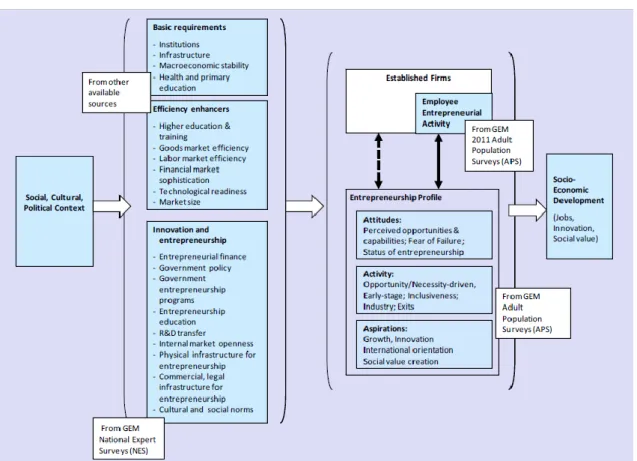
This version of the model was revised aiming at an adaptation to the typology of "Factor-driven economies", "Efficiency-"Factor-driven economies" and "Innovation-"Factor-driven economies" proposed by Porter et al. (2002), allowing GEM to better describe and measure the conditions under which entrepreneurship and innovation can develop.
114
Figure 1 - GEM conceptual model
Source: Bosma et al. (2012: 12)
"Factor-driven economies” are countries in the early stages of the development process, usually dependent on agriculture and the extraction of natural resources. In "Efficiency-driven economies" there is already an industrial sector and the consequent gains in productivity resulting from economies of scale achieved as well as a minimally sophisticated financial system. In "Innovation-driven economies" there is a gradual shift to the tertiary sector and to research and development and knowledge generation activities.
2.2. Methodological Approach
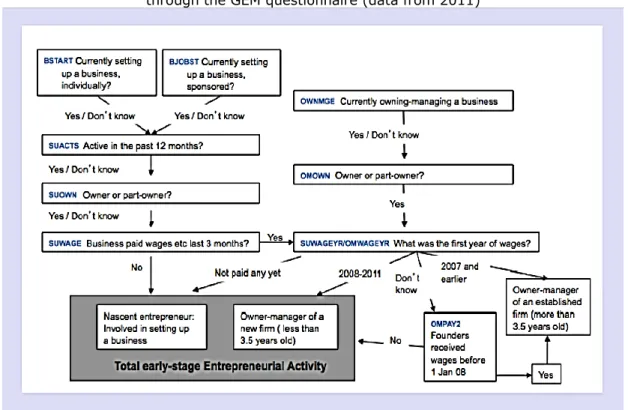
From a methodological point of view, the purpose of the GEM is to identify and characterise entrepreneurs throughout the various phases of the entrepreneurial process: opportunity recognition/nascent entrepreneurship; start-up a new firm; owning-managing a new firm. The first two steps together are early-stage entrepreneurial activities.
115
Figure 2 - Methodological process to identify the various stages of the entrepreneurial process through the GEM questionnaire (data from 2011)
Source: Source: Bosma et al. (2012: 21)
Figure 3 describes the entrepreneurial process as it is conceptually defined by the GEM. But more than separating the phases of the entrepreneurial process, the great methodological contribution of the GEM is to enable the identification of the attitudes that underlie the entrepreneurial activity.
Another important aspect that the questionnaire captures is not only the size of the phenomenon of discontinuity of the companies but also the reasons associated with this stop, whether they start a new business or become economically (and/or financially) infeasible.
Figure 3 - Phases of the entrepreneurial process in the GEM’s theoretical model
116
2.3. Results From Sub-Saharan Africa
Given the weak adherence of the African countries to the GEM, with the (expected) exception of South Africa, the project's coordination has focused on making a sectoral report for Sub-Saharan Africa (Herrington & Kelley, 2012).
Following the same methodology, and the same purposes of the national GEM reports, this work was carried out in a period of 3 years until 2012 and focused on the following sample of 10 countries: Angola, Botswana, Ethiopia, Ghana, Malawi, Namibia, Nigeria, Uganda and Zambia.
According to the Porter et al. (2002) typology, South Africa and Namibia are classified as "Efficiency-driven economies" and the remaining countries are "Factor-driven economies". No country in Sub-Saharan Africa belongs to the"Innovation-driven economies” group.
Although the relative lack of timeliness of the data can be seen as a limitation for this work, the period covered in the study corresponds to a triennium of strong economic growth in most of the countries studied, after the effects of the international financial crisis of 2007-2008 and before the status quo created by the fall in oil prices in the second half of 2014.
Thus, it will certainly be interesting to see how entrepreneurship unfolds and is perceived in a time period where countries are experiencing generalised economic expansion. The most striking conclusions can be synthesised in 7 groups: (i) attitudes, (ii) opportunities perceived, (iii) fear of failure, (iv) entrepreneurial intentions, (v) entrepreneurship beliefs, (vi) initial entrepreneurial activity, (vii) established business rates.
Figure 4 - Entrepreneurial attitudes in Sub-Saharan Africa
117
Surprisingly (or perhaps not) the (simple) average of people who consider entrepreneurship as a good career choice (76%) is superior to all other regions in the world, being only matched by the neighbouring Middle East and North Africa (MENA). In the other two parameters analysed with regard to entrepreneurial attitudes, the relative position is also at the highest level - the case for status - or even above all of them - the case of media coverage achieved in the case of entrepreneurial success. These results may be explained, in part, by the previously identified lack of opportunities in the labor market, especially among young people, and by a certain mystification of entrepreneurial success leveraged by international success stories, especially by African Americans in the American press.
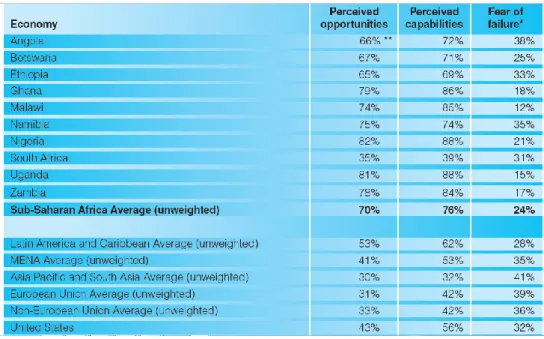
With regard to the perception of the opportunities available in the market for the development of an entrepreneurial initiative, and the corresponding capacities to follow it up, the results show a pessimism on the South African side and widespread optimism in all other countries, particularly in Nigeria.
When analysing the fear of failure, the standard deviation between the country with the highest and the country with the lowest result is lower. Pessimism about the likelihood of failure is most pronounced in Angola, Namibia and Ethiopia, and optimism about the likelihood of failure is clearer in Malawi, Uganda and Zambia.
Figure 5 - Perceived capabilities, opportunities and fear of failure
Source: Herrington & Donna (2012: 22)
Considering the comparison with the results from other regions, there appears to be several bias factors in the entrepreneurs' perception, notably due to the lack of a sufficient sample of reference cases in each country (except for South Africa) to allow for
118
the creation of a balanced perception. This is particularly visible in the issue of competencies, where evaluation distortions seem particularly evident.
Figure 6 - Entrepreneurial Intentions in Sub-Saharan Africa
Source: Herrington & Donna (2012: 24)
In the variable of entrepreneurial intentions among the non-entrepreneurial population, there are significant disparities. Again, and not surprisingly, South Africa has values similar to those in Europe and the United States, and relatively close to those in Asia. The explanation for these values will certainly be linked to the quantity and maturity of entrepreneurship in this unique sub-Saharan country.
Ethiopia, perhaps for cultural reasons, given geographical proximity, presents values similar to those of the MENA region. Angola, Botswana and Uganda all display values of entrepreneurial intent that are absolutely overwhelming, albeit in line with previous indicators such as career opportunities and career prospects.
In the chapter on the level of entrepreneurial activity, South Africa is once again repeating the pattern of a behaviour similar to that of regions whose economic development is superior to that of the region where it is situated, in some cases at the highest level in the world.
Relative to other countries, it seems clear that there are two groups in terms of levels of entrepreneurial activity: Angola, Botswana, Ethiopia, Malawi, Namibia and Zambia have, as one would expect, a rate of established enterprises much lower than the rate observed in previous steps. Nigeria is in this pattern of behaviour but the break is much less pronounced.
Ghana and Uganda, on the other hand, have the opposite behaviour, suggesting a much greater maturity as regards to the entrepreneurial process, which may arise from the type of sectors chosen or the quality of entrepreneurship support in those countries.
119
The most surprising results come even from the breakdown of entrepreneurial initiatives between necessity-driven and opportunity-driven (or productivity) initiatives.
Figure 7 - Activity levels and entrepreneurial motivations
Source: Herrington & Donna (2012: 27)
In this case, apart from Uganda and Malawi in which there is a very slight superiority of necessity-driven entrepreneurship, and Namibia in which there is perfect equality, the percentage of opportunity-oriented entrepreneurs vis-à-vis those who claim to have created their enterprise by necessity is higher in all other countries. In Ethiopia, this difference is more than three times and in Ghana it is almost double. These values are in line with what is happening in the rest of the world and are contrary to theory and several other studies on the subject.
Figure 8 - Reasons for the discontinuation of entrepreneurial activity
120
Finally, analysis of the reasons for ending or closing the deal allows us to identify a large disparity of situations.
However, despite the fact that benchmarks are not presented for other regions, the two reasons most frequently mentioned - lack of profitability and problems in obtaining financing - are also the most common reasons for the discontinuation of entrepreneurial activity in more developed regions of the world.
In Angola, the frequency of business opportunities is curious, well above any other country in the region.
Equally curious is the realisation that none of the respondents in Ethiopia say they have planned a way out of their business, in stark contrast to what is happening in more developed economies.
Even in South Africa, the frequency does not exceed 1%, which allows us to raise the possibility of significant differences, despite the various similarities between the profile of entrepreneurship in this country and the more developed countries of Europe and the United States.
Conclusion
This paper aims to describe, analyse and explain the theme of entrepreneurship in Africa, both in terms of its theoretical framework and in the empirical context of the Global Entrepreneurship Monitor (GEM).
The theoretical analysis made it possible to clarify, first and foremost, the difference between the informal economy and entrepreneurship in an African context, identifying the first concept, particularly dear to development economists, with the notion of "survival entrepreneurship" and the second concept - more expensive to microeconomists and business scholars - of "opportunity entrepreneurship" (or productivity).
In other words, the informal economy is the prevailing context of survival entrepreneurship in Africa, although much entrepreneurship of this nature takes place in the formal economy context on the African continent and elsewhere.
Another important element that emerged from the theoretical analysis conducted was the discussion of the complex causal links that connect entrepreneurship to economic growth and development.
The positive impact of entrepreneurship on both growth and development is taken for granted with economists and researchers from various quarters, and is sometimes presented in an almost axiomatic (though not dogmatic) perspective.
However, this relationship is more than established and research proceeds at a much deeper level, understanding the different nuances of the same relation, namely having the economic and institutional contexts as moderating variables.
121
From the point of view of the analysis of the 2012 GEM report on Sub-Saharan Africa, it was possible to draw some interesting and perhaps unexpected conclusions about the entrepreneurial process in those countries.
A first (expected) conclusion is that South Africa presents significant differences relative to the other countries in the sample studied.
What one might not expect is that, although it is classified as an "efficiency-driven economy", South Africa clearly presented some indicators of an "innovation-driven economy".
Another surprising conclusion is the clear prevalence of opportunity entrepreneurship in almost all sampled countries, especially Ethiopia and Ghana.
Is the informal economy an entrepreneurial form of African non-entrepreneurship? Or is there just a bias in the data? A deepening of this issue seems to be a promising research clue.
Finally, it should be pointed out that this work has important limitations of scope. It was not intended, at all, to cover the topic exhaustively, and certain relevant variables remained undeveloped.
In this context, it will be desirable in future work to consider the Sub-Saharan Africa sub-region independently of the African continent. Historical and economic reasons not discussed in this study justify a separation of this geography for the purpose of a more objective analysis of this subject.
References
Acs, Z. J. & Varga, A. (2005). «Entrepreneurship, Agglomeration and Technological Change». Small Business Economics. 24 (3): 323-334.
Adusei, M. (2016). «Does Entrepreneurship Promote Economic Growth in Africa?».
African Development Review. 28 (2): 201-214.
Bosma, N. & Coduras, A. & Litovsky, Y. & Seaman, J. (2012). GEM Manual – A report on
the design, data and quaity control of the Global Entrepreneurship Monitor. Disponível
em: www.gemconsortium.org
Braxiova, Z. (2010). «Unlocking Productive Entrepreneurship in Africa’s Least Developed Countries». African Development Review. 22 (3): 440-451.
Braxiová, Z. & Ncube, M. & Bicaba, Z. (2015). «Skills and Youth Entrepreneurship in Africa: Analysis with Evidence form Swaziland». World Development. 67 (1): 11-26. Ekekwe, N. (2016). «Why African Entrepreneurship is Booming». Harvard Business
Review, 94 (7): 2-4.
Global Entrepreneurship Monitor (2017). Global Entrepreneurship Monitor 2016/17. Global Entrepreneurship Research Association. Disponível em: www.gemconsortium.org Herrington, M. & Donna, K. (2012). African Entrepreneurship – Sub-Saharan African
122
Hilson, G. & Hilson, A. & Maconachie, R. (2018). «Opportunity or Necessity? Conceptualizing Entrepreneurship at African Small-Scale Mines». Technological
Forecasting & Social Change. 131 (6): 286-302.
Klingebiel, R. & Stadler, C. (2017). «3 Things Driving Entrepreneurial Growth in Africa».
Harvard Business Review. 95 (2): 2-4.
Lopes, C. M. (2007). «Comércio informal, transfronteiriço e transnacional: que articulações? Estudo de caso no mercado de S. Pedro (Huambo) e nos mercados dos Kwanza e Roque Santeiro (Luanda)». Economia Global e Gestão. 12 (3): 35-55.
Ndulu, B. & Chakraborti, L. & Lijane, L. & Ramachadran, V. & Wolgin, J. (2007).
Challenges of African Growth – Opportunities, Constraints and Strategic Directions. The
International Bank for Reconstruction and Development, World Bank, Washington DC. Porter, M. E. & Sachs, J. J. & McArthur, J. W. (2002). Executive Summary: Competitiveness and Stages of Economic Development. In Porter, M. E. & Sachs, J. J. & Cornelius, P. K. & McArthur, J. W. & Schwab, K. (Eds). The Global Competitiveness Report 2001-2002, pp. 16-25. Oxford University Press, New York.
Sarkar, S. (2014). Empreendedorismo e Inovação. Escolar Editora, Lisboa.
How to cite this critical review
Pereira, Renato; Maia, Redento (2018). “Entrepreneurship in Africa: An exploratory analysis with data from the Global Entrepreneuriship Monitor (GEM)”. Critical review, JANUS.NET e-journal of International Relations, Vol. 9, Nº. 2, November 2018-April 2019. Consulted [online] on the date ofthe last visit, DOI