ABSTRACT | Purpose: The aim of this study was to compare the corneal cell viability and thickness of LASIK flaps created by 3 femtosecond lasers in eye-bank human corneas. Methods:
Forty-five eye-bank human sclerocorneal buttons (15 corneas in each group) were examined after the creation of 120 µm-thick laser-assisted keratomileusis (LASIK) flaps with 150kHz iFS In traLase™ (IL), Z6 Femto LDV™ (LDV), or 200kHz Wavelight™ FS200 (FS200). The thickness of the flaps was measured using anterior segment optical coherence tomography (AS-OCT; Visante™). Cell viability was blindly evaluated with immuno-histochemistry for keratocyte apoptosis using anti-caspase 3 antibodies. Results: The standard deviation from the intended flap thickness was less than 10 µm in all the groups. There was a statistically significant difference in corneas treated with LDV and IL with regard to the flap thickness horizontally at +3.00 mm (p=0.0124), -0.5 mm (p=0.0082), and -1.00 mm (p=0.0425) from the corneal vertex and +0.5 mm from the flap edge (p=0.0240), and those treated with LDV and FS200 with regard to the flap thickness horizontally at -0.5 mm from the corneal vertex (p=0.0082). The mean keratocyte apoptosis numbers were 13.09 ± 1.10, 15.59 ± 3.28, and 17.72 ± 1.49 in corneas treated with IL, FS200, and LDV, respectively (p<0.001). Conclusion: All 3 assessed femtosecond lasers provided predictable LASIK flap thickness. The mean stromal keratocyte apoptosis number was low in all groups.
Keywords: Keratomileusis, laser in situ; Femtosecond;
Tomo-graphy, optical coherence, Anti-caspase 3; Cornea; Eye-bank
RESUMO | Objetivos: Comparar a viabilidade celular e a espessura do disco de LASIK confeccionado por três laseres de femtosegundo, em córneas humanas de banco de olhos. Mé
todos: Quarenta e cinco botões córneo-esclerais humanos de
banco de olhos (15 córneas em cada grupo) foram examinados, após a criação de disco de LASIK com 120 µm de espessura, utilizando-se o iFS IntraLase® 150kHz (IL), o Femto LDV® Z6 (LDV), ou o Wavelight® FS200 200kHz (FS200). Tomografia de coerência óptica do seguimento anterior (OCT Visante®) foi usada para medir a espessura dos discos. A viabilidade celular foi avaliada por meio de imuno-histoquímica para apoptose dos ceratócitos, com anti-caspase 3. Resultados: O desvio padrão da espessura planejada do disco foi inferior a 10 µm em todos os grupos. Houve diferença estatisticamente significante da espessura do disco horizontalmente a +3,00 mm (p=0,0124), -0,5 mm (p=0,0082) e -1,00 mm (p=0,0425), a partir do vértice corneal, e a +0,5 mm (p=0,0240), a partir da borda do disco, em córneas tratadas por LDV e IL, e horizontalmente a -0,5 mm a partir do vértice corneal, entre LDV e FS200 (p=0,0082). A
média de apoptose dos ceratócitos foi (13,09 ± 1,10), (15,59
± 3,28) e (17,72 ± 1,49), em córneas tratadas pelo IL, FS200 e LDV, respectivamente (p<0,001). Conclusão: Todos os três laseres de femtosegundo estudados produziram disco de LASIK com predictibilidade de espessura. A média de apoptose dos ceratócitos foi baixa em todos os grupos.
Descritores: Ceratomileuse assistida por excimer laser in situ; Femtosegundo; Tomografia de coerência óptica; Anti-caspase 3; Córnea; Banco de olhos
INTRODUCTION
The predictability and accuracy of laser-assisted ke-ratomileusis (LASIK) flap thickness, diameter, and mor-phology, as well as the homogeneity of its interface can alter refractive outcomes and the risks of complications
Thickness and immunohistochemistry of LASIK flaps created
by different femtosecond lasers in eye-bank corneas
Espessura e imunohistoquímica de flap de LASIK criado com diferentes
laseres de femtosegundo em córneas de banco de olhos
Grazielly Martins Peixoto de Oliveira1, Walton Nosé2, Maria Lúcia Zaidan Dagli3, Vanessa Vieira Cordeiro1, Nicolas Cesário Pereira1, Adriana S. Forseto1,2
1. Department of Refractive Surgery, Banco de Olhos de Sorocaba, Hospital de Olhos de Sorocaba, Sorocaba, SP, Brazil. 2. Department of Refractive Surgery, Eye Clinic, São Paulo, SP, Brazil.
3. Laboratory of Experimental and Comparative Oncology, Department of Pathology, Faculdade de Medicina Veterinária e Ciência Animal, Universidade de São Paulo, São Paulo, SP, Brazil.
Submitted for publication: October 5, 2017 Accepted for publication: February 16, 2018
Funding: No specific financial support was available for this study.
Disclosure of potential conflicts of interest: None of the authors have any potential conflict of interest to disclose.
Corresponding author: Grazielly Martins Peixoto de Oliveira. Rua Nabek Shiroma, 210 - Sorocaba - SP - 18031-060 - Brazil E-mail: [email protected]
from the procedure(1-3). LASIK flap thickness can be
measured with anterior segment optical coherence to-mography (AS-OCT), and this approach is reliable and reproducible(1). Zone cell damage in the LASIK
retroa-blation area can also alter refractive outcomes, as it interferes with the corneal wound healing process and with remodeling(4). Apoptosis of stromal keratocytes is
an early corneal wound-healing response after injury of the cornea. It can be used to analyze cell damage and viability, and mean keratocyte apoptosis is considered to be proportional to corneal remodeling(4,5). Caspase 3
plays a central role in the proteolytic cascade of apopto-sis, and it is considered as a reliable marker to identify apoptotic cells(6).
The LASIK flap is created with a mechanical microke-ratome or with a femtosecond (FS) laser(7). While many
studies have compared a microkeratome flap with a laser flap, there have been limited comparisons among flaps obtained with FS systems(8,9).
The aim of this study was to compare the corneal cell viability and thickness of LASIK flaps created by 3 FS lasers with eye-bank human corneas.
METHODS
This study was approved by the Ethics Committee of Sorocaba Eye Bank, Sorocaba Ophthalmologic Hospital. Forty-five eye-bank human sclerocorneal buttons from Sorocaba Eye Bank (Sorocaba, SP, Brazil), which were preserved in Optisol-GS™ (Bausch and Lomb Surgical, Rochester, NY, USA) at between 2 and 8°C up to 7 days after enucleation and were not considered for trans-plantation because of a positive serology status, were selected. The buttons were evaluated using the slit lamp Topcon SL-D7 (Topcon Medical Systems, Inc., Oakland, NJ, USA) before and after preservation, and the num-ber and morphology of corneal endothelial cells were analyzed using the Konan Eye Bank Kerato Analyzer (Konan Medical, Inc., Nishinomiya, Japan). The intensity of corneal stromal edema was classified as 0, +1, +2, +3, or +4, where 0 corresponded to the absence of edema and +4 corresponded to the maximum intensity of edema. Corneas with stromal edema intensity of 0 or +1 and with at least 2,000 endothelial cells in a regular mosaic format were selected. Corneas were divided into the following 3 groups (15 corneas in each group) accor-ding to the type of FS laser platform used to manufacture the LASIK flaps: 150kHz iFS IntraLase™ (IL) (Abbott Medical Optics, Santa Ana, CA, USA); Z6 Femto LDV™
(LDV) (Ziemer Ophthalmic Systems AG, Port, Switzer-land); and 200 kHz Wavelight™ FS200 (FS200) (Alcon Laboratories, Inc., Fort Worth, TX, USA) groups.
Flap creation
Each cornea was removed from Optisol-GS™ and fixed in a disposable artificial anterior chamber (AAC) (Katena Products, Inc., Denville, NJ, USA for the IL and FS200 groups, and Ziemer Ophthalmic Systems AG for the LDV group), which was filled with balanced salt so-lution (BSS, Alcon Laboratories, Inc.) with a pressure of approximately 30 mmHg(10). Epithelial debridement of
the cornea was performed with a disposable crescent blade (Katena Products, Inc.).
All FS laser platforms were programmed to create a flap having a thickness of 120 µm and a diameter of
9.00 mm.
Each sclerocorneal button was applanated using the disposable interface contact lens of the system without the need for a suction ring. An Intershield™ spacer (Ziemer Ophthalmic Systems AG), which is a sheet of plastic positioned between the laser handpiece and the cornea, was used in the LDV group (11).
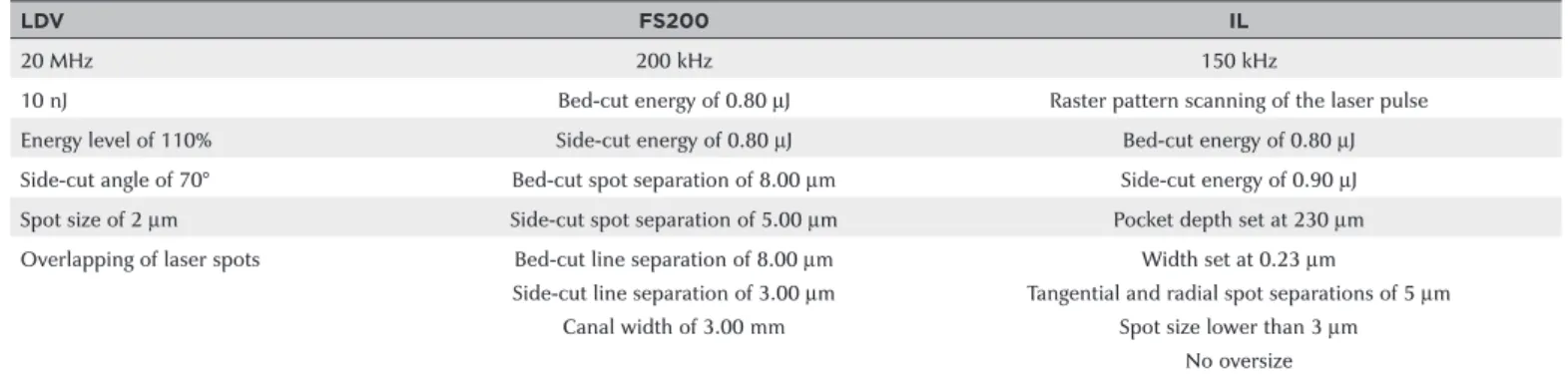
The FS laser settings for creating the LASIK flaps in all groups are described in table 1(12,13).
Flap evaluation
Two cross-sectional axial scans (10.0 mm in size) were performed horizontally and vertically with the high- speed AS-OCT system Visante™ (Carl Zeiss Meditec, Du-blin, CA, USA). The axial scan frequency was 2,000 Hz, and each image was composed of 256 A-scans (axial and transversal resolutions of 18.0 µm and 60.0 µm,
respectively)(1). LASIK flap thickness was measured in
Table 1. Lasik flap creation parameters in each treatment group
LDV FS200 IL
20 MHz 200 kHz 150 kHz
10 nJ Bed-cut energy of 0.80 µJ Raster pattern scanning of the laser pulse
Energy level of 110% Side-cut energy of 0.80 µJ Bed-cut energy of 0.80 µJ
Side-cut angle of 70° Bed-cut spot separation of 8.00 µm Side-cut energy of 0.90 µJ
Spot size of 2 µm Side-cut spot separation of 5.00 µm Pocket depth set at 230 µm
Overlapping of laser spots Bed-cut line separation of 8.00 µm Width set at 0.23 µm
Side-cut line separation of 3.00 µm Tangential and radial spot separations of 5 µm
Canal width of 3.00 mm Spot size lower than 3 µm
No oversize
LDV= Z6 Femto LDV™; FS200= 200-kHz Wavelight™ FS200; IL= 150-kHz iFS IntraLase™.
A
B
C
flap edge)(1,14,15). Immediately after the imaging study, the
flap was lifted with a LASIK spatula (Katena Products, Inc.), and it was repositioned for immunohistochemical examination. Corneas were kept refrigerated in Opti-sol-GS™ medium for 12 h after LASIK flap creation until fixation. After 12 h of fixation in 10% formaldehyde, the specimens were cut and embedded into paraffin blocks, and 5 µm sections were created from the paraffin
blo-cks(16) and were mounted on silane-coated slides, dried,
deparaffinized in xylene, and rehydrated in ethanol. Sections then underwent heat-induced antigen retrie-val with a microwave oven (3 x 5 min cycles in 10 mM Tris-EDTA buffer [pH 9] at 650 W). Endogenous pero-xidase was quenched with 3% hydrogen peroxide for 5 min. Sections were carefully wiped to absorb excess moisture. Using a pen draw (Dakocytomatic, Dako, CA, USA) on the glass slide, a complete circle was made around each section. This hydrophobic barrier confined reagents to the section, thus preventing them from sprea-ding. Briefly, the sections were rinsed with TBS (0.01 M Tris, 0.15 M NaCl, pH 7.6) in a solvent tank. Slides were incubated with the primary antibody for caspase 3 (1:100; Uniscience, Fort Garry Ind. Park, Winnipeg, Canada). The primary antibody solution or negative control completely covered the sections. The slides were placed in a humidified container and were incubated at 4°C overnight (around 16 h)(6). The slides were rinsed
in PBS thrice (each rinse was for 5 min). Sections were incubated with biotinylated goat anti-rabbit IgG (1:400 in PBS; secondary antibody; Vector Laboratories Inc., Burlingame, CA, USA) for 30 min at room temperature. The slides were rinsed in PBS thrice (each rinse was for 5 min). Sections were incubated in FITC-streptavidin for 30 min, with the slides protected from light. The slides were rinsed in PBS thrice (each rinse was for 5 min), and a cover slip was placed with aqueous mounting medium and was sealed with nail polish. Slides were scanned using the fluorescence microscope Nikon Eclipse® E-800
(Nikon, Melville, NY, USA) under 400× magnification, and 5 fields were imaged and stored by a computerized image analysis program (Image Pro Plus, Nikon, Melville, NY, USA) prior to cell counting. The locations of the 5 fields were as follows: the central LASIK retroablation zone; 2 fields distance from the central field to the right; 2 fields distance from the central field to the left; imme-diately right of the flap edge; and immeimme-diately left of the flap edge. A blinded examiner counted the keratocyte apoptotic cells.
Statistical analysis
The Kruskal-Wallis test with Dunn’s post-hoc test was used to evaluate statistical differences in the thickness of the flaps and keratocyte apoptosis.All statistical analy-ses were performed using Prism 5 software (GraphPad Software Inc., San Diego, CA, USA), and a p-value <0.05 was considered significant.
RESULTS
Fifteen eye-bank corneas were allocated in each of the 3 groups (LDV, FS200, and IL groups). There were no differences with regard to preservation time and endothelial cell count among the groups. Additionally, no intraoperative flap complications were observed in any of the groups.
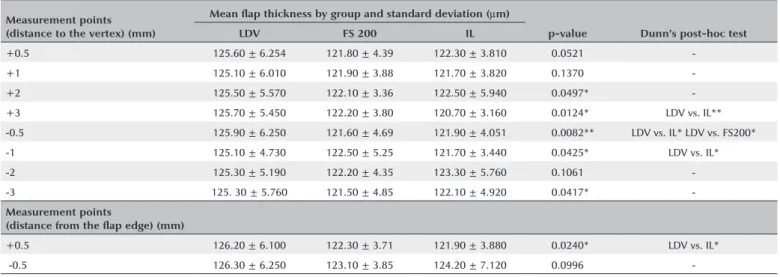
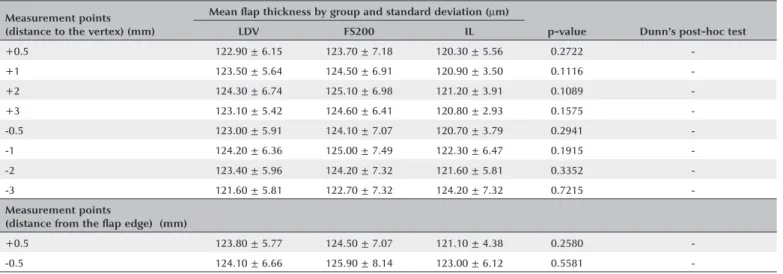
The mean flap thickness measurements at all points in the groups are shown in tables 1 and 2, and figures 2 and 3. There were statistically significant differences in the corneas between the LDV and IL groups with regard to the flap thickness horizontally at +3.00 mm (p=0.0124), -0.5 mm (p=0.0082), and -1.00 mm (p=0.0425) from the corneal vertex and at +0.5 mm from the flap edge (p=0.0240) (Table 1). Additionally, there were statistically significant differences in the corneas between the LDV and FS200 groups with regard to the flap thickness horizontally at -0.5 mm from the corneal vertex (p=0.0082) (Table 2). No statistically sig-nificant difference was found vertically (Table 3).
The mean keratocyte apoptosis numbers were 13.09 ± 1.10, 15.59 ± 3.28, and 17.72 ± 1.49 in corneas treated with IL, FS200, and LDV, respectively (p<0.001), with significant differences between LDV and IL, and between LDV and FS200 (Table 4).
DISCUSSION
Flap thickness regularity and predictability are im-portant for optimal LASIK surgery outcomes. A thin cor-neal flap maintains the integrity of the epithelium and Bowman’s layer and a thick residual stroma, reducing complications, such as corneal ectasia(2).
FS laser technology has the advantage of producing a LASIK flap with predictability, a more uniform thickness throughout(3), and a more planar morphology(3,14). The
Table 2. LASIK flap thickness measured horizontally (OCT slit at 0 and 180°)
Measurement points (distance to the vertex) (mm)
Mean flap thickness by group and standard deviation (µm)
pvalue Dunn’s posthoc test
LDV FS 200 IL
+0.5 125.60 ± 6.254 121.80 ± 4.39 122.30 ± 3.810 0.0521
-+1 125.10 ± 6.010 121.90 ± 3.88 121.70 ± 3.820 0.1370
-+2 125.50 ± 5.570 122.10 ± 3.36 122.50 ± 5.940 0.0497*
-+3 125.70 ± 5.450 122.20 ± 3.80 120.70 ± 3.160 0.0124* LDV vs. IL**
-0.5 125.90 ± 6.250 121.60 ± 4.69 121.90 ± 4.051 0.0082** LDV vs. IL* LDV vs. FS200*
-1 125.10 ± 4.730 122.50 ± 5.25 121.70 ± 3.440 0.0425* LDV vs. IL*
-2 125.30 ± 5.190 122.20 ± 4.35 123.30 ± 5.760 0.1061
--3 125. 30 ± 5.760 121.50 ± 4.85 122.10 ± 4.920 0.0417*
-Measurement points
(distance from the flap edge) (mm)
+0.5 126.20 ± 6.100 122.30 ± 3.71 121.90 ± 3.880 0.0240* LDV vs. IL*
-0.5 126.30 ± 6.250 123.10 ± 3.85 124.20 ± 7.120 0.0996
-*= p-value <0.05; *-*= p-value <0.001; **-*= p-value <0.0001.
OCT= optical coherence tomography; LDV= Z6 Femto LDV™; FS200= 200-kHz Wavelight™ FS200; IL= 150-kHz iFS IntraLase™.
Figure 2. LASIK flap thickness measured horizontally (optical coherence tomography slit at 0 and 180°).
Figure 3. LASIK flap thickness measured vertically (optical coherence tomography slit at 90 and 270°).
of a stromal opaque bubble layer (OBL), which is more likely with high-energy devices(9,10,17). In this study, no
clinical difference in OBL formation was observed among the groups. Comparisons between 15- and 30kHz FS In-traLase™ devices in eye-bank corneas with regard to the creation of partial thickness donor corneal buttons for lamellar keratoplasty showed a more homogeneous inter-face with the lower energy per pulse device (FS 30 kHz)(18).
The standard deviation (SD) of corneal flap thick-ness may range from 22 to 30 µm with a
microkerato-me(7,15,19,20) and from 4 to 18.4 µm with FS(3,21). In this
study, the SD of corneal flap thickness ranged from 4.73 to 6.74 µm with LDV, from 3.36 to 8.14 µm with
FS200, and from 2.93 to 7.32 µm with IL.
All of the FS laser platforms created planar LASIK flaps, with no thickness variation from the center to the periphery and excellent thickness predictability. LDV
Table 3. LASIK flap thickness measured vertically (OCT slit at 90 and 270°)
Measurement points (distance to the vertex) (mm)
Mean flap thickness by group and standard deviation (µm)
pvalue Dunn’s posthoc test
LDV FS200 IL
+0.5 122.90 ± 6.15 123.70 ± 7.18 120.30 ± 5.56 0.2722
-+1 123.50 ± 5.64 124.50 ± 6.91 120.90 ± 3.50 0.1116
-+2 124.30 ± 6.74 125.10 ± 6.98 121.20 ± 3.91 0.1089
-+3 123.10 ± 5.42 124.60 ± 6.41 120.80 ± 2.93 0.1575
--0.5 123.00 ± 5.91 124.10 ± 7.07 120.70 ± 3.79 0.2941
--1 124.20 ± 6.36 125.00 ± 7.49 122.30 ± 6.47 0.1915
--2 123.40 ± 5.96 124.20 ± 7.32 121.60 ± 5.81 0.3352
--3 121.60 ± 5.81 122.70 ± 7.32 124.20 ± 7.32 0.7215
-Measurement points
(distance from the flap edge) (mm)
+0.5 123.80 ± 5.77 124.50 ± 7.07 121.10 ± 4.38 0.2580
--0.5 124.10 ± 6.66 125.90 ± 8.14 123.00 ± 6.12 0.5581
-*= p-value <0.05; *-*= p-value <0.001; **-*= p-value <0.0001.
OCT= optical coherence tomography; LDV= Z6 Femto LDV™; FS200= 200-kHz Wavelight™ FS200; IL= 150-kHz iFS IntraLase™.
Table 4. Immunohistochemical expression of caspase 3
Mean keratocyte apoptosis number and standard deviation
pvalue Dunn’s posthoc test
FS200 LDV IL
Caspase 3 (mean) 15.59 ± 3.28 17.72 ± 1.49 13.09 ± 1.10 <0.001 LDV vs. IL LDV vs. FS200
LDV= Z6 Femto LDV™; FS200= 200-kHz Wavelight™ FS200; IL= 150-kHz iFS IntraLase™.
A prospective comparative case series using Fou rier-domain OCT, which has a depth resolution of 5 µm,
showed a uniform LASIK flap with FS 60kHz IntraLase™ and with 200kHz VisuMax™ FS laser (Carl Zeiss Meditec) and a meniscus-shaped flap with Femto LDV™ Crystal Line, as well as low thickness variation between the peri-phery and center with IntraLase™(14). Although we found
few flap thickness differences, the results of this study demonstrate a significant improvement with LDV when compared to previous equipment, as the device creates a far more uniform flap, without a meniscus shape.
The cellular effects of the laser are also important for LASIK surgery outcomes, as they interfere with the corneal wound healing process and remodeling(4).
Nu-merous studies have used immunochemistry to detect apoptosis markers (Fas, Fas ligand, caspase 3, Bcl-2, and Bax)(4-6,16). Caspase 3 plays a central role in the
pro teolytic cascade in apoptosis, and it is considered an early and specific marker to detect cells destined to die by apoptosis, as it can detect these cells before the appearance of morphological alterations (fragmenta-tion of the nucleus, forma(fragmenta-tion of apoptotic bodies, and chromatin condensation)(6). The expression of apoptosis
has been shown to be associated with keratocyte
de-pletion and regeneration, corneal endothelial recovery, and wound healing and remodeling(5). Corneal wound
healing after LASIK has an important role in the develo-pment of surgery complications, such as overcorrection and undercorrection(22). Thus, it is expected that greater
keratocyte apoptosis is associated with greater corneal remodeling and lower safety and effectiveness of the refractive procedure. Apoptosis and inflammatory cell infiltration are proportional to the amount of energy with the FS system(23,24). Four hours after corneal
epithe-lial injury, it is possible to observe the peak of stromal keratocyte apoptosis(23,25) and stromal cell inflammatory
infiltration, and these remain high even at 24 h after the injury(23,24,26).
In our study, there was a slight difference in ke-ratocyte apoptosis among the groups. At 12 h after treatment, there was no evidence of inflammatory cell infiltration, probably because corneas without blood supply were used.
corneas treated with FS 15kHz IntraLase™ than with FS 30- and 60 kHz IntraLase™ for LASIK flap creation(26).
Ra-bbit corneal keratocyte apoptosis marked with the ter-minal uridine deoxynucleotidyl transferase dUTP nick end labeling (TUNEL) assay, which was evaluated after LASIK flap creation with FS 60kHz IntraLase™, showed mean apoptotic cell numbers of 31.9 ± 7.1, 22.2 ± 1.9, and 17.9 ± 4.0 with high, intermediate, and low energy, respectively(24). Current FS systems with high repetition
rates can reduce the energy required, with a conse-quent decrease in bubble layer formation, decrease in inflammation, decrease in the time to flap creation, and increase in the ease of lifting the flap(17,28). The
produc-tion of LASIK flaps with FS or microkeratome has been shown to cause similar corneal stromal cellular effects with current devices(8,27-30). Corroborating the findings
of previous research, the mean keratocyte apoptosis number in our study was low in all groups. This is partly associated with significant improvements in the FS laser systems used in this study. Additionally, the finding is associated with the use of caspase 3 for assessment, as caspase 3 is a more specific marker to detect apoptosis than other approaches used in previous studies (TUNEL). Thus, caspase 3 is expected to mark a lower number of cells when compared to TUNEL, as TUNEL marks not only apoptotic cells but also necrotic cells(31).
In our study, the mean keratocyte apoptosis number was the highest in corneas treated with LDV (17.72 ± 1.49), followed by those treated with FS200 (15.59 ± 3.28) and those treated with IL (13.09 ± 1.10). Although low energy is provided by LDV, it is possible that over-lapping of its laser spots because of its high repetition rate may play a role in this apoptotic reaction. On the other hand, although both the FS200 and IL systems are classified as high-energy and low-repetition FS systems, both are far beyond the earlier studied FS models of 15 kHz. A lower apoptosis rate is associated with less corneal remodeling, which increases the chance of achieving the refractive goals of treatment (with less overcorrection, undercorrection, and surgery compli-cations), as it depends on corneal healing stability(4,22).
It is important to consider the limitations of as-sessing cellular responses with human sclerocorneal buttons from an eye bank. In addition to animal mo-dels, interesting experimental human organ models are being developed. Although there is currently no human corneal model with a stable 3D layer conformation, to allow studies on LASIK flaps, the most promising organ systems being developed are human iPS cell-derived
organoids involving sequential rounds of differentiation programs(32). These organoids share features of the
de-veloping cornea, harboring 3 distinct cell types with ex-pressions of key epithelial, stromal, and endothelial cell markers. However, currently, they do not have the same biomechanics as those of a real human cornea, and they are not considered a good model for refractive surgery research yet. In the future, a better human experimental model may be developed to study the inflammatory and cellular responses of corneal healing after surgery.
Although previous studies correlated the cellular effects of laser with LASIK surgery outcomes(4), this is an
experimental study and does not have clinical validity. In conclusion, all 3 studied FS lasers provided pre-dictable LASIK flap thickness and a low mean keratocyte apoptosis number.
REFERENCES
1. von Jagow B, Kohnen T. Corneal architecture of femtosecond la-ser and microkeratome flaps imaged by anterior segment optical coherence tomography. J Cataract Refract Surg. 2009;35(1):35-41. 2. Chen HJ, Xia YJ, Zhong YY, Song XL, Chen YG. Anterior segment
optical coherence tomography measurement of flap thickness af-ter myopic LASIK using the Moria one use-plus microkeratome. J Refract Surg. 2010;26(6):403-10.
3. Cummings AB, Cummings BK, Kelly GE. Predictability of corneal flap thickness in laser in situ keratomileusis using a 200 kHz femto-second laser. J Cataract Refract Surg. 2013;39(3):378-85.
4. Li Q, Ashraf MF, Bekoe NA, Stark WJ, Chan CC, O’Brien TP. The role of apoptosis in the early corneal wound healing after excimer laser keratectomy in the rat. Graefe’s archive for clinical and expe-rimental ophthalmology=Albrecht von Graefes Archiv fur klinische und experimentelle Ophthalmologie. 2000;238(10):853-60. 5. Wilson SE, Kim WJ. Keratocyte apoptosis: implications on corneal
wound healing, tissue organization, and disease. Invest Ophthal-mol Vis Sci. 1998;39(2):220-6.
6. Abu-El-Asrar AM, Dralands L, Missotten L, Al-Jadaan IA, Geboes K. Expression of apoptosis markers in the retinas of human subjects with diabetes. Invest Ophthalmol Vis Sci. 2004;45(8):2760-6. 7. Patel SV, Maguire LJ, McLaren JW, Hodge DO, Bourne WM.
Fem-tosecond laser versus mechanical microkeratome for LASIK: a ran domized controlled study. Ophthalmology. 2007;114(8):1482-90. 8. Santhiago MR, Wilson SE. Cellular effects after laser in situ kerato-mileusis flap formation with femtosecond lasers: a review. Cornea. 2012;31(2):198-205.
9. Lubatschowski H. Overview of commercially available femtose-cond lasers in refractive surgery. J Refract Surg. 2008;24(1):S102-7. 10. Malta JB, Soong HK, Shtein R, Banitt M, Musch DC, Sugar A, et al.
Femtosecond laser-assisted keratoplasty: laboratory studies in eye bank eyes. Current Eye Res. 2009;34(1):18-25.
11. Pietila J, Huhtala A, Jaaskelainen M, Jylli J, Makinen P, Uusitalo H. LASIK flap creation with the Ziemer femtosecond laser in 787 consecutive eyes. J Refract Surg. 2010;26(1):7-16.
13. Riau AK, Liu YC, Lwin NC, Ang HP, Tan NY, Yam GH, et al. Com-parative study of nJ- and muJ-energy level femtosecond lasers: evaluation of flap adhesion strength, stromal bed quality, and tissue responses. Invest Ophthalmol Vis Sci. 2014;55(5):3186-94. 14. Ahn H, Kim JK, Kim CK, Han GH, Seo KY, Kim EK, et al. Comparison
of laser in situ keratomileusis flaps created by 3 femtosecond lasers and a microkeratome. J Cataract Refract Surg. 2011;37(2):349-57. 15. Zhou Y, Tian L, Wang N, Dougherty PJ. Anterior segment optical
coherence tomography measurement of LASIK flaps: femtosecond laser vs microkeratome. J Refract Surg. 2011;27(6):408-16. 16. Podesta F, Romeo G, Liu WH, Krajewski S, Reed JC, Gerhardinger
C, et al. Bax is increased in the retina of diabetic subjects and is associated with pericyte apoptosis in vivo and in vitro. Am J Pathol. 2000;156(3):1025-32.
17. Soong HK, Malta JB. Femtosecond lasers in ophthalmology. Am J Ophthalmol. 2009;147(2):189-97 e2.
18. Sarayba MA, Maguen E, Salz J, Rabinowitz Y, Ignacio TS. Femto-second laser keratome creation of partial thickness donor corneal buttons for lamellar keratoplasty. J Refract Surg. 2007;23(1):58-65. 19. Solomon KD, Donnenfeld E, Sandoval HP, Al Sarraf O, Kasper TJ,
Holzer MP, et al. Flap thickness accuracy: comparison of 6 mi-crokeratome models. J Cataract Refract Surg. 2004;30(5):964-77. 20. Paschalis EI, Labiris G, Aristeidou AP, Foudoulakis NC, Koukoula
SC, Kozobolis VP. Laser in situ keratomileusis flap-thickness pre-dictability with a pendular microkeratome. J Cataract Refract Surg. 2011;37(12):2160-6.
21. Farjo AA, Sugar A, Schallhorn SC, Majmudar PA, Tanzer DJ, Trattler WB, et al. Femtosecond lasers for LASIK flap creation: a report by the American Academy of Ophthalmology. Ophthalmology. 2013; 120(3):e5-e20.
22. Wilson SE. Analysis of the keratocyte apoptosis, keratocyte proliferation, and myofibroblast transformation responses after photorefractive keratectomy and laser in situ keratomileusis. Trans Am Ophthalmol Soc. 2002;100:411-33.
23. Kim JY, Kim MJ, Kim TI, Choi HJ, Pak JH, Tchah H. A femtosecond laser creates a stronger flap than a mechanical microkeratome. Invest Ophthalmol Vis Sci. 2006;47(2):599-604.
24. de Medeiros FW, Kaur H, Agrawal V, Chaurasia SS, Hammel J, Dupps WJ, Jr., et al. Effect of femtosecond laser energy level on corneal stromal cell death and inflammation. J Refract Surg. 2009;25(10):869-74.
25. Wilson SE, Li Q, Weng J, Barry-Lane PA, Jester JV, Liang Q, et al. The Fas-Fas ligand system and other modulators of apoptosis in the cornea. Invest Ophthalmol Vis Sci. 1996;37(8):1582-92.
26. Netto MV, Mohan RR, Medeiros FW, Dupps WJ, Jr., Sinha S, Krue-ger RR, et al. Femtosecond laser and microkeratome corneal flaps: comparison of stromal wound healing and inflammation. J Refract Surg. 2007;23(7):667-76.
27. Binder PS. Flap dimensions created with the IntraLase FS laser. J Cataract Refract Surg. 2004;30(1):26-32.
28. Winkler von Mohrenfels C, Khoramnia R, Salgado J, Wullner C, Donitzky C, Maier M, et al. First clinical results with a new 200 kHz femtosecond laser system. Br J Ophthalmol. 2012;96(6):788-92. 29. Winkler von Mohrenfels C, Khoramnia R, Maier MM, Pfaffl W,
Holzlwimmer G, Lohmann C. [Cut quality of a new femtosecond laser system]. Klin Monbl Augenheilkd. 2009;226(6):470-4. 30. Khoramnia R, Salgado JP, Wuellner C, Donitzky C, Lohmann CP,
Winkler von Mohrenfels C. Safety, efficacy, predictability and stabi-lity of laser in situ keratomileusis (LASIK) with a 1000-Hz scanning spot excimer laser. Acta Ophthalmol. 2012;90(6):508-13.
31. Grasl-Kraupp B, Ruttkay-Nedecky B, Koudelka H, Bukowska K, Bursch W, Schulte-Hermann R. In situ detection of fragmented DNA (TUNEL assay) fails to discriminate among apoptosis, ne-crosis, and autolytic cell death: a cautionary note. Hepatology. 1995;21(5):1465-8.