Biodegradation studies on fatty amines used for reverse
fl
otation of iron ore
D.M. Araujo
a, M.I. Yoshida
a,*, J.A. Takahashi
a, C.F. Carvalho
b, F. Stapelfeldt
c aDepartment of Chemistry, Federal University of Minas Gerais, CP702, 31.270-901 Belo Horizonte, MG, BrazilbDepartment of Chemistry, Federal University of Ouro Preto, Ouro Preto, MG, Brazil cConsultant Environmental Enginering, Belo Horizonte, MG, Brazil
a r t i c l e
i n f o
Article history:
Received 23 September 2008 Received in revised form 21 July 2009
Accepted 9 January 2010 Available online 27 January 2010
Keywords:
Flotation Iron ore Fatty amine Biodegradation
Enterobacter cloacae Serratia marcescens
a b s t r a c t
Bacteria present in effluents from the process of iron oreflotation were isolated and identified in an attempt to identify the microorganisms responsible for fatty amine degradation. Water samples collected at the tailings dam led to the identification of the bacterial speciesSerratia marcescensas the microor-ganism responsible for degradation, while in laboratory flotation conditions, a strain ofEnterobacter cloacaewas shown to be the biodegrading agent. BothS. marcescensandE. cloacaeare Gram-negative, non-sporulated, mobile and facultative anaerobic bacteria. Monitoring of the effluent had shown that after 5 days, around 34% of amine was already consumed, increasing to 75% after 10 days; these data are important for testing the reuse of the fatty amines contained in effluents. Biodegradation experiments carried out withS. marcescensrevealed the significant role of temperature and concentration on the biodegradation rate of the etheramine EDA 3B. For the concentration of 10 mg L 1, amine biodegradation rates are very close at all temperatures. However, as amine concentration increases, the influence of temperature can be better observed, mainly for concentrations of 40 and 60 mg L 1. This isolate will be potentially useful in biotreatment of wastewaters and bioremediation of contaminated soils.
Published by Elsevier Ltd.
1. Introduction
Fatty amines are compounds bearing one or more nitrogen atoms attached to an alkyl group of 6 or more carbon atoms. Carbon chains constitute the hydrophobic portion of the amines and have different sizes and degrees of unsaturation, depending on the starting material used. Main sources of such carbon chains are fatty acids derived from vegetable oils and animal fats (Combs, 1985; Riggs and Andress, 1996; Krogh and Sipe, 2001). Fatty amines and their respective salts have been used in important industrial sectors as petroleum additives, oil field chemicals, asphalt emulsifiers, germicides, antiseptic agents, and mining agents, among other things (Visek, 2003).
Amine salts are useful as flotation agents (collectors) and at present are the most important cationic collectors used in iron ore flotation. All silicateflotations in the Brazilian state of Minas Gerais are accomplished using fatty amines and basically consist of the selective separation of quartz particles from iron oxides. In this process, the fatty amine is added to the system being adsorbed on the quartz surface, and both are removed from the system as a foam. However, at the pH where this process occurs (close to 10),
both quartz and hematite surfaces are positively charged and, therefore, can adsorb the amine despite its preferential attraction for quartz. In order to avoid competitive iron oxideflotation, starch is used as a depressing agent (Houot, 1983; Leja, 1983; Numela and Iwasaki, 1986).
After amines are used in industrial flotation processes, such compounds are released to the tailings dam and remain there. It is estimated that approximately 5500 tons of amine derivatives per year are used inflotation processes only in Brazil. With the ongoing world demand for iron ore, amine consumption tends to constantly increase. Environmental introduction of high levels of fatty amines can be harmful for aquatic organisms (Saube, 1986; Newsome et al., 1991; Schultz et al., 1991). Aquatic toxicity to the bacteria
Photo-bacterium phosphoreumand the crustaceaDaphnia magnahas been
evaluated by García et al. (2007). The results showed that the bacteria proved to be more sensitive to the toxic effects of the amine oxide-based surfactants (LC50from 0.11 to 11 mg L 1) than crustacea (LC50from 6.8 to 45 mg L 1).Saube (1986), however, reports toxicity levels for surfactant diestearyldimethyl ammonium chloride as an LC50of 1.5e40 mg L 1forfish and 4.0e100 mg L 1forD. magna.
Currently, the behavior of amines in tailingsdparticularly their
degradation and the products formeddis not completely
under-stood, although some studies on amine biodegradation have been reported.Yoshimura et al. (1980)studied the metabolism of several fatty amines by Pseudomonas sp, measuring their biochemical *Corresponding author. Tel.:þ55 31 3409 6376; fax:þ55 31 3409 5700.
E-mail address:[email protected](M.I. Yoshida).
Contents lists available atScienceDirect
International Biodeterioration & Biodegradation
j o u r n a l h o m e p a g e : w w w . e l s e v i e r . c o m / l o c a t e / i b i o d
oxygen demand as an indication of susceptibility to biodegradation. van Ginkel et al. (1995), studying the activity ofPseudomonassp on dodecylamine, reported a bacterial degradation yield of 80% in one week's time.García et al. (2007)studied the aerobic and anaerobic biodegradability of two fatty amine oxides and one fatty amide amine oxide. The three amine oxide-based surfactants tested were readily biodegradable under aerobic conditions, but only the alkyl amide amine oxide was found to be easily biodegradable under anaerobic conditions. Work onBacillus polymyxa(Deo & Natarajan, 1998; Chockalingam et al., 2003) showed this organism could degrade dodecylamine by taking out carbon and nitrogendrequired
for growthdfrom the amine and yielding polysaccharides, proteins
and fatty acids as metabolic products. In this case, the utilization of microorganisms is highly beneficial since the products formed are much less toxic than their precursors.
Fatty amine degradation constitutes, therefore, an important way to remove these compounds from effluents in order to keep them at low levels in the environment. In the present work, microorganisms present in iron ore flotation effluents were iso-lated, aiming at identifying the microorganism(s) responsible for amine degradation. Initially, the effluent was characterized in this way. After the identification of key biodegradation microorganisms, further studies were carried out to verify the ideal biodegradation conditions for fatty amines.
2. Materials and methods
2.1. Reagents
All reagents were of p.A. grade. Amines used were Flotigam EDA 3B and Flotigam 2835, both produced by Clariant (Brazil), with the molecular formulae ReOe(CH2)3eNH3(Flotigam EDA 3B), where R¼alkyl group with 10e14 carbon atoms, and ReOe(CH2)3eNHe
(CH2)3eNH3 (Flotigam 2835), where R¼alkyl group with 10 or more carbon atoms.
2.2. Tailings dam
For physico-chemical characterization of tailing water, pH, temperature, dissolved oxygen and conductivity were measured at the same spots where the samples were collected. Samples of water were manually collected by using an aluminum sampler and then transferred to plastic bottles. Containers for sample storage were previously sterilized in the laboratory by using acids, and the containers for sample storage of microorganisms were previously sterilized using an autoclave.
Water samples werefiltered with 0.45
m
m membranefilters to remove possible interfering materials such as particles in suspen-sion that could interfere in nitrate, nitrite, ammonium and amine analysis. Amine quantification was carried out using bromocresol green methodology and nitrate, nitrite and ammonium by using methodology described byALPHA (1998).The dissolved oxygen was measured by use of selective elec-trode to O2. Portable oxygen meter model CG867, manufactured by Schott Geräte, was used for measurements in the sampling place, before transferring the water to the sampling bottles. The conductivity was also measured in the sampling place, using a portable device model LF37, manufactured by Leittähigkeit.
Water fromfive spots was sampled for analysis. Spot 1 (S1) is located on a concentration unit outlet and spot 2 (S2) refers to the place where all of the plant's reject material is discarded. The plant has two tailings dams (effluent from barrage 1 goes to barrage 2), whose inlets were chosen as spots 3 and 4 (S3 and S4), andfinally, spot 5 (S5) was the treated water outlet. From spot 5, treated water is sent straight to the natural watercourse.
2.3. Culture medium
The culture medium used for isolation and experimental growth was Bromfield, prepared in distilled water at pH8.0, which con-tained the following composition: 0.5 g L 1of KH2PO4, 0.2 g L 1of MgSO4.7H2O, 1.0 g L 1of (NH4)2SO4, 0.15 g L 1of yeast extract and 20.0 g L 1of glucose (Anand et al., 1996).
The medium was sterilized in an autoclave for 15 min. Due to their volatility, amines and substrates were always added after sterilization.
2.4. Growth and isolation of microorganisms
For microorganism isolation, samples from the tailings dam and also water samples obtained from flotations carried out in the laboratory were used. Aliquots of 10 mL of Bromfield medium and 1 mL of water sample were placed in 250 mL Erlenmeyers and incubated at 30C. After two days, 0.5 mL of the broth was
trans-ferred to Petri dishes containing 39 g L 1nutrient agar. Petri dishes were incubated under the same conditions: at 30C, for 3 days.
Upon growth, microorganisms presenting different shapes and colors were individually transferred with the help of a transferring needle to new Petri dishes for the isolation of individual strains.
Theflotation experiments were performed in a Denver bench-scale flotation machine with a 2-L cell. The conditions of the experiment were: 1200 rpm, 45% solids, conditioning starch (300 g t 1) for 5 min, conditioning the collector for 1 min and removal of froth. The tests were done at pH10.5.
2.5. Test for amine degradation
In order to verify which colonies were able to degrade ether-amine, the following test was carried out in modified Bromfield medium (only 1% of original described glucose concentration was used): 200 mL of modified Bromfield medium was placed in a 500 mL Erlenmeyer and autoclaved. The experiment was carried out as follows:
Flask 1/medium/bacteria inoculation/24h/
addition of EDA 3Bð10mgL 1Þ
Flask 2ðsubstrate controlÞ/medium/bacteria inoculation/ 24h/no addition of EDA 3B
Flask 3ðbacteria controlÞ/medium/no bacteria inoculation/
24h/addition of EDA 3Bð10mg L 1Þ
After 7 days, remaining amine was quantified in the samples. The buffer solution of bromocresol green at pH 5 was used for sample quantification; 25 mL of chloroform, 10 mL of bromocresol green buffer solution and 10 mL of sample were placed in a sepa-ratory funnel. After agitation, the liquid in the funnel turned yellow. After decanting the chloroform fraction, absorbance reading was taken in the spectrophotometer (Araujo et al., 2009).
2.6. Identification of microorganisms
of the strains in comparison with reference data for the strains found in the literature.
2.7. Determination of conditions necessary for bacterial growth
After isolation and identification of bacteria present in the samples from laboratory flotation, two further flotation tests were carried out. In thefirst experiment, iron ore samples were autoclaved prior to the flotation experiments to assure that no microorganisms would remain in the sample. Flotation was accomplished, and the remaining water solution was kept for 7 days at room temperature. After this period, bacteria isolation, growth and biodegradation experiments were carried out as described previously. In the second experiment, all methodology was identical, except that the iron ore was not added to the sample.
2.8. Biodegradation screening using Serratia marcescens
For evaluation ofS. marcescens behavior towards etheramine, this strain was fed to different concentrations of amine EDA 3B (10, 40 e 60 mg L 1) in Brom
field medium (200 mL) prepared without glucose. Tests were carried out at several temperatures: 25, 30, 35 and 38C. Aliquots (10 mL) were taken after 8, 16, 24, 32, and 36 h
of incubation to quantify the amount of amine remaining in the system. The quantification of the amine was performed using a Hewlett Packard UV/Vis spectrophotometer.
2.9. Infrared characterization of degradation product
For characterization of degradation product Infrared Perkin Elmer Spectrum GTXe FTIR equipment was used. The samples
were analyzed in KBr cells.
The samples used in the analyses were extracted from the solution used in the degradation tests, with ethylacetate. The organic phase was dried with sodium sulphate,filtered and taken to a rotavapor. The products were purified by chromatography over silica column gel, using, as eluent, hexane/ethylacetate. Column fractions were monitored by CCD (elution system: hexane/ ethylacetate 9:1, using vanillin/H2SO4 15% under heating as a revealing agent).
CCD was conducted in order to verify products purity. The products obtained presented oily aspect and were analyzed by infrared spectroscopy.
3. Results
3.1. Physico-chemical characterization of the tailings dam water
Table 1presents the results for physico-chemical analysis of tailings dam water. Values found for dissolved oxygen (DO) in the different sampling locations were low, possibly affecting aquatic life in this environment. Usually the tailings dams collect a huge amount of organic biodegradable material. Aerobic microorganisms present in the barrage water will degrade all this material by using
all available oxygen. In this way, the high levels of etheramine, among other biodegradable compounds present, increase oxygen consumption.
High conductivity values were also found and can be explained by the high levels of dissolved ionic compounds coming from the ore itself, and also by the presence of acidic and basic compounds used for water neutralization. The temperature in the studied region remained at the average temperature of 25C during the
time of sample collection.
Inorganic dissolved nitrogen was measured as nitrite, nitrate and ammonium, to evaluate the conversion of nitrogen present in the etheramines (EDA 3B and F2835) in some of these chemical species.Table 1shows the results found with detection of low levels of nitrite, nitrate and ammonium. Amine concentration is expected to decrease as the sampling location becomes further from the concentration plant. Amine concentration also decreased with time as shown inTable 1.
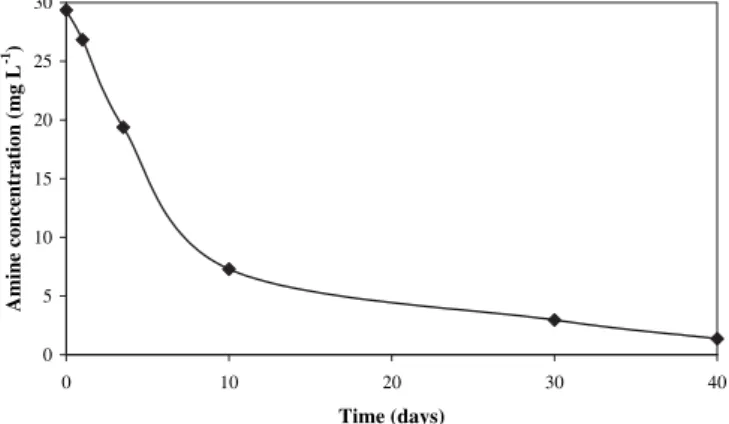
Samples of water from a plant unit at a point with the highest amine level were taken to screen amine concentration in the medium. As shown inFig. 1, amine concentration dropped off as a function of time. It can be observed that initial amine concen-tration was 29.3 mg L 1 and, after 40 days, the concentration dropped to 1.37 mg L 1. It was also verified that, after 5 days, around 34% of amine was already consumed, increasing to 75% after 10 days. The sample contained both etheramines EDA 3B and F2835.
3.2. Isolation of bacterial biodegradation strains
After effluent water plating and careful transfer of single strains to fresh Petri dishes, four different bacterial colonies were isolated. Each of the strains were individually tested in the amine degradation screening, and only one was able to decrease amine concentration. This strain was identified as the Gram-negativeS. marcescensBizio, a non-sporulated, mobile and facultative anaerobic species. This species has been used as a reducing agent for metals such as
Table 1
Physico-chemical characteristics of the water in the tailings dam.
Sampled spot DO (mg L 1) pH Conductivity (
mS cm 1) Nitrite (mg L 1) Nitrate (mg L 1) Ammonium (mg L 1) Amine (mg L1)
S1 NM NM NM 38.3 0.31 0.009 13.48
S2 NM NM NM 48.1 0.50 0.051 23.88
S3 5.0 8.81 514 12.2 0.21 0.007 7.98
S4 2.5 7.90 349 13.8 0.19 0.029 3.70
S5 4.9 8.16 352 13.3 0.29 0.037 5.86
DO¼Dissolved oxygen NM¼Not measured S1¼Concentration plant S2¼Plant outlet to tailings dam 1 S3¼Outlet of tailings dam 1 to tailings dam 2 S4¼Tailings dam 2 S5¼Outlet of tailings dam 2 to the water stream.
0 5 10 15 20 25 30
0 10 20 30 40
Time (days)
L
g
m(
n
oi
t
ar
t
ne
c
n
oc
e
ni
m
A
1-)
molybdenum (Shukor et al., 2008) and also for chlorophenol and nitrophenol degradation (Pakala et al., 2006; Singh et al., 2007).
Flotation was also carried out on a laboratorial scale, and remaining solutions containing residual amine were plated. Some strains were isolated from these solutions and tested for amine degradation. The only one able to accomplish this process was identified as Enterobacter cloacae, also a Gram-negative, non-sporulated, mobile and facultative anaerobic bacteria.E. cloacaehas been used in the biodegradation of chlorobenzenes, explosives such as trinitrotoluene (TNT) and pentaerythritol tetranitrate (PETN) (Binks et al., 1996; French et al., 1998; Robertson and Jemba, 2005; Adebusoye et al., 2007), and in the biological control of plant diseases (Nelson and Craft, 1991; Abdel-Salam et al., 2007).
3.3. Biodegradation screening using S. marcescens
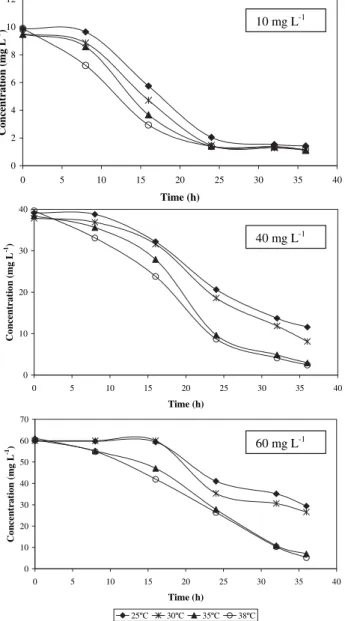
Biodegradation results for concentrations of 10, 40 and 60 mg L 1can be seen inFig. 2in response to the temperatures tested (25, 30, 35 and 38C). Biodegradation rates are initially slow,
especially at higher amine concentrations. At 10 mg L 1(Fig. 2), biodegradation rates were very close to each other at all tested
temperatures, showing low interference of the temperature parameter at this stage of the process. At 38C, the reaction sped up
slightly. After 16 h, 70.6% of the amine was already degraded, while at 25 C, only 45% of amine was consumed. After 24 h, amine
concentrations were about the same in all tested temperatures. At concentrations of 40 and 60 mg L 1, temperature had a significant influence on biodegradation rates, the greatest infl u-ence occurring at 38C. After 36 h, 93.8% of all amine was already
degraded at 40 mg L 1, while at the concentration of 60 mg L 1, degradation reached 91.3%, after the same period of time.
3.4. Determination of conditions necessary for bacterial growth
Three flotation tests were carried out in the laboratory at distinct conditions to observe the growth of E. cloacae in the resulting liquid. Flotations were accomplished using reagents and usual conditions, and bacterial growth was observed. When previously autoclaved iron ore was added to the medium, bacterial growth was observed, but when iron ore was not added to the medium,E. cloacaedid not grow, showing that minerals present in iron ore are essential for normal development of this strain. Chemical analysis of the iron ore used in the experiments has shown that species like Fe (52.540%) and SiO2(32.500%) are present in higher concentrations than elements like P (0.026%), Ca (0.012%), Al (0.210%), Mn (0.017%) and Mg (0.012%).
3.5. Infrared characterization of degradation product
The infrared spectrum of etheramine EDA 3B is shown inFig. 3 (Transmission, in arbitrary unity a. u.), where a peak can be observed at 3361 cm 1, very typical for an ammonium salt due to the axial deformation of NeH bond. An intense peak can also be
seen at 1113 cm 1, characteristic of a C
eOeC axial asymmetric
deformation on an ether group.
The infrared spectrum of the product recovered after ether-amine degradation, shown inFig. 3, has a different profile. A novel peak is seen at 1731 cm 1, typical of a C]O axial deformation with
an absorption frequency very close to the one typical of carbonyl in ester groups or carboxylic acid. In accordance with this, an absorption observed at 1272 cm 1 would correspond to an axial deformation of a CeO bond on an ester group. Peaks representing
CeH groups were seen in both starting material and products,
suggesting an oxidation of the product with a carbon chain remaining. At 1463 cm 1, an angular deformation of CH and at 1378 cm 1, angular deformation of a CH3group can be seen.
An oxidative degradation of the initial alkylamine to alkanal, and then to an acid group, has been proposed in the literature (Deo and Natarajan, 1998; van Ginkel et al., 2008).
0 2 4 6 8 10 12
0 5 10 15 20 25 30 35 40
Time (h)
L
g
m(
n
oi
t
ar
t
ne
c
n
o
C
1-)
0 10 20 30 40
0 5 10 15 20 25 30 35 40
Time (h)
L
g
m(
n
oi
t
ar
t
ne
c
n
o
C
1-)
0 10 20 30 40 50 60 70
0 5 10 15 20 25 30 35 40
Time (h)
L
g
m(
n
oi
t
ar
t
n
e
c
n
o
C
1-)
25ºC 30ºC 35ºC 38ºC
10 mg L-1
40 mg L-1
60 mg L-1
Fig. 2.Biodegradation of EDA 3B as a function of time and temperature at a concen-tration of 10, 40 and 60 mg L 1.
4. Conclusions
The screening for the identification of microorganisms respon-sible for fatty amine degradation showed that, infield samples, the metabolism of this compound is accomplished byS. marcescens, but whenflotation is carried out in the laboratory, E. cloacaeis the organism responsible for amine biodegradation. Studies on bacte-rial growth showed that the iron ore is a key substrate in the medium, providing the minerals essential for bacterial develop-ment. In biodegradation tests usingS. marcescens, the significant influence of temperature and substrate concentration on the rate of etheramine EDA 3B degradation was observed. For concentrations of 10 mg L 1, rates of etheramine EDA 3B degradation are very similar. However, by increasing amine concentration, the temper-ature influence is more apparent, mainly at concentrations of 40 and 60 mg L 1.
Acknowledgement
The authors acknowledge thefinancial support from the Bra-zilian Science and Technology Agency (CNPq).
References
Abdel-Salam, M.S., Abd El-Halim, M.M., El-Hamshary, O.I.M., 2007. Enhancement of
Enterobacter cloacaeantagonistic effects against the plant pathogenFusarium oxysporium. Journal of Applied Sciences Research 3 (9), 848e852.
Adebusoye, S.A., Picardal, F.W., Ilori, M.O., Amund, O.O., Fuqua, C., Grindle, N., 2007. Aerobic degradation of di- and trichlorobenzenes by two bacteria isolated from polluted tropical soils. Chemosphere 66 (10), 1939e1946.
ALPHA, 1998. Standard Methods for the Examination of Water and Wastewater, twentieth ed. Apha-Awwa-Wpcf.
Anand, P., Modak, J.M., Natarajan, K.A., 1996. Biobeneficiation of bauxite using
Bacillus polymyxa: calcium and iron removal. International Journal of Mineral Processing 48, 51e60.
Araujo, D.M., Yoshida, M.I., Carvalho, C.F., 2009. Colorimetric determination of ether amine greases utilized in theflotation of iron ore. Journal of Analytical Chem-istry 64 (4), 390e392.
Binks, P.R., French, C.E., Nicklin, S., Bruce, N.C., 1996. Degradation of pentaerythritol tetranitrate byEnterobacter cloacaePB2. Applied and Environmental Microbi-ology 62 (4), 1214e1219.
Chockalingam, E., Subramanian, S., Natarajan, K.A., 2003. Studies on biodegradation of organicflotation collectors usingBacillus polymyxa. Hydrometallurgy 71, 249e256. Combs, D.L., 1985. Processing for industrial fatty acids. Journal of the American Oil
Chemists’Society 62 (2), 327e330.
Deo, D., Natarajan, K.A., 1998. Biological removal of someflotation collector reagents from aqueous solutions and mineral surfaces. Minerals Engineering 11 (8), 717e738.
French, C.E., Nicklin, S., Bruce, N.C., 1998. Aerobic degradation of 2,4,6-trinitrotol-uene byEnterobacter cloacaePB2 and by pentaerythritol tetranitrate reductase. Applied and Environmental Microbiology 64 (8), 2864e2868.
García, M.T., Campos, E., Ribosa, I., 2007. Biodegradability and ecotoxicity of amine oxide based surfactants. Chemosphere 69 (10), 1574e1578.
van Ginkel, C.G., Pomper, M.A., Stroo, C.A., Kroon, A.G.M., 1995. Biodegradation of fatty amines: utilization of the alkyl chain by isolated micro-organisms. Tenside Surfactants Detergents 32, 355e359.
van Ginkel, C.G., Louwerse, A., van der Togt, B., 2008. Substrate specificity of a long-chain alkylamine-degrading Pseudomonas spisolated from activated sludge. Biodegradation 19, 129e136.
Houot, R., 1983. Beneficiation of iron ore byflotationereview of industrial and potential applications. International Journal of Mineral Processing 10, 183. Krogh, J.A., Sipe, M.R., 2001. Amine ether acid salt surfactant composition. United
States Patent and Trademark Office 6, 169, 064.
Leja, J., 1983. Flotation surfactants. In: Surface Chemistry of Froth Flotation. Plenum Press, New York and London, pp. 205e339.
Nelson, E.B., Craft, C.M., 1991. Introduction and establishment of strains of Enter-obacter cloacaein golf course turf for the biological control of dollar spot. The American Phytopathological Society. Plant Disease 75 (5), 510e514.
Newsome, L.D., Johnson, D.E., Lipnick, R.L., Broderius, S.J., Russom, C.L., 1991. A QSAR study of the toxicity of amines to the fathead minnow. Science of the Total Environment 109/110, 537e551.
Numela, W., Iwasaki, I., 1986. Iron oreflotation. In: Advances in Mineral Processing. Littleton, cap., Colorado, p. 18.
Pakala, S.B., Gorla, P., Pinjari, A.B., Krovidi, R.K., Baru, R., Yanamandra, M., Merrick, M., Siddavattam, D., 2006. Biodegradation of methyl parathion andp-nitrophenol: evidence for the presence of ap-nitrophenol 2-hydroxylase in a Gram-negative
Serratia sp. strain DS001. Applied Microbiology and Biotechnology 73 (6), 1452e1462.
Riggs, W.F., Andress, C., 1996. Alkyloxyalkanneamines useful as cationic froth
flotation collectors. United States Patent and Trademark Office 5, 540, 37. Robertson, B.K., Jemba, P.K., 2005. Enhanced bioavailability of sorbed
2,4,6-trini-trotoluene (TNT) by a bacterial consortium. Chemosphere 58 (3), 263e270. Saube, J., 1986. Surfactants in Consumer Products: Theory, Technology and
Appli-cations. Springer-Verlag, Berlin.
Schultz, T.W., Wilke, T.S., Bryant, S.E., Hosein, L.M., 1991. QSARs for selected aliphatic and aromatic amines. Science of the Total Environment 109/110, 581e587. Shukor, M.Y., Habib, S.H.M., Rahman, M.F.A., Jirangon, H., Abdullah, M.P.A.,
Shamaan, N.A., Syed, M.A., 2008. Hexavalent molybdenum reduction to molybdenum blue byS. marcescensstrain Dr. Y6. Applied Biochemistry and Biotechnology 149, 33e43.
Singh, S., Chandra, R., Patel, D.K., Rai, V., 2007. Isolation and characterization of novelSerratia marcescens(AY927692) for pentachlorophenol degradation from pulp and paper mill waste. World Journal of Microbiology and Biotechnology 23, 1747e1754.
Visek, K., 2003. Amines, Fatty. Kirk-Othmer Encyclopedia of Chemical Technology. John Wiley & Sons. doi:10.1002/0471238961.0601202022091905.a01.pub2. Yoshimura, K., Machida, S., Masuda, F., 1980. Biodegradation of long chain