HMC08
Lime mortars with rice husk ash for ancient masonry
Nuno Gouveia de Almeida
MSc/Civil Engineer, UTL-Instituto Superior Técnico, Lisbon, Portugal, [email protected]
Paulina Faria
Assistant Professor/Civil Engineer, Nova University of Lisbon, Lisbon, Portugal, [email protected]
Ana Paula Ferreira Pinto
Assistant Professor/Civil Engineer, UTL-Instituto Superior Técnico- ICIST, Lisbon, Portugal, [email protected]
SUMMARY: This paper presents some preliminary results achieved in the aim of a research program with the main objective of evaluating the potential interest of using rice husk ashes on aerial lime based mortars for old buildings. The mechanical and physical characteristics and potential durability of lime mortars formulated with commercial rice husk ashes are analysed and their behaviour compared with a pure lime mortar. The results are also analysed taking into account the main aspects that are responsible for the compatibility between the new mortars and the original building materials. The potential durability of the tested mortars is evaluated through salt crystallization tests performed with sodium chloride and sodium sulphate solutions.
The improvement of some properties of the lime mortars due to the presence of rice husk ashes pointed out the interest of the research in this domain, namely in what concerns the design of mortars with a moderately hydraulic behaviour for old buildings.
KEY-WORDS: compatibility, lime, pozzolanic additions, rice husk ash, salt crystallization
1 INTRODUCTION
1.1
Mortars for ancient masonry
these replacing mortars should have lower mechanical properties than the support, low water absorption characteristics and water vapour permeability similar to the support. Moreover, these mortars should be durable, which means that they also have to present, among other characteristics, a good resistant to salt crystallisation processes as they are the biggest threats to ancient buildings, especially those standing nearest to the sea (Henriques [2], Veiga [4]).
The aerial lime mortars are usually referred as presenting the necessary compatibility with ancient masonries. However, their application is somewhat restricted, which is usually justified by their slow setting time and low mechanical properties at early curing times. On the other hand, their durability is also limited when submitted to degradation processes by salt crystallisation because they can be responsible for the presence of internal stresses higher than the material resistance (Faria [5]).
1.2
Lime mortars with pozzolanic additions
It is referred that lime based mortars with pozzolanic properties were largely used since the Roman time until the earliest of the XX century when the cement mortars took their place (Moropoulou [6]).
However, some recent interventions carried out with cement based mortars make clear that they are incompatible with the old materials. Cement mortars favour the damage of substrates caused by salt crystallisation processes due to its content on alkaline ions and present mechanical properties quite different from the ancient masonries (Moropoulou [6], Arandigoyen [7]).
The use of lime based mortars with pozzolanic materials is often referred as a promising option for replacing mortars due to the experience of their use in the past, the recognised cement mortars incompatibility with the ancient supports, and the low durability of pure lime mortars
Artificial and natural pozzolans are able to produce a pozzolanic reaction with portlandite in presence of water. From this reaction, hydraulic compounds are developed and the resulting mortars present faster setting time than lime mortars which can occur in environments with high relative humidity. Furthermore, those mortars have higher mechanical resistances and durability than lime mortars, as well as a higher deformability and lower resistance than cement mortars.
The research on the potential interest of pozzolanic industrial by-products has been increased due to the necessity of improving the sustainable construction practices, namely with the aim of enhancing the lime mortars properties (Faria [5], Fragata [8], Moropoulou [6], Velosa [9]).
1.3
Rice husk ash as pozzolanic addition
HMC08
Considering the important worldwide rice production, and the waste that the rice husk represent (approximately 20 % of the husk production), several industries have been developing efforts to use this agricultural waste (Chandrasekhar [11], Sousa [12]).
In construction, rice husk could be used directly as an industrial by-product for concrete light panels or bricks production (Sousa [12]). Notwithstanding, their use as a pozzolanic material in concrete and mortars formulation implies their transformation on rice ash. The rice husk when burned under controlled conditions (time, temperature and presence of oxygen) becomes an ash with a large amount of amorphous silica, which is essential for a pozzolanic reaction (James [13], Metha [14], Nair [15], Nehdi [16]). This ash must be grounded to a fine size to get high surface area in order to increase its reactivity (Chandrasekhar [11], Metha [14]). The amorphous silica of ash when mixed with lime and water reacts with the hidroxium calcium, Ca(OH)2 and forms calcium silicates hydrates (C-S-H) (James [13], Metha [14]).
According to Metha rice husk ash, like silica fume, “belong to a superior class of pozzolans because they do not suffer the variability in mineralogical character typical of fly ashes. Also both materials possess exceedingly high surface area which is an important reason for their highly active pozzolanic behaviour” (Metha [14]). However, it should be noticed that only some rice ashes are able to be mineralogical homogeneous due to the dependence of the mineralogical composition with the rice husk and burning conditions (Chandrasekhar [11]).
Several researches have been done with the objective of increasing the cement mortars and concrete properties through the addition of rice husk ash (Coutinho [17], James [13], Metha [14], Nair [15], Nehdi [16], Sousa [12]). Metha was one of the researchers that started the study of this waste as mineral admixture to cement mortars and concretes. He found that it can be achieved a strength increase of 40% on cement mortars with 3, 7 and 28 days of curing with a cement replacement by rice husk ashes of 30% (Metha [14]). Metha concluded that the pozzolanic reaction may start as soon as calcium and hydroxyl ions were available from the cement compounds and so contribute to the initial strength enhance (Metha [14]). This conclusion could be a good intention for the lower lime mortar setting time. Similar results reporting the increase of resistance have been published by others authors (James [16], Nedhi [18]).
Although the diversity of studies of rice husk ashes in cement and concrete, researches with rice husk ashes as a constituent of lime based mortar are not common.
Besides the potential improvement of some mortar properties, the use of this by-product could lead to a substantial reduction of cost and energy consumption when compared to other materials, Table 1.
Table 1 – Energy requirements for production of various cementitious/pozzolanic materials (Ramachandran referred in Chandrasekhar [13])
Materials Energy (kJ/kg) Cement 372
Lime 173
Hydrated lime 142
Burnt clay pozzolan 68
Rice husk ash 12
Brick powdered 12
The rice husk addition in lime mortars might be an environmentally, technically and economically promising practice (Almeida [18]).
2 EXPERIMENTAL
WORK
2.1 Materials
For the present study a river sand was used (from Tagus river). The aerial lime and rice ask ashes used were both Portuguese commercial products. The hydrated lime in powder belongs to the class CL90 according to European standards [EN459-1]. The ashes were previously prepared in two ways:
• Rice ask ashes (ash) - The commercial ash was mechanical sieved for two minutes in the sieve n.º 30 (from principal ASTM series - 0,600mm).
• Rice ask ashes (ash,p) - The rice ask ash previously sieved (ash) was powdered for 3 minutes in a balls-mill (ash,p).
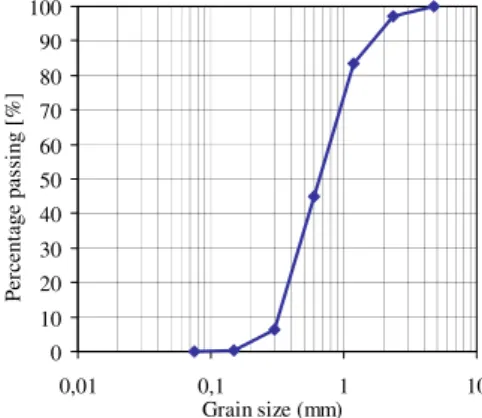
Figure 1 shows the particle size distribution of the sand used and Table 2 presents the particle size of lime and both ashes of 10%, 50% and 90% of cumulative mass passed, determined by low angle laser light scattering.
0 10 20 30 40 50 60 70 80 90 100
0,01 0,1 1 10
Grain size (mm)
P
er
cen
ta
ge
pa
ss
ing [
%
]
Figure 1 – Particle size distribution of river sand used
Table 2– Lime and ashes particles size distribution
Material d(0.1) [μm] d(0.5) [μm] d(0.9) [μm]
lime 1.14 2.31 4.49
ash 5.09 27.16 92.69
ash,p 3.62 18.23 47.56
HMC08
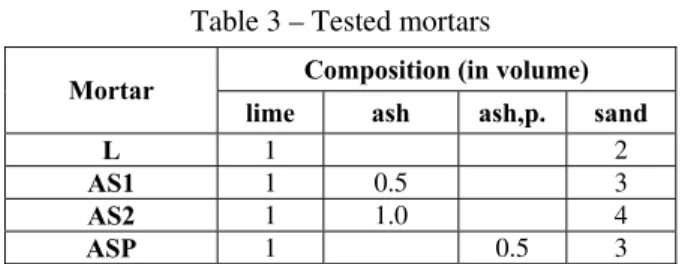
Table 3 – Tested mortars
Composition (in volume) Mortar
lime ash ash,p. sand
L 1 2
AS1 1 0.5 3
AS2 1 1.0 4
ASP 1 0.5 3
The water content of the mortars was established in order to ensure a flow of 65-70% in the table (EN 1015-3 – [19]). Six prismatic specimens (40x40x160mm) and three cylindrical specimens (95mm of diameter and 10mm of thickness) were prepared for each mortar. The cylindrical specimens were manual compacted pressing with a float, while the prismatic were mechanically compacted.
The specimens were stored until their characterisation (60 days of curing time) under controlled conditions of 23±3ºC and 65±5 % RH. The samples were demoulded 5 days after their preparation.
2.2 Experimental work
Tests on compressive and flexural strengths and the determination of the dynamic modulus of elasticity were carried out on prismatic specimens in order to evaluate the mechanical properties of the mortars. The open porosity, water absorption by capillarity and water vapour permeability were the characteristics used for the physical evaluation of the mortars. The behaviour of the mortars to sodium chloride and sodium sulphate crystallization process was also evaluated.
The dynamic modulus of elasticity was determined on all the six prismatic specimens which afterwards were submitted to the flexural test. Compressive strength tests were performed on one of the half resultant from the flexural test and the other six halves were used to perform the capillary water absorption test. After the water absorption by capillarity test, the specimens were dried in an oven at 60ºC until constant mass was achieved and submitted to the durability evaluation by salt attack (3 half specimens to sodium chloride and the other to 3 sodium sulphate). The open porosity of the tested mortars was evaluated on small fragments of the specimens resulting from compressive tests. The water vapour permeability was determined on the cylindrical specimens.
3 RESULTS
AND
DISCUSSION
3.1 Dynamic modulus of elasticity, flexural and compressive strength
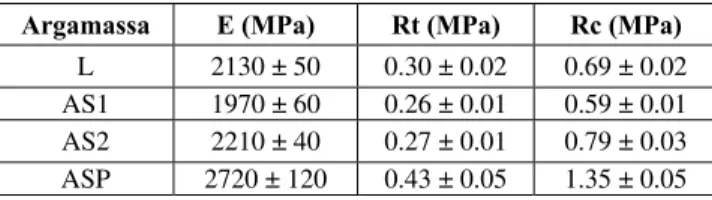
The dynamic modulus of elasticity test was performed based on the determination of the longitudinal resonance frequency using a Zeus Computer System according to NF B 10-511 [20]. Flexural and compressive strength were evaluated according to EN 1015-11 [21] (except the preparation of the specimens, described previously). Table 4 presents the average values and standard deviation of the dynamic modulus of elasticity (E) and the flexural (Rt) and compressive strength (Rc).
amount of rice ash (in volume); however the rice ash used in ASP present lower particle size, which is responsible for the higher mechanical properties of ASP. As expected the reduction of particle size, associated to the increment of specific surface, seems to potenciate the pozzalanic activity (Metha [14]). According to James (James [13]), possibly occurred the formation in more proportions of hydrates compounds, like calcium silicates, which are responsible for the resistances increase.
Table 4 – Mechanical resistances of mortars
Argamassa E (MPa) Rt (MPa) Rc (MPa) L 2130 ± 50 0.30 ± 0.02 0.69 ± 0.02 AS1 1970 ± 60 0.26 ± 0.01 0.59 ± 0.01 AS2 2210 ± 40 0.27 ± 0.01 0.79 ± 0.03 ASP 2720 ± 120 0.43 ± 0.05 1.35 ± 0.05
The enhancement of the mechanical behaviour by adding powdered rice husk, ASP, when compared to the pure lime mortar behaviour, is in accordance to other works with lime mortars with pozzolans (Faria [5], Fragata [8], Moropoulou [6], Velosa [9]). Moropoulou [6] reached an increment of compressive and flexural strength in lime mortars with ceramic powder when comapared to a pure lime mortar. The same trend was achieved by other authors namely Faria [5], Fragata [8], and Velosa [9] using respectively brick powder and kaolins, kaolins and glass powdered.
Considering the mortars AS1 and AS2, both have a similar mechanical performance to the lime mortar. However, when comparing these two mortars it is observed that the increment of sieved rice husk ash was responsible for a slight enhancement of the mechanical properties, especially for the compressive test.
3.2 Porosity and density
Table 5 presents the average values and standard deviation of porosity and density of the tested mortars determined with a procedure based on EN 1936 [22]. It can be observed that lime mortar presents the highest value of porosity while the porosities of all mortars with rice ashes are similar. This could be explained by the formation of hydrated compounds, which are more expansive than CaCO3 resulting from the carbonation reaction (Faria [5]). The density values of these mortars show that the rice ash with smaller particle size (ASP) may be responsible for the registered increase of density.
In spite of density values of the mortars L, AS1 and AS2 are similar there porosities were slightly different, maybe because the mortars with sieved hash have more pores not accessible to water than in lime mortar, thus decreasing their open porosity values.
Table 5 – Density and porosity of hardened mortars
Mortar Density (kg/m3) Porosity (%)
L 1730 ± 10 33.3 ± 0,4
AS1 1740 ± 15 31.7 ± 1,3
AS2 1750 ± 55 31.4 ± 0,8
HMC08
3.3 Water absorption by capillarity
The procedure adopted for evaluation of the water absorption by capillarity was based on EN 1925 [23] and EN 1015-18 [24].
The specimens were kept inside a plastic box where saturated ambiance was created in order to avoid the evaporation of water from the specimens. The specimens were dried at 60ºC and their dry mass evaluated. They were placed vertically inside a tray over absorbent paper and it was guaranteed that a layer of 2mm of water stayed in contact with the lateral surfaces of the specimens. Water was added during the test to maintain the water level. The specimens were weighted after 5, 10, 15, 30, 60, 180 min, 24h from the beginning of the test and afterwards each 24h, until the differences between two successive weightings were not greater than 1%. The coefficient of water absorption by capillarity (kg/m2.s0.5) was determined.
Table 6 presents the average values and standard deviation of coefficients of water absorption by capillarity of the tested mortars.
Table 6- Coefficient of water absorption by capillarity
Mortar Coefficient of water absorption by capillarity (kg/m2.s½)
L 0.28 ± 0,00
AS1 0.23 ± 0,00
AS2 0.24 ± 0,01
ASP 0.20 ± 0,00
It can be observed that pure lime mortar present the highest coefficient of water absorption by capillarity. The results of AS1 and ASP present in Table 6 point out the influence of the particle size of the rice ash to its reactivity. These mortars have the same amount of rice ash (in volume) though the rice ash used in ASP presents a smaller particle size, which was responsible for the lower rate of water absorption registered on ASP.
The same trend of decreasing the initial water absorption caused by the addition of pozzolanic materials in lime mortars was achieved by Faria with pozzolanic additions like fly ashes, brick powder, kaolins among others (Faria [5]).
3.4 Water vapour permeability
This test was performed based on European Standard EN 1015-19 [25]. After drying, the lateral surface of the specimens were sealed and afterwards positioned on individual circular iron cups, containing a layer of 1cm of water, in order to maintain the 100% of RH inside. The set (cup + specimen) was initially weighted and then placed inside a climatic chamber at 20ºC and 40 % RH. Sets were periodically weighted until a vapour flow is stable in order to evaluate the specimens permeability.
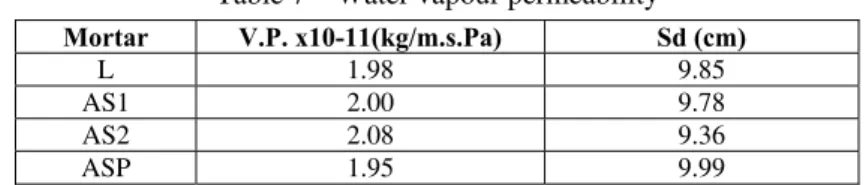
Table 7 presents the average values of water vapour permeability and the thickness of the diffusion air layer equivalent to 10 mm of mortar (m).
Table 7 – Water vapour permeability Mortar V.P. x10-11(kg/m.s.Pa) Sd (cm)
L 1.98 9.85
AS1 2.00 9.78
AS2 2.08 9.36
ASP 1.95 9.99
3.5 Salt crystallisation tests
3.5.1 Sodium chloride
The specimens aged through the sodium chloride crystallisation test were contaminated with a saturated salt solution by immersion for 24 hours, which was followed by the drying of the specimens at 105±5ºC until constant mass was achieved. The amount of sodium chloride retained was determined by the dry mass variation of the specimens before and after immersion. The salt loaded specimens were submitted to 35 cycles inside a climate chamber at 20ºC and weighted every week. The cycles had the duration of 24 hours: 12 hours at 90% RH and 12 hours at 40% RH. The ageing of the specimens was monitored by visual observation and through the evaluation of the mass variation expressed in percentage of the initial salt loaded dry mass.
Figure 2 presents the evolution of the mass variation during the sodium chloride salt chrystallisation test. Table 8 presents the retained chloride sodium and the average values of mass variation change at the end of tests, in terms of percentage of initial dry mass.
-50 -40 -30 -20 -10 0 10
0 7 14 21 28 35
cycles (days)
m
ass v
ar
iat
io
n
(%
)
L AS1 AS2 ASP1
Figure 2 - Chloride sodium test, mass variation
Table 8 –Chloride sodium test, average values of retained sodium and mass
variation at the end of the test
Mortar Retained salts (%)
Mass variation (%)
L 3,6 -27,3
AS1 3,3 -31,9
AS2 3,2 -41,6
ASP 3,1 1,1
HMC08
behaviour probably is justified by the higher resistance of ASP (ash,p) induced by the higher specific surface as referred on the mechanical behaviour analysis.
3.5.2 Sodium sulphate
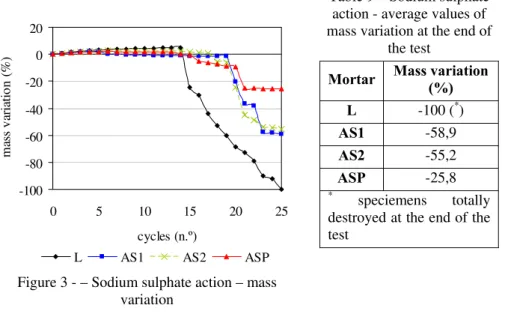
The test of sodium sulphate attack was performed based on EN 12370 [25]. Each cycle corresponds to the specimens contamination with a 6% anhydrous sodium sulphate solution by immersion for 2 hours and afterwards dried at 105±5ºC for 22 hours. The specimens were submitted to 25 cycles and the ageing process was monitored by visual observation of the specimens and through the evaluation of their mass variation expressed in percentage of the initial dry mass.
Figure 3 presents the evolution of the mass variation during the sodium sulphate salt crystallisation test. Table 9 presents the average values of mass variation change at the end of tests, in terms of percentage of initial dry mass.
-100 -80 -60 -40 -20 0 20
0 5 10 15 20 25
cycles (n.º)
m
ass v
ariat
io
n
(%
)
L AS1 AS2 ASP
Figure 3 - – Sodium sulphate action – mass variation
Table 9 – Sodium sulphate action - average values of mass variation at the end of
the test
Mortar Mass variation (%)
L -100 (*) AS1 -58,9 AS2 -55,2 ASP -25,8 *
speciemens totally destroyed at the end of the test
4. CONCLUSIONS
The potential interest of using rice husk ash on lime based mortars was evaluated studying the behaviour of different mortars. The behaviour of these mortars was compared with a pure lime mortar with an equal binder/aggregate ratio, since these types of mortars are usually referred as being compatible with ancient masonries.
According to the results achieved, the addition in pure lime mortars of powdered rice husk ash causes a better mechanical behaviour due to the increment of compressive and flexural strength, respectively 43% and 96%, as well as the increase of 28% of dynamic modulus of elasticity that is not sufficient high to compromise the required deformability. This addition is also responsible for a 40% decrease of absorbent water by capillarity which is advantageous for the protection of the support. The other physical characteristics under analysis, porosity and vapour water permeability, do not suffer significant alterations when compared to pure lime mortar. The durability of pure lime mortar, evaluated in terms of salt crystallisation, is also improved with this addition.
On the other hand, the additions in two different proportions of sieved rice husk ashes were not responsible for an important alteration of the lime mortar mechanical behaviour. Thus the main advantages of the use of sieved rice husk ashes were the increment of the value of the resistance to sodium sulphates action and the slightly decrease of the water absorbent by capillarity for the two formulations tested.
It is concluded that for most of the properties under analysis the powdered rice husk ash is better addition to mortars than ash just sieved due to their smaller particle size that is responsible for a higher pozzolanic activity.
This study contributes to verify the potential gains in the addition of rice husk ash to lime mortars.
REFERENCES
1
COLLEPARDI, M. - Degradation and restoration of masonry walls of historical buildings. Materials and Structures, 23, 1990, 81–102.
2
HENRIQUES, Fernando - Replacement Mortars in Conservation: An Overview, Keynote speech. 10th International Congress on Deterioration and Conservation of Stone. Stockholm, Sweden, 2004 3
MOSQUERA, M.J., BENITEZ, D., PERRY, S.H. - Pore structure in mortars applied on restoration: effects on properties relevant to decay of granite buildings. Cem. Concr. Res., 32, 2002, 1883–1888.
4
VEIGA, M. R., et al. - Experimental applications of mortars with pozzolanic additions: Characterization and performance evaluation. Construction and Building Materials, 2008, doi:10.1016/j.conbuildmat.2007.12.003
5
FARIA, P. - Mortars for old masonries renders. Ph.D. thesis, Faculdade de Ciência e Tecnologias, Universidade Nova de Lisboa, Portugal, Lisbon, 2004. (in Portuguese)
6
MOROPOULOU, A., et al. - Strength development and lime reaction in mortars for repairing historic masonries. Cement & Concrete Composites, 27, 2005, 289–294.
7
ARANDIGOYEN, M., ALVAREZ, J.I. - Pore structure and mechanical properties of cement–lime mortars. Cement and Concrete Research, 37, 2007, 767–775.
8
HMC08 9
VELOSA, A. - Argamassas de cal com pozolanas para revestimentos de paredes antigas. Ph.D. Thesis, Universidade de Aveiro; Aveiro, Portugal, 2006.
10
BIRICIK, H. - Study of pozzolanic properties of wheat straw ash. Cement and Concrete Research, Pergamon, 29, 1999, 637-643.
11
CHANDRASEKHAR, S. et al. - Review. Processing, properties and applications of reactive silica from rice husk – an overview. Journal of Materials Science, 38, 2003, 3159-3168.
12
SOUSA, S. B. - Betões eco-eficientes com cinza de casca de arroz. Master thesis, Faculdade de Engenharia da Universidade do Porto, 2005.
13
JAMES, J., RAO, M. Subba – Reaction product of lime and silica from rice husk ash. Cement and Concrete Research, 16, 1986, 67-73.
14
METHA, P.K. - Pozzolanic and Cementitiuos byproducts as mineral admixtures for concrete – A critical Review.Proc. First Int. Conf. on the use of fly ash, silica fume, slag and other mineral by-products in concrete. Montebello, Canada, 1983, 1-46.
15
NAIR, D.G., et al. - A structural investigation relating to the pozzolanic activity of rice husk ashes, Cement and Concrete Research (2007), doi:10.1016/j.cemconres.2007.10.004
16
NEHDI, M, et al. - Performance of rice husk ash produced using a new technology as a mineral admixture in concrete. Cement and Concrete Research, 33, 2003, 1203-1210.
17
COUTINHO, J. S. - The combined benefits of CPF and RHA in improving the durability of concrete structures, Cement&Concrete Composites, 25, 2003, 51–59.
18
ALMEIDA, N. G. - Lime mortars with rice husk ash for ancient masonry. Master thesis, Instituto Superior Técnico, Portugal, Lisbon, 2008. (in Portuguese)
19
EUROPEAN COMMITTEE FOR STANDARDIZATION (CEN) - EN 1015-3, European Standard, Methods of test for mortar for masonry – Part 3: Determination of consistence of fresh mortar (by flow table, February 1999.
20
ASSOCIATION FRANÇAISE DE NORMALISATION (AFNOR) - NF B 10-511, Norme Française Homologue, Mesure du module d´élasticité dynamique, April 1975.
21
EUROPEAN COMMITTEE FOR STANDARDIZATION (CEN) - EN 1015-11, European Standard, ‘‘Methods of test for mortar for masonry – Part 11: Determination of flexural and compressive strength of hardened mortar, August 1999.
22
EUROPEAN COMMITTEE FOR STANDARDIZATION (CEN) - EN 1936 European Standard Natural stone test methods - Determination of real density and apparent density and of total and open porosity, , September 1999.
23
EUROPEAN COMMITTEE FOR STANDARDIZATION (CEN) - EN 1925, European Standard Natural stone test methods. Determination of water absorption coefficient by capillarity, August 1999. 24
EUROPEAN COMMITTEE FOR STANDARDIZATION (CEN) - EN 1015-18, European Standard, ‘‘Methods of test for mortar for masonry – Part 18: Determination of water absorption coefficient due to capillary action of hardened mortar, December 2002.
25
EUROPEAN COMMITTEE FOR STANDARDIZATION (CEN) - EN 1015-19, European Standard, ‘Methods of test for mortar for masonry – Part 19: Determination of water vapour permeability of hardened rendering and plastering mortars, September 1998.
26