Use of Waste Flyash in Fabrication of
Aluminium Alloy Matrix Composite
Ajit Kumar Senapati #1, Purna Chandra Mishra *2, Bharat Chandra Routara #3
#
Bhuaneswar-751024, Odisha, India
School of Mechanical Engineering, KIIT University
1
Bhuaneswar-751024, Odisha, India
School of Mechanical Engineering, KIIT University
2
Abstract— Waste flyash from two different industries (named as type A and type B) were utilized as reinforcement in fabricating aluminium alloy based matrix composites (AMC). The AMCs were fabricated by continuous stir-casting method in a bottom pouring furnace at 700
0C. Casting was made in
rectangular metal mould having dimension 250x20x45 mm3
Keyword-Aluminium Matrix Composite, Flyash, Mechanical Properties, Microstructure, SEM
. Effect of adding different flyash contents were realized thorough various mechanical behaviour tests. For measuring mechanical properties such as Brinell hardness, impact strength, compression strength, tensile strength, and micro hardness of both the AMCs, samples were prepared as per the standards in the mechanical workshop. The flyash distributions in the AMCs were confirmed through microstructure examination conducted on image analyzer and scanning electron micrographs. Results revealed that there is a great effect of reinforcing different flyash in aluminium alloy matrix composites. Type B flyash gave more enhanced mechanical properties compared to type A flyash. Thus, selection of flyash for reinforcement was found one of the most important criteria for fabricating aluminium matrix composites.
I. INTRODUCTION
Metal matrix composites (MMCs) represent a new generation of engineering materials in which a strong ceramic reinforcement is incorporated into a metal matrix to improve its properties including specific strength, specific stiffness, wear resistance, excellent corrosion resistance and high elastic modulus [1, 2]. MMCs combine metallic properties of matrix alloys (ductility and toughness) with ceramic properties of reinforcements (high strength and high modulus), leading to greater strength in shear and compression and higher service-temperature capabilities [3, 4]. Thus, they have significant scientific, technological and commercial importance. During the last decade, because of their improved properties, MMCs are being used extensively for high performance applications such as in aircraft engines and more recently in the automotive industry [2, 4]. Over the past two decades metal matrix composites (MMCs) have been transformed from a topic of scientific and intellectual interest to a material of broad technological and commercial significance [5]. MMCs offer a unique balance of physical and mechanical properties. Aluminium based MMCs have received increasing attention in recent decades as engineering materials with most of them possessing the advantages of high strength, hardness and wear resistance. The stir casting method is widely used among the different processing techniques available. Stir casting usually involves prolonged liquid reinforcement contact, which can cause substantial interface reaction [6]. Charles and Arunachalam [7] studied the properties of aluminium alloy hybrid (Al-alloy/Silicon carbide (SiC)/fly ash) composites. They reported that the wear and hardness were enhanced on increasing the volume fraction of SiC. They also reported that the tensile strength was high at 10 volume fraction of SiC and decreased as the volume fraction increased. Basavarajappa et al. [8] investigated the mechanical properties of aluminum alloy (Al2024) reinforced with SiC and graphite particles. Their results revealed that the mechanical properties such as ultimate tensile strength, yield strength, hardness and compressive strength of the composite increased predominantly with the increase in volume fraction of reinforcement. Mahendra et al. [9] investigated the properties of Al-4.5% Cu alloy composite with fly ash as reinforcement. They reported the increase in hardness, tensile strength, compression strength and impact strength with increase in the fly ash content. Sudarshan et al. [10] studied characterization of A356 Al - fly ash particle composites with fly ash particles of narrow range( 53-106μm) and wide size range(0.5-400 μm) and reported that addition of fly ash lead to increase in hardness, elastic modulus and 0.2% proof stress.
these things also increase with increase in the aging duration with the marginal improvement in the ductility which may be due to the formation of precipitate in matrix alloy. Ahlatci et al. [12] investigated the mechanical properties of Aluminium Silicon with 60 volume % SiC composites and concluded that as amount of Si increased up to 1%, the strength of composites increased without significant loss in toughness after which the strength showed a decline with further increase in Si content.
Fly ash particles are potential discontinuous dispersoids used in metal matrix composites, since they are low-cost and low-density reinforcement available in large quantities as a waste by-product in thermal power plants. The fly ash contains the most important chemical constituents like SiO2, Al2O3, Fe2O3
Most of the previous studies carried out on processing of aluminium–fly ash composites have utilized different size of reinforcement, different amount of reinforcement. Almost no work found on effect of flyash types on the characteristics of AMCs. However, to achieve enhanced properties of AMCs it is very important to have good selection of flyash. Therefore, an attempt was made to use two different types of flyash as reinforcement to fabricate the AMCs and a comparative analysis is presented interms of their mechanical and tribological properties. The details of experimentation and results are discussed in subsequent sections below.
and CaO. It constitutes quartz, mullite, magnetite, hematite, spinel, ferrite and alumina [13]. Addition of fly ash particles in to Al matrix improves the hardness, wears resistance, damping properties, stiffness and reduces the density [13-18]. Aluminum–fly ash composites have potential applications as covers, pans, shrouds, casings, pulleys, manifolds, valve covers, brake rotors, and engine blocks in automotive, small engine and the electromechanical industry sectors. The fly ash reinforced AMCs are also termed as ‘Ash alloys’ [16].With the increase in the content of fly ash in Al or its alloys, the mechanical properties such as hardness, modulus of elastics, 0.2% proof stress, tensile strength, compression strength and impact strength are enhanced [17]. It is reported that addition of fly ash in narrow range has enabled superior mechanical properties of AMC as compared to AMC prepared with wider size range fly ash particles [17].The ductility of the composite decreases with increase in the weight fraction of reinforced fly ash and decreases with increase in particle size of the fly ash. However, for composites with more than 15% weight fraction of fly ash particles, the tensile strength is reported to be decreasing [18].
II. MATERIALS AND METHODS
In the composite materials two or more dissimilar materials that are intimately bonded to form integrated structure. There are two main segments of the composite material one is matrix which is continuous and the other one is reinforcement which is discontinues. Processing techniques using for the production of the composite materials are broadly classified into solid state and liquid state processing. The selection of the processing technique mainly depends on the application and state of the matrix and reinforcement materials. In this work, liquid state processing is preferred for the manufacturing of the desired composite material. Several methods are available for the liquid state processing like stir casting, infiltration, spray deposition, etc. The stir casting is considered for the process.
A. Materials Used
Eutectic Al–Si alloy LM6 containing 12.2491% Si was used as a matrix. The chemical compositions of the alloy are given in Table I. Cenospheres of two different types of fly ash Type-A and Type-B were used as a reinforcement material in this investigation. The chemical compositions of these two types of flyash are listed in Table II and Table III respectively. They are formed in the temperature range of 920–1200 °C [23].
TABLE I
Chemical Composition of Al-Si Alloy [Wt. %] Designated as Base Alloy
Compound Wt. % Compound Wt. %
Si 12.2491 Ti 0.0672
Co 0.0174 Zn 0.0944
Fe 0.4353 Ni 0.0264
Cu 0.0800 Sn 0.0632
Mn 0.1601 Cr 0.0199
Ca 0.0082 V 0.0146
Al 86.7654
TABLE III
TABLE IIIII
Chemical Composition of Flyash Type- B
Compound SiO2 Al2O3 Fe2O3 CaO MgO C K2O
(Wt. %) 68.41 20.73 4.97 0.62 0.46 5.60 0.97
B. Stir Casting
After cleaning Al-Si ingot, it was cut to proper sizes, weighed in requisite quantities and was charged into a vertically aligned pit type bottom poured melting furnace shown in Fig.1. Fly ashes were preheated to 650oC ± 5oC before pouring in to the melt of Aluminium-Silicon Alloy. This was done to facilitate removal of any residual moisture as well as to improve wettability. The molten metal was stirred with a BN coated stainless steel rotor at speed of 600-650 rpm. A vortex was created in the melt because of stirring where preheated fly ash was poured centrally in to the vortex. The rotor was moved down slowly, from top to bottom by maintaining a clearance of 12mm from the bottom. The rotor was then pushed back slowly to its initial position. The pouring temperature of the liquid was kept around 7000C. Casting was made in rectangular metal mould of dimension 250x20x45 mm3. To compare the desired characteristics, two AMCs were fabricated by repeating the same procedure, one with Type A fly ash and the other with Type B fly ash respectively.
Fig.1. Real photo of used vertically aligned pit type bottom poured melting furnace
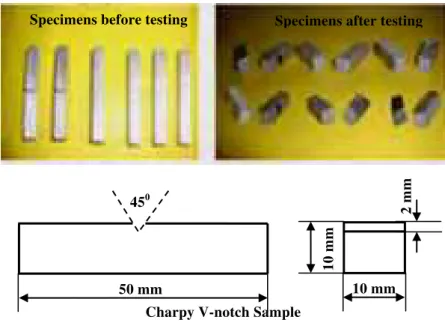
C. Impact Strength Test
Charpy V-notch Sample
Fig. 2. Real photo of used impact testing machine (charpy V notch), specimens before and after testing and schematic of charpy V-notch sample.
D. Compression Strength Test
Compression test is done in the Universal Testing Machine (UTM). The cylindrical test specimen is mounted on the base plate of the UTM. The specimen here used had same diameter as that of height of the specimen. The load is applied on the specimen gradually until the sample is compressed until its height reduces by 50%. With the application of load increases the displacement also does, then the displacement reduces drastically as it cannot be compressed more. The real photo of used UTM and test specimens is shown in Fig. 3.
Fig. 3. Real photo of used universal testing machine (UTM) and test specimens before and after testing
E. Tensile Strength Test
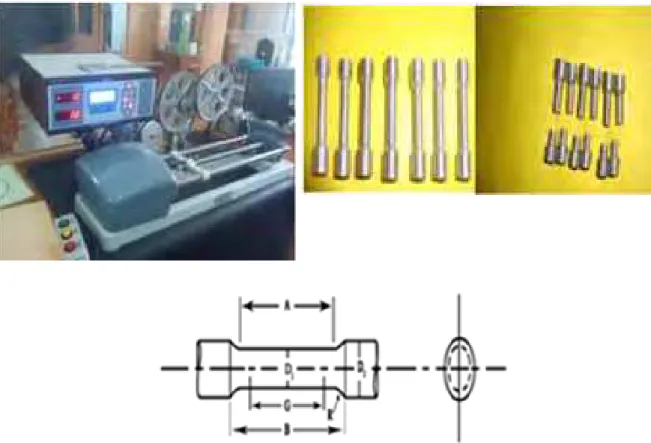
An electronic tensometer was used to measure the tensile strength of the AMC specimens as shown in Fig. 4. The specimens were prepared as per the standards. The tensometer specimens were loaded between two grips that are adjusted manually. A constantly increasing force was applied to the specimen by electronic control means. The load and elongation were continuously recorded. The UTS and percentage elongation were then calculated.
Specimens before testing Specimens after testing
50 mm 450
10 mm
1
0
m
m
2
Fig. 4. Real photo of used Hounsefield computerized tensile testing machine (20 kN) and test specimens before and after testing
F. Micro Hardness Test
Micro hardness tests were performed by digital display micro hardness tester HVS-1000. The specimens were polished upto the desired standards and then held perpendicular to the indenter. The used micro hardness testing machine gives an allowable range of load for testing with a diamond indenter; the resulting indentation was measured and converted to a hardness value. During the test, a constant load of 0.98 N was maintained.
III.RESULTS AND DISCUSSION
A. Characteristics of Flyash
Chemical analysis of both fly ashes Type A and Type B as depicted in Table II and Table III, revealed the presence of compounds such as Al2O3, SiO2, and Fe2O3
B. Optical Micrographs
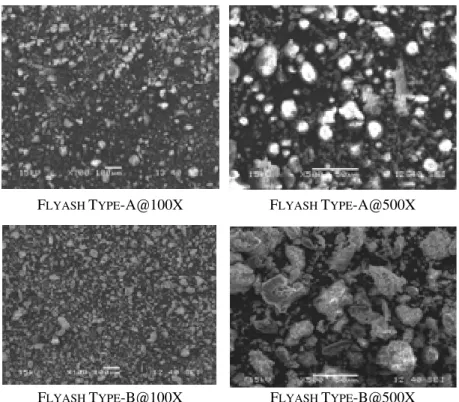
as major constituents. The SEM micrographs shown in Figs. 5 confirmed the shape, size and distribution of Type A and Type B flyash particles at two different magnifications i.e., 100x and 500x respectively before their reinforcement. For the Type A fly ash, the shape of the particles were spherical with size ranging between 5µm to 30µm. For fly ash Type B, the morphology, shape and size of particles have altered. It was observed that there were rod shaped particles with varying aspect ratios, 2 to 3 on an average and number of irregular shaped particles in the fly ash Type B. The change in size and morphology of particles were thought to be important proposition since the addition of fly ash (Type B) with such morphology and distribution would result in enhancement of mechanical properties of Al-Si based composites.
FLYASH TYPE-A@100X FLYASH TYPE-A@500X
FLYASH TYPE-B@100X FLYASH TYPE-B@500X
Fig. 5. SEM micrographs of Fly ash Type A and Type B at 100x and 500x.
(a)
(b) (c)
Fig. 6. Optical micro graphs of (a) LM6 alloy, (b) Alloy + Fly ash Type A and (c) Alloy + Fly ash Type B.
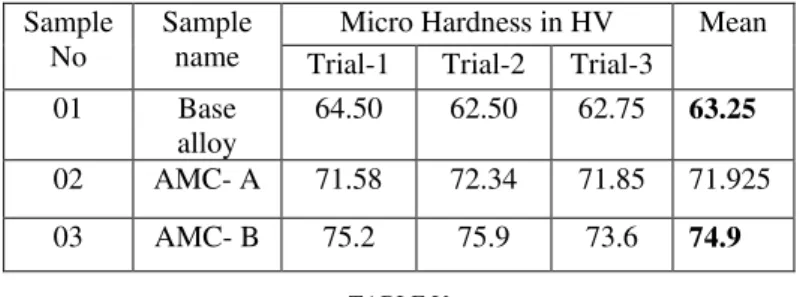
comparison to that of base alloy i.e, LM6, but for AMC with Type A fly ash the mean value remained unchanged. Data from compression test had also shown the highest strength value for AMC prepared with Type B fly ash as given in Table VII. The largest value obtained under static as well as dynamic test conditions for AMC prepared with type-B fly ash material was attributed to the microstrural differences, presence of small amount of carbon, change in morphology of the microstructure i.e spherical shape to rod shaped as well due to fineness of the reinforcing particles.
TABLE IVV
Microhardness Data for LM6, AMC Type A and AMC Type B
Sample No
Sample name
Micro Hardness in HV Mean Trial-1 Trial-2 Trial-3
01 Base
alloy
64.50 62.50 62.75 63.25
02 AMC- A 71.58 72.34 71.85 71.925
03 AMC- B 75.2 75.9 73.6 74.9
TABLE V
Tensile Strength of LM6, AMC Type A and AMC Type B
TABLE VI
Impact Strength of LM6, AMC Type A and AMC Type B
Sample No
Sample name
Impact strength in joule Mean Trial-1 Trial-2 Trial-3
01 LM-6 0.5 0.5 0.5 0.5
02 MMC A 1.5 1.5 1.5 1.5
03 MMC B 1.5 1.5 1.5 1.5
TABLE VII
Compression Strength of LM6, AMC Type A and AMC Type B
IV.CONCLUSION
The continuous stir casting method used to prepare the composites could produce uniform distribution of the reinforced fly ash particles. In the present investigation, it was anticipated that both the composites i.e Al-Si with fly ash Type A and Type B fly ash will have the same vol% of the dispersed phases. However, within the experimental limitation, it was possible to have 10.2 and 9.8 vol% of particulates in the AMC A and AMC B composites respectively. The Tensile Strength, Compression Strength, Impact strength and Hardness values
Sample No
Sample name
Tensile strength in KN Mean Trial-1 Trial-2 Trial-3
01 Base
alloy
114.62 118.13 111.29 114.68
02 AMC A 130.73 134.26 131.31 132.11
03 AMC B 136.15 140.23 140.22 138.87
Sample No N
Sample name
Compressive Strength in
N/mm2 Mean
Trial-1 Trial-2 Trial-3
01 Base alloy 461 463 462 462
02 MMC A 479 478 477 478
because of the microstrural differences, presence of small amount of carbon, change in morphology of the microstructure i.e spherical shape to rod shaped as well due to fineness of the reinforcing particles.
The experimental data reveals that selection of reinforcement is one of the important aspects in production of metal matrix composites especially when the enhanced mechanical properties are desired. Several iterations on volume fraction, types of reinforcement, characterization etc. are needed before manufacturing a suitable metal matrix composite.
ACKNOWLEDGMENT
The authors wish to acknowledge entire staff of mechanical engineering department and metallurgy department, GIET, Gunupur, Odisha, India for their extended help during fabrication and experimentation activities.
REFERENCES
[1] G. S. Hanumanth, and G.A. Irons, “Particle incorporation by melt stirring for the production of metal-matrix composites,” J. Mater. Sci., vol. 28, pp. 2459–2465, 1993.
[2] Y. Sahin, and S. Murphy, “The effect of fibre orientation of the dry sliding wear of borsic-reinforced 2014 aluminium alloy,” J. Mater. Sci., vol. 34, pp. 5399–5407, 1996.
[3] Y. H. Seo, and C. G. Kang, “The effect of applied pressure on particle dispersion characteristics and mechanical properties in melt-stirring squeeze-cast SiC/Al composites,” J. Mater. Process. Technol., vol. 55, pp. 370–379, 1995.
[4] K. Purazrang, K. U. Kainer, and B. L. Mordike, “Fracture toughness behavior of a magnesium alloy metal-matrix composite produced by the infiltration technique,” Composites, vol. 22 (6), pp. 456–462, 1991.
[5] D. B. Miracle, “Metal Matrix composites-From science to technological significance,” Composites Science and Technology, vol. 65, pp. 2526-2540, 2005.
[6] Y. Sahin, “Wear behaviour of aluminium alloy and its composites reinforced by SiC particles using statistical analysis,” Materials and Design, vol. 24, pp. 95-103, 2003.
[7] S. Charles, and V. P. Arunachalam, “Property analysis and mathematical modeling of machining properties of aluminium alloy hybrid (Al-alloy/SiC/fly ash) composites Produced by liquid metallurgy and powder metallurgy techniques,” Indian Journal of Engg. & Material Science, vol. 11, pp. 473-480, 2004.
[8] S. Basavarajappa, G. Chandramohan, and A. Dinesh, “Mechanical properties of MMC’s- An experimental investigation,” in Proc. ISRME’04, 2004, paper 01, p. 1-8.
[9] K. V. Mahendra, and K. Radhakrishna, “Fabrication of Al-4.5% Cu alloy with fly ash MMC and its characterization,” Material science Poland, vol. 25, pp. 57-68, 2007.
[10] Sudarshan, and M. K. Surappa, “Synthesis of fly ash particle reinforced A356 Al composites and their characterization,” Material Science and Engineering- A, vol. 480 (1-2), pp. 117-124, 2008.
[11] M. B. Mahagundappa, H. K. Shivanand, and M. Muralidhara, “Influence of Reinforcements and Thermal Ageing on the Mechanical Properties of Al (6061) Based Hybrid Composites,” India Foundry Journal, vol. 52, pp. 20-43, 2006.
[12] H. Ahlatci, E. Candan, and H. Cimenoglu, “Abrasive wear and mechanical properties of Al-Si/SiC composites,” Wear, vol. 257, pp. 625-632, 2004.
[13] P. K. Rohatgi, “Low-Cost, fly-ash-containing aluminum–matrix composites,” JOM, vol. 46, pp. 55–69, 1994.
[14] P. K. Rohatgi, R. Q. Guo, P. Huang, and S. Ray, “Friction and abrasion resistance of cast aluminum alloy–fly ash composites,” Metal Mater Trans, vol. 28, pp. 245–50, 1997.
[15] B. N. Keshavaram, K. G. Satyanarayana, B. Majumdar, P. K. Rohatgi, B. Duttagur, In Proc. ICF-6, 1984. p. 2979.
[16] P. K. Rohatgi, “Synthesis of metal matrix composites containing flyash, graphite, glass, ceramics or other metals,” U.S. Patent 5228494, 1993.
[17] P. K. Rohatgi, R. Q. Guo, H. Iksan, and R. Asthana, “Pressure infiltration technique for synthesis of aluminum–fly ash particulate composite,” Mater Sci. Eng. A, vol. 244, pp. 22–30, 1998.