* Extracted from the dissertation: “Ação da acupuntura auricular chinesa sobre a dor crônica em pessoas com distúrbios musculoesqueléticos na coluna vertebral: ensaio clínico randomizado”, Programa de Pós-Graduação em Enfermagem da Universidade Federal de Alfenas, 2016. 1 Universidade Federal de Minas Gerais, Escola de Enfermagem. Programa de Pós-Graduação em Enfermagem, Belo Horizonte, MG, Brazil. 2 Universidade Federal de Alfenas, Escola de Enfermagem, Alfenas, MG, Brazil.
3 Universidade Federal de Minas Gerais, Escola de Enfermagem, Departamento de Enfermagem Básica, Belo Horizonte, MG, Brazil.
4 Universidade Federal de Alfenas, Instituto de Ciências Biomédicas, Departamento de Ciências Fisiológicas, Alfenas, MG, Brazil. 5 Universidade Federal de Alfenas, Instituto de Ciências Exatas, Departamento de Estatística, Alfenas, MG, Brazil.
6 Universidade Federal de Alfenas, Escola de Enfermagem, Departamento de Fisioterapia, Alfenas, MG, Brazil.
ABSTRACT
Objective: To evaluate the effects of auricular acupuncture on pain intensity, its impact on daily activities, the relief provided by the intervention, and the pain threshold in people with back musculoskeletal disorders. Methods: Randomized clinical trial carried out with people randomly allocated into three groups: treatment, placebo, and control. Evaluations were performed using the Brief Pain Inventory and a digital algometer before (initial) and after (final) the treatment and after a 15-day follow-up period. Results: The sample was 110 people. There was a decrease in pain intensity in the treatment and placebo groups as revealed by the comparison between the initial and final evaluations (p<0.05), and in the treatment group in the comparison between the initial and follow-up evaluations (p<0.05). A decreased impact of pain on daily activities in the treatment and placebo groups over time was found (p<0.05). At the final evaluation, the impact of pain was lower in the treatment group (p<0.05). Auricular acupuncture did not increase the pain threshold. Conclusion: Auricular acupuncture presented positive effects by reducing the chronic pain intensity and its impact on daily activities in people with back musculoskeletal disorders. Brazilian Clinical Trials Registry: RBR-5X69X2
DESCRIPTORS
Chronic Pain; Musculoskeletal Pain; Acupuncture, Ear; Rehabilitation; Holistic Nursing; Complementary Therapies.
Effects of auricular acupuncture on chronic pain in people with
back musculoskeletal disorders: a randomized clinical trial*
Efeitos da auriculoacupuntura na dor crônica em pessoas com distúrbios musculoesqueléticos nas costas: ensaio clínico randomizado
Efectos de la auriculoacupuntura en el dolor crónico en personas con disturbios musculoesqueléticos en la espalda: ensayo clínico randomizado
Caroline de Castro Moura1, Erika de Cássia Lopes Chaves2, Tânia Couto Machado Chianca3, Silvia Graciela Ruginsk4, Denismar Alves Nogueira5, Denise Hollanda Iunes6
How to cite this article:
Moura CC, Chaves ECL, Chianca TCM, Ruginsk SG, Nogueira DA, Iunes DH. Effects of auricular acupuncture on chronic pain in people with back musculoskeletal disorders: a randomized clinical trial. Rev Esc Enferm USP. 2019;53:e03418. DOI: http://dx.doi.org/10.1590/S1980-220X2018009003418
Received: 03/15/2018 Accepted: 07/31/2018
Corresponding author:
Caroline de Castro Moura Escola de Enfermagem, UFMG Avenida Professor Alfredo Balena, 190, Santa Efigênia
CEP 30130-100 – Belo Horizonte, MG, Brazil [email protected]
Effects of auricular acupuncture on chronic pain in people with back musculoskeletal disorders: a randomized clinical trial
INTRODUCTION
Back pain, especially in the cervical and lumbar regions, is a common condition in people of different ages and may lead to years of disability(1). Among its causes,
those associated with poor posture, a sedentary lifestyle, and age-related degenerative pathologies stand out(2).
This type of pain usually occurs in sporadic episodes and heals after one to four weeks, but in some cases the pain remains for over three months, which characterizes the condition as chronic(3).
Auricular acupuncture (AA) is a therapeutic resource that has been used for approximately 2,500 years to treat many clinical conditions(4), including chronic back pain,
mainly in the lumbar region(5).
According to the traditional Chinese medicine, stimuli in the ear activates energy channels called meridians over the body to restore and increase the circulating flow of Qi (vital energy) and Xue (blood)(6) and, consequently,
pro-mote pain relief. The Western clinical approach advocates that the action mechanisms of AA are related to the neu-roendocrine, immune, and autonomic nervous systems(4),
which jointly contribute to minimizing or eliminating pain.
However, because of the significant heterogeneity in clinical protocols and methodological flaws in the studies, such as those observed in randomization, blinding, and determination of sample size processes, current evidence on the use of AA to treat chronic pain remains limited(7).
No consistent evidence describing the effects of AA in all back regions is currently available. Given this panorama, the objective of the present study was to evaluate the effects of Chinese AA on the intensity of chronic pain, the relief caused by the intervention, the impact of pain on daily activities, and the pain threshold in people with back musculoskeletal disorders.
METHOD
Study type
A parallel and blind randomized clinical trial was car-ried out between June 2015 and March 2016 in a public university in the state of Minas Gerais, Brazil.
The examined population was 535 people who waited for treatment in the physical therapy clinic of the institution.
Sample Selection criteria
The screening criterion was the presence of back pain, so 149 people were initially excluded. The following inclu-sion criteria were considered for the remaining partici-pants: age group from 18 to 80 years; presence of chronic back pain for at least three months, of any origin, with an intensity equal to or higher than 4 in the Numerical Rating Scale(8); and schedule availability to attend the
AA sessions. Exclusion criteria were: presenting an infec-tion, inflammainfec-tion, or wound in the ear; having allergy to
months which preceded the intervention; being under any physical therapy treatment or taking continuous medica-tion for pain relief; refusing to receive auricular treatment with needles; and being pregnant. Additionally, interven-tion discontinuity criteria were applied: being hospital-ized, missing two consecutive sessions, and not attending the clinic on the days scheduled for the evaluations.
intervention and data collection
The AA treatment was carried out with steril-ized and disposable semi-permanent auricular needles (Complementar Agulhas®), with 0.20 x 1.5 millimeters. The antisepsis of the ear was executed previously with cotton balls and a 70% ethyl alcohol solution. Acupoints were located with an Acu-Treat (DongBang®) localiza-tion device and the needles were inserted and attached with micropore.
To define the best treatment therapy plan, an AA intervention protocol was developed based on the recom-mendations of the Standards for Reporting Interventions in Clinical Trials of Acupuncture(9). The protocol informed
the style of acupuncture (traditional Chinese medicine); details of needling (number of needles, names or location of points used – if uni or bilateral, depth of insertion, needle stimulation, needle retention time, and needle type, including diameter, length, and manufacturer or material); treatment regimen (number, frequency, and duration of sessions); setting and context of treatment, including instructions to practitioners, and information and explanations to patients; practitioner background; and a precise description of the control or comparator (placebo). The protocol was submitted to an evaluation process by five acupuncturists with more than ten years of experience in the area.
The auricular points of the treatment group were defined based on the energy balance according to the standards of traditional Chinese medicine and applied in the following order: Shenmen (TF4); kidney (CO10); sympathetic nervous system (AH6a); points of restoration of the energy balance, corresponding to an organ and a viscus; and cervical vertebrae (AH13), thoracic vertebrae (AH11), and/or lumbosacral vertebrae (AH9)(10).
The placebo group received the application of the Eye point (LO5)(10). This point, located in the center of the ear
lobe(10), is distant from the points applied in the treatment
group and has no relationship with the focus of observa-tion of the present study.
Both groups attended five AA sessions, which occurred once a week for one month and a half, with alternation of ears in subsequent sessions. The whole procedure was carried out by a professional specialized in acupuncture, with more than three years of experience in the area.
The people allocated in the control group received no orientation and were submitted to no intervention during the evaluation period.
(follow-up evaluation) by the same trained examiners. The following variables were examined to determine the sociodemographic and pain profiles of the sample: age, gender, pain duration and type (constant or recurrent), impact of pain on daily living activities (eating, dressing, and personal hygiene care), mood swings due to pain (to depressive or anxious), emotional changes (fear of movement), physical stamina (tiredness), impossibility to practice physical activities as a consequence of pain, and main causes of pain.
Pain intensity, considered a primary outcome, was assessed using the Brief Pain Inventory (BPI)(11). The
impact of pain on daily activities(11), the relief provided
by the intervention(11), and the pain threshold as
mea-sured using digital algometry were classified as secondary outcomes, were.
The BPI(11), translated into Portuguese, adapted to
the Brazilian culture(12) and with proper psychometric
characteristics(13), allows to evaluate pain severity and the
level of its impact on common dimensions related to feel-ings and organic functions using numerical scales ranging from 0 (no pain/does not interfere) to 10 (pain as bad as you can imagine/completely interferes). In addition, the instrument includes a question about the use of medi-cations or non-pharmacological methods for pain relief and the percentage of relief(13). The result is in the form
of two final scores related to the mean of the four items that address pain intensity (subscale 1) and the mean of the seven items that focus on the impact of pain on daily activities (subscale 2)(13). In the sample of the
pres-ent study, Cronbach’s alphas were 0.907 and 0.934 for subscales 1 and 2, respectively, which reveals a significant internal consistency of the instrument.
A digital algometer (Kratos®) was used to measure the pain threshold when a mechanical stimulus was applied. During the procedure, patients lay on a stretcher in the prone position. The evaluation followed a standard for points of the cervical (insertion of suboccipital muscles: in the lower trapezius, at the height of the fifth and sixth cervical vertebrae), thoracic (midpoint of the lower tra-pezius muscle, between the acromion and the seventh cervical vertebra: lower trapezius at the inferior angle of the scapula and at the height of the eighth thoracic vertebra), and lumbar (posterior superior iliac spine: para-vertebral muscle, at the height of the fourth and fifth lumbar vertebra and gluteal muscle at the eminence of
the sciatic nerve) regions(14). The compression pressure was
increased gradually at a speed of 1 kilogram per second. When the sensation of pressure caused by the algometer turned into pain, participants pressed a button, and the examiner ended the stimulus immediately. The mean of the measured values for the dorsal region was calculated for data analysis.
preteSt and Sample Size calculation
A pretest was carried out with 15 people(15) to evaluate
the feasibility of the intervention proposal, verify the per-tinence of the evaluation tools, and estimate the sample size. The intervention protocol was considered adequate by the acupuncturists who evaluated it and suffered no alterations during the pretest. Changes were performed in the evaluation instrument designed to obtain the socio-economic and pain profiles and in the assessment of the pain threshold after a mechanical stimulus using a digi-tal algometer. Additionally, the application of research instruments was standardized in the form of an interview with the participants.
Sample size calculation was run with the programs GPower version 3.1 and BioEstat version 5.0. The statis-tical power, average effect size, and level of significance were set at 90%, 0.5, and 5%, respectively. The average pain intensity in the previous 24 hours was defined as the main variable, and the result of the calculation was 30 people per group. To prevent sample losses, this calculation was adjusted in 30%(16). Consequently, 110 people who met
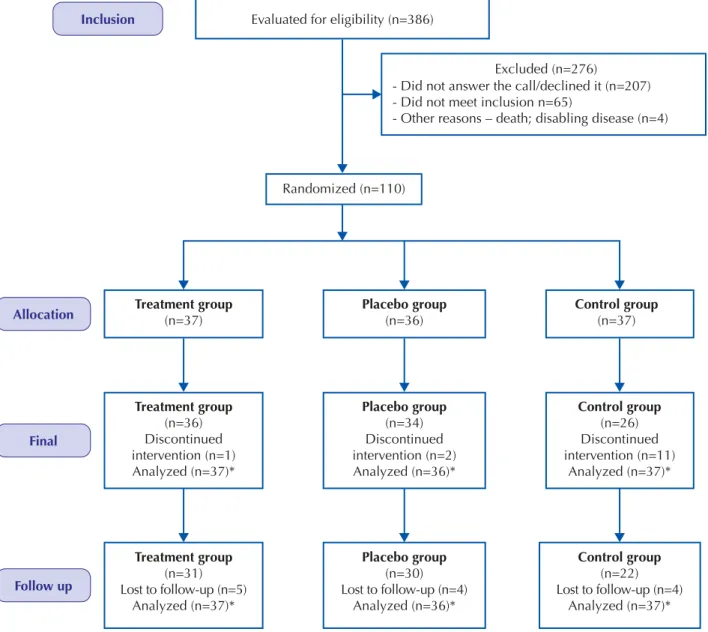
the inclusion criteria made up the study sample, and 83 completed the study steps, which represents a loss of 27 (24.54%) people (Figure 1).
The selected patients were randomly allocated into three parallel study branches: treatment group (n=37), placebo group (n=36), and control group (n=37). Randomization was carried out in four blocks, with approximately 27 people in each block, by a researcher who did not participate in the study as an author using the program R version 3.1.1. Each number of the randomiza-tion sequence was put inside an opaque envelope, which was sealed and handed to the practitioner only when the first session was about to be performed.
Effects of auricular acupuncture on chronic pain in people with back musculoskeletal disorders: a randomized clinical trial
data analySiS and treatment
Collected data were inserted into a Microsoft Office Excel® spreadsheet, version 2013, by two independent researchers, and the consistency of the data was tested later. Statistical analysis was carried out using the programs SSPS version 23.0 and BioEstat version 5.0.
Data were treated with the intention-to-treat analysis through the repetition of the values of the last evalua-tion, in accordance with Consort recommendations(17). The
variables of the sociodemographic and pain profiles were submitted to chi-square and Kruskal-Wallis tests. In the intergroup evaluation, the Kruskal-Wallis test was applied, followed by the Student-Newman-Keuls test whenever necessary. The intragroup evaluation was performed using
Evaluated for eligibility (n=386)
Inclusion
Allocation
Final
Follow up
Randomized (n=110)
Placebo group
(n=36)
Treatment group
(n=37)
Treatment group
(n=36) Discontinued intervention (n=1) Analyzed (n=37)*
Placebo group
(n=34) Discontinued intervention (n=2) Analyzed (n=36)*
Control group
(n=26) Discontinued intervention (n=11)
Analyzed (n=37)*
Treatment group
(n=31) Lost to follow-up (n=5)
Analyzed (n=37)*
Placebo group
(n=30) Lost to follow-up (n=4)
Analyzed (n=36)*
Control group
(n=22) Lost to follow-up (n=4)
Analyzed (n=37)*
Control group
(n=37)
Excluded (n=276)
- Did not answer the call/declined it (n=207) - Did not meet inclusion n=65)
- Other reasons – death; disabling disease (n=4)
Figure 1 – Flowchart showing the sample screening process. *Intention-to-treat analysis
Source: Adapted from Consort (http://www.consort-statement.org/consort-statement/flow-diagram).
ethical aSpectS
The present study was approved by a research eth-ics committee as per report no. 1.041.266 of 2015 and followed the ethical recommendations of the Brazilian National Health Council according to Resolution 466/12(18). At the end of the investigation, the people in
the placebo and control groups had been submitted to the same number of AA sessions than participants in the treatment group.
RESULTS
Table 1 – Sample characterization regarding age, gender, and pain profile in the three studied groups – Alfenas, MG, Brazil, 2016.
Variables Treatment group(n=37) Placebo group(n=36) Control group(n=37) p value
Age (µ±sd) (years) 47.51±13.89 51.03±14.90 46.19±15.73 0.272a
Gender (%)
Male 18.90 25.00 18.90 0.763b
Female 81.10 75.00 81.10
Pain duration (µ±sd) (months) 47.51±13.89 51.03±14.90 46.19±15.73 0.850a
Pain type (%)
Constant 48.60 47.2 27.00 0.108b
Recurring 51.40 52.8 73.00
Impact of pain
Impact on activities of daily living (%)
Eating 8.10 2.80 0.00 0.167a
Dressing 27.00 19.40 24.30 0.742a
Showering 2.70 19.40 13.50 0.080a
Intimate hygiene 8.10 11.10 5.40 0.673a
Mood swings (%)
Depressive 32.40 44.40 21.6 0.115a
Anxious 75.70 77.80 59.5 0.167a
Emotional change (%)
Fear of movement 59.50 61.10 48.60 0.504a
Physical stamina (%)
Tiredness 75.70 77.80 75.70 0.971a
Impossibility to practice physical activities (%) 59.50 61.10 54.10 0.814a
Most common causes of pain
Posture changes (%) 16.21 44.44 16.21
--Osteoarthritis (%) 35.13 41.65 16.21
--Note: aKruskal-Wallis test; bchi-square test; µ: mean; sd: standard deviation; (n=110). women between 40 and 50 years old, who presented a prevalence of recurring pain for around four years. The most affected activity was dressing in the treatment and con-trol groups, whereas people in the placebo group reported similar difficulties regarding dressing and showering. Most participants declared to be anxious and complained of feel-ing tired and befeel-ing unable to practice physical activities because of the fear to move. These people were monitored for one month and a half, a period which encompassed the evaluations and intervention.
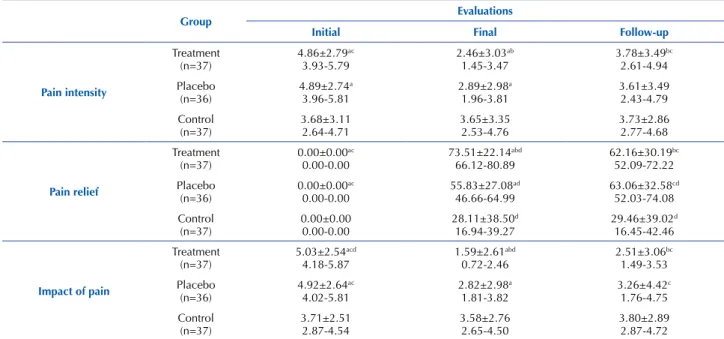
According to the data shown in Table 2, pain inten-sity and relief did not differ among the examined groups in the initial evaluation, and there was no modification in the performance of the control group over time in the three analyzed variables (pain intensity and relief and impact of pain on daily activities), as expected. However, the treat-ment and placebo groups had a decrease in the score of pain intensity in the final evaluation. A remarkable aspect found in this set of evaluations which illustrates the limited benefit of the so-called placebo effect is the evidence that the pain intensity got back to pre-session levels in the placebo group, but not in the treatment group, in the follow-up evaluation. Nearly the same behavior was observed for pain relief, which
was higher in the treatment group and lower in the placebo group in the final evaluation. Nevertheless, after 15 days of the end of the treatment, pain relief decreased in the treat-ment group, getting close to the results of the placebo group. Pain relief remained higher in the follow-up evaluation in the treatment and placebo groups in comparison with the results registered in the initial evaluation.
Table 2 also brings evidence that pain interferes with the execution of daily activities. Once more, the intragroup analysis revealed an improvement in this parameter after the sessions (final evaluation) in the treatment and placebo groups. Nevertheless, according to the intergroup analysis carried out in the same period, the impact of pain was sig-nificantly lower in the treatment group in comparison with the placebo one. In the follow-up evaluation, there was a slight increase in this parameter in the treatment and pla-cebo groups, with the former showing the highest variation, indicating that the continuity of treatment is decisive to keep an adequate mobility.
Effects of auricular acupuncture on chronic pain in people with back musculoskeletal disorders: a randomized clinical trial
DISCUSSION
The present study demonstrated that the AA based on the principles of traditional Chinese medicine produced positive effects on chronic back pain intensity and relief, decreasing the impact of this condition on daily activities. The main underlying mechanisms of these effects relate to 1) the analgesia induced by acupuncture; 2) the activation of descending pathways of the inhibitor system of pain control; and 3) the expectations of patients regarding pain relief, that is, the placebo effect(19-22).
The acupuncture-induced analgesia is, at least partially, mediated by sensory-discriminative and affective-social aspects of touch that activate the “gate theory” for pain con-trol(19). According to this model, the concomitant and quick
conduction of discriminative spatial information through Aβ type myelinated fibers surpasses the pain-related
infor-through type C fibers may also be influenced by emotional and motivational aspects related to the procedure(20).
Another important aspect that must be emphasized is the design implemented in the present study. The experi-ment included not just a group of people who received regular treatment, but also a control group, whose members received no intervention, and a placebo group, whose par-ticipants received sham AA. An additional positive char-acteristic of the present investigations was its significant period of follow-up, which lasted 15 days and contrib-uted to discern the efficacy of the intervention, especially between the treatment and placebo groups.
This standardization strengthens the findings, although some of the results may be attributed to the placebo effect of the AA, which is inherent to the patients’ expectations regard-ing the therapy and modulates the perception of pain(23). It is
Table 3 – Intragroup and intergroup analyses of pain threshold expressed as mean ± standard deviation, with a confidence interval of 95%, for the three studied groups at three different moments – Alfenas, MG, Brazil, 2016.
Groups Evaluations
Initial Final Follow-up
Treatment
(n=37) (2.38±1.27)1.95-2.80 (2.21±0.90)1.90-2.51 (2.14±0.86)1.85-2.43
Placebo (n=36) (3.00±2.16) 2.27-3.73 (2.49±1.07) 2.13-2.85 (2.45±1.26) 2.02-2.87 Control (n=37) (2.07±1.22) 1.66-2.47 (2.13±1.03) 1.78-2.47 (2.06±1.00) 1.73-2.39
Note: There was no statistically significant difference in the intraclass (Wilcoxon test) and intergroup (Kruskal-Wallis test followed by Student-New-man-Keuls test) analyses; n=110.
Table 2 – Intragroup and intergroup analyses of pain intensity, pain relief after intervention, and impact of pain on daily activities expressed as mean ± standard deviation, with a confidence interval of 95%, for the three studied groups at three different moments – Alfenas, MG, Brazil, 2016.
Group Evaluations
Initial Final Follow-up
Pain intensity Treatment (n=37) 4.86±2.79ac 3.93-5.79 2.46±3.03ab 1.45-3.47 3.78±3.49bc 2.61-4.94 Placebo (n=36) 4.89±2.74a 3.96-5.81 2.89±2.98a 1.96-3.81 3.61±3.49 2.43-4.79 Control (n=37) 3.68±3.11 2.64-4.71 3.65±3.35 2.53-4.76 3.73±2.86 2.77-4.68 Pain relief Treatment (n=37) 0.00±0.00ac 0.00-0.00 73.51±22.14abd 66.12-80.89 62.16±30.19bc 52.09-72.22 Placebo (n=36) 0.00±0.00ac 0.00-0.00 55.83±27.08ad 46.66-64.99 63.06±32.58cd 52.03-74.08 Control
(n=37) 0.00±0.000.00-0.00 28.11±38.50
d
16.94-39.27 29.46±39.02
d
16.45-42.46
Impact of pain
fibers, resulting in the activation of the insular cortex rather than the somatosensory system, which leads to emotional and hormonal reactions. Therefore, it is likely that the placebo group had this sensory/emotional component of pain control activated and experienced pain relief. Another evidence that reinforces this hypothesis, as discussed further in this section, is the fact that the pain threshold did not change among the groups. This finding suggests that the main command for pain relief may originate directly in the central nervous system and not through the activation of peripheral sensory nervous terminations. Although researchers(24) have reported
significant effects of real and placebo AA to treat lumbar pain, some studies(5,25) agree that, despite the positive effects shown
by patients treated with the sham intervention, these results are less significant when compared to those of the treatment group, which was also observed in the present investigation. Consequently, pain intensity decreased in the treatment and placebo groups, as revealed by the comparison of initial and final evaluations. The procedure proved effective and, although the pain increased slightly in the treatment group after the follow-up, it did not reach the pre-sessions level. The AA resulted in a pain reduction of 80% during the interven-tion period, which lowered to 60% after 15 days. From these results, it is possible to conclude that the AA produces high-impact measurable positive effects on the management of chronic back pain. Another beneficial aspect that distinguishes AA from classic pharmacological strategies for pain control is the relative absence of side effects. Additionally, chronic pain in the musculoskeletal system is usually refractory to the most common painkillers(26), which suggests that the AA can
become a treatment of choice for this condition.
The inter and intragroup evaluations revealed that the AA was also effective in reducing the impact of pain on daily activi-ties in the treatment and placebo groups. Similarly to what was observed for the other parameters, the most significant result occurred in the treatment group, and the effects were detected 15 days after the last AA session. An investigation(27) in which
the BPI was also applied reported a decreased impact of pain on daily activities after the treatment with ear acupressure. However, this study(28) lacked a placebo or control group and
a follow-up period after the last session, which impaired the identification of the contribution of the placebo effect and of the duration of the potential benefit of the technique.
As mentioned previously, the AA was not satisfactory regarding the change of the pain threshold in the present study. The authors believe that either the number of sessions was not enough to increase this variable, or the stimulus applied with the needles in the ear, far from the affected region and presenting a low intensity, was not capable of affecting the mechanisms of peripheral and central sensitization involved in chronic pain. In agreement with this hypothesis, an inves-tigation showed that associating electrical stimulation with AA may strengthen the effects of the latter and increase the pain threshold(28). This result may be explained by the fact
that electroacupuncture leads to more pronounced changes in membrane potentials, which triggers an additional release of several mediators in the nervous central system, including
endogenous opioids, substances known for playing a funda-mental role in the increase of tolerance to pain.
The application of a local intervention, such as systemic acupuncture, may also be effective to reduce the sensitiza-tion of peripheral nociceptors in chronic pain. In this type of procedure, the insertion and handling of needles cause a sensation called De Qi (numbness, distension, electricity, heat, cold, weight, irradiation)(29), which leads to a greater
participa-tion of low-conducparticipa-tion Aδ and C fibers, simultaneously to the quick conduction of Aβ fibers(30-31). A positive
correla-tion has been reported among the numbness sensacorrela-tion, the pain triggered by the De Qi, propagated by these nociceptive fibers, and the efficacy of acupuncture-induced analgesia(32).
Therefore, it is believed that techniques applied locally can be more effective to decrease the pain threshold in comparison with long-distance interventions, such as the AA.
In summary, the treatment protocol established in the present study showed better results in the decrease of pain intensity and impact of pain on daily activities and increase of pain relief. The authors believe that some results were influenced by the placebo response. This effect is an inher-ent part of the human potinher-ential to respond positively to a certain treatment and cannot be excluded. Instead of being considered as a methodological bias, the authors believe it should be seen as an important part of the treatment plan given that it produces beneficial results, reducing the need for additional interventions.
The present study had a few limitations. The adoption of an individualized application of the intervention based on the energy balance hinders the replicability of the study, despite the observation of promising results. It is possible that the application of an invasive stimulus in the participants of the placebo group contributed to strengthening the effects reg-istered in this group. It is noteworthy the loss of participants in the control group (over 30%), which may be attributed to a long follow-up period without intervention, although the right to receive it after the follow-up had been assured. Finally, the difference between the number of points used in the treat-ment and placebo groups must be considered a hindering factor, because it allowed the participants to detect application differences in the procedures of these groups.
For future studies, the authors suggest the adoption of the same number of auricular points in both intervention groups and an increased intensity in the AA stimulation, that is, an association with electrostimulation, which may induce clinical changes in the pain threshold and extend the potential benefits of the AA itself.
CONCLUSION
Effects of auricular acupuncture on chronic pain in people with back musculoskeletal disorders: a randomized clinical trial RESUMO
Objetivo: Avaliar os efeitos da auriculoacupuntura sobre a intensidade da dor, a sua interferência nas atividades cotidianas, o alívio proporcionado pela intervenção e o limiar de dor em pessoas com distúrbios musculoesqueléticos nas costas. Método: Ensaio clínico randomizado, realizado com pessoas randomizadas em três grupos: tratado, placebo e controle. As avaliações foram realizadas usando o Inventário Breve de Dor e um algômetro digital antes (inicial) e após o tratamento (final), em um período de seguimento de 15 dias (follow-up). Resultados: Participaram 110 pessoas. Houve redução na intensidade da dor nos grupos tratado e placebo entre as avaliações inicial e final (p<0,05), e no grupo tratado entre a avaliação inicial e o follow-up (p<0,05). Também ocorreu diminuição da interferência da dor nas atividades cotidianas nos grupos tratado e placebo ao longo do tempo (p<0,05). Na avaliação final, a interferência da dor foi menor no grupo tratado (p<0,05). A auriculoacupuntura não foi suficiente para aumentar o limiar de dor. Conclusão: A auriculoacupuntura apresentou efeitos positivos ao reduzir a intensidade da dor crônica e sua interferência nas atividades cotidianas em pessoas com distúrbios musculoesqueléticos nas costas. Registro Brasileiro de Ensaios Clínicos: RBR-5X69X2
DESCRITORES
Dor Crônica; Dor Musculoesquelética; Acupuntura Auricular; Reabilitação; Enfermagem Holística; Terapias Complementares.
RESUMEN
Objetivo: Evaluar los efectos de la auriculoacupuntura sobre la intensidad del dolor, su interferencia en las actividades cotidianas, el alivio proporcionado por la intervención y el umbral de dolor en personas con disturbios musculoesqueléticos en la espalda. Método: Ensayo clínico randomizado, realizado con personas aleatorizadas en tres grupos: tratado, placebo y control. Las evaluaciones se llevaron a cabo usando el Breve Inventario del Dolor y un algómetro digital antes (inicial) y tras el tratamiento (final), en un período de seguimiento de 15 días (follow-up). Resultados: Participaron 110 personas. Hubo reducción en la intensidad del dolor en los grupos tratado y placebo entre las evaluaciones inicial y final (p<0,05), y en el grupo tratado entre la evaluación inicial y el follow-up (p<0,05). También ocurrió disminución de la interferencia del dolor en las actividades cotidianas en los grupos tratado y placebo a lo largo del tiempo (p<0,05). En la evaluación final, la interferencia del dolor fue menor en el grupo tratado (p<0,05). La auriculoacupuntura no fue suficiente para aumentar el umbral de dolor. Conclusión: La auriculoacupuntura presentó efectos positivos al reducir la intensidad del dolor crónico y su interferencia en las actividades cotidianas en personas con disturbios musculoesqueléticos en la espalda. Registro Brasileño de Ensayos Clínicos: RBR-5X69X2
DESCRIPTORES
Dolor Crónico; Dolor Musculoesquelético; Acupuntura Auricular; Rehabilitación; Enfermería Holística; Terapias Complementarias.
REFERENCES
1. Vos T, Barber RM, Bell B, Bertozzi-Villa A, Biryukov S, Bolliger I, et al. Global, regional, and national incidence, prevalence, and years lived with disability for 301 acute and chronic diseases and injuries in 188 countries, 1990-2013: a systematic analysis for the Global Burden of Disease Study 2013. Lancet. 2015;386(9995):743-800. DOI: https://doi.org/10.1016/S0140-6736(15)60692-4
2. Ritter PA, Fernández RR, Biancardi SG, Orellana MEF, Lorenzini NV, Ojeda MM. et al. Intervencionismo musculoesquelético en
cuidados paliativos. Dolor [Internet]. 2011 [citado 2016 nov. 28];56:12-16. Disponible en: http://www.ached.cl/upfiles/revistas/
documentos/4fe3846d31914_intervencionismo.pdf
3. Task Force on Taxonomy of the International Association for the Study of Pain. Classification of chronic pain: descriptions of chronic pain
syndromes and definitions of pain terms. 2nd ed. Pain Suppl. 1986;3:S1-226.
4. Hou PW, Hsu HC, Lin YW, Tang NY, Cheng CY, Hsieh CL. The history, mechanism, and clinical application of auricular therapy in traditional Chinese Medicine. Evid Based Complement Alternat Med. 2015;2015:495684. DOI: http://dx.doi.org/10.1155/2015/495684
5. Yeh CH, Chien LC, Balaban D, Sponberg R, Primavera J, Morone NE, et al. A randomized clinical trial of auricular point acupressure for chronic low back pain: a feasibility study. Evid Based Complement Alternat Med. 2013;2013:196978. DOI: http://dx.doi. org/10.1155/2013/196978
6. Lee EJ, Frazier SK. The efficacy of acupressure for symptom management: a systematic review. J Pain Symptom Manage [Internet]. 2011
[cited 2016 Nov 28];42(4):589-603. Available from: https://www.ncbi.nlm.nih.gov/pmc/articles/PMC3154967/
7. Zhao HJ, Tan JY, Wang T, Jin L. Auricular therapy for chronic pain management in adults: A synthesis of evidence. Complement Ther Clin Pract. 2015;21(2):68-78. DOI: http://dx.doi.org/10.1016/j.ctcp.2015.03.006
8. Yeh CH, Kwai-Ping Suen L, Chien LC, Margolis L, Liang Z, Glick RM, et al. Day-to-day changes of auricular point acupressure to manage chronic low back pain: a 29-day randomized controlled study. Pain Med. 2015;16(10):1857-69. DOI: http://dx.doi.org/10.1111/pme.12789
9. MacPherson H, Altman DG, Hammerschlag R, Youping L, Taixiang W, White A, et al. Revised Standards for Reporting Interventions in Clinical Trials of Acupuncture (STRICTA): extending the CONSORT Statement. PloS Med [Internet]. 2010 [cited 2015 Apr 25];7(6):1-11. Available from: https://www.ncbi.nlm.nih.gov/pmc/articles/PMC2882429/
10. World Federation of Acupuncture-Moxibustion Societies (WFAS). Auricular Acupuncture Point (WFAS STANDARD-002:2012). World J Acupunct Moxibustion. 2013;23(3):12-21.
11. Daut R, Cleeland C, Flanery R. Development of the Wisconsin Brief Pain Questionnaire to assess pain in cancer and other diseases. Pain. 1983;17(2):197-210.
12. Toledo FO, Barros PS, Herdman M, Vilagut G, Reis GC, Alonso J, et al. Cross-Cultural Adaptation and Validation of the Brazilian version of the Wisconsin Brief Pain Questionnaire. J Pain Symptom Manage. 2013;46(1):121-30. DOI: http://dx.doi.org/10.1016/j. jpainsymman.2012.07.017
This is an open-access article distributed under the terms of the Creative Commons Attribution License.
14. Moura CC, Iunes DH, Agostinho AAM, Santos N, Silva AM, Chaves ECL. Assessment and correlation between subjective and physiological variables of chronic spinal pain. Rev Dor [Internet]. 2017 [cited 2016 Nov 28];18:1-5. Available from: http://www.scielo.br/pdf/rdor/ v18n3/1806-0013-rdor-18-03-0194
15. Hertzog MA. Considerations in determining sample size for pilot studies. Res Nurs Health. 2008;31(2):180-91. DOI: 10.1002/nur.20247
16. Miot HA. Tamanho da amostra em estudos clínicos e experimentais. J Vasc Bras [Internet]. 2011 [citado 2016 nov. 28];10(4):275-8. Disponível em: http://www.scielo.br/pdf/jvb/v10n4/v10n4a01
17. Consort Transparent Reporting of Trials. Intention-to-treat analysis [Internet]. 2013 [cited 2018 June 01]. Available from: http://www. consort-statement.org/contents/item/display/500
18. Brasil. Ministério da Saúde; Conselho Nacional de Saúde. Resolução n. 466, de 12 de dezembro de 2012. Dispõe sobre diretrizes e normas regulamentadoras de pesquisas envolvendo seres humanos [Internet]. Brasília; 2012 [citado 2018 mar. 12]. Disponível em: http:// conselho.saude.gov.br/resolucoes/2012/reso466.pdf
19. Melzack R, Wall PD. Pain mechanisms: a new theory. Science. 1965;150(3699):971-9.
20. Chae Y, Olausson H. The role of touch in acupuncture treatment. Acupunct Med. 2017;35(2):148-52. DOI: http://dx.doi.org/10.1136/ acupmed-2016-011178.
21. Fleckenstein J. Acupuncture in the context of diffuse noxious inhibitory control. Eur J Pain. 2013;17(2):141-2. DOI: http://dx.doi. org/10.1002/j.1532-2149.2012.00237.x
22. Lin JG, Chen WL. Acupuncture analgesia: a review of its mechanisms of actions. Am J Chin Med. 2008;36(4):635-45. DOI: http://dx.doi. org/10.1142/S0192415X08006107
23. Medoff ZM, Colloca L. Placebo analgesia: understanding the mechanisms. Pain Manag [Internet]. 2015 [cited 2017 Aug 17];5(2):89-96. Available from: https://www.ncbi.nlm.nih.gov/pmc/articles/PMC4388042/
24. Lund I, Lundeberg T. Are minimal, superficial or sham acupuncture procedures acceptable as inert placebo controls? Acupunct Med.
2006;24(1):13-5.
25. Yeh CH, Chien LC, Albers KM, Ren D, Huang LC, Cheng B, et al. Function of auricular point acupressure in inducing changes in
inflammatory cytokines during chronic low-back pain: a pilot study. Med Acupunct. 2014;26(1):31-9. DOI: https://doi.org/10.1089/
acu.2013.1015
26. Machado GC, Maher CG, Ferreira PH, Day RO, Pinheiro MB, Ferreira ML. Non-steroidal anti-inflammatory drugs for spinal pain: a
systematic review and meta-analysis. Ann Rheum Dis. 2017;76(7):1269-78: DOI: https://doi.org/10.1136/annrheumdis-2016-210597
27. Yeh CH, Chien LC, Chiang YC, Huang LC. Auricular point acupressure for chronic low back pain: a feasibility study for 1-week treatment. Evid Based Complement Alternat Med [Internet]. 2012 [cited 2017 Aug 17];2012:383257. Available from: https://www.ncbi.nlm.nih.gov/ pmc/articles/PMC3395299/
28. Ulett GA, Han S, Han JS. Electroacupuncture: mechanisms and clinical application. Biol Psychiatry. 1998;44(2):129-38.
29. Yuan HW, Ma LX, Zhang P, Lin C, Qi DD, Li J, et al. An exploratory survey of deqi sensation from the views and experiences of chinese patients and acupuncturists. Evid Based Complement Alternat Med. 2013;2013:430851. DOI: http://dx.doi.org/10.1155/2013/430851
30. Hui KK, Nixon EE, Vangel MG, Liu J, Marina O, Napadow V, et al. Characterization of the “deqi” response in acupuncture. BMC Complement Altern Med [Internet]. 2007 [cited 2017 Aug 17];7:33. Available from: https://www.ncbi.nlm.nih.gov/pmc/articles/PMC2200650/
31. Zhou W, Benharash P. Significance of “Deqi” response in acupuncture treatment: myth or reality. J Acupunct Meridian Stud.
2014;7(4):186-9. DOI: http://dx.doi.org/10.1016/j.jams.2014.02.008
32. Kong J, Fufa DT, Gerber AJ, Rosman IS, Vangel MG, Gracely RH, et al. Psychophysical outcomes from a randomized pilot study of manual, electro, and sham acupuncture treatment on experimentally induced thermal pain. J Pain. 2005;6(1):55–64. DOI: http://dx.doi. org/10.1016/j.jpain.2004.10.005
Financial support: