Voice Over IP:
Guaranteeing Carrier
Grade Performance
T
able of Contents
Introduction 1
VoIP Architecture 3
Test Strategy 4
VoIP Testing 6
Gateway Testing 13
Gatekeeper Testing 16
IVR Testing 19
Billing & Pre-paid Testing 21
NMS Testing 22
Conclusion 22
Appendix 1: List of Specifications 24
Appendix 2: Glossary 25
G
uaranteeing Carrier Grade Performance
Introduction
Voice over IP networks are complex. They represent the converging worlds of tele- and data communications, and therefore present myriad implementation and testing challenges:
• Integration to traditional telecom infrastructure • Integration to billing systems
• Many add-on services • Large variety of protocols • Quality is an issue
• Network specialists are expensive and scarce • Reliability is a must
• Multiple High Quality Services: voice, fax, video, unified messaging, call centers, etc.
This white paper presents a typical VoIP architecture and then suggests a framework for testing VoIP networks. The test strategy is presented as well as a detailed discussion of the actual testing required for each network element.
Currently, there is only one system in the market that allows full end to end testing and mapping of quality vs. stress. This is RADCOM's VoIP
Performer™.
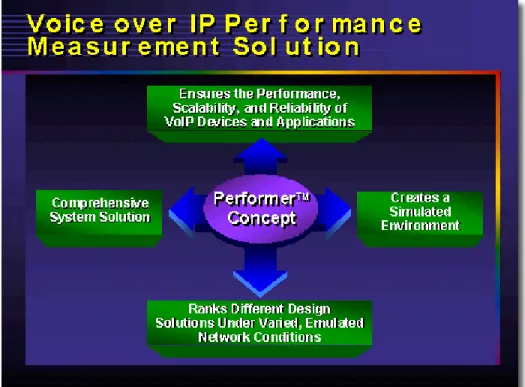
It introduces a new conceptual method for testing Voice over IP networks, as can be seen in Figure 1. The Performer™ includes high performance
emulation and simulation components as well as powerful quality
measurement and analysis components. The complete system is controlled from a single management console and allows scripting and automating of the testing procedures.
The following are the components of the Performer™:
• QPro - multiple PSTN client emulation including objective quality measurements.
• 323Sim - multiple H.323 client emulation including registration, signaling and media.
• SIPSim - multiple SIP client emulation including registration, signaling and media.
• MediaPro - real time packet based objective and subjective quality measurements.
Figure 1: RADCOM's VoIP Performer™ introduces a new conceptual method for testing Voice over IP networks
VoIP Architecture
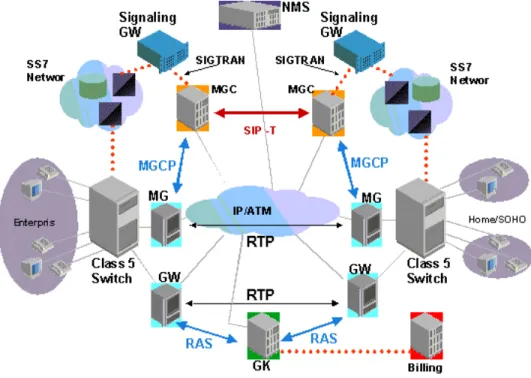
A typical VoIP network includes the following components:
• Media gateways • Signaling gateways • Gatekeepers
• Class 5 switches • SS7 network
All of these network elements communicate with each other using a plethora of protocols, as can be seen in Figure 2. A detailed list of protocols and
specifications can be seen in Appendix I.
Figure 2: Typical VoIP architecture
Test Strategy
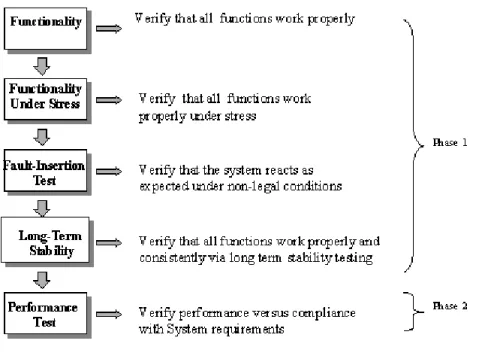
Testing VoIP networks is a tri-fold task:
A successful pre-deployment testing strategy must address each of these three facets:
Figure 3: Test Strategy
Changes such as software or hardware version upgrades can cause
shows a very basic script performing a repeated test and recording the results each time.
Figure 4: RADCOM's Performer™ MasterScript provides an easy way to perform automatic degradation tests
VoIP Testing
Following are VoIP network components that must be tested prior to deployment:
• Gateway (GW) and Media Gateway (MG)
• Gatekeeper (GK) and Media Gateway Controller (MGC) • Signaling Gateway
• Proxy, Registrar and Location Servers
• Billing and Prepaid system
• Network Management System (NMS)
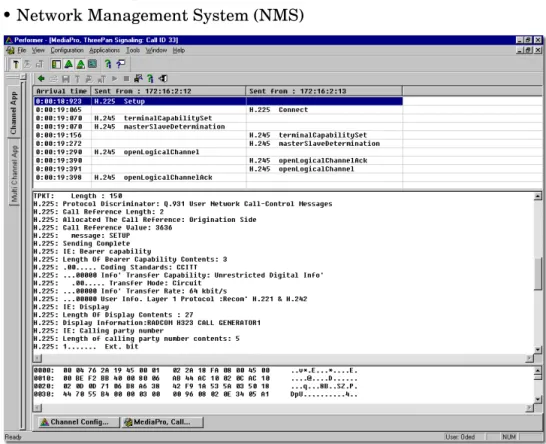
Figure 5: Call oriented signaling decodes
messages. Figure 5 shows the signaling decodes of a VoIP call and Appendix I includes the current list of all VoIP protocols and their specifications.
Figure 6: RADCOM's 7 layer protocol decodes
RADCOM's Performer™ provides call oriented decodes of the signaling plane as well as media oriented decodes.
In addition, a complete protocol analyzer is integrated into the Performer™. This allows engineers to capture traffic from the link and decode all 7 layers as can be seen in Figure 6.
Furthermore, the user can quickly troubleshoot specific issues by applying complex and flexible filters that are very easy to configure and do not require very deep understanding of all protocol layers and fields.
per user. Once these numbers are known or estimated they can be inputted into RADCOM's Performer™ simulation components.
Figure 7: A variety of traffic profiles is available with the Performer's emulators
Figure 7 shows an example of a Ramp model and a Poisson model, both can be used when defining the traffic generation characteristics of the SIPSim to emulate SIP calls in a way that will emulate real world behavior.
Existing network infrastructure should also be taken into account - what type of network is used: Frame Relay, ATM, VSAT, xDSL, WLL etc. The expected network performance including parameters such as latency, packet loss and available bandwidth is also of significant importance. The Performer's NetSim can emulate the expected network conditions in a lab environment, thus eliminating the need to deploy a global network. Figure 8 shows a typical network emulated by the NetSim.
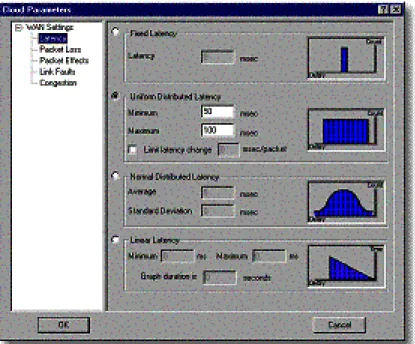
It can also emulate several network impairments such as latency (as seen in Figure 9), packet loss, congestion, fragmentation problems, link faults and more.
Figure 9: Latency emulation using NetSim
packets, retransmitted packets, and more. Figure 10 show a typical results screen on the MediaPro.
Figure 10: MediaPro provides detailed quality measurements such as real time jitter, lost packets, retransmissions, and more
The Poisson statistical model, a generally accepted tool to predict end user behavior, should be incorporated in the pre-deployment test plan. Using this model and based on the assumption that the average call duration is 180 sec, the VoIP network specifications can be defined using the following
parameters:
Or in other words,
2. Busy Hour Traffic-This is the amount of call traffic handled by a group of phone lines during the busiest hour of the busiest day for your system. Busy Hour Traffic is defined in units of Erlangs or CCS. It can be typically calculated as,
B.H.T= (Number of anticipated end users) * 0.05
3. Centi-Call Seconds (CCS)- This is a unit of Busy Hour Traffic
commonly used for traffic measurement. 36 CCS equals 1 Erlang of traffic. 4. Erlang- This is a unit of Busy Hour Traffic and represents the continuous
use of a single line for one hour. For example, 30 calls of 2 minutes holding time each would equal 1 Erlang of traffic. On a typical Voice over IP network the end user traffic is between 0.01 Er and 0.15 Er. For detailed Erlang calculations you may refer to http://www.erlang.com/calculator/.
When designing a Voice over IP network it is important to avoid bottlenecks in the design. A T1 can usually support up to 18 Erlang with a Grade of Service of 5%. An E1, on the other hand, can support up to 24.8 Erlang with a Grade of Service of 5%. From these requirements one can calculate the number of customers a typical link can support. For a T1,
And for an E1,
Blocking =Required Grade of Service
100
Blocking =Number of failed call attempts
Total number of call attempts
N(T1) =18Erlang 0.05Erlang
=360 customers
N(T1) =24.8Erlang 0.05Erlang
After the Voice over IP network has been proven for functionality, a series of stress tests should be conducted. It is important to have a consistent definition of stress. The recommended criteria for a stressed network dictate the
configuration of the test devices and are as follows:
A. Pre-define number of calls per session and 100 setup calls per second.
B. Create Jitter, Packet-loss, Packet out of sequence and Latency in Uniform mode.
C. The VAD and the silence suppression mechanism should be activated.
D. The RTP packets should consist of 1 frame per packet and 3 frames per packet.
All of these parameters can be configured on the Performer's simulators namely the H.323Sim, SIPSim, QPro and NetSim. RADCOM has added extensive signaling and media stress capabilities to its Performer system. The MegaSIP is capable of generating hundreds of thousands of simultaneous calls at a rate of thousands of calls per second. This tool provides an effective way to conduct a variety of performance tests on different network components.
The foregoing reflects general requirements involved in VoIP network testing. The following will address specific tests of the various components:
• Gateway testing • Gatekeeper testing • IVR testing
• Billing system testing
• Network management system testing
Gateway Testing
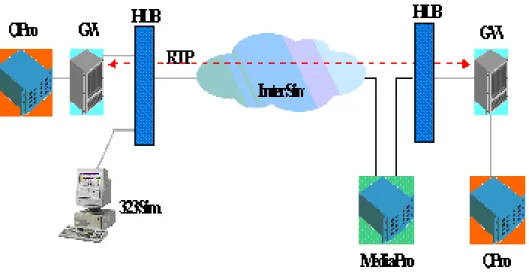
it is recommended that the complete system be tested using an end-to-end test scheme, like the one displayed in Figure 11.
Figure 11: Gateway testing
Two gateways are connected through an Internet cloud passing calls that are generated on the circuit side. RADCOM's NetSim emulates the Internet cloud. This is the most ubiquitous configuration in current VoIP networks. The scenario includes performance measurement on both the circuit side and the packet side to provide a complete picture of the capability of the network under test.
The tests should include a variety of aspects:
• Compression and De-compression • Bandwidth utilization
• Silence suppression and VAD • DTMF detection and Generation
• Jitter suppression and Echo cancellation • Fall-back to PSTN mechanism
Moreover, testing and evaluating voice quality is extremely important. PAMS (Perceptual Analysis Measurement System), developed by British Telecom, is an algorithm commonly used for this purpose.
Figure 12: PAMS provides objective MOS results
Additionally, an enhanced algorithm, PESQ (Perceptual Evaluation of Speech Quality) was recently introduced by the ITU. A speech signal is generated on one side of the network and the degraded signal is captured at the other side. A quality prediction is made on the received signal based on a mathematical comparison to a stored reference file. Both algorithms implement a human hearing model and transform the speech signal into a three-domain
measurements, allowing quick isolation of voice degradation sources, as can be seen in Figure 13.
Figure 13: Performer's QPro and MediaPro isolate audio quality degradation sources The second test includes a QPro generating calls to the 323Sim that replies with a PAMS or PESQ signal going towards the QPro that measures quality. In this way, a single gateway can be tested for functionality, performance, and quality.
Finally, in a real converged network voice and data are not the only types of traffic. Fax is also very common on VoIP networks. When considering fax transmissions the most important thing to test is the packet loss recovery mechanism. This includes the T.38 redundant packet transmission, the TCP retransmission sliding window mechanism and the FEC (Forward Error Correction). Furthermore, the switching mechanism between fax and voice needs to be tested. All of these tests can be performed by sending fax traffic through a simulated packet network with a variety of different network conditions emulating the loss of packets and measuring the quality of the fax received.
Gatekeeper Testing
network conditions is crucial for providing a carrier grade solution (an acceptable Grade of Service).
Figure 14: Gatekeeper testing
The first thing to test on a Gatekeeper is its Registration mechanism - to ensure that it can register VoIP elements. Privacy and security are an important aspect of any network and are of particular concern on a VoIP network. Therefore, it is also important to test the Admission and
Authorization mechanism on the Gatekeeper. The complexity the gatekeeper has to deal with grows exponentially as more and more IP phones try to perform the RAS handshake with it simultaneously. Using RADCOM's 323Sim engineers can save money and time by emulating multiple IP terminals with multiple aliases all doing RAS with the gatekeeper thus quickly identifying stress related problems, as can be seen in Figure 15.
The Gatekeeper communicates with both the VoIP terminals and the Gateway, and the language it uses is H.225 and more specifically RAS (Registration, Admission, Status). To properly test the compliancy of the Gatekeeper's implementation of RAS, emulation of a VoIP terminal
performing RAS negotiation with the Gatekeeper under a stressed network is required.
Once the Gatekeeper accepts a terminal, it can make calls and use the Routing Directory Service that the Gatekeeper provides. This routing can be done in two ways - least cost routing or best cost routing. Least cost routing means that the least costly route will be selected. Best cost routing means that the best BPS (Bit Per Second) route will be selected. In other words, the
Gatekeeper will choose a route that provides the best combination of performance and cost. Some Gatekeepers support RSVP (Resource
ReSerVation Protocol) and can assign a route to a call based on the resources available toward the receiving end.
Gatekeepers have two modes of operation - direct mode and routed mode. The routed mode is more commonly used. When the gatekeeper performs address translation, the gatekeeper provides endpoints with the transport address for the call signaling channel destination. In the direct mode, the gatekeeper provides the endpoints with the address of the destination endpoint and directs them to the call-signaling channel so that all messages can be exchanged directly between the two endpoints without gatekeeper
involvement. The Gatekeeper test procedure should include tests for both modes of call control routing.
The Gatekeeper can also control bandwidth allocation. Through H.225.0 signaling, the gatekeeper is able to limit the bandwidth of the call to less than what was requested as well as reject calls from a terminal if it determines that there is insufficient bandwidth available on the network to support the call. The testing scenario should include several test configurations using
RADCOM's 323Sim, with generated calls asking for bandwidth that is just below, and just above, the allocated bandwidth, to verify the operation of the bandwidth allocation mechanism on the Gatekeeper. This should be
IVR Testing
IVR (Interactive Voice Response) is an integral part of any business phone system. Practically every call center implements some sort of an IVR system because it reduces operational and human resource costs.
Figure 16: IVR testing
For VoIP systems to be used in a business environment they must support IVR, which also means that they have to be tested to ensure their correct operation in real world applications. Both functionality and performance under stress need to be tested. IVR systems use DTMF (Dual Tone Multi Frequency) tones to transfer user requests to the system. DTMF tones are the same tones used for tone dialing. The DTMF tones are sums of two sine wave tones at the following frequencies:
Figure 17: DTMF frequencies
Testing the capability of VoIP networks to deal with IVR systems must include a DTMF integrity test that passes all combinations of DTMF tones on the VoIP network and verifies the correct transmission over the packet
1209 Hz 1336 Hz 1477 Hz
697 Hz
770 Hz
852 Hz
network. But verifying correct transmission alone is not sufficient, careful attention should be given to ensure that the transmission would remain correct even when the network is under stress traffic. In addition several scenarios should be tested with varying time differences between adjacent DTMF tones. Figure 18, shows how this can be configured on RADCOM's 323Sim.
Figure 18: 323Sim can generate outband DTMF as well as inband DTMF
Of paramount importance to IVR systems is the ability to record the user's voice. Voice mail is the most common application. Testing this capability of the IVR system requires the ability to play back the voice mail and measure voice quality on the recorded audio stream. Voice recognition is another mechanism of IVR systems and it should be tested to ensure its functionality and
reliability under stressed network conditions.
Billing & Pre-paid Testing
Billing systems are arguably the most mission critical part of the Voice over IP network. If they fail, the service provider's bottom line can be adversely affected.
Figure 19: Billing/Prepaid system testing
It is crucial to ensure CDR (Call Detail Record) integrity when the network is operational - which means 24*7*365. CDR integrity consists of the correct transmission and measurement of the following parameters:
• CLID (Calling Line Identification) • Call duration
• Called ID
• PIN (Personal Identification Number)
When the network is used for voice and data traffic, the billing system should also be able to measure bandwidth used by the customer, as well as the Quality of Service provided.
Prepaid calling cards allow mobile users to place inexpensive phone calls. This service employs a combination of an IVR system and the billing system and, as such, should also be tested for functionality.
The billing system is automatically connected to the charging system -automatically charging a customer's account (service provider account or credit card account) upon usage of the network. This is another aspect of the billing system that needs to be verified to ensure that there is no lost revenue.
NMS Testing
The Network Management System will typically have connections to the Gateway and the Gatekeeper of the Voice over IP network. It will aggregate and report on network alarms such as over utilization of the assigned bandwidth, bottlenecks and network degradation situations.
Figure 20: NMS testing
This is usually done in two ways:
• Proactive and preventive - a status report will be generated every pre-configured period of time.
• Breakdown maintenance - alarms will be sent when a specific failure has occurred.
The testing should include alarms verification when specific failures occur. This can be accomplished by emulating the types of errors that might occur in the real world, using RADCOM's NetSim:
• Jitter exceeds a certain threshold - a typical number would be 5 mSec. • Packet loss percentage exceeds a certain threshold - a typical number would
be 5%.
technology. Service providers eye global expansion as a means of achieving economies of scale and increasing their subscriber base. Toward that end, many are engaged in building POPs on international markets and/or entering partnerships with local players. However, in order to attract and maintain customers, VoIP networks must deliver a successful combination of
functionality, performance and quality. RADCOM provides a complete system that allows network engineers to perform all the required tests to ensure those critical characteristics. RADCOM's Performer™ is currently the only available end-to-end test solution that includes call generators on the packet and circuit sides, as well as performance measurement and objective quality
Appendix 1: List of Specifications
Protocol Description Spec URL
H.323 including H.225, RAS, H.245, H.248, H.261, H.263
ITU specs Can be downloaded from the ITU
web site if you are a member of the ITU forum at http://
www.itu.int/search/index.html just search for the name of the spec. IPDC Internet Protocol Device Control draft- taylor-ipdc-00.txt http://www.alternic.org/drafts/ drafts-t-u/draft-taylor-ipdc-00.txt MGCP/ SGCP Media Gateway Control Protocol
RFC 2705 http://www.ietf.org/rfc/
rfc2705.txt?number=2705
Megaco MEdia
GAteway COntrol
RFC 3015 http://www.ietf.org/rfc/rfc3015.txt
SDP Session
Description Protocol
RFC 2327 http://www.ietf.org/rfc/
rfc2327.txt?number=2327
SIP Session
Initiation Protocol
RFC 2543 http://www.ietf.org/rfc/
rfc2543.txt?number=2543
RTP Real Time
Protocol
RFC 1889 http://www.ietf.org/rfc/
rfc1889.txt?number=1889
RTCP Real Time
Control Protocol
RFC 1889 http://www.ietf.org/rfc/
rfc1889.txt?number=1889
RSTP Real Time
Streaming Protocol
RFC 2326 http://www.ietf.org/rfc/
Appendix 2: Glossary
Acronym... Stands for...
ASN.1 Abstract Syntax Notation 1 - An international
standard for classifying data structures. There are 27 data types with tag values starting with 1; for
example, Boolean (1), integer (2), and bit string (3). ASN.1 is widely used in ground and cellular
telecommunications as well as aviation. ASN.1 uses additional rules to lay out the physical data, the primary set being the Basic Encoding Rules (BERs), which are often considered synonymous with ASN.1. Distinguished Encoding Rules (DER) are used for encrypted applications, and Canonical Encoding Rules (CER) is a DER derivative that is not widely used. Packed Encoding Rules (PER) result in the fewest number of bytes.
CAS Channel Associated Signaling.
CCS Centi Call Seconds - A unit of measurement equal to
100 seconds of conversation. One hour = 36 CCS.
CLID Calling Line IDentification.
db Decibel - The unit that measures loudness or strength
of a signal. dBs are a relative measurement derived from an initial reference level and a final observed level. A whisper is about 20 dB, a normal conversation about 60 dB, a noisy factory 90 dB and loud thunder 110 dB. 120 dB is the threshold of pain.
dBm Decibels referenced to 1mW.
DTMF Dual Tone Multi Frequency (DTMF, or "touch-tone")
is a method used by the telephone system to
communicate the keys pressed when dialing. Pressing a key on the phone's keypad generates two
simultaneous tones, one for the row and one for the column. These are decoded by the exchange to determine which key was pressed.
Frame A fixed length block of data for transmission. It is
comprised of a number of packets or blocks.
GoS Grade of Service - The probability of a call being blocked or delayed more than a specified interval, expressed as a decimal fraction. Grade of service may be applied to the busy hour or to some other specified period or set of traffic conditions. Grade of service may be viewed independently from the perspective of incoming versus outgoing calls, and is not necessarily equal in each direction.
H.245 The H.245 control channel is responsible for control
messages governing operation of the H.323 terminal.
H.323 This standard defines a set of call control channel set
up and CODEC Specifications for transmitting real time voice and video over networks that don't offer guaranteed service or high quality of service. H.323 is comprised of a number of standards.
IE Information Element - a field within a signaling
message.
IP Internet protocol - The IP part of the TCP/IP protocol,
which routes a message across networks. Each entry on the Internet has a unique IP address for purposes of routing.
IPDC (Internet Protocol Device Control) A protocol for
controlling media gateways developed by the
Technical Advisory Committee, which was convened by Level 3 and others. It analyzes incoming data signals, in band control signals and tones and sets up and controls the appropriate gateways. It also handles management and reporting.
ISP Internet Service Provider.
ITSP Internet Telephony Service Provider.
IVR (Interactive Voice Response) An automated telephone
answering system that responds with a voice menu and allows the user to make choices and enter information via the keypad. IVR systems are widely used in call centers as well as a replacement for
Jitter The Jitter of an audio stream is defined as the variation (calculated as standard deviation) of the inter arrival times of the audio RTP packets. For each pair of successive RTP packets the difference in arrival time at the receiver is divided by the difference in the transmission time at the transmitter. These ratios are accumulated for the whole audio stream and the standard deviation of these values provides the jitter of the stream.
Kbps Kilo bits per second.
KHz KiloHertz
LIM Line Interface Module
Mbps Million bits per second
Megaco MEdia GAteway COntrol). An IP telephony protocol
that is a combination of the MGCP and IPDC protocols. It is simpler than H.323.
MGCP Media Gateway Control Protocol. Used for controlling
telephony gateways from external call control elements called media gateway controllers or call agents.
MOS Mean Opinion Score - a method for measuring voice
quality. Provides a means of evaluating the subjective performance of voice and/or video transmission
equipment using procedures as set out in ITU-T P.800.
Packet A frame or block of data used for transmission over
communication channels.
PAMS Perceptual Analysis Measurement System.
PESQ Perceptual Evaluation of Speech Quality.
PDD Post Dialing Delay - The time between punching in
the last digit of a telephone number and receiving a ring or busy signal.
PGAD Post Gateway Answer Delay.
Port A communications connection to the PC or to a device.
QoS Quality of Service - The ability to define a level of
performance in a data communications system.
RTCP Real time control protocol, used for control of RTP.
About RADCOM
RADCOM designs, manufactures, markets and supports network test and quality management solutions for service providers, developers and enterprises worldwide. The company specializes in comprehensive
performance measurement and voice quality management systems for VoIP and cellular converged networks as well as in a line of high quality, integrated, multitechnology WAN/LAN/ATM test solutions. RADCOM's analysis and simulation solutions are used in the development and manufacture of network devices, and in the installation and ongoing maintenance of operational networks to facilitate real-time isolation, diagnosis, and resolution of network problems. RADCOM's sales network includes over 60 distributors in 50 countries worldwide and 9 manufacturer's representatives across North America. Customers include AT&T, Cisco, Ericsson, Lucent, Nokia, Nortel, Motorola, Sprint, Worldcom, British Telecom, Deutsche Telecom and Telstra.
RTP Real Time protocol, used by RSVP to establish
communication between user and network.
RTP Real time protocol, IETF specification for audio and
video signal management.
Silence
Suppression Transmission where silence during the voice
conversation is filled with other transmission such as data, video etc.
SIP Session Initiation Protocol, an application layer
control simple signaling protocol for VoIP implementations.
SSRC A unique identifier of the audio stream, part of the
RTP header.
UDP User datagram protocol, the transport layer above IP.
VoD Voice over Data.
VoIP Voice over Internet Protocol.
12 Hanechoshet St., Tel Aviv, 69710, Israel Tel: +972-3-6455055, Fax: +972-3-6474681 E-mail: [email protected]
US Office:
RADCOM Equipment Inc.
6 Forest Avenue, Paramus, NJ 07652, USA
Tel: (201) 518-0033 or 1-800-RADCOM-4, Fax: (201) 556-9030 E-mail: [email protected]
China Office:
RADCOM Ltd.
Handerson Center, Office 506, Tower 3,
18 Jianguomennei Avenue, Beijing 1000005, P.R. China Tel: +86-10-65187723, Fax: +86-10-65187721
E-mail: [email protected]
United Kingdom Office: