online | memorias.ioc.fiocruz.br
Study of the antimalarial properties of hydroxyethylamine derivatives
using green fluorescent protein transformed
Plasmodium berghei
Mariana Conceição Souza1,2/+, Tatiana Almeida Padua1,2, Natalia Domingos Torres1,2, Maria Fernanda de Souza Costa1,2, Victor Facchinetti3, Claudia Regina Brandão Gomes3,
Marcus Vinícius Nora Souza3, Maria das Graças Henriques1,2
1Laboratório de Farmacologia Aplicada 3Departamento de Síntese Orgânica,Farmanguinhos 2Instituto Nacional de Ciência e Tecnologia de
Gestão da Inovação em Doenças Negligenciadas, Centro de Desenvolvimento Tecnológico em Saúde-Fiocruz, Rio de Janeiro, RJ, Brasil
A rapid decrease in parasitaemia remains the major goal for new antimalarial drugs and thus, in vivomodels must provide precise results concerning parasitaemia modulation. Hydroxyethylamine comprise an important group of alkanolamine compounds that exhibit pharmacological properties as proteases inhibitors that has already been proposed as a new class of antimalarial drugs. Herein, it was tested the antimalarial property of new nine different hydroxyethylamine derivatives using the green fluorescent protein (GFP)-expressing Plasmodium berghei strain. By comparing flow cytometry and microscopic analysis to evaluate parasitaemia recrudescence, it was observed that flow cytometry was a more sensitive methodology. The nine hydroxyethylamine derivatives were obtained by inserting one of the following radical in the para position: H, 4Cl, 4-Br, 4-F, 4-CH3, 4-OCH3, 4-NO2, 4-NH2 and 3-Br. The antimalarial test showed that the compound that received the methyl group (4-CH3) inhibited 70% of parasite growth. Our results suggest that GFP-transfected P. berghei is a useful tool to study the recrudescence of novel antimalarial drugs through parasitaemia examination by flow cytometry. Furthermore, it was demonstrated that the insertion of a methyl group at the para position of the sulfonamide ring appears to be critical for the antimalarial activity of this class of compounds.
Key words: experimental malaria - novel antimalarial drugs - hydroxyethylamine
doi: 10.1590/0074-02760140466
Financial support: CNPq, FAPERJ, CAPES, FIOCRUZ + Corresponding author: [email protected] Received 9 December 2014
Accepted 24 April 2015
Malaria is the most relevant parasitic disease and, despite the many efforts made to eradicate malaria, the disease still accounts for 0.5 million deaths per year glob-ally (WHO 2015). In Brazil, despite the number of cases has been decreasing, it still accounts for 177,767 cases in 2013 (de Pina-Costaet al. 2014, WHO 2015). The current antimalarial treatment recommended by World Health Organization (WHO) is artemisinin-based combination therapy because of artemisinin’s efficacy and ability to lower the rate at which resistance emerges (WHO 2010). However, several cases of resistance to artemisinin deriv-atives have been observed, first at the Cambodia-Thailand border (Dondorpet al. 2010) and now spread across South-east Asia (Ashleyet al. 2014). Such a scenario compels the discovery of novel antimalarial drugs. Several approaches have been used in antimalarial drug discovery, including the use of drugs that prevent transmission or new infec-tion, stop relapse or can be used in cases of uncomplicated and severe malaria (Aguiaret al. 2012a, Anthony et al. 2012). However, a rapid decrease in parasitaemia remains the major goal for new drugs (Burrowset al. 2013).
The biological activities of hydroxyethylamine core have been extensively studied. Hydroxyethylamines have been described as human immunodeficiency virus
(HIV) protease inhibitors (Ghosh et al. 2014) and, over the last several years, this class have been studied for their antimalarial activity (de Souzaet al. 2012). The an-timalarial mechanism of action of hydroxyethylamines comprises the selective inhibition of plasmodium pro-teases such as falcipain and plasmepsin without interfer-ing with human proteases (Muthaset al. 2005, Rathiet al. 2013). Indeed, the study of hydroxyethylamine deriva-tives as a new class of antimalarial drugs could represent a safe antimalarial drug. Recently, it was demonstrated that the insertion of a ciclohexyl group in hydroxyeth-ylamine core synthesised from alkhydroxyeth-ylamines increase the antimalarial of such molecule (de Souzaet al. 2012).
Herein, it was tested newly synthesised nine differ-ent hydroxyethylamine derived from ring-opening of the (2S,3S)-Boc-phenylalanine epoxide with benzylamine in refluxing isopropanol, according its antimalarial activity using the mouse in vivo model of infection with green fluo-rescent protein-expressing Plasmodium berghei (PbGFP).
MATERIALS AND METHODS
Ethics statement - This work was carried out in strict accordance with the recommendations in the Guide for the Care and Use of Laboratory Animals of the National Institutes of Health. The protocol was ap-proved by the Committee on Ethical Use of Laboratory Animals of the Oswaldo Cruz Foundation (Fiocruz) (Rio de Janeiro, Brazil) (permit LW52/12).
facility, with a temperature ranging from 22-24ºC and a 12 h light/dark cycle, until use.
For the nontransfected and PbGFP ANKA infection [GFPcon 259cl2 was kindly provided by Dr L Carvalho (Fiocruz) and is a donations from the Malaria Research and Reference Reagent Resource Center - MR4, depos-ited by CJ Janse and AP Waters (MRA-865)], the mice were intraperitoneally (i.p.) inoculated with 5 x 10⁶ P.
berghei-parasitised red blood cells withdrawn from a previously infected mouse. Artesunate, chloroquine or primaquine was orally administered to mice on the third day of infection (100 mg/kg, diluted in 10% ethanol and 90% propylene glycol; Farmanguinhos). For the evalua-tion of survival rate, lethality was registered every day until day 14 post-infection. Mice were euthanised by an i.p. injection with a mixture of ketamine (100 mg/kg) and xylazine (10 mg/kg) prior to pentobarbital (150 mg/kg).
Parasitaemia evaluation - At the indicated time points after infection, a thin blood smear was performed for parasitaemia determination by Diff-Quick staining. The determination of parasitaemia by microscopy was performed by counting five fields of approximately 200 erythrocytes per field. To evaluate parasitaemia by flow
cytometry, 4 µL of blood was resuspended in 500 µL of phosphate buffered saline/0.1% azide and the cell sus-pension was immediately submitted to flow cytometry (FACSCalibur, BD Biosciences), as described (Franke-Fayardet al. 2004). Forward scatter and side scatter were set to gate the total erythrocytes and the percentage of PbGFP-infected erythrocytes was determined by fluo-rescence intensity. At least 10,000 events were acquired in the gate. The data analyses were performed using Cell-Quest software (BD Immunocytometry Systems, USA).
Antimalarial activity of hydroxyethylamine deriva-tives - The target compounds 5a-i were obtained as previously described (Facchinettiet al. 2014, Morethet al. 2014). To evaluate the in vivo antimalarial efficacy of hydroxyethylamine derivatives, the PbGFP four-day suppressive test was used (Fidock et al. 2004). Two hours after infection with PbGFP, mice were randomly
assigned to 11 groups: nontreated (vehicle, 200 μL i.p.),
artesunate treated [10 mg/kg/day diluted in 5% dimethyl sulfoxide (DMSO)] and a group for each hydroxyeth-ylamine derivatives (5a-i; 10 mg/kg/day diluted in 5% DMSO). Mice were treated daily up to day 4 after infec-tion when parasitaemia determinainfec-tion was performed by
flow cytometry. The results are expressed as drug ac-tivity as described previously (Fidocket al. 2004). The difference between the mean value of the control group (taken as 100%) and that of the experimental groups was calculated and expressed as percent reduction (= activ-ity) using the following equation: activity = 100 - [(mean parasitaemia treated/mean parasitaemia control) x 100].
Statistical analysis - A log-rank (Mantel-Cox) test was used to compare the percentages of survival and the significance level was set at p < 0.05. The correlation coefficient and Bland-Altman limit were calculated. Ad-ditional statistical significance was assessed using ANO-VA followed by the Newman-Keuls t test. The results are expressed as the mean ± standard error of the means and the significance level in all cases was set at p< 0.05.
RESULTS
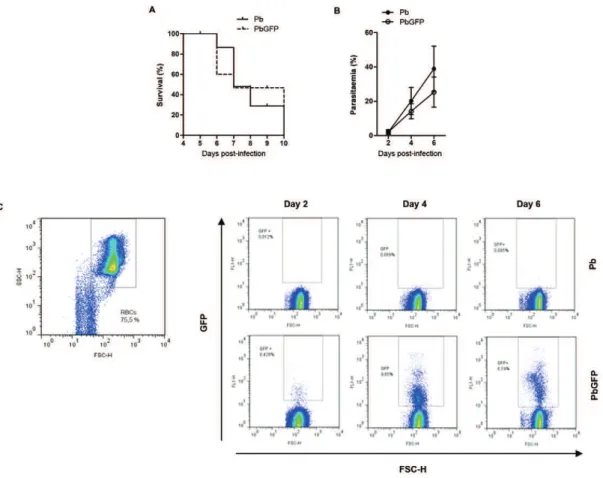
Comparison of recrudescence test using Pb and PbGFP-infected mice - In view of the importance to ob-serve the rapid decrease of parasitaemia after antima-larial treatment, it was first compared two methodolo-gies used to the test of new antimalarial drugs (Aguiar et al. 2012b, de Souzaet al. 2012). It was observed that Pb and PbGFP-infected mice exhibited similar survival curves (p= 1.00) (Fig. 1A). In addition, the parasitaemia in the Pb and PbGFP groups, as counted by microscopy, was not statistically different and increased up to day 6 post-infection (Fig. 1B). PbGFP-infected erythrocytes were further counted by flow cytometry and it was ob-served increased levels of parasitaemia up to day 6 post-infection (Fig. 1C). A positive correlation was observed between the parasitaemia counted by microscopy from Pb and PbGFP-infected mice (Fig. 2A). In addition, the evaluation of parasitaemia from PbGFP-infected mice analysed by microscopy or by flow cytometry revealed a significant positive linear correlation (p = 0.006) (Fig. 2B). To confirm that two different methodologies would infer the same result, it was performed a Bland-Altman analysis that also indicated that the evaluation of parasi-taemia by cytometry and by microscopy are equivalent (bias = 0.1%; 95% limit of agreement = 4.2%) (Fig. 2C).
Concerning recrudescence studies, up to 48 h after treatment with chloroquine, no infected erythrocytes were found in the blood smears obtained from treated mice (Fig. 3A-C, respectively). However, using flow
cy-Fig. 2: correlation analyses of parasitaemia estimated by microscopy and cytometry. A: correlation between parasitaemia in mice infected with Plasmodium berghei (Pb) or green fluorescent protein-express-ing Pb (PbGFP) evaluated by microscopy; B: correlation between parasitaemia in PbGFP-infected mice evaluated by microscopy and cytometry; C: Bland-Altman plot representing the bias (0.1%) and 95% limit of agreement (4.2%) for the parasitaemia evaluation.
Fig. 3: evaluation of recrudescence after treatment with antimalarial drugs. Mice were infected with green fluorescent protein-expressing
tometry, an increase in the parasitaemia of treated mice was observed, especially in mice treated with primaquine or chloroquine. At 72 h and 96 h after treatment, infected erythrocytes were observed in the blood smears at the same extent observed by flow cytometry.
Antimalarial activity of hydroxyethylamine deriv-atives - Because PbGFP is an effective model to study antimalarial drugs, PbGFP-infected mice were treated
Fig. 4: reaction and conditions (i: isopropanol, reflux, 16 h; ii: Et3N, DMF, RC6H4SO2Cl, CH2Cl2, r.t., 4 h; iii: H2, Pd/C 10%, EtOH, r.t., 16 h; iv: HCl gas, EtOH, r.t., 4 h).
Fig. 5: antimalarial activity of the hydroxyethylamine derivatives. The mice were treated daily with artesunate (ART) or derivatives (10 mg/kg/day; intraperitoneally). Drug activity was evaluated at day 4 after infection and is expressed as (A) parasitaemia levels or as (B) activity, according the following equation: activity = 100 - [(mean parasitaemia treated/mean parasitaemia control) x 100]. It was used at least six animals per group in two different experiments.
with nine hydroxyethylamine derivatives ((2S,3R)-2- (amino)-[4-(N-benzylarenesulfonamido)-3-hydroxy-1-phenylbutane). The preparation of the target com-pounds 5a-i (Fig. 4) has been previously described (Facchinettiet al. 2014, Morethet al. 2014).
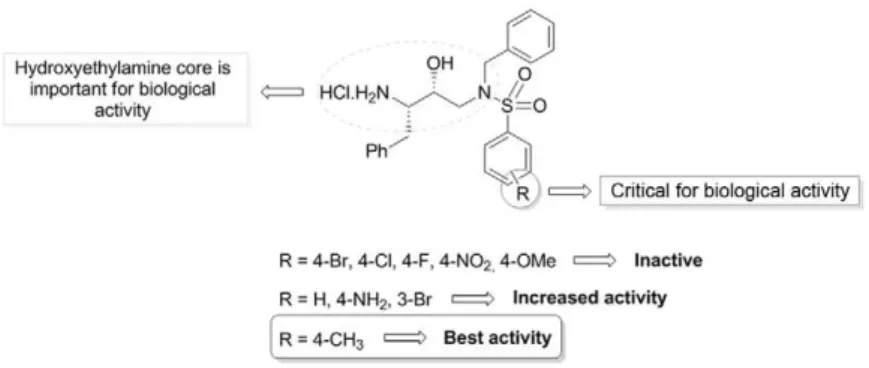
Fig. 6: structure-activity relationship for the studied hydroxyethylamine 5a-i series.
DISCUSSION
Herein, it was proposed the study of newly synthesised hydroxyethylamine derivatives as antimalarial compounds using PbGFP. Furthermore, it was observed that parasitae-mia evaluation by flow cytometry reveal low parasitaeparasitae-mia levels, which is not observed by microscopic analysis.
As described before, according the Medicine for Ma-laria Venture, the “ideal” candidate profile of an antima-larial drug is whom account for fast parasite clearance over 48 h after treatment (Burrowset al. 2013). In such way, it is important to use techniques for parasite evalua-tion that lead to accurate results. The construcevalua-tion of PbG-FP was performed by Franke-Fayard et al. (2004) and has been used in a wide range of studies (Sultanet al. 1999, Sanchez et al. 2004, Tewariet al. 2010, de Souzaet al. 2012), including the screening of novel antimalarial drugs (de Souzaet al. 2012, Lamet al. 2013, Wanget al. 2014). It is interesting to note the presence of infected erythrocytes up to 48 h after treatment with chloroquine by flow cytom-etry that was not detected by microscopic analysis. Flow cytometry allows faster and accurate parasitaemia exami-nation because this technique can identify small amounts of parasites in the blood (Malleretet al. 2011). Although flow cytometry is a costly and complex technology to ex-amine parasitaemia for routine diagnosis purposes, the required instrumentation and materials are widely avail-able in research and development institutions for research purpose (Shapiroet al. 2013). Parasitaemia evaluation by microscopic examination, despite widely used as main test for diagnosis purposes (WHO 2015), is labour and time-consuming, as well as dependent on microscopist training and ability (Payne 1988). Limitations for PbGFP usage as a tool for the discovery of pyrimethamine-based drugs should be addressed, since the construction of Pb-GFP required the insertion of pyrimethamine-resistant gene at the same vector where GFP gene is insert aiming to select the successfully transfected parasites.
Hydroxyethylamine derivative has been used in dif-ferent biological approaches, as HIV-1 protease inhibi-tor (Ghoshet al. 2014) and inhibitor of β-secretase 1, an enzyme associated with neurodegeneration (Nordeman et al. 2014). As well, the hydroxyethylamine-based com-pounds has been tested as antimalarial drugs since this
compounds are able to inhibit the activity of plasmepsin (Muthaset al. 2005) and falcipain (Rathiet al. 2013), main enzymes involved in parasite development (Blackman 2008). It was previously showed that hydroxyethylamine derivatives (ciclohexyl group inserted in hydroxyeth-ylamine core) synthesised from alkhydroxyeth-ylamines presented antimalarial activity (de Souza et al. 2012). Herein, it was tested the in vivo activity of new nine different ((2S,3R)-2-(amino)-[4-(N-benzylarenesulfonamido)-3-hydroxy-1-phenylbutane derivatives and observed that the insertion of a methyl group at the para position of the sulfonamide ring appears to be critical for the anti-malarial activity of this class of compounds (Fig. 6). In-terestingly, hydroxyethylamine exhibits no toxic effect on erythrocytes and does not inhibit human proteases (Muthaset al. 2005), suggesting that hydroxyethylamine derivatives would be safe and effective novel antima-larial drugs. In fact, its biological activity may be attrib-uted to a secondary alcohol structural element, which mimics the tetrahedral intermediate during metabolite cleavage by proteases (Cunicoet al. 2009). In addition, Jaudzemset al. (2014) showed that the insertion of two methyl group in hydroxyethylamine-based compounds increased compound activity on Plasmodium faciparum enzymes when compared to nonmethylated compound.
Together, our results suggest that PbGFP is a useful tool to study the recrudescence of novel antimalarial drugs through parasitaemia examination by flow cy-tometry. Furthermore, it was demonstrated that the in-sertion of a methyl group at the para position of the sul-fonamide ring appears to be critical for the antimalarial activity of this class of compounds.
REFERENCES
Aguiar ACC, da Rocha EMM, de Souza NB, França TCC, Krettli AU 2012a. New approaches in antimalarial drug discovery and devel-opment - A Review. Mem Inst Oswaldo Cruz107: 831-845. Aguiar ACC, Santos RM, Figueiredo FJB, Cortopassi WA, Pimentel
AS, França TCC, Meneghetti WR, Krettli AU 2012b. Antimalarial activity and mechanisms of action of two novel 4-aminoquinolines against chloroquine-resistant parasites. PLoS ONE 7: e37259. Anthony MP, Burrows JN, Duparc S, Moehrle J, Wells TN 2012. The
Ashley EA, Dhorda M, Fairhurst RM, Amaratunga C, Lim P, Suon S, Sreng S, Anderson JM, Mao S, Sam B, Sopha C, Chuor CM, Nguon C, Sovannaroth S, Pukrittayakamee S, Jittamala P, Chotivanich K, Chutasmit K, Suchatsoonthorn C, Runcharoen R, Hien TT, Thuy-Nhien NT, Thanh NV, Phu NH, Htut Y, Han KT, Aye KH, Mokuolu OA, Olaosebikan RR, Folaranmi OO, Mayxay M, Khanthavong M, Hongvanthong B, Newton PN, Onyamboko MA, Fanello CI, Tshefu AK, Mishra N, Valecha N, Phyo AP, Nosten F, Yi P, Tripura R, Borrmann S, Bashraheil M, Peshu J, Faiz MA, Ghose A, Hos-sain MA, Samad R, Rahman MR, Hasan MM, Islam A, Miotto O, Amato R, MacInnis B, Stalker J, Kwiatkowski DP, Bozdech Z, Jeeyapant A, Cheah PY, Sakulthaew T, Chalk J, Intharabut B, Silamut K, Lee SJ, Vihokhern B, Kunasol C, Imwong M, Tarn-ing J, Taylor WJ, Yeung S, Woodrow CJ, Flegg JA, Das D, Smith J, Venkatesan M, Plowe CV, Stepniewska K, Guerin PJ, Dondorp AM, Day NP, White NJ2014. Spread of artemisinin resistance in
Plasmodium falciparum malaria. N Engl J Med371: 411-423. Blackman MJ 2008. Malarial proteases and host cell egress: an
“emerging” cascade. Cell Microbiol10: 1925-1934.
Burrows JN, van Huijsduijnen RH, Möhrle JJ, Oeuvray C, Wells TN 2013. Designing the next generation of medicines for malaria control and eradication. Malar J 12: 187-207.
Cunico W, Gomes CR, Moreth M, Manhanini DP, Figueiredo IH, Penido C, Henriques MG, Varotti FP, Krettli AU 2009. Synthesis and antimalarial activity of hydroxyethylpiperazine derivatives.
Eur J Med Chem44: 1363-1368.
de Pina-Costa A, Brasil P, Di Santi SM, de Araujo MP, Suárez-Mutis MC, Santelli ACFS, Oliveira-Ferreira J, Lourenço-de-Oliveira R, Daniel-Ribeiro CT 2014. Malaria in Brazil: what happens outside the Amazonian endemic region. Mem Inst Oswaldo Cruz109: 618-633. de Souza MC, Gonçalves-Silva T, Moreth M, Gomes CR, Kaiser
CR, Henriques MO,de Souza MV 2012. Synthesis and in vivo antimalarial evaluation of novel hydroxyethylamine derivatives.
Med Chem8: 266-272.
Dondorp AM, Yeung S, White L, Nguon C, Day NP, Socheat D, von Seidlein L 2010. Artemisinin resistance: current status and sce-narios for containment. Nat Rev Microbiol8: 272-280.
Facchinetti V, Gomes CRB, de Souza MVN, Vasconcelos TRA, Wardell S, Wardell JL 2014. Solvates of two ethyl 6-(2-(aryl)-4 -oxothiazolidin-3-yl)-1-ethyl-4-oxo-1,4-dihydroquinoline-3- car-boxylates. J Chem Crystallogr44: 471-479.
Fidock DA, Rosenthal PJ, Croft SL, Brun R, Nwaka S 2004. Antima-larial drug discovery: efficacy models for compound screening.
Nat Rev Drug Discov3: 509-520.
Franke-Fayard B, Trueman H, Ramesar J, Mendoza J, van der Keur M, van der Linden R,Sinden RE,Waters AP, Janse CJ 2004. A
Plasmodium berghei reference line that constitutively expresses GFP at a high level throughout the complete life cycle. Mol Bio-chem Parasitol137: 23-33.
Ghosh AK, Schiltz GE, Rusere LN, Osswald HL, Walters DE, Amano M, Mitsuya H 2014. Design and synthesis of potent macrocyclic HIV-1 protease inhibitors involving P1-P2 ligands. Org Biomol Chem12: 6842-6854.
Jaudzems K, Tars K, Maurops G, Ivdra N, Otikovs M, Leitans J,
Kanepe-Lapsa I, Domraceva I, Mutule I, Trapencieris P, Black-man MJ, Jirgensons A 2014. Plasmepsin inhibitory activity and structure-guided optimization of a potent hydroxyethylamine-based antimalarial hit. ACS Med Chem Lett5: 373-377.
Lam CFC, Pearce AN, Tan SH, Kaiser M, Copp BR 2013. Discovery and evaluation of thiazinoquinones as anti-protozoal agents. Mar Drugs11: 3472-3499.
Malleret B, Claser C, Ong AS, Suwanarusk R, Sriprawat K, How-land SW, Russell B, Nosten F, Rénia L 2011. A rapid and robust tri-color flow cytometry assay for monitoring malaria parasite development. Sci Rep1: 118-128.
Moreth M, Gomes CR, Lourenço MC, Soares RP, Rocha MN, Kaiser CR, de Souza MV, Wardell SM, Wardell JL2014. Syntheses and antimy-cobacterial activities of (2S,3R)-2-(amino)-4-(arenesulfonamido)-3-hydroxy-1-phenylbutane derivatives. Med Chem10: 189-200. Muthas D, Noteberg D, Sabnis YA, Hamelink E, Vrang L,
Samuels-son B, Karlén A, Hallberg A 2005. Synthesis, biological evalu-ation and modeling studies of inhibitors aimed at the malarial proteases plasmepsins I and II. Bioorg Med Chem13: 5371-5390. Nordeman P, Estrada S, Odell LR, Larhed M, Antoni G 2014. (11) C-labeling of a potent hydroxyethylamine BACE-1 inhibitor and evaluation in vitro and in vivo. Nucl Med Biol41: 536-543. Payne D 1988. Use and limitations of light microscopy for
diagnos-ing malaria at the primary health care level. Bull World Health Organ66: 621-626.
Rathi B, Singh AK, Kishan R, Singh N, Latha N, Srinivasan S, Pan-dey KC, Tiwari HK, Singh BK 2013. Functionalized hydroxy-ethylamine based peptide nanostructures as potential inhibitors of falcipain-3, an essential proteases of Plasmodium falciparum.
Bioorg Med Chem21: 5503-5509.
Sanchez BA, Mota MM, Sultan AA, Carvalho LH 2004. Plasmodium berghei parasite transformed with green fluorescent protein for screening blood schizontocidal agents. Int J Parasitol34: 485-490. Shapiro HM, Apte SH, Chojnowski GM, Hanscheid T, Rebelo M,
Grimberg BT 2013. Cytometry in malaria - a practical replace-ment for microscopy? Curr Protoc Cytom11: Unit 11.20. Sultan AA, Thathy V, Nussenzweig V, Menard R 1999. Green
fluo-rescent protein as a marker in Plasmodium berghei transforma-tion. Infect Immun67: 2602-2606.
Tewari R, Straschil U, Bateman A, Bohme U, Cherevach I, Gong P, Pain A, Billker O 2010. The systematic functional analysis of Plas-modium protein kinases identifies. Cell Host Microbe8: 377-387. Wang J, Kaiser M, Copp BR 2014. Investigation of indolglyoxamide
and indolacetamide analogues of polyamines as antimalarial and antitrypanosomal agents. Mar Drugs12: 3138-3160.
WHO - World Health Organization 2010. Guidelines for the treatment of malaria, 2nd ed., WHO, Geneva, 194 pp.