https://doi.org/10.1177/1938965518777224 Cornell Hospitality Quarterly 2019, Vol. 60(2) 150 –158 © The Author(s) 2018 Article reuse guidelines: sagepub.com/journals-permissions DOI: 10.1177/1938965518777224 journals.sagepub.com/home/cqx Article
Introduction
“Safety and security” has been identified as one of the five global forces that will drive the tourism industry in the new millennium. Providing quality tourism experiences which incorporate principles of safety and security is becoming an overriding objective of all tourism destinations (Reisinger & Mavondo, 2005). As Pizam and Mansfeld (1996) state, “safety, tranquillity and peace are a necessary condition for prosperous tourism . . . most tourists will not spend their hard money to go where their safety and well-being may be in jeopardy” (p. 1).
The security issue does not affect only the international tourism flow (e.g. Enders, Sandler, & Parise, 1992) but also the willingness of tourists to pay a price premium for prod-ucts and services that provide them with a higher level of security (Cró & Martins, 2017). Enz (2009) and Cró and Martins (2017) also note the existence of a strong correla-tion between accommodacorrela-tion security standards and the price charged for them, referring to the existence of a pre-mium in terms of price for accommodations that offer high safety standards. Feickert, Verma, Plaschka, and Dev (2006) and Hecht and Martin (2006) refer that factors such as tour-ist gender and age influence the premium in terms of price. In the case of women and older customers, they are willing to pay a higher premium in terms of price than men and young people, respectively, for an accommodation with a
higher level of security. Finally, according to Barker, Page, and Meyer (2002), the type of accommodation is also a major factor in the crime rate on tourists and on the price premium they are willing to pay. The authors refer the exis-tence of a higher incidence of crime in hostels (39.3%), fol-lowed by the accommodation choices of friends and relatives (32.1%) and camping and caravanning (17.9%). Boakye (2010) refers that backpackers with a limited bud-get patronize cheap facilities which fall outside the tourist zone with “official” protection, and hence, no capable guardian which exposes them to crime. Conversely, the backpackers with a higher budget may be able to afford high quality accommodation facility which may be well protected from criminals at the destination.
The objective of this study is thus to quantify and discuss the impact that online reviews placed by hostel customers in Hostelworld website have in terms of hostel’s price
1IGOT, Universidade de Lisboa, Portugal
2CITUR/Universidade da Madeira, Funchal, Portugal
3Estoril Higher Institute for Tourism and Hotel Studies and Center for
Advanced Studies in Management and Economics, University of Évora, Portugal
Corresponding Author:
António Miguel Martins, Universidade da Madeira, Caminho da Penteada, 9020-105 Funchal, Portugal.
Email: [email protected]
Effect of Security on Hostels’ Price
Premiums: A Hedonic Pricing Approach
Susana Cró
1, António Miguel Martins
2, José Manuel Simões
1,
and Maria de Lurdes Calisto
3Abstract
This article evaluates the impact of security in the hostel industry on the willingness to pay by customers. More specifically, given the importance of security in the decision to travel and in the choice of a given destination, we analyze the impact of security guest reviews on a consumer-generated website on hostel room prices. Furthermore, we investigate whether the impact of security guest reviews on the hostel room prices is higher for the hostels located in the countries with the lowest ranking in the Global Peace Index. Finally, we examine whether females and older guests are willing to pay a premium in terms of price for a hostel with a higher level of security. For this purpose, we estimate a hedonic price function for a sample of consumer reviews of 477 hostels in 22 worldwide capitals, with different levels of peace, from Hostelworld. The results highlight the importance of security on the determination of hostel room prices. We find that customers are willing to pay a higher premium in terms of price, in the least worldwide peaceful countries, for a hostel room with higher levels of security. In the case of women and older guests, the premium they are willing to pay is higher.
Keywords
premium and absolute price using the hedonic price method. More specifically, given the importance of security in the decision to travel and destination country choice, we intend to ascertain whether hostel customers pay a premium depending on (a) the level of accommodation security, (b) the level of risk in terms of the destination country’s secu-rity, and (c) demographic factors, for example, the gender and age of customers. To answer our research questions, we collect data of consumer reviews of 477 hostels in 22 world-wide capitals, with different ranking positions in the Global Peace Index (GPI; that provides a comprehensive analysis of a country’s state of peace), from the website Hostelworld. We estimate a hedonic price function that includes the secu-rity, location, and cleanliness attributes together with another set of variables that the previous literature has linked with hostel room price. The security attribute is stud-ied simultaneously with cleanliness and location attributes given that customers’ perceptions of hostel security are determined by the cleanliness of the establishment, fol-lowed by location (see Amblee, 2015).
The innovative contribution of this study to the literature is the analysis of the impact of the security attribute in the price premium paid by tourists in hostels, based on the hedonic pricing method for the most peaceful/safe versus least peaceful/safe worldwide countries. Thus, it diverges from the study carried out by Cró and Martins (2017) which addressed only European countries, where the differences in terms of security are not so noticeable. Our study focuses exclusively on hostels for two reasons: (a) because it is the type of accommodation, in view of their characteristics, with a higher level of crime (see Barker et al., 2002; Boakye, 2010) and (b) the fact that the security attribute is only col-lected and disclosed on Hostelworld’s website.
Literature Review
The Importance of Security on Tourism Industry
Tourism and security are inevitably intertwined phenomena, where security often emerges as the determining factor in the choice of a given destination (e.g., Boakye, 2010; Pizam & Mansfeld, 1996; Sönmez & Graefe, 1998). Lepp and Gibson (2003) refer that previous studies have identified four major risk factors: terrorism, war and political instabil-ity, health concerns, and crime. There are numerous studies that demonstrate that tourist destinations are strongly affected by security perceptions and safety and risk manage-ment (see, for example, Boakye, 2010; Sönmez & Graefe, 1998). The questions of security obviously could affect the international tourism flows, as has been demonstrated by several studies carried out in different parts of the world (e.g., Enders et al., 1992; Ghaderi, Saboori, & Khoshkam, 2017; Pizam & Smith, 2000).
According to the model developed by Enders et al. (1992),
the prices of tourist activities depend on money outlay, the value of time, and risk factors. Alterations in travel risks, arising from increased terrorists’ incidents in a given country raise the price of tourist activities, thereby increasing relative prices as perceived by the consumer. Such increased activities would necessitate loss of time and increased expenditure on protection,
reason why they tend to cause a substitution effect and con-sequently a change of travel plans to safer destinations, with potential tourists avoiding regions where one or more coun-tries have taken terrorist acts or simply postponing the deci-sion to travel to those destinations (p. 534). In addition to the substitution effect, a contagion effect may occur as the occurrence of terrorist or criminal acts in a given country may deteriorate the destination image of neighboring coun-tries belonging to the same region (Enders et al., 1992), with tourists avoiding this region. This phenomenon is also identified in the literature by the term generalization effect.
Reichel, Fuchs, and Uriely (2007) show that the risk per-ceived by backpackers is a multidimensional and heteroge-neous phenomenon, which tends to vary according to the characteristics of the individual and the trip, such as gender, age, nationality, previous travel experience, travel purpose, motivation, travel arrangements, the existence of fellow travelers, and destination. In addition, the authors note that in their studies, backpackers tend to present a global risk perception relatively similar to the perceptions of mass and individual tourists.
Finally, as shown by Barker et al. (2002, p. 771), the hostel segment has the highest crime rate among the various types of accommodation. In this way, it is not surprising that tourists are willing to pay a premium in terms of price when the lodgings show signs of greater security (Cró & Martins, 2017; Feickert et al., 2006). Enz (2009) points out that hotels positioned in the higher price segments, located in urban areas or near airports and new hotels, tend to main-tain high safety standards. The author concludes that there is a strong correlation between hotel security standards and the price charged by hotels, mentioning the existence of a price premium for hotels that offer high security standards. In addition, Amblee (2015) based on an empirical study finds that customers perceptions of hostel security are deter-mined by the cleanliness of the establishment, followed by location. Finally, Hua and Yang (2017) reported that the crime has a negative and significant impact on hotel operat-ing profitability (as measured by income earned per room). Thus, in the context of hostels segment, given that cleanli-ness, location, and security are determining factors when guests choose a hostel, it is expected that the hostels with
the best rating on these criteria require a premium in terms of price.
Research Hypotheses
We consider the following four research hypotheses:
Hypothesis 1: The security attribute (as well as location
and cleanliness attributes) have a statistically signifi-cant effect on hostel prices.
In line with previous studies (Cró & Martins, 2017; Enz, 2009), it is expected that customers show a willingness to pay a premium in terms of price in hostels that offer high security standards.
Hypothesis 2: The coefficients linked to security
attri-bute (as well as location and cleanliness attriattri-butes) have a stronger effect on hostel prices in the least peaceful worldwide countries.
Given that the level of risk perceived by the customer tends to be higher in countries with a higher level of insecu-rity (least peaceful countries) compared with the other countries analyzed, as a result of the existence of risk aver-sion by most backpackers, it is expected that there is greater propensity on the part of potential customers to pay a higher premium in terms of price in hostels that offer high security standards in the least peaceful worldwide countries com-pared with the most peaceful worldwide countries (see, for example, Cró & Martins, 2017).
Hypothesis 3: The females and contemporary tourism
backpackers are willing to pay a premium in terms of price for a hostel with high levels of security.
Hecht and Martin (2006) refer that backpackers cannot be treated as a homogeneous group, and there are differ-ences due to demographics factors, such as gender and age. As highlighted by Hecht and Martin (2006) “most of the recent research suggest that the backpacker market is made up of two sub segments: (i) the youth tourism backpacker— between 15 and 29 years; and (ii) the contemporary tourism backpacker—30 years and older” (p. 70). Given that females and older customers are the group that tends to be more fearful of being victimized (Warr, 1984), it is expected that this group of individuals show a willingness to pay a higher premium in terms of price than males and young hostel customers, respectively, for an accommodation with a higher security level (Feickert et al., 2006; Hecht & Martin, 2006).
Hypothesis 4: The females and contemporary tourism
backpacker are willing to pay a premium in terms of
price for a hostel with high levels of security in the least peaceful worldwide countries comparatively with the most peaceful worldwide countries.
As explained in the previous hypothesis, the premium in terms of price paid by hostel customers tends to be lower in the more peaceful worldwide countries (e.g., Cró & Martins, 2017).
Data and Method
To test the hypotheses, set up in the previous section, we use a database of prices, hostel characteristics, and consumer reviews of 477 hostels for 22 worldwide capitals, collected in November 2016, from the website Hostelworld.1 The selection of capital countries was based on the level of peace in the countries, which are disclosed through the 2016 GPI2 constructed by Institute for Economics and Peace and reported on the website http://visionofhumanity. org/indexes/global-peace-index/. Based on the state of peace score obtained by each country, the countries are ranked in five different groups in the GPI. They are ranked among the group of countries with a very high state of peace and the group of countries with very low state of peace. The very high state of peace group of countries contains 11 countries. Our sample is composed of the 11 countries ranked in the very high state of peace and the 11 countries with the worst score to have a balanced panel of countries. Our sample is composed of all the hostels located in the 22 capitals analyzed, for which there is the necessary informa-tion to estimate the empirical model.3 The sample distribu-tion of hostels by country is shown in Table 1.
For the dependent variable (hostel price), in the case of hostels offering only one type of accommodation (dormito-ries or private rooms), a single price was recorded. For those offering dormitories and private rooms, the average of both prices was calculated and considered in the analysis. Hereafter referred to as “absolute price.” Regarding price variations related to different dates, the minimum available price for November 2016 was recorded as in Santos (2016) and Cró and Martins (2017). Given that we are also inter-ested in the hostel’ price premium (or relative price), we calculate the difference between each hostel absolute price (located in the capital) and the average price of hostels in the capital. The hostel’ price premium (in €) for each hostel and the absolute price are the final dependent variables of the model. Table 2 presents the descriptive statistics.
Ordinary least squares (OLS) regressions are used to test the hypotheses formulated in “Research Hypotheses” sec-tion. Given that observations (hostels) are grouped into clusters (countries), with model errors uncorrelated across clusters but correlated within cluster, a cluster-robust vari-ance matrix is estimated, that is, robust to both heteroske-dasticity and to within-cluster correlation (e.g., Wooldridge,
2003). In line with the approach commonly used in the lit-erature on hedonic pricing for tourism accommodations, a semilogarithmic form is used in this study.
Empirical Results
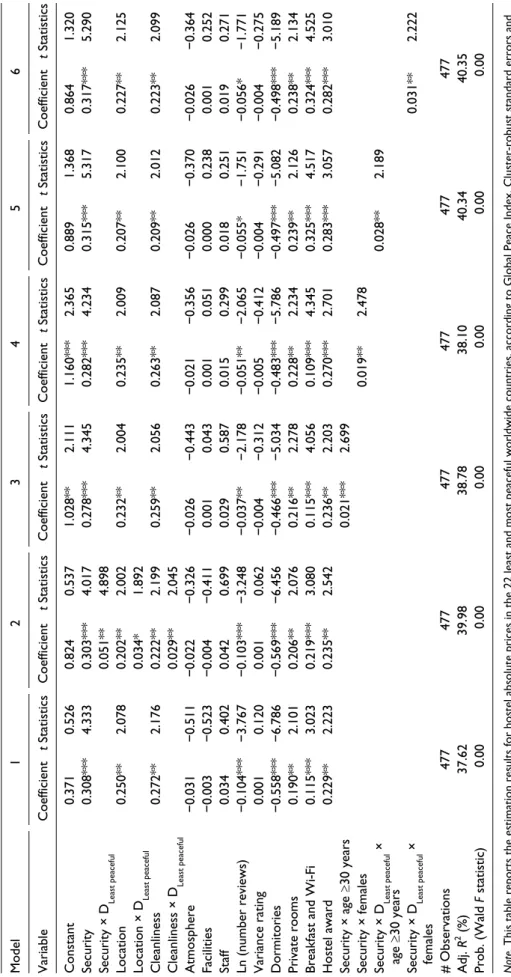
The empirical results are reported in Tables 3 and 4. In all estimates, it is clear that among the six quality hostel char-acteristics under scrutiny, only security, cleanliness, and location have significant positive effects on hostel’s pre-mium prices and/or hostel’s absolute prices. The other three characteristics—atmosphere, facilities, and staff have non-significant effects on price. This evidence is in line with the results obtained by Amblee (2015) and Cró and Martins (2017). The results also show a negative significant effect off the number of reviews on both variables of hostel prices. Thus, the number of reviews is associated with lower abso-lute prices and hostel’s price premium. Santos (2016) argues that result could be associated with economies of scale, where larger hostels are able to charge lower prices, at the same time that they have more customers and consequently a greater number of reviews. Most of the estimates also reveal that standard deviation variable for the most recent 20 reviews presents a nonsignificant effect on prices. As expected, the results reveal that accommodation in dormito-ries is cheaper than in private rooms, with both dummy variables statistically significant. The results also show that the policy of offering breakfast and Wi-Fi by the hostels can be a good business policy by allowing them to charge a higher price. Finally, the results show that hostels that have won the HOSCAR prize tend to charge a higher price and a higher price premium compared with other hostels. This result seems to suggest that Hostel Award dummy variable can be used to rate hostels’ quality, such as in hotels with the star rating system, given the absence of this indicator for hostels.
Next, we present the evidence obtained regarding the four research hypotheses. In the first research hypothesis, the coefficients associated with the variables security, loca-tion, and cleanliness are positive and statistically significant in all estimated regressions, showing that as expected, cus-tomers are willing to pay a higher price and a premium in terms of price in hostels that offer high security standards, in line with the results obtained by Enz (2009) and Cró and Martins (2017).
With respect to the second research hypothesis, we find that multiplicative dummy variables included in both tables (security × DLeast peaceful; location× DLeast peaceful and
cleanli-ness × DLeast peaceful) show positive and statistically significant
coefficients. Given that DLeast peaceful assumes the value of 1 for the capitals of the least peaceful countries in the world, this means that customers are willing to pay a higher price and/or higher price premium in the least peaceful countries comparatively with most peaceful countries, if the hostel has higher levels of security, location, and cleanliness.
Finally, regarding the last two research hypotheses, we conclude that females and contemporary tourism backpack-ers are willing to pay a higher price and/or higher price pre-mium than males and young hostel customers, respectively, for a hostel with a higher security level, given that security
× age ≥30 years and security × females multiplicative
dum-mies in Tables 3 and 4 show positive and statistically sig-nificant coefficients. Given that females and older customers are the group of customers that tends to be more fearful of being victimized (Warr, 1984), it is expected that this group of individuals show a willingness to pay a higher premium in terms of price than males and young hostel customers, respectively, for an accommodation with a higher security level (Feickert et al., 2006; Hecht & Martin, 2006), because as is shown by Barker et al. (2002), the hostel segment has the highest crime rate among the various types of accom-modation. Finally, security × DLeast peaceful × age ≥30 years
Table 1.
Sample Distribution of Hostels by Country’s Capital.
Most Peaceful Countries GPI Index # Least Peaceful Countries GPI Index #
Iceland (Reykjavik) 1.192 13 Ukraine (Kiev) 3.278 13
Denmark (Copenhagen) 1.246 11 Russia (Moscow) 3.079 29
Austria (Vienna) 1.278 20 Colombia (Bogotá) 2.764 49
New Zealand (Auckland) 1.287 11 Lebanon (Beirut) 2.752 2
Portugal (Lisbon) 1.356 55 Turkey (Ankara) 2.710 42
Czech Republic (Prague) 1.360 73 Israel (Jerusalem) 2.656 8
Switzerland (Bern) 1.370 2 Egypt (Cairo) 2.574 10
Canada (Ottawa) 1.388 7 India (New Delhi) 2.566 13
Japan (Tokyo) 1.395 51 Mexico (Mexico City) 2.557 21
Slovenia (Ljubljana) 1.408 18 Philippines (Manila) 2.511 19
Finland (Helsinki) 1.429 6 Azerbaijan (Baku) 2.450 4
Note. This table presents the sample distribution of hostels by country’s capital, the value of the 2016 GPI Index, as well as the number of hostels
and security × DLeast peaceful × Females show positive and statistically significant coefficients in regressions 5 and 6 of Tables 3 and 4. As in the least peaceful worldwide coun-tries, the risk perception and the objective probability of women and older customers being victimized is much higher than in the most peaceful worldwide countries, it is not surprising that in the least peaceful countries, females and older customers are willing to pay a higher price or a price premium than in most peaceful countries.
Conclusion
The results show that security, cleanliness, and location attributes are determining factors when customers choose a
hostel, with the best-rated hostels in these three attributes requiring a premium in terms of price in both country pan-els analyzed. However, customers are willing to pay a higher premium in terms of price for hostels located in the least worldwide peaceful countries compared with hostels located in peaceful countries, if the hostel room offers a high level of security. These results are also in line with those obtained by Cró and Martins (2017) for European hostels. Finally, in the case of female and older customers, the results show that they are willing to pay a higher price and/or higher price premium than males and young hostel guests, respectively, for a hostel with a higher security level. This is especially true in the case of least peaceful countries as females and older customers are the group of individuals
Table 2.
Descriptive Statistics.
Variable M SD Minimum Maximum Skewness Kurtosis
Panel A (210 observations) Price premium 11.797 14.544 −19.090 101.76 1.705 10.449 Absolute price 24.011 15.271 5.620 115.56 2.407 11.360 Security 8.908 0.849 6.000 10.000 −1.251 4.618 Location 8.958 0.853 6.000 10.000 −1.275 4.808 Cleanliness 8.854 1.406 4.000 10.000 −0.762 3.032 Atmosphere 8.057 1.239 4.000 10.000 −0.924 3.688 Facilities 8.194 1.114 4.000 10.000 −0.940 3.758 Staff 8.860 1.198 5.000 10.000 2.060 7.091 Number reviews 17.685 26.158 2 183 3.215 16.072 Variance rating 2.321 3.110 0.000 21.780 3.217 16.971 Dormitories 0.138 0.345 0 1 2.098 5.401 Private rooms 0.076 0.266 0 1 3.194 11.207
Breakfast and Wi-Fi 0.495 0.501 0 1 0.019 1.000
Age ≥30 years 0.414 0.494 0 1 0.348 1.121 Females 0.481 0.500 0 1 0.076 1.006 Hostel award 0.114 0.318 0 1 2.424 6.879 Panel B (267 observations) Price premium 24.157 23.104 –34.36 155.855 8.986 10.600 Absolute price 52.652 35.103 4.950 198.505 8.611 9.807 Security 8.808 0.937 4.000 10.000 –1.810 7.591 Location 8.681 0.971 4.500 10.000 –0.901 3.742 Cleanliness 8.828 1.129 2.700 10.000 1.498 2.384 Atmosphere 8.024 1.199 2.700 10.000 –1.032 4.558 Facilities 8.162 1.257 2.700 10.000 –1.252 4.969 Staff 8.768 0.919 4.700 10.000 –1.218 4.581 Number reviews 42.996 64.023 2 551 3.376 20.609 Variance rating 1.945 2.478 0.000 25.205 4.270 33.751 Dormitories 0.179 0.384 0 1 1.667 3.781 Private rooms 0.149 0.357 0 1 1.962 4.851
Breakfast and Wi-Fi 0.269 0.444 0 1 1.038 2.077
Age ≥30 years 0.423 0.495 0 1 0.310 1.097
Females 0.487 0.500 0 1 0.052 1.002
Hostel award 0.202 0.402 0 1 1.483 3.198
Note. This table shows the descriptive statistics of the variables, for the 477 hostels analyzed in this study. Panel A includes hostels in the capitals of the
155
Table 3. Effect of Security on Hostel’ Price Premium. Model
1 2 3 4 5 6 Variable Coefficients t Statistics Coefficients t Statistics Coefficients t Statistics Coefficients t Statistics Coefficients t Statistics Coefficients t Statistics Constant −31.124*** −3.700 −28.841*** −3.719 −28.813*** −3.498 −27.877*** −3.499 −28.944*** −3.773 −26.551*** Security 3.825*** 3.001 3.673*** 3.081 3.189*** 2.786 3.424*** 3.233 3.525*** 2.903 3.425*** Security × D Least peaceful 0.504*** 3.210 Location 1.986*** 2.799 1.713** 2.467 1.859*** 2.606 1.774** 2.186 1.840*** 2.644 1.780** Location × D Least peaceful 0.479*** 3.066 Cleanliness 2.296** 1.995 2.375* 1.886 2.248** 2.000 2.183** 2.099 2.457** 1.967 2.273* Cleanliness × D Least peaceful 0.600*** 3.622 Atmosphere 0.078 0.062 0.129 0.154 0.092 0.090 0.150 0.144 0.098 0.115 0.061 Facilities 0.010 0.101 0.040 0.468 0.025 0.317 0.021 0.136 0.021 0.270 0.020 Staff −0.527 −0.669 −0.703 −0.604 −0.329 −0.264 −0.573 −0.599 −0.397 −0.331 −0.626 Ln (number reviews) −1.053** −2.111 −1.588* −1.809 −0.748* −1.715 −1.031** −2.329 −0.730* −1.519 −0.782* Variance rating 0.136 0.333 0.081 0.416 0.132 0.644 0.123 0.544 0.105 0.593 0.086 Dormitories −9.847*** −5.322 −9.207*** −5.586 −9.363*** −5.978 −9.721*** −5.992 −9.080** −5.100 −9.317*** Private rooms 13.099*** 4.874 14.259*** 4.133 12.665*** 4.022 12.943*** 6.896 13.350*** 4.717 13.333***
Breakfast and Wi-Fi
4.142*** 2.987 3.121** 2.180 4.336*** 3.034 4.354*** 3.568 3.971*** 2.656 3.951*** Hostel award 5.404** 2.453 5.975*** 3.133 4.565** 2.222 5.250** 3.215 5.242*** 2.713 5.476*** Security × age ≥30 years 0.388*** 2.777 Security × females 0.239** 1.967 Security × D Least peaceful × age ≥30 years 0.510*** 3.357 Security × D Least peaceful × females 0.515*** # Observations 477 477 477 477 477 477 Adj. R 2 (%) 37.62 41.96 38.78 38.10 39.01 39.09 Prob. (Wald F statistic) 0.00 0.00 0.00 0.00 0.00 0.00 Note.
This table reports the estimation results for hostel’ price premiums in the 22 least and most peaceful worldwide countries, according to Global Peace Index. Cluster-robust standard errors and
156
Table 4. Effect of Security on Hostel Absolute Prices. Model
1 2 3 4 5 6 Variable Coefficient t Statistics Coefficient t Statistics Coefficient t Statistics Coefficient t Statistics Coefficient t Statistics Coefficient t Statistics Constant 0.371 0.526 0.824 0.537 1.028** 2.111 1.160*** 2.365 0.889 1.368 0.864 Security 0.308*** 4.333 0.303*** 4.017 0.278*** 4.345 0.282*** 4.234 0.315*** 5.317 0.317*** Security × D Least peaceful 0.051** 4.898 Location 0.250** 2.078 0.202** 2.002 0.232** 2.004 0.235** 2.009 0.207** 2.100 0.227** Location × D Least peaceful 0.034* 1.892 Cleanliness 0.272** 2.176 0.222** 2.199 0.259** 2.056 0.263** 2.087 0.209** 2.012 0.223** Cleanliness × D Least peaceful 0.029** 2.045 Atmosphere −0.031 −0.511 −0.022 −0.326 −0.026 −0.443 −0.021 −0.356 −0.026 −0.370 −0.026 Facilities −0.003 −0.523 −0.004 −0.411 0.001 0.043 0.001 0.051 0.000 0.238 0.001 Staff 0.034 0.402 0.042 0.699 0.029 0.587 0.015 0.299 0.018 0.251 0.019 Ln (number reviews) −0.104*** −3.767 −0.103*** −3.248 −0.037** −2.178 −0.051** −2.065 −0.055* −1.751 −0.056* Variance rating 0.001 0.120 0.001 0.062 −0.004 −0.312 −0.005 −0.412 −0.004 −0.291 −0.004 Dormitories −0.558*** −6.786 −0.569*** −6.456 −0.466*** −5.034 −0.483*** −5.786 −0.497*** −5.082 −0.498*** Private rooms 0.190** 2.101 0.206** 2.076 0.216** 2.278 0.228** 2.234 0.239** 2.126 0.238**
Breakfast and Wi-Fi
0.115*** 3.023 0.219*** 3.080 0.115*** 4.056 0.109*** 4.345 0.325*** 4.517 0.324*** Hostel award 0.229** 2.223 0.235** 2.542 0.236** 2.203 0.270*** 2.701 0.283*** 3.057 0.282*** Security × age ≥30 years 0.021*** 2.699 Security × females 0.019** 2.478 Security × D Least peaceful × age ≥30 years 0.028** 2.189 Security × D Least peaceful × females 0.031** # Observations 477 477 477 477 477 477 Adj. R 2 (%) 37.62 39.98 38.78 38.10 40.34 40.35 Prob. (Wald F statistic) 0.00 0.00 0.00 0.00 0.00 0.00 Note.
This table reports the estimation results for hostel absolute prices in the 22 least and most peaceful worldwide countries, according to Global Peace Index. Cluster-robust standard errors and
that tends to be more fearful of being victimized according to Warr (1984).
The practical implications of the present study are of various order. First, the results suggest that security is an important factor in guests’ selection of a hostel, particularly, in the least peaceful countries. Our findings show that man-agers should be willing to invest in improving the hostels’ security systems such as high-tech security systems and staff security training. Second, for the hostels, in addition to security measures, there are practical implications from the point of view of marketing communication. Safer hostels should take advantage of this. As emphasized by Björk and Kauppinen-Räisänen (2012) “insight into risk dimensions that tourists discuss online enable destination marketers to take action, eliminate factors that cause risk perception, refine destination marketing communication, and build strong brands” (p. 65). Seabra, Dolnicar, Abrantes, and Kastenholz (2013) add the need for a suitable marketing mix for different risk segments regarding the heterogeneity in terms of risk perception among international tourists. Finally, concerns about hostel security should be higher in the case of females and older customers, where exceptional security measures should be created for this group of cus-tomers, such as the need for females’ and/or older guest’s floors with special security measures as they are willing to pay a higher premium for increased security compared with other customers.
Finally, to provide more conclusive results about the importance of security on lodging prices, new empirical studies should be carried out for other types of accommoda-tion, such as hotels and apartments, to find out the impact of security attribute on prices as they have lower crime rates than hostels. Given the absence of the security attribute in consumer review reports compiled by the most common tourism platforms, such studies should be performed by surveys.
Declaration of Conflicting Interests
The author(s) declared no potential conflicts of interest with respect to the research, authorship, or publication of this article. Funding
The author(s) received no financial support for the research, authorship, or publication of this article.
Notes
1. The website Hostelword is the world leading hostel book-ing channel and not only provides information about hostels but also about bed and breakfasts, hotels, camping sites, and other categories of accommodation establishments. This study analyzes only accommodation establishments classi-fied as hostels.
2. The Global Peace Index (GPI) provides a comprehensive analysis of a country’s state of peace. The index gauges
global peace using three broad themes: the level of safety and security in society, the extent of domestic and international conflict, and the degree of militarization.
3. With regard to the least peaceful countries in the world, the following countries were not considered in the analy-sis because they did not offer hostel-type accommodation on the Hostelworld website—Syria (GPI of 3.806), South Sudan (3.593), Iraq (3.570), Afghanistan (3.538), Somalia (3.414), Yemen (3.399), Central African Republic (3.354), Sudan (3.269), Libya (3.200), Pakistan (3.145), D.R. Congo (3.112), D.P.R. Korea (2.944), Nigeria (2.877), Palestine (2.832), Venezuela (2.651), Burundi (2.500), Mali (2.489), Chad (2.464), and Eritrea (2.460).
ORCID iD
António Miguel Martins https://orcid.org/0000-0001-7082-5460 References
Amblee, N. (2015). The impact of cleanliness on customer per-ceptions of security in hostels: A WOM-based approach.
International Journal of Hospitality Management, 49, 37-39.
Barker, M., Page, S., & Meyer, D. (2002). Modeling tourism crime: The 2000 America’s cup. Annals of Tourism Research,
29, 762-782.
Björk, P., & Kauppinen-Räisänen, H. (2012). A netnographic examination of travelers’ online discussions of risks. Tourism
Management Perspectives, 2, 65-71.
Boakye, K. (2010). Studying tourists’ suitability as crime targets.
Annals of Tourism Research, 37, 727-743.
Cró, S., & Martins, A. (2017). The importance of security for hos-tel price premiums: European empirical evidence. Tourism
Management, 60, 159-165.
Enders, W., Sandler, T., & Parise, G. (1992). An econometric analysis of the impact of terrorism on tourism. Kyklos, 45, 531-554.
Enz, C. (2009). The physical safety and security features of U.S. hotels. Cornell Hospitality Quarterly, 50, 553-560.
Feickert, J., Verma, R., Plaschka, G., & Dev, C. (2006). Safeguarding your customers: The guest’s view of hotel secu-rity. Cornell Hotel and Restaurant Administration Quarterly,
47, 224-244.
Ghaderi, Z., Saboori, B., & Khoshkam, M. (2017). Does security mat-ter in tourism demand? Current Issues in Tourism, 20, 552-565. Hecht, J., & Martin, D. (2006). Backpacking and
hostel-pick-ing: An analysis from Canada. International Journal of
Contemporary Hospitality Management, 18, 69-77.
Hua, N., & Yang, Y. (2017). Systematic effects of crime on hotel operating performance. Tourism Management, 60, 257-269.
Lepp, A., & Gibson, H. (2003). Tourist roles, perceived risk and international tourism. Annals of Tourism Research, 30, 606-624.
Pizam, A., & Mansfeld, Y. (1996). Tourism, crime and
interna-tional security issues. Chichester, UK: John Wiley & Sons.
Pizam, A. and Smith, G. (2000). Tourism and Terrorism: A Quantitative Analysis of Major Terrorists Acts and Their Impact on Tourism Destinations. Tourism Economics, 6(2), 123-138.
Reichel, A., Fuchs, G., & Uriely, N. (2007). Perceived risk and the non-institutionalized tourist role: The case of Israeli student ex-backpackers. Journal of Travel Research, 46, 217-226. Reisinger, Y., & Mavondo, F. (2005). Travel anxiety and
inten-tions to travel internationally: Implicainten-tions of travel risk per-ception. Journal of Travel Research, 43, 212-225.
Santos, G. (2016.). Worldwide hedonic prices of subjective char-acteristics of hostels. Tourism Management, 52, 451-454. Seabra, C., Dolnicar, S., Abrantes, J., & Kastenholz, E. (2013).
Heterogeneity in risk and safety perceptions of international tourists. Tourism Management, 36, 502-510.
Sönmez, S., & Graefe, A. (1998). Influence of terrorism risk on foreign tourism decisions. Annals of Tourism Research, 25, 112-144.
Warr, M. (1984). Fear of victimization: Why are women and the elderly more afraid? Social Science Quarterly, 65, 681-702. Wooldridge, J. (2003.). Cluster-sample methods in applied
econo-metrics. American Economic Review, 93, 133-138.
Author Biographies
Susana Cró is a PhD student in Tourism at the Institute of
Geography and Spatial Planning (IGOT) of the University of Lisbon, Portugal.
António Miguel Martins is an Assistant Professor at the Faculty
of Social Sciences, Universidade da Madeira, Portugal.
José Manuel Simões is a full Professor and researcher at IGOT,
Universidade de Lisboa. Current research interests: Planning and Land Use Management, Urban and Regional Development, Urbanism, Tourism, Programming of Collective Facilities and Evaluation of EU Programs and Initiatives.
Maria de Lurdes Calisto is an Assistant Professor at Estoril
Higher Institute for Tourism and Hotel Studies (Portugal). The current research interests include strategy, innovation in services, strategic entrepreneurship and intrapreneurship, and strategic human resources management.