A Work Project, presented as part of the requirements for the Award of a Master Degree in Management from the NOVA – School of Business and Economics.
Brand Avoidance among 21
stcentury Hipsters
by
Simone Roos, 3005
A Project carried out on the Master in Management Program, under the supervision of: Irene Consiglio, Assistant Professor
Abstract
21st century hipsters have been identified as consciously avoiding certain brands. However, little is known about their motives. Thus, this research aims to explore brand avoidance motives among today´s hipsters by means of an abductive research approach with in-depth interviews. The findings can confirm previously identified main avoidance types, namely: experience, identity, moral, and deficit-value avoidance. However, also a new theme has emerged: indirect avoidance, where brands may be avoided due to negative inferences hipsters draw from geo-graphic locations of a store or chosen retail stores to a certain brand. Further, mass marketing and visible logos may amplify the underlying reasons of avoidance. Practical implications for brand managers are discussed.
Keywords
Contents
1 Introduction ... 4
2 Theoretical Background ... 5
2.1 Brand Avoidance ... 6
2.2 The 21st century Hipster ... 8
2.3 Brand Avoidance and 21st century Hipsters ... 11
3 Methodology ... 12
3.1 Sample and Data Collection ... 13
3.2 Data Analysis ... 14
4 Findings ... 15
5 Discussion and Conclusion ... 21
1 Introduction
In recent years, a trend of demanding unbranded goods emerged. As a result, big corporate brands are increasingly under attack (Holt, 2002; Joel, 2013; Klein, 2000) and i.e. in fashion some brands, such as A&F, even tried to adjust to it by removing visible logos (Joel, 2013). This movement has been mainly associated with 21st century hipsters who have been trans-formed into a global consumption community characterized by aiming to be anti-mainstream (Schiermer, 2014; Cronin et al., 2012; Holt, 2016). However, whereas some big corporate brands, i.e. Tommy Hilfiger, are being strictly avoided, other popular brands, i.e. Apple or Nike, are not being avoided. Hence, the question is what causes the avoidance of specific brands among hipsters and how can brand managers properly react to it or exploit its opportunities?
Researchhas mainly focused on positive consumer-brand relationships.Negative relation-ships, such as anti-consumption and especially brand avoidance, only gained attention in recent years (Lee et al.,2009a/b; Knittel et al.,2016; Hogg et al., 2009). However, without considering the negative side, current brand management frameworks may be incomplete or misleading, and as negative information is more likely to be shared than positive one, it may even lead to diluted brand meanings (Fournier and Alvarez,2013; Wilk, 1997). Thus, Knitel et al. (2016) and Lee et al.(2009a/b) already provided an initial framework why a certain brand may be avoided. How-ever, although interest in the topic is growing, there is still a lack of profound understanding of brand avoidance and its motives (Lee et al., 2009b; Knittel et al., 2016). Also, these studies did not focus on specific consumer groups, but studying information-rich cases of consumers who consciously avoid certain brands, such as hipsters, might illuminate the phenomenon of brand avoidance as they can provide further deep important insights (Patton, 1990). In this regard, Cronin et al. (2012) studied the phenomenon of anti-consumption among hipsters and also detected brand avoidance as one of their most significant behaviors. However, this study was only one-dimensional as it only focused on the food sector and it was not directed to underlying reasons. Thus, this study tries to close this research gap by focusing on brand avoidance among
today´shipsters across industries to obtain a first comprehensive understanding of their motives. This is not only highly relevant to supplement the understanding of brand avoidance, but also for practical implications, as through the global diffusion of the hipster lifestyle and as it is perceived as trendy by a growing global millennial consumer base, hipsters have become highly influential in today´s world (Arsel and Thompson, 2011; Schiermer, 2014). It is even argued, that they make imminent changes of the current Western culture visible, as they herald social and cultural changes, such as the gentrification of big Western cities with new alternative `hipster´ districts and by changing consumption habits and sensibilities (Schiermer, 2014; Hub-bard, 2016). Even the Google hits of `hipster´ (232 million) exceed by far those of `millennials´ and `Generation Y´ (83 /25 million) which is perceived as the most influential population cohort (Lazarevic, 2012). Thus, if in today´s digital world such a trend continues to diffuse and may further influence the consumption patterns of others, it can have a significant impact on today´s brands and may threaten the efficiency of current branding methods (Holt, 2002). Thus, it is of great importance for researchers and marketers to understand why hipsters avoid certain brands and how marketers can properly react to it or exploit its opportunities. Therefore, this thesis is moving from the general framework of brand avoidance (Lee et al., 2009a/b; Knittel et al., 2016) to a deeper conception by relating it to new and rich qualitative data of 21st century hipsters
aiming to present a substantive framework and major practical implications for marketers. 2 Theoretical Background
In recent years, the broad area of anti-consumption gained more interest in academia rang-ing from resistance (Kozinets and Handelman, 2004; Banister and Hogg, 2004) to rejection (Lee et al., 2009a/b; Knittel et al., 2016; Hogg et al., 2009). Consumer resistance describes the abandonment of general consumption and capitalism, i.e. may displayed in form of boycott or culture jamming. In contrast, rejection only involves the avoidance of specific products, ser-vices or brands and is more difficult to recognize (Hogg et al., 2009). Brand avoidance belongs to the latter one and is directed towards the conscious rejection of specific brands, which
con-sumers avoid due to negative brand associations and to avoid adding undesired meanings to their lives (Lee et al., 2009a/b; Knittel et al., 2016; Hogg et al., 2009). As today´s hipsters do not aim to reduce their general level of consumption or do not display critique on capitalism (Maly and Varis, 2016) and as brand avoidance was detected as one of their most significant behaviors (Cronin et al., 2012), its concept is best suited to serve as a theoretical framework and is thus used as a basis to explore why 21st century hipsters avoid specific brands.
2.1 Brand Avoidance
Research has mainly focused on investigating reasons for buying a specific brand. How-ever, it is equally important to also understand reasons against consuming a certain brand, as it is not possible to simply reverse motives for approaching a brand into motives for avoiding it, i.e., if consumers buy eco-friendly brands because they want to protect the earth, it is not logical to assume that a reason not to buy eco-friendly brands would be a desire to harm the environ-ment (Chatzidakis and Lee, 2013). In this regard, Lee et al. (2009a, 170) define brand avoidance “as the incidents in which consumers deliberately choose to reject a brand”. Thus, it is the anti-choice of a brand and focuses on the active anti-choice to reject it, while ignoring not-consumption, if a brand is not available, accessible, or affordable, as this happens instinctively and brings no light on its phenomenon (Lee et al., 2009a). Based on a qualitative study, Lee et al. (2009a/b) developed the first conceptual framework of brand avoidance and identified four main types of avoidance: experience, identity, deficit-value, and moral avoidance. Knittel et al. (2016)
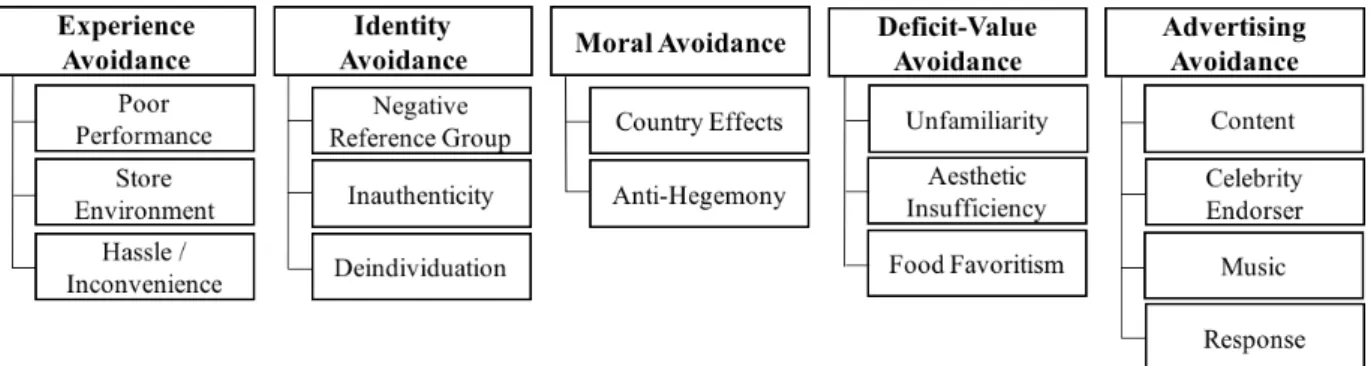
ex-panded this framework, by analyzing qualitative data of millennials, with a fifth type: advertis-ing. Each type, its attendant reasons and subthemes are discussed and can be seen in Figure 1.
Experience Avoidance: The first type occurs due to negative first-hand experiences with branded products or services. As brands communicate values to consumers they create promises (Balmer and Gray, 2003) which result in expectations (Grönroos, 2006). If these expectations are not fulfilled or coherent with consumer´s experiences, consumers become dissatisfied and brand avoidance is likely to emerge. Hence, experience avoidance occurs due to unmet
expecta-tions. Its subthemes include poor performance, hassle/inconvenience perceived in obtaining the product as well as an unpleasant store environment (Lee et al, 2009a/b; Knittel et al., 2016).
Identity Avoidance: This type occurs due to the failure of a brand to meet individual´s sym-bolic identity needs and is based on the concept of undesired self. It suggests, that if a brand´s values or meanings are inconsistent with an individual´s self, disidentification (Bhattachrya, 2002) and hence brand avoidance might occur (Lee et al., 2009a). It also proposes, that uphold-ing or enhancuphold-ing one´s self-concept is not only achievable through acquiruphold-ing brands thatare congruent, but also through avoiding brands that are incongruent with one’s desired or actual self-concept (Banister and Hogg, 2004). Based thereon, this type contains three subthemes. First, consumers may avoid brands they connect with a negativereference group that is incom-patible with their self-concept and is often associated with a stereotypical product/brand-user
-imagery (BanisterandHogg, 2004;Englis et al., 1995).Second, if a brand lacksauthenticity it will likely be avoided. It is proposed, that brands might lose their authenticity if they become too popular or mainstream (Holt, 2002).The final theme, deindividuation, refers to the avoid-ance of mainstream brands as they may not fulfill consumer´s desire to be individual or unique. Thus, brands are avoided to avert losing individuality or self-identity (Lee et al., 2009a/b).
Moral Avoidance: Moral avoidance is driven by ideological incompatibility between brands and consumers as they are not in line with their political, socio-economic, and ethical sets of beliefs (Kozinets and Handelmann, 2004). Hence, brand avoidance may occur to resist a dominant brand to keep the power between brands and consumers balanced and may be
tivated by doing “the right thing” (Lee et al., 2009a). Overall, moral avoidance can be divided into two subthemes. First, country effects, where consumers might avoid brands on the basis of associations they have with the brand´s country of origin. For instance, if consumers have a feeling of animosity towards a country they are likely to transfer this feeling towards brands being representatives for this country. Further, consumers might have the desire to avoid brands that will not provide well-being or economic development to their own country and are thus likely to prefer local brands (Lee et al., 2009b). Within the second subtheme, anti-hegemony, dominant or multinational companies are avoided to prevent the development of monopolies, or because they are perceived as irresponsible and impersonal (Lee et al., 2009a/b).
Deficit-Value Avoidance: This type occurs if consumers perceive the expected benefit of a brand as not acceptable relative to its cost. It can be easily confused with experience avoidance, however, here no first-hand contacts are necessary. This type includes three subthemes. First, consumers might avoid unfamiliar brands, as they are associated with lower quality and greater risk (Richardson et al., 1996) resulting in low value. Second, brands might be rejected due to their aesthetic insufficiency, as consumers might judge the functional value of a brand based on its appearance. Third, food-favoritism occurs if consumers likely avoid food products from cer-tain deficit-value brands (Green et al., 2003), without necessarily rejecting the same brand in other categories due to the high importance consumers may attach to food (Lee et al, 2009a/b).
Advertising Avoidance: Based on negative feelings towards certain TV and radio commer-cials consumers might also start to avoid the advertised brand (Knittel et al., 2016). This type contains four specific subthemes: the content of the advertising, the music and celebrity endors-ers that may trigger a negative response leading to brand avoidance.
2.2 The 21st century Hipster
In academia, the term hipster is poorly defined as a result of its complex and translocal nature (Maly and Varis, 2016). However, as the hipster lifestyle has spread globally among millennials, who possess a huge buying power which in combination with the digital age
ena-bles them to change markets (Lazarevic, 2012), hipsters have become highly relevant for mar-keters (McWilliams, 2015) and also has gained more interest in academia (Arsel and Thomp-son, 2011; Cronin et al., 2012; Hubbard, 2016; Maly and Varis, 2016; Schiermer, 2014).
The term ´hipster´ was first mentioned in the 1940s used to describe trendy connoisseurs in the jazz culture (Schiermer, 2014). Later it was mainly associated with a local subculture in Brooklyn, New York and its left-policy orientation, its critique on capitalism as well as a revival of the bohemian1 identity and consumption ideology (Greif et al., 2010; Cronin et al., 2012). By describing today´ hipsters, many handbooks (Lanham, 2003; Greif et al., 2010; Mande, 2010) and academic studies (Schiermer, 2014; Hubbard, 2016; Maly et al., 2016; Cronin et al., 2012) generally agree on the following characteristics: Today´s hipsters are typically middle-class, between 20 and 35 years old, live in urban areas, contribute to the gentrification of big Western cities, and follow or are on top of the latest trends regarded as being outside the mainstream. However, more depth is needed to understand today´s hipsters. Thus, differences to the early hipsters as well as the most important external and internal hipster characteristics are discussed.
Differences: Although,thebohemian dimension partly survivesamong today´s hipsters un-der the name indie, which is short for independent and refers to a rejection of mainstream con-sumerism (Cronin et al., 2012; Lanham, 2003; Hubbard, 2016), no real critique on materialism or capitalism can be identified (Schiermer, 2014; Arsel and Thompson, 2011; Maly andVaris, 2016;Cronin et al, 2012). On the contrary, today´s hipsters actively take part in current eco-nomic structures and are highly conscious of what they are consuming. Thus, they are in general rathermaterialistic than protesting against it and are not necessarily guided by political orien-tations or interests in arts (Mande, 2010;Arsel and Thompson, 2011; Lanham, 2003). Accord-ing to Cronin et al. (2012, p. 22), it “appears to be largely an issue of identity maintenance or status seeking” rather than the desire to “change [...] principles,practices, and policies”.
1 The term bohemian emerged in the 19th century to describe artists or intellectuals, who reacted to mass culture and production with revolutionary and rebellious attitudes and the desire to be different from the masses (Cronin et al., 2012; Schiermer, 2014).
Typical ExternalCharacteristics: Most attempts to describe today´s hipsters include de-scriptions about their highly fashionable indie style and activities perceived to be divergent from mainstream (Arsel and Thompson, 2011; Cronin et al., 2012; Schiermer, 2014). However, individuals who clearly fit criteria of hipsters will likely deny being one as they desire to be perceived as authentic and distinct (Lanham, 2003). Hipsters are rather identified as such by their appearance, making fashion and the places they frequent the most important hipster traits (Maly and Varis, 2016). Decisive are possessing skinny jeans, beanies, old-school sneakers, vintage or thrift shop goods as well as frequenting independent local art galleries or fancy cafés (Lanham, 2003; Bartz and Ehrlich, 2010; Mande, 2010). Central is also, that they uphold objects of the past and have a penchant for irony (Schiermer, 2014). Hence, hipsters can be identified by a certain look and concrete consumption practices (Cronin et al, 2012; Maly and Varis, 2016). Typical Internal Characteristics: Equally important in defining hipsters is theirdesire for uniqueness, authenticity and individuality resulting in a strong appeal to stand out from the masses (Maly and Varis, 2016; Arsel and Thompson,2011). Thus, they perceive typical external characteristicsas internal status symbols(Croninetal.,2012). However, through the digital age, mass gentrification and the rise of global companies, such as Urban Outfitters, selling this trendy style, the hipster identity has become global and commoditized (Arsel and Thompson, 2011; Hubbard, 2016; Cronin et al., 2012; Schiermer, 2014). This ironic integration into the mainstream, threatens their desire to be perceived as authentic and distinct and as a result even more effort is needed to maintain or acquire its identity (Arsel and Thompson, 2011; Maly and Varis, 2016). In this regard, Arsel and Thompson (2011) try to classify today´s hipster into two categories: real and fake hipsters, both trying to be in contrast to the mainstream. Real hipsters seem to uphold values of the original hipster subculture and consumed things before they be-came mainstream and thus sense themselves as authentic. Fake hipsters seem to adopt this life-style and may be considered as commercial actors signaling a hipster status. However, through
its commercialization, the reality is much more complex. As both frequent the same places, read the same magazines and consume the same objects the boundaries between real/fake hip-sters blur (Schiermer, 2014; Maly and Varis, 2016), which makes it nearly impossible to distin-guish them. Thus, as both display same behavior patterns, both can provide meaningful insights to answer the research question and hence are considered as one unity: the 21st century hipster. Thus, this thesis uses the term `21st century hipster` to describe an individual (1) who is fashionable, prefers alternative and independent spaces, goods and services and possesses the specific hipster look, and (2) who strives to be distinct, unique and authentic and to be perceived as outside the mainstream, but is not necessarily associated with showing social protests. 2.3 Brand Avoidance and 21st century Hipsters
As 21st century hipsters grew up with saturated markets, they are highly knowledgeable
about brands and marketing activities and thus sophisticated in making brand-related decisions (Lazarevic, 2012). They mainly strive for small-scale, localized products and at the same time widely reject objects being considered as consumed by the broad mass (Lanham, 2003). Hence, many literatures agree that hipsters prefer authentic, natural independent brands over franchises or big corporate brands such as Starbucks (Hubbard, 2016; Bartz and Ehrlich, 2010) or Tommy Hilfiger (Lanham, 2003). Even the infrastructure in ´hipster´ neighborhoods of some Western cities has changed, as mainstream stores and franchise chains have been replaced by vintage stores and independent cafés (Hubbard, 2016; Maly and Varis, 2016; Lanham, 2003).
By studying hipsters´ anti-consumption in the category of food, Cronin et al. (2012) de-tected brand avoidance as one of their most significant behaviors. They proposed that hipsters mainly avoid popular global brands, especially the market leaders and the ones that are strongly branded, to uphold a distinct identity and because they are perceived as non-creative and main-stream. Also, according to Lanham (2003, p.51) hipsters tend to prefer generic brands as they widely lack a recognized name or logo and are typically not advertised. Likewise, Mc Williams (2015) suggests in his book “The Flat White Economy”, that the hipster movement is successful
because it is not linked to specific logos, making it easy to build a social identity. This leads to the assumption that hipsters predominantly have a foible for unbranded or minimal branded goods making it harder for popular brands to capture them. Paradoxically, although they desire to express themselves in terms of non-conformity to the mainstream and thus mainly consume outside the ordinary, they are also identified as consuming some mass-marketed or big cor-porate brands, such as Adidas, Apple or the two most popular hipster brands, Urban Outfitters and American Apparel (Greif et al., 2010; Maly and Varis, 2016). Hence, it still lacks a com-prehensive understanding why they reject specific brands. Thus, as many reasons can lead to brand avoidance and no comprehensive research combined brand avoidance and hipsters, this thesis aims to develop a deeper understanding by reassessing the general brand avoidance framework and exploring new categories explaining the phenomenon among today´s hipsters. 3 Methodology
Since to date, no research combined brand avoidance and hipsters, and to explore its central phenomenon and complex motives, this study was exploratory in nature (Strauss and Corbin, 1990). Further, as anti-consumption in general is difficult to reveal by methods such as obser-vation (Wilk, 1997), talking to hipsters about avoided brands can be considered as the best way to gain insights. Thus, a qualitative method in form of in-depth interviews was used to get more insights about their brand avoidance motives as it also incorporates richness, depth, and com-plexity and as it has been proven to be an effective way to ascertain the symbolic meanings and experiencesof consumers (Ritchieet al., 2003). These empirical data were exploredthrough the modification of the pre-existing general conceptual brand avoidance framework (Lee et al., 2009a/b; Knittel et al.,2016). Thus, an abductive research approach was applied as it gives new insights into an already existing phenomenon by exploring it from a new perspective rather than taking a purely inductive or deductive approach (Kovács and Spens, 2005). Its ability to explain social phenomena, by drawing inferences from combining theoretical input and empirical data (Danermark et al, 2002; Richardson et al., 2006), makes it best suited to provide answers to the
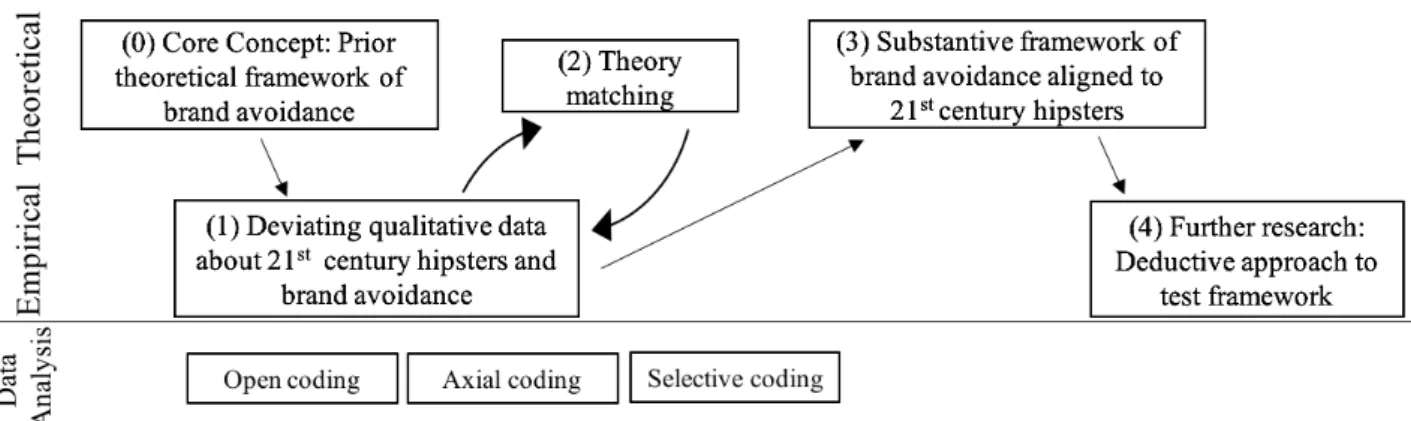
research question. The same research approach was also used by other studies addressing sim-ilar research questions, Sepp et al. (2011) being one example. The structure of this process is shown in Figure 2. The pre-existing framework of brand avoidance was used as a prior theoret-ical input (0). The new gathered qualitative data (1) were then combined with this framework in order to match theory and findings (2), resulting in a substantive framework of brand avoi-dance aligned to 21st century hipsters (3) that can be tested deductively in further research (4).
3.1 Sample and Data Collection
The selection of informants was limited to individuals fitting reasonable criteria as today´s hipsters. Thus, homogeneous purposive sampling was applied as hereby informants are chosen by the qualities they possess and as it is most effective in studying certain cultural domains (Patton, 1990; Ritchie and Lewis, 2003). However, selecting an appropriate sample was diffi-cult as hipsters shy away from identifying themselves as those. Thus, this thesis followed a similar approach like Cronin et al. (2012) by not letting them self-identify as hipsters but rather by its definition applying appropriate criteria. Thus, despite the demographic characteristics of 21st century hipsters, the two criteria identified in chapter 2 had to be fulfilled:
Criteria 1 – External characteristics: Someone, who is fashionable, has a preference for alternative
and independent spaces, goods and services and possesses the specific hipster look.
Criteria 2 – Internal characteristics: Someone, who strives to be distinct, unique and authentic and
to be perceived as outside the mainstream.
Within these criteria, typical hipster preferences, i.e. regarding fashions or spaces, identified in literature, were combined with non-hipster preferences. Also,appropriate scales were used
tifying their internal characteristics (Bearden et al., 2011). App. 1 provides a summary of these participant qualifications, allowing for replicability for further studies. As purposive sampling admits using surveys to select informants (Ritchie and Lewis, 2003), an online pre-question-naire was conducted inquiring these criteria. Participants were then chosen who best met the predetermined criteria (App. 2). However, even if the informant selection should rest upon the best judgment in the course of the specific study, within purposive sampling a suitable assess-ment of the sample should to some extent be based on self-identification (Hammersley and Aktinson, 1995). Thus, during the interviews informants were asked to confirm being a hipster.
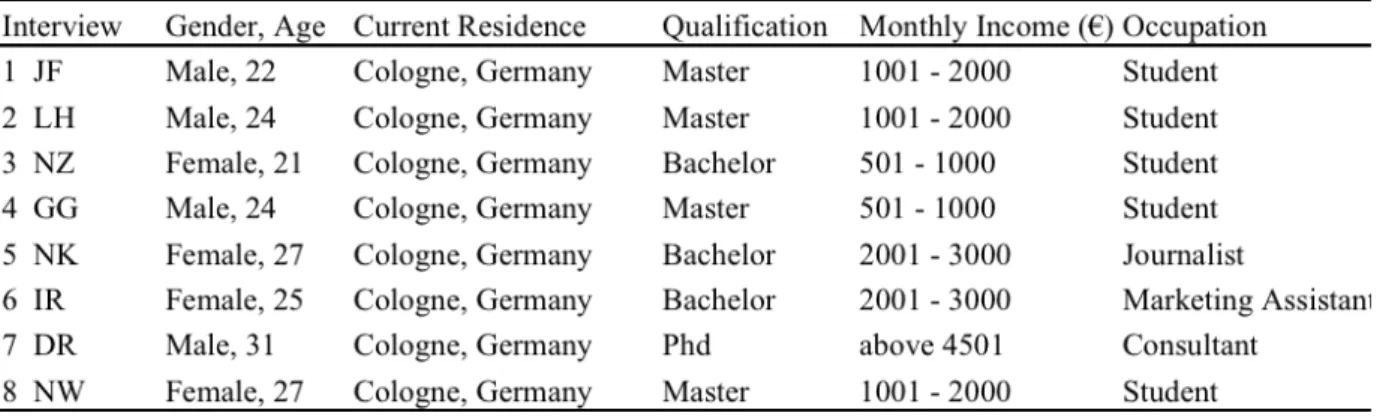
To ensure reliability and consistency this study followed a semi-structured interview guide (App.3). It gave structure to the interview, allowed interviewees to give subjective answers but also allowed to bring up new ideas which is best suited by attempting to get a comprehensive understanding of an understudied subject (Ritchie and Lewis, 2003). All interviews were held in a café in a ´hipster´ district in Cologne, Germany. In total, 8 fully recorded and transcribed interviews were completed with each lasting over 1 hour. This number is qualified as purposive sampling only requires five respondents for the data to be reliable and robust (Seidler, 1974). Also, one of the most influential studies in marketing and consumer theory had a sample size of 3 (Fournier, 1998). Hence, in qualitative research it is the depth that is decisive rather than a large sample size (Patton, 1990). Table 1 presents demographic details of the participants. 3.2 Data Analysis
As proposed by abductive literature (Danermark et al., 2002; Richardson et al., 2006), for the analysis to be reliable and valid it should follow a grounded theory method (Strauss and Corbin, 1990). Hence, the coding process started with open coding, by grouping data into cat-egories without relating it to the existing framework, continued with axial coding, by identify-ing connections between categories and structuridentify-ing them into subthemes, and progressed with selective coding, by modifying and integrating the findings into the pre-existing brand avoi-dance framework. The result is a substantive brand avoiavoi-dance framework aligned to hipsters.
4 Findings
All informants engage in conscious brand avoidance behavior among four main categories: fashion, food, restaurants/cafés, and electronics. However, consequent avoidance occurs mostly for high-involvement decisions, as low-involvement products, i.e. underwear or basic groceries, may be purchased from otherwise avoided brands. In general, three main types of brands are actively avoided by informants that they widely perceive as mainstream: Popular-global, low-budget and conspicuous2 brands. Thus, they mainly avoid heavily marketed or branded products being in line with previous studies (Cronin, 2012). Also, as they have a huge desire to discover unique things they rather prefer small and unknown brands and solely want friends to recognize consumed brands. Regarding avoidance motives, the four types presented by Lee et al (2009a/b) were also revealed, though with some differing attendant subthemes. Also an additional theme emerged that has not been unveiled before, termed as indirect avoidance. However, in contrast to Knittel et al. (2016), advertising and its subthemes were not mentioned as an avoidance rea-son. Rather, the coding process revealed, that mass marketing, including advertising, aswellas visible logos, appear to amplify avoidance motives rather than being standalone reasons.
When someone throws their marketing at me... like McDonald ́s or other big chains that I don´t want to support, they will achieve the opposite result. I would even more avoid this brand. (GG, male, 25)
This might also be explained due to the fact that advertising is only part of a brand´s commu-nication strategy belonging to subordinate marketing activities, delivering brand-related infor-mation that may solely create negative brand associations (Keller, 2013). In contrast, the other avoidance types rather represent negative brand associations that can create negative brand
2 The term conspicuous was used by interviewees to describe a brand that is used as a status symbol
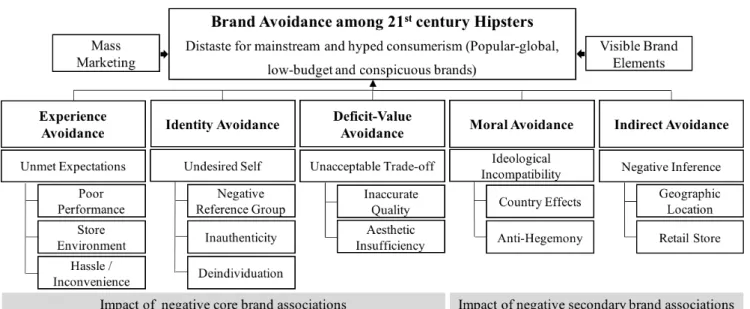
ages in consumers´ minds may result innegative brand equity (Keller, 2013) and hence in brand avoidance (Lee et al., 2009b). Thus, advertising is not on the same level as the other avoidance types as it is not a brand association itself, but rather a transmitter of it. The resulting brand avoidance framework among today´s hipsters, its attended reasons and subthemes, all being related to the three mentioned types of brands, is discussed and displayed in Figure 3.
Experience Avoidance: Unmet expectation resulting in negative experiential associations, was also identified. In contrast to the general framework (Lee et al., 2009b), all subthemes are related to mainstream brands. Each informant was complaining about the poor product performance and an unpleasant store environment if brands are or started to be construed for the broad mass:
Poor Performance: There are brands that can ruin themselves easily by labeling their products and
producing mass products with a low quality. I feel fooled if North Face is suddenly producing rain capes not protecting you from the rain anymore just because they realized that they arrived at the mass market. This moment is the death of a brand...if you lose the focus of your core competency. (NW, female, 27)
Store Environment: I hate all these mainstream stores. They always play this super stressful music. I
don´t like the look of the store, the service, the people and what makes it even worse are these marketing banners on every wall. I therefore totally avoid these corporate brands and chain stores. (JF, male, 22)
Identity Avoidance:This was one of the most frequently mentioned reasons to avoid brands. All themes identified by Lee et al. (2009a) were indicated among each informant mainly leading to the avoidance of mainstream brands. They rather prefer small, local and unknown brands or unbranded products to fulfill their desire to be unique and distinct. Mass marketing and visible logos, especially branded clothes, or cafés, highly reinforce the negative symbolic perception
of a brand. By describing stereotypical users, informants revealed to avoid brands they associate with mainstream and conspicuously consuming persons, as they are perceived as inauthentic:
Negative Reference Group: I avoid brands that signal non-reflected richness and a belonging to certain
groups. [Interviewer: What groups?] Of course, they want to signal a status, wearing sailor stuff without being able to sail. I ask myself, what do they connect with the brand? These people all look the same. I don’t want to belong to such groups and it is an impression I don´t want to make. (DR, male, 31)
Inauthenticity of a brand itself, as it appears to be fake and artificial, was also manifested:
Inauthenticity: I think Esprit tries to catch people like us, but it seems so forced. They trying too hard
and then it just isn´t authentic. Even if Tom Tailor would offer cool minimalistic things, like Cos, I would think what is wrong with them? I would not think they care or be passionate about it as when you go to a small store…there is just no history behind it. (NZ, female, 21)
Participants also avoid mainstream brands to prevent a loss of individuality and self-identity, and are even willing to pay more for unknown brands to get a feeling of uniqueness:
Deindividuation: I am more motivated to buy a small brand, that is not mass-marketed. I would also pay more for it as there is more behind it than just a huge organization. They have higher production costs etc. And most important: not everyone has it. I would probably be the only one of my friends and I like to have something special. This is mainly why I avoid mainstream brands like Zara, Hilfiger, mass sneakers...also…Starbucks, Vapiano and all these inauthentic chains. (IR, female, 25)
Deficit-Value Avoidance: Informants want to receive goodquality and minimalistic design from a product and are even willing to pay a premium if these two criteria are met. On the one hand, they are reluctant to buy conspicuous brands, and on the other hand, they avoid low-budget brands, not only for identity reasons, but also as they do not perceive high functional value from acquiring these items with respect to both requirements, quality and aesthetics:
Inaccurate Quality: When shopping, I never enter stores like Primark, Pimkie, Orsay or other low budget stores. I don ́t go there because they have a low quality and it is just not my style. (NK, female, 27) Ralph Lauren is not beautiful and the quality is not good. It´s expensive just because of the brand. The price-quality ratio is not appropriate. And I don ́t like to buy an empty shell. I also buy expensive prod-ucts but the prodprod-ucts have to meet these requirements, quality and simple design. (NW, female, 27)
Insufficient aesthetics regarding missing a desired minimalism is not only affecting products themselves but also its packaging:
Aesthetic Insufficiency: Take a Boss pullover, where maybe the pullover itself is considerable...but when
it says in capital letters ́Hugo Boss ́ then it is not considerable anymore, like at all. It just doesn ́t fit for aesthetic reasons. It is just not minimalistic and this is also why I avoid Hugo Boss. (DR, male, 31) Product design is extremely important to me. It already starts when I buy soap or detergent. When they are packaged in a simplistic or cool package then they catch me more than mainstream ugly brands. No! Even not when it only costs 1€. (NZ, female, 21)
The subtheme of unfamiliarity was not revealed. Conversely, informants desire to discover new things and do not associate low quality or high risk with unfamiliar brands or unbranded goods. Moral Avoidance: In this type, informants avoid brands mainly due to the behavior of a whole company rather than of a single brand, but also due to inferences they draw from the country of origin. Concerning the latter reason, avoidance occurs mainly due to the quality associated with a country and its unfair production conditions rather than animosity issues:
Country Effect: Concerning electronics I totally avoid cheap made in China things. Like the people that
go to Turkey for holidays and bring faked handbags etc. I really hate this. No! (NZ, female, 21) I avoid firms that produce in unethical or unsustainable ways or are manipulative like Nestle. They exploit people in poorer countries and don ́t care about the environment. If I read they produce in Africa, I already know it did not happen under fair conditions and then I do not buy the brand. (LH, male, 24)
However, even more important for all informants is to support small and local entities resulting in the avoidance of large monopolies:
Anti-Hegemony: I don ́t like Starbucks as it is a big corporation. You would not support someone in our
age, who maybe has a cool start-up or a café. I don ́t want to support chains, only individual stores and cafés. Therefore, these huge companies are not appealing to me; also like McDonald ́s. (GG, male, 24)
Another theme belonging to anti-hegemony is corporate irresponsibility addressing political or socioeconomic issues. Within this theme, all informants put a very high focus on environmental sustainability as well as human or animal exploitation of companies as major reasons to avoid brands. These specific motives were not revealed by Lee et al. (2009a/b) or Knittel et al. (2016):
Anti-Hegemony: If a company is not responsible in terms of only wasting resources, or only producing
synthetically. I mean, if they do not accept the responsibility...or the influence that they have on soci-ety...then I avoid a brand. Also, if they are produced under unfair conditions. (DR, male, 31)
Some firms are not responsible or ethical, like Nestle. They not only exploit the environment but also animals and even humans...I can not consume brands from firms that do this. (JF, male, 22)
Indirect Avoidance: A unique contribution is the emergence of indirect avoidance. The basic premise is, as in the case of moral avoidance, that brands might be avoided due to negative inferences being drawn from negative associations of other entities to a certain brand. The in-ference of secondary associations can be best explained through “cognitive consistency”, by assuming what is true for another entity, must also be true for the brand (Keller, 2013; Dimofte and Yalch, 2011). By studying this effect on brand evaluations, Dimofte and Yalch (2011)
found that negative secondary associations may affect brand judgment, and as shown in the type of moral avoidance, may also lead to brand avoidance. All informants revealed to strictly avoid main shopping streets3 and department stores resulting in avoiding brands offered there
and instead preferring independent stores in alternative districts. Thus, two subthemes emerged: geographic locations of stores and chosen retail partners.
Geographic Location: Besides the country of origin, other geographic locations can also create secondary associations consumers may transfer to a certain brand (Keller, 2013). That store locations, its environments or `atmospherics´, are important in influencing consumer´s purchase decisions, is not new (Keller, 2013; Kotler, 1973). However, studies in atmospherics mainly focus on interior variables of stores (Kotler, 1973), external variables, such as store surround-ings or districts, almost gained no attention in research (Grossbart et al, 1975; Turley and Mil-liman, 2000). However, it may influence perceived brand images (Kumagai and Nagasawa, 2017), and here even lead to brand avoidance. All informants transfer their negative image about main shopping streets, they associate with mass-processing, commercialization and lack of uniqueness, to the brands sold there resulting in a general avoidance of them:
Geographic Location: I mean if a brand is located in main shopping street, you directly know who their target customers are, no? Of course they want to attract ordinary people. I mean I don´t go shopping there anyway, but if a brand is located there I directly know that it is a mass brand that I don´t want to buy. (LH, male, 24) WhenI was in NewYork I found a cool brand, Brandy Melville. But, 1 year later or so I saw that they opened a store in a big shopping street in Hamburg, and then I stopped buying it. (IR, female, 25)
Retail Stores: Retail stores can also indirectly affect consumer´s associations and judgments about a brand by transferring the image of the retail store to a brand (Keller, 2013). As retailers have their own brand images in consumer´s minds, it can influence the image consumers have of an offered brand in a positive or negative way (Pettijohn et al., 1992, Lee, 2004). All inform-ants perceive a brand differently if it is sold in department or retail stores they sense as incon-venient and designed for the broad mass. Thus, the transfer of this store image has a negative
3 As all informants currently live in Cologne, Germany they mainly referred to Schildergasse, which is the busiest shopping street in Germany, with more than 16.000 people passing through every hour (Statista.com, 2016).
impact on the evaluation of the brand and results in brand avoidance:
Retail Stores: Stores like Karstadt, C&A and P&C. All these big department stores. OMG! I would never go there. I avoid all the brands listed there. I simply don´t like these mass stores. (IR, female, 25)
IR perceives department stores as unappealing and transfers this negative image on the brands listed there and as a result claims to avoid these brands in general.
Retail Stores: P&C, C&A. I hate big corporate chains. I think their clothes are boring and not special. I don ́t like the whole style of them. It is just like a mass processing. Also, it is too crowded and going shopping there is not relaxed and fun. Even if they would offer my favorite brand, I would question if this is still my favorite brand. Then I would rather go to smaller stores and buy an unknown brand. (LH, male, 24)
LH not only transfers his negative association of retail stores on unfamiliar brands, but he would even question his favorite brand if it was sold there and may start to avoid this brand. Thus, linking a brand to other entities may not only create new brand associations and judgments but also can affect existing ones (Keller, 2013) and may lead to brand avoidance.
In summary, the findings suggest that an interplay of five avoidance types may lead 21st century hipsters to reject certain brands: with undesired self, inaccurate quality, unmet mini-malistic aesthetics, hegemonic issues and both indirect avoidance subthemes being the most cited ones. However, to provide further insights for practical implications it is also crucial to understand why some mainstream brands are not being avoided. Five major themes emerged during the interviews. First, low-involvement products, due to a lack of purchase motivation (Keller, 2013), may also be purchased from otherwise avoided brands. Second, lack of alterna-tives or knowledge that a brand belongs to a firm that usually is avoided, i.e. Nestle, may be the reason to buy brands anyway. Third, all informants solely acquire big popular brands like Nike or Adidas in small local stores located in alternative districts, offering limited editions or sub-brands, like Nike SB, rather than mainstream collections. In this regard, informants also claimed to highly appreciate that marketing efforts are solely done through the store´s private Instagram accounts, rather than mass marketing initiated by the brand itself. Fourth, another reason a pop-ular global brand, such as Adidas or Levi´s, is not being avoided, is its authentic brand image. Informants perceive a brand as authentic if it incorporates credible corporate responsibility
pro-grams or if it possesses a unique story or an ironic or historical character, being consistent with the findings of Schiermer (2014). In this case, all informants have no objection with visible logos. Finally, brands like Apple or Urban Outfitters are not being avoided by justifying that these brands were already consumed before they became mainstream and due to their highly functional and aesthetic value components informants do not want to start to avoid them. 5 Discussion and Conclusion
This thesis presents an initial framework of brand avoidance motives among today´s hip-sters, explained by the impact of negative brand associations (Figure 3). The results suggest brand avoidance as a notable behavior among hipsters, mainly avoiding brands which are per-ceived as mainstream. This resonates with previous findings (Cronin et al., 2012). However, the reasons far exceed those of identity issues. Rather, the results suggest that hipsters avoid certain brands due to five avoidance types and its attendant reasons, namely, experience, iden-tity, deficit-value, moral and indirect avoidance. The first four types, although with some dif-fering subthemes, are consistent with previous research (Lee et al., 2009a/b; Knittel et al., 2016). The results, however, do not appear to support advertising avoidance (Knittel et al., 2016) among hipsters. Rather, it seems that mass marketing as well as visible logos amplify reasons to avoid brands.Thus, similarities as well as distinctions exist to the general framework of brand avoidance (Figure1). It seems, that even if the hipster lifestyle and its consumption habits already spread globally, local brands stay local and hence remain unique and distinct.
Indirect avoidance has not been unveiled before and proposes that hipsters may avoid cer-tain brands due to negative inferences they draw from unfavorable store locations or inadequate retailers, if both are designed to appeal to the broad mass. These findings can be supported by previous studies claiming that hipsters prefer new local businesses in former rundown districts of big Western cities, where, through the absence of big firms, an authentic and aesthetic alter-native to the mainstream consumption space is created fulfilling their desire to be different and special (Zukin, 2009; Hubbard, 2016). Also, other studies found that hipsters actively avoid
shopping malls (Lanham, 2003). Thus, there might be a connection between main shopping streets and malls, as both represent concentrated and high-frequented commercial areas. Further, there are multiple studies confirming the impact of retailer image on brand image, but solely have not been related to brand avoidance, Pettijohn et al. (1992) and Lee (2004) being two examples.Also, eventhough there is almost no existing literature about external environments of stores, i.e. districts, (Grossbart et al., 1975; Turley and Milliman, 2000) one study confirmed its influence on brandimage(Kumagaiet al., 2017). These studies and previous literature con-firming that secondary brand associations can lead to brand avoidance (Lee et al., 2009b; Knittel et al., 2016), make indirect avoidance a further potential type of brand avoidance.
As hipsters have been transformed into a global and influential community of consumption it is of high importance for marketers not only to focus on strategic attempts to encourage them to buy their brands but also to consider negative brand relationships, as otherwise these brand-ing efforts may be incomplete (Holt,2002; Fournier and Alvarez,2013). For instance, it might not be sufficient to solely remove visible logos from products, as in the case of A&F (Joel, 2013), as their sales are still dropping (A&F, 2016). Rather, it is highly important to fully derstand the underlying reasons of brand avoidance. Thus, by providing a first attempt to un-derstand hipster´s brand avoidance motives, the results of this thesis might enable marketers across industries, to properly react to it or exploit its opportunities if attempting to target hip-sters or if its trend continues to diffuse. As diverse reasons can occur simultaneously for one single brand, managers might first need to detect applicable avoidance types before making strategic decisions. A summary of major implicationsformarketers, derived from the findings, addressing each avoidance type is presented in Table 2. Beforehand, in order to appeal to hip-sters, it might be helpful not to initiate or to reduce mass marketing as well as visible logos. Marketing activities might be effective if they are solely done through Instagram accounts of local stores or through sending like-minded field marketers to or sponsoring alternative hipster
events i.e. local art galleries or skateboard events, rather than through traditional marketing. This is also in line with the marketing strategy of Pabst Blue Ribbon, one of the most successful hipster brand in America (Segran, 2014). Also, logos may be solely appropriate if the brand exhibits an authentic brand image, such as a unique story or an ironic or historical character.
However, the findings and implications should be interpreted within its context. If marketers do not attempt to target hipsters and if they are already successful, the practical implications might not be of high relevance. Nevertheless, if such a trend continues to diffuse it might change the face of branding (Holt, 2002) and thus might at least require awareness. The high relevance is shown by the latest strategy of Tommy Hilfiger, being among each informant and hipster literature the most strictly avoided brands. Through a limited comeback edition of its 90s fash-ion style, symbolizing history, retro, and irony and a cooperatfash-ion with Urban Outfitters, Tommy Hilfiger is trying to tackle the hipster movement (Tommy Hilfiger website, 2017). Thus, they may attempt to overcome identity as well as indirect avoidance.
Besides its contributions, this study also has limitations providing potential for further re-Brand Avoidance Reasons Managerial Implications
Experience Avoidance: May occurs due
to poor performance and unpleasant store environments if brands are con-strued for the broad mass.
Focus on your core competency and quality rather than to cre-ate a hype or a mainstream appeal. Instead, try to develop pop-ularity over a longer period of time. Also, it might be helpful to adjust your store environment to a minimalistic design.
Identity Avoidance: Might occurs due to
undesired self of not being unique and distinct.
Address hipster´s desire to be unique and distinct by avoiding mainstream appeal and rather creating curiosity. For example, it might be helpful to offer limited or custom-made editions, to create a sub-brand or to embody vintage and retro qualities. Also, may create authenticity by providing a unique story be-hind the brand or invoke its historical or ironically character.
Deficit-Value avoidance: A brand is
likely to be avoided due to inaccurate quality or insufficient aesthetic require-ments.
Hipsters may be highly sophisticated and hence do not buy an empty shell or get fooled by marketing/branding tricks. Thus, conspicuous branding should be avoided. Rather, an adequate price-quality ratio and minimalistic design may be favorable.
Moral Avoidance: May occurs due to the
desire to support local business and due to environmental/ social consciousness.
It might be conducive to credibly engage in social corporate re-sponsibility in terms of being sustainable and behaving morally and ethically.
Indirect Avoidance: Might occurs due to
negative brand inferences drawn from store locations and retailers, that are con-strued to appeal to the broad mass.
Before deciding on store locations or retail partners a strategic analysis should be undertaken identifying `hipster/mainstream` districts as well as hipster´s preferences and aversions of retail partners, such as Urban Outfitters or unique small local stores.
search. First, the study solely consisted of German participants. However, consumer behavior may also be influenced by cultural backgrounds, as i.e. consumers across cultures may perceive a different value from acquiring a certain brand (Overby et al., 2005) and hence may also from avoiding it. Thus, it would be interesting for further research to address this issue. Also, in combination with the qualitative design of this study and its general focus across categories, that was necessary to get an initial profound understanding of the phenomenon, make the results not generalizable across populations. Thus, future research could repeat the study for confirma-tion in a different populaconfirma-tion, by using a similar sample method and may focus on a specific industry. Second, the use of a qualitative method and that the study was only directed to hipsters with the purpose of theoretical abstraction, also requires further research to test the framework deductively using a quantitative method and may include comparisons with non-hipsters to provide additional insights into the uniqueness of hipsters and to improve the generalizability of the present framework. I.e., as proposed by the findings, it could be evaluated if today´s hipsters´ brand avoidance behavior is mainly affected by an undesired self, inaccurate quality, unmet minimalistic aesthetics, hegemonic issues as well as both indirect avoidance subthemes. Finally, the unique emergence of indirect avoidance and its attendant reasons require further research. It would be highly interesting to understand how not only the internal, being already researched widely, but also the external environment of stores affects brand judgment and may lead to brand avoidance. This would facilitate marketing managers to plan their store location by reducing the risk of triggering a negative brand image especially if targeting hipsters.
In conclusion, this study provides an initial attempt towards the understanding of brand avoidance motives among 21st century hipsters. It suggests, that they mainly reject mainstream brands due to an interplay of five avoidance types. Besides supporting prior findings, one novel type emerged, namely, indirect avoidance. With its rise, the findings may not only enhance the understanding of hipsters, but also contribute to the general phenomenon of brand avoidance.
References
Arsel, Zeynep and Craig Thompson. 2011. “Demythologizing consumption practices: How consumers pro-tect their field-dependent identity investments from devaluing marketplace myths.” Journal of
Con-sumer Research, 37(5): 791–806.
Bhattacharya, C. B. and Kimberly D. Elsbach. 2002. “Us versus them: The role of organizational and dis-identification in social marketing initiatives.” Journal of Public Policy & Marketing, 21 (1): 26-36. Balmer, John M. and Edmund R. Gray. 2003. “Corporate brands: What are they? What of them?” European
Journal of Marketing, 37 (7/8): 972-97.
Banister, Emma N. and Margaret K. Hogg. 2004. “Negative symbolic consumption and consumers’ drive for self- esteem.” European Journal of Marketing, 38 (7): 850-868.
Bartz, Andrea and Brenna Ehrlich. 2010. Stuff Hipsters Hate. A field guide to the passionate opinions of
the indifferent. Berkeley, CA: Ulysses Press.
Bearden, William O., Richard G. Netemeyer and Kelly L. Haws. 2011. Handbook of Marketing Scales.
3rd edition. Los Angeles, London, New Dehli, Singapore, Washington DC: SAGE Publications.
Chatzidakis, Andreas and Michael S. W. Lee. 2013. “Anti-Consumption as the Study of Reasons against.”
Journal of Macromarketing, 33 (3): 190-203.
Cronin, James M., Mary B. McCarthy and Alan M. Collins. 2012. “Covert distinction: how hipsters prac-tice food-based resistance strategies in the production of identity.” Journal of Consumption Martkets
and Culture, 17 (1): 2-28.
Danermark, Berth, Mats Ekström, Liselotte Jakobsen and Jan Ch. Karlsson. 2002. Explaining Society –
Critical realism in the social sciences. London and New York: Routledge.
Dimofte, Claudiu V. D and Richard F. Yalch. 2011. “The mere association effect and brand evaluations.“
Journal of Consumer Psychology, 21 (1): 24–37.
Englis Basil G. and Michael R. Solomon M. 1995. “To be and not to be: lifestyle imagery, reference groups, and the clustering of America.” Journal of Advertising, 24(1):13–28.
Fournier, Susan. 1998. “Consumers and Their Brands: Developing Relationship Theory in Consumer Re-search.” Journal of Consumer Research, 24(4):343-373.
Fournier, Susan and Claudio Alvarez. 2013. “Relating Badly to Brands.” Journal of Consumer Psychology, 23 (2): 253-264.
Green, Judith M., Alizon K. Draper, and Elizabeth A. Dowler. 2003. “Short cuts to safety: risk and ‘rules of thumb’ in accounts of food choice.” Health, Risk and Society, 5 (1): 33.
Greif, Mark, Kathleen Ross and Dayna Tortorici. 2010. What was the Hipster? A Sociological
Investiga-tion. New York: N+1 FoundaInvestiga-tion.
Grönroos, Christian. 2006. “On defining marketing: Finding a new roadmap for marketing.” Marketing
Theory, 6 (4): 395- 417.
Grossbart, Sanford L., Mittelstaedt, Robert A., Curtis, William W., and Rogers, Robert D. 1975. “Environ-mental Sensitivity and Shopping Behavior.” Journal of Business Research, 3 (4): 281–294.
Hammersley, Martin and Paul Atkinson. 1995. Ethnography Principles in Practice. London: Routledge. Hogg, Margaret K., Emma N. Banister and Christopher A. Stephenson. 2009. “Mapping symbolic anti-
consumption.” Journal of Business Research, 62 (1): 148–159.
Holt, Douglas. 2002. “Why do brands cause trouble? A dialectical theory of consumer culture and brand-ing.” Journal of Consumer Research, 29 (1): 70-90.
--- 2016. “Branding in the Age of Social Media.” Harvard Business Review, 95 (3): 40-48.
Hubbard, Phil. 2016. “Hipsters on Our High Streets: Consuming the Gentrification Frontier.” Sociological
Research Online, 21 (3): 1-6.
Joel, Mitch. 2013. “The rise of the unbrand.” Harvard Business Review, 91 (1).
Keller, Kevin Lane. 2013. Strategic Brand Management. Building, Measuring, and Managing Brand
Klein, Naomi. 2000. No Logo. London: Flamingo.
Knittel, Zana, Karolin Beurer and Adele Berndt. 2016. “Brand avoidance among Generation Y consumers”.
Qualitative Market Research: An International Journal, 19 (1): 27-43.
Kotler, Philip. 1973. “Atmospherics as a Marketing Tool.” Journal of Retailing, 49 (4): 48-64.
Kovács, Gyöngyi and Karen M. Spens. 2005. “Abductive reasoning in logistics research.” International
Journal of Physical Distribution & Logistics Management, 35 (2):132-144.
Kozinets, Robert V. and Jay M. Handelman. 2004. “Adversaries of consumption: Consumer movements, activism, and ideology.” Journal of Consumer Research, 31 (3): 691-704.
Kumagai, Ken and Shin’ya Nagasawa. 2017. “Consumers’ perceptions of store location effect on luxury, non-luxury, and unknown apparel brands.” Journal of Global Fashion Marketing, 8 (1): 21-39. Lanham, Robert. 2003. The Hipster Handbook. New York: Anchor Books.
Lazarevic, Violet. 2012. “Encouraging brand loyalty in fickle generation Y consumers.” Young Consumers, 13 (1): 45-61.
Lee, Dongdae. 2004. “Image congruence and attitudes toward private brands.” Journal of Advances in
Consumer Research, 31 (1): 435-441.
Lee, Michael S. W., Judith Motion and Denise Conroy. 2009a. “Anti-consumption and brand avoidance. Journal of Business Research, 62 (2): 169–180.
--- 2009b. „Brand Avoidance: A Negative Promises Perspective.“ Advances in Consumer Research, 36 (1): 421-429.
Maly, Ico and Varis, Piia. 2016. “The 21st-century hipster: On micro-populations in times of superdiver-sity.” European Journal of Cultural Studies, 19 (6): 637–653.
Mande, Joe. 2010. Look at this F*cking Hipster. New York: Saint Martin’s Griffin.
McWilliams, Douglas. 2015. The Flat White Economy. London and New York: Duckworth Overlook. Overby, Jeffery W., Robert B. Woodruff and Sarah F. Gardial. 2005. “The influence of culture upon
con-sumers’ desired value perception: A research agenda.” Marketing Theory, 5 (2): 139-163.
Patton, Michael. 1990. Qualitative evaluation and research methods. 2nd ed. London: Sage Publications. Pettijohn, Linda S., Douglas W. Mellott and Charles E. Pettijohn. 1992. "The relationship between retailer
image and brand image." Psychology & Marketing, 9 (4): 311-328.
Richardson, Rudy and Eric Hans Kramer. 2006.“Abduction as the type of inference that characterizes the development of a grounded theory.” Qualitative Research, 6 (4): 497–513.
Richardson, Paul, S., Arun Jain, K., and Alan Dick. 1996. “Household store brand proneness: A frame-work.” Journal of Retailing, 72 (2): 159-85.
Ritchie, Jane and Jane Lewis. 2003. Qualitative Research Practice - A Guide for Social Science Students
and Researchers. London, Thousand Oaks, New Delhi: SAGE Publications.
Schiermer, Björn. 2014. “Late-modern hipsters: New tendencies in popular culture.” Acta Sociologica, 57(2): 167–181.
Segran, Elizabet. 2014. “How a brand hunts cool young customers.”, available at: www.fastcompany.com-/3039481/how-one-brand-hunted-cool-young-consumers-and-captured-them (accessed 02.03.2017). Seidler, John. 1974. “On using informants: a technique for collecting quantitative data and controlling
measurement error in organization analysis.” American Sociological Review, 39 (6): 816-831.
Sepp, Marianne, Veronica Liljander and Joh. Gummrus. 2011. “Private bloggers’ motivations to produce content - a gratifications theory perspective.” Journal of Marketing Management, 27(13): 1479–1503. Strauss, Anselm L. and Juliet Corbin. 1990. Basics of Qualitative Research: Grounded Theory Procedures
and Techniques. Newbury Park: Sage Publications.
Turley L. W. and Ronald E. Milliman. 2000. “Atmospheric Effects on Shopping Behavior: A Review of the Experimental Evidence”. Journal of Business Research, 49 (1): 193–211.
Wilk, Richard. 1997. “A critique of desire: Distaste and dislike in consumer behavior.” Consumption,
Mar-kets and Culture, 1 (2): 175-96.
Appendix 1 - Informant Criteria
In order to select informants, this thesis followed a similar approach like Cronin et al. (2012) by identifying hipsters on the basis of its definition and inquiring appropriate criteria. Thus, purposive sampling was applied in order to select informants, where selection is based on predetermined criteria (Ritchie and Lewis, 2003). Within this type of sampling, the informant selection should rest upon the best judgment in the course of the specific study (Hammersley and Aktinson, 1995; Ritchie and Lewis, 2003). Thus, criteria of hipsters were determined based on a literature review identifying appropriate characteristics (Ritchie and Lewis, 2003).
All criteria, concerning the external characteristics, such as specific preferences of 21st century hipsters, were selected from hipster handbooks (Kinzey, 2012; Lanham, 2003; Greif et al., 2010; Bartz and Ehrlich, 2010; Mande, 2010) and academic studies (Schiermer, 2014; Hubbard, 2016; Mali and Varis, 2015; Cronin et al., 2012.; Arsel and Thompson, 2011). Besides that, in order to identify their internal characteristics, specific questions are chosen from the Handbook of Marketing Scales (Bearden et al., 2011).
Required Demographics:
1. Age: Between 20 and 35 years old
2. Middle-Class: Higher Education: University degree or equivalent and higher Higher Income: 1.050 EURO (net) – 4.400 EURO (net) 3. Gender: Desired 50%/50%
4. Residence: Big Western City
Required Characteristics:
Criteria 1: Someone, who is fashionable, has a preference for alternative and independent spaces, goods and services and posses the specific hipster look.
(a) Who is fashionable:
o Fashion Product Involvement
(Cronbach alpha=0.97; 5-point Likert-type scale: Strongly Agree - Strongly Disagree (Manchiraju, Srikant and Lynn Damhorst, 2016 in Baerden et al., 2011)
§ Fashion is a significant part of my life.
§ I have a very strong commitment to fashion that would be difficult to break. § For me personally fashion clothing is an important product.
§ Fashion is important to me.
(b) Who has a preference for alternative and independent spaces, goods and services: o Desire for unique consumer products
(Specific consequences of a high DUCP include an increased tendency to acquire and use products that are scarce, innovative, customized, and/or outmoded, as well as a desire to shop at small, unique retail outlets.)
(Cronbach alpha=0,78; 5-point Likert-type scale: Strongly Agree - Strongly Disagree) (Bearden et al., 2011)
§ I am more likely to buy a product if it is scarce.
§ I would prefer to have things custom-made than to have them ready-made. § I enjoy having things that others do not.
o How do you feel about each of the following spaces and services? (5-point Likert-type scale: Strongly Like - Strongly Dislike) Identified typical hipster preferences:
§ Local indie café (Cronin et al., 2012; Schiermer, 2016; Hubbard, 2016; Greif et al., 2010, p.46)
§ Vegetarian/vegan restaurant (Cronin et al., 2012; Greif et al, 2010, p.24)
§ Organic smoothie bar (Greif et al, 2010, p.110)
§ Independent restaurant (Arsel&Thompson, 2011; Cronin et al., 2012; Lanham, 2003, p37; Hubbard, 2016, Schiermer, 2016)
§ Local galleries (Hubbard, 2016; Kinzey, 2012, p.21)
• Things Hipsters typically reject:
§ Fast-food chains (eg. McDonalds, Burger King) (Cronin et al., 2012; Lanham, 2003, p37)
§ Franchise restaurants (eg. Vapiano; Starbucks) (Lanham, 2003, p.272/p.37; Kinzey, 2012, p.120)
§ Bistro/Café in the main shopping street of your city (Hubbard, 2016)
§ Strip-malls (Lanham, 2003, p.37)
§ Tanning-salon (Lanham, 2003, p.13)
o When shopping for groceries, you are most likely to go to which of the following options?
(5-point scale: Always – Never)
• Identified typical hipster preferences:
§ Farmer´s market (eg. Fruit market) (Cronin et al, 2012)
§ Healthfood store (eg. Reformhaus) (Cronin et al, 2012)
§ Organic store (eg. Alnatura, Biodirect) (Cronin et al, 2012)
§ Corner shop, (eg. Tante-Emma-Laden) (Lanham, 2003; McCracken, 2010)
• Things Hipsters typically reject:
§ Supermarket chains (eg. Aldi, Lidl) (Cronin et al, 2012) § Big-box retailer (eg. Walmart) (Kinzey, 2012, p.120)
(c) Who posses the specific hipster look:
o Which ones of the following items do you own and wear? (5-point scale: Always – Never + I don´t own this)
• Identified typical hipster preferences: § Plaid Shirt (Bartz&Ehrlich, 2010, p. 156)
§ Skinny jeans (Mali&Varis, 2016; Greif et al., 2010, p. 185)
§ Vintage sunglasses (Lanham, 2003, p. 128; Mali&Varis, 2016; Michael, 2015)
§ Retro jacket (Michael, 2015)
§ Oversized jeans jacket (Michael, 2015)
§ Ironic T-shirts (Greif et al, 2010, p.9)
§ Old-school sneaker (Mali&Varis, 2016
§ Bicycles (Mali&Varis, 2016; Hubbard, 2016; Greif et al., 2010, p. 185)
§ Beanie (Cronin et al., 2012)
• Things Hipsters typically reject: § Cars (Mali&Varis, 2016
§ Muscle shirts (Bartz&Ehrlich, 2010, p. 154)
§ Polo shirts (Bartz&Ehrlich, 2010, p. 531)
§ High heels (Bartz&Ehrlich, 2010, p. 191)
§ Light Denim Jeans (Bartz&Ehrlich, 2010, p. 531)
o How likely are you to buy one of the following brands or products? (5-point scale: Very likely – Very unlikely)
• Identified typical hipster preferences:
§ Urban Outfitters (Mali&Varis, 2016; Arsel&Thompson, 2011)
§ American Apparel (Mali&Varis, 2016; Arsel&Thompson, 2011)
§ Obey (Mali&Varis, 2016)
§ Second-hand clothes (Lanham, 2003, p.43)
§ Vintage or thrift shop clothes (Lanham, 2003, p.43; Mali&Varis, 2016; Kinzey, 2012, p.16)
• Things Hipsters typically reject:
§ Tommy Hilfiger (Lanham, 2003, p.28; Bartz&Ehrlich, 2010, p. 146)
§ Ed Hardy (Bartz&Ehrlich, 2010, p. 534
• Neutral § Zara § H&M
Criteria 2: Someone, who strives to be distinct, unique and authentic and to be perceived as outside the mainstream.
o Uniqueness/Distinction/Outside the Mainstream:
(5-point Likert-type scale: Strongly Agree - Strongly Disagree Bearden et al., 2011)
• Creative Choice/Counterconformity
§ I collect unusual products as a way of telling people I’m different. § I have sometimes purchased unusual products or brands as a way to
create a more distinctive personal image.
§ I often look for one-of-a-kind products or brands so that I create a style that is all my own.
• Unpopular Choice/Counterconformity
§ When dressing, I have sometimes dared to be different in ways that others are likely to disapprove.
§ As far as I’m concerned, when it comes to the products I buy and the situations in which I use them, customs and rules are made to be broken.
§ I often dress unconventionally, even when it’s likely to offend others • Avoidance of Mainstream/Similarity
§ When products or brands I like become extremely popular, I lose interest in them.
§ I avoid products or brands that have already been accepted and purchased by the average consumer.
§ I give up wearing fashions I’ve purchased once they become popular among the general public
o Authenticity:
Authentic living involves being true to oneself in most situations and living in accordance with one’s values and beliefs.
Questions are slightly changed to: Someone who strives to be authentic: Eg. I am true to myself in most situations – I want to be true to myself in most situations.
(Cronbach alpha > 0,7; 5-point Likert-type scale: Strongly Agree - Strongly Disagree) § I think it is better to be yourself, than to be popular.
§ I always [want] to stand by what I believe in. § I [want to] be true to myself in most situations.
Appendix 2 – The Pre-Questionnaire Evaluation of the Sample
An evaluation of all filled out pre-questionnaires was made in order to facilitate the selection process of identifying informants who best meet reasonable classifications as hipsters. In total, 143 people completed the survey. If the pre-questionnaires predominantly met the defined hipster criteria participants were contacted. 8 participants were then chosen who overall met the predetermined criteria in the best available way (Hammersley and Aktinson, 1995; Ritchie and Lewis, 2003). This is appropriate, as “decisions about the relative significance of different criteria are being made on the basis of the best evidence available combined with the hypotheses, theories or issues that are central to the research” (Ritchie and Lewis, 2003, p.99) and as the “selection of informants must be based on the best judgments one can make in the circumstances” (Hammersley and Atkinson; 1995, p. 139). However, as a suitable judgment of the sample should to some extent be based on self-identification (Hammersley and Atkinson; 1995), during the interviews informants were asked to confirm being a hipster.
Additionally, as the external characteristic is one of the most important hipster criteria, participants were asked to send a photo best expressing themselves, as another source of identification: