Repositório ISCTE-IUL
Deposited in Repositório ISCTE-IUL:
2019-02-18
Deposited version:
Post-print
Peer-review status of attached file:
Peer-reviewed
Citation for published item:
Bento, N. & Fontes, M. (2018). Legitimation and guidance in scaling up energy innovation systems. In 9th International Sustainability Transitions Conference. Manchester
Further information on publisher's website:
http://www.confercare.manchester.ac.uk/events/ist2018/
Publisher's copyright statement:
This is the peer reviewed version of the following article: Bento, N. & Fontes, M. (2018). Legitimation and guidance in scaling up energy innovation systems. In 9th International Sustainability Transitions Conference. Manchester. This article may be used for non-commercial purposes in accordance with the Publisher's Terms and Conditions for self-archiving.
Use policy
Creative Commons CC BY 4.0
The full-text may be used and/or reproduced, and given to third parties in any format or medium, without prior permission or charge, for personal research or study, educational, or not-for-profit purposes provided that:
• a full bibliographic reference is made to the original source • a link is made to the metadata record in the Repository • the full-text is not changed in any way
The full-text must not be sold in any format or medium without the formal permission of the copyright holders. Serviços de Informação e Documentação, Instituto Universitário de Lisboa (ISCTE-IUL)
Av. das Forças Armadas, Edifício II, 1649-026 Lisboa Portugal Phone: +(351) 217 903 024 | e-mail: [email protected]
Innovation Systems
Nuno Bento a,b *, Margarida Fontes c
a DINÂMIA’CET, ISCTE-IUL
Av. das Forças Armadas, Edifício ISCTE, Sala 2N19, 1649-026 Lisboa, Portugal
b Universidade Católica Portuguesa, Departamento de Economia, Gestão e Ciências Sociais de Viseu, 3504-505 Viseu, *Corresponding author: [email protected]
b LNEG – Laboratório Nacional de Energia e Geologia
Estrada do Paço do Lumiar, 22, 1649-038 Lisboa Portugal, [email protected] Version of June 14, 2018
Abstract
This paper examines the role of legitimacy and guidance in accelerating the take-off of emerging low-carbon innovations. We analyze the national roadmaps that have been
developed for offshore wind energy in deepwaters (more than 50 meters deep) which strives to enlarge the scale of the technology and market. The analysis focus on how actors create and share collective visions to prepare the growth of the system. The results point to different types of guidance depending on the technological and institutional context, particularly a higher external openness as technology matures and governments get involved. A survey of actors’ opinion complements the roadmaps analysis revealing the tendency for overinflating expectations. It suggests roadmaps have had a positive, though limited, impact on the technology development. Policy implications include recommendations for managing the process of formation of visions of new technologies entering into upscaling.
Keywords: legitimation; guidance; upscaling; roadmaps; offshore wind energy.
Highlights:
- legitimation and guidance are key processes in innovation systems upscaling - roadmaps influence expectations formation (legitimation) and sharing (guidance) - actors used roadmaps to prepare the upscaling of floating offshore wind energy - types of guidance change with technological maturity and government involvement - survey indicates roadmaps have positive but limited impact on technological dynamics
1. Introduction
Many energy innovations in the past went through a process of intense upscaling before dissemination, from cars to airplanes, fossil fuels power plants to wind energy technologies (Smil, 2008). Upscaling describes the process of increase in size or performance of a
technology (Luiten & Blok, 2003). It is a well-known constant characteristic of production (Winter, 2008), routed in the natural development of technological trajectories and paradigms (Nelson & Winter, 1977; Dosi, 1982). Upscaling occurs during a period in the technology life cycle when a radical innovation establishes itself as the dominant design (Frenken & Leydesdorff, 2000). It is typically motivated by the potential of unit economies of scale to reduce costs (Sahal, 1985; Luiten & Blok, 2003; Wilson, 2012). Non-economic factors like social acceptance are also important to mobilize the resources needed in a context of high
uncertainties on both the technology and the market potential (Bergek et al., 2008a; Kemp et al., 1998).
The creation of legitimacy (legitimation) and of guidance are important processes for accelerating energy innovations. Legitimacy has been identified in organization studies with social acceptance and conformity with current norms and values (Johnson et al., 2006; Zelditch, 2001; Suchman, 1995; Aldrich & Fiol, 1994). It has been reported as critical for the access to resources (capital, infrastructure, etc) (Deegan, 2002), and thus is a prerequisite for upscaling new systems (Bergek et al., 2008b; Hekkert et al., 2007; Markard et al., 2016). In addition, the actions of the actors should be consistent with the goal of enlarging the technology and the market. Guidance or influence on the direction of search express the necessity to direct the resources of the actors (both the established and new) into critical activities for technology growth including experimentation of larger technologies, building of supply chains or demand articulation (Bergek et al., 2008a). Therefore we expect that technology upscaling involves the formulation and sharing of collective strategies.
Legitimation and guidance have been the object of an emerging attention in technological innovation systems (Binz et al., 2016; Markard et al., 2016; Bergek et al., 2008b). The theory assigns public opinions and institution preferences to legitimation, and policy action plans and collective strategies to guidance (Borup et al., 2013; Bergek et al., 2008b). However, the distinction is still unclear at the conceptual level, let alone for the analyst in the practice.
This paper aims to answer the question: How legitimacy and guidance accelerate the diffusion of emerging innovation systems? We address this question by analyzing directive documents such as roadmaps as reference analytical instruments. Roadmaps are increasingly used to
address the requirements of growing systems (McDowall et al, 2012; Rip, 2012). They can give a glimpse into the evolution of innovation processes such as legitimation and guidance (Borup et al., 2013). As empirical setting, we study the development of offshore wind in deepwaters which is an emerging energy technology that could unlock huge amounts of low-carbon electricity but arguably needs to upscale to reach that potential (Rodrigues et al., 2015).
The analysis contributes to consolidate the definitions of legitimation and guidance and to better operationalize these two processes. Roadmaps help to fulfill these innovation processes, but their guidance co-evolves with the degree of maturity of the innovation and their effectiveness is contingent on factors such as the participatory character of the
roadmapping and the involvement of key stakeholders (investors, governments, users, etc.).
The remainder of the paper is structured as follows: Section 2 reviews key innovation
processes in systems’ upscaling, with a particular focus on legitimation and guidance. Section 3 explains the methodological approach followed to operationalize these processes as well as the empirical setting. Section 4 presents the results of the roadmaps analysis and of the survey. The last section discusses the findings and their implications for the theory and the policy.
2. System dynamics, legitimation and guidance 2.1 Technological innovation systems upscaling
In the early phases of innovation, new technologies suffer from the ‘liability of newness’ (Freeman et al., 1983) because they are perceived as strange or unfamiliar and promoters find unclear opportunities in their development. The issue is more than technological as
innovations like new energy technologies often require the establishment a new set of practices and institutions to penetrate into the market. The nature of these systemic challenges have been researched in technological innovation systems (TIS) studies (e.g. Markard et al, 2012, Berkek et al., 2015).
According to the TIS perspective, the success of a new industry relies on the capacity to establish a supportive innovation system around the new technology (Markard et al., 2012; Carlsson & Stankiewicz, 1991). In particular, the emergence of new innovation systems involves the establishment of structural components (technology, networks and institutions, cf. Jacobsson & Bergek, 2004) and the performance of key innovative processes or “functions” (Hekkert et al, 2007; Bergek et al, 2008a,b; Jacobsson & Bergek, 2011; Markard et al, 2012).
The constituent elements are gradually built in the early years against a context of deep uncertainty about the future of the technology and the market. Over time, the focus
eventually changes to enlarging both the technology and the industry in more advanced stages (Bergek, 2008a).
Two processes are particularly critical in the transition to growth (Suurs et al, 2009; Hekkert & Negro, 2009; Markard et al, 2016): legitimacy and influence on the direction of search. These two system building processes co-evolve with five other functions for enlarging the innovation system: knowledge creation, entrepreneurial experimentation, resource mobilization, market formation, and development of positive externalities (Bergek et al, 2008a; Hekkert et al, 2007). For instance, Binz et al. (2016) shows that legitimacy and direction of the search strongly interacted between each other and with resource mobilization, entrepreneurial
experimentation and market formation in the diffusion of potable water reuse TIS in California.
2.2 Legitimation
Legitimacy refers to the degree of acceptance by the society and of conformity with the current institutions (Johnson et al., 2006; Zelditch, 2001; Suchman, 1995). It is a process of collective acceptance of the social object, comprising a cognitive dimension about beliefs and values, and a normative dimension on what the object should be (Suchman, 1995). In these terms, legitimacy results from a socio-political process by which expectations are formed and shaped in favor of a technology (Aldrich & Fiol, 1994). Indeed, legitimacy has a prescriptive component as remembered by Zelditch (2001). The conformity with societal expectations is also fundamental for innovation systems to ensure the access to social resources (Deegan, 2002). In the context of technological innovation systems, technology legitimacy has been recognized as a prerequisite for the mobilization of critical resources like personnel, capital and infrastructures (Bergek et al., 2008b; Hekkert et al., 2007). It involves a growing
acceptance by the relevant stakeholders (e.g. capital goods suppliers, investors and buyers), as well as the establishment of stronger links between the system and its context (Bergek et al, 2008a; Markard et al, 2016; Markard & Hoffman, 2016). Therefore legitimacy shapes
expectations and improves the social desirability of the emerging system (Negro et al., 2007; Bergek et al., 2008b).
The creation of legitimacy (or legitimation) is a process often steered by the stakeholders. Aldrich & Fiol (1994) posits that entrepreneurs construct legitimacy gradually by increasingly building trust, reliability, reputation, and institutional legitimation. Rao (1994) demonstrates
how important were the victories in reliability and speed contests for the survival of the early automakers in the US. In the same vein, Johnson et al. (2006) suggests that new objects gain legitimacy through a process that goes from local to general validation. To be successful, the process of legitimation must evolve and be sustained over time as pointed by Aldrich and Fiol (1994): “a single venture's uniqueness during initial stages of an industry's development must be counterbalanced with the collective efforts of all players in the emerging industry to portray the new activity as familiar and trustworthy, if they are to survive as a group” (Aldrich & Fiol, 1994, p.664). The literature has highlighted several processes that actors use to increase legitimacy such as lobbying, coalition formation, negotiation and debate framing (Aldrich & Fiol, 1994; Geels & Verhees, 2011; Bork & Schoormans, 2015; Binz et al., 2016; Makard et al., 2016). For example, Geels & Verhees (2011) remember how decisive was the creation of positive meanings around nuclear energy to influence investments and external support in the Netherlands in the early years, in order to emphasize that legitimacy needs to be maintained in the later stages of maturity of the new technology.
The legitimation process is subject to the interest of actors and agency. In particular, it can be influenced by dominant actors seeking legitimacy in the three dimensions identified by
Suchman (1995): pragmatic (support for a practice); moral (values, perception of what is right); and cognitive (comprehensibility, taken-for-grantedness). Hence, dominant actors can use strategic communication to actively manipulate the general perceptions to support a certain practice, inculcate their beliefs and enhance emulation and comprehensibility around a certain direction.
2.2 Guidance
Influence on the direction of search or guidance designates the mechanisms that set the direction inside the system and improve the attractiveness of the TIS to new (external) actors. It combines expectations on the technology and market potential with the actors’ perceptions about the relative advantage of the technology against the incumbent or other alternatives (Bergek et al, 2008a). As pointed by Hekkert et al. (2007, p.423): “guidance of the search is not solely a matter of market or government influence; it is often an interactive and cumulative process of exchanging ideas between technology producers, technology users, and many other actors, in which the technology itself is not a constant but a variable.”
Influence in the direction of search highlights the importance of the processes that lead to the articulation and sharing of expectations, including roadmaps (McDowall et al, 2012; Phaal et
al., 2011). Smith et al. (2005: 1506) note that: “codified representations of technological expectations play a vital role in framing socio-technical problems, as well as motivating actors to seek to solve them …” . Technology roadmaps materialize visions and guidelines for the future development, being increasingly used by advocacy coalitions and governments in emerging technologies or industries, particularly in the case of sustainable energies (Amer & Daim, 2010).
Roadmaps are instruments for the articulation of shared visions and expectations, as well as of strategies to reach those targets, regarding the future development of the technology. They contribute to align key actors and to guide their future behavior (McDowall, 2012). Thus, roadmapping has become “a powerful technique for supporting technology management and planning, especially for exploring and communicating the dynamic linkages between
technological resources, organizational objectives and the changing environment” (Phaal et al, 2004: 5).
The capacity of roadmaps to guide the actors’ activities is contingent on several factors. The effectiveness of roadmaps depends on the extent to which the proposals are acknowledged as being grounded in credible, good quality, analysis and if they result from a participatory process involving key actors (McDowall et al, 2012). That is, visions are more or less powerful depending on how broad is the involvement of actors in their formulation and how inclusive is the consensus reached on the chosen path(s) (McDowall, 2012). It also means that targets set by the government are more credible than when result from the initiative of specific industry or technology advocacy coalitions, where they can have an additional role of policy lobbying (Amer & Daim, 2010). In addition, the construction of guidance is an evolutionary process that is influenced by the own system dynamics. As Jacobsson and Lauber (2006) concludes from the analysis of the diffusion of renewable energy technologies in Germany: “Legitimacy and visions are shaped in a process of cumulative causation where institutional change, market formation, entry of firms (and other organisations) and the formation and strengthening of advocacy coalitions are the constituent parts” (Jacobsson & Lauber, 2006: 272).
2.3 Relation between legitimation and guidance
Legitimation and guidance are typically interdependent and related through expectations (see Box 1). While legitimation refers to the process of formation of expectations around the technology, guidance deals with the impact and share of expectations on collective strategies. Indeed, legitimation processes create “strong expectation for what is likely to occur” (Johnson
et al., 2006, p.72). Bergek et al. (2008a: 417) notes that: “Legitimacy also influences expectations among managers and, by implication, their strategy (and thus the function ‘influence on the direction of search’)”.
Box.1 Indicators of legitimation and of influence on the direction of search (cf.Bergek et al., 2008a)
Legitimation:
• the extent to which the TIS is aligned with the current legislation and the dominant system of values in industry and society,
• the way that legitimacy constrains demand, legislation and firm behavior; and • the determinants of legitimacy (what, who or how).
Influence on the direction of search: • views on market potential,
• incentives and the relative advantage, e.g. subventions and taxes on energy services, • regulatory pressures, e.g. minimum performance levels, and
• the articulation of demand from leading clients.
Expectations are real time representations of the future that can be “performative”, i.e. shape action (Borup et al, 2006; Bakker et al, 2011). They can change as a result of the purposive action of early actors that engage in system building and institutional work like in the case of potable water reuse in California (Binz et al., 2016). Expectations can also be an elusive phenomenon that temporarily attracts the general interest on a certain technology based on ambitious promises before moderating or fading away (Van Lente, 1993). Inflated expectations undermine confidence on the technology, even if it confronts with competitors in the process of variety and selection, and “enactors” must draw the attention of “selectors” in arenas of expectations (Bakker et al, 2011).
Accepting that system change accelerate and spark virtuous cycles whenever two or more processes interact (Hekkert et al., 2007; Suurs et al., 2009), the purposeful action from the actors to create legitimacy and guidance can help us to understand how emerging TISs prepare for growth.
In the following, we focus on processes of construction and sharing of expectations to mobilize the resources needed for technology upscaling, i.e., the “change in gears” in the transition from emerging to mature innovation systems. We analyze (i) the process of formulation and outcome of collective strategies, (ii) the effect of these collective strategies in the general formation of expectations and institutions, and (iii) the relationship between them and the impact on system change. We expect influence on the direction of search to be greater in the case of clear guidance issued by a broad consensus among actors. In addition, the direction
should contribute to the formation of the different types of legitimacy in terms of cognitive (understanding of the technology), normative (conformity with major design principles) and regulatory (sociopolitical change) legitimation (Suchman, 1995). And, finally, strong direction and higher legitimacy should relate to the innovation systems’ preparedness to scale up.
3. Methodology
This research seeks to understand the effect of planning in the up-scale of new sustainable energy technologies in order to answer the following question: How legitimation and guidance contribute to accelerate the growth of low carbon energy technologies?
The empirical setting for the study is the development of offshore wind energy in deepwaters – more than 50 meters deep, where most of the resource potential is located but whose technology is still immature.
The strategy consists of the analysis of roadmaps (and equivalent documents) and the conduction of an actors’ survey to provide a comparative approach to the issues under analysis.
Roadmaps are the result of a negotiation process between different anticipations of the future (Rip, 2012). They articulate and convey (shared) visions & expectations on the future of the technology and translate them into broad guidelines for action; They provide important insights about the creation and dissemination of expectations around the new technology (Borup et al., 2013). Thus, Roadmaps are good analytical instruments, both concerning the legitimation of the technology and regarding the provision of guidance to actors, contributing to their alignment and guiding their behavior (McDowall et al, 2012).
We analyze the roadmaps (and equivalent documents) that have been published in the context of emerging offshore wind energy in deepwaters (Table 1). We conduct an in-depth
assessment of these documents according to the requirements for the emergence of
technological innovation systems in terms of: context, structure and functions, as identified in the literature (Bergek et al., 2008b; Hekkert et al., 2007; Markard, 2016). Subsequently, we further check the results through a content analysis of the roadmaps with a powerful
computer software package: CorTexT Manager (application available in the CorTexT platform: www.cortext.net).
The actors’ survey validates the expectations formulated in the roadmaps. The survey goes along the same lines as the roadmap analysis with questions about the expectations on technology development, main challenges and strategies pursued to overcome them (see Bento & Fontes, 2017 for more details). In addition, actors were questioned on how they perceived the role of roadmaps (i.e. asked to rate their effectiveness in a scale from 1 to 5). This question limits the generalization of the findings, but provides valuable information about the perceived influence of roadmaps in practice that would be difficult to extract otherwise.
We have identified a total of 68 entities active in the field of offshore wind energy in deepwaters worldwide. The entities comprise companies (e.g. technology providers,
developers) and other organizations (e.g. research centers, government agencies, consultants). They participated in demonstration projects, reported interest in the technology in
newspapers (different media), or published reports in the field. The sample is representative (not exhaustive) of the main actors that operate in this emerging technological innovation system worldwide. The survey was sent to these entities during the year of 2016. The response rate was 18% overall (12 replies), varying according to the type of actors: 7.4% for companies (5 replies on 40 contacts) and 25% for other organizations (7 replies on 28 contacts).
Companies tend to be more careful to release information that could reveal their strategy in this emerging business.
More details on both the examination of each roadmap (following the analytical framework) and the survey (including all the questions and results) are available in a separate technical report (Bento & Fontes, 2017).
Table 1 Roadmaps and equivalent documents analyzed
Document Country Date Type Initiative Code
Target & roadmap for Japanese wind
power Japan 2014 Roadmap
Wind Power
Association JA14 Demowfloat - Demonstration of the
WindFloat Technology Roadmap (Windplus)
Portugal 2014 Project report
Organizational
(companies) PO14P Technological Roadmap by the
Technological Observatory for the Offshore Energies
Portugal 2014 Roadmap Coalition of
stakeholders PO14R UK Renewable Energy Roadmap Update
2013 UK 2013 Roadmap Government UK13R
Industrial Strategy: government and
industry in partnership UK 2013
Action plan/
Strategy Government UK13S Rapport de la mission d'étude sur les
énergies marines renouvelables France 2013
Strategy/ Roadmap Government (mission report) FR13 A National Offshore Wind Strategy:
Creating an Offshore Wind Energy Industry in the US
US 2011 National
plan Government US11 Offshore Renewable Energy Strategic
Action Plan 2012-2020
Northern Ireland 2012
Action plan/
Strategy Government NI12
UK Renewable Energy Roadmap UK 2011 Roadmap Government UK11R
Concerning an Act on Offshore Renewable Energy Production (the Offshore Energy Act)
Norway 2009 Strategy
(legislative) Government NO09
4. Results
We study the elements in the roadmaps that aim to set the direction inside the system and to improve the attractiveness of the TIS (section 4.1), and the creation of expectations and institutions in the field (section 4.2) before confronting these insights with the results from a survey of opinions (section 4.3).
4.1 Roadmaps and Guidance
The effect of roadmaps in the guidance depends on its impact on the expectations and collective strategies (Bergek et al, 2008a). It namely concerns the extent to which the actors share the same anticipations about the future of the technology. The effect also materializes in the capacity of the system to attract new actors from other sectors.
The roadmaps under analysis denote some convergence of visions and strategies. They are optimistic (and often ambitious) concerning the growth of floating offshore wind energy and preview an acceleration of development in the coming years. All countries define goals for technology development and six of them additionally set-up intermediate steps. The only exception is Norway, whose “Offshore Energy Act” refers to targets to be set later. The plans of deployment range from 27 MW in Portugal to 100 MW in Japan by 2020 and up to 4,000 MW in Japan by 2030. Intermediate steps often refer to deployment, but there are cases where it relates to a technological target such as costs reduction (e.g. GBP 100/MWh in UK or $0.10/kWh in the US) by 2020.
The roadmaps identify identical technological requirements. They refer to similar needs for the up-scale and growth of the technology, e.g.: demonstration of full-scale operating systems; cost reduction and standardization; development of supply-chain. We observe a general agreement about the priority areas to address, including the need for: more “real-world” experimentation through pilot experiments and pre-commercialization projects; expansion of networks of knowledge; and the introduction of policies to create early demand and spark growth (we develop further this point in the section 4.2). This agreement signals a relatively shared perspective (in this community) on the “structuration” of the innovation system, as part of the process of up-scaling and transition to the main markets.
The promotion of a new domestic industry is another feature of the roadmaps. All documents have a strong national flavor, frequently pointing to the interest of developing competitive capacity and achieving first-mover advantages. The roadmaps defend the need to develop or reinforce the value chain at country level, namely by profiting from the existing strengths in complementary areas that are critical for the development of an “industry” around offshore wind. The roadmaps often emphasize the domestic production of a substantial number of components. They present these components as complementary activities that can provide organizations from a variety of fields (e.g. offshore oil and gas in Norway, or declining sectors like metallurgy in Portugal) with opportunities to broaden their markets and to increase their export prospects. The extreme case is Norway that focuses its strategy for growth of the offshore industry almost exclusively on exports. The national focus, nevertheless, appears to be excessive considering the highly internationalized nature of the field, leading to some neglect of the potential competition from other countries with similar goals (the UK roadmap is a rare exception). In the limit, foreign organizations are never referred to, like in the Japanese roadmap.
More specific goals and strategies vary from country to country depending on the different internal conditions. These include: objectives in terms of market penetration (share of renewable energy in electricity generation), performance of other offshore sectors (e.g. offshore wind or oil & gas), industrial specialization (e.g. level and type of activity in
complementary sectors along the value chain), and country’s organization and resources that can be mobilized. The roadmaps attempt to propose visions and paths that are adjusted to the stage of development of the system and that might be “reasonably” pursued given the country specific conditions. These supports the hypothesis that strategies conveyed in roadmaps are determined by the technological and socio-economic context (Bergek et al., 2015).
To gain additional insights into the nature of the proposals offered by the roadmaps, we performed a more in-depth content analysis of the roadmaps with the help of a specialized software (CorTexT Manager). The analysis reveals three main areas of attention in the roadmaps, related to renewable energy, offshore energy and government (see Appendix 1.). These areas globally overlap with the three main areas identified in the TIS literature,
suggesting that the actors recognize the importance of creating networks and institutions for the growth of the new technology.
Therefore, the roadmaps and equivalent documents contribute to influence the direction of search in some way or another. Comparing their outcomes with the indicators suggested by Bergek et al (2008a), it can be argued that they contribute to foster the expectations on offshore wind in deepwaters (beliefs in growth). Roadmaps seek to persuade policy-makers to enact favorable regulation and taxes/subsidies in order to attract more investment to the system. They also aim to articulate the interest of leading actors in the industry (even if not always the main customers, such as utilities). However, the effectiveness of the guidance will depend on whether the expectations and collective strategies have the capacity to attract actors from other sectors.
4.2 Roadmap and Legitimation
We assess the impact of the roadmaps in the formation of expectations around the
technology. The capacity of roadmaps to improve the acceptability of the technology depends much on the process that led to the formation of visions and expectations. This primarily concerns the quality of the analysis and participatory character of the process (McDowall, 2012).
The quality of analysis varies, in the different roadmaps, with respect to the depth of study and the balance of expectations. Roadmaps present a (more or less) comprehensive diagnostic of the technology as well as of the country’s strengths and weaknesses in relation to the
development of the system. They resort to experts opinion to validate projections, particularly when roadmaps are from public initiative (e.g., FR13, NI12, US11). However, roadmaps are generally optimistic and there is a risk of overpromising, which may undermine their credibility and utility (Brown, 2003).
Actor inclusiveness varies in extent and nature as regards to formal recognition of involvement, but participatory character of the process is often difficult to assess from
documental analysis. Roadmaps show some preoccupation with the engagement of key actors during the formulation of strategies (at least consultation). They also attempt to achieve wide diffusion, involve new actors and align their activities with the goals set. Most documents define strategies for that purpose, including the promotion of specific initiatives, networks or infrastructures (e.g. setting-up demonstration sites, solving grid connection problems). But a diversity exists in terms of the level/type of actor involvement and thus on the nature of consensus achieved. Less inclusive roadmaps are more vulnerable to reflect the interests of specific groups (excluding some others), constraining the capacity to influence the general expectations.
The origin of roadmaps - government led versus actors’ initiative - impacts their content and the capacity to create legitimacy. Government can enact key policies and its participation ensures support to the direction set. The effect on expectations depends on the perception of stability of the commitment given the possibility of changes in the policies with the arrival of a new administration. The roadmaps of stakeholder initiative (cases of Japan (JA14) and Portugal (PO14R, PO14P)) signal the motivation and feasibility of the visions, particularly when they involve key actors in the field. They stress the need for government endorsement of the preconized visions and proposals to reinforce their legitimacy and influence on further development – in this sense they can also be regarded as a documental piece of lobbying.
Formation of technology specific institutions emerges as a priority to raise social acceptance. Roadmaps recognize that standards and regulations need to be in place before the market take-off. They often make specific recommendations, such as the implementation of maritime spatial planning that anticipate and address potential conflicts with existing activities and communities. Preoccupation with improving public perceptions is further pronounced in the documents under review. Roadmaps often present floating offshore wind as a solution to
avoid the acceptance problems associated with fixed wind turbines installation close to the coast (not to speak onshore). They sometimes point to survey results to support these assertions (e.g. UK13S), in what is a clear attempt to improve the public opinion on the technology.
In regard to the indicators of legitimacy presented by Bergek et al (2008a,b), the roadmaps seek to raise the public (and business) awareness of floating offshore wind and align the policies and regulations with the needs of the technology. The promotors of the technology strive to increase legitimacy by convincing the governments to take the initiative of these directive documents, or by using roadmaps as a lobby instrument for more active policies. However, differences in respect to actor involvement impact the credibility of consensus. Despite the relevance of social aspects, a content network analysis (Appendix 2) reveals that these types of issues are missing from the list of the most important terms in the roadmaps.
Additionally, we operationalize the content analysis by defining indicators of guidance and legitimacy and assessing the effect of roadmaps in these measures. This allows us to
interrelate these two important innovation processes with the degree of development of the system in the different contexts. We take the attractiveness of the sector to companies from other countries (openness to foreign actors) as indicator of direction of search, and the degree of government involvement as indicator of legitimation. We draw these indicators directly from the definition of the functions (cf. Borup et al., 2013; Bergek et al., 2008a). We acknowledge that regulation simultaneously signals legitimation and influences the
attractiveness of the sector (potential endogeneity issue), but we come back to this issue later. Figure 1 compares the roadmaps in these two dimensions and relates them to contextual information concerning the pervasivity/scale of the plans (size of the figures) and timing for deployment (shapes).
Figure 1 Stylized representation of roadmaps according to measures of guidance (openness to foreign actors) and legitimation (government involvement)
Source: roadmaps and documents alike listed in Table 1. Countries were sorted in terms of “Openness to foreign countries” according to the stated preferences for domestic manufacturing and expected development of actors & networks, reported in a separated report (Bento & Fontes, 2017). Regarding “Government involvement” in the
roadmap creation, countries were sorted following the information on the “Initiative” of the roadmap.
The results show that government involvement and proximity to deployment increase the openness to foreign companies. This trend is particularly clear when one compare, for example, JA14 with UK13R (roadmap) and UK13S (action plan/strategy). Medium and high degree of government involvement is associated to more openness to foreign actors, the only exception is Norway (NO09) that at the same time states low ambitions of offshore
development (less than 100MW). Note the evolution of the UK’s position from the roadmap (an updated version of the 2011 document) to the more concretely defined action plan. The degree of openness is higher with the proximity of deployment (shape of the symbols) – note that no triangle shows “low” openness. Therefore, the results reinforce the earlier conclusions about the influence of contextual structures (Bergek et al., 2015), particularly concerning the political involvement and the effect of more advanced technological contexts.
4.3 Confronting roadmaps with expectations
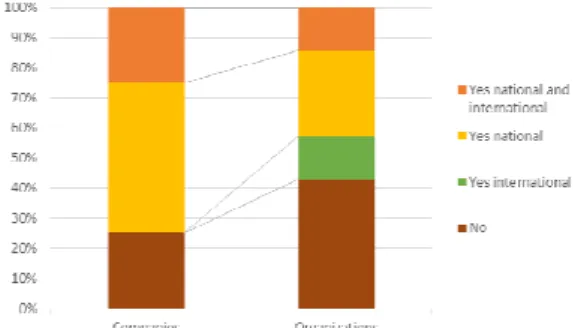
The expectations conveyed in the roadmaps are confronted with the opinions of the major players in the field expressed in an inquiry. Figures 2-6 present the main results.
The surveyed opinions converge with the roadmaps in several aspects. According to the actors, floating offshore wind is still in the pre-commercial stage of development. The barriers to overcome are similar and mainly deal with cost reductions, access to financial capital, standardization and grid connection. The first markets should locate in Japan, United States and United Kingdom (ca. 70% of the opinions) (Figure 2). The interest in floating offshore wind has been mainly driven by the opportunities to explore areas with higher wind potential, higher capacity factor, lower production costs and less public resistance (Figure 3). However, companies and other organizations differ on the prime factors that pull the investment in deeper waters: companies underline the higher resource potential as the main driver, whereas other organizations primarily point to the lower social resistance to installations.
Figure 2 Countries were commercialization will first start
Figure 3 Drivers of investment
There are also substantial differences between companies and other organizations concerning the timings and readiness of the system to grow. Companies are more optimist than
organizations concerning the availability of system resources (Figure 4). Contrary to
organizations, they do not perceive a lack of core resources (e.g. knowledge, infrastructure) or of coherence in the system. Companies also expect relatively faster and greater cost
reductions, which would allow floating offshore wind to become competitive more rapidly (Figure 5). As a consequence, they are more optimistic concerning the commercialization, which they expect to start before 2020 (Figure 6). In contrast to companies, 70% of
organizations report that the competitiveness of floating offshore wind is very uncertain, or will never happen at all.
Figure 4 Availability of system resources
Figure 5 Cost reductions and technology competitiveness
Figure 6 Expected year of commercialization
Overall, the survey reveals that actors perceive roadmaps as having a positive, though limited, impact on both policies and system developing. The opinions of companies are more closely aligned with the visions and strategies expressed in the roadmaps. In average, companies have been more active than other organizations in the formulation of the roadmaps (Figure 7). Thus, it is possible that their positions prevailed in the final consensus that was in the basis of the roadmaps.
Figure 7 Participation in roadmapping
5. Discussion and policy implications
The paper aims to understand the role of legitimation and influence on the direction of search in innovation systems upscaling. It studies the role of these processes in the emergence of floating offshore wind energy, which expansion is necessary to achieve its full potential in the generation of low carbon energy. This is important because the access to resources (labour, capital, infrastructures, etc) depends on the acceptance and attractiveness of the new
technology. We examine the formation and sharing of collective visions through the analysis of the roadmaps. A survey of the actor’s opinion complement the analysis to compare results and discern any effects in the expectations around the technology.
The results shows that roadmaps can contribute to the performance of key processes like legitimation (acceptability) and guidance (attractiveness). However, the analysis points to different types of guidance depending on the technological and institutional context. For instance, the tendency for higher external openness (as an indicator of guidance) appears to be related with government involvement (as an indicator of legitimation), as well as with approximation of technology deployment (stage of technology).
The survey of actors’ opinion confirm that roadmaps have a positive, although limited, impact on the technology development and tend to overinflate expectations. The overoptimistic vision of companies tend to prevail in the roadmaps. Inflated expectations undermine the credibility of the plans and thus their influence in the mobilization of the resources.
The analysis has implications for the theory in several ways. In terms of the operationalization of the concepts, we approach the legitimation and direction of search in terms of government involvement and openness to foreign actors, respectively. These measures are in line with the
canonical definitions of the system functions (Bergek et al., 2008ab; Hekkert et al., 2007; Borup et al., 2013), but have some overlaps as government involvement simultaneously signal
legitimation and influence on the direction of search. In what concerns the relationship between the two processes, we distillate two dimensions at least. First, the inclusiveness of the roadmapping process affects its legitimacy and thus the chances to become widely accepted by the actors (McDowall et al., 2012). Second, agency and power balance influence the legitimacy of roadmaps. Visions and guidelines can reach higher social repercussion when no particular opinion (e.g. of the incumbent) prevailed in the negotiation process (Geels, 2014). The tendency for overpromising reduce the trust in the guidelines over time (Bakker et al, 2011).
Therefore, policy makers aiming at accelerating the diffusion of low carbon technologies with roadmaps should pay attention to the process of formation and sharing of expectations. It is important to ensure a minimum representation of the stakeholders (firms, consumers, community, etc). Visions and guidelines resulting from a negotiation process that is captive from the interests of the more powerful actors are less effective to raise social support. Finally, the ambitions should be reasonable and based on rational expectations to increase the
confidence in the targets and in the recommended strategies for action.
The results have limitations that lay the ground for further research. First, ongoing public debates may affect the attractiveness of technologies and contribute to accelerate innovation dynamics. Discursive analysis could unveil the process of creation of legitimacy and how it affected the guidance, contributing to accelerate (or hinder) technology upscaling. Second, targets and strategies conveyed in roadmaps can change the social perception on the technology. The analysis of the investments over time would unveil possible effects of the publication of roadmaps. Or similarly one could track the impact on the development of technology-specific institutions (e.g. standards) (Markard & Hoffman, 2016). Finally, the study of more cases could deepen our results about the co-evolution of legitimation and guidance in innovation systems upscaling.
References
Amer, M. and Daim, T.U. (2010) Application of technology roadmaps for renewable energy sector, Technological Forecasting & Social Change 77: 1355–1370
Aldrich, H. E., & Fiol, C. M. (1994). Fools rush in? The institutional context of industry creation. Academy of Management Review, 19(4), 645-670.
Bakker, S., Van Lente, H. & Meeus, M. (2011) Arenas of expectations for hydrogen technologies, Technological Forecasting & Social Change, 78: 152.162.
Bento, N., & Fontes, M. (2017). Direction and legitimation in system upscaling–planification of floating offshore wind. Working Papers DINÂMIA'CET, WP n.º 2017/01, ISCTE-IUL.
Bergek, A., Hekkert, M., Jacobsson, S., Markard, J., Sandén, B., & Truffer, B. (2015). Technological innovation systems in contexts: Conceptualizing contextual structures and interaction dynamics. Environmental Innovation and Societal Transitions, 16, 51-64.
Bergek, A., Jacobsson, S., & Sandén, B. A. (2008b). ‘Legitimation’and ‘development of positive externalities’: two key processes in the formation phase of technological innovation systems. Technology Analysis & Strategic Management, 20(5), 575-592.
Bergek, A., Jacobsson, S., Carlsson, B., Lindmark, S., & Rickne, A. (2008a). Analyzing the functional dynamics of technological innovation systems: A scheme of analysis. Research Policy, 37(3), 407-429.
Binz, C., Harris-Lovett, S., Kiparsky, M., Sedlak, D. L., & Truffer, B. (2016). The thorny road to technology legitimation—Institutional work for potable water reuse in California.
Technological Forecasting and Social Change, 103, 249-263.
Bork, S., Schoormans, J. P., Silvester, S., & Joore, P. (2015). How actors can influence the legitimation of new consumer product categories: A theoretical framework. Environmental Innovation and Societal Transitions, 16, 38-50.
Borup, M., Brown, N., Konrad, K., Van Lente, H. (2006). The sociology of expectations in science and technology, Technology Analysis and Strategic Management, 18: 285–298.
Borup, M., Klitkou, A., Andersen, M. M., Hain, D. S., Lindgaard Christensen, J., & Rennings, K. (2013). Indicators of energy innovation systems and their dynamics. a review of current practice and research in the field: Radar report. EIS.
Brown, N. (2003). Hope Against Hype: Accountability in Biopasts, Presents and Futures, Science Studies 2: 3-21.
Carlsson, B., & Stankiewicz, R. (1991). On the nature, function and composition of technological systems. Journal of Evolutionary Economics, 1(2), 93-118.
Deegan, C. (2002). Introduction: The legitimising effect of social and environmental
disclosures–a theoretical foundation. Accounting, Auditing & Accountability Journal 15(3), 282-311.
Dosi, G. (1982). Technological paradigms and technological trajectories: a suggested
interpretation of the determinants and directions of technical change. Research Policy, 11(3), 147-162.
Freeman, J., Carroll, G. R., & Hannan, M. T. (1983). The liability of newness: Age dependence in organizational death rates. American Sociological Review, 692-710.
Frenken, K., & Leydesdorff, L. (2000). Scaling trajectories in civil aircraft (1913–1997). Research Policy, 29(3), 331-348. Frenken, K., & Leydesdorff, L. (2000). Scaling trajectories in civil aircraft (1913–1997). Research Policy, 29(3), 331-348.
Geels, F. W. (2014). Regime resistance against low-carbon transitions: Introducing politics and power into the multi-level perspective. Theory, Culture & Society, 31(5), 21-40.
Geels, F. W., & Verhees, B. (2011). Cultural legitimacy and framing struggles in innovation journeys: a cultural-performative perspective and a case study of Dutch nuclear energy (1945– 1986). Technological Forecasting and Social Change, 78(6), 910-930.
Hekkert, M. P., & Negro, S. O. (2009). Functions of innovation systems as a framework to understand sustainable technological change: Empirical evidence for earlier claims. Technological Forecasting and Social Change, 76(4), 584-594.
Hekkert, M. P., Suurs, R. A., Negro, S. O., Kuhlmann, S., & Smits, R. E. (2007). Functions of innovation systems: A new approach for analysing technological change. Technological forecasting and social change, 74(4), 413-432.
Jacobsson, S., & Bergek, A. (2011). Innovation system analyses and sustainability transitions: Contributions and suggestions for research. Environmental Innovation and Societal Transitions, 1(1), 41-57.
Jacobsson, S., & Bergek, A. (2004). Transforming the energy sector: the evolution of technological systems in renewable energy technology. Industrial and Corporate Change, 13(5), 815-849.
Jacobsson, S., & Lauber, V. (2006). The politics and policy of energy system transformation— explaining the German diffusion of renewable energy technology. Energy Policy, 34(3), 256-276.
Johnson, C., Dowd, T. J., & Ridgeway, C. L. (2006). Legitimacy as a social process. Annu. Rev. Sociol., 32, 53-78.
Kemp, R., Schot, J., & Hoogma, R. (1998). Regime shifts to sustainability through processes of niche formation: the approach of strategic niche management. Technology Analysis & Strategic Management, 10(2), 175-198.
Luiten, E. E., & Blok, K. (2003). Stimulating R&D of industrial energy-efficient technology; the effect of government intervention on the development of strip casting technology. Energy policy, 31(13), 1339-1356.
Markard J. (2016), Conceptualizing the Lifecycle of TIS, Presented at the 6th IST conference, Wuppertal, September.
Markard, J., & Hoffmann, V. H. (2016). Analysis of complementarities: Framework and
examples from the energy transition. Technological Forecasting and Social Change, 111, 63-75. Markard, J., Raven, R., & Truffer, B. (2012). Sustainability transitions: An emerging field of research and its prospects. Research Policy, 41(6), 955-967.
Markard, J., Wirth, S., & Truffer, B. (2016). Institutional dynamics and technology legitimacy–A framework and a case study on biogas technology. Research Policy, 45(1), 330-344.
McDowall, W. (2012) Technology roadmaps for transition management: The case of hydrogen energy, Technological Forecasting & Social Change, 79: 530–542.
Negro, S.O. (2007). Dynamics of technological innovation systems: the case of biomass energy. Utrecht, Copernicus Institute for Sustainable Development and Innovation.
Negro, S.O., M.P. Hekkert, and R.E. Smits. 2007. Explaining the failure of the Dutch innovation system for biomass digestion – a functional analysis. Energy Policy 35, no. 2: 925–38.
Nelson, R. R., & Winter, S. G. (1977). In search of useful theory of innovation. Research Policy, 6(1), 36-76.
Phaal, R., Farrukh, C. & Probert, D. (2004). Technology roadmapping—A planning framework for evolution and revolution. Technological Forecasting & Social Change, 71: 5–26.
Phaal, R., O'Sullivan, E., Routley, M., Ford, S. & Probert, D. (2011) A framework for mapping industrial emergence, Technological Forecasting & Social Change 78: 217–230.
Rao, H. (1994). The social construction of reputation: Certification contests, legitimation, and the survival of organizations in the American automobile industry: 1895–1912. Strategic Management Journal, 15(S1), 29-44.
Rip, A. (2012). The Context of Innovation Journeys. Creativity and Innovation Management 21 (2): 158–70.
Rodrigues, S., Restrepo, C., Kontos, E., Pinto, R. T., & Bauer, P. (2015). Trends of offshore wind projects. Renewable and Sustainable Energy Reviews, 49, 1114-1135.
Sahal, D. (1985). Technological guideposts and innovation avenues. Research Policy, 14(2), 61-82.
Smil, V. (2008). Energy in nature and society: general energetics of complex systems. MIT press. Suchman, M. C. (1995). Managing legitimacy: Strategic and institutional approaches. Academy of Management Review, 20(3), 571-610.
Suurs R.A., Hekkert M.P., Smits R.E., 2009. Understanding the build-up of a technological innovation system around hydrogen and fuel cell technologies. International Journal of Hydrogen Energy 34(24), 9639-9654.
Van Lente, H. (1993). Promising technology. In: Rip, A. (Ed.), The Dynamics of Expectations in Technological Development. Universiteit Twente, Twente.
Wilson, C. (2012). Up-scaling, formative phases, and learning in the historical diffusion of energy technologies. Energy Policy, 50, 81-94.
Winter, S. G. (2008). Scaling heuristics shape technology! Should economic theory take notice?. Industrial and Corporate Change, 17(3), 513-531.
Zelditch, M. (2001). Theories of legitimacy. In: J.T. Jost, B. Major (ed) “The psychology of legitimacy: Emerging perspectives on ideology, justice, and intergroup relations”, pp.33-53.
Appendix 1. Content Analysis (Analysis performed with CorTexT Manager Application, from the CorTexT platform (www.cortext.net) )
Appendix 2. Top 35 terms in the Roadmaps (Analysis performed with CorTexT Manager Application, from the CorTexT platform (www.cortext.net) )
No. Years 2010 2011 2012 2013 2014 Total
1 Renewable energy 11 172 22 135 1 341
2 Offshore Renewable (Energy) 10 10 50 3 3 76
3 Energy Roadmap Update 0 0 0 74 0 74
4 projet 0 0 0 37 0 37 5 Wave energy 0 0 0 0 34 34 6 Case Study 0 11 0 18 0 29 7 Ramsar sites 0 0 24 0 0 24 8 mitigation measures 0 0 24 0 0 24 9 electricity generation 1 10 3 10 0 24 10 Action Plan 1 7 9 5 0 22 11 renewable transport 0 16 1 5 0 22
12 offshore wind farms /projects 1 8 0 13 0 22
13 potential 0 0 0 21 0 21 14 adverse effect 0 1 19 0 0 20 15 wind farm 2 0 4 13 0 19 16 Welsh Government 0 12 0 7 0 19 17 wind turbine 2 8 1 8 0 19 18 Resource Zones 0 0 18 0 0 18 19 economic growth 0 7 0 9 0 16 20 wind projects 0 8 0 6 0 14 21 energy consumption 0 8 0 5 0 13 22 marine environment 0 4 9 0 0 13 23 UK energy 0 4 0 9 0 13
24 Northern Ireland waters 0 0 13 0 0 13
25 marine renewables 0 4 7 2 0 13
26 financial support 0 8 0 2 0 10
27 carbon energy 0 5 0 5 0 10
28 London Array 0 0 0 9 0 9
29 Energy Bill 0 0 3 6 0 9
30 Wind Industrial Strategy 0 0 0 5 0 5
31 investment in the UK 0 1 0 4 0 5
32 Government action 0 3 0 0 0 3
33 UK offshore wind 0 0 2 1 0 3
34 EU Skills 0 0 0 1 0 1