CUIDADO É FUNDAMENTAL
UNIVERSIDADE FEDERALDO ESTADODO RIODE JANEIRO. ESCOLADE ENFERMAGEM ALFREDO PINTO
R E V I S T A O N L I N E D E P E S Q U I S A RESEARCH
CUIDADO É FUNDAMENTAL
UNIVERSIDADE FEDERALDO ESTADODO RIODE JANEIRO. ESCOLADE ENFERMAGEM ALFREDO PINTO
DOI: 10.9789/2175-5361.2018.v10i2.343-350
DOI: 10.9789/2175-5361.2018.v10i2.343-350 | Silva JMB; Oliveira LMRS; Mamede JAN; et al. | Level of satisfaction: factor…
Nível de satisfação: fator gerador de qualidade de vida no trabalho
Level of satisfaction: factor generator of quality of life at work
Nivel de satisfacción: el factor generador de calidad de vida en el trabajo
Jaqueline Miranda Barros Silva1; Lícia Magna Rodrigues Santos Oliveira2; Jaminuan Aucê do NascimentoMamede3; Tatiana Peres Santana Porto Wanderley4; Solange Maria Miranda Silva5; Juliana Miranda Barros6
How to quote this article:
Silva JMB; Oliveira LMRS; Mamede JAN; et al. Level of satisfaction: factor generator of quality of life at work. Rev Fund Care Online. 2018 abr/jun; 10(2):343-350. DOI: http://dx.doi.org/10.9789/2175-5361.2018. v10i2.343-350
ABSTRACT
Objective: Knowing the level of satisfaction of nursing professionals of care to the donor of blood of the
Hematology Center Coordinator of palms. Method: Study of exploratory nature of quantitative approach, population composed by 218 employees and sample by 34. The data were collected in September/2016, in answer to the donor, the Hematology Center Coordinator of Palmas, by means of a questionnaire based on the model of Walton. Results: The average number of professionals in the categories of each dimension was 6, satisfied and 5, slightly satisfied, with the exception of the benefits and possibility of career, whose means of both were 4, neutral. The global average of professionals in eight dimensions was 6, satisfied. Conclusions: Professionals are satisfied and have quality of life at work - QLW. It is expected the insertion of this assessment strategy, in order to monitor the indicators related to QWL whereas it is a dynamic process.
Descriptors: Satisfaction, Service, Quality of life, Motivation.
1 Nurse. Master in Nursing. Professor of the Nursing Undergraduate Program at the Lutheran University Center of Palmas / CEULP.
Palmas (TO), Brazil. E-mail: [email protected].
2 Nurse. Graduated in Nursing at the Lutheran University Center of Palmas / CEULP. Palmas (TO), Brazil.
E-mail: [email protected].
3 Nurse. Master in Intensive Therapy by the Brazilian Institute of Intensive Care. Professor of the Nursing Undergraduate Program at
the Lutheran University Center of Palmas / CEULP. Palmas (TO), Brazil. E-mail: [email protected].
4 Nurse. Specialist in Collective Health and Health Education. Professor of the Undergraduate Nursing course at the Lutheran
University Center of Palmas / CEULP. Palmas (TO), Brazil. E-mail: [email protected].
5 PhD in Nutrition, Federal University of Pernambuco. Professor of the Nursing Undergraduate Program at the Lutheran University
Center of Palmas / CEULP. Palmas (TO), Brazil. E-mail: [email protected].
RESUMO
Objetivo: Conhecer o nível de satisfação dos profissionais de enfermagem do Atendimento ao Doador de Sangue do Hemocentro Coordenador de Palmas. Método: Pesquisa de caráter exploratório de abordagem quantitativa, população composta por 218 funcionários e amostra por 34. Os dados foram coletados em setembro/2016, no setor de Atendimento ao Doador, do Hemocentro Coordenador de Palmas, através de um questionário embasado no modelo de Walton. Resultados: A média dos profissionais nas categorias de cada dimensão foi 6, satisfeitos e 5, levemente satisfeitos, com exceção dos benefícios e possibilidade de carreira, cujas médias de ambos foram 4, neutros. A média global dos profissionais nas oito dimensões foi 6, satisfeitos. Conclusão: Os profissionais estão satisfeitos e, apresentam Qualidade de Vida no Trabalho - QVT. Espera-se a inserção desta estratégia de avaliação, a fim de monitorar os indicadores relacionados à QVT considerando ser um processo dinâmico.
Descritores: Satisfação, Trabalho, Qualidade de vida, Motivação.
RESUMEN
Objetivo: Determinar el nivel de satisfacción de los profesionales de enfermería de atención a los donantes de sangre de la Hematología coordinador del Centro de las palmas. Método: Método: Estudio de naturaleza exploratoria de enfoque cuantitativo, población compuesta por 218 empleados y la muestra por 34. Los datos fueron recolectados en septiembre/2016, en respuesta a los donantes, el coordinador del Centro de Hematología de Palmas, por medio de un cuestionario basado en el modelo de Walton. Resultados: Resultados: El promedio de profesionales en las categorías de cada dimensión fue de 6, y 5, ligeramente satisfecho satisfecho, con la excepción de los beneficios y posibilidades de carrera, cuyos medios de ambos fueron 4, punto muerto. El promedio mundial de profesionales en 8 dimensiones era 6, satisfecho. Conclusión: Los profesionales están satisfechos y tener calidad de vida en el trabajo - QLW. Se prevé la inserción de esta estrategia de evaluación, a fin de monitorear los indicadores relacionados con la QWL considerando que es un proceso dinámico.
Descriptores: Satisfacción, Labor, Calidad de vida, La motivación.
INTRODUCTION
Globally in most diverse cultures, most institutions and companies, in short, every organizational structure for labor relations is invented according to human requirements, with the aim of making profit, taking advantage of briefly and effectively, consequently little or almost none Importance to man. And in this context, the solid continuity of the institution is unreal, whereas in the contemporary conjuncture of human labor, whether individual or collective, it is based on human satisfaction, mainly, and not exclusively, on the salary received.
Daily achievements and good interpersonal relationships characterize some of the many motivating actions that permeate higher productivity and quality of services considered the key to success at work.1 In addition, it is
important to emphasize other aspects of the human factor, namely: a lasting permanence Of employee, support, stimuli to their needs to their motivations, as well as a harmonious relationship between employee and employer that effectively
contribute to organizational ascension and perpetuity in a strengthened way.2
There is still no concise and consensual definition of QVT, since the implementation of this theme in Brazil is still in its infancy. Many researchers argue that QVT can be understood as a tactic, whose main goal of such an approach is to reconcile the interests of individuals and organizations, that is, at the same time that it improves worker satisfaction, improves company productivity.3
Therefore, the blood bank for assuming a relevant social role, related to the health of the individual, needs positive attributes in the blood donor care team in the blood bank, mainly related to the quality of life at work, even for loyalty of this donor.4
It is worth remembering that in Brazil the amount of blood stock is still low in relation to the World Health Organization (WHO) recommendation and, in this relation, individual-institution, it is pertinent to know the level of satisfaction of the nursing professionals in the care of the donor Of blood from the Hemocentro de Palmas Coordinator - TO, this primordial indicator that characterizes the quality of care in the process of donating blood.
Thus, this study had as general objective to know the level of satisfaction of the nursing professionals of the Blood Donor Attendance of the Bloodcenter Coordinator of Palmas - TO and to identify among the measured dimensions those that interfere in the satisfaction of the nursing professionals; And, characterize Quality of Life at Work - QVT from the measurement of satisfaction level.
METHODS
The research in question referred to an exploratory study with a quantitative approach. The exploratory study is a scientific method of enlightening nature with investigative characteristics to obtain a broader fact of a specific fact. The quantitative approach referred to the application of statistical methods as an aid, making it possible to determine the numerical values of the research data, which allows to obtain a certain level of accuracy in the quantification of this data and later analysis.5
In a population of 218 employees who make up the Hemocentro de Palmas Coordinator, the study had as a sample 34 nursing professionals who are part of the Blood Donor Care and the data were collected in September 2014, in the Donor Service sector Of Hemocentro Blood of the Palms Coordinator.
It was part of this study, the nursing professionals of the Blood Donor Attending Service at the Blood Center Coordinator; The professionals who were present on the research day; And, the professionals who agreed to participate in the research, signing the Free and Informed Consent Term (TCLE). Those nursing professionals who were, on the day of data collection, on leave, leave, ongoing, day off, and
medical certificate, were excluded from the survey; and; The professionals who refused to sign the TCLE.
In order to enable data collection and to meet the proposed objectives, a questionnaire was built based on the model proposed by Walton in which the QVT indicators are divided into eight conceptual dimensions: Remuneration; Work conditions; Use and capacity building; Opportunity for growth and stability; Social integration in the service; Rights of professionals; Work and personal life; And, Social relevance of work in life.3
The punctuation form of all the items surveyed adopted the Likert type scale that varies from one to seven points: (7) quite satisfied; (6) satisfied; (5) slightly satisfied; (4) neutral; (3) slightly dissatisfied; (2) dissatisfied and, (1) quite dissatisfied. Fernandes (1996). Therefore, there are two extremes, since the values corresponding to one refer to the level “quite dissatisfied” and seven “very satisfied”.
The collection began only after authorization from the Institution for the study and approval of the Research Ethics Committee - CEP, according to opinion nº 774.591. And, for the data collection, first, the management of the sector was asked the scales, corresponding to the month of September / 2014. The recruitment of the participants of the research was done by sectors that make up the Blood Donor Attendance of the Blood Center Coordinator, starting with the information and marrow, followed by Hematologic screening, clinical screening and blood collection respectively, in a way that did not interfere In the service flow. To that end, the participants were individually taken to a reserved room of the Institution so that after clarifying the objectives and doubts of the research and signing of the TCLE, the research subject was given the questionnaire, and the questionnaire was given to the researcher at the end of his / Completion for further analysis and discussion of results.
This research followed the ethical and legal precepts of Res. CNS n.466 / 2012 that regulates research involving human beings.6 Thus, the subject of the research was assured,
secrecy of the information, guarantee of anonymity and permission of the subject to give up the research.
RESULTS
The results were organized and discussed based on the eight conceptual dimensions of satisfaction proposed by Walton, namely: Dimension I - Remuneration; Dimension II - Working Conditions and Environment; Dimension III - Use and Capacity Development; Dimension IV - Opportunity for Growth and Stability; Dimension V - Social integration in the service; Dimension VI - Rights of Professionals; Dimension VII - Work and life Personal and Dimension VIII - Social relevance of Work in life. These dimensions serve to demonstrate qualitatively the satisfaction of the individual at work, as well as guide the quantification of the level of satisfaction according to Likert scale.3
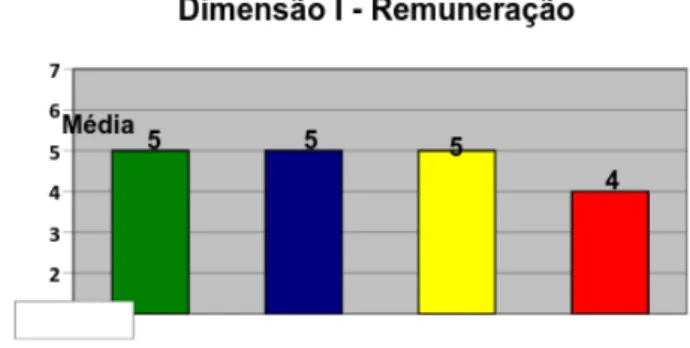
Figure 1 below shows the average level of satisfaction with the subcategories of Dimension I - Compensation.. Figure 1 - Average satisfaction of professionals according to
Dimension I - Remuneration. Palmas/TO, 2014
Source: Field survey data. Palmas/TO, 2014.
According to figure 6, the lowest mean ( = 4) was obtained in the subcategory Benefits, in which the professionals according to the satisfaction level scale were classified as neutral. In the other subcategories they are slightly satisfied, whose average satisfaction was 5. This data was divergent from the research developed at the Hemocentro de Pelotas-RS, in which it pointed out the employees as dissatisfied with regard to benefits and salary equity.7 It should be noted that Remuneration must be fair
and adequate, since the professional must satisfy his/her wishes, as well as his personal and economic needs.3
According to the two factors theory of Frederick Herzberg’s motivation, particularly the theory of hygienic factors, he states that lack of salary, benefits, among other pertinent sub-items to remuneration, triggers high levels of job dissatisfaction.
However, according to a study carried out to evaluate job satisfaction as an indicator of quality in the management of human resources in nursing, he pointed out that remuneration is considered a factor generating dissatisfaction, but it is not the main determinant of job satisfaction.8
Therefore, it should be noted that although the research results showed neutrality in the subcategory benefit, the collaborators showed some satisfaction, considering the general average of this dimension of 5 (slightly satisfied). Despite the average dimension, improving this category is relevant, while this neutrality may generate satisfaction in the same way that it may also generate dissatisfaction, a fact that is negative in relation to the quality of life at work.
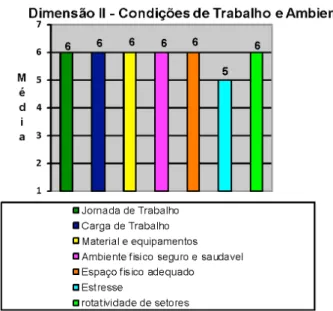
Figure 2 shows the average level of satisfaction in relation to the subcategories of Dimension II - Working conditions and environment in which it indicates items such as working hours, workload, material and equipment, a safe and healthy physical environment, adequate physical space, stress and turnover in the sectors.
Figure 2 – Average satisfaction of professionals according to
Dimension II - Working Conditions and Environment. Field research. Palmas/TO, 2014
Source: Field survey data. Palmas/TO, 2014.
In Figure 2, the lowest mean ( = 5) was obtained in the subcategory stress, in which the professionals according to the level of satisfaction of the research were slightly satisfied, however the other subcategories of dimension II, the average satisfaction was 6 indicating satisfaction, considered an unusual event in the labor context of health professionals in the current Brazilian reality, since in the case of health professionals these issues are constantly cited and claimed.
Although the data have been positive in this regard, the individual likes what they exercise professionally when they perform activities that match their abilities, however, the environment and physical conditions of work can disrupt if it is inappropriate resulting in dissatisfaction.9
To do this, to institute new forms of organization in terms of workload, working day, work environment, in order to reduce the wear and exhaustion of workers, especially nursing, and consequently lower rate of illness and dissatisfaction of this professional.
Dimension III - Use and Capacity Development, listed the items: autonomy for the execution of the work, self-control, space to develop skills, information about their actions developed in the work and information about the work process as a whole. In all the dimensions of this dimension, the average satisfaction was 6, it can be concluded that the professionals are satisfied. This result is important, since it indicates the professional’s appreciation in the development of individual abilities and potentialities, which are fundamental to the community.
The use and capacity development factor, suggests the good use of human talent, or intellectual value and thus adopt the need to grant autonomy, to stimulate the use of the complete competence of each individual in the performance
of their functions and constant feedback on the implications obtained At work and the process as a whole.10
This assertion is ratified by the intrinsic relationship in which the individual is motivated when they satisfy their human needs. In this way, observing and detecting individual skills and competences in a team and thus valuing it can ensure that this institutional action, whether public or private, provides greater productivity and quality of services from individual valuation.11
Figure 3 concerns dimension IV - Opportunity for Growth and Stability.
Figure 3 - Average satisfaction of professionals according to
Dimension IV - Opportunity for Growth and Stability. Field research. Palmas/TO, 2014
Source: Field survey data. Palmas/TO, 2014.
In figure 3, the professionals were highlighted in the employment stability subcategory ( = 6), indicating satisfaction. However, the career possibility subcategory obtained a lower mean ( = 4), in which professionals were placed as neutral according to the scale adopted in this study. Although the nursing professionals were indifferent about the functional progression in the service, it was still superior to the one found in the Hemocentro de Pelotas - RS study, in which it pointed out the servers as dissatisfied in this question.7
Although the other sub-categories of Dimension IV presented positive values related to satisfaction, placing the average of the dimension at 5, it is worth noting that, because it is a Public Institution, there is in some way an impingement of the function exercised, making this professional impossible Within the service.
In this context, the opportunity for growth and stability encompasses policies of the institution that matches with the development and safety of its employees, so this statement represents how much the organization appreciates its employees. Therefore, it is considered that the recognition and the opportunities in the work interfere yes, positively, in the satisfaction of the professional and consequently in the quality of life in the work.10
Figure 4 presents Dimension V - Social integration in the service, which involves equality of opportunity and
cultivation to the good relationship, items that pertain to the contentment of the individual in the exercise of his function. Figure 4 - Average satisfaction of professionals
accord-ing to Dimension V - Social integration in the service. Field research. Palmas/TO, 2014
Source: Field survey data. Palmas/TO, 2014.
Figure 4 that involves dimension V presented greater prominence in the relationship category with the team (
= 7), in which the professionals were classified as quite satisfied. The lowest satisfaction rate ( = 5) was concentrated in the categories: vacation negotiation, equal opportunities and participation in decision-making, in which professionals were slightly satisfied. In the other categories of this dimension, all had satisfaction ( = 6). Taking as a parameter the averages of each category and still, the general average of the dimension that was of 6, it can be said that all the professionals are satisfied.
Thus, social integration in the organization refers to the presence of respect, harmonious place, mutual assistance and absence of prejudices and hierarchical differences in the institution as indicators of satisfaction.12
Thus, in a work team, the good relationship between the team’s employees, and finally, the interpersonal factor, in the broader context, favors social interaction at work, even if their salary is not attractive or consistent with their function. This affirmation was verified in this research, in which the professionals, despite being neutral in relation to the benefits, did not interfere negatively in their relationship between the team.
Therefore, the relationship between people in the service in a permanent and effective way contributes to decrease absenteeism and turnover, generating positive aspects for the Institution.
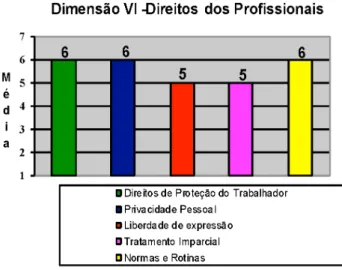
In figure 5 that involves the dimension VI, it indicates the Rights of the Professionals, that is, it shows norms and rules in the institution and if it follows the labor legislation.
Figure 5 - Average satisfaction of professionals according to
Dimension VI - Rights of Professionals. Field research. Pal-mas/TO, 2014
Source: Field survey data. Palmas/TO, 2014.
In figure 5, which covers the dimension VI, despite the positive result regarding satisfaction, the categories freedom of expression and impartial treatment obtained the lowest average 5, highlighting the professionals as slightly satisfied.
Measuring the degree to which employee rights are exercised at the institution suggests respect for labor rights; Personal privacy, sometimes distant from the contemporary business environment; Free wills are linked to the constitution of quality of life at work.10
So instituting and preserving workers’ rights, as well as the privacy and manifestation of individual opinion is understood as a way of human appreciation in their professional scope, highlighting what says Maslow’s theory in which the individual is motivated to fulfill his needs Preferably.
Dimension VII addressed work and social life, which consists of the balance between personal and work life, a positive fact with regard to the health of the worker. We found, therefore, an average of 6 regarding satisfaction in all categories of this dimension.
This data is positive when considering the current reality regarding the sickness of the professional of Nursing, where the majority is due to the imbalance between the personal life and the work causing physical and mental exhaustion.
The quality of life of people is linked to work, family, leisure, friends, religion and affection, because the professional can not be a person in the company and another outside of it. Therefore, the quality of life at work must be categorically established in the general context where there is any form of work, taking into account professional life, of course, but also personal, so that the individual can achieve without compromising his or her health between private life and the activity it carries out.13
Facing dimension VIII, which includes the social relevance of work in life, all categories, employee perception
regarding the image of the institution, social responsibility of the institution in the community and responsibility for services and products, achieved satisfaction, presenting average 6.
In order to reach the level of employee satisfaction, to be proud of being part of the company and the contribution of the organization in a positive way to society is relevant with regard to quality of life at work.13
In this way, it is important to emphasize that pride, satisfaction in belonging to a given institution, coupled with the social commitment that it represents for society, attributes this employee an unparalleled contentment that adds directly to the quality of life at work.
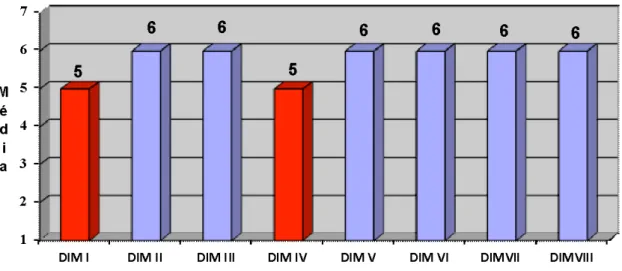
After analyzing the results separately from the eight conceptual dimensions of satisfaction, it is necessary to demonstrate the general mean of each dimension, in a succinct way for a better understanding and display of the data obtained, besides allowing a comparison and an overall closure of the average of satisfaction of ATDO/HCP nursing professionals.
Figure 6 - Overall satisfaction of nursing professionals according to conceptual dimensions. Field research. Palmas/TO, 2014
Source: Field survey data. Palmas/TO, 2014.
According to figure 6, in dimensions I and IV and in the subcategory stress of dimension II professionals were slightly satisfied, whose mean was 5. In the other dimensions, they were satisfied ( = 6). According to the scale proposed in the research and considering the global average ( = 6), professionals are satisfied, an extraordinary event, because it is a nursing team in which negative aspects constantly overlap with the positive aspects of the profession.
Annual report produced in 2013 by Quality Management - HCP GQUA indicated a donor satisfaction index of 96.5%.14 Given this data, it can be said that the satisfaction
of the product: DONOR is a reflection of the satisfaction of the service: TEAM.
Thus, “you can not talk about quality of products and services if those who will produce them do not have quality of life at work.” Thus, the result of the research verified the author’s statement, while the team was satisfied and, consequently, Quality of Life at Work.3
CONCLUSIONS
The conceptual dimensions of Walton were inherent to this research, while knowing worker’s QVT becomes necessary for the globalized contemporary world in which the human factor stands out as a real tool for service success, given that from these dimensions it was possible To quantify the level of satisfaction of the ATDO professionals, the main target of the analysis, and thus to idealize actions and corrective measures in an effective way, and not immediatist in relation to QVT.
In this context, it was possible to verify as a global average of the survey 6, which indicates satisfaction and, consequently, QVT, despite the category benefits and career possibility have presented average 4, ie neutrality.
It is worth remembering that despite the subcategory stress show if with the result slightly satisfied, it is pertinent to adopt strategies that improve this item of dimension II until because in dealing with nursing stress is one of the main villains that affects this profession, as bad consequences for organization The increase of absenteeism, delays, turnover, poor performance, accidents are some of them, already as
is incident, in which it is defined as a psychic disorder of a depressive character preceded by physical, mental exhaustion in the Majority in the course of stress in the professional practice. However implementing the practice of physical exercises, meditation, relaxation techniques are some measures that can minimize and even eradicate this common problem in the professional context.
Therefore, the accomplishment of this research in the general scope was of great relevance, mainly, in relation to the shortage of compendia on the subject, and in particular with HCP that from the organizational point of view knew the level of satisfaction of the ATDO team.
Thus, this study will enable the competent manager of this Institution to insert such a strategy in order to monitor the QVT-professional indicators considering that it is a dynamic process and vulnerable to changes and, with this, to ensure the satisfaction and QVT of the professionals and, consequently, Service excellence.
REFERENCES
1. Matos FG. Empresa feliz. 3. ed. São Paulo: Ed Makron Books; 1996. 2. Goulart IB. Psicologia organizacional e do trabalho: teorias e temas
correlatos. São Paulo: Casa do Psicólogo; 2002.
3. Fernandes EC. Qualidade de vida no trabalho: como medir para melhorar. Casa da Qualidade. Editora Ltda; 1996.
4. Ludwig ST, Rodrigues ACM. Doação de sangue: uma visão de marketing. Cad. Saúde Pública. 2005; 21 (3): 932-39.
5. Gil AC. Métodos e técnicas de pesquisa social. 6. ed. São Paulo: Ed Atlas; 2008.
6. Brasil. Ministério da Saúde. Resolução do Conselho Nacional de Saúde - N° 466/2012. Brasília (DF): MS; 2012.
7. Garcia DF. Qualidade vida no trabalho: a satisfação dos servidores do Hemocentro regional de Pelotas/RS. Escola de Administração UFRGS, Janeiro de 2012.Disponivel em:http://www.lume.ufrgs.br/ bitstream/handle/10183/67699/000870012.pdf.
8. Siqueira VTA, Kurcgant P. Satisfação no Trabalho: indicador de qualidade no gerenciamento de recursos humanos em enfermagem. Revista da Escola de Enfermagem. USP. 2012; 46 (1):
151-57. Disponível em: http://www.revistas.usp.br/reeusp/article/ viewFile/40931/44429.
9. Maximiano ACA. Teoria geral da administração: da escola cientifica a competitividade em economia globalizada. São Paulo: Ed Atlas; 1997. 10. Vasconcelos AF. Qualidade de Vida no Trabalho: origem, evolução e
perspectivas. Caderno de Pesquisa em Administração. 2001; 8 (1): 23-35 Disponível em: http://www.luzimarteixeira.com.br/wp-content/ uploads/2009/06/qualidade-de-vida-no-trabalho-origem.pdf. 11. Krumm DJ. Psicologia do Trabalho: uma Introdução á Psicologia
Industrial/ Organizacional. Rio de Janeiro: Ed LTC; 2005. 12. Carvalho FJ, Martins TPE, Lucio L, Papandrea JP. Qualidade de
Vida no Trabalho e fatores motivacionais dos colaboradores nas organizações. Educação em Foco, 2013; Ano 9 (7): 21-31. Disponivel: http://wwwUnifra.edu.br/revista_eletronica/revistas/gestão_foco/ artigos/ano2013/setembro/qualidade_motivação.pdf.
13. Karpinski D, Stefano RS. Qualidade de vida no Trabalho e satisfação um estudo de caso no setor atacadista de Beneficiamento de Cereais. Revista Eletrõnica Lato Sensu. 2008; Ano 3 (1): 1-16. Disponivel em: http://www.file:///C:/Users//Downloads/QVT4%20(4).pdf. 14. HCP, Hemocentro Coordenador de Palmas. Gestão da qualidade:
informações canal de comunicação cliente. Palmas (TO); 2013.
Received on: 04/10/2016 Reviews required: No Approved on: 04/01/2017 Published on: 10/04/2018 _________
Author responsible for correspondence:
Jaqueline Miranda Barros Silva Avenida Teotônio Segurado 1501 Sul, Palmas/TO ZIP Code: 77019-900