Received from Universidade Federal de Sergipe (UFS), Brazil.
1. Medical Student of UFS
2. Masters in Health Sciences; Anesthesiologist of Hospital Universitário da UFS; Coordina-tor of Anestesiologia do Hospital Universitário da UFS
3. Anesthesiologist of Cooperativa de Anestesiologia de Sergipe
Submitted on August 11, 2010. Approved on December 13, 2010.
Correspondence to:
Dr. Austeclínio Newton Marinho Andrade SPECIAL ARTICLE
Assessment of the Stress Level of Anesthesiologists of the
Sergipe Anesthesiologists Cooperative
Austeclínio Newton Marinho Andrade
1, Marco Antônio Costa de Albuquerque, TSA
2,
Aley Newton Marinho Andrade
3Summary: Andrade ANM, Albuquerque MAC, Andrade ANM – Assessment of the Stress Level of Anesthesiologists of the Sergipe Anesthesio-logists Cooperative.
Background and objectives: To assess the impact caused by stress on occupational health of anesthesiologists in Sergipe and to propose solutions to improve work conditions, quality of the service provided, and quality of life.
Methods: WHOQOL-BREF questionnaire was applied; the sample size was determined by the Barbetta method; and Student t test and Analysis of Variance were used for intergroup comparisons, considering significant a p < 5%.
Results: This study demonstrated that the mean weekly working hours is 61.33 hours. In the subjective analysis of quality of life, 53.1% of the respondents had a negative or non-established evaluation. On the item “leisure activities”, 61.2% answered they have very few opportunities or none at all, demonstrating agreement with personal satisfaction and working assessment. The age group of 41 to 52 years old had the best sco-res. A significant difference regarding gender and number of working days/week was not observed. The general domain had lower scores than the others in all variables analyzed.
Conclusions: Excessive working load contributed to a negative self-evaluation on quality of life, besides hindering access to leisure activities. The implementation of a quality policy in work institutions, as well as a personal reevaluation in search of innovation, professional recycling, leisure alternatives, and motivation are factors that can contribute to improve the quality of life and work of these professionals.
Keywords: Anesthesiology; Quality of Life; Stress, Psychology; Occupational Health.
[Rev Bras Anestesiol 2011;61(4): 486-494] ©Elsevier Editora Ltda.
INTRODUCTION
Due to personal and collective needs, occupational health is constantly being discussed. In view of the repercussions cau-sed by stress not only in the professional life of an individual but also in personal and social life, society has been recogni-zing its importance 1,2.
With anesthesiologists the situation is the same, since stress is unavoidable, and it becomes harmful when one cannot con-trol it resulting in physical and psychosocial problems 3.
In the eyes of the population, health care professionals are protected from these problems by the institution they work at, by their colleagues, and by the financial return 4.
However, direct and indirect evidence that this conception is unrealistic do exist, since Anesthesiology is an area identi-fied as being extremely stressful 5, which has been
demons-trated in several studies 5.
We evaluated the level of stress of anesthesiologists of the Sergipe Anesthesiologists Cooperative, relating quality of life and the degree of satisfaction with ones’ health, the number of weekly workdays and shifts, gender, and age group.
This study assessed the impact of stress on their personal and professional life, proposing solutions to improve working conditions, quality of service provided, and quality of life.
METHODS
An exploratory, descriptive, transversal study was undertaken without identifying the volunteers, using a standardized ques-tionnaire.
ASSESSMENT OF THE STRESS LEVEL OF ANESTHESIOLOGISTS OF THE SERGIPE ANESTHESIOLOGISTS COOPERATIVE
with general personal data such as age, gender, working shift, and number of weekly working days; and the second that con-tained the quality of life evaluation through a questionnaire developed by the Quality of Life Group of the World Health Organization, the abbreviated version of the World Health Or-ganization Quality of Life (WHOQOLBREF) whit 26 questions and scores graded from 1 to 5 points 6.
This questionnaire contains two general questions on quali-ty of life and the degree of satisfaction with one’s health, while the remaining 24 involve physical and psychological aspects, social relationships, and environment. With this questionnaire it is possible to subjectively assess the degree of satisfac-tion of the respondent with his/her working capacity, physical appearance, access to information, leisure, sex life, financial status, working and health services conditions, general social relationships, work safety, and housing 6.
The guidelines of the Quality of Life Group of the World Health Organization regarding the questionnaire scores were followed. The Barbetta method was used to define the sample size.
The study population was composed of 104 anesthesiolo-gists, and the tolerable error considered was 5%. We obtai-ned a study sample of 49 anesthesiologists.
The Student t test and Analysis of Variance (ANOVA) were used in the intergroup comparisons, considering a level of significance of 5%. The objective of the Student t test is to compare means between two groups or samples, indepen-dently or paired, assuming the homogeneity of variances, whi-le ANOVA has the same objective, but in case of more than two groups.
The SPSS 17.0 (Statistical Package for the Social Scien-ce) was used in the analysis, and data were expressed as percentage, and mean and standard deviation.
Physicians who refused to participate, professionals that could not be found, and the authors were excluded from the study.
Before answering the questionnaire, all participants signed an informed consent.
RESULTS
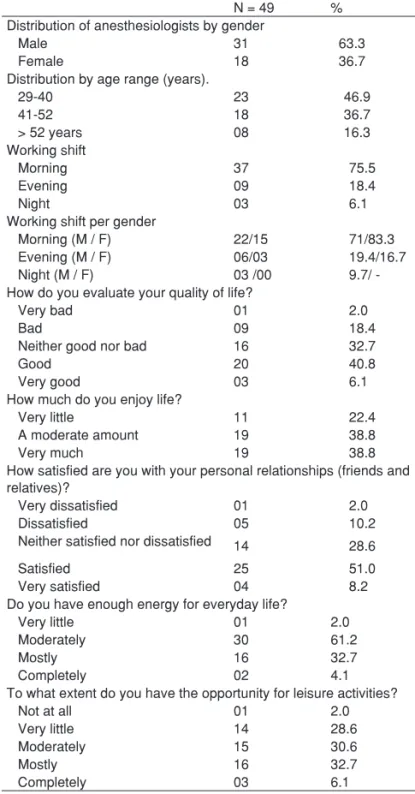
Forty-nine anesthesiologists from the Sergipe Anesthesiolo-gists Cooperative, representing 45.79% of the total, partici-pated in the study. The mean time of employment was 15.04 years, ranging from 3 to 38 years, and mean weekly hours worked was 61.33, ranging from 35 to 90 hours (Table I).
Thirty-one were males (63.3%) and 18 females (36.7%) (Table II). A predominance of the age range between 29 and 40 years, representing 46.9% of the sample, followed by 41 and 52 years (36.7%), and over 52 years (16.3%), was obser-ved (Table II). Participants’ age ranged from 29 to 65 years with a mean of 42.2 years (Table III).
Table I – Time of Employment (years) and Mean Weekly Working Hours
Time of employment Weekly working hours
Mean 15.04 61.33
Standard Deviation 09.30 14.37
Minimal 03 35
Maximal 38 90
Number of anesthesiologists: 49.
Table II – Distribution of Anesthesiologists
N = 49 %
Distribution of anesthesiologists by gender
Male 31 63.3
Female 18 36.7
Distribution by age range (years).
29-40 23 46.9
41-52 18 36.7
> 52 years 08 16.3
Working shift
Morning 37 75.5
Evening 09 18.4
Night 03 6.1
Working shift per gender
Morning (M / F) 22/15 71/83.3
Evening (M / F) 06/03 19.4/16.7
Night (M / F) 03 /00 9.7/
-How do you evaluate your quality of life?
Very bad 01 2.0
Bad 09 18.4
Neither good nor bad 16 32.7
Good 20 40.8
Very good 03 6.1
How much do you enjoy life?
Very little 11 22.4
A moderate amount 19 38.8
Very much 19 38.8
How satisfied are you with your personal relationships (friends and relatives)?
Very dissatisfied 01 2.0
Dissatisfied 05 10.2
Neither satisfied nor dissatisfied 14 28.6
Satisfied 25 51.0
Very satisfied 04 8.2
Do you have enough energy for everyday life?
Very little 01 2.0
Moderately 30 61.2
Mostly 16 32.7
Completely 02 4.1
To what extent do you have the opportunity for leisure activities?
Not at all 01 2.0
Very little 14 28.6
Moderately 15 30.6
Mostly 16 32.7
Table IV – Comparison of Domain Scores by Student t test
Male (n = 31) Female (n = 18) p Physical 70.39 ± 13.50 70.04 ± 14.71 0.932 Psychological 67.34 ± 12.96 65.51 ± 15.84 0.663 Social relationships 65.59 ± 14.71 65.74 ± 17.82 0.975 Environment 63.71 ± 17.63 63.89 ± 15.87 0.972 General 58.47 ± 19.20 59.72 ± 21.67 0.834
Data expressed as mean ± standard deviation.
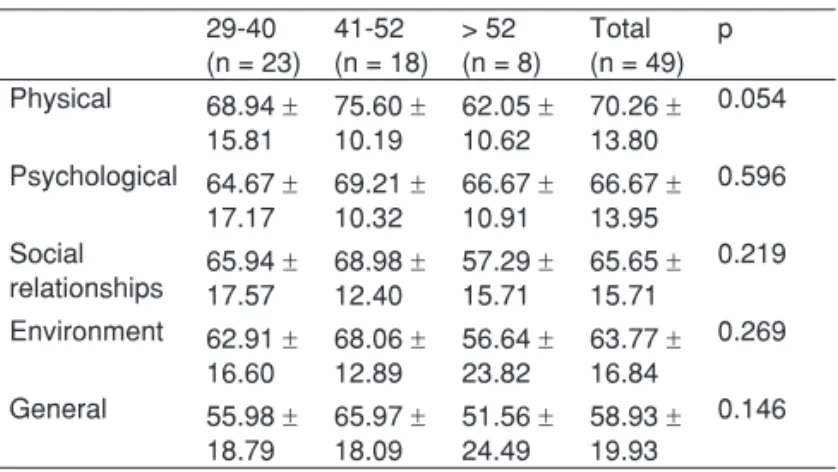
Table V – Comparison of Domain Scores by Age Group (years)
29-40 (n = 23)
41-52 (n = 18)
> 52 (n = 8)
Total (n = 49)
p
Physical 68.94 ± 15.81
75.60 ± 10.19
62.05 ± 10.62
70.26 ± 13.80
0.054
Psychological 64.67 ± 17.17
69.21 ± 10.32
66.67 ± 10.91
66.67 ± 13.95
0.596
Social
relationships 65.94 17.57± 68.98 12.40± 57.29 15.71± 65.65 15.71± 0.219
Environment 62.91 ± 16.60
68.06 ± 12.89
56.64 ± 23.82
63.77 ± 16.84
0.269
General 55.98 ± 18.79
65.97 ± 18.09
51.56 ± 24.49
58.93 ± 19.93
0.146
Data expressed as mean ± standard deviation.
Table VI – Comparison of Mean Weekly Hours Worked According to Time of Employment
Time of employment
# Mean Standard deviation
Minimal Maximal
3-14 years 23 63.13 15.24 40 90
15-26 years 19 56.32 10.29 40 72
> 26 years 07 69.00 17.90 35 90
Total 49 61.33 14.37 35 90
Table VII – Comparison of Domain Scores by Weekly Working Days
4 to 5 days (n = 21)
6 to 7 days (n = 28)
p
Physical 67.86 ± 12.63 72.07 ± 14.58 0.296 Psychological 66.07 ± 14.21 67.11± 14.00 0.799 Social relationships 65.08 ± 15.73 66.07 ± 16.03 0.830 Environment 63.69 ± 14.10 63.84 ± 18.89 0.976 General 59.52 ± 18.50 58.48 ± 21.26 0.976
Data expressed as mean ± standard deviation. The morning shift predominated (75.5%), followed by the
evening shift (18.4%) and nocturnal (6.1%) (Table II).
Among women, 15 work more often in the morning (83.3%) and 3 in the evening (16.7%). Of the women interviewed, none of them work in the nocturnal shift, and among males 3 had a larger working load at night (9.7%), but the morning shift also predominated with 71%, followed by the evening with 19.4% (Table II).
When quality of life was subjectively evaluated (general do-main), 6.1% answered very good, 40.8% good, 32.7% neither good nor bad, 18.4% bad and very bad 2% (Tale II). Regarding how much they enjoy life (psychological domain), 19 answered very much (38.8%); 19 more or less (38.8%); and 11 very little (22.4%) (Table II).
When they were assessed regarding the degree of satis-faction with their personal relationships (social domain), 51% stated they were satisfied; 5 (10.2%) were dissatisfied; and one (2%) was very dissatisfied (Table II). Regarding whether they have enough energy for their daily life (physical domain), 61.2% answered moderately, and only 2% said very little (Table II).
Regarding leisure activities (environmental domain), 28.6% answered they have very little leisure opportunities.
When the scores per gender were compared with Student
t test, a statistically significant difference was not observed in any of the gender-related domains, with a p higher than 5%. Al-though the absolute value of the psychological and physical do-mains was higher among males; among females it was higher in the social, environmental, and general domains (Table IV).
When comparing the scores per domain among the different age groups, we noticed that the age group between 41-52 ye-ars had higher scores when compared to other age groups in all domains (Table V).
Analyzing mean scores according to the length of employ-ment in relation to weekly hours worked, it was observed that professionals with 15 to 26 years of occupation had lower sco-res (56.32) when compared to those with more than 26 years (69) and those with less than 15 years (63.13) (Table VI).
Among the interviewees, a relative variation was observed regarding the number of days worked per week, with a mini-mum of four and a maximini-mum of seven days per week. When the scores of the questionnaire were analyzed it was observed that the differences were not statistically significant (Table VII).
Table III – Descriptive Statistics of Age (years)
# Minimal Maximal Mean Standard
Deviation
ASSESSMENT OF THE STRESS LEVEL OF ANESTHESIOLOGISTS OF THE SERGIPE ANESTHESIOLOGISTS COOPERATIVE
DISCUSSION
This study was carried out with 45.79% of the anesthesiolo-gists of the Sergipe Anesthesioloanesthesiolo-gists Cooperative, a signifi-cant percentage when compared to similar studies 5.
The mean weekly workload of the anesthesiologists in Ser-gipe is 61.33 hours, considered elevated when compared to other professions, but lower than that observed in other pla-ces in the same field. In a study published in 2004 titled “The night shift in Anesthesiology reduces sleep latency”, it was observed that the mean workload was 72 hours 7. It is also
interesting that over the years the mean number of working hours did not decrease, which deserves a deeper analysis explaining the motivating factors for remaining at work with elevated working hours.
On the subjective analysis of quality of life, 53.1% of inter-viewees had a negative or undefined assessment, a higher percentage than a similar study undertaken in Recife, where 44.6% had the same perception 5, and than a study performed
amongst Uruguayan physicians 8, which indicates the need of a
more detailed study to attest such degree of dissatisfaction. Regarding how much they enjoy life, 61.2% answered a moderate amount or very little, also considered a high score that reflects psychological dissatisfaction, corroborating the previous data.
We observed that among respondents, 63.2% considered that they have moderate or very little energy for everyday life.
On the item leisure activities, 61.2% of anesthesiologists answered a moderate amount, or very little or no opportunity at all, revealing that they have a high level of demand and that overwork limits performance of other activities conside-red essential for physical and mental health. They are also dissatisfied with their personal relationships (friends and re-latives), and 40.8% answered dissatisfied, very dissatisfied, or indifferent.
After data analysis, we observed that being an Anesthe-siologist in the State of Sergipe is very stressful, disrupting several aspects of life, causing not only physical and psycho-logical changes, but also in personal and environmental rela-tionships. We propose a reevaluation of all professionals in this field to review working conditions and wages, which are the causative factors of professional dissatisfaction resulting in consequences in physical and psychoemotional health.
Other studies reported similar problems regarding anes-thesiologists. Studies on their personalities observed that they are more reserved, serious, intelligent, assertive, self-sufficient, and uptight when compared to physicians in other specialties 9.
Their specialty gives them the impression that they do not need the cooperation of other physicians. Because they work alone, they feel they have stability and independence, there-fore, they have difficulties in trusting their colleagues fearing the patient will develop severe sequelae, which leads them to trust only their own performance generating psychological and emotional overload, being responsible for the high rate of drug addiction and suicide among these professionals 3.
The creation of a commission to evaluate working condi-tions in the hospitals in the State of Sergipe is of capital im-portance. This commission should be independent and have the support of public and private sectors to put into practice in all hospitals and clinics where anesthesia is performed the Resolution # 1,802/06 of the Federal Medical Board, to im-prove working conditions. In parallel, the Society of Anesthe-siologists of the State of Sergipe can elaborate a proposal to improve the working health of these professionals, searching for subsidies to perform, along with the Anesthesiologists Cooperative, periodical evaluations of these professionals, directly interfering on the insertion of anesthesiologists in the labor force. Additionally, they also should try to improve ne-twork services and guidance on working conditions, as well as evaluate the workload and other factors that interfere with the practice of anesthesiology.
01. Nogueira-Martins lA – saúde mental dos profissionais de saúde. Rev Bras Med trab, 2003;1:56-68.
02. Nogueira-Martins lA – A saúde do profissional de saúde, em: de Marco MA – A Face Humana da Medicina: do Modelo Biomédico ao Modelo Biopsicossocial. são paulo, Casa do psicólogo, 2003.
03. duval Neto gF – dependência Química e os Anestesiologistas, em: Cavalcanti il, Cantinho FAF, Assad AR – Medicina perioperatória. Rio de Janeiro, sAeRJ, 2006;981-989.
ANdRAde, AlBUQUeRQUe, ANdRAde
06. Fleck MpA, louzada s, Xavier M – Aplicação da versão em portu-guês do instrumento abreviado de avaliação da qualidade de vida WHoQol-bref. Rev saúde pública, 2000;34:178-183.
07. Mathias lAst, Coelho CMF, Vilela ep et al. – o plantão noturno em anestesia reduz a latência ao sono. Rev Bras Anestesiol, 2004;54:693-699.
08. schwartzmann l – la calidad de vida de los medicos: estudio de una muestra de medicos del Uruguay. Vertex, 2007;18:103-110.
09. Aragão pW, prazeres Jo, Aragão VMF et al. – pressão arterial do anestesiologista durante o ato anestésico-cirúrgico no período matu-tino. Rev Bras Anestesiol, 2002;52:591-600.
Resumen: Andrade ANM, Albuquerque MAC, Andrade ANM – eva-luación del Nivel de estrés del Anestesiólogo de la Cooperativa de Anestesiología de sergipe.
Justificativa y objetivos: evaluar el impacto que el estrés genera en la salud ocupacional de los anestesiólogos de sergipe, y proponer soluciones para la mejoría de las condiciones de trabajo, calidad del servicio realizado y calidad de vida.
Método: se aplicó el cuestionario WHoQol-BReF, la definición del tamaño de la muestra por el método de Barbetta, y las
comparacio-nes entre grupos por los test t student y Análisis de Varianza. se
consideraron significativos los valores de p < 5%.
Resultados: la investigación demostró que la carga horaria prome-dio semanal de trabajo es de 61,33 horas. en el análisis subjetivo sobre la calidad de vida, un 53,1% de los entrevistados obtuvieron una evaluación negativa o esa evaluación no se estableció. en el aspecto del ocio, un 61,2% respondieron que tienen poca o ninguna oportunidad, demostrando estar a tono con la evaluación de la satis-facción personal y de trabajo. el rango etario entre 41 y 52 años fue el que presentó mejores puntuaciones. No hubo diferencia significativa con relación al género y a los días de trabajo semanales. el dominio general presentó puntuaciones inferiores a los demás en todas las variables analizadas.
Conclusiones: la carga horaria excesiva aportó una autoevaluación negativa sobre la calidad de vida, además de dificultar el acceso al ocio. la implementación de una política de calidad en las institucio-nes de trabajo, como también una nueva evaluación personal bus-cando la innovación, el reciclaje profesional, las alternativas de ocio, y la motivación, son factores que podrán aportar una mejoría de la calidad de vida y de trabajo de esos profesionales.