Vol.49, Special : pp. 73-77, January 2006
ISSN 1516-8913 Printed in Brazil
BRAZILIAN ARCHIVES OF
BIOLOGY AND TECHNOLOGY
A N I N T E R N A T I O N A L J O U R N A L
Determination of N-nitrosamines and N-nitrosables
Substances in Rubber Teats and Sothers by GC-TEA
Eleno Rodrigues Vieira
∗, Nilso José Pierozan and Viviane Lovison
SENAI-CETEPO; São Leopoldo; BrasilABSTRACT
N-Nitrosamines are receiving special attention because they present high mutagenic and carcinogenic potential. They can be found in several areas. In rubber, for example, they can be found in Nipples and Pacifiers. Spiegelhalder and Pressumann, have observed that N-Nitrosamines present in nipples and pacifiers could easily migrate to artificial saliva. They have also observed that a considerable amount of N-Nitrosamines precursors, such as nitrosable amines, could migrate to saliva, increasing the possibility of N-Nitrosamines formation into the stomach of living beings. In 80’s, Holland, Germany and FDA-U.S.A. have established volatile N-Nitrosamines limit levels. In 2002, in Brazil, limit levels came through Resolução RDC n°221 of ANVISA. This resolution refers to NBR10334 and NBR 13793 standards where limits and analysis methods are specified. In this work SENAI-CETEPO presents the method adopted for determination of N-Nitrosamines and N-Nitrosables in nipples and pacifiers. The detection and determination limits of the analytical system as well the method uncertainty were evaluated, in order to demonstrate the adequacy of this technique to comply with the requirements of NBR10334/2003 and NBR 13793/2003 standard.
Key words: N-Nitrosamines, method, nipples and pacifiers
∗ Author for correspondence
INTRODUCTION
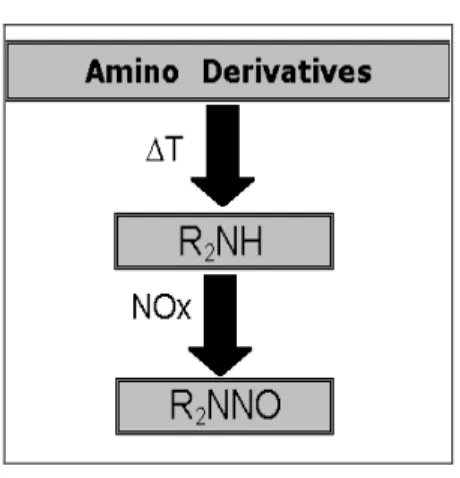
N-Nitrosamine term (NA's) congregates a wide variety of homologous chemical substances of different molecular weights that come from the reaction of amines (especially secondary ones) and nitrosating agents, as shown in Fig. 1[1; 2].
These substances are receiving special attention, because they present high mutagenic and carcinogenic potential that can induce tumors in different places of the organism of some animal species[3; 4].
N-Nitrosamines affect the human being in several ways. These substances can be found in foods, such as bacon, fish, cheese, beer, tobacco, water and also in rubber products [3; 5].
In the rubber area they can be found in several production sites (air in work environment) and in finished goods. Among rubber parts, emphasis is given to those that get in contact with food (food processing machines) and mainly by direct contact with human beings, such as, nipples and pacifiers [2; 6; 7].
NOx = nitrosating agents : N2O2, NO2, N2O3, N2O4.
∆T = heating
Figure 1 - N-Nitrosamines formation.
In 1985, FDA-U.S.A. (Food and Drug Administration) established a maximum level of 10ppb (parts per billion) of total volatile N-Nitrosamines for nipples and pacifiers. Holland and Germany have more strict volatile limits than FDA-U.S.A., which vary from 1 to 20ppb for N-Nitrosamines and 200 to 20 ppb for N-Nitrosable compounds [6].
In 2002, in Brazil, the Resolução RDC n°221 of ANVISA (National Agency of Sanitary Monitoring) determined acceptable limits for N-Nitrosamines and N-Nitrosables in nipples and pacifiers.
To help Brazilian industries concerning N-Nitrosamines determination, SENAI-CETEPO introduced methods for qualitative and quantitative determination of Nitrosamines and N-Nitrosables in rubber goods
Due to the importance of this analysis, it is essential to ensure that the analytical results are reliable in qualitative and quantitative terms. The adoption of a selective and sensible method and the determination of the limits of the analytical system are essential to show the applicability of the method.
In this work SENAI-CETEPO present the method selected and used for accomplishment of the analyses of N-Nitrosamines and N-Nitrosables in nipples and pacifiers. The limit of detection, limit of determination of the analytical system and the uncertainty of the method are evaluated, as a means of evaluating the sensitivity of the technique and demonstration of its adequacy, to
MATERIALS AND METHODS
Materials
Lab glassware , calibrated lab glassware, solvents (Methylene Chloride and n-Hexane P.A.), standardized solutions (NaOH 0,1 and 1M and HCl 0,1 and 1M), artificial saliva solution, Rota-evaporator (Büchi), Gas Chromatograph equipment (Perkim Elmer) -Autosystem XL and TEA detector (Thermo Energy Analyser) were used.
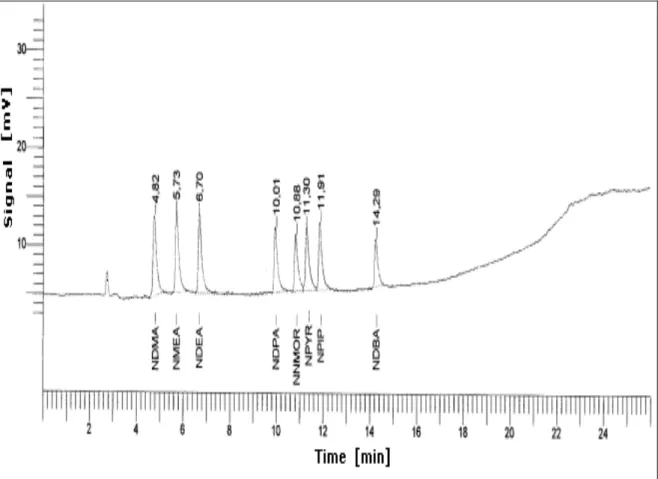
TEA detector is specific for N-Nitrosamines detection. It shows signals based on chemiluminescense emitted when excited NO2,
stechiometrically generated from a N-Nitroso group (NNO) from N-Nitrosamine decline, inducing a emission of a wave length of 600nm (Chromatogram - Fig. 2).
The standards used were: calibration standard - N-Nitrosamines MIX - EPA 8207 and a internal standard - N-Nitrosodiisopropilamine (NDiPA).
Methods
NBR10334 e NBR 13793 standard, referred to on Resolution - RDC n°221, establish the limits for N-Nitrosamines and N-Nitrosables in Nipples and Pacifiers and make reference to EN12868 and ASTM 1303 standard for Nitrosamines and N-Nitrosables analysis. The limits are 10 ppb for any type of N-Nitrosamines and its total amount cannot exceed 20ppb and N-Nitrosable cannot exceed 100ppb.
In this case, the techniques to detect these levels are liquid and gas Chromatography[8].
Based on NBR standards, international adopted methods and cooperative studies with DIK (Deutsches Institut für Kautschuktechnologie e. V.), SENAI-CETEPO made the choice for the analysis method presented on the European standard EN12868.
Figure 2 - Time (minutes) x Signal (mV) - Chromatogram - Analysis Register of N-Nitrosamines MIX - EPA 8207 by CG-TEA.
Table 1 - Investigated N-Nitrosamines
N-Nitrosodimethylamine (NDMA) N-Nitrosodiethylamine (NDEA) N-Nitrosomethylethylamine (NMEA) N-Nitrosodipropylamine (NDPA) N-Nitrosodibutylamine (NDBA) N-Nitrosopyrrolidine (NPYR) N-Nitrosopiperidine (NPIP) N-Nitrosomorpholine (NMOR)
The qualitative analysis is made by comparison of the retention time of sample peaks with the retention time of standard ones registered in the chromatograms.
The quantitative analysis is made by the correlation of areas of the standard peaks and the sample ones. An internal standard is used for accounting losses during sample working (extraction and concentration). Area values of the internal standard and sample are used in the equations defined in the quantification method, when N-Nitrosamine is identified.
A
B
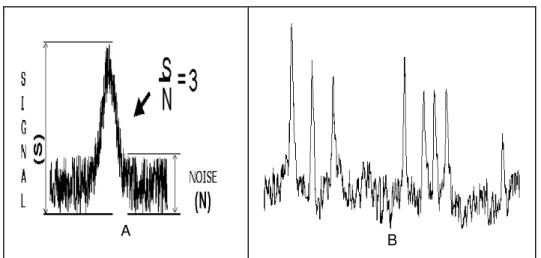
Figure 3 - A - Relation noise-signal that identifies the absolute detection limit. B - Amplified region of the chromatogram from the 20 ng/mL standard.
The absolute determination limit of the analytical method was also evaluated, using 10g of sample (similar to the method) which was submitted to extraction in artificial saliva and after preparation, the extract was concentrated to 1,5mL. Considering these values and the absolute limit of detection 0,02ng, the value evaluated as determination limit of the analytical method is 30ng of N-Nitrosamine/10g of sample = 3µg/kg (µg/kg=ppb).
The uncertainty of the method was evaluated according to ISO-GUM guide and it is approximately ± 20% for a confidence level of 95%.
RESULTS AND DISCUSSION
It was observed that the analysis method is complex and that the maximum limits allowed according to NBR10334 and NBR 13793 standard are in magnitude of ppb=µg/kg. Since the values are very low, it is necessary to use a technique with great sensibility.
The adopted method, where sample is extracted with artificial saliva and N-Nitrosamines are analysed by CG-TEA, according to EN12868 and it presents the following relevant aspects:
•An absolute detection limit of the measurement system - CG-TEA of 0,02 ng.
•A determination limit of the analytical method is 3 µg/kg = 3ppb.
•uncertainty of ± 20% for a confidence level of 95%.
It was possible to show that the method used is adequate to determine Nitrosamines and N-Nitrosable according to the required limits in NBR standards and other.
It is also very important to consider the TEA detector, since it is specific for N-Nitrosamines detection and it’s very sensitive.
Using a universal detector as FID (Flame ionization detector) for this analysis, the obtained chromatogram would present many interfering peaks, reducing the detection sensibility and making qualification a complex task.
This analytical method was strictly followed under well established procedures and it was accredited by INMETRO.
CONCLUSION
Deutsches Institut für Kautschuktechnologie e. V.
Departamento Nacional do Serviço Nacional de Aprendizagem Industrial
SENAI
-CETEPO Centro Tecnológico de Polímeros - SENAI
REFERENCES
[1] Sanches, P. J. F.; Zanin, K. E.; Camarão, E.B.; Garcia, R. C.; Rios, A. and Válcarcel, M. (2003), Pré-concentração de nitrosaminas a partir de amostras aquosas por extração em fase sólida e cromatografia capilar eletrocinética micelar.
Química Nova, 26 : (2), 193-196.
[2] Pierozan, N. J. (2003), Nitrosaminas na indústria da borracha. Borracha Atual, 24, 41-42.
[3] Kataoka, H.; Shindoh, S. and Makita, M. (1996), Selective determination of volatile n-nitrosamines by derivatization with diethyl chlorothiophosphate and gas chromatography with flame photometric detection. Journal of chromatography A, 723, 93-99.
[4] Domanska, K. and Kowalski, B. (2002), Effect of different storage conditions on n-nitrosamine content in polish edible offals processed meat products. Bull. Vet. Inst. Pulawy, 46, 317-324. [5] Nitroisaminas (2004), Disp. in: http://www.ff.
up.pt/toxicologia/monografias/anoo3o4/Nitrosami nas/nitrosaminas.htm Access in: 22 mar. 2004.
[6] Glória, M. B. A. (1991), N-Nitrosamines in baby bottle and pacifiers. Ciência e Cultura, 43, 44-47. [7] Fiddler, W.; Pensabene, J.; Sphon, J. and
Andrzejewski, D. (1992), Nitrosamines in rubber bands used for orthodontic purposes. Fd. Chem. Toxic., 30 : (4), 325-326,.
[8] Sanches, P. J. F.; Rios, A.; Válcarcel, M.; Zanin, K. E. and Camarão, E. B. (2003), Determination of nitrosamines in preserved sausages by solid-phase extraction - micellar electrokinetic chromatography. Journal of chromatography A,
985, 503-512.