Article
0103 - 5053 $6.00+0.00
*e-mail: [email protected]
Synthesis and Biological Activity of Novel Statine Derivatives
Containing Ferrocenyl Moiety
Lijun Gu, Bingqin Yang* and Feilong Liu
Key Laboratory of Synthetic and Natural Functional Molecule Chemistry (Ministry of Education), Department of Chemistry, Northwest University, Xi’an 710069, People’s Republic of China
Na busca por novos inibidores de protease aspartica, conjugados de ferroceno com estatina foram planejados e sintetizados através de reação de aclopamento usando o protocolo padrão
N,N’-diciclohexilcarboimida (DCC) e 1-hidroxibenzotrizol (HOBt). Os novos compostos foram caracterizados por espectroscopia de IR, 1H NMR, MS e análise elementar. Os resultados do
bioensaio mostraram que alguns dos novos compostos podem servir como ponto de partida.
In a search for new aspartic protease inhibitors, conjugates of ferrocene with statine were designed and synthesized by coupling reaction using the standard N,N’-dicyclohexylcarbodiimide (DCC) and 1-hydroxybenzotriazole (HOBt) protocol. The title compounds were characterized by IR, 1H NMR spectroscopy, MS and elemental analysis. The results of bioassay showed that some
title compounds could serve as a starting point.
Keywords: statine, ferrocene, aspartic protease, synthesis, biological activity
Introduction
Aspartic proteases are involved in many biological pathways in fungi, plants, humans, parasites, retroviruses.1-2
Aspergillus oryzae aspartic proteinase is found to have activity not only for the activation of trypsinogen but also for the activation of chimotrypsinogen with the cleavage of the Arg15-Ile16 bond.3 Statine, the (3S, 4S )-4-amino-3-hydroxy-6-methylheptanoic acid conigurational isomer is a key component of pepstatin and of other synthetic peptide inhibitors of aspartic protease.4 It is well known that long-chain peptides can exhibit poor penetration and are generally unsuitable for a metabolically stable drug, because of enzymatic degradation.5 In many case, this inconvenience can be circumvented by shortening the length of the inhibitors.
Ferrocene is a member of a special organometallic group known as metallocenes or “sandwich” molecules. Among metallocenes there are compounds with antiproliferative effect, antibiotics, and inhibitors of enzymes.6-9 Conjugates of ferrocene with well-known drugs were reported.10-11 Ferrocene-containing compounds often possess unexpected biological activity.12 We report here the search for shorter aspartic protease inhibitors resulting from introducing
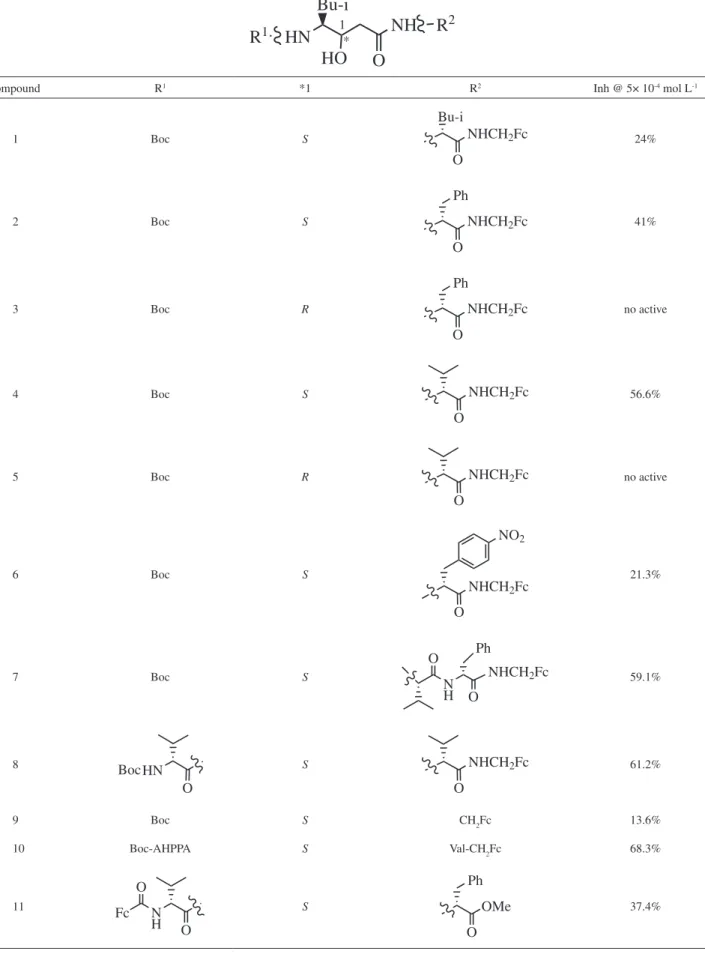
ferrocenyl unit into statine and synthesized the novel statine derivatives which might provide interesting biological properties. The structure of target compounds is listed in Table 1.
Experimental
Materials and equipment
Table 1 Structure of target comounds and their biological activities
Bu-i
HN
HO
R
1O
NH
R
2 *1
Compound R1 *1 R2 Inh @ 5× 10⁻⁴ mol L -1
1 Boc S
Bu-i
NHCH2Fc
O
24%
2 Boc S NHCH2Fc
O Ph
41%
3 Boc R NHCH2Fc
O Ph
no active
4 Boc S NHCH2Fc
O
56.6%
5 Boc R NHCH2Fc
O
no active
6 Boc S
NHCH2Fc
O
NO2
21.3%
7 Boc S
N H
NHCH2Fc
O Ph O
59.1%
8 HN
O
Boc S NHCH2Fc
O
61.2%
9 Boc S CH2Fc 13.6%
10 Boc-AHPPA S Val-CH2Fc 68.3%
11 Fc N
H O
O
S
Ph
O
General procedure A: Coupling reactions using DCC / HOBt
The amino compound (1 mmol) was dissolved in DCM (1 mL) and DMF (1 mL). Boc-amino acid (1.25 mmol) and HOBt (1.4 mmol) were added followed by a solution of DCC (1.4 mmol) in DCM (3 mL). The reaction mixture was allowed to stir at 0 ˚C for 5 h and at room temperature overnight. DCU was iltrated, and the iltrate was evaporated under reduced pressure. The residue was dissolved in ethyl acetate, washed successively with cold 1 mol L-1 HCl, saturated NaHCO
3, and saturated NaCl, and dried (MgSO4). The peptide was puriied by silica gel chromatography (3% methanol in chloroform (v/v)).
General procedure B: Removal of the tert-butoxycarbonyl group
The Boc-peptide (1 equiv.) in a solution of 4 mol L-1 HCl in dioxane (10 equiv. of HCl) was stirred at room temperature and the reaction monitored by TLC. Complete reaction was generally achieved in about 30 min. Excess reagent was removed under reduced pressure to give a solid residue. The residue was washed three times with ethyl ether and dried in vacuum over KOH and P2O5 for several hours. The resulting hydrochloride was used without further puriication. The hydrochloride was neutralized with NMM in DCM to give free amine.
Bioassay method
The inhibition of the tested bacteria (Aspergillus oryzae) was determined with the method of dull colony notation.16 All
compounds tested were dissolved in DMSO (500 μmol) and subsequently diluted in the culture medium before treatment of the suspension ofthe tested bacteria. The suspension at three concentrations was inoculated on the culture medium treated with compound and incubated at room temperature for 60 h. In parallel, the tested bacterial was treated with DMSO as control. For each compound, three repetitions were conducted to ensure the reliability of the results. The percent inhibition was determined using the following relationship: inhibition rate (%) = [av colony numbers of control (not treated with compound) - av colony numbers smeared with drugs] / av colony numbers without drugs.
Results and Discussion
The representative synthesis of various inhibitors containing ferrocenyl moiety is outlined in Scheme 1 and 2. Boc-protected leucine 13 was coupled to aminomethylferrocene 12 using DCC and HOBt as the coupling agent. The Boc-group was removed by treatment with 4 mol L-1 HCl in dioxane, neutralized with N -methyl-morpholine (NMM), and the resulting free amine was allowed to couple subsequently with N-Boc-statine using the same coupling sequence to give the compound 1. Other compounds (such as 5, 7,etc.) in Table 1 were prepared by analogous sequence as described above.
Phenylalanine methyl ester hydrochloride 16 was neutralized with NMM. Using the method described above, compound 11 was obtained in 27.6% yield for the coupling/ deprotection steps.
The target compounds are characterized by IR and
1H NMR spectroscopy, MALDI-TOF MS and elemental
analyses. The results are in accordance with the expected
+
Bu-i
NHBoc
HO2C
14 13
12
a
15 1
NH2 HN
O Bu-i
NHBoc b
H N
O Bu-i
NH2 .HCl c, d
H N
O Bu-i
N H
O OH
Bu-i NHBoc Fe
Fe
Fe
Fe
Scheme 1. Synthesis of compound 1. Reagents and conditions: (a) DCC/HOBt; (b) 4 mol L-1 HCl/dioxane; (c) NMM/DCM, (d) N-Boc-statine, DCC/
structures. In the mass spectra they give peaks corresponding to the molecular ion. In the case of compounds 1-10, an intense fragment ion was observed at m/z 199 and is due the [FcCH2]+ cation. Fragment ions corresponding to [M-65]+ were also noted. This corresponds to loss of the unsubstituted (η5-C
5H5) ring.
For compounds 1-10, their 1H NMR spectra are characteristic: the ferrocenyl substituent gives rise to a ive-proton singlet for the unsubstituted cyclopentadienyl ring and a multiplet for the monosubstituted ring. The protons of the methylene unit adjacent to the ferrocene moiety appear as a doublet often overlapping with the singlet of the (η5-C
5H5) ring.
In compound 11, the (η5-C
5H5) ring appears as a singlet in 1H NMR spectrum at δ 4.21 whereas the meta and ortho protons on the (η5-C
5H4) ring are present at δ 4.27 and 4.71, respectively. The characteristic bands of the ferrocenyl group in the IR spectra of the compound 2 appear at 3091, 1440, 1277, 1175, 1041 and 744 cm-1.
All the target compounds were screened against the tested bacteria (Aspergillus oryzae) and the results of their biological activity are shown in Table 1. Replacing valine with leucine, phenylalanine or 4-nitro-phenylalanine residue renders lower activity (4 vs 1, 2, 6, Table 1). This might suggest that the valine residue is necessary. Truncation of the C-terminus by removal of the C-terminal amino acid residue resulted in some loss of potency (1, 2, 4,
7 vs 9, Table 1). Compound 8 was found to have an activity of 61.2% inhibition and higher than compound 4. This might indicate that amino acid residue of N-terminus is very important. Compound 3 and 5 having the R-coniguration, and as expected they have no activity. Replacing Boc group with FcCO-Val residue leads to inhibitor 11 with 37.4% inhibition. Interestingly, bis-statine based compound 10
has an activity of 68.3% inhibition and higher than others.
Conclusions
In conclusion, a novel series of statine derivatives with short peptides containing ferrocenyl moiety have been prepared. All the compounds were characterized by elemental analyses, MS, 1H NMR and IR spectra. The results of bioassay showed that compounds 4, 8 and 11
might serve as a starting point.
Acknowledgements
The authors thank the National Natural Science Foundation of China (No. 20572085, 20472067) for inancial support.
Supplementary Information
Supplementary data are available free of charge at http:// jbcs.sbq.org.br, as PDF ile.
References
1. Abdel-Meguid, S. S.; Med. Res. Rev. 1993, 13, 731. 2. Dunn, B. M.; Chem. Rev. 2002, 102, 4431.
3. Matsubara, H. & Feder, J. In The Enzymes; Boyer, P. D., eds.; 3rd Ed., Academic Press: New York, 1994, vol. 3, pp. 721. 4. Umezawa, H.; Aoyagi, T.; Morishima, H.; Matzuzak, M.;
Hamada, M.; Takeuchi, T.; J. Antibiot.1970, 23, 259; Rich, D. H.; J. Med. Chem 1985, 28, 263; Leung, D.; Abbenante, G.; Fairlie, D. P.; J. Med. Chem. 2000, 43, 305.
5. Fehrentz, J. A.; Chomier, B.; Bignon, E.; Venaud, S.; Chermann, J. C.; Nisato, D.; Biochem. Biophys. Res. Commun. 1992, 188, 873.
6. Dombrowski, K. E.; Baldwin, W.; Sheats, J. E.; J. Organomet. Chem. 1985, 302, 281.
Scheme 2. Synthesis of compound 11. Reagents and conditions: (a) NMM/DCM, (b) N-Boc-statine, DCC/HOBt; (b) 4 mol L-1 HCl/dioxane; (c) NMM/
DCM; (d) FcCO-Val-OH, DCC/HOBt, 27.6% for steps (a)-(d).
Ph
NH
2HCl
MeO
2C
Ph
N
H
O
MeO
O
OH
Bu-i
NHBoc
a, b
c, d
N
H
H
N
N
H
O
MeO
Ph
O
OH
Bu-i O
O
17 16
11
7. Top, S.; Vessières, A.; Cabestaing, C.; Laios, I.; Leclercq, G.; Provot, C.; Jaouen, G.; J. Organomet. Chem. 2001, 637, 500. 8. Biot, C.; Delhaes, L.; Abessolo, H.; Domarle, O.; Maciejewski,
L. A.; Mortuaire, M.; Delcourt, P.; Deloron, P.; Camus, D.; Dive, D.; Brocard, J. S.; J. Organomet. Chem. 1999, 589, 59. 9. Silva, B. V.; Ribeiro, N. M.; Pinto, A. C.; Vargas, M. D.; Dias,
L. C.; J. Braz. Chem. Soc.2008, 19, 1244.
10. Edwards, E. I.; Epton, R.; Marr, G.; J. Organomet. Chem. 1976,
107, 351.
11. Edwards, E. I.; Epton, R.; Marr, G.; J. Organomet. Chem. 1976,
122, C49.
12. Biot, C.; Delhaes, L.; Abessolo, H.; Domarle, O.; Maciejewski, L. A.; Mortuaire, M.; Delcourt, P.; Deloron, P.; Camus, D.; Dive, D.; Brocard, J. S.; J. Organomet. Chem. 1999, 589, 59; Huang, R. Q.; Wang, Q. M.; J. Organomet. Chem. 2001, 637, 94.
13. Rich, D. H.; Sun, E. T.; Boparai, A. S.; J. Org. Chem. 1978, 43, 3624; Rich, D. H.; Sun, E. T.; J. Med. Chem. 1980, 23, 27. 14. Kelly, P. D.; Prêtre, A.; Devoy, S.; O’Rielly, I.; Devery, R.; Goel,
A.; Gallagher, J. F.; Lough, A. J.; Kenny, P. T. M.; J. Organomet. Chem. 2007, 692, 1327.
15. Gu, L. J.; Liu, F. L.; Li, X. G.; Gao, B.; Yang, B. Q.; Synth. Commun. accepted manuscript.
16. Guo, H. Z.; Ma, L. Z.; Jiangsu Agr. Sci.2007, 4, 211. 17. A b b r ev i a t i o n s : N B o c A H P PA , ( 3 S , 4 S ) ( t e r t
-Butoxycarbonylamino)-3-hydroxy-5-phenyl-pentanoic acid; AHPPA, (3S, 4S)-4-amino-3-hydroxy-5-phenyl-pentanoic acid; Nph, 4-nitro-phenylalanine.
Received: January 16, 2009
Supplementary Information
0103 - 5053 $6.00+0.00*e-mail: [email protected]
Synthesis and Biological Activity of Novel Statine Derivatives
Containing Ferrocenyl Moiety
Lijun Gu, Bingqin Yang* and Feilong Liu
Key Laboratory of Synthetic and Natural Functional Molecule Chemistry (Ministry of Education), Department of Chemistry, Northwest University, Xi’an 710069, People’s Republic of China
Boc-Leu-NH-CH
2Fc 14
Yellow sticky oil, yield 73.5%, [α] D
20 = −1.8° (c 0.11,
MeOH ); IR (KBr): 3313, 3093, 2967, 2872, 1655, 1520, 1293 and 1168 cm-1 . 1H NMR (CDCl
3, 400 MHz): d
0.93-0.98 {m, 6H, (CH3)2CH}, 1.05-1.09 (m, 1H, CHMe2), 1.44 {s, 9H, (CH3)3}, 1.65 -1.76 (m, 2H, CH2CHMe2), 3.72 (d, J=0.8 Hz, 1H, CHCO), 4.11-4.16 (m, 11H, C5H4, C5H5, CH2N), 4.87 (br, 1H, NH), 6.38 (br, 1H, NH). Anal. Calcd for C22H32FeN2O3 : C 61.69, H 7.53, N 6.54; found C 61.81, H 7.42, N 6.59.
Boc-Phe-NH-CH2Fc 17
Yellow sticky oil, yield 71.4%, [α] D
20 = +3.1° (c 0.16,
MeOH ); IR (KBr): 3415, 3004, 2926, 1711, 1516, 1419, 1362, 1222, 1031, 903 and 531 cm-1. 1H NMR (CDCl
3,
400 MHz): d 1.39 {s, 9H, (CH3)3}, 3.05 (d, J=8 Hz, 2H, CH2Ph), 4.03-4.19 (m, 11H, C5H4, C5H5, CH2N), 4.32 (br, 1H, CHCO), 5.10 (s, 1H, NH), 6.10 (s, 1H, NH), 7.18-7.30 (m, 5H, ArH). Anal. Calcd for C25H30FeN2O3 : C 64.94, H 6.54, N 6.06; found C 65.17, H 6.83, N 6.21.
Boc-Val-NH-CH2Fc 18
Yellow sticky oil, yield 77.2%, [α] D
20 = −0.6° (c 0.51,
MeOH ); IR (KBr): 3311, 3092, 2967, 2874, 1656, 1520, 1244 and 1169 cm-1. 1H NMR (CDCl
3, 400 MHz): d 0.96
(q, J=0.8Hz, 6H, (CH3)2CH), 1.17-1.25 (m, 1H, CHMe2), 1.44 {s, 9H, (CH3)3}, 3.87 (t, J=0.4 Hz, 1H, CHCO), 4.13-4.17 (m, 11H, C5H4, C5H5, CH2N), 5.00 (br, 1H, NH), 6.15 (br, 1H, NH). Anal. Calcd for C21H30FeN2O3 : C 60.88, H 7.30, N 6.76; found C 60.75, H 7.18, N 6.55.
Boc-Nph-NH-CH2Fc 19
Yellow sticky oil, yield 65.5%, [α] D
20 = +0.97° (c 0.23,
MeOH ); IR (KBr): 3305, 3086, 2931, 2868, 1656, 1602, 1521, 1452, 1345, 1248, 1165, 1021, 854 and 486 cm-1. 1H NMR (CDCl
3, 400 MHz): d 1.39 {s, 9H, (CH3)3}, 3.11
(q, J=0.8 Hz, 2H, CH2Ph), 3.21-3.26 (m, 1H, CHCO), 4.05-4.19 (m, 11H, C5H4, C5H5, CH2N), 5.08 (d, J=5.6 Hz, 1H, NH), 6.07 (d, J=6.6 Hz, 1H, NH), 7.33 (q, J=8.8 Hz, 2H, ArH), 8.15 (q, J=6.4 Hz, 2H, ArH). Anal. Calcd for C25H29FeN3O5 : C 59.18, H 5.76, N 8.28; found C 59.20, H 5.83, N 8.24.
Boc-Val-Phe-NH-CH2Fc 20
Yellow sticky oil, yield 71.4%, [α] D
20 = −9.4° (c 0.16,
MeOH ); IR (KBr): 3422, 2932, 1663, 1497, 1439, 1390, 1253, 1101 and 700 cm-1. 1H NMR (CDCl
3, 400 MHz): d
0.79-0.91 {m, 6H, (CH3)2CH}, 1.38 {s, 9H, (CH3)3}, 1.43-1.45 (m, 1H, CHMe2), 2.99 (m, 2H, CH2Ph), 3.04 (t, J=1.6 Hz, 1H, CHCO), 3.87 (t, J=6 Hz, 1H, CHCO), 4.04-4.17 (m, 11H, C5H4, C5H5, CH2N), 4.62 (d, J=6.4 Hz, 1H, NH), 4.81 (br, 1H, NH); 6.17 (br, 1H, NH); 7.28-7.16 (m, 5H, ArH). Anal. Calcd for C30H39FeN3O4 : C 64.17, H 7.00, N 7.48; found C 64.31, H 7.14, N 7.36.
Boc-Statine-Leu-NH-CH2Fc 1
Yellow solid, yield 49.2%, m.p. 71-72 °C, [α] D
20 = −41°
(c 0.10, MeOH ); IR (KBr): 3325, 3092, 2957, 2930, 2870, 1689, 1645, 1535, 1465, 1366, 1248, 1169, 1045, 881 and 644 cm-1. 1H NMR (CDCl
3, 400 MHz): d 0.75-0.98
{m, 12H, (CH3)2CH, (CH3)2CHCH2}, 1.23-1.49 (m, 6H, CH2CHMe2, CH2CHMe2), 1.53 {s, 9H, (CH3)3}, 2.23-2.40 (m, 2H, CH2CO), 3.64-3.74 (m, 1H, NCH-Bu-i), 3.87-3.95 (m, 2H, NCHCO, CH-O), 3.97-4.09 (m, 11H, C5H4, C5H5, CH2N), 4.30 (q, 1H, J=8 Hz, NH), 4.65 (d, J=8 Hz, 1H, NH), 6.32 (d, J=8 Hz, 1H, NH). MALDI-TOF MS: m/z =586 [ M+1] +. Anal. Calcd for C
30H47FeN3O5 : C 61.53, H
8.09, N 7.18; found C 61.64, H
Boc-Statine-Phe-NH-CH2Fc 2
Yellow solid, yield 53.6%, m.p. 79-81 °C, [α] D
20 = −44°
(c 0.21, MeOH ); IR (KBr): 3310, 3088, 3031, 2956, 2929, 2869, 1688, 1643, 1532, 1452, 1365, 1248, 1168, 1044, 817 and 744 cm-1. 1H NMR (CDCl
{m, 6H, (CH3)2CHCH2}, 1.33-1.43 (m, 3H, CH2CHMe2), 1.56 {s, 9H, (CH3)3}, 2.17-2.36 (m, 2H, CH2CO), 2.90-3.07 (m, 2H, CH2Ph), 3.45-3.57(m, 1H, NCH-Bu-i), 3.84-3.93 (m, 2H, NCHCO, CH-O), 3.95-4.04(m, 11H, C5H4, C5H5, CH2N), 4.62 (d, J=9.6 Hz, 1H, NH), 5.98(br, 1H, NH), 6.46 (d, J=8 Hz, 1H, NH), 7.10-7.20 (m, 5H, ArH). MALDI-TOF MS: m/z =619 (M+). Anal. Calcd for C
33H45FeN3O5 :
C 63.97, H 7.32, N 6.78; found C 63.74, H 7.45, N 6.62.
Boc-(3R, 4S)-Statine-Phe-NH-CH
2Fc 3
Yellow solid, yield 53.6%, m.p. 85-87 °C, [α] D
20 =
−30.7° (c 0.17, MeOH ); IR (KBr): 3333, 3088, 2953,
2930, 2853, 1681, 1633, 1532, 1449, 1368, 1248, 1169, 698 and 670 cm-1. 1H NMR (CDCl
3, 400 MHz):
d 0.85-0.93(m, 6H, (CH3)2CHCH2), 1.31-1.33 (m, 3H, CH2CHMe2), 1.57 {s, 9H, (CH3)3}, 2.25-2.43 (m, 2H, CH2CO), 3.00-3.14 (m, 2H, CH2Ph), 3.52-3.59 (m, 1H, NCH-Bu-i), 3.73-3.91 (m, 2H, NCHCO, CH-O), 4.03-4.10 (m, 11H, C5H4, C5H5, CH2N), 5.99 (br, 1H,NH), 6.38 (d, J=7.6 Hz, 1H, NH), 6.47 (d, J= 8.0 Hz, 1H, NH), 7.17-7.24 (m, 5H, ArH). MALDI-TOF MS: m/z =619 (M+). Anal. Calcd for C
33H45FeN3O5 : C 63.97, H 7.32, N
6.78; found C 63.81, H 7.19, N 6.90.
Boc-Statine-Val-NH-CH2Fc 4
Yellow solid, yield 50.7%, m.p. 86-88 °C [lit. [15]
86-88 °C], [α] D
20 = −41.4° (c 0.23, MeOH ); IR (KBr): 3326,
3095, 2929, 2851, 1688, 1631, 1533, 1444, 1367, 1246, 1167, 1046, 821, 641 and 482 cm-1. 1H NMR (CDCl
3, 400
MHz): d 0.82-0.95 {m, 12H, (CH3)2CH, (CH3)2CHCH2}, 1.20-1.48 (m, 4H, CHMe2, CH2CHMe2), 1.59 {s, 9H, (CH3)3}, 2.32-2.43 (m, 2H, CH2CO), 3.48 (q, 1H, J=0.4 Hz, NCH-Bu-i), 3.83-3.95 (m, 2H, NCHCO, CH-O), 4.12-4.21 (m, 11H, C5H4, C5H5, CH2N), 4.73 (d, J=12Hz, 1H, NH), 6.24 (br, 1H, NH), 6.51 (d, J=8 Hz, 1H, NH). MALDI-TOF MS: m/z =571 (M+). Anal. Calcd for C
29H45FeN3O5 :
C 60.94, H 7.94, N 7.35; found C 60.85, H 7.88, N 7.29.
Boc-(3R, 4S)-Statine-Val-NH-CH2Fc 5
Yellow solid, yield 54.3%, m.p. 89-91 °C, [α] D
20 = −27°
(c 0.21, MeOH ); IR (KBr): 3326, 3091, 2954, 2932, 2871, 1685, 1626, 1538, 1440, 1367, 1277, 1175, 1041, 744 and 483 cm-1. 1H NMR (CDCl
3, 400 MHz): d 0.80-0.95 {m,
12H, (CH3)2CH, (CH3)2CHCH2}, 1.44 {s, 9H, (CH3)3}, 1.50-1.68 {m, 4H, CHMe2, CH2CHMe2}, 2.33-2.40 (m, 2H, CH2CO), 3.46-3.56 (m, 1H, NCH-Bu-i), 3.71-3.95 (m, 2H, NCHCO, CH-O), 4.02-4.18 (m, 11H, C5H4, C5H5, CH2N), 4.73 (d, J=9.6 Hz, 1H, NH), 6.22(br, 1H, NH), 6.51 (d, J=8.4 Hz, 1H, NH). MALDI-TOF MS: m/z =572 [M+H]+. Anal. Calcd for C
29H45FeN3O5 : C 60.94, H 7.94,
N 7.35; found C 60.73, H 8.01, N 7.17.
Boc-Statine-Nph-NH-CH2Fc 6
Yellow solid, yield 40.5%, m.p. 96-98 °C, [α] D
20 = −39°
(c 0.15, MeOH ); IR (KBr): 3319, 3077, 2956, 1689, 1647, 1522, 1445, 1345, 1167, 1046, 845 and 486 cm-1. 1H NMR
(CDCl3, 400 MHz): d 0.92 {q, J=1.2 Hz, 6H, (CH3)2CH}, 1.07-1.11 (m, 1H, CHMe2), 1.44 {s, 9H, (CH3)3}, 1.56-1.71 (m, 2H, CH2CHMe2), 2.31-2.40 (m, 2H, CH2CO), 3.14-3.22 (m, 2H, CH2-Ar), 3.43-3.51 (m, 1H, NCH-Bu-i), 3.71-3.95 (m, 2H, NCHCO, CH-O), 4.07-4.16 (m, 11H, C5H4, C5H5, CH2N), 4.71 (d, J=4.4 Hz, 1H, NH), 6.42 (d, J=4.4 Hz, 1H, NH), 6.69 (d, J=8.0 Hz, 1H, NH), 7.33 (q, J=5.2 Hz, 2H, ArH), 8.08 (q, J=8.4 Hz, 2H, ArH). MALDI-TOF MS: m/z =664 (M+). Anal. Calcd for C
33H44FeN4O7 : C 59.64, H
6.67, N 8.43; found C 59.67, H 6.71, N 8.53.
Boc-Statine-Val-Phe-NH-CH
2Fc 7
Yellow solid, yield 30.2%, m.p. 166-168 °C, [α] D
20 =
−53° (c 0.10, MeOH ); IR (KBr): 3422, 2932, 1663, 1497,
1439, 1390, 1253, 1101 and 700 cm-1. 1H NMR (CDCl 3, 400
MHz): d 0.86-0.99 {m, 12H, (CH3)2CH, (CH3)2CHCH2}, 1.28-1.38 (m, 2H, CHMe2, CHMe2), 1.44 {s, 9H, (CH3)3}, 1.50-1.69 { m, 2H, CH2-Pr-i}, 2.49-2.62 (m, 2H, CH2CO), 3.05-3.17 (m, 2H, CH2Ph, NCH-Bu-i), 3.50 (t, J=3.6 Hz, 1H, NCHCO), 3.89 (br, 1H, CH-O), 4.00-4.17 (m, 12H, NCHCO, C5H4, C5H5, CH2N), 4.86 (d, J=7.6 Hz, 1H, NH), 5.04 (d, J=8.4 Hz, 1H, NH), 5.51 (br, 1H, NH), 6.38 (br, 1H, NH), 7.30-7.10 (m, 5H, ArH). MALDI-TOF MS: m/z =718 (M+). Anal. Calcd for C
38H54FeN4O6 : C 63.50, H 7.57,
N 7.80; found C 63.62, H 7.66, N 7.65.
Boc-Val-Statine-Val-NH-CH2Fc 8
Yellow solid, yield 32.4%, m.p. 142-144 °C, [α] D
20 =
−49° (c 0.10, MeOH ); IR (KBr): 3326, 3086, 2929, 2850,
1687, 1627, 1573, 1534, 1367, 1245, 1167, 1087 and 642 cm-1. 1H NMR (CDCl
3, 400 MHz): d 0.81-0.96 {m, 18H,
(CH3)2CH, (CH3)2CH, (CH3)2CHCH2}, 1.04-1.43 (m, 3H, CHMe2, CHMe2, CHMe2,), 1.57 {s, 9H, (CH3)3}, 1.61-1.70 (CH2-Pr-i), 2.33-2.38 (2H, CH2CO), 3.45-3.56 (m, 2H, NCH-Bu-i, NCHCO), 3.71-3.99 (m, 2H, NCHCO, CH-O), 4.02-4.17 (m, 11H, C5H4, C5H5, CH2N), 4.76 (d, J=9.2 Hz, 1H, NH), 6.21 (br, 1H, NH), 6.51 (d, J=8.8 Hz, 1H, NH), 6.65 (br, 1H, NH). MALDI-TOF MS: m/z =670 (M+). Anal.
Calcd for C34H54FeN4O6: C 60.89, H 8.12, N 8.35; found C 61.01, H 8.20, N 8.29.
Boc-Statine-NH-CH
2Fc 9
Yellow solid, yield 57.7%, m.p. 109-111 °C, [α] D
20 =
−21° (c 0.17, MeOH ); IR (KBr): 3327, 3095, 2929, 2850,
1688, 1627, 1534, 1366, 1246, 1168, 816, 643 and 482 cm-1. 1H NMR (CDCl
3, 400 MHz): d 0.88 {q, J=0.4 Hz,
9H, (CH3)3}, 2.28-2.39 (m, 2H, CH2CO), 3.39-3.56 (m, 1H, NCH-Bu-i), 3.95-3.98 (m, 1H, CH-O), 4.01-4.20 (m, 11H, C5H4, C5H5, CH2N), 4.72 (d, J=9.6 Hz, 1H, NH), 6.09 (br, 1H). MALDI-TOF MS: m/z =472 (M+). Anal. Calcd for
C24H36FeN2O4 : C 61.02, H 7.68, N 5.93; found C 61.44, H 7.65, N 6.01.
Boc-AHPPA-Statine-Val-NH-CH
2Fc 10
Yellow solid, yield 20.3%, m.p. 125-127 °C [lit. [15]
125-127 ˚C], [α] D
20 = −62.6° (c 0.10, MeOH ); IR (KBr):
3323, 3088, 2960, 2928, 1648, 1534, 1451, 1366, 1247, 1167, 1047, 817, 699 and 483 cm-1. 1H NMR (CDCl
3): d
0.82-0.98 {m, 12H, (CH3)2CH, (CH3)2CH2CH}, 1.33-1.38 (m, 2H, CHMe2, CHCH2Me2), 1.42 {s, 9H, (CH3)3}, 1.54-1.69 (m, 2H, CHCH2Me2), 2.24-2.53 (m, 4H, CH2CO, CH2CO), 2.91 (t, 2H, J=2.8 Hz, CH2Ph), 3.49-3.52 (m, 1H, NCHCO), 3.74-3.78 (m, 2H, CH-O, CH-O), 4.01-4.09 (m, 2H, NCHBn, NCHBu-i), 4.12-4.26 (m, 11H, C5H4, C5H5, CH2N), 4.97 (d, 1H, J=8.8 Hz, NH), 6.24 (br, 1H, NH), 6.38 (br, 1H, NH), 6.76 (d, 1H, J=8.8 Hz, NH), 7.18-7.27
(m,5H, ArH). MALDI-TOF MS: m/z =762 (M+). Anal.
Calcd for C40H58FeN4O7 · H2O : C 61.53, H 7.75, N 7.18; found C 61.55, H 7.78, N 7.21.
FcCO-Val-Statine-Phe-OMe 11
Yellow solid, yield 27.6%, m.p. 105-107 °C, [α] D
20
= −50° (c 0.13, MeOH ); IR (KBr): 3447, 3097, 2925,
1774, 1678, 1488, 1367, 1260, 1055, 881, 746, 523 and 493 cm-1. 1H NMR (CDCl
3, 400 MHz): d 0.91-0.99 { m,
12H, (CH3)2CH2, (CH3)2CH2}, 1.39-1.42 (m, 2H, CHMe2, CHMe2), 1.59-1.75 (m, 2H, CH2-Pr-i), 2.37-2.38 (d, J=6.4 Hz, 2H, CH2CO), 3.01 (q, J=6.4 Hz, 2H, CH2Ph), 3.10 (q, J=5.6 Hz, 2H, NCH-Bu-i), 3.73 (s, 3H, CH3O), 4.02-4.12 (br, 1H, NCHCO), 4.21 (s, 5H, Fc), 4.27 (d, J=2 Hz, 2H, FcCO), 4.71 (d, J=1.2 Hz, 2H, FcCO), 4.79 (q, J=6.4 Hz, 1H, NH), 5.98 (d, J=7.6 Hz, 1H, NH), 6.41 (d, J=9.2 Hz, 1H), 7.07-7.24 (m, 5H, ArH). MALDI-TOF MS: m/z =647 (M+). Anal. Calcd for C
34H45FeN3O6 : C 63.06, H 7.00, N