Vol.53, n. 1: pp. 203-209, January-February 2010
ISSN 1516-8913 Printed in Brazil BRAZILIAN ARCHIVES OF
BIOLOGY AND TECHNOLOGY
A N I N T E R N A T I O N A L J O U R N A L
Physiochemical Parameters Optimization for Enhanced
Nisin Production by Lactococcus lactis (MTCC 440)
Puspadhwaja Mall
1, Bijaya Kumar Mohanty
2, Dhananjay Bhawanishankar Patankar
1,
Rustom Mody
1and Rashbehari Tunga
1*1Intas Biopharmaceuticals Ltd; 423/P/A/GIDC; Moraiya; Ahmedabad-382 210; India. 2Department of Botany and
Biotechnology; Khallikote Autonomous College; Berhampur; Orissa - India
ABSTRACT
The influence of various physiochemical parameters on the growth of Lactococcus lactis sub sp. lactis MTCC 440 was studied at shake flask level for 20 h. Media optimization (MRS broth) was studied to achieve enhanced growth of the organism and also nisin production. Bioassay of nisin was done with agar diffusion method using Streptococcus agalactae NCIM 2401 as indicator strain. MRS broth (6%, w/v) with 0.15µg/ml of nisin supplemented with 0.5% (v/v) skimmed milk was found to be the best for nisin production as well as for growth of L lactis. The production of nisin was strongly influenced by the presence of skimmed milk and nisin in MRS broth. The production of nisin was affected by the physical parameters and maximum nisin production was at 300C while the optimal temperature for biomass production was 370C.
Key words: Nisin, Lactococcus lactis, Streptococcus agalactae, skimmed milk
*Author for correspondence: [email protected]
INTRODUCTION
Nisin, a bacteriocin isolated first in 1928 from lactic acid producing micro-organism, is a naturally occurring antimicrobial peptide, discovered in 1928 (Hurst, 1967; Montville and Chen 1998). Initially, it was considered to be a conventional antibiotic; however, later it became clear that nisin was distinctive in several ways. It is a protein;,whereas most therapeutic antibiotics are not. Some 30 years after it was discovered, nisin was used commercially in England and Europe. In 1988, it was approved by the US Food and Drug administration (USFDA) for a narrow range of foods, including pasteurized egg products. It has been accepted as safe and natural preservative in more than 50 countries and is
widely used as antimicrobial agent in the food industries (Cleveland et al 2001).
Nisin has been applied in food preservation (Turner et al., 2004) and dental care products (Delves-Broughton et al., 1990). Nisin inhibits spore germination and growth of Gram-positive bacteria and for this reason, it is widely used as a natural preservative (Vessoni Penna and Moraes 2002; Thomas et. al., 2002). The solubility of nisin increases with a substantial increase in acidity. Nisin is stable at pH 2.0 and can be autoclaved at 1210C. Nisin activity decreases with increase in pH but complete inactivation occurs after 30 minutes of incubation at 630C and 11.0 pH (Hansen et al., 1991).
Mall, P. et al. 204
lactis MTCC 440 in MRS broth and in other combinations of MRS broth. The effect of various physical parameters (temperature and agitation) and chemical parameters (concentration of MRS, milk and nisin) were also studied.
MATERIALS AND METHODS
Bacterial strains
In the present study, the nisin producer strain Lactococcus lactis MTCC 440 and nisin sensitive indicator strain Streptococcus agalactae NCIM 2401 were used. The cultures were revived in MRS broth. The cultures were preserved in 20% glycerol at -800C.
Chemicals
All the chemicals, except skimmed milk and Tween-80 were obtained form Fluka, Switzerland. Skimmed milk (Amul Lite) was obtained from Amul, India. Tween-80 was procured from Sigma, USA.
Quantification of nisin
Nisin quantification was done by agar diffusion assay.
Step 1
MRS broth (2%, w/v) along with 0.1% (v/v) Tween-80 was autoclaved at 1210C for 15 minutes. Frozen cultures of S.agalactae (500 µl) were inoculated in the sterilized medium and incubated at 370C, 180rpm till the optical density reached to 0.8±0.2.
Step 2
MRS broth (2%, w/v) along with 0.1% (v/v) Tween-80 and 1% agar powder was autoclaved at 1210C for 15 minutes. After cooling to 45±50C, S.agalactae was added in such a way that the final optical density becomes 0.001. Approximately 30±1 ml was poured on to the Petri plates. The media was allowed to solidify for one hour and 5 mm wells were created using a gel puncture.
Step 3
Different concentrations of standard nisin were prepared with acidic water and filtered through 0.22 µm syringe filter. Standard samples were loaded in the wells and incubated for 20 h and then diameters were measured and a standard curve was plotted.
Optical density measurement
To measure the optical density, 1 ml sample was taken from the flask under aseptic conditions and centrifuged at 10,800g for 15 minutes. Supernatant was discarded and 1 ml of water for injection (WFI) was added to the cell pellet, vortexed and was centrifuged again to remove the turbid particles. The washing step was repeated twice and finally 1 ml of WFI was added and mixed. Optical density was measured at 600 nm taking WFI as blank.
Optimization of fermentation process
Experiments were carried out in 250 ml Erlenmeyer flask containing 50 ml of medium. Flasks were autoclaved at 1210C for 15 minutes. After cooling, inoculum was added to the flasks in such a way that the initial optical density becomes 0.01. The flasks were incubated in an incubator shaker for 20 h and then the contents were centrifugation at 10,800g for 30 minutes.
Inoculum preparation
MRS broth (2%, w/v) with 0.1% (v/v) Tween-80 was autoclaved at 1210C for 15 minutes. Frozen culture of L. lactis (500 µl) was inoculated to the sterilized medium and incubated at 370C and 180 rpm in an incubator shaker till the optical density reached to 1.0±0.2.
Optimization of MRS broth concentration
Different concentrations of MRS broth (1, 2, 4, 6, 8 and 10%, (w/v)) were used for the optimization of best concentration for the growth of L.lactis and nisin production by incubating for 20 h as described earlier. For quantification of nisin, supernatant was filtered by 0.22µm syringe filter and loaded in the wells as given in materials and methods.
Optimization of skimmed milk concentration
To increase the production of nisin, different concentrations of milk (0.05, 0.1, 0.3, 0.5, 0.7 and 0.9%, (v/v)) were supplemented to the MRS medium. Fermentation was carried out for 20 h as above.
Effect of temperature on nisin production
In order to increase the biomass first, L.lactis was grown at 370C till the optical density reached to 2.0. Afterwards the temperature was shifted to 300C, keeping the fermentation time constant i.e. 20 h from inoculation time.
To increase the biomass, the cells were grown at 370C till the OD reached to 2.0. Afterwards the biomass was aseptically transferred to the fresh medium (composition, same as the previous one). Afterwards fermentation was continued at 300C for 20 h at 180 rpm.
Growth studies
L. lactis was grown 30 and 370C. Sampling was done at every hour and optical density was measured at 600 nm. Growth curve was prepared by taking Optical density and time interval.
Optimization of agitation
In order to optimize the best aeration, L. lactis was grown at 100, 140 and 180 rpm keeping all other parameters constant.
Effect of nisin on nisin production
Different concentration of nisin (0.1, 0.15, 0.20, 0.25.0.30, 0.35 µg/ml) was added to optimize the best concentration required for maximum nisin yield. Flasks were incubated as above for 20 h.
RESULTS AND DISCUSSION
Quantification of nisin
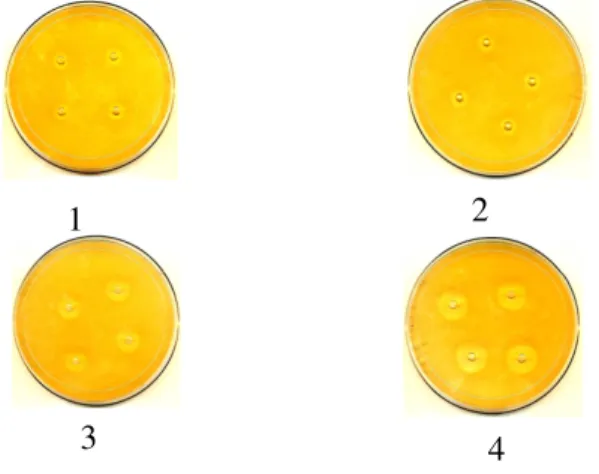
Figure 1 shows the zone of inhibition formed. It was found that at lower concentration of nisin linearity was achieved.
Figure1 - Inhibition zone formed by different concentrations of nisin.
Optimization of MRS concentration
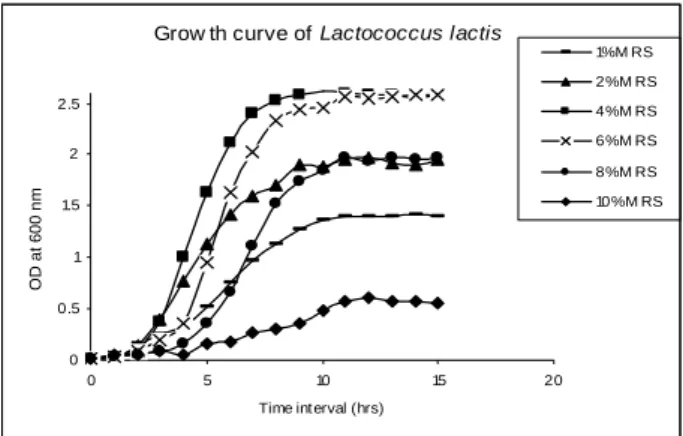
MRS and M17 media have been reported as suitable media for promoting growth and nisin production with L. lactis (Cheig et al., 2002). Various percentages of MRS were taken in order to optimize the best concentration of MRS not only for its growth but also for nisin production. Among the various percentages used, the maximum growth was seen in 4 and 6% as shown in Figure 2. Average specific growth rate, i.e. µaverage was calculated and it was found that L.
lactis attained µaverage of(0.59 h -1
, 0.58 h-1) in 4 and 6% MRS, respectively. Higher and lower concentrations of MRS broth resulted in slow growth rate and poor nisin yield which might be
due to substrate limitation in former and substrate inhibition in later. Initial pH of the medium was adjusted to 6.3 but during the growth of L.lactis, the pH of media changed drastically. The final pH of the broth was measured and found to be 4.0, 4.3, 4.7, 5.0, 5.2 and 5.7 for 1, 2, 4, 6, 8 and 10% MRS broth, respectively. The difference between the initial and final pH was calculated for all the flasks (Fig. 3) which was 2.3, 2.0, 1.6, 1.3, 1.1 and 0.6, respectively. The rationale for decrease in the pH was either decreased buffering capacity of the medium due to more dilution or higher buffering capacity at increased MRS concentration, when biomass and lactate productions were lower.
1 2
Mall, P. et al. 206
Grow th curve of Lactococcus lactis
0 0.5 1 1.5 2 2.5
0 5 10 15 20
Time int erval (hrs)
1% M RS
2% M RS
4% M RS
6% M RS
8% M RS
10% M RS
Figure 2 - Growth pattern of L .lactis in different concentration of MRS broth at 370C and 180 RPM.
pH profile during the growth of
Lactococcus lactis
0 0,5 1 1,5 2 2,5
Concentration of MRS broth
D
e
c
re
a
s
e
d
p
H
v
a
lu
e
Figure 3 - The pH decreased during the growth of Lactococcus lactis in different concentration of MRS broth.
Optimization of skimmed milk concentration
Jojala et al., (2004) found that 25% MRS or 25% M17 supplemented with 25% milk favored the nisin production and released it into the media at final pH between 4.6 and 4.8. The 25% milk concentration showed a positive influence on the formation and release of nisin by the cells and appeared to be the best. It was found that nisin production increased consistently from first to fifth transfer in M17+milk medium. Enhanced nisin yield was obtained in 6% MRS broth as compared to 4% MRS broth (Table 1). The 0.5% milk in combination with 6% MRS favored maximum nisin production in comparison to other concentrations of milk (Table 1).
Effect of temperature on nisin production
It was found that at 300C more nisin and less biomass were produced, while at 370C more biomass and less nisin was produced (Table 1).
Growing L.lactis first at 370C till 2.0 OD and shifting the temperature to 300C did not favor much nisin production in comparison to the constant growth at 300C. Similarly, transferring the cells to 300C when the OD reached to 2.0 along with the change of medium (6%MRS and 0.5%milk) didn’t favor increase in nisin production (Table 1).
Growth studies
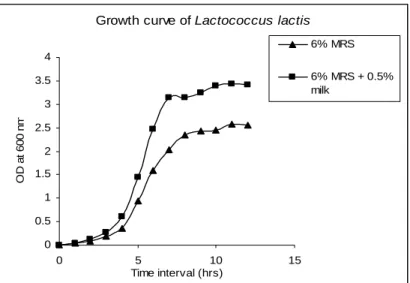
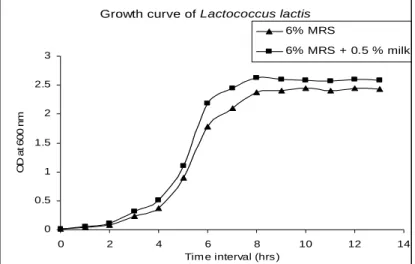
When L. lactiswas grown at 370C, more biomass was obtained (final O.D 3.4), whereas L. lactis grown at 300C resulted in poor yield of biomass (final O.D 2.55).
Optimization of agitation
It was found that the production of nisin increased significantly, when L. lactis was grown at 100 RPM (Table 1).
1% MRS 2% MRS 4% MRS 6% MRS 8% MRS 10% MRS
O
D
a
t
6
0
0
n
Table 1 - Nisin production (20h ) under different physiochemical parameters.
Sl no Media composition Growth conditions nisin yield
µg/ml
1 1% MRS 370C, 180 RPM 0
2 2% MRS 370C, 180 RPM 0
3 4% MRS 370C, 180 RPM 0.56
4 6% MRS 370C, 180 RPM 1.77
5 8% MRS 370C, 180 RPM 0
6 10% MRS 370C, 180 RPM 0
7 6% MRS 300C, 180 RPM 33.33
8 6% MRS + 0.05% milk 370C, 180 RPM 1.88
9 6% MRS + 0.1% milk 370C, 180 RPM 5.1
10 6% MRS + 0.3% milk 370C, 180 RPM 8.6
11 6% MRS + 0.5% milk 370C, 180 RPM 31.25
12 6% MRS + 0.7% milk 370C, 180 RPM 20.83
13 6% MRS + 0.9% milk 370C, 180 RPM 10.42
14 6% MRS + 0.5% milk 370C, 180 RPM (biomass transfer at OD 2.0 along with temp 300C) 18.75 15 6% MRS + 0.5% milk 370C, 180 RPM (at OD 2.0 and temp changes to 300C) 9.38
16 6% MRS + 0.5% milk 300C, 140 RPM 96.88
17 6% MRS + 0.5% milk 300C, 100 RPM 121.88
18 6% MRS + 0.5% milk 300C, 100 RPM, initial concentration of nisin 0.1 µg/ml 149.9
19 6% MRS + 0.5% milk 300C, 100 RPM, initial concentration of nisin 0.15 µg/ml 206.1
20 6% MRS + 0.5% milk 300C, 100 RPM, initial concentration of nisin 0.2 µg/ml 149.8
21 6% MRS + 0.5% milk 300C, 100 RPM, initial concentration of nisin 0.25 µg/ml 149.75 22 6% MRS + 0.5% milk 300C, 100 RPM, initial concentration of nisin 0.3 µg/ml 99.7 23 6% MRS + 0.5% milk 300C, 100 RPM, initial concentration of nisin 0.35 µg/ml 99.65
Growth curve of Lactococcus lactis
0 0.5 1 1.5 2 2.5 3 3.5 4
0 5 10 15
Time interval (hrs)
O
D
a
t
6
0
0
n
m
6% MRS
6% MRS + 0.5% milk
Mall, P. et al. 208
Effect of nisin on nisin production
Nisin has an autoregulatory system, i.e., it induces its own expression. The presence of nisin in media induces the autophosphorylation of histidine kinase that activates the transcription of nisin structural gene (Chandrapati and O’Sullivan 1999, 2002). The gene (nisin) encoding the desired
protein/enzyme by the addition of auto-inducer nisin to the growth medium (de Ruyter et al. 1996b, Kuipers et al. 1998, Kleerebezem et al. 2000). Among different concentrations of nisin, 0.15µg/ml was the most suitable concentration for the best yield of nisin (Table 1).
Growth curve of Lactococcus lactis
0 0.5 1 1.5 2 2.5 3
0 2 4 6 8 10 12 14
Tim e interval (hrs )
O
D
a
t
6
0
0
n
m
6% MRS
6% MRS + 0.5 % milk
Figure 5 - Growth pattern of L.lactis in 6% MRS and, 6% MRS supplemented with 0.5% skimmed milk at 300C at 100 RPM (table 1).
CONCLUSION
Quantification of nisin by agar diffusion assay gave best result at its lower concentration. MRS (6%) and 0.5% milk with 0.15µg/ml of nisin were the best parameters for nisin production. Among the physical parameters, 300C and 100 rpm for 20 h were the best. The temperature of 300C favored the production of nisin whereas 370C enhanced the biomass production.
ACKNOWLEDGEMENT
The work was financially supported by INTAS Biopharmaceutical Ltd., Ahmedabad. We thank L.Gupta, R.Jena, D.Dave, V.Kumar, V.Parikh, G.Mehta, K.Patel for their technical support.
REFERENCES
Chandrapati, S., O’Sullivan, D.J. (1999), Nisin independent induction of the nisA promoter in Lactococcus lactis during growth in lactose or galactose. FEMS Microbiol. Lett. 170, 191–198. Chandrapati, S., O’Sullivan, D.J. (2002),
Characterization of the promoter regions involved in galactose- and nisin-mediated induction of the nisA gene in Lactococcus lactis ATCC 11454. Mol. Microbiol., 2, 467–477.
Cheig, C. I., Choi, H. J., Park, H., Kim, T.S., Hwang, J. K., Pyun, Y. R. (2002), Influence of growth condition on the production of a nisin like bacteriocin by lactococcus lactis subsp lactis A164 isolated kimchi.J.Biotechnnol.,95, 225-235.
Delves-Broughton J, Blackburn P, Evans RJ, Hugenholtz, J. (1990), Application of bacteriocin nisin. Antonie Van Leeuwenhoek, Rev., 69, 193-202. Hensen JN, chung Y, Liu, W. (1991), Biosynthesis and
mechanism of the action of nisin and subtilin. ESCOM science Publishers In: Nisin and novel antibiotics, Leiden. pp.287-302.
Hurst, A. (1967), Function of nisin and nisin like basic proteins in the growth cycle of streptococcus lactis. Nature, 214, 1232-1234.
Jozala,A.F, de Lencastre Novaes, L.C., Cholewa, O., Dante, M., Vessoni Penna, T.C. (2005), Increase of nisin production by Lactococcus lactis in different media. African Journal of Biotechnology.Vol 4 (3),
262-265.
Kleerebezem, M., Hols, P., Hugenholtz, J. (2000), Lactic acid bacteria as a cell factory: rerouting of carbon metabolism in Lactococcus lactis by metabolic engineering. Enzyme Microb. Technol., 26, 840–848.
Kuipers, O.P., de Ruyter, P.G.G.A., Kleerebezem, M., de Vos, W.M. (1998) Quorum sensing-controlled gene expression in lactic acid bacteria. J. Biotech.,
64, 15–21.
Monteville, T.J. and Chen, Y. (1998), Mechanism of action pediocin and nisin based germicidal formulation on teat skin of live cows. J. Dairy Sci.,
75, 3185-3190.
Thomas, L.V., Ingram, R.E., Bevis, H.E., Davies, A,, Milne, C.F., Delves-Broughton.(2002),Effective use of nisin to control Bacillus and Clostridium spoilage of a pasteurized mashed potato product. J.Food.Protect, 65:1580-1585.
Turner, S.R., Love, R.M., and Lyons, K.M. (2004), An in vitro investigation of the antimicrobial effect of nisin on root canals and canal wall redicular dentine. J.Int. Endodontic., 37, 664-671.
Vessoni Penna T.C., Moraes, D.A. (2002), The effect of nisin on growth kinetics from activated Bacilllus cereus spores in cooked rice and milk, J.Food Protec.,65, 419-422.