INSTITUTO DE INVESTIGAÇÃO E FORMAÇÃO AVANÇADA
Orientadores |
Prof. Doutora Esmeralda de Jesus Ratinho Lopes ArranhadoRamalho
Prof. Doutor João Manuel de Sousa Andrade e Silva
Prof. Doutora Fernanda Paula Mora Peixe
Tese apresentada à Universidade de Évora para obtenção do Grau de
Doutor em Economia
Évora, julho de 2019
Is Energy Efficiency Reflected in Residential
Property Prices in Portugal?
An Investigation Based on Hedonic House Price Functions and
Quantile Regression Analysis
i
An investigation based on hedonic house price functions and
quantile regression analysis
Rui Alexandre Alves Evangelista
Orientadores |
Prof. Doutora Esmeralda de Jesus Ratinho Lopes Arranhado RamalhoProf. Doutor João Manuel de Sousa Andrade e Silva
Prof. Doutora Fernanda Paula Mora Peixe
Tese apresentada à Universidade de Évora para obtenção do Grau de
Doutor em Economia
Évora, julho de 2019
Is Energy Efficiency Reflected in Residential
Property Prices in Portugal?
ii
Júri:
Presidente:
Doutora Maria Aurora Murcho Galego, Professora Associada da Universidade de Évora (por delegação do Diretor do Instituto de Investigação e Formação Avançada);
Vogais:
Doutora Esmeralda de Jesus Ratinho Lopes Arranhado Ramalho, Professora Associada com Agregação da Universidade de Lisboa (Orientadora);
Doutora Isabel Maria Dias Proença, Professora Associada com Agregação da Universidade de Lisboa;
Doutora Maria Aurora Murcho Galego, Professora Associada da Universidade de Évora;
Doutor Paulo Manuel Marques Rodrigues, Professor Catedrático Convidado da Universidade Nova de Lisboa;
Doutor Luís Filipe Farias de Sousa Martins, Professor Auxiliar com Agregação do ISCTE – Instituto Universitário de Lisboa;
Doutora Andreia Teixeira Marques Dionísio, Professora Auxiliar da Universidade de Évora.
iii
iv
Acknowledgments
I owe my deepest gratitude to my thesis supervisors Esmeralda Ramalho, João Andrade e Silva and Fernanda Peixe for their guidance, constructive criticism and support during my PhD. This thesis would not have been possible without the support of Instituto Nacional de Estatística and Agência para a Energia, who made possible the access to data at the premises of Instituto Nacional de Estatística.
I would also like to thank the comments from the participants of the 2016 Doctoral Consortium at Universidade de Évora. I am also indebted to Sonia Gouveia, who always had time to proofread early manuscripts, and to my colleagues at Instituto Nacional de Estatística, who encouraged me during these years.
v
Abstract
This thesis investigates the degree to which energy efficiency, as it is assessed by Energy Performance Certificates (EPCs), is reflected in residential property prices in Portugal. Its results are based on the analysis of a comprehensive dataset containing information of around 256 thousand residential property sales carried out from 2009 to 2013, a period largely characterized by depressed market conditions. This is the first large-scale study for a southern European country in this area of research. For the first time in this context, the impact of energy efficiency is analyzed along the distribution of residential property prices, using the unconditional quantile regression framework. The findings disclose a 13% sales premium for most energy efficient apartments (i.e. those bearing an A or B EPC rate) and a 5 to 6% market price premium for houses. However, quantile regression results show that the value attached to energy efficiency is not always positive across the distribution of prices. In particular, houses located at or below the 0.2th price quantile display clear energy efficiency price discounts. The use of different energy efficiency scales and cross-country comparisons support the view that energy efficiency price premiums are higher in the Portuguese residential market than in northern European markets. These results contribute to a more comprehensive understanding of the impact of energy efficiency on the real estate market and provide important messages to all political decision-makers interested in improving energy efficiency standards in Portugal.
Keywords: Portugal, energy efficiency, residential property market, hedonic price models, cross-country comparisons, quantile regression JEL classification: C21, C52, C55, Q41, R21, R30
vi
É A EFICIÊNCIA ENERGÉTICA REFLETIDA NOS PREÇOS DOS IMÓVEIS RESIDENCIAIS EM PORTUGAL?
Uma investigação baseada em funções de preços hedónicas e na análise de regressão por quantis
Resumo
Esta tese investiga em que medida a eficiência energética, tal como é avaliada pelos Certificados de Desempenho Energético (CDE), é refletida nos preços dos imóveis residenciais em Portugal. Os resultados obtidos baseiam-se na análise de um conjunto exaustivo de dados com informação sobre cerca de 256 mil vendas de imóveis realizadas entre 2009 e 2013, um período predominantemente caracterizado pela recessão. Este é o primeiro estudo de larga escala realizado para um país do sul da Europa nesta área de investigação. Pela primeira vez neste contexto, o impacto da eficiência energética é analisado ao longo da distribuição dos preços das habitações através do método da regressão por quantis incondicionais. Os resultados revelam um prémio na venda de 13% para os apartamentos mais eficientes em termos energéticos (i.e., aqueles com CDE A ou B), e de 5 a 6% para as moradias. No entanto, a análise de regressão por quantis mostra que o valor associado à eficiência energética nem sempre é positivo ao longo da distribuição dos preços. Em particular, as moradias situadas abaixo do vigésimo percentil mostram claros descontos associados à maior eficiência energética. A utilização de diferentes escalas energéticas e a comparações entre países apoia a ideia de que os prémios associados à eficiência energética são maiores no mercado português do que em mercados do norte da Europa. Estes resultados contribuem para um conhecimento mais amplo do impacto da eficiência energética no mercado imobiliário e fornecem importantes mensagens a todos os decisores políticos interessados em melhorar os padrões de eficiência energética em Portugal.
Palavras-chave: Portugal, eficiência energética, mercado residencial, modelo de preços hedónicos, comparação entre países, regressão por quantis
vii
Acronyms
ADENE Agência para a Energia
AT Autoridade Tributária e Aduaneira
CO2 Carbon Dioxide
CQR Conditional Quantile Regression
EPBD Energy Performance of Buildings Directive
EPC Energy Performance Certificate
EU IMI
European Union
Imposto Municipal sobre Imóveis
IMT Imposto Municipal sobre a Transmissão Onerosa de Imóveis
INE Instituto Nacional de Estatística
LAD Least Absolute Deviation
LM Lagrange-Multiplier
OLS Ordinary Least Squares
UQR Unconditional Quantile Regression
viii
Contents
Acknowledgments ... iv
Chapter 1 Introduction ... 1
Chapter 2 Measuring the impact of energy efficiency on residential property prices ... 5
2.1. Introduction ... 5
2.2. Links between energy efficiency and residential property prices ... 6
2.3. Assessing the impact through the use of the hedonic price model ... 7
2.3.1. The hedonic price model as a measurement tool ... 7
2.3.2. The roots and applications of the hedonic price model ... 9
2.3.3. Survey of empirical evidence ... 11
2.4. Summary ... 22
Chapter 3 Data and econometric approach ... 23
3.1. Introduction ... 23
3.2. Data sources ... 24
3.2.1. Transaction prices and dwelling characteristics ... 24
3.2.2. Energy efficiency of residential units ... 27
3.2.3. Data matching process ... 29
3.3. Data analysis ... 32
3.4. Modelling strategy ... 37
3.5. Summary ... 40
Chapter 4 Impact of energy efficiency on residential property prices in Portugal ... 42
4.1. Introduction ... 42
4.2. Working hypotheses... 45
4.2.1. Market versus sub-market hedonic model specification ... 45
4.2.2. The value of energy efficiency ... 47
4.2.3. Overall market conditions ... 48
4.2.4. Building technology and quality of construction works ... 49
4.3. Hedonic regression results ... 51
4.3.1. Evidence on sub-market model specificities ... 51
4.3.2. Impact of energy efficiency in the Portuguese residential market ... 55
4.3.3. Valuation of energy efficiency through time ... 60
4.3.4. Influence of building technology and quality of construction works ... 62
ix
Chapter 5 Soundness of hedonic regression energy efficiency partial effects ... 68
5.1. Introduction ... 68
5.2. Measurement errors ... 70
5.3. Omission of relevant variables characterizing the quality of properties ... 78
5.4. Large samples and inflated significance levels ... 83
5.5. Cross-country comparisons ... 88
5.6. Summary ... 93
Chapter 6 Conditional and unconditional quantile regression energy efficiency partial effects ... 95
6.1. Introduction ... 95
6.2. Conditional and unconditional quantile partial effects ... 98
6.3. Preliminary evidence on heterogeneous energy efficiency effects ... 101
6.4. Estimation of conditional and unconditional regression coefficients ... 102
6.5. Coherence of results ... 108 6.6. Summary ... 113 Chapter 7 Conclusions ... 115 Bibliography ... 119 Appendices ... 129 I - Tax forms ... 130
II - Energy Performance Certificate ... 133
III - Heteroskedasticity-robust tests ... 135
IV - Variables used in regression analysis ... 138
V - OLS parameter estimates ... 143
VI – Deriving error measurement parameters used in simulated list prices ... 147
x
List of Tables
Table 2.1: Most important factors linking energy efficiency and property prices ... 7
Table 2.2: Summary of studies on the impact of energy efficiency on housing prices ... 18
Table 3.1: Summary statistics of a group of selected variables ... 34
Table 3.2: Most important dwelling attributes by group of variables ... 39
Table 4.1: Hedonic regression results for existing apartments ... 52
Table 4.2: Test results for sub-market model specification ... 54
Table 4.3: Impact of energy efficiency on property prices ... 56
Table 4.4: Valuation of energy efficiency in urban areas ... 57
Table 4.5: Assessing the influence of being new ... 59
Table 4.6: Point estimates of relevant interaction terms ... 63
Table 5.1: Features of transaction and simulated prices, appraisals and no. of bedrooms ... 74
Table 5.2: Energy efficiency parameters in different variable replacement scenarios... 75
Table 5.3: Energy efficiency parameters in different omitted variable scenarios ... 80
Table 5.4: Energy efficiency parameters derived from different sample sizes ... 84
Table 5.5: Perc. of statistically insignificant energy efficiency coefficients at the 5% level ... 87
Table 5.6: Impact of energy efficiency on the log of price level ... 90
Table 5.7: Impact of energy efficiency on the log of price per square meter ... 91
Table 6.1. Most energy efficient properties, percentages by price quartile group ... 101
Table 6.2. Selected property characteristics, mean values by price quartile group ... 102
Table 6.3. Comparing OLS, UQR and CQR partial effect estimates ... 103
xi
List of Figures
Figure 3.1: EPC label scale ... 28
Figure 3.2: Data flow chart ... 31
Figure 3.3: Geographical distribution of transactions in initial and final datasets ... 32
Figure 3.4: Box-and-whisker plots of the natural logarithm of prices ... 36
Figure 4.1: Mortgage credit, prices and number of transactions from 2009 to 2014 ... 48
Figure 4.2: Effect of energy efficiency on prices from 2009 to 2013 ... 61
Figure 5.1: Distribution of energy efficiency coefficients for new houses ... 77
Figure 5.2: Energy efficiency in benchmark and omitted variables cases ... 82
Figure 5.3: Distribution of energy efficiency coefficients for different sample sizes ... 86
Figure 6.1: Conditional and unconditional energy efficiency partial effects ... 105
Figure 6.2: Upper and lower bounds confidence interval differences (existing apartments) ... 107
Figure 6.3: Selected OLS and CQR coefficients for existing apartments ... 109
1
Chapter 1 Introduction
In the European Union (EU), buildings account for nearly 40 percent of global energy use and the residential sector is responsible for the production of around 11 percent of total global Carbon dioxide (CO2) emissions from fuel combustion (Directive 2010/31/EU; International Energy Agency [IEA], 2017: 61). Given the relevance of the residential sector in the total building stock, the implementation of policies aimed at increasing its energy performance is regarded as one of the most effective ways to reduce CO2 emissions and mitigate a country’s dependency on energy. In Portugal, the importance of residential buildings is also high, as they are responsible for 17 percent of the country’s total energy use and for 27 percent of the electricity consumed in the country (Agência para a Energia [ADENE], 2015: 10, 19).
A possible way of achieving higher energy efficiency in housing is through the introduction of building codes with better energy saving requirements (see, inter alia, Novan et al., 2017). However, while the implementation of more and better energy saving building specifications impacts directly on the supply of (newly built) dwellings, prospective buyers may still lack information on energy performance of residential units. In the absence of this information, a price premium signal is not given to most energy efficiency properties, and less than desired investment in energy performance is achieved in residential property markets. This outcome is referred in the literature as an efficiency gap (Brown, 2001: 1198), which can be addressed through the application of policy instruments. One of the most well-known instruments consists in the implementation of energy efficiency labelling schemes, which aim at influencing buying, selling and investment decisions with the disclosure of information regarding the energy performance of properties.
Energy labelling has been applied in Europe for many years, with household appliances providing one of the earliest examples (Directive 1992/75/EEC). For buildings, energy labels were first implemented in Denmark in the 1990s (Jensen et al., 2016). More recently, with the introduction of the Energy Performance of Buildings Directive (EPBD) in 2002, which was
2
later recasted into the Directive 2010/31/EU, Member States of the EU were required to develop and implement an Energy Performance Certificate (EPC) system. In Portugal, the EPC scheme was first implemented in June 2007 as a consequence of the partial transposition of the EPBD into national law by a decree-law (Decreto-Lei n.º 78/2006).
Notwithstanding the potential advantages associated with the introduction of an energy efficiency label, the key question regarding its usefulness revolves around the degree to which energy efficiency improvements are capitalized into residential property transaction prices. While the existence of energy efficiency market price premiums is in line with an anticipation of energy expenditure savings from more efficient properties, it should be noted that, due to the existence of market failures and barriers, this relationship may well be insignificant or take up the form of a market price premium or a price discount. Thus, a quantitative valuation of the relationship between energy efficiency and residential property transaction prices is extremely important for an assessment of energy efficiency labels.
This thesis addresses the question of knowing whether energy efficiency, as measured by the EPC label, has any impact on transaction prices of residential properties in Portugal 1. This country constitutes an excellent case study for a good number of reasons. First, the compliance and public awareness of the label has always been high, with 90 percent of all building completions and transactions already being done in 2010 with an issued EPC (Buildings Performance Institute Europe [BPIE], 2010: 59). This result stems not only from the mandatory status of energy efficiency certification, but also from its effective promotion by Agência para a Energia (ADENE), the national supervision body responsible for the implementation and administration of the European EPC system in Portugal 2. As a consequence, selection problems associated with the generation of data by a non-mandatory system, such as the one that was implemented in the Netherlands (Brounen and Kok, 2011), are avoided when the Portuguese case is analyzed. Second, Portugal was one of the first countries to establish a national database in which the information generated by the EPC system was registered, analyzed and stored. This database, when combined with residential property transactions data, gives rise to a rich source of information for research purposes.
1 The focus is on the sales residential market, which is much more important than the rentals residential market.
According to the 2011 Census, in Portugal more than 72 percent of all family dwellings were not rented
(Insti-tuto Nacional de Estatística [INE], 2012).
2 This agency is designated as ADENE even in texts written in English. As such, this acronym will be used
3
Finally, Portugal represents an interesting case study in its own right since the overwhelming literature in this area refers to northern European countries, which have climatic idiosyncrasies different from those located in the south of Europe (e.g., Fuerst et al., 2016; Högberg, 2013).
The investigation of the relationship between the EPC label and residential property prices in Portugal was carried out through the econometric estimation of the hedonic price model (Rosen, 1974), which has been used as the workhorse in this area of research. The hedonic model is based on the assumption that the value of a good, such as housing, is ultimately determined by the bundle of its quality attributes. Central to the hedonic price model is the existence of a functional relationship between prices and attributes, which could be estimated econometrically. Under this framework, the coefficient of the hedonic function associated with the variable measuring energy performance reveals important information on how the market rewards energy efficiency levels. Fesselmeyer (2018) and Ayala et al. (2016) are two recent examples of the application of this methodology for the residential property market.
This research is based on a comprehensive dataset with more than 256 thousand residential property sales carried out from 2009 to 2013. It is the result of the combination of information taken from ADENE and the Autoridade Tributária e Aduaneira (AT), the Portuguese Tax and Customs Authority 3, on two taxes: the Imposto Municipal sobre a Transmissão Onerosa de Imóveis (IMT) 4, and the Imposto Municipal sobre Imóveis (IMI) 5. The tax sources cover the population of residential property sales since it is not possible to carry out a transaction without a proof of payment of the IMT. The IMT and IMI data are currently employed in the compilation of the residential and commercial property price indexes for Portugal (INE, 2017a; 2017b). A subset of the data available in the IMT and IMI records was also used in an empirical application to produce hedonic price indexes (Ramalho et al., 2017).
This thesis makes use of one of the largest datasets ever used in this research context and constitutes the first large-scale study on the impact of energy efficiency on residential
3 The Portuguese Tax and Customs Authority is generically identified by AT, its abbreviated form which will be
used in the text whenever there is a need to mention it.
4 The real estate transfer tax is designated as Imposto Municipal sobre a Transmissão Onerosa de Imóveis or
simply as IMT. Following the same approach that was used for AT and ADENE, the Portuguese abbreviated expression will be used throughout the text to designate this tax.
5 The local property tax is designated as Imposto Municipal sobre Imóveis. Its abridged name IMI will be used in
4
property transactions in a southern European country. Although some evidence exists for meridional markets (e.g., Ayala et al., 2016), it is based on small samples and on proxy transaction prices. It is also the first study that investigates the impact of increased energy efficiency across the distribution of residential property prices. Overall, the findings confirm that energy efficiency is positively rewarded in the Portuguese residential sales market. However, the results also show that the EPC label impacts differently across the price distribution, throughout time and according to dwelling categories, with apartments yielding higher price premiums than houses. Given the importance of the former dwelling category in the Portuguese housing stock 6, the findings not only contribute to the growing literature on the effect of energy labels on market prices, but also provide new and important policy messages to all interested in enhancing energy efficiency in Portugal.
This thesis is organized as follows. Chapter 2 presents the hedonic price model as a measurement instrument for the assessment of the impact of energy efficiency on market residential property prices and addresses the association between energy efficiency and property prices. A literature review of 21 studies conducted in this area of research from 2008 to 2018 is presented in this chapter. Chapter 3 describes the sources, variables and information available in the dataset gathered for this research. Chapter 4 presents the application of the hedonic price models and provides the Ordinary Least Squares (OLS) results of the effect of energy efficiency in property prices in Portugal. Chapter 5 assesses, through 12 different experiments, the coherence and sensitivity of the energy efficiency estimates to modifications in the estimation context provided in Chapter 4. These include changes in sample size, the use of error-prone variables, and the comparison across different measurement scales and country results. Chapter 6 focuses on the question, which is investigated through quantile regression techniques, of how energy efficiency and other dwelling attributes vary across the residential property price distribution. Finally, the last Chapter summarizes the research findings and draws directions for future research in this area.
6 The Portuguese housing stock amounts to 5,859,540 classic residential dwellings (INE, 2012). Of these,
52 percent refer to residential single family (detached, semi-detached and row) houses (author’s own calculations based on Census data).
5
Chapter 2 Measuring the impact of
ener-gy efficiency on residential property
prices
2.1. Introduction
This chapter overviews the hedonic price model as a measurement tool to investigate the impact of energy efficiency on residential property prices. It presents the results of a comparative literature review of a total of 21 studies that apply the hedonic price model in this research context. This comparative exercise, which covers the most important papers and reports produced from 2008 to 2018, offered the research directions that were followed in this thesis.
While the idea that housing markets attribute a price premium to energy efficiency is consistent with an anticipation of future energy savings, it remains an empirical issue to investigate whether and to what extent markets capitalize this expected outcome in practice. However, as it will be seen, the relationship between these two variables is far from being straightforward. In practice, due to factors such as the anticipation of higher future costs in maintaining (more expensive) energy efficiency technology, price premiums can be reduced or even take the form of price discounts. This literature review reflects this mixed outcome, with the majority of the studies pointing out to the existence of a market price premium and some other unveiling price discounts or an indifference to energy efficiency as a variable to explain residential property prices.
This chapter is divided into three sections. Section 2.2 points out the main links associating energy efficiency and property prices. Section 2.3 presents the hedonic price model, which has been used as the main instrument to measure the impact of energy efficiency on real estate market prices, and provides the results of the comprehensive literature review. Finally, a summary is given in section 2.4.
6
2.2. Links between energy efficiency and residential property prices
Achieving energy efficiency gains is generally perceived as providing several benefits, from which participants in the real estate market may profit. Perhaps the most obvious stems from the fact that, with increased efficiency, homeowners may benefit from lower utility bills (Dinan and Miranowski, 1989). Conversely, particularly in markets where energy efficiency standards are perceived as high, extra efficiency gains can be regarded not as a benefit, but as imposing high additional technological maintenance costs (Yoshida and Sugiura, 2015). In general, the idea underlying the relationship between energy efficiency and housing prices is anchored in the notion that markets are able to internalize (in market prices) the benefits associated with lower energy consumption patterns. Following this reasoning, more efficient properties would have higher future energy saving benefits and should, for this reason, have a market premium when transacted on the market.
Unfortunately, the relationship between energy efficiency and prices is far from straightforward. Due to the existence of market failures, less than desired investment in energy performance often surfaces on the market, a situation that is described in the literature as an efficiency gap (Brown, 2001). Since energy efficiency is an attribute that can only be experienced after purchase (e.g. through the comparison of utility bills), buyers tend to concentrate on more immediate and tangible dwelling characteristics and will not be willing to provide a price premium to any potential future benefits from a dwellings’ greater energy efficiency performance. Homeowners, on the other hand, will not have an incentive to invest in energy efficiency, if markets fail to translate them into higher property prices. More recently, behavioral failures, such as low energy literacy rates and households’ energy expenditure awareness, also started to receive attention from researchers (Brounen et al., 2013). For a summary of informational and behavioral failures see Ramos et al. (2015a).
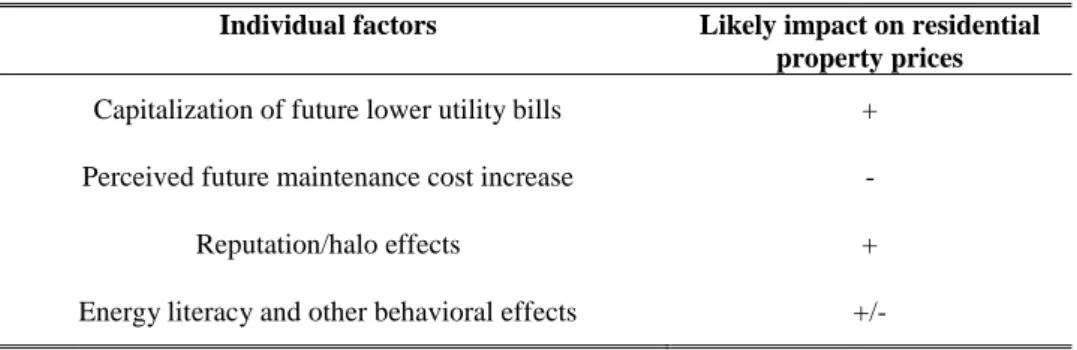
From a theoretical point of view, it is possible to identify and estimate all potential factors linking energy efficiency and residential property prices. However, some factors, such as reputation or image effects (e.g., those stemming from owning an eco-certified property) are, due to its intangible nature, extremely hard to be measured and it is only possible to estimate their combined or aggregated effect. Table 2.1 summarizes the most important factors that are
7
associated with energy efficiency and that have a potential impact on residential property prices.
Table 2.1: Most important factors linking energy efficiency and property prices
Individual factors Likely impact on residential
property prices
Capitalization of future lower utility bills + Perceived future maintenance cost increase -
Reputation/halo effects +
Energy literacy and other behavioral effects +/-
As individual factors can have conflicting signs, the relationship between property prices and energy efficiency is far from simple and may well be insignificant or take up the form of a market price premium or discount. Under this framework, it is of paramount importance to measure the way markets value energy efficiency and investigate the degree to which policy instruments, such as energy efficiency labels, contribute to close efficiency gaps.
2.3. Assessing the impact through the use of the hedonic price model 2.3.1. The hedonic price model as a measurement tool
The hedonic price model (Rosen, 1974) rests on the assumption that the value of a good such as housing is ultimately determined by the bundle of its energy efficiency and other quality attributes. On the basis of this premise, which is referred to in the literature as the hedonic hypothesis (see, inter alia, Triplett, 2006: 91), price differences amongst similar varieties of a good, such as housing, can be explained by the different (quantities of) quality attributes found in each one of them. Central to the hedonic price model is the idea of the existence of a functional relationship between prices and attributes that, for the present research context, can be expressed in the following manner:
𝑝𝑖,𝑡∗ = 𝑓
𝑡(𝐸𝑖,𝑡∗ , 𝑥𝑖,𝑡;1∗ , … 𝑥𝑖,𝑡;𝑘∗ , 𝑢𝑖,𝑡). (2.1)
In (2.1), 𝑝 and 𝐸 stand for the price and energy efficiency characteristics and 𝑝∗ and 𝐸∗ represent some transformation of 𝑝 and 𝐸, respectively. Moreover, the 𝑥𝑖,𝑡;𝑗∗ , 𝑗 = 1, … , 𝑘 , corresponds to the remaining housing attributes, with the i and t subscripts identifying the
8
dwelling and the time it was transacted, the * signals the fact that the variable could have been transformed and 𝑢 is a term representing additional random factors, which are not measured by the k+1 attributes included in the functional form. In the housing context, typical examples of 𝑥∗ are the location of the dwelling (Kiel and Zabel, 2008), its area or floor space (Colwell, 1993) and age of the residential structure (Goodman and Thibodeau, 1995). As noted in the literature (see, inter alia, Malpezzi, 2003; Cropper el al., 1988), theory sheds little light on the selection of the appropriate functional form of (2.1). In the absence of such guidance, the derivation of the hedonic function tends to be essentially seen as an empirical matter, which should be guided with the help of statistical tests and, where possible, economic and engineering considerations.
It is possible to use econometric techniques to estimate the hedonic price function (2.1), where the coefficient associated with energy efficiency can be interpret as the implicit (shadow) price for that characteristic. In this context, the parameter estimate is read as the additional (or partial) effect of adding that covariate to the model, when all other explanatory variables were already accounted for. Applying the chain rule to calculate the first derivative of 𝑝∗ with respect to the energy efficiency attribute, one obtains the partial effect of 𝐸 on 𝑝∗in the following way:
𝜕𝑝∗ 𝜕𝐸
=
𝜕𝑝∗ 𝜕𝐸∗.
𝜕𝐸∗ 𝜕𝐸,
(2.2)where 𝛽𝐸 corresponds to the coefficient obtained from the hedonic model, which is associated with the variable measuring energy efficiency. In a linear additive model, the partial effects are constant and equal to 𝛽𝐸 only when 𝑝∗= 𝑝 and 𝛽𝐸∗ = 𝛽𝐸. Except for some unusual transformations of 𝐸, such as its reciprocal where 𝑑𝐸∗/𝑑𝐸 is negative
,
𝛽𝐸 determines the direction of the impact of energy efficiency on 𝑝∗. Market price premiums (discounts) are thus associated with statistically significant positive (negative) partial effects for higher levels of energy efficiency. Due to its frequent utilization in the literature dealing with the impact of energy efficiency on dwelling prices, the case in which 𝑝∗ assumes a logarithmic transformation of 𝑝 assumes particular relevance. In this situation, the relative effect of 𝐸 on dwelling prices can be calculated by [𝑒𝑥𝑝(𝛽̂𝐸)− 1] and the percentage change is obtained by multiplying this expression by 100 (Halvorsen and Palmquist, 1980). However, for small values of 𝛽̂𝐸, which typically occur when changes in 𝐸 are of an infinitesimal nature (e.g.,9
when this variable assumes a continuous form), it is possible to use the coefficient result as a reasonable approximation of the relative effect on dwelling prices (Megerdichian, 2018).
The econometrics associated with the estimation of hedonic price functions has been covered in several textbooks. A classical reference is Bernt (1991), which tackles, among other issues, the effects of omitting relevant covariates from the regression model, heteroskedasticity and other model specification issues 7. More recent reviews are provided in the fifth and sixth chapters of Triplett’s (2006) handbook on hedonic price indexes and in Ramalho and Ramalho (2010).
2.3.2. The roots and applications of the hedonic price model
The origins of the hedonic price method can be traced back to the pioneering work carried out by agricultural economists, of which Waugh (1928), who analyzed the impact of quality factors on the formation of fresh vegetables prices on the Boston wholesale market, constitutes one of the earliest published references (Colwell and Dilmore, 1999). The term hedonic was coined in Court (1939), which is considered to be the first published paper to use hedonic regressions in the compilation of price indexes (Stapleford, 2011) 8. Although with some notable exceptions, of which Stone’s (1956) report on the compilation of price and quantity price indexes for national accounts is an example, the use of the hedonic price model remained largely unnoticed until the beginning of the 1960s, when Griliches (1961) revived the interest in the method and prompted its application in a vast body of empirical work, which can be broadly divided into two main areas 9.
The first area, in which the present research can be included, addresses the estimation of the hedonic function and the measurement of the impact of a product’s attribute (or group of attributes) on its price. This may include not only an investigation about the statistical
7 It is interesting to note that, in addition to model specification problems, data issues, in particular those caused
by the existence of measurement errors, a topic which has been overlooked in the subsequence literature on he-donics, are not ruled out from this early reference textbook. See, on this particular point, Bernt (1991: 129) and the note that identifies Amel and Bernt (1986), and the work cited in it, as first references in this area.
8 Although firmly rooted in the literature, this designation is seen as to be a bit of a misnomer since hedonic
coefficients are a reduced form solution, which do not generally provide information on the structure of the de-mand side alone but on the intersection of the dede-mand and supply curves.
9 Goodman (1998) and Stapleford (2011) provide tentative explanations as to why there was so little follow-up to
Court’s (1939) work. While the former focuses on practical issues (e.g., rudimentary state of the art in compu-ting, data collection and coding activities), the latter attributes the lack of interest to the fact that the paper was written at a time were the economics profession was essentially dominated by a knowledge-based (or expert) rather than a market-based view of the relationship between price and quality.
10
significance of the impact, but also the estimation of intervals for regression coefficients and carrying out consistency checks on its sign and dimension relative to other studies. There are almost an uncountable number of applications of this type of analysis, ranging from the estimation of wage regressions (Montgomery el at., 1992) to the identification of wine price-determining factors (e.g., Combris et al., 1997). For housing, the use of the hedonic price model has a long tradition. Nelson (1982), who summarizes nine studies estimating the relationship between traffic noise and property values, is an early example. A more recent illustration of this approach is given by Stanley et al. (2016), who estimate the effect of increased energy efficiency on the value of housing. Chin and Chau (2003) and Malpezzi (2003) are two excellent reviews of the application of the hedonic price model to housing.
The adjustment of observed prices from changes in quality attributes in the construction of quality-adjusted price indexes is the second area in which the hedonic method is widely used. This application stems from the idea that virtually all empirical applications of the hedonic function can be conceived as an index number problem (Triplett, 2006). Oaxaca (1973), who applies hedonic functions to estimate male-female wage discrimination in the labour market, provides a notorious example in this area. Further applications include the use of the hedonic methodology in the construction of deflators for national accounts aggregates (Bover and Izquierdo, 2003) and in the compilation of price indexes for goods as different as cars (Santos and Coimbra, 1995) and paintings (Collins et al., 2009). A description of the methods available for the construction of price indexes using the hedonic method is available in Tripplet (2006). Specific reviews for residential housing are available in Hill (2013) and in Eurostat (2013).
In a more theoretical fashion, following the seminal work of Rosen (1974), a strand of the literature has been concerned with the use of hedonic models as a tool for the identification of supply and demand functions for product characteristics. Examples include Epple (1987), Arguea and Hsiao (1993), Ekeland et al. (2002), Bajari and Benkard (2005) and, more recently, Kuminoff and Pope (2012). Starting from the premise that hedonic models are essentially underidentified (i.e., consumer preferences or technology parameters are generally not directly obtained from hedonic implicit prices), this body of literature attempts to find the particular market conditions under which it is possible to estimate, from the information taken from hedonic regressions, supply and demand functions for product characteristics. Some of
11
the special cases under which it is possible to derive a product’s supply and demand functions are provided in Bernt (1991: 130). Since this thesis is focused on the assessment of the impact of energy efficiency on residential property transaction prices (rather than on the derivation of demand or supply curves for energy efficiency), no further explanations will be made on this topic.
2.3.3. Survey of empirical evidence
The first papers investigating the extent to which markets signal energy efficiency in housing prices were published after the energy crisis of the 1970s in the 1980s. This literature suffered from a number of limitations, the most important being the use of very small, highly localised samples, which were typically taken from subsidized or non-market environments (e.g., Laquatra, 1986), the lack of characteristics available for regression analysis and difficulties in finding a proper energy efficiency measure, which was usually built upon information taken from proxy variables, such as energy utility bills (e.g., Dinan and Miranowski, 1989). A comprehensive critical review of the earlier literature applying the hedonic method in this research context is available in Laquatra et al. (2002). Due to these shortcomings, any general conclusions drawn from this early body of research have to be considered with care. However, it can be said that it provides some evidence that improvements in energy efficiency were, at least to a certain extent, capitalized into property prices.
The last decades have witnessed a renewed interest in this research topic. This has been driven, at least in part, by the introduction of energy label schemes in housing markets, something which had already motivated the investigation of the impact of energy standards on the prices of certain goods such as household appliances, computers and electronic equipment (Greening et al., 1997; Howarth et al., 2000). However, despite the importance of the residential sector, commercial office buildings have attracted a much larger number of academic studies than its residential market counterpart. The reasons for this situation may rest, on the one hand, in the characteristics of the markets (e.g., the housing market is usually more regulated and, as such, more subject to inefficiencies, which makes it more problematic to estimate the effects of energy labels on prices) and, on the other, in difficulties in obtaining relevant data for research purposes (e.g., the supply and the demand of residential properties is far more atomised than in the office market segment). Among the papers that investigate the effect of green labels on commercial property prices, Eichholtz et al. (2010; 2013) and
12
Fuerst and McAllister (2011a; 2011b) stand out as references in this area. On the whole, these studies provide qualitative evidence supporting the idea that green office buildings display a premium when compared to conventional office space.
For the residential housing market, Soriano (2008) constitutes one of the first examples of the renewed research interest on the relationship between energy efficiency attributes and residential house prices. Based on 2005 and 2006 samples of around 2,400 and 2,700 sales of detached houses sold in Canberra, this work reports the existence, for both years, of a significant positive relationship between energy efficiency, as measured by the Australian Energy Efficiency Rating system, and transaction prices. Using the Dutch experience in the implementation of a non-mandatory EPC label scheme in 2008, Brounen and Kok (2011) find that greener properties obtain over less energy efficient homes, a 3.7% price premium in sales prices. An interesting feature of this paper has to do with the use of the Heckman (1979) two-step procedure to tackle sample selection bias arising from systematic differences in characteristics of certified and non-certified homes (of the 177 thousand transactions available for the study, only 32 thousand had an EPC label). Hyland et al. (2013) applied the same estimation procedure for the Irish residential market. Although based on list and not on transaction prices 10, the conclusions of these authors reinforce those of Brounen and Kok’s (2011) in regard to the existence of a price premium associated with more energy efficient homes. Hyland el al. (2013) find evidence supporting the idea that the sales market segment rewards energy efficiency more strongly than the rental market segment and that the price premium attached to energy efficiency was stronger when the market was depressed. Interestingly, Fuerst et al. (2015) suggest that the price effects of energy efficiency are lower for detached and semi-detached houses than for flats or terraced dwellings and that they are not constant across English regions. For detached houses specifically, the paper reports no significant price effects, something which the authors explain by the influence of a small and atypical portion of the sample of detached dwellings located in rural areas.
Using a dataset with single-family house sales in an area of Florida, USA, Bruegge et al. (2016) find that the price premium associated with the transaction of new properties disappears in the resale market. While these results reinforce the idea that energy efficiency price premiums may vary across time, space and market segments, they also point out
10 List or asking prices are derived at earlier phases of the buying and selling process and are, for this reason,
13
directions for future research. In particular, given the characteristics of the housing stock in Portugal, it would be interesting to investigate whether energy efficiency is rewarded differently across the houses’ and apartments’ and new and existing market segments. Moreover, it would be important to investigate if energy efficiency price effects varied from 2009 to 2013, a period in which there was a strong contraction of the housing market. Högberg (2013) explores a sample of around 1,100 family house sales in the Stockholm area with the main aim of seeing whether energy efficiency is reflected in market transaction prices. An interesting feature of this paper is the inclusion of explanatory dummy variables describing categories of energy performance improvement recommendations found in EPC data. While this study corroborates the idea that the market signals improved energy efficiency with price premiums, the author finds out that buyers require price discounts from suggested energy improvements, thus revealing that sellers may have an incentive to improve energy standards prior to sale. Unfortunately, the dataset used in our research does not include information on improvement recommendations and it will not be possible to investigate this issue for the Portuguese market.
While the omission of relevant covariates appears as the elephant in the room problem in hedonic regression applications, it is interesting to note that the literature dealing with the estimation of the impact of energy efficiency on residential transaction prices does not provide many examples of omitted variable bias and little, if any, evidence on its direction and size. Stanley et al. (2016) highlight the importance to include controls for the age of the dwelling, since their omission could lead to biased energy efficiency estimates. For the Helsinki second-hand apartments market, Fuerst et al. (2016) obtain a significant price premium of 3.4 percent for the three most energy efficient EPC classes, which reduces to 1.3 percent after location, neighborhood and maintenance costs attributes are added to the regression specification. The results point to the existence of omitted variable bias when location and other quality attributes are missed out from the hedonic models. Further examples include the omission of neighborhood covariates from the regression (Fuerst et al., 2016) and the non-inclusion of hard-to-measure factors, such as buyer’s predisposition to environmental ideology (Brounen and Kok, 2011) and developer’s reputation (Zheng et al., 2012). All in all, it can be said that, in addition to omitted variable bias, the sensitivity of energy efficiency partial effect estimates to data and model specification issues has not been much subject to empirical research. An example of an overlooked researched topic has to do
14
with the fact that some studies use appraisals or list prices as a proxy for transaction prices (e.g., Ayala et al., 2016; Hyland et al., 2013). Although it can be argued, at least on theoretical grounds, that the use of list prices may not bias partial effect estimates, this assumption is seldom, if ever, tested. In practice, it may be possible that the differences between true and proxy prices are correlated with some of the regressions’ covariates (e.g., dwelling dimension or energy performance) thus leading to biased coefficient estimates. In this context, part of the differences found in the literature on the price impact of energy efficiency may be attributable to the use of different price measurements. As the database used in the present thesis includes appraisal values and transactions prices, it is possible to look into this issue and investigate whether or not the use of mismeasured or surrogate price variables could bias energy efficiency estimated impact.
Additional evidence on the existence of price premiums is provided in Kahn and Kok (2014), for the Californian housing markets. By the same token, Cajias and Piazolo (2013) quantify the energy premium in the German residential market measured on a continuous scale based on 2,630 building observations from 2008 until 2010. According to these authors, a 1 percent increase in energy conservation produces a 0.45 percent increase in market value and 0.08 percent increase in rent prices. Fuerst et al. (2016) found no significant price premium for energy efficiency classes below the comparison rate. According to these authors, this is justified with the buyer’s predisposition to pay more for more energy efficiency, which are not interested with below the average energy efficient properties (green clientele effect). Fuerst et al. (2015) constitute the largest study made to date in this field. Based on a sample of more than 333 thousand dwellings that were sold at least twice in the period from 1995 to 2012, the results of this study suggest the existence of a positive relationship between the EPC rating and prices per square meter of transacted dwellings in England.
Evidence on southern European countries is scarce and based on small samples and using proxy transaction prices. Ayala et al. (2016), finds a 10.3 percent price premium for the properties displaying one of the three top EPC ratings (A, B or C). However, the conclusions of this paper are based on a small sample of 1,507 observations and use stated housing prices as a surrogate of transaction prices. Ramos et al. (2015b) presents the first study for the Portuguese residential market. Based on a sample of 21 thousand dwelling adverts taken in March 2015 from an internet real estate portal, the authors find a 6.1 percent price premium for properties with an A, B or C EPC rating. This result is essentially driven by most efficient
15
dwelling adds, with the most efficient rate showing a 0.404 coefficient and the second one 0.141 (Ramos et al., 2015b: 33) 11. Interestingly, the results suggest that the Portuguese residential market rewards energy efficiency more than in northern European countries (e.g., Brounen and Kok, 2011; Fuerst et al., 2015). A growing awareness of the benefits associated with energy efficiency, which could have been triggered by increasing electricity prices, and an effective divulgation of the EPC label in Portugal are referred in the paper as possible explanations for this result. However, part of the explanation may also rest on the use of list (instead of transaction) prices, as these are typically set above real transaction values and its use may cause bias to estimated coefficients 12.
Recent research has not only been confined to the American and European contexts. Deng et al. (2012), Deng and Wu (2014) and, more recently, Fesselmeyer (2018), present evidence on the impact of the voluntary Green Mark label on residential property prices in Singapore. Covering different time length periods, the papers support the idea that green properties receive market price premiums over non-labelled dwellings. Zheng et al. (2012) build a Green Index using information about residential project attributes found on the internet and investigate whether the emerging real estate market for environmentally friendly properties in China sell for a price premium. After controlling for the time in which apartments are sold (i.e., before and after green certification), Fesselmeyer (2018) obtains a 3 percent premium the properties that were sold after the attribution of an energy certificate. This suggests that the market attaches value to energy efficiency labels, a finding that is also supported in Jensen et al. (2016), where a higher premium is found in Denmark for the period starting after the display of the EPC was made obligatory in advertisements of property sales.
Although the majority of studies investigating a link between energy efficiency and transaction prices suggest that the former is associated with price premiums, empirical evidence on this matter is not unanimous. In particular, Zheng et al. (2012) report the
11 These coefficients represent price premiums of 49.8 percent and 15.1 percent for the A and B EPC rates over
the hold-off category considered in the study (i.e., the D rate).
12 Ramos et al. (2015b: 13) report list prices that are 35 percent higher than those obtained from mortgage loan
processes (a statistics provided by INE). Unfortunately, this comparison is not correct, since it compares two different means. While bank appraisals are based on the geometric mean, the paper’s average of the sample of advertised dwellings is compiled using an arithmetic mean. However, it is possible on page 14 to obtain the mean of the logarithm of sampled advertised prices, which allow us to calculate a geometric average simply by taking the anti-logarithm of the reported average. With averages of the same type, list prices are 5.2 percent above bank appraisals, which, in turn, are slightly higher than the geometric average of transaction prices for March 2015.
16
existence of price discounts at the resale stage in China and Cerin et al. (2014) were not able to provide evidence on the full capitalization of energy efficiency gains in property prices in Sweden. For Belfast, Northern Ireland, Davis et al. (2015) finds a negative relationship between energy efficiency and price of dwellings in a model where the natural logarithm of transaction price per square meter is the dependent variable. However, this situation could be rooted in model misspecification problems caused by the absence of important variables in the data. Although the study concentrates on a small and dense area, the models do not control for location and researchers had no access to variables providing insight into the condition of the property. In addition, Yoshida and Sugiura (2015) suggest that green condominiums in Tokyo are associated with price discounts. Stressing the idea that more energy efficient homes could be perceived as requiring higher maintenance costs, the authors attribute their finding to the possible low marginal benefit in investing in costly new technology in a market where energy efficiency levels are already high. However, a more recent paper based on a bigger sample (Fuerst and Shimizu, 2016), shows that green condominiums in the Tokyo metropolitan area command a small but statistically significant price premium for both list and transaction prices (higher in the former than in the latter case). By taking into account buyer characteristics in the hedonic model, this study finds evidence supporting the idea that condominiums purchased by wealthier buyers are associated with higher price premiums. Further evidence regarding this point could be taken from studying the way energy efficiency is valued across the price distribution of dwellings through the use of quantile regression (since most expensive homes are essentially bought by the households with the highest income and the less expensive homes by the poorest). However, this area has not been explored.
The investigation of the relationship between energy efficiency and the value of residential properties has typically been conducted using cross sectional (e.g., Högberg, 2013) or pooled cross sections of data (e.g., Cerin et al., 2014). Panel data has not generally been used in this context where, for the residential property market, it is difficult to obtain large samples containing repeated measurements for the same residential units across time. Moreover, given the importance of the coefficient estimate associated with energy efficiency characteristics, it is a bit puzzling to see the little attention that the literature has given to the use of tests that could help identify omitted variable bias and other hedonic specification problems (e.g.,
17
Ramsey, 1969) 13. However, this extends to all other areas in which the hedonic regression is used and is explained, at least partly, by the work of Cropper et al. (1988) in which the good performance of parsimonious functional forms (e.g., semi-log) in presence of omitted variables is highlighted. Kuminoff et al. (2010) mark this paper as the most influential in the subsequent empirical hedonic price model literature and suggest that the reason why researchers are willing to provide results based on untested assumptions about the shape of the hedonic function rests on the idea that simpler models would hedge against the risk of omitted variable bias. Perhaps as a result of this, the overwhelming majority of the hedonic studies estimating energy efficiency partial effects typically apply a semi-log function where the variable measuring energy efficiency enters the model as a dummy or as a set of dummy variables. Another interrelated issue has to do with the extraction of the energy efficiency price effect from estimated hedonic coefficient figures. With some notable exceptions (e.g., Yoshida and Sugiura, 2015), when energy efficiency is measured as a dummy variable, most studies do not apply either Kennedy’s (1981) or van Garderen and Shah’s (2002) estimators for the percentage impact change of energy efficiency on prices. However, this situation is understandable since, in practice, these estimators do not yield striking differences among them or even when they are compared to simpler estimators (see Section 4.3.2). A summary of the key features of a total of 21 empirical studies on the impact of energy labels on residential property prices is presented in Table 2.2.
13 Or, in the words of Malpezzi (2003: 83), “...it is somewhat surprising that the literature applying formal
18
Table 2.2: Summary of studies on the impact of energy efficiency on housing prices
Paper/study Geographical
coverage
Energy label
Property type coverage
and type of property value Sample size
Estimation
method Main findings
(1) Fesselmeyer
(2018)
Singapore Green Mark
New apartments, Transaction
prices
119,826 obs.
(2000-2016) OLS
Buyers attach a value to certification. Prices per square meter for new apartments receive a price premium of around 3% after green
certification is attributed.
(2) Ayala et
al. (2016) Spain EPC
All dwelling types,
Respondent’s stated housing price
1,507 obs. (2013) OLS
Stated price of properties rated A, B or C obtain a 10.3% price premium in relation to less energy efficient properties. This price premium decreases to 5.5% when properties rated D are added to
the three top rates.
(3) Bruegge et al. (2016) USA, Florida, Gainesville area Energy Star Single-family residential houses, Transaction prices
5,031 to 5,528 obs. (January 1998 to August
2009)
OLS
Most energy efficient new single-family houses receive a 1.2% price premium over less energy efficient properties. Price premium vanishes in the resale (i.e., for existing properties) market. First-sale premium may have been eroded by the adoption
of successively tighter building codes. (4) Fuerst et
al. (2016)
Finland, Helsinki
metropolitan area EPC
Second-hand apartments,
Transaction prices
6,194 obs.
(2009-2012) OLS
Transaction prices of properties rated A, B or C display a 3.4% price premium over D-rated properties, which reduces to 1.3% after controlling more carefully for locational and neighboring
attributes. (5) Fuerst and Shimizu (2016) Japan, Tokyo Green Building Program Condominiums,
List and transaction prices
23,922
(2004-2011) OLS
Evidence supporting the idea that the price premium of green condominiums is substantially higher for list prices than for
transactions prices. First study controlling for buyer characteristics.
(6) Jensen et
al. (2016) Denmark EPC
Detached single-family houses, Transaction prices
117,483 obs. (January 2007 to September 2012)
OLS
Price premiums of properties rated A, B or C increased from 2.4% to 10.6% after the display of energy performance rating has been
19
Paper/study Geographical
coverage
Energy label
Property type coverage
and type of property value Sample size
Estimation
method Main findings
(7) Stanley et al. (2016)
Ireland, Dublin
area EPC
All dwelling types,
List prices
2,792 obs. (2009 – June
2014)
OLS
Evidence that energy efficiency has a significant and positive relationship with list prices. The omission of age from the regression leads to downward biased energy efficiency estimates.
(8) Davis et al. (2015)
Northern Ireland,
Belfast EPC
All dwelling types,
List prices 3,797 OLS
The baseline model shows that a one point increase in energy performance rating increases sales prices per £420. However, the authors also find the existence of a negative relationship between
energy performance and the log-price per square meter. (9) Fuerst et
al. (2015) England EPC
All dwelling types,
Transaction prices of
dwellings sold at least twice
333,095 obs.
(1995-2011) OLS
Transaction prices per square meter of properties rated A or B obtain a 5% premium over D-rated properties. Results highlight the importance to control for property type in
regression analysis. (10) Ramos et
al. (2015b) Portugal EPC
All dwelling types,
List prices 21,170 obs. (March 2015) Heckman (1979) two-stage estimation
Dwellings ranked A, B or C have a 6.1% list price premium over D-rated advertised properties. Dwellings advertised with an A show a 49.8% price premium over the D category. Higher price
premiums than those estimated for northern European markets. (11) Yoshida and Sugiura (2015) Japan, Tokyo Green Building Program Condominiums, Transaction prices 11,933 obs. (2002-2009) OLS
Transaction prices of newly-built green condominiums are approximately 10% lower than their non-green counterparts. Price
discounts are interpreted as evidence on the capitalization of higher future maintenance costs.
(12) Cerin et al. (2014)
Sweden, large cities and commuting areas
EPC All dwelling types,
Transaction prices
67,559 obs.
(2009-2010) OLS
Suggest that, while it is not possible to conclude that energy performance is fully capitalized by the market as a whole, specific
market segments may exhibit price premiums.
(13) Deng and Wu (2014) Singapore Green Mark Apartments, Transaction prices 35,730 obs. (2000- June 2010) OLS
Evidence that the market rewards in a different way Green Mark properties at presale and resale stages, with developers obtaining a
lower premium (4%) than at resale stage (10%).
(14) Kahn and
Kok (2014) USA, California
LEED, Energy Star and GreenPoint Single-family homes, Transaction prices 314,759 obs. (2007-2012) OLS
When compared with non-certified homes, the most conservative estimate signals a 2% price premium in green homes.
20
Paper/study Geographical
coverage
Energy label
Property type coverage
and type of property value Sample size
Estimation
method Main findings
(15) Cajias and Piazolo (2013) Germany, Mainly the southern part of the country
EPC Residential buildings,
Market value of properties
2,630 obs.
(2008-2010) OLS
A 1% reduction in energy consumption increases rents by 0.08% and is associated with a 0.45% increase in the market value of
residential properties.
(16) Hyland et
al. (2013) Ireland EPC
All dwelling types,
List prices 11,060 in second stage equation (2008–March 2012) Heckman (1979) two-stage estimation
A-rated properties obtain, over D-rated properties, a 2% premium in advertised rentals and a 9% premium in offer sales prices.
Premium is higher when market conditions are worse. (17) Högberg
(2013)
Sweden, Stockholm municipality
EPC Single-family homes,
Transaction prices
1,073 obs.
(2009) OLS
A 1% reduction in standard energy consumption yields a premium of 0.04% in sale prices.
Suggestions for improvements associated with price discounts. (18) Deng et
al. (2012) Singapore
Green Mark
All dwelling types,
Transaction prices
36,512 obs. (2000-June 2010)
OLS with the inclusion of a two stage price equation variant
Green properties receive a 4% price premium over non-rated properties in sale prices. (The two stage price equation suggests a
higher premium: 15%.)
(19) Zheng et
al. (2012) China, Beijing -
Dwellings in residential projects,
Average transaction prices
3,171 obs.
(2003-2008) OLS
Green properties sell for a price premium.
Residential projects constructed according to a Google-based green index. Green units sell for a price premium at the presale
stage, but with a price discount at the resale stage.
(20) Brounen and Kok
(2011)
Netherlands EPC All dwelling types,
Transaction prices 31,993 obs. in second-stage equation (2008-August 2009) Heckman (1979) two-stage estimation
Properties rated with A, B or C labels get, over less efficient properties, a 3.7% price premium in sale prices.
(21) Soriano (2008) Australia, Camberra Energy Efficiency Rating Detached houses, Transaction prices 5,104 obs. (2005 and 2006) Feasible Generalized Least Squares
A one unit increase in the star rating scale is associated with a 1.2% price premium in sale prices (2005 data). Using 2006 data,