The impact of sources of
credibility on purchase
intentions of different
beauty product – Mediator
effect of perceived quality
Ana Rita Monteiro Teixeira Cordeiro Pereira
Dissertation written under the supervision of
Prof. Paulo Romeiro and Prof. Wilson Bastos
Dissertation submitted in partial fulfillment of requirements for the MSc in
Management with Specialization in Strategic Marketing at the Universidade
ABSTRACT
Title: The impact of sources of credibility on purchase intentions of different beauty product
– Mediator effect of perceived quality.
Author: Ana Rita Cordeiro Pereira
Beauty in a very difficult concept to measure and the beauty industry used this to its advantage. In the never-ending search for beauty it is crucial for brand to understand which is the best way to speak to the consumers and which is the most efficient way to make sure the message in being delivered to the consumer. The aim of this research is to find out what is the best character to use in and advert for both a new and an established product.
Through an online pre-test and survey, the author aggregated enough information to study the relation between the variables. The respondents were exposed to two different ads. The first containing only the product, a moisturizing cream. The second advert contained the face of an influencer representing a source of credibility. There were two products being teste. A new one, H20 and an established one NIVEA. There were also three sources of credibility being tested: attractiveness, expertise and trustworthiness.
The data analysis was performed through independent t-test and thought the operation of PROCESS.
Opposing to what is expected and was mentioned in the literature, attractiveness did not have an impact to what respects the established product. Additionally, and surprisingly, all the influencers have an impact in the purchase intentions of the new product but never on the established
Simplifying, for the Portuguese market, influencer have a higher impact in new products.
SUMÁRIO
Titulo: O impacto das fontes de credibilidade nas intenções de compra de produtos de beleza-
efeito moderador da qualidade percepcionada.
Autor: Ana Rita Cordeiro Pereira
Beleza é um conceito muito complicado de definir e a indústria da beleza tem usado esse facto para vantagem própria. A infindável procura pela beleza é crucial para as marcas compreenderem a melhor maneira de chegarem ao consumidor assim como a maneira mais eficiente de fazerem a mensagem chegar ao consumidor. O objectivo desta pesquisa é descobrir qual é a melhor figura para usar em campanhas promocionais tanto em novos como em produtos estabelecidos no mercado.
Através de um pré-teste e de um inquérito online o autor recolheu a informação necessária para estabelecer a relação entre as variáveis. Os participantes foram expostos a duas campanhas diferentes. A primeira continha apenas o produto, um hidratante fácil. O segundo continha apenas a imagem de um influenciador que representava uma fonte de credibilidade. Estavam dois produtos a serem testados. Um novo, H20 e um estabelecido NIVEA. As fontes de credibilidade a serem testadas são: atractividade, especialidade e confiança.
A análise dos dados foi feita através de t-tests de amostras independentes e no programa PROCESS.
Em oposição ao que era esperado e ao mencionado na literatura, atractividade não teve impacto no que diz respeito ao produto estabelecido. Adicionalmente, e surpreendentemente, todos os influenciadores tiveram impacto no produto novo e nunca no produto estabelecido no mercado.
Simplificando, no mercado português, os influenciadores têm um impacto apenas em novos produtos.
ACKNOWLEDGEMENTS
It was a long way since the day I step foot on that classroom at Cátolica.
I would like to start my acknowledgements thank to my supervisor, Professor Paulo Romeiro for every hour spent in this journey with me. Thank you for never giving up on me even after all the setbacks, and thank you for your advices for this project.
Secondly, I would like to thank to my parents. Thank you for being such a great role model of persistency and hard work. Without you nothing would have been possible. Thank you for supporting me through the bad moments and for never giving up on this big project. Thank you for giving me the opportunity to study at such an amazing school and to follow my dreams.
To my partner, Bernardo, thank you for all the smart advice, the sleepless nights and for every kind word. Thank you for always being there every time I felt demotivated.
To my brother, Paulo. Thank you for setting the bat so high and thank you for always being there for always making me laugh.
To all my friend that have never stopped asking about my project and that have spent hours trying to understand it, my deepest thanks.
TABLE OF CONTENTS
SUMÁRIO ... III ACKNOWLEDGEMENTS ... IV TABLE OF CONTENTS ... V TABLE OF FIGURES ... VII TABLE OF TABLES ... VIII TABLE OF APPENDICES ... ERRO! MARCADOR NÃO DEFINIDO.
CHAPTER 1: INTRODUCTION ... 1
1.1 BACKGROUND AND PROBLEM STATEMENT ... 1
1.2 PROBLEM STATEMENT ... 2
1.2 RELEVANCE ... 3
1.4 RESEARCH METHODS ... 3
1.5 DISSERTATION OUTLINE ... 4
CHAPTER 2: LITERATURE REVIEW AND CONCEPTUAL FRAMEWORK ... 5
2.1 ENDORSERS IN ADVERTISING ... 5
2.1.1 CELEBRITY ENDORSER ... 5
2.1.2 THE PRODUCT EXPERT ... 6
2.1.3 THE TYPICAL CONSUMER ... 6
2.1.4 INFLUENCERS ... 6
2.2 ATTRACTIVE VS. NON-ATTRACTIVE MODELS ... 7
2.3 TYPES OF BEAUTY PRODUCTS: BEAUTY ENHANCERS VS. BEAUTY PROBLEM-SOLVERS ... 7
2.4 THE MATCH-UP THEORY AND CONGRUENCY ... 8
3. BRAND EQUITY ... 9
3.1 BRAND EQUITY DIMENSION ... 10
3.1.1 BRAND AWARENESS ... 11
3.1.2 BRAND ASSOCIATIONS ... 11
3.1.3 PERCEIVED QUALITY ... 11
3.1.4 BRAND LOYALTY ... 12
4. PURCHASE INTENTIONS ... 12
SUMMARY AND RESEARCH HYPOTHESIS ... 13
CHAPTER 3: METHODOLOGY ... 15 3.1 RESEARCH APPROACH ... 15 3.2 SECONDARY DATA ... 15 3.3 PRIMARY DATA ... 15 3.3.1 DATA COLLECTION ... 17 3.3.2 MEASUREMENT / INDICATORS ... 17 3.3.3 DATA ANALYSIS ... 18 3.3.3.1 PRE-TEST ... 19 3.3.3.2 QUESTIONNAIRE ... 19
4.1 RESULTS ... 21
4.1.1 DESCRIPTIVE STATISTICS ... 21
4.1.2 SAMPLE CHARACTERISTICS: DEMOGRAPHICS AND SHOPPING HABITS ... 22
4.1.3 CONSTRUCTS’ RELIABILITY ... 23
4.1.4 SOURCES OF CREDIBILITY ... 24
4.1.4.1 RESULTS OBTAINED FROM THE PRE-TEST ... 24
4.1.4.2 VERIFICATION OF THE RESULTS OBTAINED ON THE PRE-TEST... 26
4.1.5 RESULTS FROM THE HYPOTHESIS TESTED... 27
4.1.5.1 NORMALITY TEST ... 29
4.2: TESTING HYPOTHESIS: PAIRED SAMPLE T-TEST ... 31
4.3: TESTING HYPOTHESIS: MEDIATOR ANALYSIS WITH SPSS PROCESS. ... 35
CHAPTER 5: CONCLUSIONS AND LIMITATIONS ... 40
5.1 MAIN FINDINGS & CONCLUSIONS ... 40
5.2 MANAGERIAL / ACADEMIC IMPLICATIONS ... 42
5.3 LIMITATIONS AND FURTHER RESEARCH ... 42
REFERENCE LIST ... I APPENDICES ... V
TABLE OF FIGURES
Figure 1: Conceptual Model ... 14 Figure 2: Characters used in the Pre-test ... 16
TABLE OF TABLES
Table 1: Constructs used in the Research ... 18
Table 2: Results on Attractiveness of the Pre-Test ... 25
Table 3: Results on Trustworthiness of the Pre-test ... 25
Table 4: Results on Expertise from the Pre-Test ... 26
Table 5:Verification of the Results from the Pre-test ... 27
Table 6: Purchase Intention of H20 ... 28
Table 7: Purchase Intentions of NIVEA ... 28
Table 8: Perceived Quality of H20 ... 29
Table 9: Perceived Quality of NIVEA ... 29
Table 10: Normality Test results ... 30
Table 11: The impact of attractiveness in the purchase intentions of an established product ... 31
Table 12:The impact of attractiveness on the purchase intentions of a new product ... 32
Table 13: The impact of expertise on the purchase intentions of an established product ... 32
Table 14: The impact of expertise on the purchase intentions of a new product ... 33
Table 15: The impact of trustworthiness on the purchase intentions of an established product ... 34
Table 16: The impact of trustworthiness on the purchase intentions of a new product ... 34
Table 17: The mediator effect of perceived quality on the impact of attractiveness over the purchase intention of an established product ... 35
Table 18: The mediator effect of perceived quality on the impact of attractiveness over the purchase intention of a new product ... 36
Table 19: The mediator effect of perceived quality on the impact of expertise over the purchase intention of a establish product. ... 36
Table 20: The mediator effect of perceived quality on the impact of expertise over the purchase intention of a new product ... 37
Table 21: The mediator effect of perceived quality on the impact of trustworthiness over the purchase intention of an established product ... 38
Table 22: The mediator effect of perceived quality on the impact of trustworthiness over the purchase intention of a new product ... 39
CHAPTER 1: INTRODUCTION 1.1 Background and problem statement
For my master’s dissertation thesis, I have chosen to focus my research on the beauty industry and specifically on how does the source of credibility of the figures featured on the adverts affect consumers’ purchase intentions.
Being a regular consumer of beauty products, a serious beauty industry lover and aspiring manager this subject has always intrigued me. Also, in the last years, we have seen all trough social media a new kind of influencer arising and gaining a power that was once held only by celebrities.
Many researches have been done about the characters presented on adverts and although some authors have concluded that “what is beautiful is good”, in a sense that advertisements featuring attractive models will receive higher evaluation when comparing to those who feature unattractive models (Baker & Churchill Jr, 1977), some other researchers have showed that sometimes “beauty is only skin deep”. Which means that although attractive models have appositive influence in beauty enhancing products, the same cannot be expressed when referring to problem-solving products (Bower & Landreth, 2001).
Studies have showed many differences of behavior of consumers depending not only on the looks of the model featured in the ad(Bower & Landreth, 2001; Caballero & Solomon, 1984), level of knowledge on the product(Friedman & Friedman, 1979) and the on the fit between model and product type (Bower & Landreth, 2001) .
Although the model industry is still very present on today’s advertising means, other kinds of endorsers are walking at a fast rate into this industry. The so called “digital influencers and Real People”.
Many businesses have been thriving, just on the ideal of using ordinary people on adverts all around the world.
If companies have always strive for the efficiency of marketing expenses (Keller, 1993) why does the beauty industry still spent a great amount of money paying to a celebrity endorser if real people in advertising are being used on a more frequent basis?
The purpose of this research is to understand the impact of the different kinds of models used on advertising (celebrities or real people) on the purchase intention of beauty products.
With this project, I hope to instigate the understanding of the positive effects that different kind of influencers have on the Portuguese market, also it will assist new companies in the market on the allocation of resources. Moreover, it will further encourage companies to understand the optimal advert policy for their range of products.
1.2 Problem Statement
The scope of this research is to understand to what extent is does the model featured in an advert campaign influences the purchase intention of facial care products in the Portuguese market.
It is important to understand which kind of model has the highest impact on the consumers having in consideration it’s source of credibility. In addition, it is also of very significant to understand if new brand should make the investment to have a celebrity endorser, or if another strategy should be applied.
Furthermore, this research has a high focus in understanding the different strategies that should be followed by a new and an established brand.
The problem statement is further explained with the following research questions
RQ1: Which source of credibility has the higher impact in purchase intentions?
With this research question, the author is trying to analyze and to understand which source of credibility is the consumer more influenced by. It is crucial to understand which are the sources of credibility that better suit this market and which are the character that better represent these sources of credibility.
RQ2: Does the source of credibility increases the quality perception of a product?
Another feature that should not be forgot, is quality perception. When trying to understand the consumer, the manager should not make the mistake of thinking that he/she is only impacted by one determinant factor. For this reason, the author is going to explore on other reasons that may help on understand the overall model.
The results of the study will add much value to the knowledge that companies have today. Each situation should be analyzed with high detail and the solutions found for a product that has been in the market for a long time and that has proved its qualities, are not the same strategies that should be followed by a new product. New products have everything to prove to their customers and the easy choice would be to spend high amounts of money everywhere and with every influencer possible. But that might not be the path to follow.
1.2 Relevance
The beauty industry worldwide in 2014 was worth 460 Billion USD and is estimated to be worth 675 Billion in 2020 growing at 6.4%.
The Portuguese Market is accountable for over 1000 Million euros ins sales on all channels.
With beauty brands and product categories expanding every day and not only big players stimulating the market, but also smaller companies growing their client based due to their unique value proposition, it is with everyone best interests to understand how does the Portuguese market behaves and to whom do consumers trust and go to for advice.
Regarding the managerial relevance of this research, it is important to also point out that companies make a very capital-intensive investment in marketing these days. Having a celebrity endorser can account for a big share of that investment. With is, it is important to truly understand if the investment is compensating in terms of sales (represented during this research in purchase intentions) or, if some may be replaced for more efficient persona.
Influencer marketing strategies are becoming rapidly an option for brands to speak with consumers in a more authentic way. It is being seen by many as the perfect route to boost reach and relevance, but in the highly measurable world, it fails to offer the directly attributable return.
In this project, the author is trying to answer the common sentence in a company “Is this worth the investment?” and how can this return on invest be leveraged.
1.4 Research methods
To answer all research questions both primary and secondary data will be used.
The first step into trying to understand the problem described in the sections above a pre-test will be conducted. The aim of this pre-test will be to assure, for the Portuguese market, that
the models used in the questionnaire will reflect the sources of credibility in study. After the pre-test, a questionnaire will be prepared to assess the validity of all hypothesis and research questions.
1.5 Dissertation outline
In the next chapter of my dissertation thesis you will contemplated with the literature review. In this chapter I will be revising a part of the researches that have been done on the topic of the use of different endorsers on the advertisement of different products. Moreover, I will review the impacts that models might have on purchase intentions and perceived quality. At last on my literature review chapter and in order to understand how purchase intentions and perceived quality are important for a business, the author will review some concepts on Brand Equity. attractiveness models on advertising and what are the hypothesis that I will focus my research on.
The following chapter, and the second, of my research will consider the methodology part through which I intent to confirm my hypothesis. All the statistical tests done to approve my hypothesis will be featured in this part.
The fourth chapter of my thesis will be dedicated to the analysis of the results obtained from the last chapter, and with those some considerations will be made.
The fifth and last chapter of my thesis will contain all the conclusions of my research and what are the managerial implications of my results. Also features in this chapter will be the future research and the limitation of so.
CHAPTER 2: LITERATURE REVIEW AND CONCEPTUAL FRAMEWORK
This chapter present the collection of some of the researches done on the subject that relate to the research questions. The bases of this assembly were all the research and empirical studies previously done and published either on books or in reference journals.
The review onsets on the definitions of the various nature of endorsers, its proven effects on consumer’s choices and some theories focused on the match between the influencer and the product. Ensuing, there is a discussion about attractive and non-attractive models used in advertising, the different kinds of products on the beauty industry and the relation between them. Moreover, the review is followed by the definition of brand equity, their various applications in the business environment and its components.
At last, here is a discussion about the effect of models on purchase intentions.
2.1 Endorsers in advertising
Advertisers, when trying to find attractive individuals to be featured on to their campaign often select a Spokesperson. This individual is selected not only due to its attractiveness but also due to its likability or dynamic (van der Waldt, van Loggerenberg, & Wehmeyer, 2009).
As revealed by Kamins (1990) the use of endorsers in advertisement is widely used as part of the brand’s promotional strategy. These endorsers can have a very diverse background and can be more or fewer acquaintance with the brand and the product. As part of this list we highlight the typical consumer, the product class expert or the celebrity (Friedman & Friedman, 1979), and the influencer.
2.1.1 Celebrity Endorser
The celebrity endorser is the individual who is known by the public for another activity not related with the product advertised (Friedman & Friedman, 1979). This kind of endorser is seen as a big business, due to the big positive impact it has on sales and, on a more financial point of view, a big return on stocks (Elberse & Verleun, 2012).
Previous research has showed that having a celebrity endorser supports ad receivers into linking celebrity associations with brand benefits. Although, this effect might also be negative if the celebrity endorser is related to many brans (creating dilution of the message),
or if the celebrity is part on any unfortunate event (such as driving under the influence of alcohol or consuming drugs) (van der Waldt et al., 2009).
Moreover, past research confirmed that having a celebrity endorser does not impact a high-priced image, although it is the most effective endorser when the purpose of the campaign is the increase in ad and brand recall (Friedman & Friedman, 1979).
2.1.2 The Product Expert
The Product Expert is someone who has acquired a superior knowledge about a particular kind of product. This knowledge may have been achieved as a result of study or experience with the product. This kind of endorsers are featured in marketing campaigns due to their inherent expertise and credibility.
As tested by previous research, the use of Experts , has greater results when matched with complex products where there exists some kind of financial or physical risk (Friedman & Friedman, 1979).
2.1.3 The Typical consumer
The typical consumer is someone that has no expert knowledge on the product but the one acquired through the use of it (Friedman & Friedman, 1979). The inherent characteristics that marketers look for in this kind of endorser is similarity, and the main goal of its use is the affinity that the consumer will hopefully feel(Simons, Berkowitz & Moyer, 1970).
Past research has found that this kind of endorser has a positive impact in ads where products of low inherent risk were demonstrated, like biscuits and cookies (Friedman & Friedman, 1979).
2.1.4 Influencers
The recent breakthrough in the use of the internet as a mean of communication has enabled brands to interact with their consumers. (Uzunoglu & Misci Kip, 2014). One of those means of communication is the use of influencers. Influencers combine the main characteristics of testimonials and endorsers.
Companies are nowadays reaching to well know influencers who are perceived as experts of the industry.
2.2 Attractive vs. non-attractive models
One of the first questions that comes to mind when discussing the subject of beauty is how can it be defined. The best answer found so far during this research is that beauty is in the eye of the beholder(Patzer, 1983).
This dilemma of defining beauty has caused a problem to marketers in what concerns whom to feature in the ads. Although has been recognized the positive effect in the use of physically attractive models in advertising (Joseph, 1982) In reality, another one of this author conclusion is that the majority of research done has been focused on facial attractiveness, and that alone is not the only determinant of an individual’s attractiveness. For the aim of this research, the definition of physical attractiveness used along the investigation will be in line with Patzer (1983)which defined physical attractiveness as the degree to which the stimulus of someone’s facial characteristics are pleasant to view.
One of the reasons that may lead to the positive effect regards the belief that attractive individuals tend to live a happier and more fulfilling life then less attractive individuals (Dion & Berscheid, 1972). In contrast, Miller (1970) concluded that attractive people have a positive effect since they are perceived “masters of their own faith”. Alternatively, Joseph (1982) arguments that the positive effect observed results from the perception from consumers that highly attractive people have an internal locus of control, which means that all the situations happening in an individual’s life is a direct result of their own actions.
Overall, the position of the authors regarding the effect of attractive individuals in advertising is in line with “what is beautiful is good” (Dion & Berscheid, 1972).
2.3 Types of Beauty products: Beauty enhancers vs. beauty problem-solvers
To assess what should be the model used on which campaign, researchers have divided beauty products into categories. The major discrimination that can be done between these beauty-related products ascribes to the final desired outcome. (Bloch & Richins, 1992). These products are grouped into two categories: beauty problem-solvers and beauty enhancers
Products which are within the beauty problem solvers are the ones whose target is to solve or hide some kind of unpleasant characteristics such has acne scars or excess hair. Some examples of these product are shampoo and tooth paste.
Contrariwise, there are beauty enhancers. The products serve a more aesthetic purpose. They are meant to enhance the characteristics of the consumer. These variety of products can also be arranged into two separate sections: the ones who are inherently beautiful, which could be some kind of jewellery related product such as earing, or the product may only serve its purpose hence it is applied. As examples of these we can find eye-shadow, serums.
The mains diction between all of the beauty products present today is on how does the consumer perceive the utility of it since some may have a dual function . (Bower & Landreth, 2001)
2.4 The match-up theory and congruency
Although many brands have chosen to integrate in their marketing strategies the use of a spokesperson or an ambassador (Kamins, 1990), it’s of extreme importance that manager carefully choose wisely who this figure is going to be.
Past research has identified some theories that might help managers understand this effect.
Firstly, and according to the congruency theory, a consumer will have a positive attitude towards a product if he/she as a positive attitude towards the advert of the product (Osgood and Tannenbaum, 1955).
Kamungo and Pang (1973), proposed a need for a fit between the product advertised and the model used to do so. Moreover, if the fit was not observable it would trigger negative evaluations from the consumer.
Also, supporting the need of some tough of the subject, Peterson & Kerin (1977) proposed a model to maximize the power of communication between the ad and the consumer. The authors have also managed to demonstrate through their research that it is possible to manipulate to which degree the endorser matched the product being advertised.
In addition, the Social Adaptation theory (Kahle & Homer, 1985) refers that the way the information is displayed will influence its impact. Following research applying the theory to the celebrity endorser has showed that not only does the physical attractiveness of a celebrity endorser increases brand recall but also has a positive effect in attitude-change.
Researchers claim that these results are an effect of consumers seeing the products as a formula for attractiveness (Kahle & Homer, 1985).
Also, Kamins (1990) developed on the Match-up hypothesis suggesting that there is an optimal combination between product and spokesperson that maximizes effectiveness of the ad. In this research, the author matched the product type (attractiveness related product or attractiveness unrelated products) with the level of attractiveness of the celebrities used in the adverts. The results show that highly attractive celebrities registered higher results when paired with attractiveness related products regarding spokesperson credibility. In contrast, for attractiveness unrelated products no evidence of high results was found for the two types of celebrity endorsers.
Regarding these theories, preceding research by Till & Busler (2000) propose that, differently to what was expected, the “expert effect” had showed to be more important than the “attractiveness effect” in the decision of matching the brand with an endorser. As a suggestion for these findings the author recognize that, especially in the beauty industry, tend to think that an attractive people is also an expert.
3. Brand Equity
Brand Equity (BE) is a famous subject among researchers and has been studied ever since 1980 (Cobb-Walgren, Ruble, & Donthu, 1995). The aim to study these subjects relates to the desirable efficiency of marketing expenses (Keller, 1993). Much has been discussed about the subject and by very different authors is really different perspectives. If some focus their research on the financial side as Simon and Sullivan (1990), others like Keller (1993) have developed a more managerial approach. Moreover, Martin and Brown (1990) have previously conceptualized brand equity has having five dimensions: commitment, trustworthiness, image, value and perceived quality.
According to Keller (1993), BE is generally defined by the marketing impact related exclusively to the brand.
Alternatively, Aaker (1996) defends that brand equity should be defined as an assortment of assets and liabilities associated to a brand’s name. Moreover, so that any definition is meaningful, the brand must be significant to the consumer (Keller, 1993).
Several authors have developed on the concept of Customer- based Brand Equity
(CBBE). CBBE is defined to be the “differential effect of a brand knowledge on consumers’
response to an element of the marketing mix” (Kamakura & Russell, 1993; Keller, 1993). Keller's (1993) defends that CBBE is a response of a consumer to the various elements of the marketing mix and that is only present when the consumer has some kind of familiar relationship with the brand. In its research, Keller (1993) compared customer’s reaction to one element of the marketing mix of a brand with the same marketing mix of a fictional brand.
According to Keller (1993), this concept had a greater advantage since enables
marketeers to specifically understand how much do their marketing strategies contribute to
the increase in value of their brand. Additionally, this concept also enables managers to understand the impact of marketing strategies in consumers’ brand knowledge and how well are brand associations established in consumers’ minds.
Keller (1993) bestowed two procedures to measure CBBE: the direct and indirect approach.
The first one suggests targeting consumers’ responses to diverse components of a brands’ marketing strategy, whereas the second one proposes the determination of presumed equity builders.
Also, according to the author when consumers react in a positive (negative) ways towards an element of the marketing mix, this reaction has a positive (negative) impact on the brand. The more favorable, unique and strong brand associations are, the greater is CBBE.
3.1 Brand Equity Dimension
Brand Equity is a complex conception and just like its definition, there are many views on how can it be constructed. (Calvo-Porral, Martínez-Fernández, Juanatey-Boga, & Lévy-Mangén, 2015). Adding on that knowledge, Keller (1993) proposed that brand equity dwells of brand knowledge, composed by brand awareness and brand image.
For the purpose of this dissertation, the author will follow Aaker's (1996) approach. The writer arranged brand equity in five dimensions: brand awareness, brand associations, perceived quality, brand loyalty and other proprietary brand assets.
3.1.1 Brand Awareness
Brand awareness is defined by the capacity of the consumer to acknowledge a brand as part of a certain product. Having a high level of brand awareness indicates that the consumer can identify the brand at the point of sale and easily link the product with the brand (Aaker, 1996)
Moreover, Keller (1993) characterized brand awareness by decomposing it into two dimensions. The first dimension is brand recall and the second one brand recognition. Brand recall relates to the capability of the consumer to recapture the brand whenever the need for the category arise. The succeeding dimension is brand recognition and this dimension relates to the aptitude of the consumer to remember a preceding exposure to brand, when given a certain brand inkling.
Brand awareness is a crucial element of consumer decision-making process considering the important of remembering the brand on any purchase occasion, furthermore, brand awareness affects the development and tenacity of brand associations (Keller, 1993).
3.1.2 Brand Associations
Aaker (1996) defined brand association has any connection to a brand stored in memory. Brand associations not only store the meaning of a brand for the consumer but also represent the characteristics of the products and the brand (Chen, 2001).
Brand associations are usually organized in a meaningful, favourable and unique way. This associations create value for the company by differencing it from other competitors, creating positive attitudes and providing reasons to purchase the product (Aaker, 1991).
3.1.3 Perceived Quality
Perceived Quality is usually seen as a primary dimensions of customer-based brand equity (Aaker, 1996). Regarding this dimension and contrary to the first impression, perceived quality regards the global perceived quality of the products and his advantage when comparing to other alternative products (Zeithaml, 1988).
According to Aaker (1996) high levels of perceived quality results in valid reasons for the consumers to choose the brand, and for the brand to both charge a premium price and have a wider and solider support for the creation of brand extensions. Moreover, many
professionals have recognized the importance of this dimensions within every decision (Morton, 1994).
Important indications for consumers at the moment of perceived quality formation are: packaging, price, product characteristics, past purchase experiences, brand producer and advertising(Jacoby, Olson, & Haddock, 1971).
3.1.4 Brand loyalty
Aaker (1991), defined brand loyalty as the centre and the main elements of brand equity. Adding on that knowledge Keller, (1993) describes brand loyalty as any favourable circumstance results in recurring buying behaviour.
This dimension can be defined by two approaches: the behavioural and the attitudinal perspective.
The behavioural perspective regards the degree to which a consumer focuses his purchases of a particular product in one single brand (Schoell and Guiltinan, 1990). The attitudinal perspective regards the option of acquiring a product of a brand considering it as first choice (Oliver, 1997).
Brand loyalty is a dimension that brings extensive value for a brand considering it provides loyal and frequent consumers (Bowen and Shoemaker, 1998; Aaker 1991).
4. Purchase Intentions
When looking for a product, there are certain characteristics that influence consumer’s perceptions of the product and at last influence consumers purchase intentions. Some of these characteristics may be price, quality and value (Chang & Wildt, 1994).
The ultimate goal of advertising is to increase sales. To reach this goal and to induce consumers to buy the product there are a various number theories about what should be featured in the ad in order to maximize the purchase intentions of a client.
There have been many researchers that have focus their work on how do the features of the ad affect the purchase intentions. Caballero & Solomon (1984), tested the reaction of consumers on two types of products (low and high involvement products) to and attractive and an unattractive model. They have concluded that attractiveness does not drive sales increase in high involvement products and, surprisingly, unattractiveness had an impressive positive effect in the results of sales increase of the low involvement product.
With some different results, possibly due to the different products used in the research, Baker & Churchill Jr (1977) concluded that attractive models do have a positive impact on purchase intentions. In addition, the authors also mention that this effect increases when the subject being evaluated is a woman and the model in the ad is an attractive man
Summary and Research Hypothesis
Previous research has focused on the impact of using attractive endorsers (celebrities or other models) on advertising different types of products, or what is the best match between the levels of perceived trustworthiness of the endorser and its impact on the different types of products. The subject that has not been studied is to what extent is the investment in a celebrity endorser (or other kind) is worth for the brand. For these reasons and in order to try to close the gap, once the past research has not been focusing on the effect of different endorser on perceived quality and on purchase intentions, the hypothesis for this research are as follows:
H1AA: Attractiveness has a positive impact in purchase intentions of an established product.
H1AB: Attractiveness has a positive impact in purchase intentions of a new product. H1BA: Expertise has a positive impact in purchase intentions of an established product.
H1BA: Expertise has a positive impact in purchase intentions of a new product. H1CA: Trustworthiness has a positive impact in purchase intentions of an established product.
H1CB: Trustworthiness has a positive impact in purchase intentions of a new product. H2AA: Attractiveness has a positive impact in purchase intentions of an established product, meditated by perceived quality.
H2AB: Attractiveness has a positive impact in purchase intentions of a new product, meditated by perceived quality.
H2BA: Expertise has a positive impact in purchase intentions of an established product, meditated by perceived quality.
H2BB: Expertise has a positive impact in purchase intentions of a new product, meditated by perceived quality.
H2CA: Trustworthiness has a positive impact in purchase intentions of an established product, meditated by perceived quality.
H2CB: Trustworthiness has a positive impact in purchase intentions of a new product, meditated by perceived quality.
After all the hypothesis have been described, it is now possible to assimilate it all on a scheme:
CHAPTER 3: METHODOLOGY
In Chapter 3, the author will expose and define the methodology performed during the study of the subject and how where the hypothesis presented in chapter 2 studied.
3.1 Research Approach
Regarding research methods, there are three approaches that can be used: Descriptive, Exploratory and Explanatory (Saunders, Lewis, & Thornhill, 2009)
Descriptive methods try to understand, characterize and analyse situation, characters or products in further specific ways using data collected from samples. The evidences (data) collected from the samples can be organized in both qualitative and quantitative ways. The main purpose of this type of model is not to make a prognosis but rather to collect evidences.
The objective of my thesis is to understand which type of source of credibility will generate the higher purchase intention for both new and existing brands, and to achieve the goal of answering to the research questions mentioned above, several approaches were implemented.
The first approach used was the application of descriptive to try to understand what has been studied through the times. By recognizing that previous research has not been done in the subject in Portugal the next step was to focus on exploratory research.
The following step of this research was the realization of a pre-test. This approach allowed me to understand which figures best represented each source of credibility.
After that stage, and to accurately study the hypothesis, a questionnaire was distributed. This method allowed the author to understand the effect that the various models had on purchase intentions, as well as how the figures impacted perceived quality.
3.2 Secondary Data
Secondary data regards the data that has already been collected in previous researches and studies. The main objective of this tool is to confirm and highlight the results found during an experiment.
3.3 Primary Data
Primary data evidences information that has been collected by the researcher. In order to achieve this data various mean can be used such as questions and experiments.
During my research, primary data was the main type of data used to draw conclusion. This data was achieved, as mentioned above, through the distribution of both a pre-test and a questionnaire.
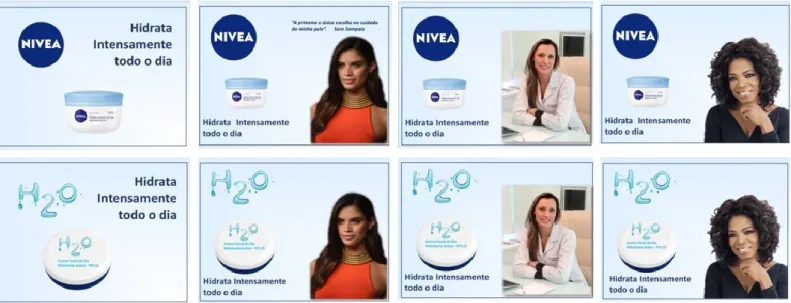
Figure 2: Characters used in the Pre-test
The main objective of the pre-test was to try to understand which models did respondents perceived has having certain source of credibility. This pre-test examined the perception of respondents on attractiveness, trustworthiness and expertise of 11 models. The model was selected in a random way only having in consideration the heterogeneity of the group, with some of the characters being familiar faces of the public and other don’t.
The figures that accounted for the higher scores in each of the credibility sources were than selected to be part of different print adverts in the main survey. The characters selected to be featured in the pre-test are as follows:
The fundamental aim of the survey is to understand which model has a higher impact in both purchase intentions and perceived quality both in a new product (H2O) and in an established product (Nivea). For the elaboration of this survey a product brand, H2O was created in addition with eight printed adverts.
3.3.1 Data Collection
The data collection will be executed through two different means. The first one is the pre-test. After having collected the images that best represent the three sources of credibility (trustworthiness, expertise and attractiveness) in the pre-test the next step of data collection is the distribution of a questionnaire.
Regarding the population defined to this research, it can be described has Portuguese individuals who have ever experienced the intention of purchasing a facial moisturizer.
3.3.2 Measurement / Indicators
There various types of data collections used in this researched were structures based on previous investigations. The constructs used, are explained in the table 1. For the evaluation of the constructs, a 5-point Likert scale with a neutral point was used to follow previous research methods.
Source of Credibility (Ohanian, 2011)
Measured on a scale from 1-5, 1= strongly disagree and 5= strongly agree
Attractiveness Trustworthiness Expertise
1.This model is attractive 6.This model is dependable 11.This model is an expert 2.This model is classy 7.This model is honest 12.This model is experienced 3.This model is beautiful 8.This model is reliable 13.This model has knowledge 4.This model is elegant 9.This model is sincere 14.This model is qualified
5.This model is sexy 10.This model is trustworthy 15.This model is skilled
Purchase Intentions (Tong & Hawley, 2009)
Measured on a scale from 1-5, 1= strongly disagree and 5= strongly agree 16. I would buy product X.
Perceived Quality (Dodds, Monroe, & Grewal, 1991)
Measured on a scale from 1-5
18.The likelihood that the product would be reliable is (very low to very high) 19. The workmanship of product would be (very high to very low) 20.This product would be of (very high quality to very low quality) 21.The likelihood that this product is dependable is (very low to very high) 22. This product would seem to be durable (strongly agree to strongly disagree)
Table 1: Constructs used in the Research
The constructs were used for the evaluation of the stimulus. To each respondent was showed a series of three adverts always containing the product and the models portraying the source of credibility. To guaranty that the respondent would not be affected, the stimulus showed would only represent one of the two brands featured in this research.
The stimuli featured in the research are represented in the next figure.
3.3.3 Data Analysis
The next step after the collection of secondary data, was the preparation and distribution of a pre-test and a questionnaire to assess which type of source of credibility had the biggest impact on purchase intentions of a new and established product and if variables like quality perception was a mediator of the model.
After the collection of secondary data, was clear that there was a need to understand who Portuguese consumers attribute has characters with the three sources of credibility (attractiveness, expertise and trustworthiness).
3.3.3.1 Pre-Test
To understand which characters were perceived to have the highest level of the three sources of credibility selected to the study (trustworthiness, attractiveness and expertise) a pre-test was designed and distributed. It consisted in the evaluation of 11 pictures (See Figure 1) within the constructs of attractiveness, expertise and trustworthiness previously tested by Ohanian (2011) in a 5-point likert scale. This test was experiences by 80 people and the figures with the higher mean within each category were then selected to be featured in the questionnaire (See appendix x).
To evaluate the figures that best fitted each source of credibility, a comparison of means was used. This method assists on the comparison between two objects (Malhotra & Briks, 2007). The picture in each category that had the highest value was then used as the face of the advert in the questionnaire.
Once the results were obtained, the next step was the construction and distribution of the questionnaire.
3.3.3.2 Questionnaire
This inquiry was designed to understand which scenario has the higher impact in purchase intentions: having a model perceived in attractive, expertise, trustworthiness or just a product. Furthermore, there was also a need to asses if this relation was different in establish or new products. At last, there was also the need to understand if the perceived quality of the product mediated the model.
Once again, the constructs used for the evaluation of attractiveness, trustworthiness, expertise, purchase intentions and perceived quality where previously testes as has been explained in the previous chapter.
The faces showed in each stimulus where re-tested to ensure that the previous respondents perceptions’ where confirmed.
purchase a hydrating face cream. After this step, all the respondents faced a control question (where only the product was featured) and a question where the stimulus (the face of the model) as featured.
The analysis of the model will be divided into four parts.
The first analysis being performed will help us understand to what extend do the sources of credibility affect the purchase intentions and perceived quality of the products showed in the ads. This analysis will be performed through a descriptive analysis of the data collected.
The second relationship that is going to be analyzed is between the source of credibility (trustworthiness, attractiveness and expertise) and the purchase intention showed by the respondent. These connections will be tested through a paired samples t-test. This procedures analyses two sets of observations relating to the same respondents (Malhotra & Briks, 2007). The test will compare the control group with each of the groups that has seen the advert with the model.
The fourth part of the analysis will consist in exploring on the possibility of having a mediator in the model studied. For that reason, the linear regression previously calculated. A mediator is another variable that explains the relationship between the dependent variable and the independent variable (Baron & Kenny, 1986). In this research, the investigation will focus on understanding if perceived quality may explain the effect that the different models (each one caring its one’s source of credibility), have in the purchase intentions of the beauty cream.
This last part of the analysis will be performed with the assistance of SPSS Process. On the next chapter of my research, the analysis of all the hypothesis will be performed and described.
CHAPTER 4: RESULTS AND DISCUSSION
Once the techniques of how the results for the research will be obtained were described and after de application of the resources used, the data was extracted from the survey and the pre-test, and the results were analyzed. In this next chapter, they will be presented. It is only in this chapter that simples number will be transformed into knowledge and hopefully will be used to sustain managerial implication in the future.
Firstly, a descriptive characterization of bot the pre-test and the main questionnaire will be conducted, followed by the separated analysis of which oh the hypothesis formed before, in chapter 2.
4.1 Results
This next section of results will be presented by chronologic order, which means that the results of the pre-test will be presented before the results of the main survey. Also, the results will always be presented according to the hypothesis formed and being evaluated and on the type of product being studied. As mentioned before, there were two types of products used in this research. The first, NIVEA, a market established brand and H2O, a new and unknown brand.
The first section will be utilized by the author to describe the variables in a more descriptive mode, which might help to unveil some concealed information. Initially each variable will be considered separately running a univariate data analysis.
Subsequently, a confirmatory analysis will be run by the author through a series of t-tests. These tests will help the author understand how does the character (dependent variable) impact the independent variable (the purchase intentions of the products).
4.1.1 Descriptive Statistics
For this research, two methods of analysis were conducted: a pre-test and a survey. The first step for the elaboration and running of the pre-test. The objective of this research was the need to find the three characters that were best capable of representing the three sources of credibility. In what respects the pre-test, 61 respondents completed the survey having 100% of valid questions. The sample size of this pre-test follows previous research by Till & Busler (2000) and has been collected in a simple random sample technique in which
each of the elements of the population have the same probability of responding to the test (Malhotra & Briks, 2007).
Regarding the questionnaire, 1546 respondents replied to it although only 1297 valid questions were accounted has valid questions. These answers were not considered valid once the respondents have not finished the questionnaire or have said that they had never bought, or considered buying the products in study. The sample technique used to this questionnaire was in line with the one used one the pre-test, which mean that a simple random sample technique was applied. According to Malhotra (2007), in the procedure of testing adverts, each one of the stimulus must have a sample between 200-300 respondents, which is in line with the research.
4.1.2 Sample Characteristics: Demographics and Shopping habits
In what regards the questionnaire, there were three demographic variables being studied. These were: age, sex and monthly income.
Regarding sex, and as featured in figure, 74,6% of the respondents were female contrasting with only 25,6% of male respondents.
In respect to age, and as showed in table x, the category with the higher level of respondents was the 16- 30 years old with 82,1% of reactions in this category. The remaining categories did not have such significance, being the category of >15 the one with the lowest
Respondents: 1546 Valid Answers: 1297
Figure 3 : Respondents and valid Answers
Female: 74,6% Male: 25,6%
As expected, and after observing the age category with the highest number of responses, the majority of respondents (56,7%) belonged to the range of >500€ followed by the 501€ to 1000€ with 20,8% of respondents. Moreover, the final three categories, 1001€ to 1500€, 1501€ to 2000€ and more than 2000€ represented respectively 11,7%, 6,8% and 4,1%. In what respect shopping habits, 78% of respondents expressed their intention to buy a face care product in one of their shopping trips, and contrasting, 22% of respondents have declared that they have never intended to buy any of those products.
4.1.3 Constructs’ Reliability
To assure that the analysis of these hypothesis, it is mostly important to accomplish a reliability test. This nature of test guarantees that the constructs used in the test are valid. To validate the performance of the test, there was a need to assemble the data into three categories. Each of the group was tested for reliability. The results of the test are described below and the value of the Cronbach’s alpha mentioned.
Attractiveness. Respondents of the survey were enforced into evaluating this construct
by apprising the level of attractiveness of the characters. The declarations were: “This model is attractive”; “This model is classy”; “This model is beautiful”; “This model is elegant”; “This model is sexy”. The results from the Cronbach’s alpha were 0,904.
Trustworthiness. In this construct, the respondents were required to evaluate each one
of the characters on their level of trustworthiness. The construct was explained by the following statements: “This model is dependable”; “This model is honest”; “This model is reliable”; “This model is sincere”; “This model is trustworthy”. The reliability test was run, and the results of the Cronbach’s alpha was 0,911.
Expertise. The construct of expertise asked the respondents to evaluate the level of
expertise of the models used on the Ads. The construct was composed by the following statements: “This model is an expert”; “This model is experienced”; “This model has knowledge”; “This model is qualified”; “This model is skilled”. The Cronbach’s alpha of this construct is 0,945.
Purchase Intentions. In the next construct, the respondents were asked to evaluate the
purchase intentions of each of the ads answering two questions: “I would by product X”; “I am likely to buy product X”. The results from this construct regarding the Cronbach’s alpha were 0,938.
Perceived Quality. The last construct being appraised in this subject inquired the
respondent to evaluate each of the product regarding its quality. The questions that composed these constructs were as follows: “The likelihood that the product would be reliable is (very low to very high)”; “The workmanship of product would be (very high to very low)”; “This product would be of (very high quality to very low quality)”; “The likelihood that this product is dependable is (very low to very high)”; “This product would seem to be durable (strongly agree to strongly disagree)”. The results for the Cronbach’s alpha were 0,89.
So that the results from the Constructs are considered valid, the results from the test must be higher than 0,6. Additionally, if the values of Cronbach’s alpha fall on the range between 0,80 and 0,89 the results of the investigation are seen as having very good consistency (Malhotra & Briks, 2007). This level of consistency is even higher if the values of the Cronbach’s alpha are higher than 0,9.
As described above, all the results from the constructs were higher than 0,8. This shows that the research is of high consistency and is possible to continue with the study since all variables are valid.
4.1.4 Sources of Credibility
4.1.4.1 Results obtained from the Pre-test
The principal objective of the pre-test was to find a character that would better represent the three different sources of credibility.
By analyzing the result in table 2, we can observe that the Sara Sampaio was the character with the highest results, with a mean of 4.6471 points out of 5. This character was also the one who has scored the lower value of standard deviation.
Attractiveness Character Mean Std. Deviation Sara Sampaio 4,65 0,40 Jennifer Anniston 4,55 0,55 Claudia Vieira 4,45 0,49 Random Girl 3,94 0,71 Random woman 3,85 0,77 Female dermatologist 3,67 0,64 Oprah 3,57 0,72 Lily Pebles 3,56 0,75 Random Expert 3,28 0,56 Anna 3,25 0,51 Male dermatologist 2,76 0,58
Table 2: Results on Attractiveness of the Pre-Test
The outcome of this analysis is that, Sara Sampaio was perceived to be the most attractive character not only by the comparison of means, but was also the character that obtained the lower discrepancy of evaluation. This is the reason why Sara Sampaio was presented has the attractive character in the main survey.
Regarding the study of second source of credibility, trustworthiness, by looking at table 3 it is observable that Oprah stands out by being the character with the highest scores, 3,8. These results made me conclude that out of all characters Oprah is the one that is perceived has having a higher level of trustworthiness, for this reason, Oprah has the character selected to represent trustworthiness in the main survey.
Trustworthiness
Character Mean Std. Deviation
Oprah 3,80 0,50 Female dermatologist 3,68 0,58 Jennifer Anniston 3,68 0,71 Male dermatologist 3,52 0,66 Random woman 3,52 0,82 Anna 3,50 0,54 Sara Sampaio 3,35 0,83 Lily Pebles 3,31 1,01 Claudia Vieira 3,24 0,69 Random Expert 3,23 0,35 Random Girl 3,09 0,50
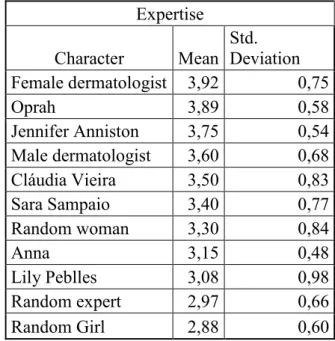
The last conclusion that need to me performed by this pre-test was the definition of the character that would better represent the third source of credibility being studied: Expertise. With an average of evaluation of 3,92, the figure of a blond dermatologist was the figure that respondents chose to represent this source the best.
Expertise
Character Mean Std. Deviation Female dermatologist 3,92 0,75 Oprah 3,89 0,58 Jennifer Anniston 3,75 0,54 Male dermatologist 3,60 0,68 Cláudia Vieira 3,50 0,83 Sara Sampaio 3,40 0,77 Random woman 3,30 0,84 Anna 3,15 0,48 Lily Peblles 3,08 0,98 Random expert 2,97 0,66 Random Girl 2,88 0,60
Table 4: Results on Expertise from the Pre-Test
4.1.4.2 Verification of the results obtained on the pre-test.
In order to verify the results, obtain in the pre-test, the author began the questionnaire by asking the respondents to, once again, evaluate each of the models in the three sources of credibility (attractiveness, trustworthiness and expertise). The results of the comparison of means are available in Table 5.
Attractiveness
Character Mean Std. Deviation Sara Sampaio 4,13 0,78 Female
dermatologist 3,40 0,85
Trustworthiness Character Mean Std. Deviation Sara Sampaio 3,11 0,50 Female dermatologist 3,12 0,58 Oprah 3,74 0,71 Expertise
Character Mean Std. Deviation Sara Sampaio 3,00 0,75 Female
dermatologist 3,36 0,58
Oprah 3,22 0,54
Table 5:Verification of the Results from the Pre-test
Regarding attractiveness, the model Sara Sampaio achieved the higher results scoring a mean of 4,13, followed by Oprah with 3,6 and the Dermatologist with 3,4.
In what concerns trustworthiness, Oprah was the model attain greater results with a mean of 3,74 accompanied with the dermatologist with 3,12 and Sara Sampaio with 3,11.
Finally, on the topic of expertise, the model representing a dermatologist represented the highest ratings with a mean of 3,36 followed by Oprah with 3,22 and Sara Sampaio with 3.
4.1.5 Results from the hypothesis tested.
The study presented in these research tries to study how does the source of credibility of the character used in an advert affects the purchase intentions of beauty products. In this thesis, the author is also trying to understand how does this effect differs according with to possible scenarios: a new product in the market, or an establish one. This study is also trying to understand another effect. This second effect reflect how does the source of credulity of a character influences the quality perception of the product.
Accordingly, to this description of effects that will be studied, a descriptive analysis of the variables was performed. As presented in the next tables and as applied in the questionnaire, respondents evaluated the following construct on a Likert-scale from 1 to 5.
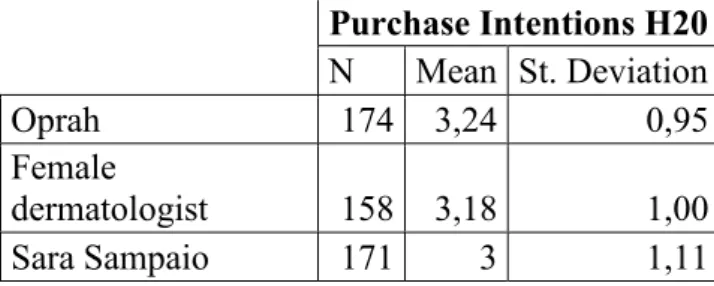
Purchase Intentions H20 N Mean St. Deviation Oprah 174 3,24 0,95 Female dermatologist 158 3,18 1,00 Sara Sampaio 171 3 1,11
Table 6: Purchase Intention of H20
Purchase Intentions NIVEA N Mean St. Deviation Oprah 172 3,45 1,02 Female dermatologist 165 3,45 1,02 Sara Sampaio 171 3,4181 0,93
Table 7: Purchase Intentions of NIVEA
By analyzing in detail, the past tables (Table 6 and 7) on purchase intentions, it is observable that there is no significant difference between the results obtained in the new product (H2O) regarding the three sources of credibility: Oprah (M= 3,24; SD= 0,95); the Dermatologist (M=3,18; SD= 1) and Sara Sampaio (M=3; SD= 1,11). In this table the observable is that, unexpectedly all the values for the standard deviation are very high.
In what concerns the table referring to the established product, NIVEA, the results are very similar with the past table. In this occasion the representatives of the three sources of credibility have also accounted for very parallel outcomes: Oprah (M= 3,45; SD=1,02); the Dermatologist (M= 3,45; SD1,02); and Sara Sampaio (M= 3,42 ; SD= 0,93) have scored results that may prove that the respondents did not have many homogenous answers
The following tables (8 and 9) concerned the perceives quality of the two products being studied.
N Mean St. Deviation Oprah 174 3,26 0,56 Female dermatologist 158 3,12 0,65 Sara Sampaio 171 3,1181 0,65
Table 8: Perceived Quality of H20
Perceived Quality NIVEA N Mean St. Deviation Oprah 171 3,65 0,54 Female dermatologist 165 3,74 0,56 Sara Sampaio 172 3,7756 0,57
Table 9: Perceived Quality of NIVEA
Regarding H2O, the results are not so different from the previous tables. The three figures of the sources of credibility accounted for similar results (Oprah M=3,26 SD=0,56; Dermatologists M=3,12 SD=0,65) and Sara Sampaio (M=3,12 SD=0,65). The lower values on standard deviations may evidence that respondents had more homogeneous answers.
Concerning the new product, H2O, the results were somehow stronger. All the characters accounted for higher results (Oprah M=3,65 SD=0,54; Dermatologist M=3,74 SD=0,56 and Sara Sampaio M=3,78 SD=0,57).
After the descriptive analysis made, the author can very previously state that there is no character or product that stand out from the group.
4.1.5.1 Normality Test
To further understand which is the character that has a higher impact on purchase intentions and perceived quality, the author still needs to run an independents sample t-test. This teste will help ensure the authenticity of the research hypothesis.
This kind of test are run under the assumption that the population follows a Normal, Binomial or Poison distribution. This rule shows that only interval or ratio data can be exploit (White and Rayner, 2014). Another characteristic of the sample should be taken in consideration, it is the homogeneity of the variances. The test chosen to make sure the population follows all the rules mentioned above was the Shapiro-Wilk test.
To perfume a Shapiro- Wilk test some other test need to be performed. This test also has some assumptions underlying. The assumption that the variances are equal tough out the sample is present in this test. So, and the overcome this obstacle, a Levene’s Test will be conducted.
The results of this test, according to Saunders and colleagues (2009), shoe that when the level of significance is lower than 0,05 that the variances are assumed to be equal which results that the two samples being testes have identical variability. On the other hand, when the lever of significance records a higher value that 0,05 the variances are not similar.
So that the population follows a normal distribution the results from the tests should be as follows: The Skewness’ level should be below 3 (SK<3) and the Kurtosis level below seven (K<7). Once these values are calculated and found to be true, it means that the deviations aren’t severe so it is possible to approximate the sample to a normal distribution.
Once all of these conditions are met it is know the time to pursue with the investigation and reach the next step: the parametric tests (Kline, 1998).
As observable in the table below, the results obtained for these tests do met the conditions enumerated before. So, the author can know say that the populations being studied does approximate to a normal distribution.
Shapiro-Wilk Skewness(SK) Kurtosis(KV) Character Product Df Sig. Statistics Std. Error Statistics Std. Error Sara Sampaio H20 Purchase Intentions 171 0 -0,21 0,19 0,44 0,37 Female
dermatologist H20 Purchase Intentions 158 0 -0,95 0,19 3,43 0,38 Oprah H20 Purchase Intentions 174 0 -0,32 0,19 0,52 0,37 Sara Sampaio NIVEA Purchase Intentions 171 0 -0,42 0,19 -0,78 0,37 Female
dermatologist NIVEA Purchase Intentions 165 0 -0,41 0,19 -0,51 0,38 Oprah NIVEA Purchase Intentions 172 0 -0,45 0,18 -0,41 0,37 Sara Sampaio H20 Perceived Quality 174 0 -0,89 0,19 0,25 0,37 Female
dermatologist H20 Perceived Quality 158 0 -0,78 0,19 0,05 0,38 Oprah H20 Perceived Quality 171 0 -0,91 0,19 0,18 0,37 Sara Sampaio NIVEA Perceived Quality 171 0 -0,08 0,19 1,19 0,37 Female
dermatologist NIVEA Perceived Quality 165 0 -0,28 0,19 1,36 0,38 Oprah NIVEA Perceived Quality 172 0 0,24 0,18 -0,01 0,37
4.2: Testing Hypothesis: Paired Sample T-test
The main objective of this research is to understand which of the three sources of credibility has a higher impact on the purchase intentions and perceived quality. To study the relations and the phenomenon that connect all the variables, an Independent sample t-test was the following test to be conducted.
Hypothesis 1AA: Attractiveness has a positive impact in purchase intentions of an established product.
The objective of this test was to understand if attractiveness, represented in this study by Sara Sampaio, has a positive impact in the purchase intentions of and establish product.
The paired t-test will help to understand this relationship by exploring more the values of the means of the two samples. Here the test reveals if the samples are significantly different or not. With these, the author will understand which product is the consumer more willing to purchase after he has seen the two different adverts.
The author created two different groups that have seen two different adverts. The first group watched the adverts containing only the product, Nivea, and the second group observed the adverts containing the influencer and the product.
Product Variables P-value Nivea Product vs. Sara Sampaio 0,382
H0:
Table 11: The impact of attractiveness in the purchase intentions of an established product
According to Table 11, and for a significance of 5%, the p-value is 0,382. With these results, the author can now say that the null hypothesis is not rejected. Thus, H1AA is rejected.
Hypothesis 1AB: Attractiveness has a positive impact in purchase intentions of a