Energy Detector Performance in
Rician Fading Channel
Srdjan S. Brkić
1, Predrag N. Ivaniš
2Abstract: In this paper we analyzed the problem of detection of unknown signals in the Rician fading channel. A closed-form expression for the probability of detection is derived, followed by the numerical results. The analysis was extended to the case of cooperative sensor network in which the environment can be modelled by independent Rician fading channels.
Keywords: Cognitive radio, Energy detection,Spectrum sensing, Rician fading.
1 Introduction
Spectrum management is an important part of next generation radio systems. Such a system is often referred to as cognitive radio and it is characterized by some revolutionary innovations. One of the innovations is enabling multiple wireless systems to work in the same frequency channel [1]. This idea requires a good detection mechanisms and minimization of collision probability of multiple users communicating through the same frequency channel – spectrum sensing mechanisms.
The goal of spectrum sensing is a primary user (PU) activity detection in the observed space-time-frequency channel. The existing spectrum sensing techniques can be broadly divided into three categories: energy detection, matched filter detection and cyclostationary detection [2]. Energy detection algorithm does not required any a priori knowledge of the primary signal and compared to other techniques has much lower complexity, therefore a large amount of research, including the results presented in this paper, is dedicated to this method.
Energy detector performance can be expressed with two parameters: detection probability and false alarm probability [3 – 8]. First parameter affects the radio system's interference level and the second the cognitive network spectral efficiency. Different effects of wireless channel, expressed through statistical distribution of received signal have influence on detection reliability. Noise level, fading and shadowing effects make spectrum sensing task difficult.
1Innovation Centre, School of Electrical Engineering, Bulevar kralja Aleksandra 73, 11000 Belgrade, Serbia;
E-mail: [email protected]
2School of Electrical Engineering, Bulevar kralja Aleksandra 73, 11000 Belgrade, Serbia; E-mail: [email protected]
The detection problem of deterministic signal in additive white Gaussian channel (AWGN) is described in details in [3]. The energy detector performance in Nakagami-m fading channel and generalized K channels, described in [4] and [5], respectively, are also known in literature. There are also interesting papers [6 – 8] from the field of cooperative spectrum sensing.
In this paper we investigated the performance of energy detection process in Rician fading channels. We derived a closed-form expression for detection probability which, to the best authors' knowledge, is not known in the literature. We also examined the performance of cooperative spectrum sensing network in the presence of Rician fading channels, when decision was made using OR decision rule.
The rest of this paper is organized as follows. In Section 2 we formulate the problem of signal energy detection in AWGN channel. Then, in Section 3 we present a derivation of detection probability in Rician channel model. Section 4 is devoted to analysis of cooperative spectrum sensing with decision fusion. The numerical results are presented in Section 5, while some concluding remarks are given in Section 6.
2 System
Model
The energy detector collects N/2 samples of input signal ri, (1 ≤ I ≤ N/2),
thus i-th sample has one of two values as follows
0
1
, ,
, ,
i i
i i i
n H
r
h s n H
= +
(1)
where ni denotes current value of noise complex envelope at moment i and hi is
i-th complex fading envelope, while si denotes i-th complex amplitude of
transmitted signal. H0 and H1 denote the hypotheses corresponding to the absence and presence of the primary signal, respectively. The goal of energy detection is to decide between the two hypotheses which can be achieved by forming a test signal as follows
( )
(
)
(
( )
)
1
0 2
2 2
1
Re Im ,
H N
i i
i
H
y r r
=
≥
= + λ
<
∑
(2)where we choose a hypotheses H0, if the value of test signal is lower than predefined threshold value λ, otherwise H1 hypotheses is chosen. The test signal
y, under hypotheses H1 has a noncentral chi-square distribution with variance equal to one, noncentrality parameter 2γ, where γ denotes a channel signal-to-noise ratio (SNR) and N degrees of freedom. Similarly, under H0 test signal will be central hi-distributed. Thus, the probability density function (PDF) of signal
2
2 2 1 2
0 2
2 2 4
2
2 1 1
2 2
1
, ,
2 ( 2)
( )
2 1
, ,
2 2
y N N N
N
y
N
y e H
N p y
y y
e I H
−
− σ
− γ + −
σ −
σ Γ
=
γ
σ γ σ
(3)
where Γ(·) denotes gamma function defined in [9, Sec. 8.31], while Iv(·)
represents modified Bessel function of the first kind described in [9, Sec. 8.43]. Performance of energy detector are measured by two parameters: detection probability (Pd) and probability of false alarm (Pfa). When only AWGN exists in
channel, expression for probability of false alarm (Pfa) is well known and can be
written as [4]
(
)
(
)
(
)
2
0
2, (2 )
Pr |
2 fa
N
P y H
N
Γ λ σ
= > λ =
Γ , (4)
while probability of detection can be derived as [4]
(
1)
2 2 22
Pr | ,
d N
P = y> λ H =Q γ λ
σ σ
, (5)
where QN/2(·,·) denotes generalized Marcum function of order N/2, defined in
[10].
3 Energy Detection in Rician Channel
The fading is a common phenomenon in telecommunication transmission and for forming a full analytical model of spectrum sensing system it is not sufficient to only know performance that can be achieved in AWGN channel. In this section we examined energy detector performance when SNR variation can be modeled by Rician statistics. Rician distribution model describes a multipath channel when exists a direct optical visibility (line of sight) between transmitter and receiver, i. e. the direct signal component has a dominant value. Thus, PDF of SNR in Rician channel can be written as follows [11]
(
)
0 ( 0 1)
0 0
0
0
1 1
( ) K e K K 2 K K
f I
γ
− − +
γ + γ
+
γ =
γ γ , (6)
whereγdenotes average channel SNR, while parameter K0 describes the direct component strength.
calculated averaging the value given by expression (5) for all values of SNR. Thus, the average detection probability of energy detector can be determined as
2
2
, 2 0
0
( , ) ( ) d
2 p
d Rice N
A
P e Q a b I c
+∞ − γ
=
∫
γ γ γ, (7)where parameters A, p2, a, b, c are: 0
0 2 K ( 1)
A e− K
= + γ, p2=2(K0+1) γ,
2
2
a= σ , M =N 2, b= λ σ2 , c=2 K0(K0+1) γ .
Substituting x= γ, the simplified form of integral that needs to be solved
is obtained 2 2 2 , 0 0
e ( , ) ( ) d p
x
d Rice M
P A x Q ax b I cx x
+∞ −
=
∫
. (8)Applying recursive identity [10, eq. (88)] generalized Marcum function of order M can be expressed by Marcum function of the first order and finite sum of modified Bessel function of first kind. Thus, we have
2 2
( ) 2
1 1 2
1 1
0
( , ) ( , ) e ( ) ( )
ax b M
i M M i
M M i
i
Q ax b Q ax b ax b I abx
+ −
−
− + − −
− − =
= +
∑
. (9)Now, applying previous relation, the integral given by (8) can be separated into two integrals and written as follows
2 2
1 1
2
, 1 2
0
e b M
i M M i
d Rice
i
P A I a b I
− − − + − − = = +
∑
, (10) where( )
2 2 2 2 21 1 0
0
2 2
2 0 1
0
e ( , ) ( ) d ,
e ( ) d .
p x p x i M M i
I x Q ax b I cx x
I x I cx I abx x
+∞ − +∞ − − + − − = =
∫
∫
(11)The solution of I1 can be represented as [10, eq. (45)]
2 2 2
1 2 1,0 2 2 2 2
1
e ,
c
p ac bp
I Q
p p p a p a
= + + , (12)
while I2 can be solved using auxiliary integral
( )
2 2 0 2 1 0 ( ) e d p x n aux nJ ax J bx
I x
x
+∞ −
−
Deriving a Bessel function of the first kind in power series according to [9, eq. (8.402)]
( )
(
)
2 2 0 1 ( )2 ! !
l
l n n l n
l
J x x
l n l
+∞ + + = − = +
∑
, (14)and with aid of [9, eq. (6.631.1)], the Iaux can be solved and presented in a
following form
( )
(
)
2 2
1 1
2( 1) 2
0
1
1; 1;
2 ! 2
l l n
aux l n l
l
b a
I F l
n l p p
+ +∞ + + = − = + − +
∑
, (15)where 1F1(·;·;·) denotes a confluent hypergeometric function described in [9, Sec. 9.21]. Dividing the integral from equation (13) with jn and substituting
a i b, with ja i jb, respectively, as well as n = M – I – 1, we can write the solution of I2 in a following fashion
(
)
2 1 2
2 1 2( 1) 1 1 2
0
1; 1;
2 1 ! 2
l M i
l M i l
l
b a
I F l
M i l p p
+ − − +∞ + − − + = = + − − +
∑
. (16)The infinite sum from the previous equation converges to a finite number when parameter l approaches to infinity. Now, we can finally write a closed-form expression for detection probability of energy detector in Rician fading channel
(
)
2 2
2
2 2
, 2 1 2 2 2 2
1 2( 1 ) 2
2
1 1
1 2( 1) 2
0 0
e , e
1;1; ( ),
2 1 ! 2
c b
p d Rice
i M l M i
M S
l M i l
i l
A ac bp
P Q A
p p p a p a
a b a
F l e S
M i l p p
− − + + − − − + − − + = = = + × + + × + + − − +
∑ ∑
(17)where S denotes the number of addends that need to be summed to achieve a chosen level of precision and e(S) is a rounding error. The value S is chosen depending on the fading parameter K0 and average SNR. Some values of S necessary for achieving the precision level e(S) < 10–5 (Pfa = 0.01) are given in
Table 1.
Table 1
The number of adders S needed to ensure accuracy of e(S) < 10–5 for Pfa = 0.01 (N = 10).
SNR K0 = 0 K0 = 10 K0 = 100
0 dB 15 9 7
10 dB 23 22 21
4 Cooperative
Spectrum
Sensing
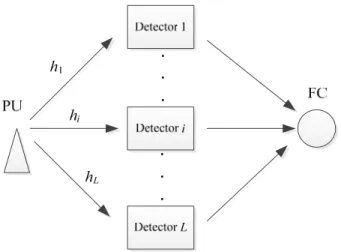
The level of confidence that can be achieved by a single detector often is not sufficient and in practice it is necessary to additionally increase the performance of spectrum sensing technique. Some of the effects that have the impact on the decision reliability are already mentioned in the introduction section. One of the solutions for overcoming deficiencies of single detector spectrum sensing is forming a cooperative network in which multiple detectors jointly examine the PU presence (Fig. 1).
Fig. 1 – Spectrum sensing in cooperative network.
As it can be seen in Fig. 1, the signal from PU is received by L spatially distributed detectors. Due to different propagation conditions, expressed by fading coefficients hi (I = 1, …, L), the decisions obtained by detectors could be
different. Each detector chooses one hypothesis (H0 or H1) and independently of the other detectors decides if PU is present. All decisions obtained by individual detectors then are forwarded to common fusion centre (FC) which, based on the adopted rule, makes a final decision. The OR rule is often used and the telecommunication channel is declared unused by PU, only if all detector chose hypothesis H1. The decisions passed to the fusion centre are binaries (0 or 1) and it is usually considered that their transmission is error free. Also, due to spatial distribution of detectors the sensing channels are considered spatially uncorrelated.
False alarm probability of cooperative network can be defined as follows [4]
(
)
(
)
2
,
2, (2 )
1 1
2
L
fa CN
N P
N
Γ λ σ
= − − Γ
Similarly, if γi denotes SNR value in channel from PU to i-th detector the
detection probability of cognitive network can be easy obtained based on Pd,Rice
given by (17) as follows [4]
, 2 2 2
1
0 0
, 1
2
1 1 , ( )
1 1 ( , ) .
L
d KM N i i
i
L
d Rice i
i
P Q f d
P N
+∞ +∞
=
=
γ λ
= − ⋅⋅⋅ − σ σ × γ γ =
= − − γ
∏
∫ ∫
∏
(19)
5 Numerical
Results
The energy detector performance can be graphically presented as Receiver Operation Characteristic (ROC) curves which represent detection probability Pd
dependence of false alarm probability Pfa. Alternatively, complementary ROC
curves that show missed detection probability (Pm = 1 – Pd) in dependence of
Pfa, can be used. The complementary ROC curves obtained using equation (17)
for average SNR γ =10dB and γ =15dB and value N = 10, for several values
parameter K0 are shown in Fig. 2. The threshold value λ was chosen based on equation (4) for predefined Pfa. Parameter K0 is proportional to direct component strength in Rician channel model and its increase improves detector performance. As it can be seen in Fig. 2, performance improvement is more visible in region with lower false alarm probability. It should be noticed that all values, obtained using procedure described in Section 3, are validated by numerical integration methods.
10-3 10-2 10-1 100
10-7 10-6 10-5 10-4 10-3 10-2 10-1 100
Probability of false alarm Pfa
P
ro
b
a
b
ili
ty
o
f
m
is
s
e
d
d
e
te
c
ti
o
n
Pm
K0=0,SNR=10 dB
K0=10, SNR=10 dB K0=100, SNR=10 dB AWGN, SNR=10 dB K0=0, SNR=15 dB K0=10, SNR=15 dB
K0=100, SNR=15 dB
AWGN, SNR=15 dB
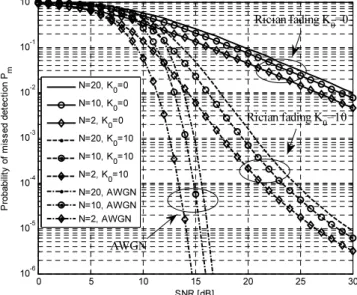
The values of probability of missed detection as a function of average SNR values, for several values of K0, are shown in Fig. 3. It can be noticed that, for example, for K0 = 10 and N = 10 the detection probability of 99% can be achieved when SNR= 16.16 dB, while for K0 = 0 (N = 10) the same reliability is obtained for much larger SNR value (SNR= 28.8 dB). If only AWGN exists in a channel the best results are obtained, as expected. Thus, in this case
Pd= 99% can be achieved for SNR= 13 dB. The influence of another significant
parameter was presented in the same figure – the number of samples that detector collects (N). Three cases are analyzed, when N = 2, 10 and 20 samples. It is noticed that the increase in number of collected samples degrades the performance level. Thus, reliability of 99%, when K0 = 10, can be achieved for SNR= 14.264 using only two samples, while it is necessary to have approximately SNR= 17.35 if N = 20. It can be concluded that the optimal approach is to choose only one sample length detection window in a both quadrature receiver branches. Described effect was already noticed in analysis of other fading channels.
0 5 10 15 20 25 30
10-6 10-5 10-4 10-3 10-2 10-1 100
SNR [dB]
P
ro
b
a
b
ili
ty
o
f
m
is
s
e
d
d
e
te
c
ti
o
n
Pm
N=20, K0=0
N=10, K0=0
N=2, K0=0 N=20, K0=10 N=10, K0=10 N=2, K0=10 N=20, AWGN N=10, AWGN N=2, AWGN
AWGN
Rician fading K0=10
Rician fading K0=0
Fig. 3 – Probability of missed detection as a function of SNR in Rician fading channel.
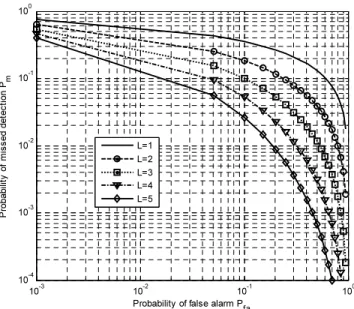
Complementary ROC curves that describe cooperative spectrum sensing technique are graphically presented in Fig. 4. The case when the SNR values in every spatially uncorrelated sensing channel are the same and are equal to 10 dB, was considered. It is clear that if the number of cooperative detectors increases, the overall sensing performance will be significantly improved and theoretically, providing large enough number of detectors, arbitrarily small missed detection can be achieved for every value of Pfa. However, in practice
10-3 10-2 10-1 100 10-4
10-3 10-2 10-1 100
Probability of false alarm Pfa
P
ro
b
a
b
il
it
y
o
f
m
is
s
e
d
d
e
te
c
ti
o
n
Pm
L=1 L=2 L=3 L=4 L=5
Fig. 4 – Complementary ROC curves for cooperative network with L detectors in independent Rician fading channels (γ =10dB, N = 10, K0 = 10).
6 Conclusion
In this paper, based on originally derived expression for detection probability, the performance of energy detector are examined if PU detection is performed in Rician fading channel. It is noticed that influence of signal direct component on detector performance is increased if the channel conditions improve. The reliability of decisions is inversely proportional to number of samples used the process of detection.
The performance improvements achieved by cooperative detection network, based on spatial diversity, are also presented. All results presented in this paper could be applied in cognitive radio systems.
7 References
[1] B.A. Fette: Cognitive Radio Technology, 2nd Edition, Elsevier, Burlington, MA, USA, 2006. [2] D. Cabric, S.M. Mishra, R.W. Brodersen: Implementation Issues in Spectrum Sensing for
Cognitive Radios, Asilomar Conference on Signals, Systems and Computers, Pacific Grove, CA, USA, 07 – 10 Nov. 2004, Vol. 1, pp. 772 – 776.
[4] F.F. Digham, M.S. Alouini, M.K. Simon: On the Energy Detection of Unknown Signals over Fading Channels, IEEE Transaction on Communications, Vol. 55, No. 1, Jan. 2007, pp. 21 – 24.
[5] H. Rasheed, N. Rajatheva: Spectrum Sensing for Cognitive Vehicular Networks over Composite Fading, International Journal of Vehicular Technology, Vol. 2011, 2011. [6] G. Ganesan, Y. Li: Cooperative Spectrum Sensing in Cognitive Radio–part I: Two user
Networks, IEEE Transaction on Wireless Communications, Vol. 6, No. 6, June 2007, pp. 2204 – 2213.
[7] G. Ganesan, Y. Li: Cooperative Spectrum Sensing in Cognitive Radio Part II: Multiuser Networks, IEEE Transaction on Wireless Communications, Vol. 6, No. 6, June 2007, pp. 2214 – 2222.
[8] S.M. Mishra, A. Sahai, R.W. Brodersen: Cooperative Sensing among Cognitive Radios, IEEE International Conference on Communications, Istanbul, Turkey, 11 – 15 June 2006, Vol. 4, pp. 1658 – 1663.
[9] I.S. Gradshteyn, I.M. Ryzhik: Table of Integrals, Series and Products, 6th Edition, Academic Press, San Diego, CA, USA, 2000.
[10] A.H. Nuttall: Some Integrals Involving the Q-function, New London Laboratory, Naval Underwater Systems Center, New London, CT, USA, 1974.