1Professor at the Instituto Federal de Educação, Ciência e Tecnologia do Sul de Minas – IFSULDEMINAS, Inconidentes (MG), Brazil. PhD in Geology, Department of
Geology and Natural Resources (DGRN), Geosciences Institute (IG), Campinas State University – UNICAMP, Campinas (SP), Brazil. E-mail: [email protected]
2Professor at the Department of Geology and Natural Resources (DGRN), Geosciences Institute (IG), Campinas State University – UNICAMP, Campinas (SP), Brazil.
E-mail: [email protected]
3Professor at the Department of Geography (DGEO), Geosciences Institute (IG), UNICAMP – Campinas (SP), Brazil. E-mail: [email protected]
*Corresponding author.
Manuscript ID: 20170101. Received on: 16/11/2016. Approved on: 08/04/2017. ABSTRACT: Soils and paleosols relect the complex interplay be-tween sedimentation, erosion and non-deposition. An analysis of the mineralogical components of paleosols is critical for the reconstitu-tion of the factors, processes and environments in which they were formed. he recognition of mineralogical assemblages can reveal the environmental conditions during pedogenesis and through quanti-tative analysis it is possible to identify a vertical variation in mineral concentration or leaching over the paleosol proiles, indirectly point-ing to environmental processes that dominated durpoint-ing the pedoge-netic evolution. he objective of this study is to discuss the signii-cance of mineral phases and to quantify the environmental evolution and degree of development of paleosols of the Marília Formation, Maastrichtian of Bauru Basin. hree sections have been described (A1, A2, A3) in the Marília Formation. he mineralogy was deter-mined by x-ray difraction, and mineral quantiication was obtained through the Rietveld reinement method. he calcretes of the Marília Formation are pedogenic, mostly authigenic minerals. he variation of quartz, calcite, palygorskite and smectite, the micromorphology, and the diversity of subsurface horizons (Bkm, Btkm, Bt) indicate that the studied paleosols did develop in semi-arid conditions, with episodes of higher rainfall rates, humidity, leaching and desilication. KEYWORDS: Calcrete; Paleoclimate; Palygorskite; Pedogenesis; Upper Cretaceous.
RESUMO: Solos e paleossolos reletem complexa inter-relação entre sedi-mentação, erosão e não-deposição. A análise dos constituintes mineralógi-cos de paleossolos é fundamental para a reconstituição dos fatores, processos e ambientes no qual esses se formaram. O reconhecimento de determi-nadas assembléias mineralógicas podem revelar as condições ambientais durante a pedogênese e através da análise quantitativa se torna possível constatar variação vertical ao longo dos peris de paleossolos, identiicando horizontes com maior concentração mineral ou lixiviação, apontando in-diretamente processos ambientais que dominavam no decorrer da evolução pedogenética. O objetivo desse trabalho foi discutir o signiicado das fases minerais e sua quantiicação na evolução ambiental e no grau de desenvol-vimento dos paleossolos da Formação Marília, Maastrichtiano da Bacia Bauru. Foram descritas três seções (A1, A2, A3) da Formação Marília. A mineralogia foi determinada através da difratometria de raios-x e para a quantiicação mineral foi utilizado o método de reinamento Rietveld. Os calcretes da Formação Marília são predominantemente pedogênico, com minerais autigênicos em sua maioria. A variação do teor de quartzo, calcita, paligorskita e esmectita, a micromorfologia e a diversidade de ho-rizontes subsupericiais (Bkm, Btkm, Bt) demonstraram que os paleossolos se desenvolveram em condições gerais semiáridas, com episódios de maiores taxas de precipitação, umidade, lixiviação e dessilicação.
PALAVRAS-CHAVE: Calcrete; Paleoclima; Paligorskita; Pedogênese; Cretáceo Superior.
The mineralogy of paleosols in the Marília
Formation and their importance in the
environmental evolution of the Maastrichtian
INTRODUCTION
Progress in identiication and mineralogical quantiication techniques has contributed to the study of paleosols. he tech-niques have become efective tools for performing paleoenvi-ronmental analysis and for identifying the evolution of conti-nental sedimentary basins. Soils and paleosols relect complex interplay between sedimentation, erosion, non-deposition and pedogenesis. Because soil is an open system that results from the interactions between factors (parent material, relief, time, climate and organisms) (Jenny 1994), and speciic pro-cesses of formation (Buol et al. 1997, Breemen & Buurman 2002, Resende et al. 2002), one can infer its origin from top to bottom. hus, it is possible to deine the factors’ conditions and the formation processes from the analysis of paleosols.
Paleosols, deined as soil formed in an ancient land-scape (Wright 1986), reveal the environmental conditions and characteristics that identify parental material, estimate formation time, and reconstitute paleosurfaces, paleoclimate and paleobiote. In addition, the use of paleosols enables the identiication of the relationship between deposition, non-deposition and erosion. hey have taken an increas-ingly prominent role in the study of paleoenvironmental and stratigraphic reconstructions (Andreis 1981, Kraus & Brown 1988, Birkeland 1999, Kraus 1999, Retallack 2001). he qualiication and quantiication of the mineralogical constituents of paleosols are critical for the reconstitution of the factors, processes and environments in which they were formed. he recognition of mineralogical assemblages may reveal the chemical, temperature, and hydrological conditions during pedogenesis (Allen & Hajek 1989, Paquet & Clauer 1997, Birkeland 1999, Meunier 2005, Kämpf et al. 2009). hrough quantitative analysis it is possible to assess the ver-tical variation of paleosol proiles, and identify horizons with higher mineral concentration (transformation, neoformation or inheritance) or leaching, which indirectly points to chemical processes that dominated during the pedogenetic evolution.
he objective of this study was to discuss the signiicance and the quantiication of mineral phases in the environmental evolution and inthe degree of development of the paleosols of the Marília Formation, Maastrichtian of Bauru Basin.
Several authors have identiied mineral assemblages in the Marília Formation and associated them with climatic condi-tions (Lepsch et al. 1977, Suguio & Barcelos 1983a, 1983b, Ribeiro 2001, Barison 2003, Dal’Bó & Basilici 2010, Fernandes 2010, Dal’Bó 2011, Pereira et al. 2015, Silva et al. 2015, 2016, 2017). However, quantitative studies aimed at the identiica-tion of mineralogical changes in time and their relaidentiica-tionship with paleoenvironmental evolution was never performed.
he Marília Formation paleosols were developed on sand-stones with diferent degrees of carbonate cementation, mostly
calcretes. he mineralogical composition and quantiication show that calcite was the second most abundant, followed by palygorskite and smectite. According to Meunier (2005), min-eralogical compositions with an assemblage of smectite, sepiolite and palygorskite identify soils derived from sediments exposed to arid or semi-arid conditions. Calcite, on the other hand, is a mineral soil that is very common in dry regions (sub-hu-mid arid) (Hubert 1978, Allen & Hajek 1989, Tanner 2010). he proposed mineralogical quantiication indicates that the paleosols of the Marília Formation were developed in semi-arid conditions, with episodes of higher rainfall rates, humid-ity, leaching and desilication. his information contributes to the knowledge about the evolution of the Maastrichtian in the Bauru Basin. It is expected that these results can corroborate the hypotheses, based on micromorphology and geochemis-try, about the evolution conditions of the Marília Formation.
GEOLOGICAL SETTING AND
STRATIGRAPHY OF THE BAURU BASIN
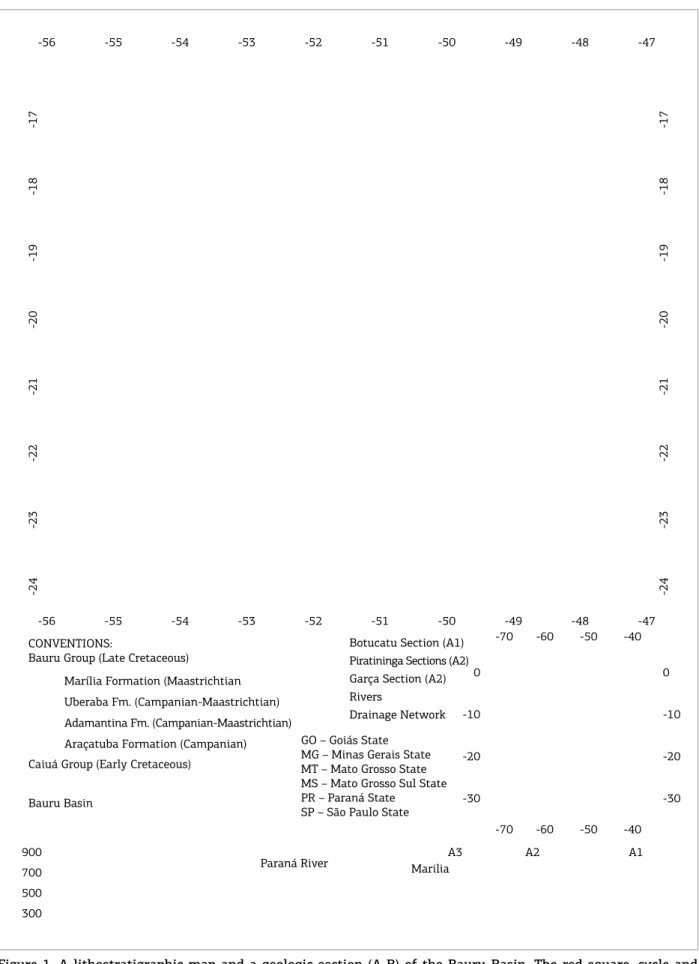
he Bauru Basin, located in southeastern Brazil, covers an area of approximately 330,000 km2, including the
cen-ter-west of São Paulo, northeastern Mato Grosso do Sul, southern Mato Grosso, southern Goiás and western Minas Gerais (Fig. 1). his basin has an elliptical shape, which is elongated in the N-NE direction and consists primarily of siliciclastic continental deposits (Batezelli 2003).
he Bauru Basin originated in the Late Cretaceous, was developed over the basalt rocks of the Serra Geral Formation, and was generated by the lexural subsidence caused by the weight of thick basalt, the Alto Paranaíba Uplift and the Alkaline Province of Goiás (Fig. 1) (Riccomini 1995, 1997, Fernandes & Coimbra 2000, Batezelli 2003, Batezelli et al. 2007, Batezelli, 2010, 2015, Batezelli & Ladeira, 2016).
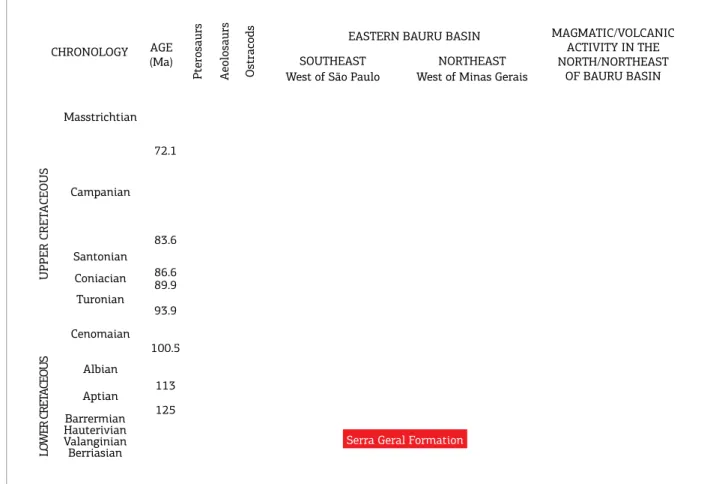
he Bauru Basin is subdivided into Caiuá and Bauru groups (Figs. 1 and 2). he lithostratigraphic position of these two groups is up for debate. Authors such as Fernandes & Coimbra (1996, 2000) and Fernandes (2004) state that the two groups are contemporary. Other authors (Fúlfaro & Perinotto 1996, Paula e Silva et al. 2005, Batezelli 2010, 2015) put the Caiuá in the lower portion of the basin, separated from the Bauru Group with a stratigraphic discordance. his discordance is signaled by a much evolved paleosol (Geosol Santo Anastásio, as in Fúlfaro et al. 1999). Batezelli (2010, 2015) and Batezelli & Ladeira (2016) demonstrated, using outcrops and well-logs data, that the two groups are not contemporary (Fig. 2), and proposed chronostratigraphy to understand the basin.
CONVENTIONS:
Bauru Group (Late Cretaceous)
-56 -55 -54 -53 -52 -51 -50 -49 -48 -47 -70 -60 -50 -40
-70 -60 -50 -40
900 700
500 300
Paraná River MariliaA3 A2 A1
0
-10
-20
-30
0
-10
-20
-30
24 23 22 21 20 19 18
-17
24 23 22 21 20 19 18
-17
-56 -55 -54 -53 -52 -51 -50 -49 -48 -47
Marília Formation (Maastrichtian
Uberaba Fm. (Campanian-Maastrichtian)
Adamantina Fm. (Campanian-Maastrichtian)
Araçatuba Formation (Campanian)
Caiuá Group (Early Cretaceous)
Bauru Basin
Botucatu Section (A1) Piratininga Sections (A2) Garça Section (A2) Rivers
Drainage Network
GO – Goiás State MG – Minas Gerais State MT – Mato Grosso State MS – Mato Grosso Sul State PR – Paraná State
SP – São Paulo State
portion of a braided, river-dominated alluvial system (According Stanistreet & McCarthy, 1993 terminology) arising from the Alto Paranaíba Uplift and the Alkaline Province of Goiás (Fig. 1).
he Bauru Group in the State of São Paulo consists of Araçatuba, Adamantina (Vale do Rio do Peixe according to Fernandes & Coimbra, 2000) and Marília (Echaporã Member) formations, from its base to the top (Batezelli, 2003, 2010, 2015). According to Batezelli (2003, 2010, 2015), the Araçatuba Formation was formed in a lacustrine environment (playa-lake) that served as the base level for the river system (Adamantina and Marília formations). he illing occurred because of the progradational advance of an alluvial system dominated by a braided river that gave rise to the Marília Formation.
he sedimentary evolution of the alluvial system was marked by periods of luvial sedimentation and eolian reworking, inter-spersed with periods of non-deposition (Batezelli 2010, 2015, Batezelli & Ladeira 2016). During non-deposition times the loodplain would be covered by vegetation, and as such, soils could develop. hus, the Marília Formation consists of a suc-cession of deposits and paleosols that record sedimentation and pedogenesis during the Maastrichtian of the Bauru Basin.
In the Marília Formation, paleosols are made up of argil-lic horizons (Btk and Bt) and a calcic horizon (Bk) with diferent degrees of cementation, constituting calcretes. he irregular distribution and diferent thicknesses of the proiles are related to the type of parent material, hydrology, topography and biology, as well as the time of exposure of deposits to weathering agents.
MATERIALS AND METHODS
Field descriptions
he facies analysis method was based on Miall (1985, 1996) and the characterization of paleosols was performed according to Andreis (1981), Retallack (1988, 2001) and Catt (1990).
hree sections have been described (A1, A2 and A3) at the Marília Formation (Figs. 1 and 3), and nine samples proiles were obtained.
hree main lithofacies were identiied: Gm (conglom-erates), Sm (sandstones) and Fm (pelites or mudstones).
MAGMATIC/VOLCANIC ACTIVITY IN THE NORTH/NORTHEAST
OF BAURU BASIN
125
LO
WER CRET
ACEOUS
UPPER CRET
ACEOUS
Masstrichtian
Campanian
Santonian
Coniacian
Turonian
Cenomaian
Albian
Aptian
Barrermian Hauterivian Valanginian Berriasian
72.1
83.6
86.6 89.9
93.9
100.5
113
CHRONOLOGY AGE
(Ma)
Pterosaurs Aeolosaurs Ostracods
EASTERN BAURU BASIN
SOUTHEAST West of São Paulo
NORTHEAST West of Minas Gerais
Serra Geral Formation
Figure 2. A chronostratigraphic chart of the eastern portion of the Bauru Basin, based on Amaral et al. 1967 (CSN sample); Hasui & Cordani 1968 (samples AX, C-3, S-10, S-31, A-C2-4, OB-SN, SB, S-1, P, T-2, B-1); Sonoki & Garda 1988 (samples CT, CS, CCI); Machado Junior 1992 (sample CCII); Guimarães et al. 2012 and Fragoso et al. 2013 (Pterosaurs); Gobbo-Rodrigues 2001 and Dias-Brito et al. 2001 (Ostracods); Santucci & Bertini 2001 and Martinelli
he ieldwork consisted of identifying horizons, ped structures, and root marks which are the main attributes of paleosols (Andreis 1981, Retallack 1988, Catt 1990, Retallack 2001). he horizons were deined through descriptions of
texture, structure, color (Munsell Color Chart), thickness and depth, types of contact — cutans, nodules or cement-ing — bioturbations, presence or absence of mottlcement-ing, gley-zation and friction surfaces (slickensides). Calcic (Bkm)
2nd order surface 3rd order surface Conventions
Root marks
Bloturbtion
Massive
Prismatic structure
Block structure
Laminar structure
Carbonate cementation (CaCO³)
Quartz clasts, clay, calcilutite A1
A2
A3
P1, P2, P3, P4, P5, P6, P7, P8: Proiles
P:Paleosols
Sm, Gm, Gc, Gt, Gml, Fm: Lithofacles
Diastern
Carbonate nodules
Waxy
Basalt clasts changed
Clasts clay
Plane-parallel lamination
Channel deposite
Cross-bedding
GB, CH, LA: Architectural Elements
Figure 3. Described sections. Botucatu section (A1): Located in the homonymous municipality (Marechal Rondon
Highway, km 151), and stratigraphic section with the lithofacies (Gc, Gt, Gm) and proiles (P1, P2); Piratininga section
(A2): Located in the homonymous municipality (Bauru-Ourinhos Highway, km 248), and stratigraphic section
with the lithofacies (Gm, Gmi) and proiles (P3, P4, P5, P6, P7); Garça section (A3): Located in the homonymous
municipality (João Ribeiro de Barros Highway), and stratigraphic section with the lithofacies (Sm, Gm, Fm) and
and argillic (Btkm and Bt) horizons were identiied in the paleosols of the study area.
Micromorphological analysis
he description of the oriented thin sections was made according to Bullock et al. (1985) and Stoops (2003) using a binocular magnifying glass to separate domains on the blade, and a petrographic microscope, with increases in magnii-cation of 2.5X to 40X, for the analysis of the groundmass (S-matrix) and pedofeatures.
Scanning electron microscopy analyzes were performed on four samples, which are representative of the diferent horizons of paleosols.
Interpretations of the groundmass and pedofeatures were based on Delvigne (1998) and Stoops et al. (2010).
X-ray diffraction
X-ray difractometry (XRD) was used to determine min-eralogy. It is a particularly useful technique in sedimentology and paleopedology for the characterization of minerals. XRD was performed in thirty representative samples of paleosol horizons and it used the powder method. he analysis fol-lowed the methodology proposed by Camargo et al. (1986), Jenkins & Snyder (1996) and Pecharsky & Zavalij (2009).
Quantitative analysis
he mineralogical analysis was reined, and the mineral phases were quantiied using the Rietveld Method (Jenkins & Snyder 1996, Fabris et al. 2009).
he basic principle of the method is the itting of a dif-fraction pattern (real) with a theoretical standard (crystal-line structure) in order to minimize the diference between calculated and measured points (Jenkins & Snyder 1996). According to Fabris et al. (2009), the difraction pattern’s best it is obtained through the least squares method for all intensity values (yi), simultaneously from the minimization of the residue (Sy) given by Equation 1:
Sy = ∑iwi(yi – yci)2 (1)
Where:
wi is the weight of each intensity given by wi = 1/ yi ,
yi is the intensity observed in the i-th step, and
yci is the intensity calculated in the i-th step, and the sum is over all the points.
he model parameters that can be reined relate to atomic position of occupation sites and thermal switch (Fabris et al. 2009, Pecharsky & Zavalij 2009). he most commonly used program functions that model the proiles of relec-tion peaks are the Gaussian, Lorentzian, Voigt, Pseudo-Voigt
and Pearson VII functions (Fabris et al. 2009). he reining process continues until “the best adjustment” is reached.
he Rietveld reinement, which aimed at quantifying the minerals, was performed through the X’Pert Highscore Plus v2.0a, using the Crystallographic Information File (CIF) data iles, which originated from the Crystallographic Open Database.
RESULTS
The characterization of Facies and paleosols
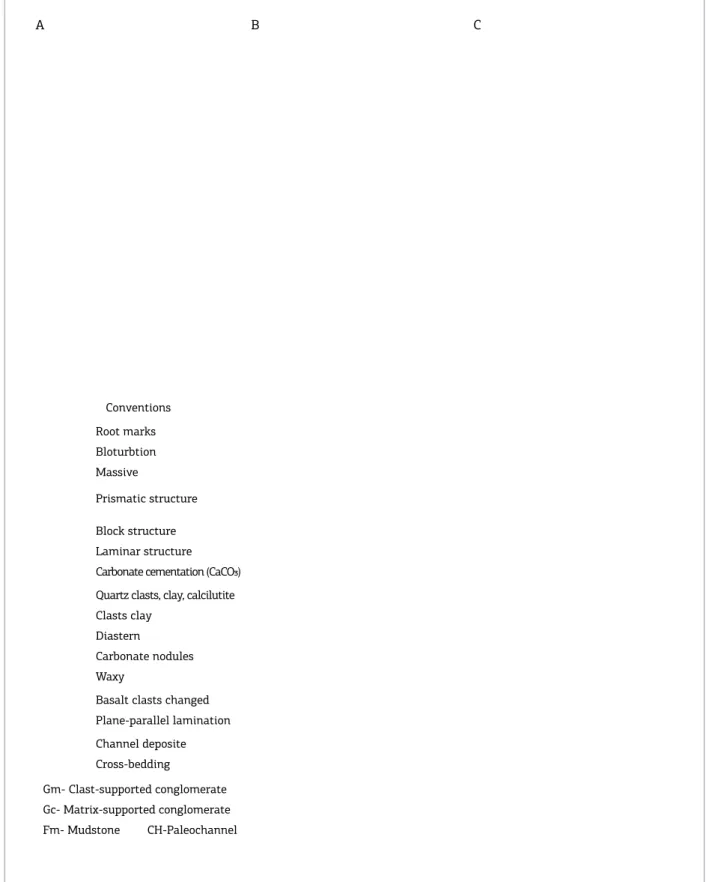
Conglomerate (Gc, Gm and Gt), sandstone (Sm) and mudstone (Fm) facies, typical of luvial depositional sys-tems, were described in the sections (A1, A2 and A3) of the Marília Formation (Fig. 4). Sandstones facies (Sm) were described and interpreted as the C horizons of paleosols, because of intense bioturbation and the predominance of massive structures,.
he identiication of pedogenic structures (blocky, pris-matic and laminar) and root marks, associated with the absence of stratiication, the predominance of massive structures and the discontinuity of carbonate cementation on the base of outcrop, were the main factors used to determine that the proiles were predominantly pedological.
In the morphological characterization, paleosols were identiied with a Bkm horizon and blocky structures in the Botucatu section (A1), argillics horizons (Btkm and Bt) with prismatic and blocky structures in the Piratininga section (A2), and Btkm and Bkm horizons in the Garça section (A3) with laminar, prismatic and blocky structures (Fig. 4).
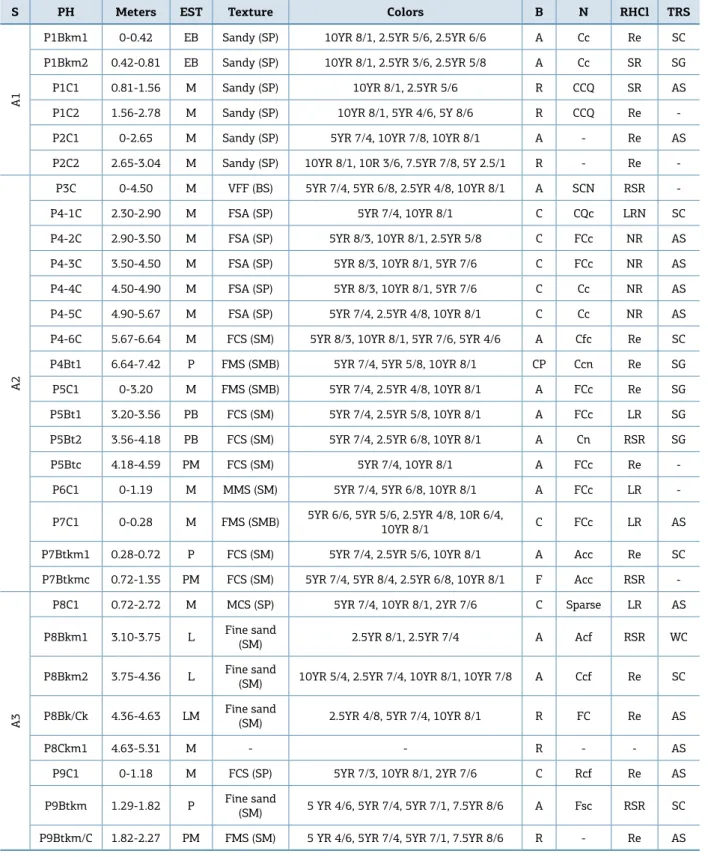
he synthesis of macro-morphological characteristics of paleosol proiles is summarized in Table 1.
he proiles also showed horizons (Bkm, Btkm, Bt), pedological structures (blocky, laminar, prismatic) and root marks (Figs. 5 and 6), which gives them the status of paleosols (Andreis 1981, Retallack 2001). Rhizoliths, rhizoconcretions, krotovines and bioturbations also occur in diferent propor-tions in the Marília Formation (Figures 5A, 5B, 5C, 5D, 5E).
In addition to these diagnostic features of paleosols, it was noted that the outcrops showed no stratiications, as they displayed massive structures, especially in horizon C proiles.
Micromorphology revealed the predominance of por-phyric c/f-related distribution in three sections, with some chitonic, enaulic, and gefuric regions. Features of coatings, inillings, nodules and microcodium were identiied in the paleosol horizons (Figs. 7, 8 and 9).
Mineralogy
Root marks Bloturbtion
Massive
Prismatic structure
Block structure Laminar structure Carbonate cementation (CaCO³)
Quartz clasts, clay, calcilutite Clasts clay
Diastern
Carbonate nodules Waxy
Basalt clasts changed Plane-parallel lamination
Channel deposite Cross-bedding
Conventions
A B C
Gm- Clast-supported conglomerate Gc- Matrix-supported conglomerate
Fm- Mudstone CH-Paleochannel
Figure 4. Facies and the macromorphology of paleosol proiles. (A) column with the lithofacies (Gc, Gt, Gm), proiles (P1, P2) and horizons of the Botucatu Section (A1); (B) column with the lithofacies (Gm), proiles (P3, P4, P5, P6, P7) and horizons of the Piratininga Section (A2); (C) column with the lithofacies (Gm, Fm), proiles (P8, P9)
Table 1. Summary of morphological characteristics of paleosols in the A1, A2 and A3 sections.
S PH Meters EST Texture Colors B N RHCl TRS
A1
P1Bkm1 0-0.42 EB Sandy (SP) 10YR 8/1, 2.5YR 5/6, 2.5YR 6/6 A Cc Re SC
P1Bkm2 0.42-0.81 EB Sandy (SP) 10YR 8/1, 2.5YR 3/6, 2.5YR 5/8 A Cc SR SG
P1C1 0.81-1.56 M Sandy (SP) 10YR 8/1, 2.5YR 5/6 R CCQ SR AS
P1C2 1.56-2.78 M Sandy (SP) 10YR 8/1, 5YR 4/6, 5Y 8/6 R CCQ Re
-P2C1 0-2.65 M Sandy (SP) 5YR 7/4, 10YR 7/8, 10YR 8/1 A - Re AS
P2C2 2.65-3.04 M Sandy (SP) 10YR 8/1, 10R 3/6, 7.5YR 7/8, 5Y 2.5/1 R - Re
-A2
P3C 0-4.50 M VFF (BS) 5YR 7/4, 5YR 6/8, 2.5YR 4/8, 10YR 8/1 A SCN RSR
-P4-1C 2.30-2.90 M FSA (SP) 5YR 7/4, 10YR 8/1 C CQc LRN SC
P4-2C 2.90-3.50 M FSA (SP) 5YR 8/3, 10YR 8/1, 2.5YR 5/8 C FCc NR AS
P4-3C 3.50-4.50 M FSA (SP) 5YR 8/3, 10YR 8/1, 5YR 7/6 C FCc NR AS
P4-4C 4.50-4.90 M FSA (SP) 5YR 8/3, 10YR 8/1, 5YR 7/6 C Cc NR AS
P4-5C 4.90-5.67 M FSA (SP) 5YR 7/4, 2.5YR 4/8, 10YR 8/1 C Cc NR AS
P4-6C 5.67-6.64 M FCS (SM) 5YR 8/3, 10YR 8/1, 5YR 7/6, 5YR 4/6 A Cfc Re SC
P4Bt1 6.64-7.42 P FMS (SMB) 5YR 7/4, 5YR 5/8, 10YR 8/1 CP Ccn Re SG
P5C1 0-3.20 M FMS (SMB) 5YR 7/4, 2.5YR 4/8, 10YR 8/1 A FCc Re SG
P5Bt1 3.20-3.56 PB FCS (SM) 5YR 7/4, 2.5YR 5/8, 10YR 8/1 A FCc LR SG
P5Bt2 3.56-4.18 PB FCS (SM) 5YR 7/4, 2.5YR 6/8, 10YR 8/1 A Cn RSR SG
P5Btc 4.18-4.59 PM FCS (SM) 5YR 7/4, 10YR 8/1 A FCc Re
-P6C1 0-1.19 M MMS (SM) 5YR 7/4, 5YR 6/8, 10YR 8/1 A FCc LR
-P7C1 0-0.28 M FMS (SMB) 5YR 6/6, 5YR 5/6, 2.5YR 4/8, 10R 6/4,
10YR 8/1 C FCc LR AS
P7Btkm1 0.28-0.72 P FCS (SM) 5YR 7/4, 2.5YR 5/6, 10YR 8/1 A Acc Re SC
P7Btkmc 0.72-1.35 PM FCS (SM) 5YR 7/4, 5YR 8/4, 2.5YR 6/8, 10YR 8/1 F Acc RSR
-A3
P8C1 0.72-2.72 M MCS (SP) 5YR 7/4, 10YR 8/1, 2YR 7/6 C Sparse LR AS
P8Bkm1 3.10-3.75 L Fine sand
(SM) 2.5YR 8/1, 2.5YR 7/4 A Acf RSR WC
P8Bkm2 3.75-4.36 L Fine sand
(SM) 10YR 5/4, 2.5YR 7/4, 10YR 8/1, 10YR 7/8 A Ccf Re SC
P8Bk/Ck 4.36-4.63 LM Fine sand
(SM) 2.5YR 4/8, 5YR 7/4, 10YR 8/1 R FC Re AS
P8Ckm1 4.63-5.31 M - - R - - AS
P9C1 0-1.18 M FCS (SP) 5YR 7/3, 10YR 8/1, 2YR 7/6 C Rcf Re AS
P9Btkm 1.29-1.82 P Fine sand
(SM) 5 YR 4/6, 5YR 7/4, 5YR 7/1, 7.5YR 8/6 A Fsc RSR SC
P9Btkm/C 1.82-2.27 PM FMS (SM) 5 YR 4/6, 5YR 7/4, 5YR 7/1, 7.5YR 8/6 R - Re AS
S: sections; A1: P1Bkm1, P1Bkm2, P1C1, P1C2, P2C1 and P2C2; A2: P3C1, P3C2, P4-1C, P4-2C, P4-3C, P4-4C, P4-5C, P4-6C, P4Bt1, P5C1, P5Bt1, P5Bt2,
P5Btc, P6C1, P7C1, P7Btkm1 and P7Btkmc; A3: P8C1, P8Bkm1, P8Bkm2, P8Bk/Ck, P9C1, P9Btkm and P9Btkm/C; PH: proile and horizon; EST: structure; B: bioturbations; N: nodules; TRS: transition between horizons; EB: blocky; L: laminar; LM: laminar tending to massive; M: massive; P: prismatic; PB: prismatic tending to blocky; PM: prismatic tending to massive; FSA: ine sandy bar to the average; MCS: medium to coarse sand; FCS: ine to coarse sand; VFF: very ine sand to ine; FMS: ine to medium sand; MMS: medium sand; BS: well selected; SP: poorly selected; SM: moderately selected; SMB: good to moderate selection; RHCl: reaction to hydrochloric acid; A: abundant (< 5% of exposed area); C: common (3–5% of exposed area); CP: common to a few (1–5% of exposed area); F: few (1–3% of exposed area); R: rare (< 1% of exposed area); Cc: clay clasts; CCQ: carbonate, clay and quartz clasts; SCN: Sandy clasts with oxide ilms, nodule CaCO3; CQc: Quartz and clay clasts; FCc: Few clay clasts; Cfc: carbonate, few clay clasts; Ccn: clay clasts and carbonate nodules; Cn: clay
A B
C D
E
Figure 5. Morphological aspects of paleosol proiles. (A) Horizon base C2 of P (the base does not have CaCO3 cementation indicating if it is a pedogenic calcrete); (B) bioturbations with and without carbonate iller material in the proile 4. The black arrow indicates a rhizolith (a precipitated carbonates tube, which illed former burrows),
a common feature in paleosols of the Marília Formation. The rhizoliths are organo-sedimentary structures produced by decomposition and plant root activity (Durand et al. 2010). The yellow arrow indicates a krotovine
(bioturbation mark illed with other materials) on top; (C) the red arrow indicates a large bioturbation (rhizolith) on the Btc horizon proile 5 with a reduction of halos (white) and oxidation (redder feature); (D) bioturbations in
the Bt horizon of the A2 section; (E) Rhizoconcretion present in the Marília Formation.
Quartz was the predominant mineral, due mainly to a large presence of sandstones in the Marília Formation, fol-lowed by calcite and palygorskite. Other mineral phases were present in a lower percentage.
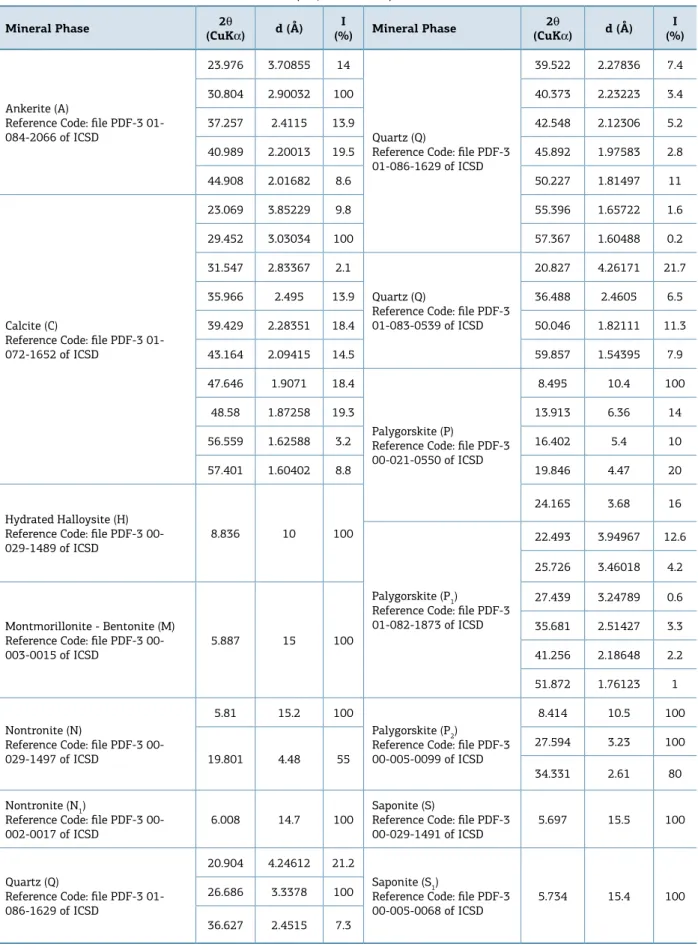
Nontronite, saponite and palygorskite have more than one chemical formula (Tab. 3). herefore, these phases received diferent designations (symbols) such as N and N1, P, P1 and P2, or S and S1 (Tab. 2).
he mineral identiication and quantiication of the Botucatu, Piratininga and Garça sections (A1, A2 and A3) are compiled in Table 3 and in Figures 10 and 11.
Palygorskite was identiied in all of the paleosol pro-iles. In the proiles with a B horizon of the sections A1, A2 and A3, the percentage of palygorskite was quite variable (Figs. 10, 11 and 12).
he mineralogy of the sections of the Marília Formation showed that, after quartz, calcite was the second most abun-dant mineral, followed by palygorskite (Tab. 3). he calcite may be inherited or have an authigenic formation. Often it takes up much of the groundmass especially in petrocalcic horizons (featuring calcretes). Some calcretes consist of more than 900 g-1 kg of calcite (Allen & Hajek 1989). he high
cal-cite content of the paleosol horizons matched the condition of calcretes, a fact that had already been examined in the ield.
Palygorskite was found to be the third most abundant mineral in the horizons and had speciation, indicating changes in the environment during its formation.
percentage lower than 1% in the paleosol horizons, and it was not considered for interpretation. he clay mineral halloysite was present in a percentage of 0.5% in the horizon Bt1 of the proile 5, and was also not considered (Fig. 12, Tab. 3).
Smectites can be found in several geological materials and remain in the soils during pedogenesis (Azevedo & Vidal-Torrado 2009). Saponite and nontronite rarely occur in soils. However these smectites can form through hydrothermalism in some types of source materials (Garcia-Romero et al. 2005). Regarding the origin of smectites through transformation, we emphasize that smectites can be formed by changes in thestruc-ture and the load on the micas layersso that theydo not cause dissolution and reprecipitation. Smectites can also be formed through the transformation of chrolites, mainly Fe-Mg chrolites. For smectites to form through precipitation from solution, it is necessary to have solutions rich in Si with Mg or Fe (Azevedo & Vidal-Torrado 2009). hese authors state that the neoforma-tion of smectites occurs more often in soils with little leaching. Examples include soils formed in drainage-limited or arid loca-tions. hese conditions allow for the maintenance of the high ion concentration required for the precipitation of these minerals.
DISCUSSION
Pedogenesis of calcretes
Plenty of calcretes in the Marília Formation records are environments with a semi-arid paleoclimate, because they are rare in arid or humid climates and develop completely in semi-arid climates (Fedorof & Courty 1989). Another factor
that endorses this thesis is the lack of gley horizons associated with calcretes. Generally calcretes from humid climates are associated with horizons of reducing environments, because their position is in relief.
Morphological characteristics led to the interpretation that calcretes are pedogenic, because the proiles showed most of the features inherent to calcretization pedological processes (Pimentel
et al. 1996, Alonso-Zarza 2003, Wright 2007). Discontinuous carbonate cementation on the basis of the proiles (Figure 5A) and the absence of a pseudogley feature also contributed to the interpretation of calcretes as having a pedogenic origin. Unlike pedogenic calcretes, groundwater calcretes have intense mottling (with gray-green tones), a feature restricted to fracture zones or roots within oxidized horizons, called pseudogley (Pipujol & Buurman 1994, Pimentel et al. 1996).
Prismatic and blocky structures recorded in the proile (Figs. 6A, 6C, 6D) are typical products of pedogenesis, and may even be preserved in paleosols of the Paleozoic age (Andreis 1981).
he micromorphologic interpretation of secondary pro-cesses, the accumulation of carbonate as recrystallization and replacement, the variety of weathering patterns, root marks, bioturbation, microcodium, nodules, the authigenesis of paligor-skita, the coating features of carbonates on quartz and coating clay, pisolite and pending calcite (Figs. 7, 8 and 9) supported the hypothesis that the proiles have a pedogenic origin.
Usually microcodium is associated with a rizogenic hori-zon (Kosir 2004). Calcite pendants (pending calcite) are another striking feature of pedogenic calcretes (Manai & Poch 2012). Microfabric Beta type (biogenic/microbial related to the presence of roots, carbonates with cellular factory,
A B C
D
Figure 6. Structures of the Marília Formation paleosols. (A) Prismatic structure Btkm1 horizon (P7), with carbonate
nodules; (B) laminar structure proile 8 (P8); (C) blocky structures Bt horizon (P5), especially lots of bioturbation;
ibrous calcite, microcodium), the presence of meniscus structures and pendent cementation are typical and strik-ing features of pedogenic calcretes (Pimentel et al. 1996).
Inillings and coatings were common features found in the calcretes (Figs. 7, 8 and 9). Coatings, hypocoatings, quasicoatings and inillings are practically the result of a
A B C
D E F
G H I
J K L
Figure 7. Characteristics of the groundmass. (A) CaCO3 recrystallization process in the C2 horizon (P1), resulting in crystalline pedological features (crystalline pedofeatures) represented by carbonate nodules (yellow arrow); (B) with crossed nicols (NC); (C) simultaneous processes and weathering replacement of the quartz polycrystalline calcite (red arrow) in the Bt1 horizon (P5); (D) with NC. With a polarized light, it is possible to perceive a
superimposition process of clayey material (iron oxides) in the carbonate features; (E) bioturbation in the Bt1 horizon (P5) illed by quartz grains (krotovine); (F) with NC; (G) replacement process and bioturbation feature
in laminar horizon Bkm1 (P8). There is a change and partial replacement of quartz with microsparitic calcite
coating, which is indicated by the yellow arrow. Coating quartz carbonate is a typical feature of soil proiles (Bedelean 2004). The red arrow indicates a calciied root mark, common in rizogenic calcrete; (H) with NC; (I)
pendant calcite (Pt) in the Btkm horizon (P9) below the quartz grains (Q) indicated by the arrows; (J) with NC; (K)
Feature coating in the Bt2 horizon (P5). The yellow arrow indicates coatings with iron oxides around the quartz
pedological formation, a weathering product in situ (Stoops 2008). Figure 7D shows the change and partial replacement of quartz with calcite that has a microsparitic coating, indi-cated by the yellow arrow. Quartz coating carbonate is a typical feature of soil proiles (Bedelean 2004).
Concentric bands of clay in pisolites (Fig. 8F), result-ing from the new formation of clay with Si and Al, and their concentric layers may indicate the control from microorganisms that are associated with the roots (Durand
et al. 2010).
Calciication-decalciication pedofeatures, common in calcretes of the Marília Formation, are associated with the impregnation of the root tissue and are often observed in semi-arid calcareous soils (Durand et al. 2010).
The paleoenvironmental
significance of clay mineralogy
Mineral phases and mineralogical measurements allow for the comparison of paleosol proiles and a discussion on the evo-lution of the Marilia Formation (Fig. 12, Tab. 3). According to
A B C
D E F
Figure 8. Features of the groundmass. (A) Chronology in the Bkm horizon (P1). The chronology revealed that palygorskite (P) precipitated in the paleosol void, as a secondary mineral. The yellow arrow indicates weathered biotite; (B) with NC; (C) crystalline pedofeature, represented by the root mark (rhizolith CaCO3) in the Bk/Ck horizon (P8); (D) Microcodium in the Bkm1 horizon proile 8 (arrows); (E) with NC; (F) pisolite shows concentric rings of iron-containing material (Bt1 horizon of P5), with natural light (LN or PPL). The yellow arrow also shows
clay with iron oxides coating the pisolite.
A B C
Figure 9. C1 horizon (P3) SEM. (A) Authigenesis of palygorskite (Pg), coating grains of quartz (Q) and calcite;
(B) detailed palygorskite (Pg) in the form of aggregate of entangled ibers coating the quartz grain (Q); (C) the
formation of palygorskite (Pg) through changing smectite (E). It is possible to observe palygorskite in the form of
Table 2. Phase minerals found in three sections (A1, A2 and A3).
Mineral Phase 2θ
(CuKα) d (Å) I
(%) Mineral Phase
2θ
(CuKα) d (Å) I (%)
Ankerite (A)
Reference Code: ile PDF-3 01-084-2066 of ICSD
23.976 3.70855 14
Quartz (Q)
Reference Code: ile PDF-3 01-086-1629 of ICSD
39.522 2.27836 7.4
30.804 2.90032 100 40.373 2.23223 3.4
37.257 2.4115 13.9 42.548 2.12306 5.2
40.989 2.20013 19.5 45.892 1.97583 2.8
44.908 2.01682 8.6 50.227 1.81497 11
Calcite (C)
Reference Code: ile PDF-3 01-072-1652 of ICSD
23.069 3.85229 9.8 55.396 1.65722 1.6
29.452 3.03034 100 57.367 1.60488 0.2
31.547 2.83367 2.1
Quartz (Q)
Reference Code: ile PDF-3 01-083-0539 of ICSD
20.827 4.26171 21.7
35.966 2.495 13.9 36.488 2.4605 6.5
39.429 2.28351 18.4 50.046 1.82111 11.3
43.164 2.09415 14.5 59.857 1.54395 7.9
47.646 1.9071 18.4
Palygorskite (P)
Reference Code: ile PDF-3 00-021-0550 of ICSD
8.495 10.4 100
48.58 1.87258 19.3 13.913 6.36 14
56.559 1.62588 3.2 16.402 5.4 10
57.401 1.60402 8.8 19.846 4.47 20
Hydrated Halloysite (H) Reference Code: ile PDF-3
00-029-1489 of ICSD 8.836 10 100
24.165 3.68 16
Palygorskite (P1)
Reference Code: ile PDF-3 01-082-1873 of ICSD
22.493 3.94967 12.6
25.726 3.46018 4.2
Montmorillonite - Bentonite (M) Reference Code: ile PDF-3
00-003-0015 of ICSD 5.887 15 100
27.439 3.24789 0.6
35.681 2.51427 3.3
41.256 2.18648 2.2
51.872 1.76123 1
Nontronite (N)
Reference Code: ile PDF-3 00-029-1497 of ICSD
5.81 15.2 100
Palygorskite (P2)
Reference Code: ile PDF-3 00-005-0099 of ICSD
8.414 10.5 100
19.801 4.48 55
27.594 3.23 100
34.331 2.61 80
Nontronite (N1)
Reference Code: ile PDF-3
00-002-0017 of ICSD 6.008 14.7 100
Saponite (S)
Reference Code: ile PDF-3
00-029-1491 of ICSD 5.697 15.5 100
Quartz (Q)
Reference Code: ile PDF-3 01-086-1629 of ICSD
20.904 4.24612 21.2
Saponite (S1)
Reference Code: ile PDF-3
00-005-0068 of ICSD 5.734 15.4 100
26.686 3.3378 100
36.627 2.4515 7.3
2θ (CuKα): annulus 2 Theta, in a vertical Bragg-Brentano geometry, operating with copper tubes (λ = 1.54) in Kα radiation originating from the innermost
Table 3. Quantiication of minerals in percentage using Rietveld reinement (Sections A1, A2 and A3).
S PH (%)
Calcite Quartz Palygorskite Montmorillonite Ankerite Nontronite Saponite Halloysite Total
A1
P1Bkm1 60.3 22.2 17.5 100
P1Bkm2 73.9 16.5 9.6 100
P1C1 53.1 30.9 16 100
P1C2 43 19.2 17.5 20.3 100
P2C1 23.9 31.5 13.4 31.2 100
P2C2 51 18.1 14.5 16.4 100
A2
P3C1 41.3 41.9 10.2 6.6 100
P3C2 24.2 58.8 16.6 0.4 100
P4-1C 70.4 29.6 100
P4-2C 74.8 25.2 100
P4-3C 77.5 22.5 100
P4-4C 85.5 14.5 100
P4-5C 77.6 22.4 100
P4-6C 77.9 22.1 100
P4Bt1 70.2 9.8 20 100
P5C1 73.9 25.7 0.4 100
P5Bt1 79.2 20.1 0.7 100
P5Bt2 61.1 12.6 26.3 100
P5Btc 47.5 23.7 28.8 100
P6C1 72.6 27.4 100
P7C1 46.8 35.6 17.6 100
P7Btkm1 33.8 43 22.7 0.5 100
P7Btkmc 43.6 44.6 11.8 100
A3
P8C1 22.5 60.7 16.8 100
P8Bkm1 54.1 34 11.9 100
P8Bkm2 37.4 44.2 18.4 100
P8Bk/Ck 13.6 57.6 22.1 6.7 100
P9C1 39.8 41.8 17.7 0.7 100
P9Btkm 16.1 37.4 27.1 19.4 100
P9Btkm/C 5.6 46.7 18.1 29.6 100
S: sections; A1: P1Bkm1, P1Bkm2, P1C1, P1C2, P2C1 and P2C2; A2: P3C1, P3C2, P4-1C, P4-2C, P4-3C, P4-4C, P4-5C, P4-6C, P4Bt1, P5C1, P5Bt1, P5Bt2,
P5Btc, P6C1, P7C1, P7Btkm1 and P7Btkmc; A3: P8C1, P8Bkm1, P8Bkm2, P8Bk/Ck, P9C1, P9Btkm and P9Btkm/C; PH: proile and horizon.
Meunier (2005), mineralogical compositions that are associated with smectite, sepiolite and palygorskite, reveal a diagnosis of the soils’ arid to semi-arid conditions. Calcite (CaCO3) is a very common mineral in soils from dry regions.
The environmental
significance of calcite and quartz
Pedogenic calcretes are formed from the secondary accumulations of CaCO3 in well-diferentiated horizons on a macro and microscopic scale. he progressive CaCO3 accumulation on the pedogenic proiles is indicated by dif-ferent morphological stages (Gile et al. 1966, Bachman & Machette 1977). hese stages vary according to the avail-ability of the calcium ion, the organisms’ activity, the rela-tionship between precipitation/evapotranspiration, the time of the evolution and the type of parent material.
According to Birkeland (1999), the formation of carbon-atic horizons in the soil is strongly dependent on moisture availability. Pedogenic carbonate accumulations are common in Holocene soils in regions where the climate is warm and seasonally dry most of the year. Seasonally dry climates with an average annual precipitation from 100 to 500 mm favor the for-mation of calcareous horizons in soil proiles (Birkeland 1999).
he calcite content in the Marília Formation ranges from 22 to 53% in the proiles with a C horizon. In pro-iles with the Bkm horizon, the calcite ranges from 37 to 73%. he content of calcite in paleosol proiles with Bt and Btkm horizons ranges from 16 to 33% (Fig. 12, Tab. 3).
According to Allen & Hajek (1989), calcite content increases with the depth of soil proiles in dry regions, due to dissolution in the upper part of the proile and subse-quent precipitation in the lower portion. his increase in carbonate content with proile depth characterizes most soils in dry regions, except for those in areas without a source of carbonates (Allen & Hajek 1989). Excluding the Bkm horizons, there was an increase in the calcite content in the C horizons (Fig. 12), according to Allen & Hajek (1989).
he presence or absence of calcic horizons in paleosols is usually evidence of dryness (Tanner 2010). Hubert (1978) indicated a well-developed calcrete in alluvial deposits in the Hartford Basin (Upper Triassic) as evidence of a
C - Calcite P - Palygorskite Q - Quartz 1200 1000 800 600 400 200 0
10 20 30 40 50 10 20 30 40 50
10 20 30 40 50 10 20 30 40 50 1800 1600 1400 1200 1000 800 600 400 200 0 1000 800 600 400 200 0 1000 800 600 400 200 0
C - Calcite P - Palygorskite Q - Quartz
Angle 2θ (CuKα)
Intensity (CPS)
Angle 2θ (CuKα)
P1Bkm1
Intensity (CPS)
Angle 2θ (CuKα)
P1BKm2
C - Calcite N - Nontronite P - Palygorskite Q - Quartz
N - Nontronite P - Palygorskite Q - Quartz P3C1
Intensity (CPS)
Angle 2θ (CuKα)
Intensity (CPS)
P4Bt1 C
C
C C C CC CC C
P
P P P Q
Q Q Q
Q Q
Q Q
C C
C C C CC C C C
P
P P P
Q
Q Q
Q Q Q
C C C C C C CC C C N N + P
P Q Q Q Q Q
Q Q N N Q Q QQ
Q Q Q Q Q
P² P² P²
Figure 10. XRD patterns with a quantitative analysis using the Rietveld reinement of the proile 3 of the Piratininga (P3C1) section and proiles with the B horizon of the Botucatu (P1Bkm1, P1Bkm2) and Piratininga
semi-arid climate, with an average annual precipitation of 100–500 mm.
Allen & Hajek (1989) state that carbonates are also common components of soils in humid regions. Carbonates may occur as
components inherited from immature proiles that have developed in highly calcareous materials, usually in small geomorphic sur-faces. he authigenic precipitation of soils in humid areas occurs on the capillary fringe, where the water table underlies calcareous
2000 1500 1000 500 0 1200 1000 800 600 400 200 0 1200 1000 800 600 400 200 0 800 600 400 200 0 1000 800 600 400 200 0 2000 1500 1000 500 0 10 20 30 40 50
Intensity (CPS) Intensity (CPS) Intensity (CPS) Intensity (CPS) Intensity (CPS) Intensity (CPS)
Angle 2θ (CuKα)
P5Bt2 P - Palygorskite P¹ - Palygorskite
Q - Quartz
S - Saponite P5Bt1
M - Montmorillonite P - Palygorskite
Q - Quartz
P8Bkm1 C - Calcite P - Palygorskite
Q - Quartz
P7Btkm1
C - Calcite
Q - Quartz
P - Palygorskite P¹ - Palygorskite H - Halloisite
P9Btkm2 C - Calcite
Q - Quartz
P - Palygorskite P¹ - Palygorskite S¹ - Saponite P8Bkm2
C - Calcit P - Palygorskite
Q - Quartz
10 20 30 40 50
Angle 2θ (CuKα)
10 20 30 40 50
Angle 2θ (CuKα)
10 20 30 40 50
Angle 2θ (CuKα)
10 20 30 40 50
Angle 2θ (CuKα)
10 20 30 40 50
Angle 2θ (CuKα)
P
P P P P P Q
Q Q
Q Q Q
Q
Q QQ Q P P¹ P P P P C C
C C C C CC
CC Q Q Q Q Q Q Q Q Q Q Q Q C
C C C C C C
Q Q Q Q Q Q
QQ Q Q Q Q
Q
Q
Q Q Q
Q Q
QCC Q C
C
CP P P
P P P P P¹ S¹ C C C C C C P P P P P H
P P P P
P P¹
Q
P P P P P S Q Q Q Q Q Q Q Q M
Root marks
Bloturbtion Massive
Prismatic structure
Block structure
Laminar structure
Carbonate cementation (CaCO³) Quartz clasts, clay, calcilutite
Clay clasts Diastern
Carbonate nodules
Waxy
Basalt clasts changed
Plane-parallel lamination
Channel deposite
Cross-bedding Conventions
A1
A2 A3
Quartz Palygorskite
Calcite
Figure 12. Percentage variation of quartz, calcite and palygorskite in the A1 (Botucatu), A2 (Piratininga) and A3
(Garça) sections of the Marília Formation. The columns on the let (7 m, 17 m and 7 m) of each section (A1, A2 and
sediments. Carbonates can also precipitate in soils from humid regions, from water percolation on slowly permeable materials, or with contact between materials with highly contrasting permea-bility. Calcretes from humid climates are mostly associated with reducing environments, due to their relief position. Moreover, calcretes are rare in arid and humid climates and predominant in semi-arid climates (Fedorof & Courty 1989). he absence of Bg (gley) horizons associated with a Bk horizon, as observed in the study area, discards the hypothesis of humid climate con-ditions for the calcrete formation environment. he discontinu-ity of carbonates is another factor supporting the hypothesis and evidence of the calcretes’ pedogenic origin.
Mineralogical analysis combined with a ield character-ization provides enough information to deine the Marília Formation calcretes as pedogenic. Maoski (2012) con-cludes that a large percentage of the calcretes of the Marília Formation (Echaporã Member) have a pedogenic origin.
Although mineralogy reveals general semi-arid conditions during the genesis of paleosols in the Marília Formation, local and regional moisture variations were also identiied (Fig. 12). he variation in calcite percentage (from 5.6 to 60.3) showed semi-arid conditions for the proile horizons 1, 2, 3, 7 and 8 (P1, P2, P3, P7 and P8) and humid conditions for the proile horizons 4, 5, 6 and 9 (P4, P5, P6 and P9). here was a signiicant increase in the percentage of calcite in paleosols with a Bkm horizon compared to Btkm and Bt horizons (Fig. 12, Tab. 3). he increase of calcite in the Bkm horizon implies changes in environmental conditions, such as an increase of leaching, precipitation and desilication pro-cesses, which leads to a climate with less arid characteristics. Khormali & Abtahi (2003) airm the coexistence of carbonate pedogenic nodules with palygorskite and illu-vial clay coatings in calcite crystals in the argillic horizon of aridisols in central Iran. hese nodules suggest a link between pedogenetic carbonate, palygorskite and the argil-lic horizon, which formed when the climate was wetter than present day. Bt horizons of the proiles 4 and 5 (P4 and P5) and Btkm of the proile 9 (P9) represented in igure 5 are in agreement with this statement.
In the paleosols of the Marília Formation, the occur-rence of carbonates associated with group 2: 1, clay minerals (such as smectites) and sepiolite-palygorskite are common, especially in the C horizon.
However the variation in the quartz content indicates higher percentages in the C horizons and desilication in the B horizons (Fig. 12, Tab. 3).
The environmental
significance of palygorskite
Palygorskite was identiied in all of the horizons of the nine proiles in the Marília Formation (Fig. 12). Palygorskite and
sepiolite are associated with dry soils of arid environments, alkaline pH and relatively high concentrations of Mg and Si (Birkeland 1999). According to the author, the accumulation of carbonates also facilitates the formation of these miner-als. However, Fedorof & Courty (1989) state that palygor-skite is not formed in very arid or desert environments, such as the Sahara Desert. According to the authors, authigenic palygorskite is mainly formed in semi-arid environments.
he palygorskite content decreased from bottom to top in the outcrops (A1, A2, and A3). here is no progressive calcite increase in the Bt1 horizons of the proile 4 (P4) and Bt2 of the proile 5 (P7). his may be related to the increase in the precipitation rate and more leaching. An increase in palygorskite content associated with the increasing calcite was found in the Bkm1 horizon (P1) and the proiles 7 and 8 (P7 and P8). his corroborates the thesis that general semi-arid environmental conditions were present during the formation of the paleosols proiles (Fig. 12). he presence of palygor-skite in these horizons suggests that semi-arid conditions and low levels of precipitation are required for stability and per-manence in this environment. Palygorskite remains stable at an average annual precipitation below 300 mm (Birkeland 1999). For Paquet & Millot (1972). Palygorskite becomes an unstable mineral and turns into smectite in soils that are subjected to an annual precipitation of greater than 300 mm.
Palygorskite and sepiolite were considered rarities in the soils (Allen & Hajek 1989). However as the authors empha-sized, these minerals have been reported with increasing fre-quency as soil components in dry regions in the last three decades. Palygorskites are much more common in pedogenic environments than sepiolites and tend to persist in calcic horizons, in dry places and in environments with very little leachate (Allen & Hajek 1989).
he origin of these clays in the soil is attributed mainly to: ■ he inheritance of sedimentary rocks or lacustrine
depos-its associated with eolian materials;
■ Pedogenic neoformation (Allen & Hajek 1989).
Bigham et al. (1980) concluded that sepiolite in soils was derived from lacustrine materials, while palygorskite proba-bly originated from pedogenic materials. Birkeland (1999) states that although palygorskite were originally considered to be a mineral inherited from clays, recent studies have left little doubt as to their pedogenic origin. Palygorskite and sepiolite, although not common in soil or regolith, occur in calcrete and carbonate regolith. hese clay minerals are rich in magnesium and are considered by many to be auth-igenic, as they are closely related to the regolith carbonate formation processes (Chen & Eggleton 2002).
and in climates where the potential evapotranspiration far exceeds the precipitation. In these conditions, the most com-mon clay minerals associated with pedogenic palygorskite are smectite, illite, and interstratiied minerals (Singer 2002). According to the author, palygorskite is particularly com-mon in modern soils in North Africa and the Middle East. In the Marília Formation paleosols, palygorskite was asso-ciated with smectite and calcite minerals (Fig. 12, Tab. 3). he results found in this research corroborate previ-ous studies performed in the Marília Formation. Lepsch
et al. (1977) considered that the presence of palygorskite in sandstones of the Bauru Group was due to relatively high contents of MgO in sediments. For Arakel & McConchie (1982), the smectite and sepiolite found in calcretes are in situ weathering products and relect the periodic transition between periods of high energy and periods of slow deposi-tion and calcretizadeposi-tion. Suguio & Barcelos (1983a, 1983b) described the palygorskite and smectite group as common clays minerals in this area.
Ribeiro (2001) noticed the occurrence of palygorskite, cementing hardened layers of soils (“palicrete”) in the Marília Formation sandstones. Barison (2003) highlighted the Quintana and Herculândia regions, where strong car-bonate cementation occurs and is associated with paly-gorskites in quartz-sandstones of the Marília Formation. In Piratininga, a region with lineaments (Fig. 1), there are palygorskites that occur in conjunction to smectite. Palygorskite also occurs nearby basalt outcrop areas, such as near Araçatuba. For Espinosa & Millán (2003), the occurrence of palygorskites indicates dry climates, with 50 to 100 mm of annual precipitation. Durand et al. (2006) argued that palygorskite would imply a maximum annual precipitation of 300 mm. Fernandes (2010) found coatings of palygorskite and/or sepiolite in the Marília Formation and suggested that it is an important indicator of arid and semi-arid climates.
he Marília Formation’s palygorskite, which occurs in conjunction with calcite and smectite, is pedogenic. It is newly formed or appears as a result of changes in smectites. he speciation of this mineral, as identiied in the difrac-tograms (Figs. 10 and 11, Tab. 3), may show diferent con-centrations of Mg, Si, and Al in solution at the moment of precipitation. hese characteristics indicate more than one type of palygorskite in the unit.
2: 1 minerals and their significance in
the paleosols of the Marília Formation
he nontronite found in the C (P3C1 and P8Bkm/Ckm) and B (P4Bt1) horizons of the paleosols, was the result of chemical weathering of 2: 1 dioctahedral clay (Azevedo & Vidal-Torrado 2009). he nontronite can be formed by
hydrothermal weathering in volcanic rocks or on the ocean loor (Hiller 1995). he saponite of the proile 5 (Bt2 and Btc) and 9 (Btkm and Btkm/C) is a result of the smectite trioctaedral mineral, and can be inherited or formed by hydrothermalism (Garcia-Romero et al. 2005, Azevedo & Vidal-Torrado 2009).
We airm the existence of a possible new formation from smectite minerals, particularly due to the high SiO2 content found in all of the paleosols proiles (Tab. 3), the necessary conditions for the stability of calcite, and alka-line pH. According to Azevedo & Vidal-Torrado (2009), the new formation of smectite occurs more often in soils with poor leaching, usually in limited drainage sites or arid climate, conditions which enable the maintenance of a high concentration of ions necessary for the precipitation of these minerals.
Often neogenic minerals tend to form in the surface layers of the soil proile, but in the case of smectite, the highest content can be found in the deepest horizons, with a decreasing trend toward the surface, where the weather-ing conditions were stronger (Azevedo & Vidal-Torrado 2009). Smectite was found mostly in the C horizon while nontronite was common in the proile 8 Bkm/Ckm hori-zon, but not on the Bkm horihori-zon, which is more superi-cial than the last.
Watts (1980), studying calcretes in Botswana, observed that montmorillonite is often associated with immature or friable calcrete. Gardner (1972) in Nevada (USA) noted that montmorillonite is very common in friable calcrete horizons and often absent or rare in calcrete horizons dominated by palygorskite. his feature was observed and proven in some of the Marília Formation paleosols, because of an absence of 2:1clay minerals (Figs. 10 and 11, Tab. 3). For Maoski (2012), the whitish crust of hard calcretes in the Marília Formation could be primarily related to the increase in the proportion of cement in the carbonate rock, partial leach-ing of iron and/or because of the substitution of smectite palygorskite in alkaline medium.
he presence of 2:1 clay minerals possibly formed by precipitation (neoformation), is indicative of semi-arid envi-ronmental conditions with poor leaching, a fact demon-strated by the high percentage of quartz in the difraction patterns (Fig. 12, Tab. 3).
The genesis of the paleosol horizons
in a paleoclimatic context during the
Maastrichtian of the Bauru Basin
Figure 13. Climate evolution model based on the mineralogy of the proiles for the paleosols of the Marília
Formation, Maastrichtian of the Bauru Basin.
Horizon B desilication for C
Arid Conditions
A) Phase 1: Genesis of Bk horizon
B) Phase 2: Genesis of Btk horizon
C) Phase 3: Genesis of Bt horizon
E- Evaporation P- Precipitation
Decrease T- Erosion W-Weathering
Increase Ca- Calcite Pa- Palygorskite Et- Esmectites Qz- Quartz
Cementation CaCO³ Block Structure Sand/Massive sandstone Laminar Structure
Prismatic Structure
Argiluviation
Translocation CaCO³
Without calcite and/or carbonation Channel deposit (Gc)
Variation of the bottom-up in the B horizon
Phase 1 (Fig. 13A) consists of the driest conditions, with low precipitation. he intense calciication processes during this phase led to the genesis of paleosols with a Bk horizon, diferent stages of development, and cementation degrees. he inverse proportional relationship between the contents of calcite and palygorskite and desilication deine the Bk horizon at this stage.
Phase 2 (Fig. 13B) marks an increase in precipitation and leaching rates, and a decrease in the calciication process, generating conditions for the formation of a Btk horizon. In this phase, there is an increase in palygorskite and smec-tites percentages and a decrease in calcite content.
The scarcity of calcite and variations of palygorskite and smectite contents define phase 3 (Fig. 13C). Due to an increase in the precipitation and leaching pro-cesses, the conditions for the development of Bt hori-zons were established.
hese results and interpretations complemented and corroborated the conclusions made by Silva et al. (2017). hrough micromorphological studies, Silva et al. (2017) suggested that climatic cyclicity or changes in the hydrol-ogy of the Bauru Basin occurred during the Maastrichtian. he studies showed, in light of the micromorphological analysis, three moments or stages in the genesis and evo-lution of the paleosols (Silva et al., 2017).
Using mineralogical, geochemical and morphology indexes, Silva et al. (2015) defined different evolution-ary stages for the paleosols of the Marília Formation. The paleosols with a Bt horizon were the most weath-ered, which is indicative of periods with high precipi-tation rates and leaching during the Maastrichtian of Bauru Basin. In turn, the paleosols with Bkm horizons had the lowest weathering rates, and therefore, reveal moments of high aridity in the Marília Formation (Silva
et al. 2015, 2017).
FINAL REMARKS
Based on the ield characterization and mineralogi-cal analysis, we were able to deine the mineralogi-calcretes of the Marília Formation as being predominantly pedogenic. he discontinuity in the concentration of carbonates at the base of the proiles was an obvious factor from the ield, which demonstrated the pedological origin of the calcretes. As such, we indicate the semi-arid climate during the Maastrichtian of the Bauru Basin since there is no relationship between Bk and Bg horizons in the paleosols. he variation in the calcite content and the heterogeneity of subsurface horizons (Bkm, Btkm, and Bt) suggest less
arid climatic conditions locally and regionally, and thus an increase in the process of leaching, precipitation, and desilication. he variation in the percentage of quartz along the proiles also indicates higher rates of leaching and desilication in the paleosols’ B horizons relative to the C horizons.
he palygorskite associated with calcite under favorable conditions of carbonate accumulation also indicate the occur-rence of a semi-arid environment during the Maastrichtian in the Marília Formation. he decrease in palygorskite con-tent without the progressive increase of calcite indicates a rise in precipitation rates and leaching. he increase in both minerals conirms the hypothesis predicting general semi-arid environmental conditions in the formation of paleosol proiles. he absence of sepiolite associated with palygorskite legitimizes the pedogenic origin of calcretes.
Palygorskite, whether formed or transformed, and asso-ciated with calcite and smectite, was interpreted as having originated from a pedological environment, under warm and dry conditions that are necessary for mineral stability. he speciation of palygorskite revealed diferent concentra-tions of Mg, Si and Al in solution at the time of its precip-itation or its transformation from smectite.
he presence of 2:1 clay minerals in possibly neo-phormed paleosol proiles emerges as another indication of semi-arid environmental conditions with possibly poor leaching, and little evidence of desilication, a fact high-lighted by a high percentage of quartz, especially in the C horizons of paleosols.
Regional and local variations in rainfall rates, leaching, and carbonation favored the genesis of paleosols with Bkm, Btkm and Bt horizons, at diferent times of paleoclimatic evolution in the Marília Formation.
ACKNOWLEDGMENTS
Allen B.L. & Hajek B.F. 1989. Mineral occurrence in soil environments. In: Dixon J.B. & Weed S.B. (Eds). Minerals of soil environments, p. 199-278. Soil Science Society of America. Book Series, 1.
Alonso-Zarza A.M. 2003. Palaeoenvironmental signiicance of palustrine carbonates and calcretes in the geological record. Earth-Sciences Reviews, 60:261-298.
Amaral G., Bushee J., Cordani U.G., Kawashiita K., Reynolds J.H. 1967. Potassium-argon ages of alkaline rocks from Southern Brazil. Geochimica et Cosmochimica Acta, 31:117-142.
Andreis R.R. 1981. Identiicación e importancia geológica de los
paleosuelos. Porto Alegre: Universidade Federal do Rio Grande do Sul, 67p.
Arakel A.V. & McConchie D. 1982. Classiication and genesis of calcretes and gypsite lithofacies in paleodrainage systems of inland Australia and their relationship to carnotite mineralization. Journal of Sedimentary Petrology, 52(4):1149-1170.
Azevedo A.C. & Vidal-Torrado P. 2009. Esmectita, vermiculita, minerais com hidróxi entrecamadas e clorita. In: Melo V.F. & Alleoni L.R.F. (Eds.). Química e mineralogia do solo. Parte I – Conceitos básicos. Viçosa: Sociedade Brasileira de Ciência do Solo. p. 381-426. Bachman G.O. & Machette M.N. 1977. Calcic soils and calcretes in the southwestern United States. U.S. Geological Survey. 163p.
Barison M.R. 2003. Estudo hidrogeoquímico da porção meridional do sistema aqüífero Bauru no Estado de São Paulo. PhD Thesis, Universidade Estadual Paulista, Rio Claro, 158 p.
Batezelli A. 2003. Análise da sedimentação cretácea no Triângulo Mineiro e sua correlação com áreas adjacentes. ThD Thesis, Universidade Estadual Paulista “Júlio de Mesquita Filho”, Rio Claro, 183p.
Batezelli A. 2010. Arcabouço tectono-estratigráico e evolução das bacias Caiuá e Bauru no Sudeste brasileiro. Revista Brasileira de Geociências, 40:265-285.
Batezelli A. 2015. Continental systems tracts of the Brazilian Cretaceous Bauru Basin and their relationship with the tectonic and climatic evolution of South America. Basin Research, 29:1-25. Batezelli A. & Ladeira F.S.B. 2016. Stratigraphic framework and evolution of the Cretaceous continental sequences of the Bauru, Sanfranciscana, and Parecis basins, Brazil. Journal of South American Earth Sciences, 65:1-24.
Batezelli A., Saad D.A.R., Basilici G. 2007. Arquitetura deposicional e evolução da seqüência aluvial neocretácea da porção setentrional da Bacia Bauru, no sudeste brasileiro. Revista Brasileira de Geociências, 37:163-181.
Bedelean H. 2004. Study on the diagenetic calcareous accumulations in a soil proile from Florestin (Cluj country, Romania). Geologia (Studia Universitatis Babes-Bolyai), 69:75-85.
Bigham J.M., Jaynes W.F., Allen B.L. 1980. Pedogenic degradation of sepiolite and palygorskite on the Texas High-Plains. Soil Science Society of America Journal, 44(1):159-167.
Birkeland P.W. 1999. Soil and geomorphology. 3ª ed. New York, Oxford University Press, 430p.
Breemen N.V. & Buurman P. 2002. Soil formation. 2ª ed. Dordrecht, Kluwer Academic Publishers, 393p.
Bullock P., Fedorof N., Jongerius A., Stoops G., Tursina T. 1985. Handbook for soil thin section description. London, Waine Research Publications, 152p.
Buol S.W., Hole F.D., McCracken R.J., Southard R.J. 1997. Soil genesis
and classiication. Ames, Iowa State University Press, 527p.
REFERENCES
Camargo O.A., Moniz A.C., Jorge J.A., Valadares J.M.A.S. 1986. Métodos
de análise química, mineralógica e física dos solos do Instituto
Agronômico de Campinas. Campinas, IAC, 94 p.
Catt J.A. 1990. Paleopedology manual. Quaternary International, 6:1-95. Chen X.Y. & Eggleton, R.A. 2002. Mineralogy and chemistry. In: Lintern J., Roach I., Chen X.Y. (Eds). Calcrete: characteristics, distribution and use in mineral exploration. Cooperative Research Centre for Landscape Environments and Mineral Exploration, p. 23-30. Dal’Bó P.F.F. 2011. Caracterização de mecanismos deposicionais
e processos paleopedogenéticos em lençóis de areia eólica: a
Formação Marília, Neocretáceo da Bacia Bauru e La Salina, Holoceno da Bacia Tulum. PhD Thesis, Universidade Estadual de Campinas, Campinas, 270p.
Dal’Bó P.F.F. & Basilici G. 2010. Estimativas de paleoprecipitação e gênese de feições cálcicas e argílicas em paleossolos da Formação Marília (Neocretáceo da Bacia Bauru). Geociências, 29(1):33-47. Delvigne J.E. 1998. Atlas of micromorphology of mineral alteration and weathering. Ontario, Mineralogical Association of Canada, 516p. Dias-Brito D., Musacchio E.A., Castro J.C., Maranhão M.S.A.S., Suarez J.M., Rodrigues R. 2001. Grupo Bauru: uma unidade continental Cretácea no Brasil – concepções baseadas em dados micropaleontológicos, isotópicos e estratigráicos. Revue de Paleobiologie, 20:245-304.
Durand N., Gunnell Y., Curmi P., Ahmad S.M. 2006. Pathways of calcrete development on weathered silicate rocks in Tamil Nadu, India: Mineralogy, chemistry and paleoenvironmental implications. Sedimentary Geology, 192(1-2):1-18.
Durand N., Monger H.C., Canti M.G. 2010. Calcium carbonate features. In: Stoops G., Marcelino V., Mees F. (Eds.) Interpretation of micromorphological features of soils and regoliths. Amsterdam, Elsevier, p. 149-194.
Espinosa R.J. & Millán J.J. 2003. Calcretes development in Mediterranean colluvial carbonate systems from SE Spain. Journal of Arid Environments,53:479-489.
Fabris J.D., Viana J.H.M., Schaefer C.E.G.R., Wypych F., Stucki J.W. 2009. Métodos físicos de análise em mineralogia do solo. In: Melo V.F., Alleoni L.R.F. (Eds). Química e mineralogia do solo. Parte I – Conceitos básicos. Viçosa, Sociedade Brasileira de Ciência do Solo, p. 611-695.
Fedorof N. & Courty M.A. 1989. Indicateurs pédologiques d’aridiication. Exemple du Sahara. Bulletin de la Société géologique de France, 1:43-53.
Fernandes L.A. 2004. Mapa litoestratigráico da parte oriental da Bacia do Bauru (PR, SP, MG), escala 1:1.000.000. Boletim Paranaense de Geociências, 55:53-66.
Fernandes L.A. 2010. Calcretes e registros de paleossolos em depósitos continentais neocretáceos (Bacia Bauru, Formação Marília). Revista Brasileira de Geociências, 40(1):19-35.
Fernandes L.A. & Coimbra A.M. 1996. A Bacia Bauru (Cretáceo Superior, Brasil). Anais da Academia Brasileira de Ciências, 68(2):195-205.
Fernandes L.A. & Coimbra A.M. 2000. Revisão estratigráica da parte oriental da Bacia Bauru (Neocretáceo). Revista Brasileira de Geociências, 30(4):717-728.