J. Braz. Chem. Soc., Vol. 16, No. 3B, 666-668, 2005. Printed in Brazil - ©2005 Sociedade Brasileira de Química 0103 - 5053 $6.00+0.00
S
ho
rt
R
e
p
o
rt
* e-mail: [email protected]
Novel Synthetic Methodology for Metalloporphyrins in Ionic Liquid
Ram Singh*
,aand Geetanjali
ba
Centre for Environmental Management of Degraded Ecosystems, School of Environmental Studies, University of Delhi, Delhi - 110 007, India
b
Department of Chemistry, University of Delhi, Delhi -110 007, India
5,10,15,20-Tetraarilporfirinas reagem com sais metálicos na presença do solvente brometo de 1-hexil-3-metilimidazol ([hmim][Br]) em temperatura ambiente, fornecendo as metaloprofirinas correspondentes, com rendimento entre 80-98%.
5,10,15,20-Tetraarylporphyrins undergo metalation with metal salts in the presence of reusable 1-hexyl-3-methylimidazolium bromide ([hmim][Br]) as solvent at room temperature to afford the corresponding metalloporphyrins in 80-98% yields.
Keywords:metalloporphyrins, free-base 5,10,15,20-tetraarylporphyrins, ionic liquid
Introduction
Heme proteins (which contain iron porphyrins) are ubiquitous in nature and serve many roles, including O2 storage and transport (myoglobin and hemoglobin), electron transport (cytochromes b and c), and O2 activation and utilization (cytochrome P450 and cytochrome oxidase).1 The metalloprphyrins with various transition metals have been used as synthetic chemical model systems to mimic heme proteins and other natural oxidation and oxygenation reactions.2,3 The synthesis of metal-loporphyrins from free-base porphyrins and metal salts have been reported in different solvents and reaction conditions.4-8 Metalation is usually carried out in a carefully chosen solvent which can offer mutual solubility to both the metal salt and free-base porphyrin. However, these methods suffer from certain disadvantages such as rates of reactions are slow, yields are low and workup of the product for purification is troublesome. Further, chlorinated hydrocarbons, pyridine, acetonitrile, tetrahydrofuran or dimethylformamide (DMF), that have their limitations towards environment,9 have been used as solvents to metalate different free-base 5,10,15,20-tetraaryl-porphyrins.4-6 DMF as a solvent is known to decompose during reflux and results in the formation of dimethylamine during metalation which acts as a nucleophile and gives side products during metalation of porphyrins having
electron withdrawing groups such as H2F20TPP.7 The use of pyridine as solvent in the metalation reaction is discouraged as it forms complexes with metals of high charge and retards the metalation process.8Hence, the environmental friendly synthesis of iron porphyrins and related metalloporphyrins has its importance in agrochemical, chemical and pharmaceutical industries.
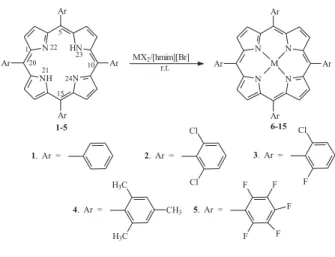
Room-temperature ionic liquids especially those based on the 1,3-dialkylimidazolium cation provide an eco-friendly reaction medium for a variety of chemical and biochemical transformations, as they lack significant vapor pressure, have ease of reuse, absence of flammability and tolerance for large temperature variations.10-13 Herein, we report for the first time the synthesis of metalloporphyrins in reusable 1-hexyl-3-methylimidazolium bromide [hmim][Br] ionic liquid (Scheme 1).
Results and Discussion
667 Novel Synthetic Methodology for Metalloporphyrins in Ionic Liquid
Vol. 16, No. 3B, 2005
salts in [hmim][Br] ionic liquid (Table 1, Scheme 1). The metalation of free base porphyrins 1-5 was studied with different metal salts in [hmim][Br]. The separation of metalloporphyrins from the reaction mixture was easy and the recovered ionic liquid was further used for other reactions. It has been observed that the ionic liquid was found to be active even after eight runs. Hence, this metalation process offers less health and environmental hazards than the traditional used solvents such as chlorinated solvents and DMF. The formation of metallporphyrins has been confirmed spectrophoto-metrically and on comparison with authentic samples, prepared by conventional methods.4-6 On the formation of a metallporphyrin, in most of the cases, the four banded spectrum collapses into an essentially two-banded one in visible region, whereas the soret may remain in the usual range or shifted to higher or lower energy depending upon the metal used.16 Interestingly, the bromide ion present in
the reaction mixture does not get exchanged with the axial chloride of the metallated porphyrins (6-15) as confirmed by the far IR spectra. The presence of peak at 294 cm-1 in
Table 1. Yields and UV-Visible spectroscopic data of metalloporphyrins prepared
Free-base MX2 Product Yielda (%) UV-visible in CHCl
3 C,H,N analysis
Porphyrins Omaxnm (Hmax×10
-3mol L-1)
H2TPP (1) MnCl2.2H2O TPPMn(III)Cl (6) 9 8 402 (30.1), 479 (47.3), For C44H28ClMnN4; calc. C, 75.16; 528 (3.5), 618 (2.1) H, 4.01; N, 7.97; found C, 75.23;
H, 3.97; N, 7.85
FeCl2.2H2O TPPFe(III)Cl (7) 9 7 416 (111.0), 510 (14.1), For C44H28ClFeN4; calc. C, 75.05; H, 576 (3.1), 657 (2.1) 4.01; N, 7.96; found C, 74.96; H,
4.11; N, 7.83
ZnCl2.2H2O TPPZn(II) (8) 9 2 419 (39.1), 555 (2.1), For C44H28ZnN4; calc. C, 77.93; H, 644 (1.0) 4.16; N, 8.26; found C, 77.85; H,
4.11; N, 8.13
H2Cl8TPP (2) FeCl2.2H2O Cl8TPPFe(III)Cl (9) 9 5 418 (72.0), 509 (8.3), For C44H20Cl9FeN4; calc. C, 53.95; H, 584 (3.3), 642 (2.3) 2.06; N, 5.72; found C, 54.01; H,
1.99; N, 5.79
MnCl2.2H2O Cl8TPPMn(III)Cl (10) 9 6 478 (69.0), 522 (4.4), For C44H20Cl9MnN4; calc. C, 54.00; 580 (8.6), 616 (2.8) H, 2.06; N, 5.72; found C, 53.91;
H, 2.14; N, 5.61
H2Cl4F4TPP (3) FeCl2.2H2O Cl4F4TPPFe(III)Cl (11) 9 5 419 (69.0), 503 (7.2), For C44H20Cl5F4FeN4; calc. C, 57.84; 581 (2.1), 644 (1.2) H, 2.21; N, 6.13; found C, 57.91;
H, 2.30; N, 5.99
MnCl2.2H2O Cl4F4TPPMn(III)Cl (12) 9 7 479 (70.1), 525 (4.5), For C44H20Cl5F4MnN4; calc. C, 57.89; 588 (7.6), 618 (3.0) H, 2.21; N, 6.14; found C, 57.79;
H, 2.29; N, 6.05
H2Me12TPP (4) FeCl2.2H2O Me12TPPFe(III)Cl (13) 9 7 416 (42.4), 510 (5.5), For C56H52ClFeN4; calc. C, 77.10; H, 576 (1.3), 694 (1.1) 6.01; N, 6.42; found C, 76.94; H,
5.91; N, 6.50
MnCl2.2H2O Me12TPPMn(III)Cl (14) 9 5 478 (68.0), 522 (4.4), For C56H52ClMnN4; calc. C, 77.18; 580 (8.7), 617 (2.0) H, 6.01; N, 6.43; found C, 77.24;
H, 5.93; N, 6.51
H2F20TPP (5) MnCl2.2H2O F20TPPMn(III)Cl (15) 8 0 476 (61.0), 562 (3.4), For C44H8ClF20MnN4; calc. C, 49.72; 589 (2.7) H, 0.76; N, 5.27; found C, 49.82;
H, 0.81; N, 4.88 aIsolated yield.
668 Singh and Geetanjali J. Braz. Chem. Soc.
the far IR of manganese complex of H2TPP with MnCl2 indicated that the axial ligand is chloride.
In conclusion, we have developed a simple, convenient and eco-friendly method for the metallation of porphyrins in reusable ionic liquid in high yields. The method avoids the use of organic solvents, excess of metal salts and refluxing at high temperature. The ionic liquids have been used as alternative of organic solvents.
Experimental
The purities of the compounds were determined on silica-coated Al plates (Merck). The electronic spectra were recorded on a Shimadzu UV-260 UV-visible spectro-photometer and the absorption maxima are expressed in nanometers (nm).
Pyrrole, benzaldehyde and its derivatives, used for the synthesis of free-base 5,10,15,20-tetraarylporphyrins,14,15 are obtained from Fluka, Switzerland. Metal salts are obtained from s.d. Fine Chemicals, India.
The required ionic liquid has been prepared by the modification of literature procedure.10-13 In a round-bottom flask (100 mL), 1-methylimidazole (12.32 g, 0.15 mol, dried over MgSO4) was mixed with n-hexyl bromide (41.25 g, 0.25 mol) and stirred for 12 h at 70-75 oC. The excess hexyl bromide was distilled off and the residue was extracted thoroughly 2-3 times (50 mL each) with diethyl ether to remove the unreacted starting materials. A clear oily liquid of 1-hexyl-3-methylimidazolium bromide [hmim][Br] was obtained in 95% yield. IR (thin film) Qmax/cm
-1: 3420, 3092, 3140, 2962, 2936, 2877, 2062,
1631, 1571, 1461, 1400, 1337, 1160, 1114, 1022, 741; 1H NMR (CDCl3, 60 MHz) d ppm: 0.81 (t, 3H, CH3), 1.11-1.93 (m, 8H, 4´CH2), 3.66 (s, 3H, N-CH3), 4.03 (t, 2H, N-CH2), 7.33 (s, 1H, CH), 7.54 (s, 1H, CH), 8.41 (s, 1H, CH); 13C NMR (CDCl
3, 75 MHz) d ppm: 12.21, 12.99, 13.41, 19.11, 30.52, 37.01, 46.43, 121.00, 123.81 and 137.03.
General procedure for the reaction of porphyrin with metal salt
The porphyrin (0.5 mmol) and metal salt (0.6 mmol) were stirred at room temperature in [hmim][Br] ionic liquid (15 mL) for one hour. After completion of the reaction as indicated by the TLC, the mixture was extracted with Et2O (5×20 mL). The combined ether layers were washed with water (2×20 mL) and dried (Na2SO4), concentrated in vacuum to afford the metallated compound, which was
further purified by column chromatography using chloroform as eluting solvent. The rest of the viscous ionic liquid was further washed with Et2O and dried under reduced pressure to retain its activity in subsequent runs.
Acknowledgment
G is thankful to CSIR, New Delhi for the award of senior research fellowship.
References
1. Messerschmidt, A.; Huber, R.; Poulos, T.; Wieghardt, K.; Handbook of Metalloproteins, John Wiley & Sons, Inc.: New York, 2001.
2. Suslick, K.S. In The Porphyrin Handbook; Kadish, K.; Smith, K.; Guillard, R., eds., Academic Press: New York, 1999. 3. Mansuy, D.; Battioni, P. In Metalloporphyrins in Catalytic
Oxidations; Sheldon, R.A., ed., Marcel Dekker: New York, 1994 pp. 99-132.
4. Chauhan, S.M.S.; Gupta, M.; Gulati, A.; Nizar, P.N.H.; Ind. J. Chem.1996,35B, 1267.
5. Assis, M.D.; Smith, J.R.L.; J. Chem. Soc., Perkin Trans 21998,
2221.
6. Tsuchida, E.; Komatsu, T.; Hasegawa, E.; Nishide, H.; J. Chem. Soc., Dalton Trans1990, 2713.
7. Kadish, K.M.; Mc-Adams, C.A.; Han, B.C.; Franzen, M.M.; J. Am. Chem. Soc.1990,112, 8364.
8. Fuhrhop, J.H.; Mauzerall, D.; J. Am. Chem. Soc.1969,91, 4174.
9. Vogel, A.I.; A Textbook of Practical Organic Chemistry, 4th Eds, Longman Group Limited: London, 1978.
10. Bao., W.; Wang, Z.; Li, Y.; J. Org. Chem.2003,68, 591. 11. Yadav, J.S.; Reddy, B.V.S.; Gayathri, K.U.; Prasad, A.R.;
Synthesis2002, 2537.
12. Park, S.; Kazlauskas, R.J.; J. Org. Chem.2001,66, 8395. 13. Bonhote, P.; Dias, A.-P.; Papageorgiou, N.; Kalyanasundaram,
K.; Gratzel, M.; Inorg. Chem.1996,35, 1168.
14. Chauhan, S.M.S.; Singh, R.; Gulati, A.; Ind. J. Heterocycl. Chem.2000,9, 231.
15. Chauhan, S.M.S.; Sahoo, B.B.; Srinivas, K.A.; Synth. Commun.
2001,31, 33.
16. Buchler, J.W. In The Porphyrins; Dolphin, D., ed., Academic Press: New York, San Francisco, London, 1978, vol. 1, pp. 390-483.
Received: July 31, 2004