Quim. Nova, Vol. 33, No. 7, 1440-1443, 2010
Artigo
*e-mail: [email protected]
FOAM-FORMING PROPERTIES OF Ilex paraguariensis (MATE) SAPONIN: FOAMABILITY AND FOAM LIFETIME ANALYSIS BY WEIBULL EQUATION
Janine Treter, Maria P. G. Peixoto e George G. Ortega*
Departamento de Produção e Controle de Medicamentos, Faculdade de Farmácia, Universidade Federal do Rio Grande do Sul, Av. Ipiranga, 2752, 90610-000 Porto Alegre - RS, Brasil
Gizele S. Canto
Departamento de Farmácia Industrial, Centro de Ciências da Saúde, Universidade Federal de Santa Maria, 97105-900 Santa Maria - RS, Brasil
Recebido em 17/7/09; aceito em 15/3/10; publicado na web em 30/7/10
Saponins are natural soaplike foam-forming compounds widely used in foods, cosmetic and pharmaceutical preparations. In this work foamability and foam lifetime of foams obtained from Ilex paraguariensis unripe fruits were analyzed. Polysorbate 80 and sodium dodecyl sulfate were used as reference surfactants. Aiming a better data understanding a linearized 4-parameters Weibull function was proposed. The mate hydroethanolic extract (ME) and a mate saponin enriched fraction (MSF) afforded foamability and foam lifetime comparable to the synthetic surfactants. The linearization of the Weibull equation allowed the statistical comparison of foam decay curves, improving former mathematical approaches.
Keywords: saponin; Ilex paraguariensis;foam stability.
INTRODUCTION
Ilex paraguariensis A. St. Hil (Aquifoliaceae)is a native South American tree, widely known for its stimulant activity on the central nervous system and the production of erva-mate, a leaves coarse powder traditionally used in the preparation of stimulant tea-like beverages.1 Mate is often associated with the high content of me-thylxanthines in leaves, but its saponin richness is seldom related. The occurrence, isolation and identiication of the main saponins from mate leaves and fruits are well described in literature.2-9 Mate saponins occur almost as bidesmosidic glycosides derived from oleanolic and ursolic acids having one or two sugar chains attached at the C-3 and C-28.5
Alike other saponins from superior plants (e.g. Quillaja, Gyp-sophila, Phytolacca and Polygala saponins), bacteria and marine animals, mate saponins are biodegradable hydrophilic surfactants.10-13 Mate saponins are weakly hemolytic, non-irritating in the Draize topi-cal test and they are also able to form abundant and persistent foam.14 Foamability is a desirable property required in some chemical, foods, cosmetic and pharmaceutical processes.15-19 An ideal foam-forming must be non-toxic and able to produce abundant, dense and stable foam, even at low concentration.20,21 There are several methods to assess foamability and foam stability,16,22 including the foam decay evaluation and rate of liquid drained from foam. An extensive com-parison among oficial and non-oficial methods for beer analysis was reported recently.22,23 However, the data analysis of foam decay is still based on the logarithmic representation of the foam column height or the volume of liquid drainage versus time, notwithstanding it can lead to unreliable results and lack of it.20,22 This work aims, therefore, to study foam-forming properties of Ilex paraguariensis saponins, comparing foam lifetime, foamability and ilm drainage behavior against the reference surfactants sodium dodecyl sulfate and polysorbate 80. In the same context, an empirical linearization of the 4-parameters Weibull is proposed in order to compare the different foam proiles.
EXPERIMENTAL
Materials
The surfactants sodium dodecyl sulfate and polysorbate 80 were purchased from Merck. Unripe fruits of Ilex paraguariensis were kindly supplied by Barão Ervas e Chás, Cotegipe RS, Brazil. The test solutions were prepared using freshly obtained distilled water (conductivity of 2.8 µS/cm). The concentration of each test solution was equivalent to 10-fold the critical micelar concentration (cmc), namely mate extract (ME) 1.1 mmol L-1, enriched saponin fraction (MSF) 1.5 mmol L-1, polysorbate 80 (POL) 6.0 mmol L-1 and sodium dodecyl sulfate (SDS) (85.8 mmol L-1). The cmc of ME and MSF was calculated and expressed using matesaponin-1 as saponin reference (mol. weight 996.45).14
Preparation of the mate extract
Fruits were manually separated from leaves and stalks, dried at 35 ºC during 72 h in a air-forced oven (Memmert, Germany) and milled with a cutter mill (Retsch SK1, Germany). The plant powder (0.85 µm) was irstly macerated with an 40% ethanol solution (100 g/L) by 40 min and extracted by turbolyses (IKA T-25, Germany) during 15 min avoiding overheating. The extract was iltered and concentrated to one-half of its original volume in a rotary vacuum evaporator (Bücchi B-480, USA) and immediately lyophilized the-reafter (Modulyo 4L Edwards, USA).
The enriched saponin fraction was obtained by solid phase extrac-tion and afterward lyophilized (Bras. Pat. PI 0501510-3 04/22/2005). The product is free of pigments, chlorophyll, lavonoids, polyphenols with very low electrolytes content.24
Foamability and foam stability test
Foam-forming properties ofIlex paraguariensis (mate) saponin 1441
Vol. 33, No. 7
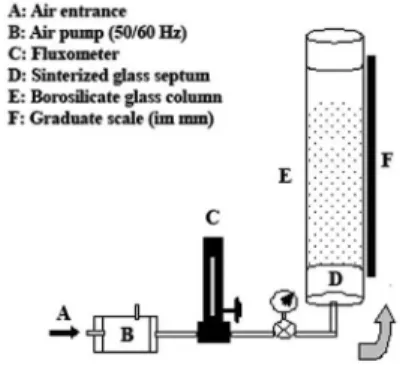
compressed air was supplied by a reciprocal pump (Inalar compact, Brazil) at a low rate of 2 L/min (Fluxometer Protec, Brazil) during exactly 20 s. Pipes and air purge valves internal diameters were 2 mm. The temperature was 25 ± 2 °C (Figure 1).
The foam column height (foamability) was recorded immediately after air supply suppression. The volume of liquid drained (LVF) after 0; 1; 2; 3; 4; 5; 10; 30 and 60 min was measured using a graduated scale ixed onto the column considering the relationship between initial volume and its corresponding height as depicted on Figure 2.
The liquid volume fraction in foam (LVF) was calculated by subtraction of the volume of liquid drained from 20, the total volume of the surfactant solution added in to the column (Equation 1).
(1) Mathematical analysis
The liquid volume fraction in foam data were plotted against time and the curve equation calculated by the least squares method regression using the 4-parameters Weibull equation (Equation 2). Weibull coeficients alpha (α), beta (β), gamma (γ) and eta (η), as well as regression standard deviation were calculated using Curve Expert 1.3 software. After the empirical linearization of the Weibull function (Equations 3 and 4), the intercept and slope calculated by the least squares method were compared by means of one-tail T test (P 0.05) for intercept (Equation 5) and slope (Equation 6)25 using Excel 2003 software.
(2) (3) (4)
(5)
(6)
where: SQE is the regression standard deviation, Sxx= Σ(xi - —x)2, and n the sample size.
RESULTS AND DISCUSSION
Saponins are natural compounds able to yield abundant foam in aqueous solutions and several of them are profusely cited in the literature.26-28 Nonetheless, mate saponins foamability is seldom men-tioned and no precedent analytical studies about its foam-forming properties are related as far as we know.
A full evaluation of the foam column height decay was impracti-cable owing the irregular breakdown patterns observed within a same working solution. Thus, the foam decay was analyzed indirectly by measuring the liquid volume drained from foam (LVD).
The foam stability and foamability data of mate extract (ME), enriched saponin fraction (MSF), polysorbate 80 (POL) and sodium dodecyl sulfate (SDS) are described in Table 1. The foamability of ME and MSF was comparable to POL and SDS ones. Foamability of ME was slightly lower than MSF, probably as a result of the presence of other compounds on the total extract. On the contrary, foams from ME and MSF stood longer and were still evident after 60 min, unlike POL and SDS, where the foam collapse was nearly complete. The decay rate of the LVF was higher and more intense in SDS and POL foams than in ME and MSF ones (Table 1, Figure 3). At the process beginning, the irst conidence limits of the mean LVF values over-lap and therefore no statistical relationship between liquid drainage rate and foam stability could be established. Only at the end of the experiment the LVF values of ME and MSF (2.38 ± 0.09 and 3.05 ± 0.14 mL, respectively) became signiicantly higher than POL (1.71 ± 0.04 mL) and SDS (1.43 ± 0.05 mL) values.
Once there is a lack of consensus about a general theory of the foam drainage, the curve itting using appropriate functions aims at its characterization or better statistical inference. In this context some empirical equations were already proposed to it such foam decay curves.20,22 In this work the 4-parameter Weibull equation was choose after a preliminary comparison with the exponential, logistic, Gompertz, and Morgan-Mercer-Flodin equations (omitted results), which are also able to it exponential and S-shape curves. For the present purpose, the meaning of the Weibull parameter was interpreted in the following way.
Figure 1. Instrumental device applied on foamability and foam stability test
Figure 2. Schematic diagram from foam column. LVF: liquid volume fraction
in foam; LVD: Liquid volume drained from foam Table 1. Determination of LVF values and foamability for ME, MSF, POL
and SDS (25 ± 2 °C) Time
(min)
LVF (mL)
ME MSF POL SDS
0 18.57 (14.5)a 19.24 (16.7)a 11.43 (14.5)a 11.43 (17.2)a
1 9.52 9.90 3.81 4.76
2 6.19 7.05 2.86 2.67
3 5.24 5.90 2.38 1.90
4 4.29 5.24 2.10 1.43
5 4.10 4.67 2.10 1.43
10 3.81 4.29 2.10 1.43
30 2.67 3.62 1.90 1.43
60 2.38 3.05 1.71 1.43
Treter et al.
1442 Quim. Nova
Parameter beta (β) expresses the curve tendency toward S-shape or exponential shape and consequently provides insight into the ove-rall foam behavior in time. The parameter gamma (γ), indicates the beginning of the liquid drainage process, that means, the lag time. The parameter eta (η) or scale parameter indicates the position of the function density along the x-axis. Thus, curves with the same β and γ values but different range of xvalues afforded different values of η.29 The parameter alpha (α) expresses directly the volume of liquid retained in the foam (LVF) at time zero. Mathematically speaking parameter αis independent of γ and β but induces proportional changes on η (Equation 2).
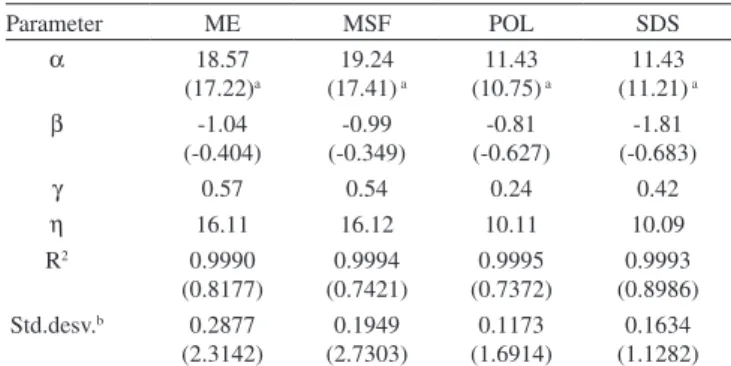
The itting parameters calculated according to Weibull and exponential equations for ME, MSF, POL and SDS are showed in Table 2.
Weibull equation was able to it the drainage curves very well, leading to regression coeficient values above 0.999 in all cases. As a result, the experimental values of LVF at time zero and the calculated values of parameter α were almost coincident. The parameter α of ME and MSF was about 2-fold higher than POL and SDS ones. No relationship between parameter LVF and foamability could be assessed by comparing foam height values of ME, MSF, POL and SDS at T0 (Table 1). The scale parameter indicated that the data density of ME and MSF are placed in a higher right ield than POL and SDS, what means, ME and MSF foams stand for a longer time.
All β values calculated are typical of exponential curves29 but with different negative magnitudes. Since LVF decreases until the system reaches the equilibrium all β parameters were therefore negative. Differently from SDS, the ME, MSF and POL values of β were equivalent. It can be noted an inverse relationship between drainage rate and the respective β magnitudes, but not between the later parameter and the time required for LVF equilibrium (Figure 3).
The values of γ indicate short lag times of about 1 min (ME, MSF and SDS) or even lower (POL).
However, differently of parameters α and η the statistical comparison of β and γ of each solution assayed seems to be more laborious. The linearization of Weibull equation30 appears to be feasible, but requires the solving and comparison of four equa- equa-tions simultaneously. The present approach comprises a two-step procedure.
The irst step implies the data standardization after parameter α, taking into account that the other three Weibull parameters are sub-tracted from it directly (Equation 1). Moreover, the foam capability of each assayed solution is an intrinsic factor and must achieves a maximum value (100%) under controlled experimental conditions. Therefore, all LVF values of ME, MSF, POL and SDS at t0 can be consider the same and equal to 100% (α =100). Under this statement the value of parameters α, β, γ and η were newly calculated (Tables 3 and 4). Obviously, the changing of parameter α of a given curve alters η but not γ and β as earlier mentioned. Besides that, the regression coeficients remain also unchanged.
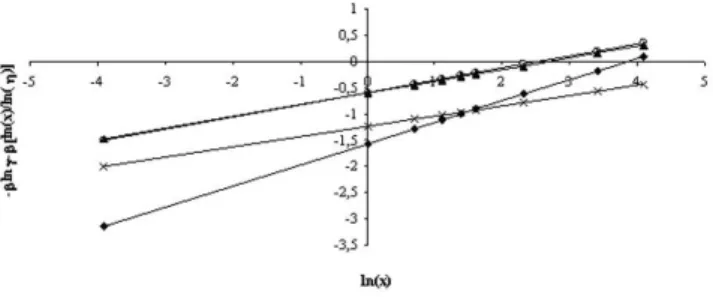
The second step considers the change of the function density (η) induced by parameter α. The right side of Equation 4 encloses the three parameters that describe the variable LVF as a function of time (x). The standardization after α changed the values of η, but the values of γ and β remained unchanged. Once η express the density of the Weibull function along the x-axis, it seems feasible to cancel out this effect dividing x by respective value of η. By this way a linear relationship can be drawn by plotting ln(x) versus –β ln(γ) – β [ln(x)/ln(η)]. After linear regression by the least squares method the slope gives straightforward the value of parameter β and the intercept corresponds to β ln(γ). The linearized curves by Equation 4 are described in Figure 4.
The comparison of the slopes (parameter β) demonstrated that the drainage rate, namely LVF decrease, of SDS was the fastest of all, while ME, MSF and POL were statistically not different from each other by the T-Student test (Tables 5 and 6). On the other hand, the statistical comparison of the intercept indicates that the drainage rate and lag time effects were more pronounced for SDS, followed by POL, MSF and ME. Moreover, the difference between slope and intercept of both ME and MSF was not signiicant.
Figure 3. Experimental data of foam drainage: (--) SDS , (-×-) POL, (-o-) ME and (--) MSF
Table 2. Weibull and exponential parameters calculated for LVF curves (25 ± 2 °C)
Parameter ME MSF POL SDS
α 18.57
(17.22)a
19.24 (17.41) a
11.43 (10.75) a
11.43 (11.21) a
β -1.04
(-0.404)
-0.99 (-0.349)
-0.81 (-0.627)
-1.81 (-0.683)
γ 0.57 0.54 0.24 0.42
η 16.11 16.12 10.11 10.09
R2 0.9990
(0.8177)
0.9994 (0.7421)
0.9995 (0.7372)
0.9993 (0.8986) Std.desv.b 0.2877
(2.3142)
0.1949 (2.7303)
0.1173 (1.6914)
0.1634 (1.1282)
a Values for the exponential model y = α exp (βx) (Potreck, 2004) b
Regression standard deviation.
Table 3. LVF values recalculated after standardization of the initial LVF data
Time (min) LVF (%)
POL SDS ME MSF
0 100.00 100.0 100.00 100.00
1 33.33 41.73 51.29 51.46
2 25.00 23.32 33.32 36.63
3 24.99 16.66 28.19 29.70
4 20.82 12.49 23.07 27.22
5 18.37 12.48 22.07 24.22
10 18.20 12.46 20.51 22.25
30 17.50 12.44 14.37 18.81
60 15.05 12.42 12.92 15.80
Table 4. Weibull parameters recalculated after standardization of the LVF data
Parameters ME MSF POL SDS
α 100.02 100.01 100.01 99.99
β -1.04 -0.99 -0.86 -1.81
γ 0.57 0.54 0.24 0.42
η 86.68 83.66 84.75 88.37
Foam-forming properties ofIlex paraguariensis (mate) saponin 1443
Vol. 33, No. 7
Table 5. Values of slope and intercept calculated by linear regression
Coeficients POL SDS ME MSF
Intercept (a) 1.2346 1.5623 0.5892 0.6059 Slope (b) -0.8643 -1.8130 -1.0374 -0.9909
Table 6. Signiicance for the slope and intercept according to Student-test (P 0.05)
T(a) T(b)
SDS and POL 1.345 9.638a
SDS and ME 3.949a 7.791a
SDS and MSF 4.229a 8.732a
POL and ME 2.525a 1.720
POL and MSF 2.745a 1.368
ME and MSF 0.072 0.496
*T(calculated)≥ t(0.025;14) = 1.7613 . aSigniicant difference at P 0.05
CONCLUSION
Saponin from mate extract and its puriied fraction showed comparable foamability to synthetics sodium dodecyl sulfate and polysorbate 80. The linearization of Weibull function allowed us to determine that the natural surfactants analyzed presented a better performance in terms of foam stability. In addition, it was possible to conclude that ME and MSF, although different in total composition, present the same decay proile.
ACKNOWLEDGMENTS
The authors gratefully acknowledge the Brazilian National Counsel of Technological and Scientiic Development (CNPq) for the inancial support and to Barão Ervas e Chás for the donation of the authentic plant material.
REFERENCES
1. Schubert, A.; Zanin, F. F.; Pereira, D. F.; Athayde, M. L.; Quim. Nova 2006, 29, 1233.
2. Gosmann, G.; Schenkel, E. P.; J. Nat. Prod. 1989, 52, 1367.
3. Gosmann, G.; Guillaume, D.; Taketa, A. T. C.; Schenkel, E. P.; J. Nat. Prod.1995, 58, 438.
4. Kraemer, K. H.; Taketa, A. T. C.; Schenkel, E. P.; Gosmann, G.; Guillaume, D.; Phytochemistry1996, 42, 1119.
5. Schenkel, E. P.; Gosmann, G.; Montanha, J. A.; Heizmann, B. M.; Athayde, M. L.; Taketa, A. T. C.; Pires, V. S.; Guillaume, D.; Cienc. Cult.1997, 49, 359.
6. Taketa, A. T. C.; Ph.D. Thesis, Rheinischen Friedrich-Wilhems-Universität, Germany, 2001.
7. Martinet, A.; Ndjoko, K.; Terreaux, C.; Marston, A.; Hostettmann, K.; Schutz, Y.; Phytochem. Anal. 2001, 12, 48.
8. Taketa, A. T. C.; Breitmaier, E.; Schenkel, E. P.; J. Braz. Chem. Soc. 2004, 15, 205.
9. Pavei, C.; Guzzato, P.; Petrovick, P. R.; Ortega, G. G.; J. Liq. Chromatogr. Relat. Technol. 2007, 30, 87.
10. Hostettmann, K.; Marston, A.; Saponins,Chemistry and Pharmacology of natural Products, 1st ed., University Press: Cambridge, 1995.
11. Oleszek, W. A.; J. Chromatogr., A 2002, 967, 147.
12. Kauffmann, C.; Machado, A. M.; Fleck, J. D.; Provensi, G.; Pires, V. S.; Guillaume, D.; Sonnet, P.; Reginatto, F. H.; Schenkel E. P.; Gosmann, G.; Nat. Prod. Res. 2004, 18, 153.
13. Rajput, Z. I.; Hu, S.; Xiao, C.; Arijo, A. G.; J. Zhejiang Univ. Sci. 2007,
8, 153.
14. Canto, G.S.; Ph.D. Thesis, Universidade Federal do Rio Grande do Sul, Brasil, 2007.
15. Shramm, L. L.; Stasiuk, E. N.; Marangoni, D. G.; Annu. Rep. Prog. Chem. 2003, 99, 3.
16. Backleh, M.; Ekici, P.; Leupold, G.; Coelhan, M.; Parlar, H.; J. Sep. Sci. 2004, 27, 1042.
17. Bamforth, C. W.; Milani, C.; J. Sci. Food Agric.2004, 84, 1001. 18. Piazza, L.; Gigli, J.; Bulbarello, A.; J. Food Eng. 2008, 84, 420. 19. Wang, L.; Yoon, R. H.; Int. J. Miner. Process.2008, 84, 101.
20. Angarska, J. K.; Tachev, K. D.; Kralchevsky, P. A.; Mehreteab, A.; Broze, G.; J. Colloid Interface Sci. 1998, 200, 31.
21. Pandey, S.; Bagwe, R. P.; Shah, D. O.; J. Colloid Interface Sci. 2003,
267, 160.
22. Potreck, M.; Ph.D. Thesis,Universität Berlin, Germany, 2004. 23. Hackbarth, J. J.; J. Inst. Brew.2006, 112, 17.
24. Pavei, C.; Master Dissertation, Universidade Federal do Rio Grande do Sul, Brasil, 2004.
25. Charnet, R.; Freire, C. A. L.; Charnet, E. M. R.; Bonvino, H.; Análise de Modelos de Regressão Linear com aplicações, 1a ed., Ed. da Unicamp:
São Paulo, 1999.
26. San Martín, R.; Briones, R.; J. Sci. Food Agric. 2000, 80, 2063. 27. Wegner, C.; Hamburger, M.; Kunert, O.; Haslinger, E.; Helv. Chim. Acta
2000, 83, 1454.
28. Patrick-Iwuanyanwu, K. C.; Sodipo, O. A.; Acta Biol. Szeged. 2007, 51, 117.
29. http://www.weibull.com/lifedatawebcontents.htm, accessed on March 2008 and June 2010.
30. Langenbucher, F.; J. Pharm. Pharmacol. 1972, 24, 979. Figure 4. Linearization of Weibull curves from foam drainage: (--) SDS,