Quim. Nova, Vol. 33, No. 7, 1496-1499, 2010
Artigo
*e-mail: [email protected]
SEPARATION AND PRECONCENTRATION TRACE AMOUNTS OF GOLD BY USING MODIFIED ORGANO NANOCLAY CLOSITE 15A
Sayed Zia Mohammadi* and Naimeh Seifollahi
Department of Chemistry, Payame Noor University, Kerman, Iran Daryoush Afzali
Nanochemistry and Environment Department, Research Institute of Environmental Sciences,International Center for Science, High Technology & Environmental Sciences, Kerman,Iran
Recebido em 7/10/09; aceito em 14/3/10; publicado na web em 20/7/10
The application of organo nanoclay 5-(4-dimethylamino-benzylidene) rhodanine-immobilized as a new, easily prepared, and stable solid sorbent for preconcentration trace amounts of Au(III) ions in aqueous solution is presented. The sorption of Au(III) ions was quantitative in the pH range of 2-4, and quantitative desorption occurred instantaneously with 10.0 mL of a mixture containing 0.5 mol L-1 Na
2S2O3 and KSCN. Various parameters, such as the effect of pH, breakthrough volume, extraction time, and interference of a large number of anions and cations have been studied. The proposed method has been applied for determination of trace amount of gold in water samples.
Keywords: nanoclay; preconcentration; gold determination.
INTRODUCTION
Gold belongs to the group of elements which occur on the Earth in very low natural contents. The concentration of gold in natural water is extremely low,1 in the range from 0.01 to 10 ng L−1. It is well known
that gold is one of the most interesting micro amount elements due to its signiicant role on biology, environment and industry. Even though it could be used as the drug in the supervised therapy of arthritis and cancer2 in the form of different Au(I) and Au(III) compounds, or in
radiotherapy of cancer in the form of radioactive isotope 198Au. It
could be also very toxic for human and animal organism and plants and account as the pollutant, because of its inhibiting effect upon the activity of many enzymes and its preventing effect upon the DNA separation.2 Numerous methods for gold determination are known:
spectrometric methods,1 UV-Vis spectrophotometry,2,3 electrothermal
atomic absorption spectrometry (ETAAS),4 inductively coupled
plasma combined with optical emission spectrometry (ICP-OES)5,6 or
mass spectrometry (ICP-MS)7 were applied for a variety of samples
in the analysis of gold.
The detection limits offered by UV-VIS, however, make the technique applicable only to the determination of relatively higher concentrations (microgram per gram levels) as compared to ETAAS, ICP-OES or ICP-MS.3,8 The last technique is particularly suited to the
determination of gold in various matrices owing to the low detection limits (picogram levels), wide dynamic range, possibility of accurate multi-element analysis, a unique capability of measuring isotopic ratios. Other sensitive techniques such as neutron activation analysis9
or total relection X-ray luorescence spectrometry (TXRF)10 are less
often applied in gold analysis due to the complexity and cost of the required instrumentation. In environmental, geological and biological samples, the low concentration of gold together with the high concen-tration of interfering matrix components often require an enrichment step combined with a matrix separation. Among the numerous tech-niques reported for preconcentration and matrix separation of gold, the methods using sorbent extraction have proved to be especially effective.11 A number of different sorbents have been investigated
for the preconcentration and separation of trace gold. They include activated carbon,12 chelating resins with selective functional groups
covalently attached to copolymer matrices6 ligand-modiied silica
gel7 and cotton ibers.13
In recent years, great attention has been paid to the application of nano structure materials. Because clay and clay minerals have primary particles with at least one dimension in the nanometer scale, they may be regarded as nanomaterials of geological and pedological origin.14
Clays are hydrous aluminosilicates broadly deined as those mi-nerals that make up the colloid fraction (< 2 µm) of soils, sediments, rocks and water.15 The particles of clay minerals may be crystalline
or amorphous, platy or ibrous and may vary from colloid dimensions to those above the limit resolution of an ordinary microscope.16 Clay
structure is layered with interlayer space and the layers may be elec-trically neutral or charged. The high speciic surface area, chemical and mechanical stability, variety of structural and surface properties, higher values of cation exchange capacities, etc., make the clays an excellent group of adsorbents. Intercalation of clays cross-linked with inorganic or organic clusters, known as pillared interlayered clays (PILC) or crosslinked clays (CLC) has received wide attention recently as shape-selective catalysts, separating agents, supports, ad-sorbents, etc. These materials have a two-dimensional pore size larger than conventional zeolites and exhibit speciic properties depending on the nature of the pillar.17 These materials are usually prepared by
ion-exchanging cations in the interlayer region of swelling clays with bulky alkylammonium ions, polynuclear complex ions bearing inor-ganic ligands (hydroxo ligand, chloro ligand), large metal complex ions bearing organic ligands, etc.
A large number of studies have been reported on use of clays for metal ion removal from aqueous solution: Zn(II) with natural bento-nite,18 and illite,19 Mn(II), Co(II), Ni(II) and Cu(II) with raw kaolin,20
Co(II) with sepiolite,21 etc. Various forms of modiied clays have also
been used: Na-exchanged bentonites for Cr(III), Ni(II), Zn(II), Cu(II) and Cd(II),22 surfactant modiied montmorillonite for Cu(II) and
Zn(II),23 1:10 phenanthroline-grafted Brazilian bentonite for Cu(II).24
Separation and preconcentration trace amounts of gold 1497 Vol. 33, No. 7
could adsorb organic substances. Therefore, the rhodanine was added to organo nanoclay, and the rhodanine-immobilized organo nanoclay was then studied for separation and preconcentration of Au(III) ion. The results showed that the rhodanine-immobilized organo nanoclay was suitable for separation and preconcentration of trace amounts of Au(III) (recoveries were > 96%).
EXPERIMENTAL
Instrumentation
A SensAA GBC atomic absorption spectrometer equipped with deuterium background correction and gold hollow-cathode lamp was used for absorbance measurements at wavelength of 242.8 nm according to instrument instruction. The instrumental parameters were adjusted according to the manufacturer’s recommendations. A Metrohm 692 pH meter was used for pH measurements. An IKA stirrer model KS 130B was used for stirring of samples. All glasswa-re was washed befoglasswa-re use with a mixtuglasswa-re of concentrated HCl and concentrated HNO3 (1:1).
Reagents and solutions
All chemicals were of analytical-reagent grade and were used without previous puriication. Nanoclay closite 15A was prepared from southern clay product (Gonzales, Texas, USA). Stock solution of gold at a concentration of 1000.0 µg mL−1 was prepared by
dis-solving an appropriate amount of HAuCl4.3H2O (Merck, Darmstadt, Germany) in double distilled water and diluting to 1.0 L. Working re-ference solutions were prepared daily by stepwise dilution from stock solution. A 0.2% (w/v) solution of 5-(4-dimethylamino-benzylidene) rhodanine (Merck, Germany) was prepared by dissolving in ethanol. Buffer solution with pH 3.5 was prepared from 0.2 mol L−1 acetic
acid and 0.2 mol L−1 sodium acetate. Solutions of alkali metal salts
(1%) and various metal salts (0.1%) were used in order to test the interference of anions and cations, respectively.
Preparation of rhodanine -immobilized organo nanoclay
Nanoclay closite 15 A dispersed in a 0.2% (w/v) solution of rhodanine in ethanol with stirring at 480 rpm for 5 h. The excess rho-danine solution was then decanted and the resultant organo nanoclay was washed sequentially several times with distilled water to remove excess of rhodanine and then dried at 110 ºC.
Preconcentration procedure
An aliquot of Au(III) containing 1.0-250.0 µg Au(III) was ad-justed to pH ~ 3.5, and then 0.1 g rhodanine -immobilized organo nanoclay was added to it with stirring at 480 rpm for 5 min. The solid mass was separated by iltration through ilter paper No. 1041 (Whatman Inc., Florham Park, NJ). At the end, the separated solid was washed with distilled water. The adsorbed metal ions were elu-ted with 10.0 mL of a mixture containing 0.5 mol L-1 Na
2S2O3 and
KSCN (1:1 ratio). The eluent was diluted in a 10.0 mL volumetric lask and aspirated directly into the lame of the AAS instrument for measurement against a blank prepared in the same manner without the addition of metal ions.
RESULTS AND DISCUSSION
In this study, combination of SPE with FAAS was developed for determination trace amounts of gold. It is based on the metal-
che-late formation of gold and rhodanine and extraction from aqueous solution. At irst, buffer and sample solution were added to 0.1 g of rhodanine-immobilized organo nanoclay. In this step, gold ions reacted with rhodanine-immobilized for Au-rhodanine formation, then the solid mass was separated by iltration and the adsorbed me-tal ions were eluted with a mixture containing 0.5 mol L-1 Na
2S2O3
and KSCN. Several factors that may affect the preconcentration and extraction process, including pH, type and volume of elution solution, extraction time, sample volume and matrix effect were studied and optimized. The optimizations were carried out on aqueous solution containing 50.0 µg of gold ions.
Effect of pH on preconcentration
The pH plays a unique role on metal–chelate formation and subsequent extraction, and is proved to be a main parameter for pre-concentration. Extraction yield depends on the pH at which complex formation is carried out. In this view, 50.0 µg of gold was studied in the pH range of 2-8. The recovery percent of gold ions are shown in Figure 1, and as can be seen at pH less than 4, the gold ions were quantitatively (> 97%) retained on the sorbent. When pH > 4, the formation of Au(OH)3 could be happened and the recoveries percent were decreased. Therefore, a pH of 3.5 in the middle of the pH range was considered as being the optimum value to avoid an abrupt change in adsorption, which may occur due to minor changes in the pH.
Addition of 2-20 mL buffer did not have any effect on the extraction. Therefore, 5 mL buffer with pH ~ 3.5 was used in all subsequent experiments.
Effect of extraction time on preconcentration
The gold extraction was also studied as a function of extraction time at the optimum condition. The gold concentration was kept at 5.0 µg mL-1 and gold extraction yield was measured by varying the
equilibrium extraction time in the range of 2-30 min. The extraction eficiency of gold is plotted in Figure 2. This igure shows that the reaction of gold and rhodanine is fast and after 5 min, gold extraction by sorbent reached to equilibrium. Therefore, extraction time 5 min was used in all subsequent experiments.
Effect of the breakthrough volume on preconcentration
The measurement of breakthrough volume is important in solid phase extraction because breakthrough volume represents the sample volume that can be preconcentrated without loss of analyte during elution of the sample. For this purpose, 30, 60, 100, 250, 500, 700 and 800 mL of aqueous solution containing 50.0 µg of Au(III) ions were processed according to the preconcentration procedure. The results are given in Table 1 and shown that, gold ions were recovered quantitatively in the Figure 1. Effect of pH on recovery of Au (III) ions. Conditions: Au (III), 50.0
Mohammadi et al.
1498 Quim. Nova
range of 30-700 mL. With respect to eluent volume (10 mL), precon-centration factors (the ratio of the highest sample volume to the lowest eluent volume) for gold ions 70 were obtained. However, for convenience, all the experiments were performed with 40 mL of the aqueous phase.
Choice of eluente
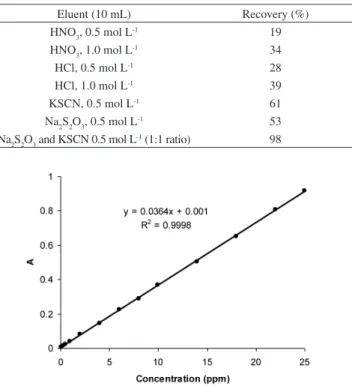
Another important factor which affects the preconcentration procedure is the type, volume and concentration of the eluent used for the removal of analytes from the sorbent. Optimization of the elution conditions were performed in order to obtain the maximum recovery with the minimal concentration and volume of the eluent solution. In order to, a number of eluents were tested to desorbed gold ions from the sorbent. Organic solvents can be used as eluents, but they removed the rhodanine reagent. If inorganic solutions were used as eluents, the rhodanine reagent was retained on the sorbent and, therefore, allowed it to be used several times.
The gold ions were stripped with 10.0 mL of different concen-trations of various eluent solutions. The results are shown in Table 2 and were shown that, the Au(III) ions were quantitatively eluted from the sorbent only with a mixture containing 0.5 mol L-1 Na
2S2O3
and KSCN (1:1 ratio). Therefore, 10.0 mL of this mixture was used in all subsequent experiments.
Analytical igures of merit
Repeatability, linearity, and detection limit were investigated under the optimized experimental conditions. The calibration graph was linear in the range of 0.1-25.0 µg mL−1 in inal solution (Figure
3) and 1.43-357.14. ng mL−1 in the original solution. The detection
limit (calculated as three times the standard deviation of 8 blank measurements, divided by the slope of the calibration curve) for gold determination was found to be 42.6 ng mL−1. The repeatability was
evaluated with 40.0 mL of a aqueous solution contain 50.0 µg Au(III). The relative standard deviation (R.S.D.) for 8 replicate measurements was 1.7%. Sensitivities for 1% absorbance for Au(III) was 93.4 ng
mL-1. The preconcentration factors as the ratio of initial volume to
inal volume and was 70. Effect of foreign ions
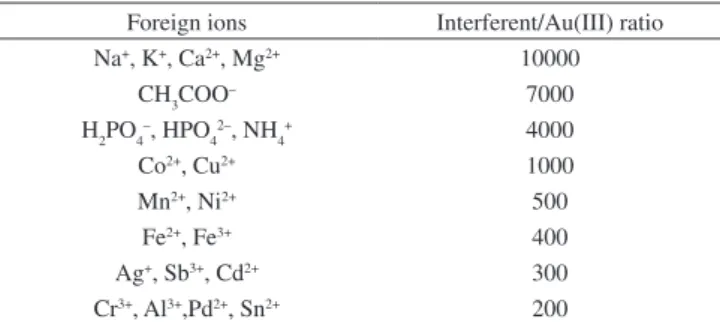
In view of the high selectivity provided by lame atomic ab-sorption spectrometry, the only interference may be attributed to the preconcentration step, in which the cations may react with rhodanine which may lead to decrease in extraction eficiency. Interferences studied were those related to the preconcentration step, cations that may react with rhodanine or species that may react with analytes and decrease the extraction eficiency. To perform this study, interferents ion in different interferents-to-analyte ratios were added to a solution containing 50.0 µg of Au(III) and were subjected to the recommen-ded procedure. Table 3 shows the tolerance limits of the interferents ions (error ± 5%). The results demonstrate that the presence of large amounts of species commonly present in water samples have no signiicant effect on the preconcentration of gold.
Determination of gold in river water samples
The method has been employed for determination of gold in Shoor river water Shahdad and Kohpayeh river water in Kerman. A 250.0 mL of water samples was adjusted to pH 1 with nitric acid, iltered and analyzed by general procedure. The results are given in Table 4.
Spike recovery tests have also been performed using the real samples and recoveries in the range 101.4-103.7% (Table 4) were obtained that demonstrating good accuracy of the method and the capability to determine gold at trace levels in various water samples. Comparison of present method with the other reported methods
A comparison of the represented method with the other repor-ted methods2,27-31 was showed in Table 5. As shown in Table 5, the
Figure 2. Effect of extraction time on recovery of Au (III) ions. Conditions were the same as Figure 1
Figure 3. Calibration curve. Conditions were the same as Figure 1, except Au (III) amount
Table 1. Inluence of the sample volume on the recovery of gold ions Sample volume (mL) Recovery (%)
30 99
60 99
100 98
250 97
500 97
700 95
750 90
Table 2. Effect of type and concentration of eluent on the recovery of the Au(III) ions
Eluent (10 mL) Recovery (%) HNO3, 0.5 mol L
-1 19
HNO3, 1.0 mol L-1 34
HCl, 0.5 mol L-1 28
HCl, 1.0 mol L-1 39
KSCN, 0.5 mol L-1 61
Na2S2O3, 0.5 mol L
-1 53
Na2S2O3 and KSCN 0.5 mol L
Separation and preconcentration trace amounts of gold 1499 Vol. 33, No. 7
characteristic data of the proposed method are compared with those reported in the literature. The detection limit obtained by the proposed method is comparable to those in reported methods.
CONCLUSION
The proposed SPE method based on nanoclay closite 15 A mo-diied with rhodanine is a simple, rapid, selective and reproducible method for the separation, preconcentration and determination of gold ions. The time taken for the separation and analysis of gold is at most 20 min. The method can be successfully applied to the separation Table 3. Tolerance limit of foreign ions
Foreign ions Interferent/Au(III) ratio Na+, K+, Ca2+, Mg2+ 10000
CH3COO– 7000
H2PO4–, HPO 4
2–, NH 4
+ 4000
Co2+, Cu2+ 1000
Mn2+, Ni2+ 500
Fe2+, Fe3+ 400
Ag+, Sb3+, Cd2+ 300 Cr3+, Al3+,Pd2+, Sn2+ 200 Conditions were the same as Figure 1.
Table 4. Determination of gold in river water samples
Sample Gold amount ( ng mL –1) a
Recovery%
Added Found
Shoor river in Shahdad
0.0 5.00 10.0
BLRb 5.15±0.21 10.37±0.48
----103.0 103.7 Kohpayeh river in
Kerman
0.0 5.00 10.0
BLR 5.18±0.24 10.14±0.51
----103.6 101.4
a Average of 4 determination, ± standard deviation. b Below of linear range
Table 5. Comparison of the reported methods with the proposed method Sample Procedure/Detection method Detection limit
(ng mL-1) Ref. Water,
pharmaceuticals SPE/FAAS 1.0 27
Ores SPE/UV-Vis Spectrophotometry 18 ng g-1 28 Minerals,
anode slime SPE/FAAS 10 29
High purity iron Coprecipitation/ETAAS 10 30 Ores Vapor Generation/ETAAS 0.8 31 Urine,
pharmaceuticals Kinetic Spectrophotometric 5.5 2
water SPE/FAAS 0.609 This
work
and determination of gold in real samples. Additionally, it shows high selectivity, adequate detection limit, no dangerous reagents or unique chemicals used and good precision and accuracy in all cases. REFERENCES
1. Hamilton, T. W.; Ellis, J.; Florence, T. M.; Anal. Chim. Acta 1983, 148, 225.
2. Rancic, S. M.; Nikolic-Mandic, S. D.; Mandic, L. M.; Anal. Chim. Acta 2005, 547, 144.
3. Zuoto, Z.; McCreedy, T.; Anal. Chim. Acta 1999, 401, 237.
4. Medved, J.; Bujdos, M.; Matus, P.; Kubova, J.; Anal. Bioanal. Chem. 2004, 379, 60.
5. Kanicky, V.; Otruba, V.; Mermet, J. M.; Talanta 1999, 48, 859. 6. Kavakli, C.; Zvatan, N. O.; Tuncel, S. A.; Salih, B.; Anal. Chim. Acta
2002, 464, 313.
7. Dressler, V. L.; Pozebon, D.; Curtius, A.; Anal. Chim. Acta 2001, 438, 235.
8. Tang, B.; Zhang, H.; Wang, Y.; Anal. Chim. Acta 2004, 525, 305. 9. Nat, A.; Ene, A.; Lupu, R.; J. Radioanal. Nucl. Chem. 2004, 261, 179. 10. Messerschmidt, J.; von Bohlen, A.; Alt, F.; Klockenkamper, R.; Analyst
2000, 125, 397.
11. De Godoi Pereira, M.; Arruda, M. A. Z.; Microchim. Acta 2003, 141, 115.
12. Rees, K. L.; van Deventer, J. S.J.; Hydrometallurgy 2000, 58, 151. 13. Yu, M.; Sun, D.; Huang, R.; Tian, W.; Shen, W.; Zhang, H.; Xu, N.;
Anal. Chim. Acta 2003, 479, 225.
14. Afzali, D.; Mostafavi, A.; J. AOAC Int. 2008, 91, 1430. 15. Pinnavaia, T. J.; Science 1983, 220, 365.
16. Deer, W. A.; Howie, R. A.; Zussman, J.; An Introduction to the Rock forming Minerals, ELBS Longman: England, 1985.
17. Ohtsuka, K.; Hayashi, Y.; Suda, M.; Chem. Mater. 1993, 5, 1823. 18. Mellah, A.; Chegrouche, S.; Water Res. 1997, 31, 621.
19. Echeverria, J. C.; Churio, E.; Garrido, J.; Clays Clay Miner. 2002, 50, 614.
20. Yavuz, O.; Altunkaynak, Y.; Guzel, F.; Water Res. 2003, 37, 948. 21. Kara, M.; Yuzer, H.; Sabah, E.; Celik, M. S.; Water Res. 2003, 37, 224. 22. Alvarez-Ayuso, E.; Garcia-Sanchez, A.; Clays Clay Miner. 2003, 51,
475.
23. Lin, S. H.; Juang, R. S.; J. Hazard. Mater. 2002, 92, 315.
24. De Leon, A. T.; Nunes, D. G.; Rubio, J.; Clays Clay Miner. 2003, 51, 58. 25. Ko, C. H.; Fan, C.; Chiang, P. N.; Wang, M. K.; Lin, K. C.; J. Hazard.
Mater. 2007, 14, 275.
26. Richards, S.; Bouazza, A.; Appl. Clay Sci. 2007, 37, 133.
27. Bagheri, M.; Mashahadiziadeh, M. H.; Razee, S.; Talanta 2003, 60, 839. 28. Al-Merey, R.; Hariri, Z.; Abu Hilal, J.; Microchem. J. 2003, 75, 169. 29. Pu, Q.; Liu, P.; Sun, Q.; Su, Z.; Microchim. Acta 2003, 143, 45. 30. Itagaki, T.; Ashino, T.; Takada, K.; Fresenius J. Anal. Chem. 2000, 368,
344.