Cerrado fragment in the State of São Paulo
Manica, LT.*, Telles, M. and Dias, MM.
Departamento de Ecologia e Biologia Evolutiva,Universidade Federal de São Carlos – UFSCar CEP 13565-905, São Carlos, SP, Brazil
*e-mail: [email protected]
Received September 5, 2008 – Accepted December 23, 2008 – Distributed May 31, 2010
Abstract
Bird species richness is an important measure for monitoring biodiversity changes. We analysed avifauna richness and composition in a 472 ha protected cerrado fragment and surroundings at Fazenda Canchim (RL-CPPSE), São Carlos, in the State of São Paulo (SP). We carried out 95.1 hours of observation (22 visits) at irregular intervals from May 2004 to December 2006. Qualitative surveys were done walking through tracks inside the fragment and on the roads at its edge. We recorded 160 species, six of which were endemic to Cerrado domain, 22 migratory, seven threatened within the State of São Paulo, and two globally threatened. We found 28 species in the cerradão, 110 in the cerrado sensu stricto, 13 in the gallery forest, 26 in the reservoir border, 26 in pasturelands and sugar cane monoculture and 55 in an anthropic area. Most of the species had low frequency of occurrence in all vegetation forms. Insectivores were the major trophic category (46.9%), which is typical in tropical regions, and it is also related to resource avail-ability. Omnivores followed with 19.4%, granivores with 8.8% and frugivores with 7.5%. We conclude that, despite its size and conservation status, our study area has a remarkable bird community and must be considered as a priority conservation area to preserve bird species in Sao Paulo State.
Keywords: avifauna, State of São Paulo, Cerrado, fragmentation.
Riqueza e composição da avifauna em um
fragmento de Cerrado no Estado de São Paulo
Resumo
A riqueza de espécies é uma medida importante para o monitoramento da perda de biodiversidade. Nosso objetivo foi verificar a riqueza e a composição da avifauna em um fragmento de cerrado de 472 ha na Fazenda Canchim (RL-CPPSE), São Carlos, Estado de São Paulo (SP). Realizamos 95,1 horas de observação (22 visitas) entre maio de 2004 e dezembro de 2006, em intervalos irregulares. Percorremos trilhas dentro do fragmento e estradas na sua borda consi-derando diferentes tipos de vegetação. Registramos 160 espécies, das quais seis são endêmicas do Cerrado, 22 migra-tórias, sete ameaçadas de extinção no estado de São Paulo e duas globalmente ameaçadas. Registramos 28 espécies no cerradão, 110 no cerrado sensu stricto, 13 na mata ciliar, 26 no entorno de uma represa, 26 em pastagens e plantações de cana-de-açúcar e 55 em áreas antropizadas. A maioria das espécies ocorreu em baixa freqüência em todos os tipos de vegetação. A categoria com maior número de espécies foi a dos insetívoros (46,9%), padrão típico em regiões tropicais e, provavelmente, relacionado à disponibilidade de recursos na área. A segunda categoria trófica foi a dos onívoros (19,4%), seguida pelos granívoros (8,8%) e frugívoros (7,5%). Nossos resultados destacam consideráveis registros de espécies aves e a importância da área de estudo na preservação da biodiversidade da avifauna no cerrado paulista.
Palavras-chave: avifauna, Estado de São Paulo, Cerrado, fragmentação.
1. Introduction
Bird species richness is an important measure for monitoring biodiversity changes (Andrén, 1994; Palmer et al., 2008). Bird community inventories, censuses and surveys provide data of great value for conservation pur-poses (e.g. Tubelis et al., 2004; Marini and Garcia, 2005;
244
ority activities in the protection of the natural environment (Stotz et al., 1996; Silva and Bates 2002, Loyola et al., 2007; Pinto et al., 2008, Piratelli et al., 2008).
The study of bird species richness also improves the knowledge of community responses in disturbed areas, because richness may be reduced in long-time isolated fragments (Aleixo and Vielliard, 1995; Marini, 2001; Stouffer and Bierregaard, 1995). Small remnants are prone to edge effects, such as nest predation increase (Marini et al., 1995), attraction of exotic predators, dis-eases and competitors or migratory and dispersal route obstructions (review in Marzluff and Ewing, 2001). All these factors may affect individual chances of reproduc-tion and reduce local species richness (Andrén, 1994).
In addition, bird richness and composition offers valuable data to understand sensitivity and resistance of species to fragmentation (Zanette et al., 2000). Species-specific responses to fragmentation are widely diverse among birds (Debinski and Holt, 2000; Watson et al.,
2005). For example, local migratory birds and species that need specific nest sites may require extensive areas to find environmental conditions to survive and breed (Sick, 1997). Furthermore, fragmentation may influence the trophic structure of bird communities (Motta-Junior, 1990; Tubelis and Cavalcanti, 2000). For example, spe-cialist groups, such as understory insectivores, are nega-tively affected in fragmented landscapes because of the reduced suitable pathways connecting multiple foraging areas(Martensen et al., 2008).
Agriculture and pastureland expansions in the Cerrado domain – one of the global biodiversity hotspots (Myers et al., 2000) – have been the major threaten-ing factors to its avifauna biodiversity since the 1970s (Alho and Martins, 1995; Cavalcanti and Joly, 2002).
The Cerrado domain has 837 bird species (Silva, 1995), from which 90.7% breed within the domain and the oth-ers migrate from the Northern Hemisphere, southern South America and southeast Brazil (Silva, 1995; 1997). Endemism in the region is high, but almost 75% of en-demic cerrado avifauna is considered at risk (Stotz et al., 1996). Furthermore, although endemic bird areas occur in the Cerrado (Birdlife International, 2003), 20% of en-demic and threatened species are outside protected areas (Machado et al., 2004).
In the State of São Paulo, the Cerrado has been re-duced to less than 7% of its original cover for the last decades and only 18% of remnants are inside protected areas (São Paulo, 1999). Different from conservation ar-eas of other domains, few Cerrado fragments are greater than 400 ha (Durigan et al., 2003). Considering the high level of degradation of the Cerrado in São Paulo, and regarding its boundary with the Atlantic Forest domain, these remnants should be concerned as important areas for conservation plans (Cavalcanti and Joly, 2002).
Even though some studies of bird communities have been previously carried out in São Paulo (Motta-Junior, 1990; Dias, 2000; Willis and Oniki, 2003; Willis, 2004;
2008), little is known about the ecology of bird commu-nities in the region. Our aim was to contribute with the knowledge of the avifauna of one fragment in central São Paulo and give data support for future local or regional reaseaches. We studied bird species richness and com-position, and identified endemic, threatened and migra-tory species of a protected cerrado fragment at Fazenda Canchim (RL-CPPSE), São Carlos, SP.
2. Material and Methods
Our study site is a 472 ha protected cerrado fragment at Fazenda Canchim (Reserva Legal-Embrapa Pecuária Sudeste, RL-CPPSE) and its surroundings, 12 km from São Carlos, in the State of São Paulo (SP) (21° 55’ S and 47° 48’ W) (Primavesi et al., 1999). This is a transition
zone from the Atlantic Forest to Cerrado domain, also characterised as an ecological tension zone, and with a high level of biodiversity (Primavesi et al., 1999). The
climate is typical of moist savanna (Cwa, according to Köppen’s classification), with a remarkable seasonality: a dry and cold winter from April to September and a wet and warmer summer from October to March (Primavesi et al., 1999).
The reserve is covered by two cerrado physiogno-mies: cerrado sensu stricto (340 ha), a typical savanna vegetation, and cerradão (130 ha), an almost closed woodland. A gallery forest (1.35 ha) occurs along a stream (Córrego da Lagoa) inside the fragment. The surroundings are composed of a reservoir (Represa do 29) in the north-east of the reserve and between cer-radosensu stricto and a small village; a 120 ha cerra-do fragment in the east; pasturelands in the south and south-east and sugar cane monoculture in the north and west of the reserve (Primavesi et al., 1999).
We used 8 × 40 binoculars for bird identification, and pictures or vocalisation records for comparison and iden-tification according to literature (Meyer de Schauensee, 1982; Sick, 1997; Souza, 1998; Develey and Endrigo, 2004) and to Manoel M. Dias’ identification. We carried out a non-standardised method of observation, because our aim was to identify as many individuals as possible. Bird nomenclature follows Comitê Brasileiro de Registros Ornitológicos (2007). Bird species endemic to Cerrado were classified following Silva and Bates (2002), and migratory birds according to Willis (1979), Motta-Junior (1990) and Sick (1997). We identified threatened species from official lists [São Paulo, 2008; Instituto Brasileiro do Meio Ambiente e dos Recursos Naturais Renováveis
(IBAMA), 2003; International Union for Conservation of Nature and Natural Resources (IUCN), 2007]. We measured the frequency of occurrence (FO) for each
spe-cies in each vegetation form, because sample effort was different among them. We calculated FO dividing the to-tal number of records of each species by the toto-tal number of visits to each area (Vielliard and Silva, 1990; Aleixo and Vielliard, 1995). Also, we classified species into nine trophic categories according to their principal feeding habits: nectarivores (NEC), carrion-eaters (CAE), carni-vores (CAR), frugicarni-vores (FRU), granicarni-vores (GRA), om-nivores (ONI), insectivores (INS), piscivores (PIS) and herbivores (HER), following Motta-Junior (1990), Sick (1997), and also our field observations.
3. Results
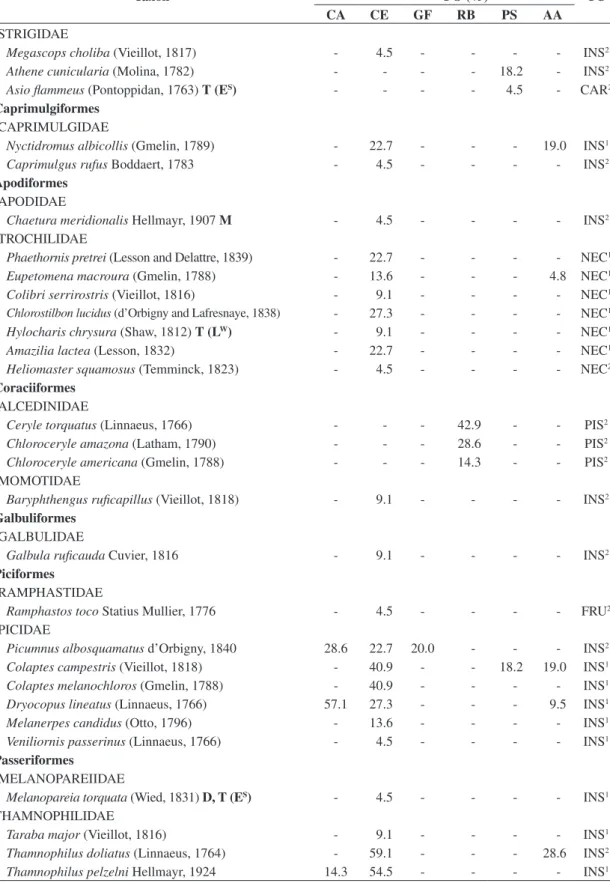
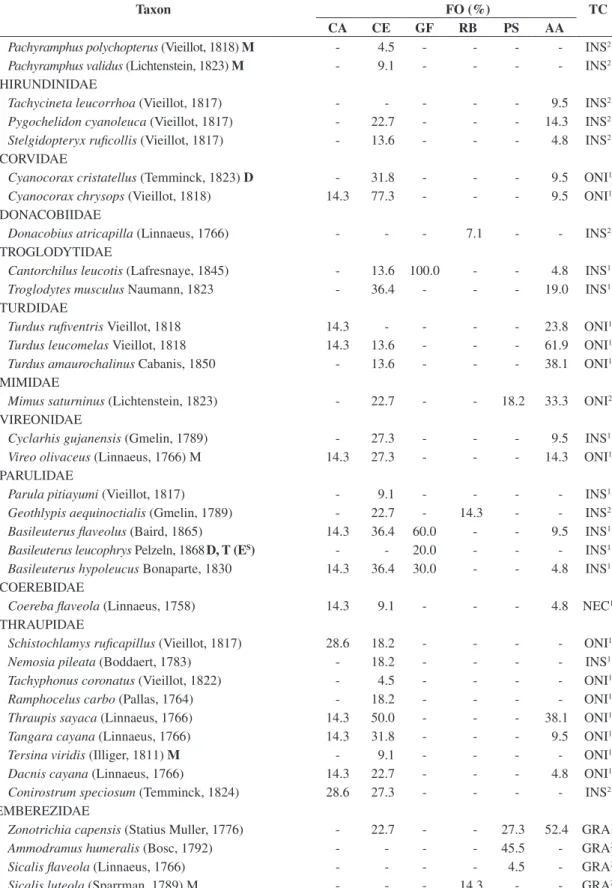
We found 160 bird species from 19 orders and 48 families (Table 1). Ninety-two (57.5%) were Passeriformes and 68 (42.5%) non-Passeriformes. We
Table 1. Bird species recorded in a cerrado fragment and surroundings at Fazenda Canchim, São Carlos, SP, from May 2004 to December 2006, and their respective frequency of occurrence (FO) in habitats (CA = cerradão; CE = cerrado sensu stricto; GF = gallery forest; RB = reservoir border, PS = pastureland and sugar cane monoculture, AA = anthropic area), trophic categories (TC) (NEC = nectarivores, CAE = carrion-eaters, CAR = carnivores, FRU = frugivores, GRA = granivores, ONI = omnivores, INS = insectivores, PIS = piscivores and HER = herbivores). Blank spaces means FO values = 0.
Taxon FO (%) TC
CA CE GF RB PS AA
Tinamiformes
TINAMIDAE
Crypturellus parvirostris (Wagler, 1827) 14.3 68.2 - - 18.2 14.3 ONI1
Pelecaniformes
PHALACROCORACIDAE
Phalacrocorax brasilianus (Gmelin, 1789) - - - 50.0 - - PIS2
Ciconiiformes
ARDEIDAE
Ardea cocoi Linnaeus, 1766 - - - 14.3 - - PIS2
Ardea alba Linnaeus, 1758 - - - 100.0 - - PIS2
Egretta thula (Molina, 1782) - - - 50.0 - - PIS2
Bubulcus ibis (Linnaeus, 1758) - - - 21.4 40.9 - INS2
Butorides striatus (Linnaeus, 1758) - - - 50.0 - - PIS2
Syrigma sibilatrix (Temminck, 1824) - - - - 13.6 - INS2
Nycticorax nycticorax (Linnaeus, 1758) - - - 21.4 - - PIS2
Tigrisoma lineatum (Boddaert, 1783) - - - 7.1 - - PIS2
THRESKIORNITHIDAE
Mesembrinibis cayennensis (Gmelin, 1789) - - 20.0 78.6 - - INS2
Cathartiformes
CATHARTIDAE
Coragyps atratus (Bechstein, 1793) - 18.2 - 7.1 27.3 14.3 CAE1
Anseriformes
ANATIDAE
Dendrocygna viduata (Linnaeus, 1766) M - - - 7.1 - - HER2 Falconiformes
ACCIPITRIDAE
Elanus leucurus (Vieillot, 1818) - 4.5 - - 4.5 - CAR2
1 Motta-Junior (1990); 2 Sick (1997); T = Threatened species; Status: V = vulnerable, CR = critically endangered, E =
en-dangered, R = near threatened, L = least concern; S Threatened at the State of São Paulo; W Threatened in world; D =
246
Taxon FO (%) TC
CA CE GF RB PS AA
Ictinia plumbea (Gmelin, 1788) M - - - - 4.5 - INS1
Rupornis magnirostris (Gmelin, 1788) - 27.3 - - 22.7 9.5 CAR1
FALCONIDAE
Milvago chimachima (Vieillot, 1816) - 9.1 - - 9.1 - CAR1
Caracara plancus (Miller, 1777) 14.3 27.3 - 7.1 22.7 9.5 CAR1
Falco sparverius Linnaeus, 1758 - - - - 4.5 - INS2
Falco femoralis Temminck, 1822 - 9.1 - - 4.5 - CAR1
Galiformes
CRACIDAE
Penelope superciliaris Temminck, 1815 - - 10.0 - - - FRU2 Gruiformes
RALLIDAE
Aramides cajanea (Statius Muller, 1776) - - - 14.3 - - ONI2
CARIAMIDAE
Cariama cristata (Linnaeus, 1766) - 13.6 - - 54.5 - INS1
Charadriiformes
JACANIDAE
Jacana jacana (Linnaeus, 1766) - - - 71.4 - - ONI2
CHARADRIIDAE
Vanellus chilensis (Molina, 1782) - - - 28.6 54.5 - ONI2 RECURVIROSTRIDAE
Himantopus melanurus Vieillot, 1817 - - - 21.4 - - CAR
Columbiformes
COLUMBIDAE
Columbina talpacoti (Temminck, 1811) - 31.8 - - - 57.1 GRA1
Columbina squammata (Lesson, 1831) - 9.1 - - - 4.8 GRA2
Patagioenas picazuro (Temminck, 1813) 28.6 45.5 10.0 - 13.6 28.6 FRU1 Patagioneas cayennensis (Bonnaterre, 1792) - 31.8 - - - 4.8 FRU2
Zenaida auriculata (Des Murs, 1847) - 9.1 - - - 28.6 GRA1
Leptotila verreauxi Bonaparte, 1855 14.3 45.5 30.0 - - 4.8 FRU1 Leptotila rufaxilla (Richard and Bernard, 1792) 14.3 - - - - 4.8 FRU2
Psittaciformes
PSITTACIDAE
Aratinga leucophthalma (Statius Muller, 1776) - 22.7 - - 13.6 14.3 FRU2
Aratinga aurea (Gmelin, 1788) - 4.5 - - - 9.5 FRU2
Forpus xanthopterygius (Spix, 1824) - 4.5 - - - - FRU2
Brotogeris chiriri (Vieillot, 1818) - 45.5 - - 18.2 23.8 FRU1
Amazona aestiva (Linnaeus, 1758) - 9.1 - - - - FRU2
Cuculiformes
CUCULIDAE
Piaya cayana (Linnaeus, 1766) 14.3 18.2 - - - - INS1
Crotophaga ani Linnaeus, 1758 - 4.5 - - - 28.6 INS1
Guira guira (Gmelin, 1788) - 4.5 - - - 19.0 INS2
Tapera naevia (Linnaeus, 1766) - 27.3 - - - - INS1
Strigiformes
TYTONIDAE
Tyto alba (Scopoli, 1769) - - - 9.5 CAR2
1 Motta-Junior (1990); 2 Sick (1997); T = Threatened species; Status: V = vulnerable, CR = critically endangered, E =
en-dangered, R = near threatened, L = least concern; S Threatened at the State of São Paulo; W Threatened in world; D =
Taxon FO (%) TC
CA CE GF RB PS AA
STRIGIDAE
Megascops choliba (Vieillot, 1817) - 4.5 - - - - INS2
Athene cunicularia (Molina, 1782) - - - - 18.2 - INS2
Asio flammeus (Pontoppidan, 1763) T (ES) - - - - 4.5 - CAR2
Caprimulgiformes
CAPRIMULGIDAE
Nyctidromus albicollis (Gmelin, 1789) - 22.7 - - - 19.0 INS1
Caprimulgus rufus Boddaert, 1783 - 4.5 - - - - INS2
Apodiformes
APODIDAE
Chaetura meridionalis Hellmayr, 1907 M - 4.5 - - - - INS2 TROCHILIDAE
Phaethornis pretrei (Lesson and Delattre, 1839) - 22.7 - - - - NEC1
Eupetomena macroura (Gmelin, 1788) - 13.6 - - - 4.8 NEC1
Colibri serrirostris (Vieillot, 1816) - 9.1 - - - - NEC1
Chlorostilbon lucidus (d’Orbigny and Lafresnaye, 1838) - 27.3 - - - - NEC1
Hylocharis chrysura (Shaw, 1812) T (LW) - 9.1 - - - - NEC1
Amazilia lactea (Lesson, 1832) - 22.7 - - - - NEC1
Heliomaster squamosus (Temminck, 1823) - 4.5 - - - - NEC2
Coraciiformes
ALCEDINIDAE
Ceryle torquatus (Linnaeus, 1766) - - - 42.9 - - PIS2
Chloroceryle amazona (Latham, 1790) - - - 28.6 - - PIS2
Chloroceryle americana (Gmelin, 1788) - - - 14.3 - - PIS2 MOMOTIDAE
Baryphthengus ruficapillus (Vieillot, 1818) - 9.1 - - - - INS2 Galbuliformes
GALBULIDAE
Galbula ruficauda Cuvier, 1816 - 9.1 - - - - INS2
Piciformes
RAMPHASTIDAE
Ramphastos toco Statius Mullier, 1776 - 4.5 - - - - FRU2
PICIDAE
Picumnus albosquamatus d’Orbigny, 1840 28.6 22.7 20.0 - - - INS2
Colaptes campestris (Vieillot, 1818) - 40.9 - - 18.2 19.0 INS1
Colaptes melanochloros (Gmelin, 1788) - 40.9 - - - - INS1
Dryocopus lineatus (Linnaeus, 1766) 57.1 27.3 - - - 9.5 INS1
Melanerpes candidus (Otto, 1796) - 13.6 - - - - INS1
Veniliornis passerinus (Linnaeus, 1766) - 4.5 - - - - INS1
Passeriformes
MELANOPAREIIDAE
Melanopareia torquata (Wied, 1831) D, T (ES) - 4.5 - - - - INS1 THAMNOPHILIDAE
Taraba major (Vieillot, 1816) - 9.1 - - - - INS1
Thamnophilus doliatus (Linnaeus, 1764) - 59.1 - - - 28.6 INS2
Thamnophilus pelzelni Hellmayr, 1924 14.3 54.5 - - - - INS1
1 Motta-Junior (1990); 2 Sick (1997); T = Threatened species; Status: V = vulnerable, CR = critically endangered, E =
en-dangered, R = near threatened, L = least concern; S Threatened at the State of São Paulo; W Threatened in world; D =
ende-mism in relation to Cerrado; M = migratory habit.
248
Taxon FO (%) TC
CA CE GF RB PS AA
Thamnophilus caerulescens Vieillot, 1816 - 31.8 - - - - INS1
Formicivora rufa (Wied, 1831) 14.3 4.5 - - - - INS1
Herpsilochmus atricapillus Pelzeln, 1868 - 9.1 - - - - INS2 FURNARIIDAE
Furnarius rufus (Gmelin, 1788) - 18.2 - - - 76.2 INS2
Synallaxis spixi Sclater, 1856 - 36.4 - - - - INS1
Synallaxis frontalis Pelzeln, 1859 - 45.5 - - - - INS1
Certhiaxis cinnamomeus (Gmelin, 1788) - 22.7 - - - - INS2 Automolus leucophthalmus (Wied, 1821) - 4.5 - - - - INS1
Xenops rutilans Temminck, 1821 - - 10.0 - - - INS1
DENDROCOLAPTIDAE
Lepidocolaptes angustirostris (Vieillot, 1818) - 36.4 - - - 9.5 INS1 TYRANNIDAE
Camptostoma obsoletum (Temminck, 1824) 28.6 45.5 - - - 9.5 INS1
Phaeomyias murina (Spix, 1825) - 13.6 - - - - INS2
Suiriri suiriri (Vieillot, 1818)T (CRS) - 4.5 - - - - INS1
Elaenia flavogaster (Thunberg, 1822) - 22.7 - - - 66.7 ONI1
Elaenia mesoleuca (Deppe, 1830) M - 4.5 - - - - ONI1
Elaenia chiriquensis Lawrence, 1865 M - 22.7 - - - - ONI1
Elaenia obscura (d’Orbigny and Lafresnaye, 1837) - 4.5 - - - - ONI1
Euscarthmus meloryphus Wied, 1831 - 18.2 - - - - INS2
Hemitriccus margaritaceiventer
(d’Orbigny and afresnaye, 1827) - 9.1 - - - - INS
1
Todirostrum poliocephalum (Wied, 1831) - 4.5 - - - - INS2
Tolmomyias sulphurescens (Spix, 1825) 14.3 - - - INS1 Hirundinea ferruginea (Gmelin, 1788) M - - - 9.5 INS2
Lathrotriccus euleri (Cabanis, 1868) - 18.2 - - - - INS2
Cnemotriccus fuscatus (Wied, 1831) - 13.6 - - - - INS2
Pyrocephalus rubinus (Boddaert, 1783) M - 4.5 - - - - INS1
Xolmis velatus (Lichstenstein, 1823) M - - - - 9.1 9.5 INS2
Fluvicola nengeta (Linnaeus, 1766) - - - 14.3 - - INS2
Arundinicola leucocephala (Linnaeus, 1764) - - - 42.9 - - INS2
Casiornis rufus (Vieillot, 1816) M - 4.5 - - - - INS1
Myiarchus swainsoni Cabanis and Heine, 1859 M - 4.5 - - - - INS1
Myiarchus ferox (Gmelin, 1789) 14.3 4.5 - - - - INS1
Myiarchus tyrannulus (Statius Muller, 1766) - 18.2 - - - - INS1
Pitangus sulphuratus (Linnaeus, 1766) - 22.7 - - - 76.2 ONI1 Megarhynchus pitangua (Linnaeus, 1766) 14.3 36.4 - - - 33.3 ONI1
Myiozetetes similis (Spix, 1825) - - 30.0 64.3 - - ONI1
Myiodynastes maculatus (Statius Muller, 1766) M 28.6 31.8 - - - - ONI1
Empidonomus varius (Vieillot, 1818) M - 22.7 - - - - INS1
Tyrannus savana Vieillot, 1808 M - 27.3 - - 13.6 9.5 INS1 Tyrannus melancholicus Vieillot, 1819 M 14.3 31.8 - - - 61.9 INS1 PIPRIDAE
Antilophia galeata (Lichtenstein, 1823) D - - 90.0 - - - FRU1
TITYRIDAE
1 Motta-Junior (1990); 2 Sick (1997); T = Threatened species; Status: V = vulnerable, CR = critically endangered, E =
en-dangered, R = near threatened, L = least concern; S Threatened at the State of São Paulo; W Threatened in world; D =
Taxon FO (%) TC
CA CE GF RB PS AA
Pachyramphus polychopterus (Vieillot, 1818) M - 4.5 - - - - INS2
Pachyramphus validus (Lichtenstein, 1823) M - 9.1 - - - - INS2 HIRUNDINIDAE
Tachycineta leucorrhoa (Vieillot, 1817) - - - 9.5 INS2
Pygochelidon cyanoleuca (Vieillot, 1817) - 22.7 - - - 14.3 INS2 Stelgidopteryx ruficollis (Vieillot, 1817) - 13.6 - - - 4.8 INS2 CORVIDAE
Cyanocorax cristatellus (Temminck, 1823) D - 31.8 - - - 9.5 ONI1 Cyanocorax chrysops (Vieillot, 1818) 14.3 77.3 - - - 9.5 ONI1 DONACOBIIDAE
Donacobius atricapilla (Linnaeus, 1766) - - - 7.1 - - INS2
TROGLODYTIDAE
Cantorchilus leucotis (Lafresnaye, 1845) - 13.6 100.0 - - 4.8 INS1
Troglodytes musculus Naumann, 1823 - 36.4 - - - 19.0 INS1
TURDIDAE
Turdus rufiventris Vieillot, 1818 14.3 - - - - 23.8 ONI1
Turdus leucomelas Vieillot, 1818 14.3 13.6 - - - 61.9 ONI1
Turdus amaurochalinus Cabanis, 1850 - 13.6 - - - 38.1 ONI1 MIMIDAE
Mimus saturninus (Lichtenstein, 1823) - 22.7 - - 18.2 33.3 ONI2 VIREONIDAE
Cyclarhis gujanensis (Gmelin, 1789) - 27.3 - - - 9.5 INS1 Vireo olivaceus (Linnaeus, 1766) M 14.3 27.3 - - - 14.3 ONI1 PARULIDAE
Parula pitiayumi (Vieillot, 1817) - 9.1 - - - - INS1
Geothlypis aequinoctialis (Gmelin, 1789) - 22.7 - 14.3 - - INS2
Basileuterus flaveolus (Baird, 1865) 14.3 36.4 60.0 - - 9.5 INS1
Basileuterus leucophrys Pelzeln, 1868D, T (ES) - - 20.0 - - - INS1
Basileuterus hypoleucus Bonaparte, 1830 14.3 36.4 30.0 - - 4.8 INS1 COEREBIDAE
Coereba flaveola (Linnaeus, 1758) 14.3 9.1 - - - 4.8 NEC1
THRAUPIDAE
Schistochlamys ruficapillus (Vieillot, 1817) 28.6 18.2 - - - - ONI1
Nemosia pileata (Boddaert, 1783) - 18.2 - - - - INS1
Tachyphonus coronatus (Vieillot, 1822) - 4.5 - - - - ONI1
Ramphocelus carbo (Pallas, 1764) - 18.2 - - - - ONI1
Thraupis sayaca (Linnaeus, 1766) 14.3 50.0 - - - 38.1 ONI1
Tangara cayana (Linnaeus, 1766) 14.3 31.8 - - - 9.5 ONI1
Tersina viridis (Illiger, 1811) M - 9.1 - - - - ONI1
Dacnis cayana (Linnaeus, 1766) 14.3 22.7 - - - 4.8 ONI1
Conirostrum speciosum (Temminck, 1824) 28.6 27.3 - - - - INS2 EMBEREZIDAE
Zonotrichia capensis (Statius Muller, 1776) - 22.7 - - 27.3 52.4 GRA1
Ammodramus humeralis (Bosc, 1792) - - - - 45.5 - GRA2
Sicalis flaveola (Linnaeus, 1766) - - - - 4.5 - GRA2
Sicalis luteola (Sparrman, 1789) M - - - 14.3 - - GRA2
1 Motta-Junior (1990); 2 Sick (1997); T = Threatened species; Status: V = vulnerable, CR = critically endangered, E =
en-dangered, R = near threatened, L = least concern; S Threatened at the State of São Paulo; W Threatened in world; D =
ende-mism in relation to Cerrado; M = migratory habit.
250
Taxon FO (%) TC
CA CE GF RB PS AA
Volatinia jacarina (Linnaeus, 1766) - - - - 36.4 - GRA1
Sporophila collaris (Boddaert, 1783) M, T(VS) - 9.1 - - - - GRA2
Sporophila lineola (Linnaeus, 1758) M - - - 21.4 - - GRA2
Sporophila caerulescens (Vieillot, 1823) - 13.6 - - 50.0 - GRA1
Arremon flavirostris Swainson, 1838 - - 20.0 - - - INS1
Charitospiza eucosma Oberholser 1905 D, T (CRS, RW) - 28.6 - - - - GRA2
Coryphospingus cucullatus (Statius Muller, 1766) - 68.2 - - 9.1 14.3 GRA1
CARDINALIDAE
Saltator similis d’Orbigny and Lafresnaye, 1837 - 9.1 - - - 4.8 ONI2
Saltator atricollis Vieillot, 1817 D, T (VS) - - - - - - ONI2 ICTERIDAE
Chrysomus ruficapillus (Vieillot, 1819) M - - - 57.1 - - ONI2
Molothrus bonariensis (Gmelin, 1789) - - - 9.5 ONI2
FRINGILLIDAE
Carduelis magellanica (Vieillot, 1805) - - - 4.8 GRA2
Euphonia chlorotica (Linnaeus, 1766) 14.3 18.2 - - - 9.5 ONI1 1 Motta-Junior (1990); 2 Sick (1997); T = Threatened species; Status: V = vulnerable, CR = critically endangered, E =
en-dangered, R = near threatened, L = least concern; S Threatened at the State of São Paulo; W Threatened in world; D =
ende-mism in relation to Cerrado; M = migratory habit.
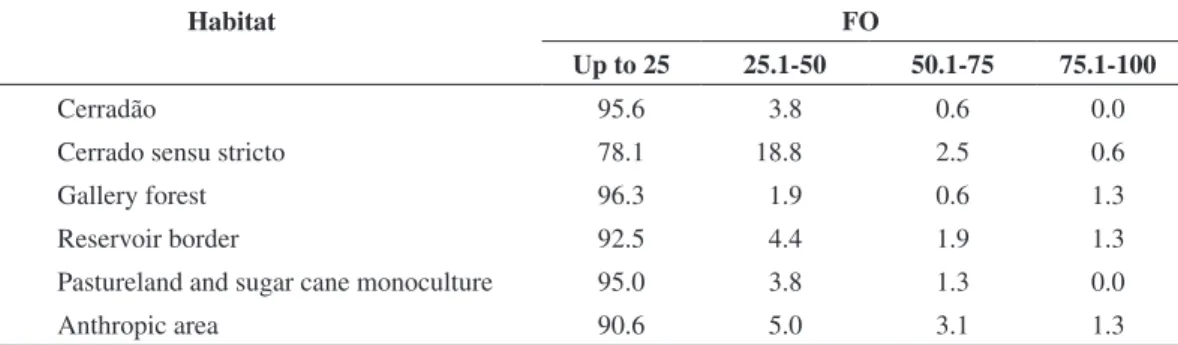
Table 2. Frequency of occurrence (%) of bird species in each habitat at RL-CPPSE and surroundings.
Habitat FO
Up to 25 25.1-50 50.1-75 75.1-100
Cerradão 95.6 3.8 0.6 0.0
Cerrado sensu stricto 78.1 18.8 2.5 0.6
Gallery forest 96.3 1.9 0.6 1.3
Reservoir border 92.5 4.4 1.9 1.3
Pastureland and sugar cane monoculture 95.0 3.8 1.3 0.0
Anthropic area 90.6 5.0 3.1 1.3
Table 3. Number of species (% in parentheses) in trophic
categories at RL-CPPSE and surroundings.
Trophic category Number of species (%)
Insectivores 75 (46.9)
Omnivores 31 (19.4)
Granivores 14 (8.8)
Frugivores 12 (7.5)
Piscivores 10 (6.2)
Nectarivores 8 (5.0)
Carnivores 8 (5.0)
Carrion-eaters 1 (6)
Herbivores 1 (6)
Total 160
found six species endemic to the Cerrado (Melanopareia torquata, Antilophia galeata, Cyanocorax cristatellus, Basileuterus leucophrys, Charitospiza eucosma
and Saltator atricollis) and 22 migratory species (Table 1). Seven species were threatened in the State
of São Paulo (Table 1): Suiriri suiriri and C. eucosma
– critically endangered; Asio flammeus, M torquata
and B. leucophrys – endangered; S. atricollis and Sporophila collaris – vulnerable (São Paulo, 2008).
Although we did not see nationally threatened spe-cies, we recorded two globally threatened (Table 1):
Hylocharis chrysura – least concern and C. eucosma – near threatened (IUCN, 2007).
reservoir border, 26 in the pasturelands and sugar cane monoculture and 55 in the anthropic area (Table 1).
Most of the species had low FO values in all vegeta-tion forms. In five of the six physiognomies, more than 90% of species were registered in less than 25% of the visits. Cerrado sensu stricto was the only one that pre-sented almost 20% of bird species registered in 25.1 to 50% of the visits (Table 2). Insectivores were the major trophic category, followed by omnivores, granivores, piscivores, frugivores, carnivores, nectarivores, carrion-eaters and herbivores (Table 3).
4. Discussion
4.1. Species richness
We found 20.8% of São Paulo avifauna (770 species) (Willis and Oniki, 2003) and 19.1% of Cerrado domain (Silva, 1995). Our results denote that RL-CPPSE has representative species richness if compared with other studies, even though there are few bird studies in São Paulo’s cerrado fragments. Twenty years ago, in 4 hours of observation, Willis and Oniki (2003) found 89 spe-cies at Fazenda Canchim, in cerrado fragment and semi-deciduous forest. Other previous studies found 214 bird species in the campus of the Universidade Federal de São Carlos in 9 years of study (Motta-Junior and Vasconcellos, 1996), 302 in Estações Ecológicas de Jataí e Experimental de Luis Antônio in 13 years (Dias, 2000), 231 in Estação Ecológica de Itirapina in 21 years (Willis, 2004) and in 9 years (Motta-Junior et al., 2008), 144 spe-cies in Parque Estadual de Vassununga in 1 year (Develey et al., 2005) and 158 and 201 species in two fragments in Estação Experimental de Itirapina in 15 months (Telles and Dias, 2010). In addition, it is important to notice that RL-CPPSE is one of the larger remnants in the region (Primavesi et al.,1999) and could be suitable as a natural corridor or habitat and food source for birds.
4.2. Endemic and threatened species
We found 20% (six species) of all endemic species to Cerrado (Silva and Bates 2002); four of them were threatened in São Paulo (São Paulo, 2008). We regis-tered Charitospiza eucosma, whichwas also recorded at
Estação Ecológica de Itirapina, SP (Motta-Junior et al.,
2008). Even though this species has been considered as missing or critically endangered in the state (Willis, 2004; São Paulo, 2008), these recent records provide evidence that there are populations breeding within São Paulo. The few Charitospiza eucosma records have been related to habitat loss, since it usually occurs in natural open areas subjected to regular fires (e.g., open savannas) (Willis, 2004), which are now rarely found in the state (Durigan et al., 1987; 2003). Furthermore, this species is consid-ered high sensitive to habitat disturbance (Stotz et al., 1996). However, the lack of studies in cerrado fragments in the state may also contribute to C. eucosma threaten status. We suggest, then, more censuses and population monitoring should be conducted in these areas.
Among other endemic and threatened species in the state, we found Melanopareia torquata, which has
been rarely studied (e.g. Tubelis and Cavalcanti, 2000). Recently, some population studies have been provid-ing information about their breedprovid-ing biology and ecol-ogy (Gressler and Marini, 2008; Kanegae et al., 2008). Although M. torquata is considered as medium-sensitive
species to anthropic disturbance (Stotz et al., 1996), we suggest that it should receive high protection effort in São Paulo. Like M. torquata, A. flammeus is classified as
endangered species in São Paulo (São Paulo, 2008). We registered this species only once, flying above pasture-land with typical foraging.
4.3. Frequency of occurrence
We found low frequency of occurrence (FO) value for most species, which was also reported in other stud-ies in fragments in São Paulo (Aleixo and Vielliard, 1995; Almeida et al., 1999; Donatelli et al. 2007). Few records for species might occur because of the unusual exploitation of the area, for instance feeding habits in the area during a short period of time. Alternatively, migra-tory and occasional species (see above) or species not easy to detect, such as hummingbirds that are difficult to see or hear, could have also contributed to FO reduced values. We were unable to compare FO between vegeta-tion forms, because the number of visits in each area was not similar.
Migrants that were found indicate this site as an important shelter and food source. We observed both short- and long-distance migratory species, such as
Dendrocygna viduata and Tyrannus savana, respective-ly. However, we did not observe three migratory species, Amazonetta brasiliensis (Gmelin, 1789), Platalea ajaja
Linnaeus, 1758 and Rynchops niger Linnaeus, 1758,
which used to be observed in the region (Manoel M. Dias, pers. comm.). This may be caused by non-annual
site use, to area isolation or to habitat quality decrease in the reserve in recent years. However, our irregular sampling method could also have failed to register more migrant species.
4.4. Bird species and vegetation forms
Inside the protected area of cerrado, we found 120 species, 75% of the total recorded. In the cerradão, we registered bird species with canopy foraging habits, such as Dryocopus lineatus, Conirostrum speciosum and Schistochlamys ruficapillus (Stotz et al., 1996). These
species had also the highest FO at this habitat. In the cer-rado sensu stricto, we found typical species of savanna or similar vegetation forms, e.g. Colaptes campestres,
which uses terrestrial and canopy foraging strata, and
Melanopareia torquata, with terrestrial and understory
habits (Stotz et al., 1996; Sick, 1997). Species with the high FO in this physiognomy were Cyanocorax chrysops, Crypturellus parvirostris, Coryphospingus cuculatus, Thamnophilusdoliatus and T. punctatus. In the gallery
252
Despite the small area of gallery forest, this vegetation type usually shows high biodiversity. Some birds might use different strata (e.g. B.flaveolus, B. leucophrys and
B.hypoleucus, Marini and Cavalcanti, 1993) allowing an
increase in species richness (Macedo, 2002).
We found 92 species in the surrounding area, in-cluding pasturelands, sugar cane monoculture, reservoir border and anthropic area. Ammodramus humeralis, Sicalis flaveola, S. luteola, Sporophila spp. and Volatinia jacarina were typical grassland species found in
pas-tureland borders. Among non-Passeriformes species,
Cariama cristata, Syrigma sibilatrix and Bubulcus ibis
were frequently found in pasturelands. They are usu-ally benefited by agriculture and pastureland occupation (Sick, 1997). For instance, Bubulcus ibis, was first regis-tered in Brazil almost 40 years ago, and rapidly became abundant (Sick, 1997). Individuals of this species usu-ally follow grazing cattle, improving their ability to find insects for feeding (Sick, 1997).
Swampy species were registered at the reservoir border, such as Certhiaxis cinnamomea, Chrysomus ruficapillus, Fluvicola nengeta and Himantopus melanura, which forage on wet ground. Aquatic species,
which are highy dependent of water for fish, aquatic insects or mollusks food items availability, were com-monly registered in the area. Ardea alba had the highest
FO in this habitat (100%), followed by Mesembrinibis cayennensis (78.6%) and Jacana jacana (71.4%). We
found a juvenile individual of Tigrisoma lineatum only
once in the reservoir border, which indicates reproduc-tion in the area.
In the anthropic area, including a small village, we frequently found many generalist species, like Pitangus sulphuratus and Furnarius rufus. Most Columbidae
species are also highly adapted to anthropic areas and are easily found in these areas. Patagioenas picazuro, P. cayennensis and Zenaida auriculata were uncommon
in São Paulo until the 1960’s, but since then, they have become abundant in the state (Willis and Oniki 1987). The expansion of mechanical agriculture increases grain availability on the ground and therefore benefits these species’ feeding behaviour (Willis and Oniki 1987)
4.5. Trophic categories
Species distribution in trophic categories follows similar results found in previous studies (Willis, 1979; Motta-Junior and Vasconcellos, 1996; Krügel and Anjos, 2000; Anjos, 2001; Tellino-Junior et al., 2005). Most species were insectivorous (46.9%), a typical pattern in tropical regions (Sick, 1997; Macedo, 2002), probably related to site resources availability. Omnivorous species followed in the rank (19.4%) and were also significant for the community composition. These species are expected to be less prejudiced in disturbed areas, because they have diverse diets (Willis, 1979; Motta-Junior, 1990).
Granivores were in third position in the categories rank. Such species records are probably related to
pas-provide suitable foraging sites. Frugivores were few-er in numbfew-er of species in our sample. Howevfew-er, we found small (Antilophia galeata), medium (Amazona aestiva) and large frugivores (Penelope superciliares and Ramphastos toco), which indicates the wide range of
food item availability. This group is of great importance in natural area conservation, since it is strongly associ-ated with seed dispersal and vegetation structure mainte-nance (Pizo, 2001).
Nectarivores were poorly represented in the bird community, and were composed almost entirely of hummingbird species. Most of these species are mutu-ally related to some plant species, as well as frugivores, since they are pollinators. Seed production or germi-nation of many plants species may be affected by the reduction of pollinators in fragmented areas (Murcia, 1996), which denotes the ecological importance of nectarivores. The category of Piscivores was mainly composed of Ardeidae species, which require aquat-ic environments for enough food availability (Saquat-ick, 1997). Therefore, on the RL-CPPSE boundary, Represa do 29 is a representative habitat for this group mainte-nance. Carnivorous species, such as hawks (Rupornis magnirostris) and owls (Tyto alba) registered in this
study, are also critical for community dynamics, be-cause they are top predators (Sick, 1997) and may con-trol the population size of small animals.
5. Conclusion
We found remarkable data at RL-CPPSE, such as endemic and critically threatened bird species, and high species richness. Species distribution in trophic catego-ries also indicates the area as a suitable environment for the existence of a wide range of birds. Therefore, here we contribute with valuable information for the development of conservation or management plans at a local or regional level. Regarding our results and the area features, such as its size, conservation status and position within the state – between Cerrado and Atlantic Forest – the study site must be considered as a priority conservation area to preserve bird species in the State of São Paulo.
Acknowledgements — We are grateful to FOG Figueiredo, KD Espartosa, MV Cianciaruso, MH Santos, RB Negrão and GC Molina for helping us in the field work. We are grateful to O. Primavesi and Embrapa Pecuária Sudeste, for allowing us to conduct this study in RL-CPPSE. We are grateful to MV Cianciaruso, L. Bezerra, MR Francisco and O. Rocha, for the comments and suggestions, and for two anonymous reviewers of the manuscript. LTM is grateful to PIBIC/CNPq, for the scholarship.
References
ALHO, CJR. and MARTINS, ES., 1995. De grão em grão o cerrado perde espaço. Brasília: WWF.
ALMEIDA, MEC., VIELLIARD, JME. and DIAS, MM., 1999. Composição da avifauna em duasmatas ciliares do rio Jacaré-Pepira, São Paulo, Brasil. Revista Brasileira de Zoologia, vol. 16, no. 4, p. 1087-1098.
ANDRÉN, H., 1994. Effects of habitat fragmentation on birds and mammals in landscapes with different proportions of suitable habitat: a review. Oikos, vol. 71, no. 3, p. 355-366. ANJOS, L., 2001. Bird communities in five Atlantic Forest fragments in Southern Brazil. Ornitologia Neotropical, vol. 12, no.1, p. 11-27.
BirdLife International, 2003. World Bird Database: the site for bird conservation. Version 2.0. Cambridge: BirdLife International. Available from: <http://www.birdlife.org>. Access in: 13/07/2008.
CAVALCANTI, RB. and JOLY, CA., 2002. Biodiversity and conservation priorities in the Cerrado region. In Oliveira, PS. and Marquis RJ. (Eds.). The cerrados of Brazil: ecology and natural history of a neotropical savanna. New York: Columbia University Press. p. 351-367.
Comitê Brasileiro de Registros Ornitológicos - CBRO, 2007. Listas das aves do Brasil. CBRO. Available from: <http://www. cbro.org.br>. Access in: 13/07/2008
DEBINSKI, DM. and HOLT, RD., 2000. A survey and overview of habitat fragmentation experiments. Conservation Biology, vol. 14, no. 2, p. 342-355.
DEVELEY, PF. and ENDRIGO, E., 2004. Aves da grande São Paulo: guia de campo.São Paulo: Aves e Fotos Editora. 295 p. DEVELEY, PF., CAVANA, DD. and PIVELLO, VR., 2005. Aves. In PIVELLO, VR. and VARANDA, EM. (Orgs.). O cerrado Pé-de-Gigante: ecologia e conservação. São Paulo: Secretaria do Meio Ambiente. p. 121-134.
DIAS, MM., 2000. Avifauna das Estações Ecológicas de Jataí e Experimental de Luiz Antônio, São Paulo, Brasil. In SANTOS, JE. and PIRES, JSR. (Eds.). Estação Ecológica de Jataí. São Carlos: Editora Rima. p. 285-301. (vol. 1).
DONATELLI, RJ., FERREIRA, CD., DALBETO, AC. and POSSO, SR., 2007. Análise comparativa da assembléia de aves em dois remanescentes florestais no interior de São Paulo, Brasil. Revista Brasileira de Zoologia, vol. 24, no. 2, p. 362-375. DURIGAN, G., SARAIVA, IR., GARRIDO, MAO., GARRIDO, LMAG. and PECHE-FILHO, A., 1987. Fitossociologia e evolução da densidade da vegetação de cerrado em Assis, SP. Boletim Técnico do Instituto Florestal, vol. 41, no. 1, p. 59-78. DURIGAN, G., SIQUEIRA, MF., FRANCO, GADC., BRIDGEWATER, S. and RATTER, JA., 2003. The vegetation of priority areas for cerrado conservation in São Paulo state, Brazil. Edinburgh Journal of Botany, vol. 60, no. 2, p. 217-241. GRESSLER, DT. and MARINI, MÂ., 2008. Nest, eggs and nestling of the Collared Crescentchest Melanopareia torquata in the Cerrado region, Brazil. Revista Brasileira de Ornitologia, vol. 14, no. 4, p. 598-600
Instituto Brasileiro do Meio Ambiente e dos Recursos Naturais Renováveis - IBAMA, 2003. Lista das espécies da fauna ameaçadas de extinção. Brasília: Ministério do Meio Ambiente.
International Union for Conservation of Nature and Natural Resources - IUCN, 2007. Red List of Threatened Species. Available from: <http://www.iucnredlist.org>. Access in: 02/03/2008.
KANEGAE, MF., TELLES, M. and DAMIANO, RZ., 2008. Primeiro registro fotográfico do desenvolvimento de ninhegos de tapaculo de colarinho. Atualidades Ornitológicas, vol. 141, p. 94-102.
KRÜGEL, MM. and ANJOS, L., 2000. Bird communities in forest remnants in the city of Maringá, Paraná State, Southern Brazil. Ornitologia Neotropical, vol. 11, no. 4, p. 315-330. LOYOLA, RD., KUBOTA, U. and LEWINSOHN, TM., 2007. Endemic vertebrates are the most effective surrogates for identifying conservation priorities among Brazilian ecoregions. Diversity and Distributions, vol. 13, no. 4, p. 389-396. MACEDO, RH., 2002. The avifauna: ecology, biogeography, and behavior. In OLIVEIRA, PS. and MARQUIS, RJ. (Eds.). The cerrados of Brazil: ecology and natural history of a neotropical Savanna. New York: Columbia University Press. p. 242-263.
MACHADO, RB., RAMOS-NETO, MB., HARRIS, MB., LOURIVAL, R. and AGUIAR, LMS., 2004. Análise de lacunas de proteção da biodiversidade no Cerrado. In Anais do IV Congresso Brasileiro de Unidades de Conservação. Curitiba: Fundação O Boticário de Preservação à Natureza. p. 29-38.
MARINI, MÂ., ROBINSON, SK. and HESKE, EJ., 1995. Edge effects on nest predation in the Shawnee National Forest, southern Illinois. Biological Conservation, vol. 74, no. 3, p. 203-213.
MARINI, MÂ., 2001. Effects of forest fragmentation on birds of the cerrado region, Brazil. Bird Conservation International, vol. 11, no. 1 p. 13-25.
MARINI, MÂ. and CAVALCANTI, RB., 1993. Habitat and foraging substrate use of three Basileuterus warblers from central Brazil. Ornitologia Neotropical, vol. 4, no. 2, p. 69-76. MARINI, MÂ. and GARCIA, FI., 2005. Bird conservation in Brazil. Conservation Biology, vol. 19, no. 3, p. 665-671. MARINI, MÂ., ROBINSON, SK. and HESKE, EJ., 1995. Edge effects on nest predation in the Shawnee National Forest, Southern Illinois. Biological Conservation, vol. 74, no. 3, p. 203-213.
MARTENSEN, AC., PIMENTEL, RG. and METZGER, JP., 2008. Relative effects of fragment size and connectivity on bird community in the Atlantic Rain Forest: implications for conservation. Biological Conservation, vol. 141, no. 9, p. 2184-2192.
MARZLUFF, JM. and EWING, K., 2001. Restoration of fragmented landscapes for the conservation of birds: a general framework and specific recommendations for urbanizing landscapes. Restoration Ecology, vol. 9, no. 3, p. 280-292. MEYER DE SCHAUENSEE, R., 1982. A guide to the Birds of South America. Wynnewood: Intercollegiate Press Inc. 498 p. MOTTA Jr., JC., 1990. Estrutura trófica e composição das avifaunas de três habitats terrestres na região central do Estado de São Paulo. Ararajuba, vol. 1, p. 65-71.
254
Regional de Ecologia. São Carlos: UFSCar. p. 159-171. (vol. 7). MOTTA Jr., JC., GRANZINOLLI, MAM. and DEVELEY, PF., 2008. Aves da Estação Ecológica de Itirapina, Estado de São Paulo, Brasil. Biota Neotropica, vol. 8, no. 3, p. 207-227. MURCIA, C., 1996. Forest fragmentation and the pollination of neotropical plants. In SCHELHAS, J. and GREENBERG, RS. (Eds.). Forest Patches in Tropical Landscapes. Washington: Island Press. p. 19-36.
MYERS, N., MITTERMEIER, RA., MITTERMEIER, CG., FONSECA, GAB. and KENT, J., 2000. Biodiversity hotspots for conservation priorities. Nature, vol. 403, p. 853-858. PALMER, GC., FITZSIMONS, JA., ANTOS, MJ. and WHITE, JG., 2008. Determinants of native avian richness in suburban remnant vegetation: Implications for conservation planning. Biological Conservation, vol. 141, no. 9, p. 2329-2341. PINTO, MP., DINIZ-FILHO, JAF., BINI, LM., BLAMIRES, D. and RANGEL, TFLVB., 2008. Biodiversity surrogate groups and conservation priority areas: birds of the Brazilian cerrado. Diversity and Distributions, vol. 14, no. 1, p. 78-86.
PIRATELLI, A., SOUSA, SD., CORRÊA, JS., ANDRADE, VA., RIBEIRO, RY., AVELAR, LH. and OLIVEIRA, EF., 2008. Searching for bioindicators of forest fragmentation: passerine birds in the Atlantic forest of southeastern Brazil. Revista Brasileira de Biologia = Brazilian Journal of Biology, vol. 68, no. 2, p. 259-268.
PIZO, MA., 2001. A conservação das aves frugívoras. In ALBUQUERQUE, JLB., CÂNDIDO Jr., JF., STRAUBE, FC. and ROOS, AL. (Eds.). Ornitologia e conservação: da ciência às estratégias. Tubarão: Editora Unisul. p. 49-59.
PRIMAVESI, O., PRIMAVESI, ACPA., PEDROSO, AF., CAMARGO, AC., RASSINI, JB., ROCHA-FILHO, J., OLIVEIRA, GP., CORREA, LA., ARMELIN, MJA., VIEIRA, SR. and DECHEN, SCF., 1999. Microbacia hidrográfica do Ribeirão Canchim: um laboratório real de laboratório ambiental. São Carlos: Embrapa Pecuária Sudeste. 133 p. (boletim de pesquisa no. 5).
SÃO PAULO, 1999. Conhecer para conservar: as unidades de conservação do Estado de São Paulo. São Paulo: Série Probio. 115 p.
______, 2008. Fauna ameaçada no Estado de São Paulo. Diário Oficial do Estado de São Paulo, vol. 118, no. 187, 60 p. SICK, H., 1997. Ornitologia brasileira. In PACHECO, JF. (Coord.). Rio de Janeiro: Nova Fronteira. 912 p.
SILVA, JMC., 1995. Birds of the cerrado region, South America. Steenstrupia, vol. 21, no. 1, p. 69-92.
______, 1997. Endemic bird species and conservation in the Cerrado Region, South America. Biodiversity Conservation, vol. 6, no. 3, p. 435-450.
SILVA, JMC. and BATES, JM., 2002. Biogeografic patterns and conservation in the South American cerrado: a tropical savanna hotspot. Bioscience, vol. 52, no. 3, p. 225-233.
SOUZA, DGS., 1998. Todas as aves do Brasil: guia de campo para identificação. Feira de Santana: Dall. 350 p.
MOSKOVITS, DK., 1996. Neotropical birds: ecology and conservation. Chicago: Chicago University Press. 478 p.
STOUFFER, PC. and BIERREGAARD, JR., 1995. Effects of forest fragmentation on understory hummingbirds in Amazonian Brazil. Conservation Biology, vol. 9, no. 5, p. 1085-1091. TELLES, M. and DIAS, MM., 2010. Bird communities in two fragments of Cerrado in Itirapina, Brazil. Revista Brasileira de Biologia = Brazilian Journal of Biology, in press.
TELLINO Jr., WR., DIAS, MM., AZEVEDO Jr., SM., LYRA-NEVES, RM. and LARRAZÁBAL, MEL., 2005. Estrutura trófica da avifauna na Reserva Estadual de Gurjaú, Zona da Mata Sul, Pernambuco, Brasil. Revista Brasileira de Zoologia, vol. 22, no. 4, p. 962-973.
TUBELIS, DP. and CAVALCANTI, RB., 2000. A comparison of bird communities in natural and disturbed non-wetland open habitats in the cerrado’s central region, Brazil. Bird Conservation International, vol. 10, no. 4, p. 331-350.
TUBELIS, DP., COWLING, A. and DONNELLY, C., 2004. Landscape supplementation in adjacent savannas and its implications for the design of corridors for forest birds in the central Cerrado, Brazil. Biological Conservation, vol. 118, no. 3, p. 353-364.
VIELLIARD, JME. and SILVA, WR., 1990. Nova metodologia de levantamento quantitativo e primeiros resultados no interior de São Paulo. In Anais do IVEncontro Nacional de Anilhadores de Aves. Pernambuco: Universidade de Pernambuco. p. 117-151. WATSON, JEM., WHITTAKER, RJ. and FREUDENBERGER, D., 2005. Bird community responses to habitat fragmentation: how consistent are they across landscapes? Journal of Biogeography, vol. 32, no. 8, p. 1353-1370.
WILLIS, EO., 1979. The composition of avian communities in remanescent woodlots in southern Brazil. Papéis Avulsos de Zoologia, vol. 33, no. 1, p. 1-25.
______, 2004. Birds of a habitat spectrum in the Itirapina savanna, São Paulo, Brazil (1982-2003). Revista Brasileira de Biologia =Brazilian Journal of Biology, vol. 64, no. 4, p. 901-910.
______, 2006. Protected cerrado fragments grow up and lose even metapopulational birds in central São Paulo, Brazil. Revista Brasileira de Biologia =Brazilian Journal of Biology, vol. 66, no. 3, p. 829-837.
WILLIS, EO. and ONIKI, Y., 1987. Invasion of deforested regions of São Paulo State by the picazuro pigeon, Columba picazuro Temminck 1813. Ciência e Cultura, vol. 39, no. 11, p. 1064-1065.
______, 2003. Aves do Estado de São Paulo. Rio Claro: Editora Divisa. 398 p.