AR
TICLE
1 Pós-Graduação em Saúde da Criança e da Mulher. Instituto Nacional de Saúde da Mulher, da Criança e do Adolescente Fernandes Figueira. Av. Rui Barbosa 716, Flamengo. 22250-020 Rio de Janeiro RJ Brasil. [email protected] 2 Hospital Sírio-Libanês. São Paulo SP Brasil.
When participation of children and youth with disabilities
is not merely activity: a study of the literature
Abstract This article analyzes the approach to
children and adolescent participation in disability studies. Methodologically, it combines a literature review and a theme-based content analysis to look at which dimensions of participation are ex-plored in the literature. As the result of this study we highlight four areas: Sports, Quality of Life/ Well-Being, School and Participation Metrics. We find that the focus is on participation as perform-ing activities within a given context, with very few broader discussions about the domain as a human value related to socialization and the development of a support network, the management of
inde-pendence and levels of deinde-pendence.
Key words Child, Adolescent, Disability, Social involvement
Tatiana Vasconcelos dos Santos 1
Martha Cristina Nunes Moreira 1
Sant
os T
Introduction
Participation is a key concept for the health of every child and adolescent, and is related to their involvement with interactive activities within a social definition. This definition focuses both on the nature and extent of this involvement, within a discussion of the sense of community and be-longing1,2.
To situate the reader, we should explain that references on disablement or people with disabil-ities or the disabled in general appear in the aca-demic literature under three major headings: spe-cial healthcare needs (easily found by searching for “special needs”), chronic health conditions and disabilities as affirmative expressions of an identity that promotes protagonism and the rec-ognition of rights. The term “special healthcare needs” is defined based on the need for support
of those with chronic conditions or disabilities3.
The term chronic health conditions is in itself a broad term, and may reduce the uniqueness of
each disease to a single and general category3.
The term disability is supported on a specific theoretical field that recognizes disability as a so-ciological problem, and as something that grants authorization for the individual to become a pro-tagonist and claim the ability to lead a public life,
as the identifier of a social movement4.
In the field of Disabilities, the Internation-al Classification of Functioning, Disability and
Health (ICF)5, and its version for children and
youth (ICF-CY)6, are a milestone in the
discus-sion of participation, in that they relate partici-pation to the social perspective of functionality and conditions it to contextual factors. Accord-ing to the ICF-CY, participation is the interaction of the child or adolescent’s capabilities with the
surrounding physical and social environment6. It
is related, for example, to interpersonal relation-ships developed as individuals are inserted into education, work, recreation and leisure activities. In this paper we use Participation with a capital P to refer to the total component described in the ICF and ICF-CY, whereas participation with a lower case p is used exclusively for the social domain.
In public health, the consideration of physical and social dimensions in the discussion of par-ticipation of people with disabilities dialogs with recent healthcare models, serving as the
concep-tual framework for documents such as Healthy
People 2010 and 20207on the interaction of an
environment free of barriers and participation in daily activities as important areas to promote
the health of people with disabilities. In Brazil,
the Law for Inclusion of People with Disabilities8
uses restrictions to participation as an indicator for defining disability, and defines the guidelines for the social insertion of this population.
The emergence of models based on social determinants is a step forward in the process to change the paradigm regarding the outlook of
disability in public health9,10. In the traditional
outlook, disablement is considered a morbidity, with practices focused on preventing the risks and controlling the diseases capable of producing
disablement9,11. This view of disability prevention
may appear strange, and can move us towards a different perspective, inserting it into the health-care agenda primarily from the point of view we discuss here, or the participation of children and youth.
The contemporary outlook incorporates quality of life as a health outcome and, since the 2000s, the emerging outlook also includes
partic-ipation as a health promotion tool9,11. It is worth
mentioning that most of the care provided to the disabled is still based primarily on the traditional model9,11.
Considering participation as a mechanism to promote the health of children and adolescents still gives rise to questions in the healthcare en-vironment. Which dimensions, possibilities and limits are associated with the participation of these subjects in their social environment? What consolidated knowledge is already available to enable promoting healthcare focused on this population?
In light of these questions, and bearing in mind the recent inclusion of this domain in dis-cussions about public health and disablement, this study attempted to analyze knowledge pro-duced on the participation of children and ad-olescents with disabilities to map and discuss those aspects and dimensions of this domain that have been highlighted and selected for attention.
Materials and Methods
One of the paths to achieve our objective is to look at the literature, in particular articles pub-lished in scientific journals, and more specifically those focused on this topic.
aúd
e C
ole
tiv
a,
21(10):3111-3120,
2016
and public health. After looking at the journals
published in this field, we selected the Disability
and Health Journal. This is a publication of the
American Association on Health and Disability and focuses on public health, health promotion, health education, well-being and prevention to reduce the incidence of secondary and medical conditions.
The search was limited to articles published in 2008 and beyond. The initial marker was the 2007 ICF-CY publication as a conceptual model to understand the participation of children and adolescents. The terms used in this survey were previously checked in the list of health science descriptors searched for using child OR adoles-cent AND social participation. Adolesadoles-cents were defined as people aged 10 to 19, as defined by the
WHO and Ministry of Health12.
We found a total of 142 articles. After read-ing the abstracts, we selected those that focused on those covering the full descriptor (and). We excluded 119 articles discussing adults, focusing on access to healthcare services, the prevalence of obesity and caregiver health. After reading the re-maining articles in full we excluded those where the average age of the participants exceeded 19, and theoretical articles on disability with no focus on participation. This left 19 articles that made up the analytical body of this study.
The analysis took place in two phases. Initial-ly we ran a descriptive anaInitial-lysis of the samples in terms of date of publication and type of study, the core content, the health conditions studied and finally, the study subjects.
In a second phase the objective of the articles was analyzed, and the specific considerations in the discussions were noted. A technical adapta-tion of Bardin’ content analysis was applied to the material13.
This author believes that the theme is a unit of meaning that frees itself from the text under analysis and may translate it in the form of an
abstract, phrase or work13. To find the theme one
must be aware of the nucleus of meaning whose presence or frequency may mean something to the analytical objective selected. In this literature review the theme is understood as a broader cat-egory that can cover more than one nucleus of
meaning. Based on the approach of Gomes et al.14
this analysis followed the following sequence: 1 - Identification of the central ideas of the tran-scribed sections of all articles; 2 - classification of the meanings underlying the ideas into themes
that summarize the production of knowledge on the topic; 3 - preparation of interpretative sum-maries of each theme.
In preparing the interpretative summaries we used works outside of the analytical body to ex-pand the discussion on the topic.
Results
Description of the literature
In terms of the date of publication of the ar-ticles, over half (10) were published in 2014 or 2015, being considered recent production, possi-bly associated with a series of official documents questioning the quality of life and participation of people with disabilities, fostering strategies to remove barriers and improve access to healthcare services and programs. As an example we would
mention the World Health Organization
2014-2021 Action Plan: Better Health for People with
Dis-abilities15, and the 2010 Healthy People7 document.
Of the articles analyzed, 17 used a quanti-tative approach, 1 a qualiquanti-tative approach and 1 was an editorial/opinion. This demonstrates that standardized tools are valued; the view of study subjects themselves on their participation expe-rience using a qualitative approach is not often explored.
Analyzing the core content of the articles, 12 addressed sports, 3 discussed quality of life and well-being, 2 addressed the use of standardized metrics and 2 discussed participation in the school environment.
Regarding the health conditions studied, we found a diversity of themes: 11 looked at children and adolescents with disabilities that included intellectual and physical disabilities, 5 addressed special healthcare needs, 1 chronic health condi-tions, 1 spina bifida and 1 Movement Coordina-tion Disorder. This finding exposes the lack of a standard term to designate this population, with different aspects considered in each definition.
Sant
os T
Themes and meaning nuclei under discussion
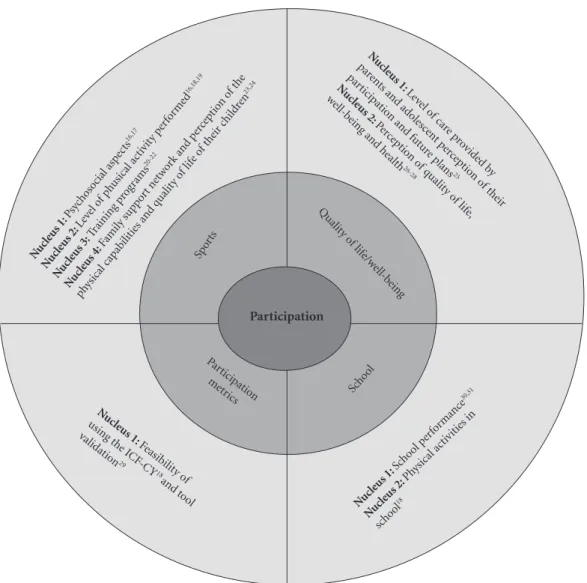
The analysis of the content of the articles re-viewed can be placed on a theme map with ar-eas related to three concentric circles, the center of which is the concept, the middle circle, split into four sub-areas, covers the themes, and the external circle integrates the meanings associat-ed with the themes and the references usassociat-ed by the study authors (Figure 1). The analytical path started out by identifying the meanings of the outer ring, then classifying the intermediate ring
for the summary concept of Participation, which
comprises the internal area.
A thorough reading of the material led to
four themes: Sports, Quality of Life/Well-Being,
School and Participation Metrics.
The first theme - Sports, is the most prevalent in the studies and addresses four nuclei. Based on the social dimensions of sport proposed by
Tubi-no32, in the articles on this theme, we explored
the dimensions of sports-participation focused on ludic pleasure and sports-performance.
The first nucleus refers to the psychosocial aspects involved in performing physical activi-ties such as attitudes, perceptions of health and
self-image, and orientation towards sports16.
This nucleus also includes the contribution of performance sports for the self-perception of
en-Figure 1. Theme map.
Nuc leus 1:
Psychoso
cial asp
ects
16,17
Nuc leus 2:
Leve
l of p
husical a
ctiv
ity p
erfo
rme d16,18,19
Nuc leus 3:
Training p
rogr
ams
20-22
Nuc leus 4:
Famil
y sup
port ne
twor
k and p
erce
ptio
n of the
physical capab
ilities and q
ualit
y of lif
e of the
ir childr
en23,24
Nuc
leus 1:
Level o f car
e p rovid
ed b y par
ents and a
dolesc ent p
ercep tio
n o f the
ir par
ticipat io
n and fu
tur e plans
25
Nuc
leus 2:
Percep tio
n o f qualit
y o f lif
e, well-b
eing and health
26-28
Nuc leus 1:
Scho
ol per
formanc
e 30,31
Nuc leus 2:
Physical a
ctivities in
scho
ol18
Nuc leus 1:
Feasib ilit
y o f using the ICF
-CY
18
and t ool validat
ion29
Par ticipat
ion me
trics
Qualit
y o f lif
e/w ell-b
eing
Scho ol
Spor ts
aúd
e C
ole
tiv
a,
21(10):3111-3120,
2016
thusiasm, physical capability, satisfaction, social acceptance and friendship, making a bridge to building an identity33 and quality of life17,23,33,34.
The second nucleus corresponds to the ap-proach of physical activity performed by children and adolescents with disabilities, also focusing on discussions about the prevalence of obesity in this population16,18,19.
Physical training programs are the third nu-cleus covering discussions of processes to imple-ment physical activity programs, their psycho-logical impact, weight-loss and improved
phys-ical performance20-22.
The fourth nucleus focuses on the interface with the family, addressing the support network parents provide to enable their children to per-form physical activities and their perception of
the physical skills of their children24, and the
quality of life of those who practice sports23.
Among the studies analyzed we found that par-ents encourage their children to practice sports, and that this is not necessarily related to the
phys-ical capabilities they assign to their children24. On
the other hand, parent perception of the quality of life of their children who practice some sort of physical activity was worse than the perception of their children23.
The second theme -Quality of life/Well-being,
combines the materials that enable a deeper dis-cussion of the construct, including both mean-ing nuclei. Despite its subjective character, it is
interesting to note that only one article26 used
qualitative methods to address the construct. The preference for using standard tools may have neglected aspects of the experience of disability, as the literature has already demonstrated that these tools address both objective and subjective aspects35.
Starting with a discussion of the impact of insertion in recreational and social activities on quality of life, the first nucleus refers to the influ-ence of parental care in adolescent perceptions of
their participation and plans for the future25.
The second nucleus addresses the perception of the dimensions of quality of life such as phys-ical, emotional and social health as well as school performance, relating them to the symptoms of
chronic health conditions27, the correlation
be-tween well-being and functional limitations28,
and the view of children and adolescents on
health and well-being26.
Participation Metrics refers to a single nucle-us of meaning.
Based on the discussion addressed in ICF-CY on the participation of children and adolescents,
this nucleus refers to the validation of standard tools based on classifications for measuring this
domain29, and the feasibility of using the ICF-CY
structure to identify restrictions to participation36.
The fourth theme - School, is summarized in
two meaning nuclei.
The first nucleus addresses the relationship between the severity of the health condition and
school performance30,31. The second nucleus is
related to physical activity in school18,
address-ing the sports-education dimension and linkaddress-ing social integration to psychomotor development and educational physical activities.
Discussion
The themes submitted are part of some nuclei of meaning associated with the concept of Partici-pation and quality of life in the ICF-CY.
The emphasis placed on discussing Sports corroborates the rationale of emerging models of disability, attempting to displace the concept of disability associated with incapacity, a point of view related to the medical model where body in-juries are responsible for the disadvantages.
In this model, all of the beliefs and values about disability are embodied in the body of the disabled, which is non-productive and at a dis-advantage. The assumption that a body with lim-itations limits output and ensures to those with disabilities a status of being passive and receptors of the decisions made by others regarding their
lives37. Disability in this context, is presented
as an anomaly compared to fixed standards of normalcy, without taking in consideration the subjective experience of those involved, which is what really leads to understanding and accepting
the condition of being disabled37. For
Canguil-hem38, human beings in their dynamic polarity
are responsible for determining where disease starts, considering that when it comes to biolog-ical standards, the individual must always be the point of reference.
From this we realize the significant contribu-tion that sports play in the percepcontribu-tion of quality of life by children and adolescents, and its poten-tial as a means of recovering capabilities with an
investment in whatever capabilities they have37.
Individual awareness of limitations and possibil-ities enable increased self-knowledge and value, the development of an identity and self-esteem, and a sense of belonging.
under-Sant
os T
stand disability beyond its physical characteris-tics and limitations, making it easier to develop skills and potential in disabled children and ad-olescents through social interaction, or what
ac-cording to Simmel39 we may call ludic forms of
socializing.
According to Simmel, the basis of society is the interaction between individuals, in particu-lar the play of simiparticu-larities and differences as the two major principles of human development. This difference enables the emergence of human
beings in their uniqueness39. The principle of
so-ciability in the Siemmelian perspective states that each individual must ensure to the other, socia-ble values (happiness, release, vivacity) compat-ible with the maximum values received by that individual. It is therefore a game, where the hap-piness of one individual is linked to the happi-ness of others, thus configuring a ludic form of sociation. These postulates are relevant when we think about the disabilities of children and ado-lescent and sport as a mechanism of sociability, and something essential to promote the neces-sary support for the growth and development of
children and youth40.
The development of skills based on the social relations fostered by sports exposes a complex network of interdependences of which we are a part, placing us as being who build and are built
within a network41. This then shifts the concept
that autonomy is built on the independence of individuals, to an intersubjective concept ensured
by social interactions of recognition42, such as
managing the dependences of diverse orders
de-pending on age, life cycle and health condition43.
As a society, we value sports. When children and adolescents with disabilities participate in so-cially valued activities, there is the possibility that they will be seen as “non-deviants”, enabling the deconstruction of disability. According to
Beck-er44: Social groups create deviation by setting rules
whose infraction constitutes deviation and, in ap-plying them to specific individuals, branding them
as outsiders. However, this classification depends
on the situation and reaction of the group to a
given behavior45. The practice of sports is an
“ac-tivator” of social inclusion. Based on the recogni-tion of social groups, the deviant label placed on disable children and adolescents is made relative. Within the context of deviant as a social la-bel, we reiterate the importance of the family as the primary and main agent of sociability and promotion of the basis for support. Acceptance of the rules imposed on disabled children and adolescents by social groups is influenced by
family member actions and mindsets, which may or may not recognize or limit their children, but that can also encourage and facilitate the devel-opment of their children’s potential. Parental recognition of the capabilities of their disabled children plays an important role in making them subjects who desire and are capable of trans-forming their impulses into desires, seeking to
realize them within or through their disability46.
The family, as the primary social group, is a de-terminant to trigger and maintain the process of
social integration47, including for example,
par-ticipation in sports. The discrepancy between the perception of parents and adolescents regarding sports-related quality of life, which is the topic of
one study23, could be a hurdle for participating in
this type of activity. If the parents do not recog-nize the benefit of sports for improved quality of life, it is doubtful that they will encourage their children to participate.
The construct quality of life was highlighted in all of the articles analyzed. Participation and quality of life often dialog in the literature on dis-ablement, and we would like to take a moment to differentiate between these concepts. Partici-pation refers to insertion in social situations, and is an objective measure. Quality of life on the other hand, addresses how a person feels when participating in these activities, and their indi-vidual perception of their place in the world and
society48. Although the literature34,49 shows a
re-lationship between the participation of disabled children and quality of life, studies on this theme focused more on the biological factors that influ-enced quality of life, such as the severity of the healthcare condition and the associated
symp-toms27,28. In other words, here we highlight an
ad-ditional construct defined using a quality of life metric rather than its conceptual, philosophical aspect, which might help us value “quality of life” in relationships, promoting values that qualify life based on differences, rather than on scores and standards.
The interface between participation and
quality of life may be explored using the
Capa-bility Approach and the theoretical focus of
Nuss-baum50. Discussing justice, fundamental rights
and the models to analyze quality of life, this ap-proach supports that one solution would be to develop the means to enable each individual to achieve and develop his or her essential
capabili-ties51. In healthcare, contributing the perspective
aúd
e C
ole
tiv
a,
21(10):3111-3120,
2016
According to Nussbaum, the starting point is to know what people are capable of being and doing, also considering the material and institu-tional conditions so that people are in fact ready
to perform at the top of their capability51.
Capa-bility in this case means the various combinations of ways of being and acting, reflecting on quality
of choice of the diverse ways of life52. To consider
the contextual barriers to freedom of choice, the
Capability Approach discourses with the social
model of disablement and is particularly use-ful for a discussion of participation. Within the scope of public policy, in light of the promotion we give to individual capabilities, society has the duty of removing the hurdles that impede or di-minish an individual’s ability to choose and
im-pact his or her quality of life52.
If the discussion of quality of life in the arti-cles highlights an assessment of life dimensions and components, at a metric level one must reflect that this trend is not limited to this con-struct. The ICF and ICF-CY incorporate these advances, as they value functionality and do not classify it based on the disease, but live with the tension of classifying levels of functionality, di-aloging with standards that may provide infor-mation about health and assessments. Fostering participation is known as an important outcome for disabled children and adolescent included in Healthcare Services. Because of the need to ad-dress this domain with metrics, ever since the ICF and ICF-CY were published, there have been efforts to develop tools that cover the
multi-di-mensional nature of participation53. However,
current discussions around the ICF and ICF-CY talk about the difficulty of conceptually differen-tiating between Activity and Participation. This impasse is reflected in the difficulty of selecting suitable metrics that address the profile of
partic-ipation of disabled children and adolescents54,55.
Also discussed is the failure to consider the sub-jective experience of participation in the classi-fication structure. Measuring performance alone neglects the meanings assigned to involvement in social situations, and the experience of autonomy
and self-determination56.
In the School dimension, the medical
mod-el of understanding disability had a strong in-fluence. The severity of the health condition was used to explain low school performance of children and adolescents with special healthcare needs30,31.
Thus, two aspects should be encouraged in
the discussions surrounding School: (a) a
pre-ponderance of analyses discussing school
perfor-mance and disability, which may reinforce or an-ticipate disadvantages, stigma and the deficiency of these children and youth; (b) the invisibility of the discussions about Schools as an important element to promote health, development, growth and sociability.
By including and discussing these aspects, we remove the discussion of disability from a gener-ic agenda, and focus strateggener-ically on its interfaces with childhood and adolescence. Here we find a differential, a value we wish to assign to what the space the disability occupies in the growth and development of children and youth. Unlike adults, disabled children and youth may be ex-posed to processes that make them vulnerable due to their age and dependence on a reference adult, while they live with the markers of disabil-ity. Here we reflect on the power of School, not only as a place to work on cognitive content, but as an important point of support for the growth and development of any child or youth, and more so whose condition bears the marks of
dis-ability. According to Rizzini et al.40, support bases
are family and community resources that provide physical and emotional security for children and youth. In terms of formal (day-care, schools, reli-gious program,...) and informal or spontaneous (friends and solidarity networks, significant oth-ers) organizations.
This outlook steps away from a vision of in-dividual behaviors, enabling an analysis of con-text and the presence of subjects based on their
relationships and the identity they assume57. The
notion of identity traits covers three important significance dimensions: otherness, recognition and belonging. These three dimensions dialog and contribute to reflections on the dimension of social interactions in terms of associations and the development of social networks by subjects within and outside institutions.
Finally, we find that discussions of studies classified as School say little or nothing of the educational move to include and insert those viewed as disabled in regular classrooms, with no segregation. This aspect needs to be further explored in terms of scientific production, ad-dressing the limits and challenges of the political/ educational principle of inclusion, especially in terms of preparing the school environment and educators to integrate disability into the “nor-mal” curriculum. In light of these findings, two considerations are important. First one must consider the technical-financial side of school
inclusion58. In light of the specificities imposed
in-Sant
os T
vestments in technology, staff training and envi-ronment adaptation are required to provide truly equivalent opportunities for diverse people or, barring that, reducing the restrictions to
partic-ipation to a minimum58.
The second consideration is based on the concept of disability as being socially construct-ed, meaning that a person will only be disabled and experienced restrictions to participation in front of an audience that considers the person
to be disabled, according to its own criteria59.
This shines a light on the contextual aspects that impact school inclusion, pointing to the need remove attention on bodily impediments and focus it on the factors of the social and physical environment that accentuate the restrictions im-posed on those with disabilities.
Final Considerations
This review shows the need to advance towards recognizing participation as a concept that is not resumed to activity, in the sense of what the individual is capable of doing in his/her normal environment. Considering that activity is some-thing that may further evoke the ideals of yield and performance, a lot of emphasis must be
placed on participation as a human value, relat-ing it to sociability and support, the management of autonomy and levels of dependence. Thus it touches all of us as human beings, but in the case of disabled children and youth, it must be taken as an ethical principle, ensuring the right to exist and be recognized, to have any possible vulner-abilities built relationally, minimized using pro-tective mechanisms of a social, health and educa-tion nature. In other words, even if we recognize the concept of functionality and its operation-ability as in the ICF and ICF-CJ, valuing Partici-pation as a component of disability, we must pay attention to possible distortions when applying it to health actions. The tradition of evaluation may compromise the philosophical basis of the concept and hence its power to address the ludic forms of social interaction.
aúd
e C
ole
tiv
a,
21(10):3111-3120,
2016
References
Law M. Participation in the occupations of everyday life. Am J Occup Ther 2002; 56(6):640-649.
Imms C. Children with cerebral palsy participate: A review of the literature. Disabil Rehabil 2008; 30(24):1867-1884.
Moreira MCN, Gomes R, Sá MRC. Doenças crônicas em crianças e adolescentes: uma revisão bibliográfica.
Cien Saude Colet 2014; 19(7):2083-2094.
Diniz D. O que é deficiência. São Paulo: Editora Brasi-liense; 2012.
Centro Colaborador da Organização Mundial da Saú-de para a Família Saú-de Classificações Internacionais, or-ganizador. CIF: Classificação Internacional de
Funcio-nalidade, Incapacidade e Saúde. São Paulo: Editora da
Universidade de São Paulo; 2003.
Centro Colaborador da Organização Mundial da Saúde para a Família de Classificações Internacionais, organi-zador. CIF-CJ: Classificação Internacional de Funciona-lidade, Incapacidade e Saúde: Versão Crianças e Jovens.
São Paulo: Editora da Universidade de São Paulo; 2011. National Center for Health Statistics. Healthy People
2010 Final Review. Hyattsville: PHS Publication; 2012.
Brasil.Lei N. 13.146, de 6 de Julho de 2015.Institui a Lei Brasileira de Inclusão Da Pessoa Com Deficiência (Estatuto Da Pessoa Com Deficiência). Diário Oficial da União 2015; 6 jul.
Krahn G, Campbell VA. Evolving views of disability and public health: The roles of advocacy and public health. Disabil Health J 2011; 4(1):12-18.
Rimmer JH. Health promotion for people with dis-abilities: the emerging paradigm shift from disability prevention to prevention of secondary conditions. Phys Ther 1999; 79(5):495-502.
Drum CE, Krahn GL, Peterson JJ, Horner-Johnson W, Newton K. Health of People with Disabilities: deter-minants and disparities. In: Drum CE, Krahn GL, Ank B, editors. Disability and Public Health. Washington: American Public Health Association; 2009. p. 125-144. Brasil. Ministério da Saúde (MS). Política nacional de atenção integral à saúde de adolescentes e jovens. Brasília: MS; 2007.
Bardin L. Análise de Conteúdo. Lisboa: Edições 70; 2009. 1.
2.
3.
4. 5.
6.
7. 8.
9.
10.
11.
12.
13.
Collaborations
TV Santos structured and drafted the article and searched for and analyzed sources. MCN Morei-ra and R Gomes helped design the methodology, draft and review the final article.
Gomes R, Lima VV, Oliveira JM, Schiesari LMC, Soeiro E, Damázio LF, Petta HL, Oliveira MS, Silva SF, Sam-paio SF, Padilha RQ, Machado JLM, Caleman G. The Polisemy of Clinical Governance: a review of literature.
Cien Saude Colet 2015; 20(8):2431-2439.
World Health Organization (WHO). WHO global dis-ability action plan 2014-2021: better health for all people
with disabilities. Geneva: WHO; 2014.
Marques A, Maldonado I, Peralta M, Santos S. Explor-ing psychosocial correlates of physical activity among children and adolescents with spina bifida. Disabil Health J 2015; 8(1):123-129.
Anderson LS, Heyne LA. Physical activity for children and adults with disabilities: An issue of “amplified” im-portance. Disabil Health J 2010; 3(2):71-73.
Queralt A, Vicente-Ortiz A, Molina-García J. The phys-ical activity patterns of adolescents with intellectual disabilities: A descriptive study. Disabil Health J 2016; 9(2):341-345.
Kim J, Greaney ML. Prevalence of physical activity, screen time, and obesity among US children by the ser-vice type of special health care needs. Disabil Health J
2014; 7(3):318-324.
Haney K, Messiah SE, Arheart KL, Hanson E, Diego A, Kardys J, Kirwin K, Nottage R, Ramirez S, Somarriba G, Binhack L. Park-based afterschool program to improve cardiovascular health and physical fitness in children with disabilities. Disabil Health J 2014; 7(3):335-342. Fragala-Pinkham M, O’Neil ME, Haley SM. Summa-tive evaluation of a pilot aquatic exercise program for children with disabilities. Disabil Health J 2010; 3(3):162-170.
Caçola P, Romero M, Ibana M, Chuang J. Effects of two distinct group motor skill interventions in psycholog-ical and motor skills of children with Developmental Coordination Disorder: A pilot study. Disabil Health J
2016; 9(1):172-178.
Shapiro DR, Malone LA. Quality of life and psycholog-ical affect related to sport participation in children and youth athletes with physical disabilities: A parent and athlete perspective. Disabil Health J 2016; 9(3):385-391. 14.
15.
16.
17.
18.
19.
20.
21.
22.
Sant
os T
Martin JJ, Choi YS. Parents’ physical activity−related perceptions of their children with disabilities. Disabil Health J 2009; 2(1):9-14.
Preskitt JK, Goldfarb SS, Mulvihill BA, Colburn S, Da-vis MM. Future plans and social/recreational activities of youth with special health care needs: The implica-tions of parental help in completing surveys. Disabil Health J 2013; 6(4):343-351.
McPherson AC, Lindsay S. How do children with dis-abilities view “healthy living”? A descriptive pilot study.
Disabil Health J 2012; 5(3):201-209.
Kim J, Chung H, Amtmann D, Salem R, Park R, Askew RL. Symptoms and quality of life indicators among children with chronic medical conditions. Disabil Health J 2014; 7(1):96-104.
Menear KS, Preskitt JK, Goldfarb SS, Menachemi N. Correlates of wellness among youth with functional disabilities. Disabil Health J 2015; 8(2):223-230. Khetani M, Marley J, Baker M, Albrecht E, Bedell G, Coster W, Anaby D, Law M. Validity of the Partici-pation and Environment Measure for Children and Youth (PEM-CY) for Health Impact Assessment (HIA) in sustainable development projects. Disabil Health J
2014; 7(2):226-235.
Reuben CA, Pastor PN. The effect of special health care needs and health status on school functioning. Disabil Health J 2013; 6(4):325-332.
Pastor PN, Reuben CA, Kobau R, Helmers SL, Luk-acs S. Functional difficulties and school limitations of children with epilepsy: Findings from the 2009–2010 National Survey of Children with Special Health Care Needs. Disabil Health J 2015; 8(2):231-239.
Tubino MJG. Dimensões sociais do esporte. São Paulo: Cortez; 2011.
Shapiro DR, Martin JJ. Athletic identity, affect, and peer relations in youth athletes with physical disabili-ties. Disabil Health J 2010; 3(2):79-85.
Shapiro DR, Martin JJ. The relationships among sport self-perceptions and social well-being in athletes with physical disabilities. Disabil Health J 2014; 7(1):42-48. Ueda S, Okawa Y. The subjective dimension of func-tioning and disability: what is it and what is it for? Dis-abil RehDis-abil 2003; 25(11-12):596-601.
Meucci P, Leonardi M, Sala M, Martinuzzi A, Russo E, Buffoni M, Fusaro G, Raggi A. A survey on feasibility of ICF-CY use to describe persisting difficulties in execut-ing tasks and activities of children and adolescent with disability in Italy. Disabil Health J 2014; 7(4):433-441. Campeão MS. O esporte paraolímpico como instru-mento para a moralidade das práticas em saúde pública envolvendo pessoas com deficiência - uma abordagem a partir da bioética da proteção [tese]. Rio de Janeiro: Fiocruz; 2011.
Canguilhem G. O normal e o patológico. Rio de Janeiro: Forense Universitária; 2011.
Simmel G. Questões fundamentais da Sociologia: indiví-duo e sociedade. Rio de Janeiro: Zahar; 2006.
Rizzini I, Barker G, Cassaniga N. Criança não é risco, é oportunidade: fortalecendo as bases de apoio familiares e comunitárias para crianças e adolescentes. Rio de Janei-ro: USU, Ed. Universitária Instituto Promundo; 2000. Moreira MCN, Macedo AD. O protagonismo da crian-ça no cenário hospitalar: um ensaio sobre estratégias de sociabilidade. Cien Saude Colet 2009; 14(2):645-652. 24.
25.
26.
27.
28.
29.
30.
31.
32. 33.
34.
35.
36.
37.
38. 39. 40.
41.
Honneth A. Luta por reconhecimento: a gramática moral dos conflitos sociais. São Paulo: Ed. 34; 2003.
Moreira MCN. E quando a doença crônica é das crian-ças e adolescentes? Contribuições sobre o artesanato de pesquisas sob a perspectiva da sociologia da infância e da juventude. In: Castellanos M, organizador. Cronici-dade: experiência de adoecimento e cuidado sob a ótica das Ciências Sociais. Fortaleza: UECE; 2015. p. 125-155. Becker HS. Outsiders: Estudos de sociologia do desvio.
Rio de Janeiro: Zahar; 2008.
Velho G, organizador. Desvio e divergência: uma crítica da patologia social. Rio de Janeiro: Zahar; 1985. Sá SMP, Rabinovich EP. Compreendendo a família da criança com deficiência física. Rev. bras. crescimento
de-senvolv. hum. 2006; 16(1):68-84.
Glat R. O papel da família na integração do portador de deficiência. Rev Bras Educ Espec 1996; 2(4):111-118. Colver A. Quality of life and participation. Dev Med
Child Neurol 2009; 51(8):656-659.
Dahan-Oliel N, Shikako-Thomas K, Majnemer A. Quality of life and leisure participation in children with neurodevelopmental disabilities: a thematic anal-ysis of the literature. Qual Life Res 2012; 21(3):427-439. Nussbaum M. Fronteiras da justiça: deficiência,
nacio-nalidade, pertencimento à espécie. São Paulo: Martins
Fontes; 2013.
Nussbaum MC. Capacidades e justiça social. In: Diniz D, Medeiros M, Barbosa L, organizadores. Deficiência e igualdade. Brasília: UNB; 2010. p. 21-42.
Strapazzon CL, Renck MHP. Direitos humanos funda-mentais das pessoas com deficiência: The Capability Approach. Rev AJURIS 2014; 41(133):155-183. Chien CW, Rodger S, Copley J, Skorka K. Comparative content review of children’s participation measures using the International Classification of Functioning, Disability and Health–Children and Youth. Arch Phys
Med Rehabil 2014; 95(1):141-152.
Coster W, Khetani MA. Measuring participation of children with disabilities: Issues and challenges. Disabil Rehabil 2008; 30(8):639-648.
Badley EM. Enhancing the conceptual clarity of the activity and participation components of the Inter-national Calssification of Functioning, Disability and Health. Soc Sci Med 2008; 66(11):2335-2345.
Hemmingsson H, Jonsson H. An occupational per-spective on the concept of participation in the Inter-national Classification of Functioning, Disability and Health-some critical remarks. Am J Occup Ther 2005; 59(5):569-576.
Dubar C. A socialização: construção das identidades so-ciais e profissionais. São Paulo: Martins Fontes; 2005. Omote S. Normalização, integração, inclusão... Ponto Vista 1999; 1(1):1-13.
Omote S. A integração do deficiente: um pseudo pro-blema científico. Temas em Psicol 1995; 3(2):55-62.
Article submitted 08/03/2016 Approved 17/05/2016
Final version submitted 19/05/2016 42.
43.
44. 45. 46.
47. 48. 49.
50.
51.
52.
53.
54.
55.
56.