PLoS Biology | www.plosbiology.org 1645
Correspondence
August 2007 | Volume 5 | Issue 8 | e216
No Forest Left Behind
Gustavo A. B. da Fonseca
*, Carlos Manuel Rodriguez,
Guy Midgley, Jonah Busch, Lee Hannah, Russell A.
Mittermeier
New research indicates that slowing tropical deforestation may play a much larger role in mitigating climate change than previously believed [1,2]. Carbon emissions from tropical deforestation are expected to increase atmospheric CO2 concentration by between 29 and 129 ppm within 100 years, much more than previously estimated [3]. The parties to the United Nations Framework Convention on Climate Change are considering policy approaches and incentives for reducing emissions from deforestation (RED) in developing countries [4–6] that are timely, in light of these recent research fi ndings. The leading proposals would enable trading of carbon saved by reducing tropical deforestation, just as carbon is currently traded from reducing industrial emissions. The state of these discussions suggests that a key group of countries are at risk of being omitted from a new framework—those with high forest cover and low rates of deforestation (HFLD).
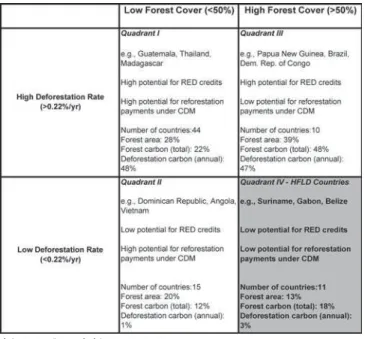
Developing countries can be classifi ed into four categories defi ned by two axes: remaining forest cover and deforestation rate (Figure 1). The HFLD countries in Quadrant IV harbor
18% of tropical forest carbon. Since current proposals would award carbon credits to countries based on their reductions of emissions from a recent historical reference rate [4], HFLD countries could be left with little potential for RED credits. Nor would they have the potential for reforestation credits under the Kyoto Protocol’s Clean Development Mechanism that the countries in Quadrant II have. Without the opportunity to sell carbon credits, HFLD countries would be deprived of a major incentive to maintain low deforestation rates. Since drivers of deforestation are mobile, deforestation reduced elsewhere could shift to HFLD countries, constituting a signifi cant setback to stabilizing global concentrations of greenhouse gases at the lowest possible levels.
An effective RED carbon regime should not allow leaks of deforestation to new regions, but should reduce net global emissions by encouraging comprehensive changes in international behavior. Some analysts have proposed adopting a reference emission rate indexed to the global deforestation rate for countries with little or no historic deforestation [7,8]. This would effectively award HFLD countries with “preventive credits” that these countries would stand to forfeit if they were to increase their deforestation rate. Preventive credits would provide a signifi cant entry barrier to new forest exploitation or policies that promote or allow deforestation.
HFLD countries would receive a signifi cant incentive to maintain low rates of deforestation from any reference emission rate indexed to the global average. At US$10/ton CO2, using one-third of the global average deforestation rate as the reference emission rate for HFLD countries, preventive credits would be worth US$365 million annually to seven countries. Using one-half of the global average deforestation rate as the reference rate would more than double the qualifying forest area, and would increase credit value to US$630 million annually to ten countries (Table 1). Using the global average deforestation rate as the reference rate would increase credit value to US$1.8 billion annually to 11 countries.
Despite the advantages of crediting for HFLD countries, some practical concerns remain. Introducing an additional source of carbon credits could lower the price of carbon, weakening the incentive to reduce deforestation in countries where rates are high. However, preventive credits should be evaluated in light of their net effect in reducing global CO2 emissions. The volume of preventive credits necessary to create an advance incentive against deforestation in HFLD countries would be 10–49 million tons of carbon annually, depending on which reference rate is selected. This is equivalent to just 1.3%–6.5% of developing countries’ emissions from deforestation. The greater the global demand for carbon credits, the less impact this increase in supply would have on carbon price. In return, preventive credits would extend substantial protection to nearly one-fi fth of tropical forest carbon.
Finally, countries like Brazil, Indonesia, and the
Democratic Republic of the Congo are so large that they have regions in multiple quadrants. The Brazilian Amazon has attributes similar to the countries in Quadrant IV, and RED credits are being negotiated for the region [9]. While the doi:10.1371/journal.pbio.0050216.g001
Figure 1. Forests and Carbon in 80 Tropical Countries
The term HFLD is applied to those countries that had forest cover greater than 50% in 2005 and average annual deforestation rates lower than the global average of 0.22% during the reference emission period of 1990–2000 (Quadrant IV). Values for forest cover, forest area, deforestation rate, and above ground biomass in forests are from [10]. “Forest area” denotes a quadrant’s share of the 80 countries’ forest area. “Forest carbon” denotes a quadrant’s share of the 80 countries’ forest carbon stock (above ground biomass). “Deforestation carbon” denotes a quadrant’s share of the 80 countries’ annual carbon emissions from deforestation.
PLoS Biology | www.plosbiology.org 1646 quadrant approach helps identify technical gaps and policy options, in practice international responses must be tailored to individual country realities.
Preventive credits are an important part of a realistic approach to quickly minimize carbon releases from loss of some of the world’s most biologically important forests. Globally indexed reference emission rates for HFLD countries should be part of any international framework for reducing global carbon emissions from deforestation.
References
1. Stephens BB, Gurney KR, Tans PP, Sweeney C, Peters W, et al. (2007) Weak northern and strong tropical land carbon uptake from vertical profi les of atmospheric CO2. Science 316: 1732–1735.
2. Bala G, Caldeira K, Wickett M, Phillips TJ, Lobell DB, et al. (2007) Combined climate and carbon-cycle effects of large-scale deforestation. Proc Natl Acad Sci U S A 104: 6550–6555.
3. Intergovernmental Panel on Climate Change (2007) Climate change 2007: Impacts, adaptation and vulnerability. Working Group II contribution to the Intergovernmental Panel on Climate Change fourth assessment report. Geneva: World Meteorological Organization. Available: http://www.ipcc. ch/SPM13apr07.pdf. Accessed 1 July 2007.
4. United Nations Framework Convention on Climate Change (2005) Reducing emission from deforestation in developing countries: Approaches to stimulate action. Submissions from parties. Bonn: United Nations Framework Convention on Climate Change. Available: http://unfccc.int/ resource/docs/2005/cop11/eng/misc01.pdf. Accessed 1 July 2007. 5. United Nations Framework Convention on Climate Change (2006) Issues
relating to reducing emissions from deforestation in developing countries and recommendations on any further process. Submissions from parties. Bonn: United Nations Framework Convention on Climate Change. Available: http://unfccc.int/resource/docs/2006/sbsta/eng/misc05.pdf. Accessed 1 July 2007.
6. United Nations Framework Convention on Climate Change (2006) Report on a workshop on reducing emissions from deforestation in developing countries. Note by the secretariat. Bonn: United Nations Framework Convention on Climate Change. Available: http://unfccc.int/resource/ docs/2006/sbsta/eng/10.pdf. Accessed 1 July 2007.
7. Santilli M, Moutinho P, Schwartzman S, Nepstad D, Curran L, et al. (2005) Tropical deforestation and the Kyoto Protocol. Clim Change 71: 267–276. 8. Mollicone D, Achard F, Federici S, Eva HD, Grassi G, et al. (2007) Avoiding
deforestation: An incentive accounting mechanism for avoided conversion of intact and non-intact forests. Clim Change. In press.
9. United Nations Framework Convention on Climate Change (2006) Submission from Brazil. Dialogue working paper 21. Bonn: United Nations Framework Convention on Climate Change. Available: http://unfccc.int/ fi les/meetings/dialogue/application/pdf/wp_21_braz.pdf. Accessed 1 July 2007.
10. Food and Agriculture Organization of the United Nations (2005) Global forest resources assessment 2005: Progress towards sustainable forest management. Rome: Food and Agriculture Organization of the United Nations. Available: http://www.fao.org/docrep/008/a0400e/a0400e00. htm. Accessed 26 June 2007.
Citation: Fonseca GABd, Rodriguez CM, Midgley G, Busch J, Hannah L, et al. (2007) No forest left behind. PLoS Biol 5(8): e216. doi:10.1371/journal.pbio.0050216 Copyright: © 2007 Fonseca et al. This is an open-access article distributed under the terms of the Creative Commons Attribution License, which permits unrestricted use, distribution, and reproduction in any medium, provided the original author and source are credited.
Gustavo A. B. da Fonseca, Carlos Manuel Rodriguez, Lee Hannah, and Russell A. Mittermeier are with Conservation International, Arlington, Virginia, United States of America. Gustavo A. B. da Fonseca is also with the Universidade Federal de Minas Gerais, Belo Horizonte, Brazil. Guy Midgley is with the Kirstenbosch Research Centre, South Africa National Biodiversity Institute, Cape Town, South Africa. Jonah Busch is with the Donald Bren School of Environmental Science and Management, University of California Santa Barbara, Santa Barbara, California, United States of America.
* To whom correspondence should be addressed. E-mail: [email protected]
August 2007 | Volume 5 | Issue 8 | e216 Table 1. Estimated Annual Value of Preventive Credits
Country Forest Cover, 2005 Forest Area, 2005 (1,000 Ha)
Average Deforestation Rate, 1990–2000 (Percent/Year)
Estimated Value of Credits (US$1 Million/Year)
Panama 57% 4,294 0.2 —
Colombia 58% 60,728 0.1 22
Democratic Republic of the Congo 66% 22,471 0.1 15
Peru 54% 68,742 0.1 17
Belize 73% 1,653 0.0 2
French Guiana 91% 8,063 0.0 88
Gabon 85% 21,775 0.0 120
Guyana 77% 15,104 0.0 57
Suriname 95% 14,776 0.0 161
Bhutan 68% 3,195 −0.3 13
Zambia 57% 42,452 −0.9 134
The value of preventive credits to HFLD countries is estimated using the following formula: V = (RER − max{0, DR}) × FA × CD × 3.67 × PC, where V is the annual value of a country’s preventive credits (US dollars/year), RER is the reference emission rate chosen for HFLD countries (percent/year), DR is the country’s actual deforestation rate (percent/year), FA is the country’s forest area (hectares), CD is the average carbon density of the country’s above ground biomass in forests ( tons carbon/hectare), 3.67 is the atomic ratio between CO2 and carbon (tons CO2/ton carbon), and PC is the price paid for carbon credits (US dollars/ton CO2). Values for forest cover, forest area, deforestation rate, and above ground biomass in forests are from [10]. Where national carbon density was unavailable, the national carbon density of the subjectively determined nearest neighbor is assumed in its place, e.g., Nepal for Bhutan, Suriname for French Guiana, and Nicaragua for Honduras. The calculations assume a reference emission rate of one-half of the global average deforestation rate (−0.11%/y) for HFLD countries and a carbon price of US$10/ton CO2.