Comparability of Accounting Choices in Future Valuation of Investment
Properties: An Analysis of Brazilian and Portuguese Listed Companies*
Flaida Êmine Alves de Souza
Universidade Federal de Uberlândia, Faculdade de Ciências Contábeis, Uberlândia, MG, Brazil
Reiner Alves Botinha
Universidade Federal de Uberlândia, Programa de Pós-Graduação em Ciências Contábeis, Uberlândia, MG, Brazil
Pablo Rogers Silva
Universidade Federal de Uberlândia, Faculdade de Gestão e Negócios, Uberlândia, MG, Brazil
Sirlei Lemes
Universidade Federal de Uberlândia, Faculdade de Ciências Contábeis, Uberlândia, MG, Brazil
Received on 05.13.2014 – Desk acceptance on 06.13.2014 – 2th version approved on 01.19.2015.
ABSTRACT
One of the main purposes for adopting the International Financial Reporting Standards (IFRS) is the quest for comparability between financial statements within the same country, over time, and between different countries. IFRS have the feature of allowing accounting choices in most of their standards. However, the existence of such flexibility in the process for recognizing, measuring, and disclosing as-sets and liabilities may impact on comparability. IFRS have been criticized both due to their accounting choices and the adoption of the fair value paradigm. This article examines these two issues, investigating the choice of the cost model versus the choice of the fair value model for investment properties (IPs), an option guaranteed under the terms of the International Accounting Standard (IAS) 40. This research aimed to identify the comparability degree and the factors that determine the accounting choices made by managers of IPs, in Brazilian and Portuguese listed companies, within the periods from 2010 to 2012. Comparability, within and between countries, was identified by the T-index and the search for the determining factors of accounting choices made by managers was performed by means of a logistic re-gression analysis. As a result, it was found that, despite the accounting choices allowed by IAS 40, there was a mean comparability between the accounting practices of firms in these countries, but showing a decrease in the index over the years. The explanatory factors identified were auditing by one of the big four (PricewaterhouseCoopers, Deloitte Touche Tohmatsu, KPMG, or Ernst & Young), companies’ indeb-tedness, relative importance of IPs’ balance, net profit, and less experience of Brazil in using the fair value method to appraise IPs.
Keywords: comparability, accounting choices, IAS 40, investment properties. T-index.
1 INTRODUCTION
Anglo-Saxon countries, by adopting IFRS, did not suc-ceeded, and in most companies accounting remained based on practices influenced by Roman Law – the Code Law regime. In countries ruled by this legal system, like Portugal and countries that were colonies in South Ame-rica, such as in the case of Brazil, laws tend to be the normative basis for the accounting practice.
hus, the Brazilian legal model brings along with it a legacy of the Portuguese colonization process, especially during the validity of the local generally accepted accoun-ting principles (GAAP), marked by a Roman system that appreciates that the law should be applied in compliance with regulatory instruments, with a reduced (or minimum) amount of subjectivism in accounting practices. Ater IFRS adoption, accounting based on principles and marked by subjectivism has gained a space of its own. hese Inter-national Standards, due to their Anglo-Saxon origin, are regarded as legitimate representatives of the accounting model based on the Common Law system (Nobes, 1998; Carmo, Ribeiro, & Carvalho, 2011), diferent, therefore, from the system of the countries studied in this research.
Considering the similarities between Brazil and Por-tugal, the impact of these factors on IFRS adoption, as well as the recent adoption, by both countries, of a con-cept inherent to a Common Law system – fair value –, the following hypothesis has provided the study with a basis:
Ho: The accounting choices made by managers of IPs, in Brazilian and Portuguese listed companies, regarding valu-ation after recognition, are highly comparable, according to the environmental similarities of the two countries.
This study contributes to the literature by identifying possible differences in financial statements, within and between countries, over time, in relation to the accoun-ting choices contained in IAS 40. Variation between the valuation of IPs through the cost method or the fair va-lue method can affect the comparability of reports and it suggests implications that flexibility, in decisions about financial statements, can lead to highly divergent choi-ces by the firms (Muller et al., 2008).
In addition to the contributions introduced, the stu-dy bridges a current gap of investigations on accounting choices, pointed out by Fields, Lys and Vincent (2001), as it is focused on a relatively new theme – fair value – in the Brazilian accounting scenario, it shows the distinc-tion of analyzing the choices made by two countries his-torically linked, over three years, and it also seeks pos-sible explanations for the choices made by companies regarding the valuation after recognition of IPs.
This research is structured into four parts, besides this introduction. In section two the theoretical fra-mework is introduced; in section three, the methodolo-gical procedures adopted in the research; in section four, the results are described and analyzed; finally, we draw the final remarks on the results obtained.
he International Financial Reporting Standards (IFRS), issued by the International Accounting Standards Board (IASB), emerged to solve the need for reliable, good--quality, transparent information (Oliveira & Lemes, 2011), as well as “information divergence problems generated by accounting reports” (Lemes & Carvalho, 2009, p. 26).
The accounting convergence process has, as one of its main features, the quest for comparability between financial reports within a country, over time, and be-tween different countries (Cairns, Massoudi, Taplin, & Tarca, 2011). In order to enable such comparability, i.e. so that the same events look alike and different events look like different (International Accounting Standards Board, 2013, item QC 23), IFRS have some choices about the several stages of accounting for an equity element, named herein as accounting choices.
One of the possible accounting choices, when ap-plying IFRS, is measuring after initial recognition (sub-sequent valuation) of investment properties (IPs), which can be appraised according to the fair value or the acqui-sition cost, as provided for by the International Accoun-ting Standard (IAS) 40. Through this choice, a question arises concerning the existence (or not) of comparability between the financial reports of firms that recognize the IPs, since they can be appraised in two different ways.
IFRS have been criticized both due to the lexibility (accounting choices) they provide and to the adoption of the fair value paradigm (Muller, Riedl, & Sellhorn, 2008). hus, this article examines these two issues, investigating the choice of the cost model versus the choice of the fair value model for IPs, an option guaranteed under the terms of IAS 40. As a result, the purpose is answering to this ques-tion: “What is the comparability degree and which are the factors that determine the accounting choices made by ma-nagers of IPs, in Brazilian and Portuguese listed companies, regarding measurement ater initial recognition?”
To meet the purpose of this research, we analyzed the financial statements of 50 Brazilian firms listed on the Stocks, Commodities, and Futures Exchange of São Paulo (BM&FBOVESPA) and 23 Portuguese firms listed on the Lisbon Stock Exchange (NYSE Euronext Lisbon), within the periods from 2010 to 2012.
These periods were selected because, to examine the comparability of accounting choices between the two countries, it was regarded as needed to consider the last corporate fiscal years, since the year in which the use of IFRS became mandatory in both. In Portugal, the com-pulsory adoption of the International Accounting Stan-dards took place for the fiscal years ended since 2005 (Regulation 1,606/2002, from the European Parliament), and in Brazil, from the fiscal years ended since 2010 (Instruction CVM 457/2007).
2.1 Comparability
According to Van der Tas (1988, p. 158), “two reports are comparable in relation to a specific case, if in the same circumstances of this event, both reports or mul-tiple reports, are accounted for in the same way.” Accor-ding to the author, an effective way to enable comparabi-lity might be by establishing standards, which would set limits to the differences between them.
From a normative viewpoint, IFRS stress the need for comparability between reports, periods, and countries, to make accounting information more useful to users’ deci-sion-making. In fact, IFRS have brought, among the qua-litative improvement features listed for the preparation of inancial statements, comparability, which, added with other features (veriiability, timeliness, and understanda-bility), provides a good-quality accounting information (International Accounting Standards Board, 2013).
hus, one of the primary purposes of IFRS adoption consists in improving comparability of inancial statements (Cairns et al., 2011), which is nothing more than making the same economic phenomena look like the same and diferent economic phenomena look like diferent, rather than making diferent phenomena look like the same, and vice versa (International Accounting Standards Board, 2013). hus, there lies the justiication for the existence and persistence of accounting choices in IFRS: ofer alternatives so that managers register accounting facts in order to issue comparable inancial reports.
Comparability may be approached from different perspectives. One of them is the distinction between de jure (or formal) and de facto (or informal) comparability. Another distinction has been made between comparabi-lity over time and between different companies within the same country or from more than one country. A third perspective addresses the comparability between accounting numbers, voluntary disclosure, press relea-ses, and so on (Cole, Branson, & Breesch, 2009).
his research was focused on measuring the compara-bility of accounting numbers by analyzing inancial state-ments. To do this, the so-called comparability indices were used, which are mathematical mechanisms created in order to measure the comparability degree between accounting reports of irms over time and between countries. Van der Tas (1988), the forerunner to the creation of these indices, proposed the indices H, C, and I, all of them with the pur-pose of measuring the comparability degree between ac-counting reports, however, each with speciic peculiarities. Taplin (2004), in his turn, developed the T-index, which covers, in a single index, all speciicities of the previous ones, in addition to correcting their limitations.
he H-index is used when one intends to investigate the comparability of inancial statements of companies belon-ging to a single country, when irms have the possibility to use only one accounting method. he C-index shows up as an evolution of the H-index, because, besides enabling the calculation of national comparability, it considers multiple
accounting choices. he I-index was created with the pur-pose of measuring international comparability (more than one country), but it does not take into account the number of companies or the size of the countries under investigation.
he T-index, the most complete of them all, has the following properties: (i) comparison between countries with a diferent number of companies; (ii) analysis within the country, between countries, and general (international focus); (iii) analysis of multiple accounting policies; and (iv) speciic treatment when there is no disclosure of the ac-counting choice made by the entity (Taplin, 2004). herefo-re, this indicator is the most appropriate for this research.
2.2 Accounting Choices
On the way towards IFRS adoption, accounting starts a transition process, from an accounting based on rules to an accounting based on principles and rules, in order to better represent the economic and financial situation of companies, something which has led accounting sub-jectivism coming from professional judgment to be em-phasized (Bennett, Bradbury, & Prangnell, 2006; Barth, 2008; Gabriel & Corrar, 2010).
This accounting subjectivism observed in IFRS is provided by the discretion allowed in their scope, by means of accounting choices. Watts (1992) defines ac-counting choices as a manager’s choice of a method over another. Fields et al. (2001, p. 256), in their turn, define accounting choices as:
[...] any decision, whose main purpose is influencing (ei-ther in form or substance) the output of the accounting system in a particular way, including not only the finan-cial statements issued in accordance with GAAP, but also tax returns and regulatory filings.
It is worth stressing, however, that such professional subjectivism provided by accounting choices did not emer-ge to the detriment of enhancing lexibility in the accoun-ting practices under inancial statements, but according to Fields et al. (2001), with a view to meet the needs of an incomplete and imperfect market, which requires a system of accounting standards that protect the many users of ac-counting information, faced with the agents’ interests.
Nevertheless, accounting theory does not have a rule that guides managers to choose this or that accounting method. It only provides explanations on the reasons le-ading certain companies to use a method, rather than another, as well as the implications of specific choices, something which becomes significant for accounting professionals, as it provides tools for better decision--making in face of the various situations caused by a sce-nario of continued change (Watts & Zimmerman, 1986). Due to sharp criticism, in the past, to its process of is-suing documents with two approaches allowed for several of its standards (a benchmark and an alternative treatment), the IASB has undertaken eforts with the irm intent to
ce them. It was, in a way, successful. Nevertheless, choices at diferent levels still remain. Could complete elimination of such choices generate more comparable accounting reports? he answer is yes. Would this generate accounting reports that do not adequately represent the economic events they are intended to represent? Probably not.
Thus, the existence of accounting choices in IFRS is an implicit and needed feature for the generation of ac-counting reports useful for decision making. Weighting and equalizing their use, without compromising the comparability intended for these reports, still remains a controversial subject in need of further discussion.
2.3 Investment Properties
Investment property, regulated by IAS 40 (item 5), issued by the IASB, is defined as “property (land or a building or part of a building or both) held (by the ow-ner or by the lessee under a finance lease) to earn rentals or for capital appreciation or both […]”
IAS 40 provided signiicant changes in international accounting, such as listed by Muller et al. (2008). First,
the revaluation model was deleted, an option allowed to account for IPs, in which, according to the author, it was considerably supported as appropriate accounting appro-ach to measure IPs. Second, it was the irst time that the IASB applied the fair value model to non-inancial long--term assets. Finally, the standard provided the irms with the option to choose between cost and fair value, as ac-counting policy for valuation ater recognition of IPs.
he IPs, however, should be measured, initially, by their cost, including the transaction costs (IAS 40, item 20). Af-ter recognition, in the subsequent assessment, IAS 40 (item 30) provides that an entity should choose, as its accounting policy, between the cost method or the fair value method, and this policy should be applied to all of its recognized IPs.
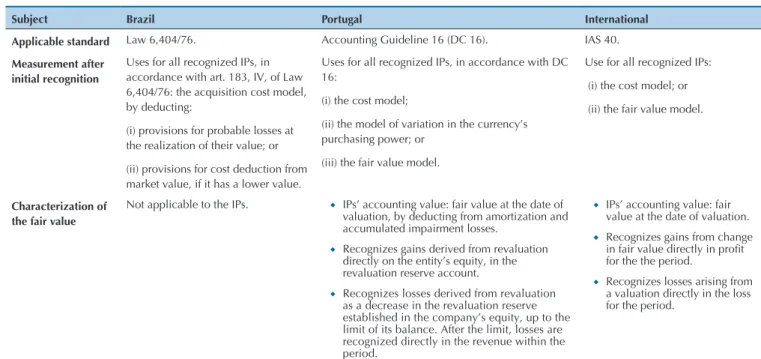
Prior to IFRS adoption, “investment property as-sets were accounted for under the domestic accounting standards applied within the firm’s country of domicile” (Muller et al., 2008, p. 7). As for Brazil and Portugal, the main differences between the International Standard and the local accounting regulations regarding IPs, prior to the adoption of IAS 40, are displayed in Table 1.
It is worth emphasizing that the fair value model es-tablished by IAS 40 for IPs’ revaluation was not allowed by local standards before IFRS, in most European coun-tries (Muller et al., 2008) or in other countries, such as Brazil. According to the fair value model, IPs are booked in the balance sheet at their fair value and any changes in their value are recognized directly in income state-ment (Muller et al., 2008). According to the authors, this recognition directly in revenue has, perhaps, brought
substantial volatility to the reported net profit, that is the reason why it was not allowed in many countries.
2.4 Method Fair Value versus Cost Method
Fair value is defined as “the price that would be re-ceived to sell an asset or paid to transfer a liability in an orderly transaction between market participants at the measurement date” (IFRS 13, item 9). The choice betwe-en the fair value and the historical cost models is one of
Subject Brazil Portugal International Applicable standard Law 6,404/76. Accounting Guideline 16 (DC 16). IAS 40.
Measurement after initial recognition
Uses for all recognized IPs, in accordance with art. 183, IV, of Law 6,404/76: the acquisition cost model, by deducting:
(i) provisions for probable losses at the realization of their value; or
(ii) provisions for cost deduction from market value, if it has a lower value.
Uses for all recognized IPs, in accordance with DC 16:
(i) the cost model;
(ii) the model of variation in the currency’s purchasing power; or
(iii) the fair value model.
Use for all recognized IPs:
(i) the cost model; or
(ii) the fair value model.
Characterization of the fair value
Not applicable to the IPs. ◆ IPs’ accounting value: fair value at the date of valuation, by deducting from amortization and accumulated impairment losses.
◆ Recognizes gains derived from revaluation directly on the entity’s equity, in the revaluation reserve account.
◆ Recognizes losses derived from revaluation as a decrease in the revaluation reserve established in the company’s equity, up to the limit of its balance. After the limit, losses are recognized directly in the revenue within the period.
◆ IPs’ accounting value: fair value at the date of valuation. ◆ Recognizes gains from change
in fair value directly in proit for the the period.
◆ Recognizes losses arising from a valuation directly in the loss for the period.
Source: Prepared by the authors.
the most widely debated issues in the accounting litera-ture (Christensen & Nikolaev, 2013).
The application of IFRS in Europe, for instance, has brought many changes in the traditional continental ac-counting practices (Demaria & Dufour, 2007). Europe-an countries have a conservative accounting Europe-and IFRS adoption, especially in the recognition at fair value of certain assets and liabilities, represents a radical pers-pective change for preparers and users (Bertoni & Dero-sa, 2005; Demaria & Dufour, 2007).
As for the benefits of using a method rather than another, according to Christensen and Nikolaev (2013), valuation at fair value seems to be better than historical cost in most qualitative features described in the Con-ceptual Framework for Financial Reporting (Internatio-nal Accounting Standards Board, 2013). “The only ex-ception is, arguably, the reliability criterion on which historical cost is likely to score higher” (Christensen & Nikolaev, 2013, p. 736). Although estimates at fair value tend to be more relevant, it is less likely they are reliable (Dietrich, Harris, & Muller, 2001).
Comparability, for instance, provides better quality in accounting information, in order to allow users to identify similarities and differences between two sets of economic phenomena (Herrmann, Saudagaran, & Tho-mas, 2006). According to Herrmann et al. (2006), the fair value method, when reliably measured, improves comparability of financial reports, while the cost me-thod may hamper comparability, both by failing to iden-tify similarities between similar items and by not distin-guishing differences between different items.
According to Shaffer (2010), those advocating for the use of fair value, also the members of the Financial Accounting Standards Board (FASB), the IASB, and the Securities and Exchange Commission (SEC), argue that this method provides stakeholders with more transpa-rent, timely, and accurate information. They claim that the fair value model improves market discipline, ena-bling more effective markets, and that “the alternative measurement models (lower of cost or market and his-torical cost) hide or delay the disclosure of important information and produce inefficient market decisions” (Shaffer, 2010, p. 4).
Despite the beneits assigned to fair value, its use is relatively limited, since it is used only when reliable esti-mates are available at a reduced cost and when they con-vey information on the entity’s operating performance (Christensen & Nikolaev, 2013). Critics of the fair value claim that its use “can increase income volatility, under-mine public conidence and adversely afect economic stability” (Shafer, 2010, p. 4). According to Shafer (2010), critics state, too, that fair values cannot have any relation to expected cash lows or the economy; they may contain determinants arising from the market’s feeling and not from economic fundamentals or conditions.
Furthermore, usually, the IPs are appraised annually by external assessors and these values are reflected in the firms’ accounting reports (Nellessen & Zuelch, 2011).
According to Nellessen and Zuelch (2011), this process of IP valuation at fair value gives rise, in the professional and academic community, to a considerable skepticism about the reliability of the valuation of these properties. According to these authors, the literature points out that valuations are prone to uncertainties and insecurities due to a number of assessor’s features.
According to Freri and Salotti (2013), factors such as market fluctuation, especially at times of crisis, the need for specific expertise (such as that in civil engineering) and the subjectivism in assessor’s judgment are some of the factors that can lead to inadequate measurement of IPs’ fair value. The very human nature of external asses-sors, the way how the valuation process is conducted, and the essence and operation of the real estate market corroborate to increase the probability of obtaining bia-sed fair values (Nellessen & Zuelch, 2011).
2.5 Previous Studies
Dietrich et al. (2001) investigated 76 firms in the UK, within the periods from 1988 to 1996, aiming to identi-fy the reliability of annual estimates of fair value in IPs. They found out that fair value estimates have values, on average, 6% lower than the actual selling prices of real estate, indicating a conservative trend in assessors’ judgments. Notwithstanding, the authors claim that fair value estimates are selling price measures considerably less biased and more accurate than their respective his-torical costs. By investigating the managerial criteria, they observed that the existence of accounting choices enables managers to choose methods that provide, for instance, higher profits, something which entails oppor-tunities for earning management. They also found that the reliability of fair value estimate of increases when monitored by external auditing, particularly if auditing is performed by companies known at the time as the “big six”: Arthur Andersen, Coopers & Lybrand, Deloitte & Touche, Ernst & Young, KPMG Peat Marwick, and Price Waterhouse.
Also focusing on measurement reliability, Muller III and Riedl (2002) sought evidence that the reliability di-fferences in estimates of professional assessors, due to using external monitors, affected informational asym-metry of investors and, therefore, the cost of capital. By using a sample with 64 companies in the UK, from 1990 to 1999, the authors point out that market agents realize lower information asymmetry in investors for compa-nies that use external assessors when compared to those using internal assessors for valuation after recognition of IPs.
companies under study, the adoption of fair value is not related to any of the features analyzed, namely: entity’s size, financial leverage, managers pay, and structure of common shares held by banks, insurance companies, or investment funds.
Muller et al. (2008) examined the causes and conse-quences of managers’ choice between IPs’ fair value and cost methods, in 133 firms from 15 European countries in 2005. Out of the firms analyzed, 27 chose the cost me-thod and 106 the fair value meme-thod. The authors found evidence that the firms that choose the fair value are those whose: (i) local standards (before IFRS) allowed or required this valuation method in the balance sheet; (ii) properties were more dispersed; and/or (iii) firms were seeking greater transparency in accounting statements. They also noticed evidence of opportunism by the firms that appraised their IPs at fair value, as they had higher profits, lower information asymmetry, and higher liqui-dity, when compared to firms that appraised these assets by the cost method.
Focusing on information power and using a sample with 446 real estate companies and 915 investment fun-ds within the periofun-ds from 1993 to 2002, Danbolt and Rees found that profit at fair value is considerably more relevant than profit at historical cost, although this re-levance can be transmitted through assets’ value and it does not require fair value to be incorporated into the measurement of profit. In the same line of research on the relevance of information in fair value vis-à-vis histo-rical cost, Lourenço (2009) pointed out that the accoun-ting numbers were more relevant for European compa-nies in the real estate sector included in the sample that measured investments in properties at fair value than those using the cost model.
Nellessen and Zuelch (2011) analyzed the reliability of fair value estimates in IPs’ valuation in 76 Europe-an compEurope-anies within the periods from 2005 to 2007. To do this, they examined the association between equity and market value of these firms. The results showed that there is a difference between these values and that these deviations may derive from: (i) the lack of confidence in the estimation of IPs’ fair value due to limitations in the valuation; (ii) the diversity of approaches applied to the valuation of IPs; and (iii) the reliability problem in the approaches by models usually applied in determining the IPs’ fair value.
Cairns et al. (2011) investigated the use of measure-ment at fair value in 228 listed companies in the UK and in Australia, at the time of initial IFRS adoption, in 2005.
As for the IPs (IAS 40), out of the 23 firms that recogni-zed them, 17 chose the fair value method and 6 the cost method. The authors found that, in relation to IAS 40, comparability within and between countries have signi-ficantly decreased because some UK companies used the option available in this standard.
Christensen and Nikolaev (2013) studied the accoun-ting choice fair value versus historical cost in non-finan-cial assets (intangible, fixed assets, and IP) of firms, in accordance with IFRS, in 2005 or in 2006, with 703 listed companies in the UK and 605 in Germany. Overall, they found a very limited use of valuation by the fair value method, indicating that “despite its conceptual merits, fair value is unlikely to become the primary valuation method for illiquid non-financial assets on a voluntary basis” (Christensen & Nikolaev, 2013, p. 734).
Freri and Salotti (2013) analyzed the comparability of six Brazilian companies, shopping center management companies, which held IPs’ balance, in 2010 and 2011. hey sought to verify which irms appraised these assets by using the cost method and which resorted to the fair value method, besides checking whether these companies complied with the mandatory disclosures contained in IAS 40. he authors found that only 2 irms appraised their IPs by using the fair value method in the 2 years analyzed and that no company fully complied with the mandatory disclosure requirements contained in the standard.
Finally, Andrade, Silva and Malaquias (2013) inves-tigated the accounting choices in IPs of 39 Brazilian companies listed on the BM&FBOVESPA, in 2009 and 2010. They identified that, out of the firms making up the sample, 44% adopted the fair value method and 56% resorted to the cost method. It also became clear that none of the variables selected for the study – assets size, indebtedness, corporate governance level, and return on equity (ROE) – showed a statistically significant relation to the valuation method chosen by the firms.
In general, studies on fair value point out better in-formation capacity when compared to historical cost. Despite these benefits, the researchers identify limited use of fair value and a certain distrust level regarding the measurement method, probably due to the fact that the studies focus on the first year of IFRS adoption. Expla-natory factors for choosing the fair value also indicate revenue management through the greater discretionary power of managers in their choice. However, the studies are not conclusive and further research is needed, espe-cially considering time periods longer and more distant of the first IFRS adoption.
3 METHODOLOGICAL ASPECTS
3.1 Sample Definition and Data Collection
he research sample consisted of 73 listed companies, 50 Brazilian and 23 Portuguese, for the iscal years 2010 to 2012. he identiication of Brazilian irms and their
website of NYSE Euronext Lisbon, and the search for IPs accounts’ balances and notes took place on the website of the Securities Market Commission (CMVM) of Portugal.
In 2013, 378 listed Brazilian companies were identiied, out of which 328 did not have IPs’ balances in 2010, 2011, and/or 2012. hus, 50 irms in Brazil made up the study sample. Re-garding Portugal, in 2013, 54 irms listed on the stock exchan-ge were identiied. Out of these, 31 did not have IPs’ balance in 2010, 2011, and/or 2012, something which led the sample of Portuguese companies to be made up of 23 listed companies.
3.2 Calculation of the Comparability Index
To measure the comparability degree of accounting choices between firms and countries, the calculation of T-index (T-index) was used, whose Equation 1 is repor-ted by Taplin (2004, p. 61):
1
where T index represents the comparability degree; αkl is the comparability coeicient between the accounting methods k and l; βij is the weight for comparing companies from coun-tries i and j; ρki is the proportion of companies from coun-try i using the accounting method k; ρlj is the proportion of companies from country j using the accounting method l; N is the amount of countries analyzed; and M is the amount of accounting methods analyzed (Taplin, 2004).
The index ranges between 0 and 1, where 0 represents a complete disharmony between the financial statements of firms and 1 represents a complete harmony (Taplin, 2004). T-index may be interpreted as the probability that two companies, randomly selected (with replacement), show the same accounting practices (Taplin, 2004).
In order to interpret the national (of each country separately) and international comparability degrees (the two countries together) of accounting choices in IPs, the scale proposed by Souza, Silva and Costa (2013) was used, it is illustrated in Table 2.
1 Software developed and provided by the index’s creator, professor Ross H. Taplin, to whom we are thankful. he calculation of national and international T-indices were carried out by using the sotware T-Index Calcula-tor1. We used the modality 1(a)2(a)3(a)4(a), that is: (i) weighting company/country: countries were weighted, in order to have equal weights, considering that the country receives a weight proportional to the number of compa-nies in the sample of each country; (ii) international focus: comparisons are made between all irms, regardless of the country to which they belong (general focus); (iii) several accounting policies: multiple accounting policies are not allowed; and (iv) non-disclosure: irms that did not disclo-se the accounting method adopted were excluded from the sample and from the index calculation (Taplin, 2010).
3.3 Logit Model
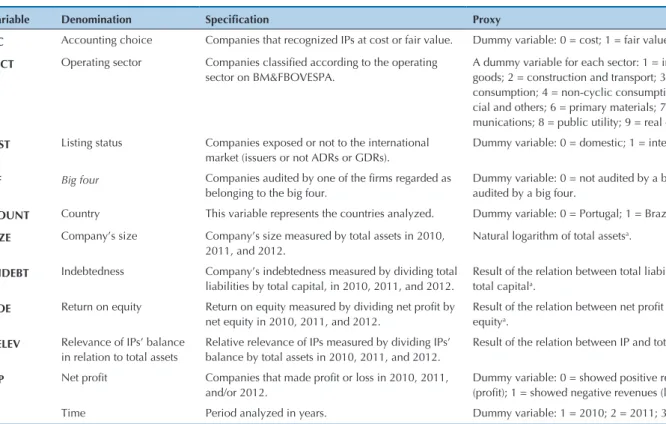
In order to examine empirically whether specific fe-atures of the firms affect their accounting choices, some explanatory variables were surveyed, which have been partly analyzed in the studies by Demaria and Dufour (2007), Jaafar and Mcleay (2007), Muller et al. (2008), Lourenço (2009), Lorencini and Costa (2012), and An-drade et al. (2013). Firms that did not disclose their IPs’ valuation policy were excluded from the sample, but only in the year for which there was no disclosure. Thus, the variables that made up the model are displayed in Table 3.
T-index Comparability
Between 0.700 and 1.000 High
Between 0.500 and 0.699 Mean
Between 0.000 and 0.499 Low
Source: Adapted from Souza et al. (2013).
It is noticed that the dependent variable (AC) takes only two values, something which makes it necessary to use binary qualitative choice models, such as linear pro-bability models (LPMs), Probit and Logit. We chose the logit model because, as claimed by Johnston and DiNardo (2001): (i) seemingly in practice, there is little diferen-ce between these three models, thus the choidiferen-ce might be indiferent; (ii) LPM has as a deiciency the fact that pre-dicted values are not restricted to the interval (0,1), and its use should be avoided in some situations; and (iii) spe-ciication tests in the Logit models are more user-friendly and easy to apply. Furthermore, a simulation was perfor-med by using the Probit method, and it was found that the statistical results were almost the same.
The general structure of the Logit models is based on probability analysis. Through a representation pro-posed by Johnston and DiNardo (2001), it is possible to illustrate the idea of the model adopted, according to Equation 2:
2
where Y is the choice of Brazilian and Portuguese ir-ms as for the method for valuation ater recognition of IPs, which is equal to 1 if fair value is chosen and 0 if cost is chosen. X represents the matrix of explanatory variables
listed in Table 3: SECT, LIST, BF, COUNT, SIZE, INDEBT, ROE, RELEV, NP, and T. β is the set of parameters that relect the impact of changes in X on the probability of a particular entity to choose the fair value method. F is the logistic distribution function that turns an appropriate model Xβ into an interval between 0 and 1. In this case, it is possible to rewrite the model according to Equation 3:
3
Considering an iid sample, the estimation of para-meters (β) of this model is obtained by maximizing the likelihood logarithm function (Equation 4):
4
−
Model adjustments were checked by means of three tests: (i) to determine whether there are significant di-fferences between observed and expected frequencies, we used the Hosmer-Lemeshow test; (ii) to verify the measures of sensitivity, specificity, and the model hit percentage, we used the classification table; and (iii) to measure the model’s capacity to distinguish between ca-tegories of the dependent variable, we resorted to the Receiver Operating Characteristic (ROC) curve.
4 DATA ANALYSIS
4.1 Results for the Calculation of Comparability
To calculate the comparability degree between companies from Brazil, Portugal, and between the two countries, irst, the
notes of each company in each country were analyzed, by iden-tifying the accounting choices as for the measurement ater initial recognition of IPs, whose result is illustrated in Table 4.
Variable Denomination Speciication Proxy
AC Accounting choice Companies that recognized IPs at cost or fair value. Dummy variable: 0 = cost; 1 = fair value.
SECT Operating sector Companies classiied according to the operating sector on BM&FBOVESPA.
A dummy variable for each sector: 1 = industrial goods; 2 = construction and transport; 3 = cyclic consumption; 4 = non-cyclic consumption; 5 = inan -cial and others; 6 = primary materials; 7 = telecom-munications; 8 = public utility; 9 = real estate.
LIST Listing status Companies exposed or not to the international market (issuers or not ADRs or GDRs).
Dummy variable: 0 = domestic; 1 = international.
BF Big four Companies audited by one of the irms regarded as
belonging to the big four.
Dummy variable: 0 = not audited by a big four; 1 = audited by a big four.
COUNT Country This variable represents the countries analyzed. Dummy variable: 0 = Portugal; 1 = Brazil.
SIZE Company’s size Company’s size measured by total assets in 2010, 2011, and 2012.
Natural logarithm of total assetsa.
INDEBT Indebtedness Company’s indebtedness measured by dividing total liabilities by total capital, in 2010, 2011, and 2012.
Result of the relation between total liabilities and total capitala.
ROE Return on equity Return on equity measured by dividing net proit by net equity in 2010, 2011, and 2012.
Result of the relation between net proit and net equitya.
RELEV Relevance of IPs’ balance in relation to total assets
Relative relevance of IPs measured by dividing IPs’ balance by total assets in 2010, 2011, and 2012.
Result of the relation between IP and total assetsa.
NP Net proit Companies that made proit or loss in 2010, 2011, and/or 2012.
Dummy variable: 0 = showed positive revenues (proit); 1 = showed negative revenues (loss)a.
T Time Period analyzed in years. Dummy variable: 1 = 2010; 2 = 2011; 3 = 2012.
a The base date for such values is related to 31/12 each year. All values were converted into reais. Source: Prepared by the authors.
As for Brazil, it was noticed that the irms still have not shown the mandatory information on IPs in their notes, despite this non-disclosure has decreased over the corpo-rate iscal years checked. he results of this survey corro-borate the indings of the study by Freri and Salotti (2013), who concluded that, among all Brazilian companies they analyzed in 2010 and 2011, none fully met the mandatory disclosure requirements contained in IAS 40. Regarding Portugal, only one entity did not disclose its policy of valu-ation ater recognition of IPs, and only in 2010 and 2011. In 2012, all Portuguese irms provided evidence as to whether they have chosen the cost or fair value method to appraise their recognized IPs.
Concerning the disclosed accounting choices, although an increase in the number of irms that chose the fair value method has been noticed, over the periods under analysis, the Brazilian companies still maintain a preference for the cost method. his result conirms the evidence found in the studies by Freri and Salotti (2013) and Andrade et al. (2013),
which, by examining Brazilian companies, identiied, res-pectively, that 66.67% and 56% of the irms analyzed chose the cost method for valuation ater recognition of IPs.
In the irms belonging to Portugal, a certain balance between the two possible methods for valuation ater re-cognition of IPs was observed. he Portuguese irms have chosen both the fair value and the cost method, in an equi-valent manner, and this choice has remained over time. hese indings are contrary to the results of the research by Christensen and Nikolaev (2013), which, by observing the accounting choices in non-inancial assets of European ir-ms in 2005 and 2006, found that, on a voluntary basis, it is unlikely that the fair value becomes the primary valuation method for illiquid non-inancial assets, such as the IPs.
hrough the analysis of the comparability degree wi-thin and between countries, we calculated the national T-index for Brazil and Portugal, alone, and then we cal-culated the international T-score for the two countries, as shown in Table 5.
For the Brazilian case, we notice a mean comparabi-lity (almost low) of accounting statements with decrea-sing values over the periods analyzed. This shows that, in relation to IPs, the comparability of accounting infor-mation from Brazilian firms has decreased every corpo-rate fiscal year. For instance, for 2010, if two firms from Brazil are randomly selected, there is a 52.25% chance they have chosen for the same accounting method as for the valuation after recognition in IPs; in 2011, a 51.02% chance; and in 2012, a 50.55% chance.
Just as in Brazil, Portugal also had a mean compara-bility regarding the IPs, with values very close to a low comparability, but having values virtually unchanged over time. The mean comparability (almost low) of the financial statements was due to the fact that Portuguese firms choose both the cost and fair value methods in an equitable manner. For instance, in 2010 and/or 2011, if two firms from Portugal are randomly selected, there is a 50.00% chance they have chosen the same accounting method for valuation after recognition of IPs.
As for the comparability between the accounting sta-tements of companies from Brazil and Portugal (inter-national comparability), we found that it is mean, also showing values close to a low comparability. This was due to the fact that, internally, these two countries are divided between the two valid accounting policies, so-mething which, as a consequence, leads this diversity to persist when the comparison is made between their fir-ms, together.
4.2 Results for the Logit Model Analysis
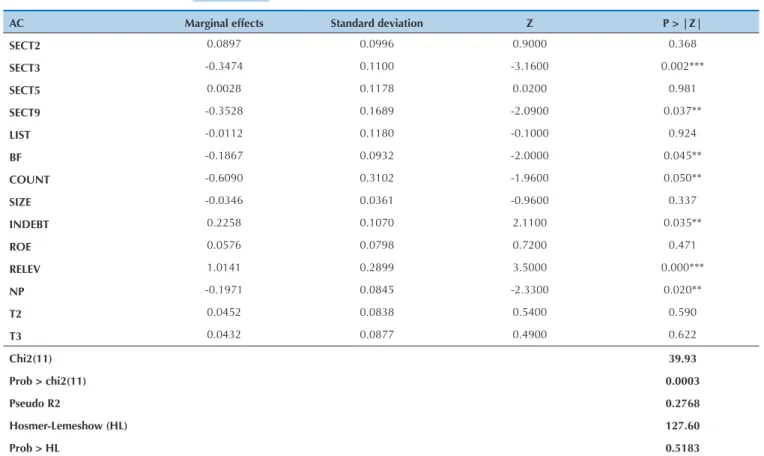
Showing only the regression coefficients is not use-ful, unless we are interested only in their sign and sig-nificance (Hosmer & Lemeshow, 2000). In this way, it is interesting, by means of the final model coefficients, to compute their marginal effects, which, in this case, allow assessing the impact on the probability that firms choose the fair value method (Y = 1), due to changes in the independent variables. Table 6 displays a summary of the results.
BRAZIL PORTUGAL
2010 2011 2012 2010 2011 2012
N N N N N N
Measurement after initial recognition 50 50 50 23 23 23
a) Cost method 20 20 21 11 11 11
b) Fair value method 13 15 17 11 11 12
c) Not disclosed 17 15 12 1 1 0
Table 4 Accounting choices in IPs
T-INDEX 2010 2011 2012
Brazil’s comparability 0.5225 0.5102 0.5055
Portugal’s comparability 0.5000 0.5000 0.5009
International comparability 0.5081 0.5038 0.5012
As for checking whether the entity’s operating sector interferes with the choice of valuation ater recognition method in IPs, it follows that the parameters for the sec-tors non-cyclic consumption, primary materials, telecom-munications, and public utility were not estimated, due to the fact that the accounting choices for each sector were the same for both countries. hat is, all irms in the sec-tors non-cyclic consumption and public utility chose the fair value method and all irms in the sectors primary ma-terials and telecommunications chose the cost method.
Also in relation to the operating sectors of irms included in the sample, it was noticed that only two sectors inluence on managers’ decisions: cyclic consumption and real estate. By analyzing their marginal efect, the fact that the entity be-longs to these sectors reduces by 34.74% (for the sector cyclic consumption) and 35.28% (for the sector real estate) the pro-bability of choosing the fair value method.
By examining whether the variables listing status, big four, country, entity’s size, indebtedness, ROE, relevance, net proit, and time interfere with managers’ decisions, it was found that only the variables listing status, company’s size, ROE, and time are not statistically signiicant. hese indings conirm the conclusions by Demaria and Dufour (2007) and Andrade et al. (2013), i.e. the adoption of fair value is not re-lated to the entity’s size and ROE, and by Jaafar and McLeay
(2007), i.e. time does not interfere with using the fair value method. However, these indings do not corroborate the re-sults found by Jaafar and McLeay (2007), who identiied that the listing status is a determining factor for using fair value.
Regarding the variable BF, it was found that the fact the entity is audited by a big four reduces by 18.67% the probabi-lity of choosing the fair value method. For the variable coun-try, the fact the entity belongs to Brazil reduces by 60.9% the probability that the company chooses the fair value method. It is worth emphasizing that, in addition to the internal fac-tors of each country, the fact that Brazil, before IFRS adop-tion, does not allow appraising IPs at fair value, may have been among the explanatory factors for such a result. his probable explanation is based on the study by Muller et al.
(2008), who found evidence that the irms choosing to use the fair value tend to be those whose local standards allowed or required this valuation method.
As for the variable indebtedness, it was found that the fact that the company is in debt increases by 22.58% the probability to choose the fair value method for valuation ater recognition of IPs. hese results corroborate the indings of Christensen and Nikolaev (2013), who found that company’s indebtedness is positively associated with choosing the fair value method.
Regarding the variable relevance, it was found that the greater the importance of IPs in relation to total assets, the
AC Marginal effects Standard deviation Z P > |Z|
SECT2 0.0897 0.0996 0.9000 0.368
SECT3 -0.3474 0.1100 -3.1600 0.002***
SECT5 0.0028 0.1178 0.0200 0.981
SECT9 -0.3528 0.1689 -2.0900 0.037**
LIST -0.0112 0.1180 -0.1000 0.924
BF -0.1867 0.0932 -2.0000 0.045**
COUNT -0.6090 0.3102 -1.9600 0.050**
SIZE -0.0346 0.0361 -0.9600 0.337
INDEBT 0.2258 0.1070 2.1100 0.035**
ROE 0.0576 0.0798 0.7200 0.471
RELEV 1.0141 0.2899 3.5000 0.000***
NP -0.1971 0.0845 -2.3300 0.020**
T2 0.0452 0.0838 0.5400 0.590
T3 0.0432 0.0877 0.4900 0.622
Chi2(11) 39.93
Prob > chi2(11) 0.0003
Pseudo R2 0.2768
Hosmer-Lemeshow (HL) 127.60
Prob > HL 0.5183
Table 6 Summary of the Logit model with marginal effects
greater the likelihood that the company choose the fair va-lue method. here was also the fact that if the entity shows loss within the period, it reduces by 19.71% the probability to choose the fair value method to valuation ater recogni-tion of IPs. his result may indicate that, for the Brazilian and Portuguese companies, the choice of the fair value me-thod may be justiied for many reasons, but not to directly improve their results.
In order to detect whether there is an association betwe-en the observed and estimated values, we resorted to the Hosmer-Lemeshow test. At the nominal signiicance level of 5%, it is found that there is an association between the obser-ved and predicted values, i.e. the Logit model, proposed as shown in Table 6, may be regarded as having a good adjust-ment (p value > 0.05). To analyze the hit percentage of the model applied, we prepared its classiication table (Table 7).
Concerning sensitivity, that is, the total amount of hits that the model shows as for the event of interest (manager’s choice for appraising her/his IPs by using the fair value method), it is found out that the model correctly classiies 70% of the irms that chose the fair value. Nevertheless, re-garding the speciicity, that is, the total amount of hits that the model shows in relation to the non-event of interest (manager’s choice for appraising her/his IPs by using the cost method), it follows that the model correctly classiies
78.38% of the irms that chose the cost method. herefore, it follows that, in general, the Logit model applied was able to correctly classify 74.31% of the observations analyzed.
Finally, to measure the logistic model’s ability to dis-criminate categories of the dependent variable, we used the ROC curve, whose area was 0.8197. Therefore, as the model’s area has a value between 0.8 and 0.9, it may be inferred that the model concerned has an outstanding discretionary power (Hosmer & Lemeshow, 2000).
5 FINAL REMARKS
This study aimed to check the comparability degree of accounting choices made by managers in relation to the measurement after initial recognition of IPs provi-ded for by IAS 40, as well as identify which features of the companies might be regarded as explanatory factors for the comparability level found.
To achieve the proposed objective, we analyzed com-panies listed on BM&FBOVESPA and NYSE Euronext Lisbon, in 2013, within the time frame from 2010 to 2012. In order to identify the comparability degree, we used Taplin’s T-index and to identify the features of companies as explanatory factors a Logit model was estimated.
At the stage of identifying the comparability degree of accounting statements of Brazil and Portugal, the-re was a mean international comparability, with values close to a low comparability, motivated by the fact that both countries are divided between two valid accoun-ting policies, something which impacts on the compara-bility of these countries. In addition, the comparacompara-bility degree between the two countries has declined over the corporate fiscal years analyzed. Thus, H0 is not accepted, because the Brazilian and Portuguese listed companies, concerning the valuation after recognition of IPs, are not highly comparable, even considering the environmental similarities between the two countries.
As for the national comparability, it was found that Brazilian firms still do not show, on a full basis, the man-datory information about IPs, although this deficiency has slightly improved over the years observed. It was no-ticed, too, that there was a mean comparability (close to low) between their accounting statements, with decrea-sing values over the periods and a preference to choose the cost method, however, having a tendency to adopt the fair value method.
Regarding Portugal, unlike the Brazilian case, there was a higher disclosure level on the valuation ater recognition of IPs, as well as a certain balance between the two valid methods for valuation ater recognition. his last fact has led, similarly to the Brazilian case, Portugal to show a mean comparability, with values close to a low comparability.
Thus, the results obtained indicate that, despite the financial choices allowed by IAS 40, there is a compa-rability between the accounting practices of Brazilian and Portuguese companies, in all periods observed in this survey. Another significant point to be reported is that, despite having more experience with IFRS, Portu-gal showed comparable rates lower than those exposed by Brazil. In this way, it is inferred that the experience with IFRS does not necessarily guarantee greater compa-rability of accounting practices.
OBSERVEDd Valuation after recognition of IPs
Fair value (+) Cost (-) Total % correct
Fair value = 1 49 16 65 70.00a
Cost = 0 21 58 79 78.38b
Total 70 74 144 74.31c
a sensitivity; b specificity; c model’s hit percentage. Cut-off point = 0.50.
In reference to the features of companies realized as explanatory factors for managers’ financial choices, it was found that big four, country, indebtedness, relevan-ce of IPs’ balanrelevan-ce, and net profit were statistically signi-ficant rates, i.e. they influence on managers’ choice in relation to the valuation after recognition of IPs. Thus, it was found out that the fact the entity is audited by a big four reduces the likelihood of choosing the fair value method by 18.67%, something which denotes that audi-tors of the so-called big four can influence on a conser-vative way their customers when reporting IPs.
Regarding the variable country, it was found that the fact the entity belongs to Brazil reduces the likelihood that the company chooses the fair value method by 60.90%. In addition to the intrinsic factors of each na-tion or each company, the fact that Brazil has not allo-wed using the fair value method before IFRS adoption (but Portugal has) may be one of the factors that justify this result.
As for the indebtedness, the fact that the company is in debt increases by 22.58% the probability that it choo-ses the fair value method. This result suggests that in-terest in paying off debts influences on the accounting choice of managers to use fair value as the method for appraising IPs. On the contrary, when there is net profit, the fact that the company has shown loss for the fiscal year does not influence on the accounting choice of ma-nagers for the fair value method. In this case, the proba-bility that these firms choose this method is reduced by 19.71%.
For the variable relevance, it was found that the higher the balance of IPs in relation to total assets, the greater the entity’s likelihood to choose the fair value method in its subsequent valuation. Concerning the operating sec-tors, it was found that all firms belonging to the sectors non-cyclic consumption and public utility have chosen the fair value method and all firms belonging to the sec-tors of primary materials and telecommunications have chosen the cost method. As a result, these sectors did not have their parameters estimated by the model.
Besides, we found that the only sectors with signiicant inluence on managers’ decisions were cyclic consump-tion and real estate. he results denoted that the fact the entity belongs to the sector cyclic consumption reduces by 34.74% the chances of choosing the fair value method and that companies belonging to the sector real estate reduce by 35.28% the probability of choosing the fair value method.
The findings of this study contribute to the inter-national literature, by supplementing previous studies (Muller et al., 2008; Cairns et al., 2011; Andrade et al., 2013; Christensen & Nikolaev, 2013; Freri & Salot-ti, 2013; Haller & Wehrfritz, 2013; Souza et al., 2013), identifying that, even with the existence of accounting choices in IAS 40, there is comparability between the financial statements of firms from Brazil and Portugal.
The study also contributes to the literature by relying on the T-index, poorly explored in accounting resear-ch as well as by providing explanatory factors to the accounting choices of managers, pointing out further possibilities of research regarding the comparability of financial information. Along with the accounting prac-tice, research contributes by indicating to users the com-parability level of accounting practices between compa-nies over time, as well as between countries. Concerning the organizations in charge of promoting the accounting convergence process, it is expected to provide evidence that there is a mean comparability degree between the accounting statements in relation to IPs, as well as warn them about the fact that there is a decrease in this com-parability over the analyzed periods.
Andrade, M. E. M. C., Silva, D. M., & Malaquias, R. F. (2013). Escolhas contábeis em propriedades para investimento. Revista Universo Contábil, 9(3), 22-37.
Barth, M. E. (2008). Global inancial reporting: implications for U.S. academics. American Accounting Association, 83(5), 1159-1179. Bennett, B., Bradbury, M. E., & Prangnell, H. (2006). Rules, principles and
judgments in accounting standards. Abacus, 42(2), 189-204. Bertoni, M., & Derosa, B. (2005). Comprehensive income, fair value
and conservatism: a conceptual framework for reporting inancial performance. In 5th International Conference on European
Integrations, Competition and Cooperation, Lovran. Recuperado de http://ssrn.com/abstract=2239303
Cairns, D., Massoudi, D., Taplin, R., & Tarca, A. (2011). IFRS fair value measurement and accounting policy choice in the United Kingdom and Australia. he British Accounting Review, 43, 1-21.
Carmo, C. H. S., Ribeiro, A. M., & Carvalho, L. N. G. (2011). Convergência de fato ou de direito? A inluência do sistema jurídico na aceitação das normas internacionais para pequenas e médias empresas. Revista Contabilidade & Finanças, 22(57), 242-262.
Christensen, H. B., & Nikolaev, V. V. (2013). Does fair value accounting for non-inancial assets pass the market test? Review of Accounting Studies, 18, 734-775.
Cole, V., Branson, J., & Breesch, D. (2009). How to measure the comparability of inancial statements? International Journal of Managerial and Financial Accounting, 1(4), 379-397.
Danbolt, J., & Rees, W. (2008). An experiment in fair value accounting: UK investment vehicles. European Accounting Review, 17(2), 271-303. Demaria, S., & Dufour, D. (2007). First time adoption of IFRS, fair value
option, conservatism: evidences from French listed companies. Recuperado de http://hal.archives-ouvertes.fr/docs/00/26/61/89/PDF/ First_adoption_and_fair_value_ Demaria_Dufour.pdf
Dietrich, J. R., Harris, M. S., & Muller, K. A. (2001). he reliability of investment property fair value estimates. Journal of Accounting and Economics, 30, 125-158.
Fields, T. D., Lys, T. Z., & Vincent, L. (2001). Empirical research on accounting choice. Journal of Accounting and Economics, 31, 255-307. Freri, M. R., & Salotti, B. M. (2013). Comparabilidade de empresas
administradoras de shopping centers do mercado de capitais brasileiro. Revista de Contabilidade do Mestrado em Ciências Contábeis da UERJ, 18(1), 28-45.
Gabriel, F., & Corrar, L. J. (2010). Gerenciamento de resultados e de capital no sistema bancário brasileiro: uma investigação empírica nas aplicações em títulos e valores mobiliários. Revista de Contabilidade
do Mestrado em Ciências Contábeis da UERJ, 15(2), 49-62.
Haller, A., & Wehrfritz, M. (2013). he impact of national GAAP and accounting traditions on IFRS policy selection: evidence from Germany and the UK. Journal of International Accounting, Auditing and Taxation, 22, 39-56.
Herrmann, D., Saudagaran, S. M., & homas, W. B. (2006). he quality of fair value measures for property, plant, and equipment. Accounting Forum, 30, 43-59.
Hosmer, D. W., & Lemeshow, S. (2000). Applied logistic regression (2a ed.). New York: John Wiley & Sons.
International Accounting Standards Board. (2013). he Conceptual Framework for Financial Reporting. Recuperado de http://www. iasplus.com/en/projects/major/cf-iasb
Jaafar, A., & Mcleay, S. (2007). Country efects and sector efects on the harmonization of accounting policy choice. Abacus, 43(2), 156-189. Johnston, J., & Dinardo, J. (2001). Métodos econométricos (4a ed.). Lisboa:
McGraw-Hill.
Lemes, S., & Carvalho, L. N. G. (2009). Comparabilidade entre o resultado em BR GAAP e U.S. GAAP: evidências das companhias brasileiras listadas nas bolsas norte-americanas. Revista Contabilidade & Finanças, 20(50), 25-45.
Lorencini, F. D., & Costa, F. M. (2012). Escolhas contábeis no Brasil: identiicação das características das companhias que optaram pela manutenção versus baixa dos saldos do ativo diferido. Revista Contabilidade e Finanças, 23(58), 52-64.
Lourenço, I. (2009). IFRS accounting policy alternatives and the value relevance of accounting numbers: evidence from the EU Real Estate Industry. FSR Forum, 5(1), 1-11.
Macedo, M. A. S., Machado, M. A. V., & Machado, M. R. (2013). Análise da relevância da informação contábil no Brasil num contexto de convergência às normas internacionais de contabilidade. Revista Universo Contábil, 9(1), 65-85.
Muller III, K. A, & Riedl, E. J. (2002). External monitoring of property appraisal estimates and information asymmetry. Journal of Accounting Research, 40(3), 865-881.
Muller, K. A., Riedl, E. J., & Sellhorn, T. (2008). Causes and consequences of choosing historical cost versus fair value. Recuperado de http:// nd.edu/~carecob/May2008Conference/Papers/RiedlMRS03062008. pdf
Nellessen, T., Zuelch, H. (2011). he reliability of investment property fair values under. Journal of Property Investment and Finance, 29(1), 59-73. Nobes, C. (1998). Towards a general model of the reasons for international
diferences in inancial reporting. Abacus, 34(2), 162-187.
Oliveira, V. A., & Lemes, S. (2011). Nível de convergência dos princípios contábeis brasileiros e norte-americanos às normas do IASB: uma contribuição para a adoção das IFRS por empresas brasileiras. Revista Contabilidade & Finanças, 22(56), 155-173.
Shafer, S. (2010). Fair value accounting: villain or innocent victim. Exploring the links between fair value accounting, bank regulatory capital and the recent inancial crisis. he quantitative analysis unit of the Federal Reserve Bank of Boston (Working paper QAU10-01). Recuperado de http://bostonfed.org/bankinfo/qau/wp/2010/qau1001.pdf
Souza, F. E. A., Silva, M. H., & Costa, P. S. (2013). A comparabilidade das escolhas contábeis na avaliação de ativos intangíveis de companhias abertas brasileiras. In 16º Seminários em Administração, São Paulo, SP. Recuperado de http://semead6.tempsite.ws/16semead/resultado/ trabalhosPDF/554.pdf
Taplin, R. H. (2004). A uniied approach to the measurement of international accounting harmony. Accounting and Business Research, 34(1), 57-73.
Taplin, R. H. (2010). Statistical inference using the T-index to quantify the level of comparability between accounts. Accounting and Business Research, 40(1), 75-103.
Van Der Tas, L. G. (1988). Measuring harmonization of inancial reporting practice. Accounting and Business Research, 18, 157-169.
Watts, R. L. (1992). Accounting choice theory and market-based research in accounting. British Accounting Review, 24, 235-267.
Watts, R. L., & Zimmerman, J. L. (1986). Positive accounting theory. Upper Saddle River, NJ: Prentice Hall.
Correspondence Address:
Flaida Êmine Alves de Souza
Faculdade de Ciências Contábeis, Universidade Federal de Uberlândia Avenida João Naves de Ávila, 2121 – CEP: 38400-902