Accrual Basis Accounting in the Brazilian Public Sector: Empirical
Research on the Usefulness of Accounting Information*
Rossana Guerra de Sousa
Ph.D. Student, Multi-institutional and Inter-regional Graduate Program in Accounting Sciences, University of Brasília/Federal University of Paraíba/Federal University of Rio Grande do Norte E-mail: [email protected]
Adriana Fernandes de Vasconcelos
Ph.D. Student, Multi-institutional and Inter-regional Graduate Program in Accounting Sciences, University of Brasília/Federal University of Paraíba/Federal University of Rio Grande do Norte E-mail: [email protected]
Roberta Lira Caneca
Ph.D. Student, Multi-institutional and Inter-regional Graduate Program in Accounting Sciences, University of Brasília/Federal University of Paraíba/Federal University of Rio Grande do Norte E-mail: [email protected]
Jorge Katsumi Niyama
Ph.D. Department of Accounting and Actuarial Sciences, University of Brasilia Email: [email protected]
Received on 8.13.2012 - Desk acceptance on 8.27.2012 - 4th version approved on 10.2.2013
ABSTRACT
This study examined the perceptions of internal and external users and preparers of accounting information in the Brazilian public sec-tor regarding a change to an accrual based accounting system and the potential for such a system to provide informational benefits to decision-makers and managers of public entities. An exploratory survey was conducted using the methodology proposed by Kober, Lee, and Ng (2010), and the data were statistically analyzed using Wilcoxon and Mann-Whitney tests. The results indicated that the survey respondents perceived accrual basis accounting as having the potential to provide informational benefits for decision-making within governmental agencies. This result suggests that the adoption of this new accounting system is not entirely driven by a mandatory re-quirement or pressure from international institutions. Differences in levels of perceived usefulness among different respondent groups suggest that actions taken by the managers of the Brazilian Accounting Standards Applied to the Public Sector (Normas Brasileiras de Contabilidade Aplicadas ao Setor Público - NBCASP) to improve dissemination of information and implement training programs may be paying off because internal and external users were more likely than other respondents to perceive accrual basis accounting as having high potential for generating information for decision-making. Additionally, these results indicate the need for NBCASP managers to focus the implementation process on the activities of other stakeholders (internal and external users) to generate an environment that is receptive to this new paradigm.
Keywords: Accrual basis accounting. Public sector. Accounting information.
1 INTRODUCTION
Many countries have experienced significant reforms in public sector accounting and management structures in the past 20 years. Comparative studies by Olson, Guthrie and Humphrey (1997 apud Guthrie, 1998) identified 10 ac-counting reforms currently underway in Organization for Economic Cooperation and Development (OECD) mem-ber countries in which the adoption of accrual basis ac-counting was a central element (Kober, Lee, & Ng, 2010).
The issue of which type of accounting system is best sui-ted to public administration has been addressed in terms of practical considerations, theoretical analyses, and cost-benefit analyses over time (Jagalla, Becker, & Weber, 2011). Contrary to common perceptions, this issue did not arise in the 1980s with the adoption of New Public Management guidelines (Bergmann, 2012; Carlin, 2003). It has remained in the center of the discussion on the political agenda since the global economic crisis of 2010, which brought up con-cerns about the transparency, sustainability and accounta-bility of national governments (Ernst & Young, 2010).
A robust accounting framework and a uniform set of ac-counting standards for the public sector are perceived as ne-cessary for bringing stability to the global economic system and increasing the accountability and efficiency of govern-ments (Ernst & Young, 2010), especially when countries use financial contributions from the global financial system to meet their resource demands for conducting public policy.
Diversity in governmental accounting information sys-tems has led to the need for harmonization and interna-tional convergence of accounting standards. According to Christiaens, Reyniers, and Rollé (2010), this has resulted in a set of standards edited by the International Federation of Accountants (IFAC), known as the International Public Sector Accounting Standards (IPSAS), which is available for voluntary adoption by countries (International Federation of Accountants, 2011). These standards, which were develo-ped and adapted for the public sector from the International Financial Reporting Standards (IFRS), include four combi-nations of accounting systems for use in the public sector (cash, modified cash, modified accrual, and accrual). Howe-ver, along with other international organizations, such as the OECD, the United Nations (UN), and the European Union, the IFAC recommends the adoption of accrual basis accoun-ting for public bookkeeping (Ernst & Young, 2010).
A study by Christiaens, Reyniers, and Rollé (2010) sho-wed that the adoption of IPSAS in Europe has occurred at different levels, but accrual basis accounting (while so-metimes not aligned with the international standards) was used in 80% of countries surveyed. In Brazil, national stan-dards aligned with those of the IFAC, known as the Brazi-lian Standards of Accounting Applied to the Public Sector (Normas Brasileiras de Contabilidade Aplicadas ao Setor Público - NBCASP), have been in operation since January of 2010. Complete adoption of these standards is planned for the three levels of Brazilian government by 2014 (Mi-nistry of Finance Ordinance No. 828/2011).
The adoption of accrual basis accounting in the public
sector involves changes in information technology or the introduction of new technology, cultural changes, conside-rable investment in information systems, and the develo-pment of appropriate skills for preparers and users (Land & Rocher, 2011). The OECD (1993) warns that the intro-duction of such a system entails substantial investment and demands a change in the management culture of public agencies in terms of understanding how to use additional information, understanding the potential benefits provi-ded by the new system, accepting of the system’s validity, and committing to making the shift to the new system.
Obtaining consistent evidence about the results of the adoption of accrual basis accounting in the public sector is difficult due to a lack of information about long-term effects (Pallot, 2001). The available literature, which highli-ghts a priori the benefits of using the accrual basis accoun-ting for the public sector, also suggests that there have been both positive and negative impacts. Carlin (2003) identi-fied four main streams of questioning for the adoption of accrual basis accounting: (a) convenience, (b) motivation, (c) manner and management of implementation, and (d) the ability of the new system to improve financial manage-ment and performance in the public sector.
Portrayed as a neutral component in decision-making and accountability, public sector accounting is, according to Guthrie (1998), a form of communication that represents and constructs reality through discourse and created images. While accounting is not the dominant element in the reflec-tive process of decision-making, it influences the process.
Accounting representation provides decision makers, especially external ones, with information about the orga-nization of interest, which reduces uncertainty related to decisions and control (Garseth-Nebaskk, 2011). Because the preparation of accounts is primarily geared towards meeting the information needs of external users, regula-tory bodies have sought, through the application of theory and conceptual structures, to achieve an exact representa-tion (faithfulness) and an accurate descriprepresenta-tion of economic phenomena of interest to users (Ruland, 1984 apud Gar-seth-Nebaskk, 2011). Accrual basis accounting has histori-cally been considered appropriate for this purpose.
According to Laughlin (2012) and Bergmann (2012), the issue of the usefulness of information for decision-making in the public sector has rarely been discussed in the literature, and these authors highlight the current impor-tance of this debate now that the IPSAS is being reviewed by the IFAC (exposure draft).
Brazil is in the process of transitioning its public accoun-ting system to accrual basis accounaccoun-ting, and the cost involved with this process may be justified by the improvements to fu-ture decision-making that are expected to occur through the availability of better information (Blondal, 2003) for managers, such as information about costs (Pigatto, Holanda, Moreira, & Carvalho, 2010; Federal Accounting Council (Conselho Fede-ral de Contabilidade - CFC) Resolution No. 1.366/11, NBC T 16:11). Given this justification and the opportunity to gather empirical evidence about the usefulness of information gene-rated by accrual basis accounting for decision-making in the public sector, our study aimed to use methodology developed by Kober et al. (2010) to answer the following question: How do users and preparers of public sector accounting informa-tion perceive the usefulness of informainforma-tion generated by ac-crual basis accounting for making decisions?
The main objective of this study was to characterize the perceptions of users and preparers of accounting infor-mation in the Brazilian public sector of the adoption of an accrual based accounting system and the potential of the new system to produce informational benefits for
decision-makers and managers of public entities.
Our study sought to expand the current debate in the litera-ture (particularly from a Brazilian perspective) on the adoption of accrual basis accounting, which to date has been largely con-fined to research at a local level. We also aimed to provide in-formation that would assist in the management and evaluation of the implementation of an accrual basis accounting system in Brazil. In particular, we aimed to determine whether the new system is being adopted only because of a mandatory require-ment or pressure from international organizations (Land & Ro-cher, 2011) or because of a genuine belief that accrual based ac-counting will have informational benefits for decision-making.
Our survey was based on the hypothesis that cash basis ac-counting is not appropriate for financial management of mo-dern governments due to concerns about transparency and accountability and that accrual basis accounting does provide more transparency and accountability benefits. We conducted a survey of internal and external users and preparers of accoun-ting information to characterize their perceptions about the usefulness of accounting information generated under cash and accrual basis systems in 10 decision-making scenarios.
The remainder of this paper is organized as follows: Sec-tion 2 presents theoretical background informaSec-tion about public sector accounting systems; methodological proce-dures are outlined in Section 3; the results of the survey are presented and analyzed in Section 4; and final considera-tions are presented in Section 5.
2 THEORETICAL BASIS
2.1 Accounting Methods in the Public Sector.
Cash basis accounting has been the main accounting system in the public sector of many countries for many years (Chris-tiaens, Reyniers, & Rollé, 2010; Bergmann, 2012). In this type of system, revenues are not recorded until they are actually re-ceived, and expenses are recognized in the accounting records when they are actually paid. Cited among the advantages of cash basis accounting are ease of operation, a high degree of ob-jectivity, and a limited number of choices. Disadvantages of this system include the mismatch between revenues and expendi-tures, which distorts actual operation costs and reflects revenue incorrectly (Tiron Tudor & Mutiu, 2006), and the fact that this type of accounting provides little information about future lia-bilities and assets (Christiaens et al., 2010).
Since the 1980s, in the wake of widespread reforms generi-cally known as the New Public Management paradigm, gover-nments have attempted to apply accrual basis accounting to record transactions in the public sector based on the argument that this type of accounting provides more and better infor-mation for decision making (Hyndman & Connolly, 2011). The movement toward accrual accounting was well-accepted in the private sector and was deemed necessary to facilitate reforms and enable performance evaluations of government agencies, especially related to budget constraints, the evalua-tion of government acevalua-tions (Pigatto et al., 2010), and public-private partnerships (i.e., to improve the sector's financial in-formation system) (Kober et al., 2010; Fédération des Experts
Comptables Européens, 2007; Christiaens et al., 2010). Accrual basis accounting is defined by the Fédération des Experts Comptables Européens (FEE, 2007) as a method of recording financial transactions in which all transactions are recorded during the period to which they relate. Accounting records generated by this method, however, are questioned for the same reasons that they are questioned related to pri-vate sector use, i.e., the inherent potential for improper use due to the subjective evaluations and judgments required to implement the method (Garseth-Nesbakk, 2011).
other events under accrual basis accounting, but certain clas-ses of assets and liabilities are not recognized (Christiaens et al., 2010). Alternatively, expenses may be recorded when acquired resources are received, and revenues may be recorded as they become measurable during the year.
The choice between cash or accrual accounting syste-ms for the public sector has been the cause of debate at both the practical and theoretical levels (Deaconu, Nistor, & Filip, 2011). The migration of governments from the cash to accrual basis accounting has, according to Carlin (2003), not been the
result of a quiet revolution. This author cites a broad body of research that both favors and opposes the adoption of accru-al basis accounting in the public sector. The most consistent criticism of accrual basis accounting is expressed by Guthrie (1998), who considers this type of system to be poorly suited to the public sector due to the differences in the objectives of the public and private sectors.
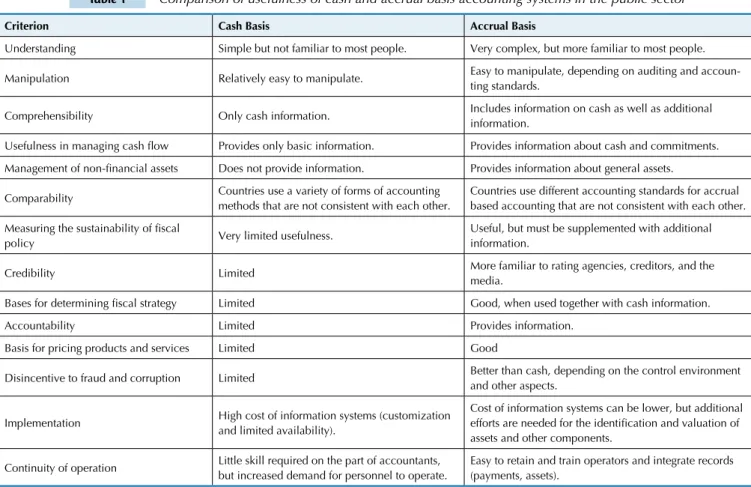
Table 1 summarizes comparisons between cash and ac-crual basis accounting systems in terms of their usefulness in the public sector.
Table 1 Comparison of usefulness of cash and accrual basis accounting systems in the public sector
Criterion Cash Basis Accrual Basis
Understanding Simple but not familiar to most people. Very complex, but more familiar to most people.
Manipulation Relatively easy to manipulate. Easy to manipulate, depending on auditing and
accoun-ting standards.
Comprehensibility Only cash information. Includes information on cash as well as additional
information.
Usefulness in managing cash low Provides only basic information. Provides information about cash and commitments.
Management of non-inancial assets Does not provide information. Provides information about general assets.
Comparability Countries use a variety of forms of accounting
methods that are not consistent with each other.
Countries use different accounting standards for accrual based accounting that are not consistent with each other.
Measuring the sustainability of iscal
policy Very limited usefulness.
Useful, but must be supplemented with additional information.
Credibility Limited More familiar to rating agencies, creditors, and the
media.
Bases for determining iscal strategy Limited Good, when used together with cash information.
Accountability Limited Provides information.
Basis for pricing products and services Limited Good
Disincentive to fraud and corruption Limited Better than cash, depending on the control environment
and other aspects.
Implementation High cost of information systems (customization
and limited availability).
Cost of information systems can be lower, but additional
efforts are needed for the identiication and valuation of
assets and other components.
Continuity of operation Little skill required on the part of accountants,
but increased demand for personnel to operate.
Easy to retain and train operators and integrate records (payments, assets).
Source: Adapted from Athukorala & Reid (2003).
2.2 Brazilian Studies on Accrual Basis
Accounting in the Public Sector.
1Studies about accrual basis accounting in the Brazilian public sector are scarce, perhaps because the adoption of accrual basis accounting was only recently made manda-tory through the NBCASP.
Reis (2006) compared cash and accrual basis accounting by analyzing regulations issued by the Secretariat of National Treasury (Secretaria do Tesouro Nacional - STN) and the Na-tional Confederation of Municipalities (Confederação Nacio-nal dos Municípios - CNM), Law No. 4,320/1964 and Com-plementary Law No. 101/2000. This author concluded that the adoption of accrual basis accounting tends to have advantages for government administration because it allows greater con-trol over and demonstration of the economic and financial position of the governmental entity. In contrast, cash basis accounting has caused distortions in government revenues because it does not enable a full view of volume for the year.
In disagreement with Reis, Silva (2006) analyzed the use of accrual basis accounting for revenue accounting in the Brazilian public sector and concluded that the adoption of the accrual basis accounting for government revenue ac-counting in Brazil is impractical because the interaction between revenue and expenses in the public sector does not conform to accounting theory.
Sothe (2009) analyzed the impacts of shifting from a mi-xed system to an accrual basis accounting system on recog-nition and measurement, as proposed by IFAC Study No. 14 (2011), which examined government public municipal accounts in the microregion of São Miguel do Oeste, SC, Brazil. Based on an analysis of the financial statements and reports of the administrative departments of five municipal governments from 2004-2008, the author concluded that the impact of changing from mixed to accrual basis metho-ds was significant in terms of asset structure, results, and fiscal indicators.
Herbest (2010) examined existing international studies to identify difficulties in changing from cash to accrual ba-sis procedures in public sector accounting. This research revealed a number of theoretical and practical difficulties in implementing accrual basis accounting, with a lack of political will being one of the main difficulties. The study also found that the information generated by the accrual basis accounting is often misused or simply not considered in decision-making by public managers.
Herbest (2010) also used a questionnaire to determine whether municipal government managers use accounting information for decision-making and whether there is a preference for information generated by accrual or cash basis accounting. He conducted interviews with 41 public municipal administrators in Espirito Santo State, including 11 mayors and 30 secretaries of 11 municipalities. The re-sults showed that the most commonly used accounting in-formation is the budget balance and that decision makers prefer the information generated by cash basis accounting.
Borges, Mário, and Cardoso (2010) proposed a simpli-fied and objective form of accrual basis accounting using the experience of the government of the state of Minas Gerais, Brazil. They used an depth interview technique to in-terview the state’s accounting manager and also used direct observation of an expert in public policy and government management in Minas Gerais. A number of incentives for adopting accrual basis accounting methods were identified that were related to decision-making, including the potential for better information about allocation of resources, analyses that predict the impact of future expenditures, and analyses of product performance or impacts to society.
Information about the cost of government operations, which is provided by accrual basis accounting, is required for adoption of the System of Cost Information in the Pu-blic Sector (Sistema de Informações de Custos no Setor Pú-blico) established by NBC T 16.11 (Resolution No. 1,366/11 (CFC, 2011). The importance of this information is highli-ghted by Pigatto, Holanda, Moreira, and Oak (2010). These authors discuss mechanisms that have produced demand for better accounting information and suggest that accoun-ting systems with a 'more comprehensive' basis contribu-te to improved fiscal and operational policy decisions. In contrast, the use of cash basis accounting procedures alone distorts the cost of government operations.
Curvinel and Lima (2011) analyzed the adoption of ac-crual basis accounting in the Brazilian public sector from the perspective of NBCASP and IPSAS by means of a lite-rature and document review. They also took into account the legal standards of the STN, the Court of Audits (Tribu-nal de Contas da União - TCU) and the Attorney General’s Office of the Brazilian Treasury (Procuradoria Geral da Fazenda Nacional - PGFN). These authors reported that NBCASP requires full accrual basis accounting results, and the Manual of Accounting for the Public Sector (Manual de Contabilidade Aplicado ao Setor Público - MCASP) aims to make the budgetary view compatible with the equity view. They also note that, given the mixed regime adopted by Law No. 4,320/1964 and the need to revise that system, there may be difficulties with adopting accrual basis ac-counting in Brazil. With regard to IPSAS, the authors em-phasized that public accounting in Brazil has evolved only in terms of budgetary records.
3 METHODOLOGICAL PROCEDURES
3.1 Methods and Techniques.
This study was an exploratory study due to the lack of accumulated and systematized knowledge about the selec-ted research topic, particularly in Brazil (Vergara, 2003). The purpose of the study was to build knowledge about the problem of adopting accrual basis accounting in Brazil. Data from field research (a survey) was analyzed quantitatively, and statistical methods were used for the data analysis.
A literature review was performed to summarize the-oretical contributions to the research problem and to help analyze the results. According to Martins (2000), literature reviews are used to study scientific contributions centered around a particular topic.
3.2 Questionnaire and Procedures.
The survey was implemented using methodology adap-ted from a study conducadap-ted by Kober et al. (2010), subject to the terms of Resolution 196 of the National Health Coun-cil of Brazil (1996)2. Questionnaires were administered on the internet to gather information about the perspectives of internal and external users and preparers regarding the
use-fulness of accounting information generated by cash and ac-crual basis accounting in 10 decision-making scenarios. The scenarios were similar to those used by Kober et al. (2010).
The decision-making scenarios corresponded to the following aspects of accounting systems: (a) performance evaluation of the entity, (b) performance evaluation of go-vernment programs, (c) effectiveness in the delivery of pro-ducts or services, (d) efficiency in the body's activity, (e) aid in the management of assets and liabilities, (f) compliance with accountability, (g) in decisions on resource allocation, (h) asset purchase, (i) identification of costs of goods and services, and (j) assessment of the entity's cash flows.
The questionnaires were posted online using an elec-tronic data collector, and links to access the questionnaires were disseminated through a network of the researchers' contacts and on websites related to the public sector. The goal was to obtain information from internal and external users and accounting preparers at three levels of govern-ment: federal, state and municipal.
Groups of respondents were based on the following cha-racteristics: (a) internal users: persons responsible for, or
nagers of, programs, sectors, departments, or agencies that use information generated by the government entity to which they are connected; (b) external users: internal and external audi-tors, members of the legislature and social control agencies, and the general public; and (c) preparers: persons responsible for accounts preparation, bookkeeping, and other actions re-lated to accounting information (accountants and accounting sector managers). The respondents self-identified themselves as members of one of the three groups at the time of the survey by selecting their group from a list of options.
As in the original study by Kober et al. (2010), the questio-nnaire was separated into two sections. In the first section, data were collected for the respondent’s amount of experience in the public sector, the respondent's group, and the governmental department in which he/she performed his/her duties. In the second section, the respondent was asked to express his/her opinion about the usefulness of information produced by cash or accrual basis accounting in the 10 decision-making scenarios
listed above, using a rating scale from 1 (not useful) to 5 (very useful). For scenarios for which the respondent was unable to answer, a "cannot evaluate" column was provided. Before the questionnaire was administered, a pilot study was performed with four accounting information users, and suggested adjust-ments for improving respondents’ understanding of the survey questions were incorporated into the final questionnaire.
3.3 Data Analysis.
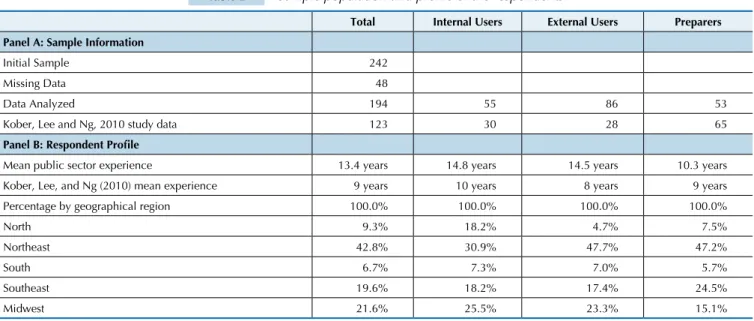
Information was collected from 242 respondents dis-tributed across three groups, and 194 valid responses were obtained. In total, 19.8% of the response data were lost due to incomplete answers. The distribution respondent groups was as follows: 55 (28.4%) internal users, 86 (44.3%) exter-nal users, and 53 (27.3%) preparers of financial statements, distributed across five geographic regions of the country. Table 2 shows information about the sample population and includes Kober et al.'s (2010) study data.
Table 2 Sample population and proile of the respondents
Total Internal Users External Users Preparers
Panel A: Sample Information
Initial Sample 242
Missing Data 48
Data Analyzed 194 55 86 53
Kober, Lee and Ng, 2010 study data 123 30 28 65
Panel B: Respondent Proile
Mean public sector experience 13.4 years 14.8 years 14.5 years 10.3 years
Kober, Lee, and Ng (2010) mean experience 9 years 10 years 8 years 9 years
Percentage by geographical region 100.0% 100.0% 100.0% 100.0%
North 9.3% 18.2% 4.7% 7.5%
Northeast 42.8% 30.9% 47.7% 47.2%
South 6.7% 7.3% 7.0% 5.7%
Southeast 19.6% 18.2% 17.4% 24.5%
Midwest 21.6% 25.5% 23.3% 15.1%
Source: Prepared by the authors based on data from the questionnaire.
The perceptions of the three groups of participants were measured on an ordinal scale (1-5) of perceived usefulness of accounting information for decision-making for the sce-narios presented. A series of data comparisons were per-formed to analyze the data in the context of the research topic (Tables 3-8).
Due to the ordinal nature of the variables, a compari-son between groups was performed using nonparametric Wilcoxon tests (for comparisons of related groups) and Mann-Whitney tests (for independent samples).
4 RESULTS
In this section, the responses obtained from second part of the survey questionnaire are analyzed. In the second part of the survey, the respondents were asked about their per-ceptions of the usefulness of information prepared using a cash or accrual basis accounting system for 10 decision-making scenarios.
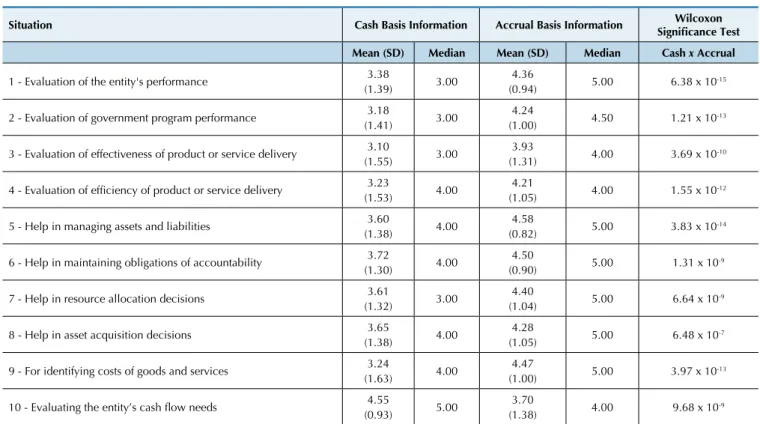
The respondents’ answers to the second part of the questionnaire were first analyzed for general patterns (Table 3). The responses were initially examined indivi-dually for each scenario but were not divided out by
res-pondent group (internal or external user or preparer). Subsequently, differences among respondent groups were examined (Tables 4, 5 and 6), and finally, the res-ponses a comparative analysis was performed (Tables 7 and 8) to identify possible variation in perceptions due to the group profiles.
Table 3 Perceived usefulness of inancial information prepared using two different accounting methods for various
decision-making scenarios
Situation Cash Basis Information Accrual Basis Information Signiicance Test Wilcoxon
Mean (SD) Median Mean (SD) Median Cash x Accrual
1 - Evaluation of the entity's performance 3.38
(1.39) 3.00
4.36
(0.94) 5.00 6.38 x 10
-15
2 - Evaluation of government program performance 3.18
(1.41) 3.00
4.24
(1.00) 4.50 1.21 x 10
-13
3 - Evaluation of effectiveness of product or service delivery 3.10
(1.55) 3.00
3.93
(1.31) 4.00 3.69 x 10⁻¹⁰
4 - Evaluation of eficiency of product or service delivery 3.23
(1.53) 4.00
4.21
(1.05) 4.00 1.55 x 10
-12
5 - Help in managing assets and liabilities 3.60
(1.38) 4.00
4.58
(0.82) 5.00 3.83 x 10
-14
6 - Help in maintaining obligations of accountability 3.72
(1.30) 4.00
4.50
(0.90) 5.00 1.31 x 10
-9
7 - Help in resource allocation decisions 3.61
(1.32) 3.00
4.40
(1.04) 5.00 6.64 x 10⁻⁹
8 - Help in asset acquisition decisions 3.65
(1.38) 4.00
4.28
(1.05) 5.00 6.48 x 10⁻⁷
9 - For identifying costs of goods and services 3.24
(1.63) 4.00
4.47
(1.00) 5.00 3.97 x 10
-13
10 - Evaluating the entity’s cash low needs 4.55
(0.93) 5.00
3.70
(1.38) 4.00 9.68 x 10
-9
Source: Prepared by the authors based on the results of the survey questionnaire.
In Tables 3, 4, 5, and 6, there were significant differences in perceived usefulness of information provided by the two accounting methods. In general, the group of respondents as a whole (Table 3) and the user and preparer groups (Tables 4, 5 and 6) thought that information based on accrual basis ac-counting was more useful than information based on the cash basis accounting for nine out of the 10 scenarios presented.
For all respondent groups, information based on cash basis accounting was only considered more important than information based on accrual basis accounting when evaluating an entity's need for cash flow (Tables 3, 4, 5, and 6). This result is consistent with the findings of Kober et al. (2010) and with other literature, such as Borges et al. (2010), Carlin (2003), and Guthrie (1998).
Table 4 Perceptions of internal users of the usefulness of inancial information provided by two different methods for
various decision-making scenarios
Situation Cash Basis Information Accrual Basis Information Signiicance Test Wilcoxon
Mean (SD) Median Mean (SD) Median Cash x Accrual
1 - Evaluation of the entity's performance 3.54
(1.51) 4.00
4.40
(0.89) 5.00 3.68 x 10⁻⁴
2 - Evaluation of government program performance 3.29
(1.47) 4.00
4.33
(0.85) 4.00 1.62 x 10
-4
3 - Evaluation of effectiveness of product or service delivery 3.20
(1.67) 3.50
3.98
(1.26) 4.00 0.002
4 - Evaluation of eficiency of product or service delivery 3.44
(1.60) 4.00
4.20
(1.05) 4.00 0.002
5 - Help in managing assets and liabilities 3.59
(1.38) 4.00
4.58
(0.87) 5.00 3.13 x 10⁻⁵
6 - Help in maintaining obligations of accountability 3.77
(1.34) 4.00
4.56
(0.84) 5.00 0.003
7 - Help in resource allocation decisions 3.90
(1.26) 4.00
4.38
(1.16) 5.00 0.044
8 - Help in asset acquisition decisions 3.70
(1.50) 4.00
4.25
(1.07) 5.00 0.079
9 - For identifying costs of goods and services 3.69
(1.59) 4.00
4.47
(0.98) 5.00 0.018
10 - Evaluating the entity’s cash low needs 4.62
(0.84) 5.00
3.59
(1.41) 4.00 9.12 x 10
-5
Table 5 Perceptions of external users of the usefulness of inancial information prepared by two different methods for
various decision-making scenarios
Situation Cash Basis Information Accrual Basis Information Signiicance Test Wilcoxon
Mean (SD) Median Mean (SD) Median Cash x Accrual
1 - Evaluation of the entity's performance 3.38
(1.42) 4.00
4.21
(1.07) 5.00 2.20 x 10
-6
2 - Evaluation of government program performance 3.19
(1.44) 3.00
4.17
(1.14) 5.00 2.23 x 10
-6
3 - Evaluation of effectiveness of product or service delivery 3.28
(1.58) 4.00
3.90
(1.33) 4.00 0.001
4 - Evaluation of eficiency of product or service delivery (1.57)3.29 4.00 4.07
(1.13) 4.00 7.06 x 10⁻⁵
5 - Help in managing assets and liabilities 4.00
(1.31) 5.00
4.54
(0.79) 5.00 0.001
6 - Help in maintaining obligations of accountability 3.94
(1.27) 4.00
4.44
(0.99) 5.00 0.004
7 - Help in resource allocation decisions 3.60
(1.33) 4.00
4.40
(0.98) 5.00 2.53 x 10⁻⁵
8 - Help in asset acquisition decisions 3.75
(1.36) 4.00
4.27
(1.13) 5.00 0.001
9 - For identifying costs of goods and services 3.36
(1.64) 4.00
4.33
(1.14) 5.00 2.16 x 10
-5
10 - Evaluating the entity’s cash low needs 4.66
(0.72) 5.00
3.75
(1.32) 4.00 8.34 x 10
-6
Source: Prepared by the authors based on the results of the survey questionnaire.
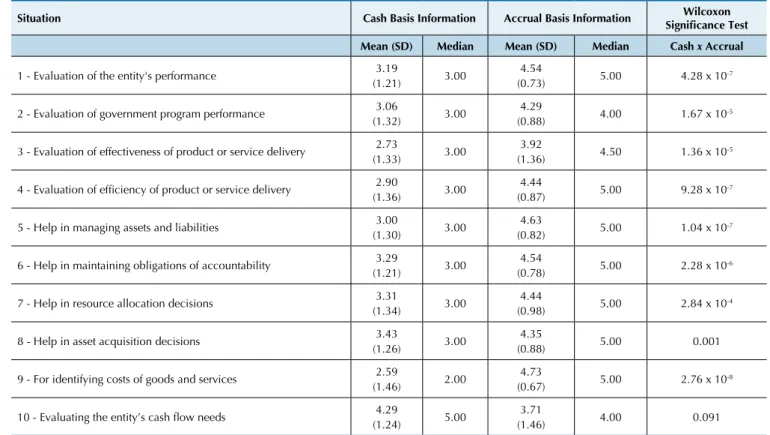
Similar to the Kober et al. (2010) study, in our simulta-neous comparison of the perceptions of the three groups of respondents regarding the usefulness of information for decision-making (Tables 4, 5, and 6), we observed that the preparers group (Table 6) attributed a lower mean
va-lue to cash basis accounting for all evaluated scenarios, indicating that preparers perceive this type of accounting system as having a lower capacity for generating informa-tion useful for decision-making than internal and exter-nal information users.
Table 6 Perceptions of preparers of the usefulness of inancial information prepared by two different methods for various
decision-making scenarios
Situation Cash Basis Information Accrual Basis Information Signiicance Test Wilcoxon
Mean (SD) Median Mean (SD) Median Cash x Accrual
1 - Evaluation of the entity's performance 3.19
(1.21) 3.00
4.54
(0.73) 5.00 4.28 x 10⁻⁷
2 - Evaluation of government program performance 3.06
(1.32) 3.00
4.29
(0.88) 4.00 1.67 x 10
-5
3 - Evaluation of effectiveness of product or service delivery 2.73
(1.33) 3.00
3.92
(1.36) 4.50 1.36 x 10
-5
4 - Evaluation of eficiency of product or service delivery 2.90
(1.36) 3.00
4.44
(0.87) 5.00 9.28 x 10
-7
5 - Help in managing assets and liabilities 3.00
(1.30) 3.00
4.63
(0.82) 5.00 1.04 x 10
-7
6 - Help in maintaining obligations of accountability 3.29
(1.21) 3.00
4.54
(0.78) 5.00 2.28 x 10
-6
7 - Help in resource allocation decisions 3.31
(1.34) 3.00
4.44
(0.98) 5.00 2.84 x 10
-4
8 - Help in asset acquisition decisions 3.43
(1.26) 3.00
4.35
(0.88) 5.00 0.001
9 - For identifying costs of goods and services 2.59
(1.46) 2.00
4.73
(0.67) 5.00 2.76 x 10
-8
10 - Evaluating the entity’s cash low needs 4.29
(1.24) 5.00
3.71
(1.46) 4.00 0.091
As shown in Table 6, the preparers also had a higher usefulness mean for information from accrual basis ac-counting in six of the nine scenarios. This perception of the preparers possibly reflects their greater familia-rity with accrual basis accounting due to their specific professional training (they were typically accountants) or as a result of training they received during accounts preparation courses for the implementation of
NB-CASP. Internal and external users' greater familiarity with cash basis accounting is consistent with the fin-dings of Herbest (2010).
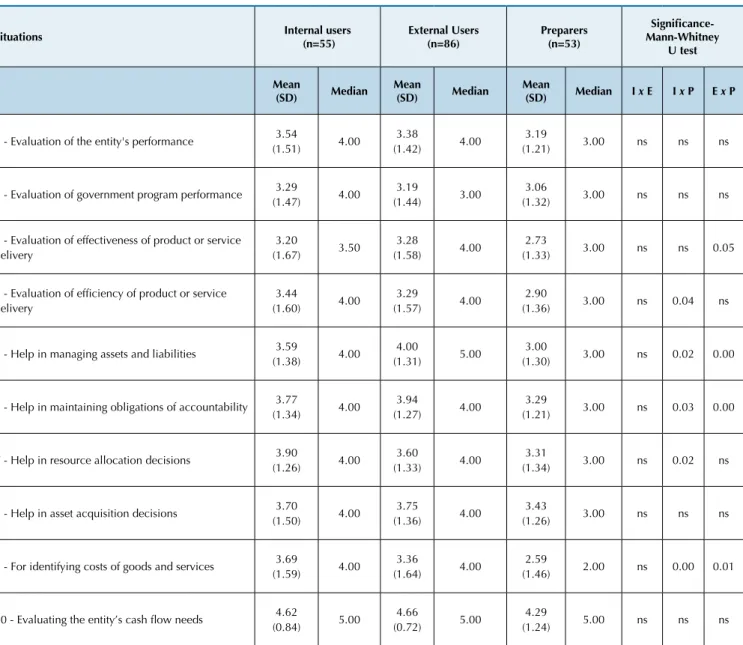
No significant difference was observed among groups regarding the usefulness of accounting infor-mation prepared using cash basis accounting methods (Table 7). This result is also consistent with the Kober et al. (2010) study.
Table 7 Differences in perceptions of usefulness of inancial reporting from cash basis accounting among internal and
external users and preparers
Situations Internal users
(n=55)
External Users (n=86)
Preparers (n=53)
Signiicance-Mann-Whitney
U test
Mean
(SD) Median
Mean
(SD) Median
Mean
(SD) Median I x E I x P E x P
1 - Evaluation of the entity's performance 3.54
(1.51) 4.00
3.38
(1.42) 4.00
3.19
(1.21) 3.00 ns ns ns
2 - Evaluation of government program performance 3.29
(1.47) 4.00
3.19
(1.44) 3.00
3.06
(1.32) 3.00 ns ns ns
3 - Evaluation of effectiveness of product or service delivery
3.20
(1.67) 3.50
3.28
(1.58) 4.00
2.73
(1.33) 3.00 ns ns 0.05
4 - Evaluation of eficiency of product or service
delivery
3.44
(1.60) 4.00
3.29
(1.57) 4.00
2.90
(1.36) 3.00 ns 0.04 ns
5 - Help in managing assets and liabilities 3.59
(1.38) 4.00
4.00
(1.31) 5.00
3.00
(1.30) 3.00 ns 0.02 0.00
6 - Help in maintaining obligations of accountability 3.77
(1.34) 4.00
3.94
(1.27) 4.00
3.29
(1.21) 3.00 ns 0.03 0.00
7 - Help in resource allocation decisions 3.90
(1.26) 4.00
3.60
(1.33) 4.00
3.31
(1.34) 3.00 ns 0.02 ns
8 - Help in asset acquisition decisions 3.70
(1.50) 4.00
3.75
(1.36) 4.00
3.43
(1.26) 3.00 ns ns ns
9 - For identifying costs of goods and services 3.69
(1.59) 4.00
3.36
(1.64) 4.00
2.59
(1.46) 2.00 ns 0.00 0.01
10 - Evaluating the entity’s cash low needs 4.62
(0.84) 5.00
4.66
(0.72) 5.00
4.29
(1.24) 5.00 ns ns ns
Source: Prepared by the authors based on the results of the survey questionnaire.
Note: Sig. <5%, I = Internal User, E = External User, P = Preparer, ns = not signiicant at 5%.
Statistically significant differences were observed in perceived usefulness of information generated by cash basis accounting between preparers and other users in 50% of decision-making scenarios for internal users and 40% for external users. This result is not consistent with the findings of Kober et al. (2010), who found no significant differences between the same three groups of users.
Table 8 Differences in the perceived usefulness of inancial reporting from accrual basis accounting among internal and
external users and preparers
Situations Internal users
(n=55)
External Users (n=86)
Preparers (n=53)
Signiicance-Mann-Whitney U test
Mean
(SD) Median
Mean
(SD) Median
Mean
(SD) Median I x E I x P E x P
1 - Evaluation of the entity's performance 4.40
(0.89) 5.00
4.21
(1.07) 5.00
4.54
(0.73) 5.00 ns ns ns
2 - Evaluation of government program performance 4.33
(0.85) 4.00
4.17
(1.14) 5.00
4.29
(0.88) 4.00 ns ns ns
3 - Evaluation of effectiveness of product or service delivery
3.98
(1.26) 4.00
3.90
(1.33) 4.00
3.92
(1.36) 4.50 ns ns ns
4 - Evaluation of eficiency of product or service
delivery
4.20
(1.05) 4.00
4.07
(1.13) 4.00
4.44
(0.87) 5.00 ns ns 0.04
5 - Help in managing assets and liabilities 4.58
(0.87) 5.00
4.54
(0.79) 5.00
4.63
(0.82) 5.00 ns ns ns
6 - Help in maintaining obligations of accountability 4.56
(0.84) 5.00
4.44
(0.99) 5.00
4.54
(0.78) 5.00 ns ns ns
7 - Help in resource allocation decisions 4.38
(1.16) 5.00
4.40
(0.98) 5.00
4.44
(0.98) 5.00 ns ns ns
8 - Help in asset acquisition decisions 4.25
(1.07) 5.00
4.27
(1.13) 5.00
4.35
(0.88) 5.00 ns ns ns
9 - For identifying costs of goods and services 4.47
(0.98) 5.00
4.33
(1.14) 5.00
4.73
(0.67) 5.00 ns ns 0.03
10 - Evaluating the entity’s cash low needs 3.59
(1.41) 4.00
3.75
(1.32) 4.00
3.71
(1.46) 4.00 ns ns ns
Source: Prepared by the authors from the results of the survey questionnaire.
Note: Sig. <5%, I = Internal User, E = External User, P = Preparer, ns = not signiicant at 5%.
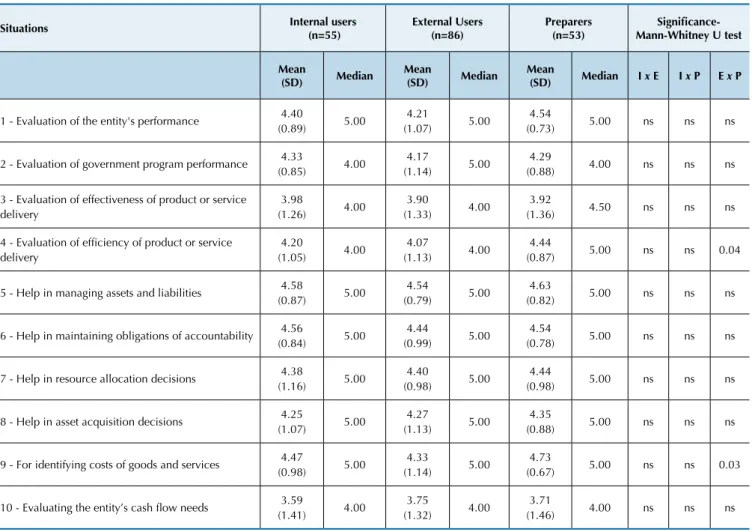
Table 8 shows a lack of statistically significant differen-ces in the perceptions of usefulness of accounting informa-tion produced by accrual basis accounting between inter-nal users and the other groups, a finding that is consistent with Kober et al. (2010).
For decisions related to the evaluation of efficiency in the delivery of products or services and the determination of costs of goods and services, statistically significant differen-ces were found between external users and preparers. This result is similar to the results for the previous scenario and may be indicative of the greater knowledge and training le-vels of the preparers in relation to external users. Training of the entire team involved in the process of adopting accru-al basis accounting, especiaccru-ally auditors (classified as exter-nal users in this research), has been identified by Land and Rocher (2011) as an important environmental factor for the successful adoption of this accounting system.
Consistent with the findings of Kober et al. (2010), the results of this study indicate that, despite different
percep-tions among user groups (internal and external users and preparers) of the usefulness of accounting information in the public sector, all groups share the view that financial in-formation based on accrual basis accounting is particularly important for most decision-making scenarios.
Based on our evidence of users’ a priori percep-tions, Brazilian expectations about accounting systems in the public sector are not consistent with the results of research conducted in the UK after 20 years of im-plementation of accrual basis accounting in government (Connolly & Hyndman, 2011). This UK study showed that British citizens held only a limited conviction that accrual basis accounting has resulted in improved ma-nagerial decision-making. This contrast between pre-implementation expectations and post-pre-implementation perceptions, as demonstrated by differences in Brazilian and British studies conducted at distinct points in time during the process of adopting new accounting practi-ces, may be an interesting topic for future studies.
5 FINAL CONSIDERATIONS
The need to increase transparency and accountability in public sector management has led to the conclusion that the information generated by cash basis accounting does not meet these goals. Accordingly, complete adoption of
While the potential advantages of accrual basis accounting are often cited by agencies seeking to align public sector agency procedures with international standards, the issue is quite con-troversial because of the substantial costs and structural changes required to transition to full accrual basis accounting, e.g., per-sonnel training and acceptance by public managers.
The central objective of this exploratory study was to investigate the perceptions of users and preparers of ac-counting information in the Brazilian public sector about changing government agency accounting systems to ac-crual basis accounting. Survey respondents were asked to rate the potential for accrual basis accounting to benefit decision-making in 10 specific scenarios.
The general perception of the respondents in this study was consistent with the national (Borges, Mário & Cardoso, 2010; Herbest, 2010) and international (Kober et al., 2010) literature regarding the usefulness of the information gene-rated by the two accounting methods examined. The predo-minant belief is that accrual basis accounting is more appro-priate for most public sector decision-making situations.
The observed differences in levels of perceived useful-ness, especially between preparers and internal and external users, suggest that managerial actions taken during NBCASP implementation with respect to dissemination of informa-tion and employee training may be paying off. Preparers generally rated the potential for accrual basis accounting to
generate improved information for decision-making more highly than internal and external users. Additionally, these results suggest that managers should focus on the activities on other stakeholders (internal and external users) during the NBCASP implementation process to increase acceptance of the new accounting paradigm (Land & Rocher, 2011).
The results of our study suggest that users and preparers of accounting information in the Brazilian public sector believe that adopting an accrual basis accounting system would result in informational benefits for decision-making and manage-ment of public entities. Therefore, the adoption of accrual ba-sis accounting in Brazil will occur not only because of a man-datory requirement or pressure from international institutions (Land & Rocher, 2011) but also due to a real belief in the in-formational benefits of this type of accounting for decision-making. Examples of improved management information generated by accrual basis accounting includes information related to costs, as highlighted by Pigatto et al. (2010).
Through the proposal and implementation of concepts and techniques related to the use of an accrual-based accounting system, the field of accounting science has provided a power-ful management tool to the Brazilian public sector. However, despite the general belief in the potential benefits of accrual basis accounting, the effectiveness of this type of system, as suggested by Warren (2012), will only be achieved if the infor-mation generated is actually applied by inforinfor-mation users.
Athukorala, L. S., & Reid, B. (2003). Accrual budgeting and accounting in
government and its relevance for DMCs. Manila: Asian Development Bank. Bergmann, A. (2012). he inluence of the nature of government
accounting and reporting in decision-making: evidence from
Switzerland. Public Money & Management, 32 (1), 15-20.
Blondal, J. (2003). Budget reform in OECD member countries: commmon
trends. Paris: OECD.
Borges, T. B., Mário, P. D., & Cardoso, R. L. (2010). Desmistiicação do
regime contábil de competência. Revista de Administração Pública
(RAP), 44 (4), 877-901.
Carlin, T. M. (2003). Accrual accounting & inancial reporting in the public
sector: reframing the debate. Sydney, Australia: MGS Working Papers in Management.
Champoux, M. (2006). Accrual accounting in New Zealand and Australia:
issues and solutions. Cambridge: Harvard Law School, Federal Budget Policy Seminar, Brieing Paper 27.
Christiaens, J., Reyniers, B., & Rollé, C. (2010). Impact of IPSAS on reforming govenmental inancial information systems: a comparative
study. International Review of Administrative Sciences, 76 (3), 537-554.
Curvinel, D. P., & Lima, D. V. (2011). Adoção do regime de competência no setor público brasileiro sob a perspectiva das normas brasileiras e
internacionais de Contabilidade. Revista de Educação e Pesquisa em
Contabilidade, REPEC, 5 (3), 69-85.
Deaconu, A., Nistor, C. S., & Filip, C. (2011). he impact of accrual accounting on public sector management. A exploratory study for
Romania. Transylvanian Review of Administrative Sciences, (32), 74-97.
Ernest & Young. (2010). Toward transparency: a comparative study of
governmental accounting in Europe. [S.l.]: Ernest &Young.
Fédération des Experts Comptables Européens. FEE. (2007). Accrual
accounting in the public sector. Brussels: Paper from the FEE Public Sector Committee.
Garseth-Nesbakk, L. (2011). Accrual accounting representations in
the public sector - a case of autopoiesis. Critical Perspectives on
Accounting, 22 (3), 247-258.
Guthrie, J. (1998). Application of accrual accounting in the australian
public sector - rhetoric or reality? Financial Accountability &
Management, 14 (1), 1-19.
Herbest, F. G. (2010). Regime de competência no setor público: a experiência
de implementação em diversos países. Dissertação de mestrado,
Fundação Instituto Capixaba de Pesquisa em Contabilidade, Economia e Finanças, Vitória, ES, Brasil.
Hyndman, N., & Connoly, C. (2011). Accrual accounting in the public
sector: a road not always taken. Management Accounting Research, 22
(1), 36-45.
International Federation of Accountants. IFAC. (2011). International
public sector accounting standards board - study 14 - transition to the accrual basis of accounting: guidance for governments and government entities. (3. ed.). Recuperado em 10 fevereiro, 2012, de http://www. ifac.org/sites/default/iles/publications/iles/IPSASB-study-14-3e.pdf. Jaballa, T., Becker, S. D., & Weber, J. (2011). A taxonomy of the perceived
beneits of accrual accounting and budgeting: evidence from german
states. Financial Accountability & Management, 27 (2), 134-164.
Kober, R., Lee, J., & Ng, J. (2010). Mind your accruals: perceived usefulness of inancial information in the australian public sector
under diferent accounting systems. Financial Accountability &
Management, 26 (3), 267-297.
Land, E., & Rocher, S. (2011). Prerequisites for applying accrual accounting
in the public sector. Public Money & Management, 31 (3), 219-222.
Laughlin, R. (2012). Debate: Accrual accounting: information for
accountability or decision usefulness? Public Money & Management,
32 (1), 45-46.
Martins, G. A. (2000). Manual para elaboração de monograias e
dissertações. São Paulo: Atlas.
Organization for Economic Cooperation and Development. OECD.
(1993). Accounting for what? he value of accrual accounting to the
public sector. Paris. Recuperado em 10 fevereiro, 2012, de http://www. oecd.org/oicialdocuments/publicdisplaydocumentpdf/?cote=OCDE %2FGD%2893%29178&docLanguage=En.
Pallot, J. (2001). A decade in review: New Zeland's experience with
resource accounting and budgeting. Financial Accountability &
Management, 17 (4), 383-400.
Pigatto, J. A., Holanda, V. B., Moreira, C. R., & Carvalho, F. A. (2010). A importância da contabilidade de competência para a informação de
custos governamental. Revista de Administração Pública (Impresso), 44
(4), 821-837.
Portaria n. 828/2011 (2011). Ministério da Fazenda. Recuperado em 10 fevereiro, 2012, de http://www.tesouro.gov.br/legislacao/download/ contabilidade/PortSTN_828_20111214.pdf.
Reis, H. D. (2006). Regime de caixa ou competência: eis a questão. Revista de Administração Municipal, 52 (260), 37-48.
Resolução n. 196/1996 (1996). Conselho Nacional de Saúde. Recuperado em 10 fevereiro, 2012, de http://www.ufrgs.br/bioetica/res19696.htm.
Resolução n. 1.366/11, NBC T 16.11 (2011). Dispõe sobre o sistema de informação de custos no setor público. Brasília, Conselho Federal de Contabilidade - CFC. Recuperado em 10 fevereiro, 2012, de http:// www.crcsp.org.br/portal_novo/legislacao_contabil/resolucoes/ Res1366.htm.
Silva, C. M. (2006). Uma análise crítica sobre a utilização do princípio
da competência no setor público. Revista Catarinense de Ciência
Contábil, 15 (5).
Sothe, A. (2009). Diretrizes do IFAC para o regime de competência:
impacto nos resultados contábeis dos governos municipais da microrregião de São Miguel do Oeste- SC. Dissertação de mestrado, Universidade Regional de Blumenau, Blumenau, SC, Brasil.
Tiron Tudor, A., & Mutiu, A. (2006 November). Cash versus accrual
accounting in public sector. Faculty of Economics and Business Administration, Babes Bolyai University, Workin Paper. Recuperado em 10 fevereiro, 2012, de http://www.ssrn.com.
Vergara, S. C. (2003). Projetos e relatórios de pesquisa em administração.
(4. ed.). São Paulo: Atlas.
Warren, K. (2012). Developing a government's balance sheet - does it