DELROY CHEVERS
[email protected] Professor at The University of the West Indies, Mona School of Business and Management – Kingston, Jamaica
ARTICLES
Submitted 06.10.2016. Approved 10.03.2016
Evaluated by double blind review process. Scientiic Editor: Marlei Pozzebon
SOFTWARE PROCESS IMPROVEMENT:
AWARENESS, USE, AND BENEFITS IN
CANADIAN SOFTWARE DEVELOPMENT FIRMS
Melhoria de processo de software: Conhecimento, utilização e benefícios em
empresas canadenses de desenvolvimento de software
Mejora del proceso de software: Concientización, uso y beneficios en
desarrolladoras de software canadienses
ABSTRACT
Since 1982, the software development community has been concerned with the delivery of quality systems. Software process improvement (SPI) is an initiative to avoid the delivery of low quality systems. However, the awareness and adoption of SPI is low. Thus, this study examines the rate of awareness, use, and bene-its of SPI initiatives in Canadian software development irms. Using SPSS as the analytical tool, this study found that 59% of Canadian software development irms are aware of SPI programs and 43% of employees use a form of SPI programs to develop software products. Although the sample size is small and the results cannot be generalized, the sample irms that use SPI programs reported an improvement in software pro-duct quality as the greatest beneit. These indings conirm the importance of SPI programs as a means of producing higher-quality software products, which can increase the likelihood of software companies winning global contracts.
KEYWORDS | Capability maturity model integration, information systems quality,software development irms, software process improvement.
RESUMO
Desde 1982, a comunidade de desenvolvimento de software tem estado preocupada com a entrega de siste-mas com qualidade. A melhoria de processo de software (MPS) é uma iniciativa que visa a evitar a entrega de sistemas de baixa qualidade. Entretanto, o conhecimento e a adoção da MPS são baixos. Assim, este estudo examina o nível de conhecimento, utilização e benefícios de iniciativas de MPS em empresas canadenses de desenvolvimento de software. Utilizando o SPSS como ferramenta analítica, este estudo descobriu que 59% das empresas canadenses de desenvolvimento de software conhecem programas de MPS, e 43% dos funcionários utilizam alguma forma de programa de MPS para desenvolver produtos de software. Embora o tamanho da amostra seja pequeno e os resultados não possam ser generalizados, as irmas estudadas que utilizam programas de MPS relataram uma melhoria na qualidade dos produtos de software como sendo o maior benefício. Estas conclusões conirmam a importância dos programas de MPS como modo de produzir produtos de software de qualidade mais elevada, o que pode aumentar a probabilidade das empresas de software de conquistar contratos globais.
PALAVRAS-CHAVE | Modelo integrado de maturidade e capacidade, qualidade de sistemas de informação, empresas de desenvolvimento de software, melhoria de processo de software.
RESUMEN
Desde 1982, la comunidad de desarrollo de software se ha preocupado con la entrega de sistemas de cali-dad. La mejora del proceso de software (Software process improvement [SPI]) es una iniciativa para evitar la entrega de sistemas de baja calidad. Sin embargo, la concientización y adopción de SPI es baja. Por lo tanto, este estudio analiza la tasa de concientización, uso y beneicios de iniciativas de SPI en desarrolladoras de software canadienses. Utilizando SPSS como herramienta analítica, este estudio descubrió que el 59% de las desarrolladoras de software canadienses tienen conocimiento de los programas SPI y el 43% de los empleados usa una forma de programas de SPI para desarrollar productos de software. Aunque el tamaño de la muestra sea pequeño y los resultados no puedan ser generalizados, las desarrolladoras de esta mues-tra que usan programas de SPI reportaron una mejora de la calidad de productos de software como el mayor beneicio. Estos hallazgos conirman la importancia de programas de SPI como medio de producir productos de software de mejor calidad, lo que puede aumentar la probabilidad de que compañías de software consi-gan contratos globales.
PALABRAS CLAVE | Integración del modelo de madurez de capacidad, calidad de sistemas de información, desarrolladoras de software, mejora del proceso de software.
INTRODUCTION
Since 1982, the software development community has been concerned with the delivery of quality systems (Gladden, 1982)
Software process improvement (SPI) is an initiative to avoid the delivery of low quality systems (Humphrey, 1989). SPI is the application of process engineering concepts, techniques, and practices to explicitly monitor, control, and improve the software process (Humphrey, Kitson, & Gale, 1991). In practice, SPI deals with the ability of a process to produce planned results, which by extension can increase the capability of software irms to produce high quality products. SPI is promoted by software engineering researchers and viewed as a strategic approach to software development (Niazi, 2012). The developmental process is examined through a process assessment, which leads to the determination of the process capability or maturity. The determination of process maturity can inform the implementation plan employed to improve the maturity of irms. Although the SPI initiative has been around for thirty-ive years, its awareness and adoption are reported to be low (Niazi, 2012).
Some scholars argue that the low adoption is due to these initiatives being costly, time consuming, disruptive, and cumbersome
(Coleman & O’Connor, 2008; Niazi, Babar, & Verner, 2010; Pino, Pardo, Garcia, & Piattini, 2010). The recent global economic crisis has challenged the performance of many irms (Silva, Wefort, Flores, & Silva, 2014). Further, an economic crisis is likely to increase claims that standards, such as SPI initiatives, are disruptive and costly. In addition, the low adoption rate of standards in rather small in small software development irms, likely due to the perception that these standards were developed for large irms (Laporte & O’Connor, 2014). In this study, very small irms are deined as having less than ten employees and a turnover of €2 million, while small irms are deined as having less than forty-nine employees and a turnover of €10 million (European Commission, 2005).
Several studies and researchers have stated the beneits of SPI programs, which include improved software product quality, improved productivity of developers, reduced project cycle time and cost, enhanced business growth, and improved customer satisfaction (Clarke & O’Connor, 2013; Harter, Slaughter, & Krishnan, 1998; Iversen & Ngwentama, 2006; Krisnan & Keller, 1999; Staples & Niazi, 2008). Thus, based on these beneits, irms are encouraged to adopt SPI programs to not only produce higher-quality software products, but to also provide business value
(Duggan, 2006). These conditions can increase the likelihood of winning global contracts (Clarke & O’Connor, 2012; Pino, Garcia, & Piattini, 2008). However, there is limited research on developing ways to efectively implement SPI programs (Niazi, 2012), with Canada being no exception.
The Canadian software development domain is not greatly studied, and this is coupled with Canada being ranked 12th in the
Network Readiness Index behind the Republic of Korea and Taiwan
(Bilbao-Osorio, Dutta, & Lanvin, 2013). The network readiness index evaluates the degree of a society’s preparedness and readiness to take advantage of their information and communication technology (ICT) infrastructure (Dutta, Bilbao-Osorio, & Geiger, 2012). Hence, in this study, we assess the level of awareness, use, and beneits of SPI initiatives in Canadian software development irms. These irms are organizations that develop and maintain software for in-house use or sale (Kasunic, 2006).
Both information systems (IS) researchers and practitioners are sensitive to the delivery of high quality systems (Livari, 2005) because unused or underutilized systems can cost irms millions of dollars (Markus & Keil, 1994). Hence, the expected contribution of this study is to ofer insights to IS practitioners in Canada regarding the state of their SPI awareness, use, and beneits. Such insights might provoke future research and encourage deeper discussion in Canada on the adoption of SPI to become more competitive in the software development industry.
LITERATURE REVIEW
Software development is a human intensive activity (Clarke & O’Connor, 2013), involving the interaction of many individuals with varied experiences, expectations, and knowledge. Thus, software development is complex (Casey & Richardson, 2009; Clarke & O’Connor, 2013). Based on its complexity, special care must be taken to ensure that software development projects are delivered on time and within budget and realize the intended beneits. This study focuses on the need to deliver high quality software products that provide business value.
In the implementation of SPI, irms must irst assess the capability and maturity of their developmental process and then establish implementation plans to achieve higher process maturity
(Humphrey, 1989). SPI involves evaluating irm’s processes through process assessment, which can lead to capability determination and process improvement initiatives (Bicego & Kuvaja, 1996). Thus, the implementation of SPI programs is reactive and many managers are reluctant to embark on these programs because they are costly and time consuming (Coleman & O’Connor, 2008).
The most popular and established assessment framework used to evaluate irm’s process maturity is the capability
maturity model integration (CMMI) (Espinosa-Curiel et al., 2013; Helgesson, Host, & Weyns, 2012). The CMMI is a reference model of established practices used to gauge IS process competence and structured systems development methodologies to establish process repeatability, which by extension can reduce the reliance on individual dedication for quality outcomes (Duggan, 2006). This model, in the staged representation, has ive levels that guide organizations in advancing their process maturity. These levels describe an evolutionary path from an ad hoc and chaotic process to a mature and disciplined developmental process
(Paulk, 1998).
Figure 1:
The staged representation of the CMMI
Optimazing (5)
Managed (4)
Deined (3)
Repeatable (2)
Initial (2)
Continuously improving process
Predictable process
Standard consistent process
Disciplined Process
Source: Paulk et al., 1995
In the CMMI staged representation (as shown in Figure 1), Level 1 is “initial” because there are no established practices to guide the developmental process. Level 2 is “repeatable” because there are prescribed project management practices, such as requirements management, project planning, and project monitoring and control. Level 3 is “deined” because it incorporates wider organizational process management practices, such as organizational training and risk management. Level 4 is “managed” as there are established performance measures to assess how well the practices are embedded. Finally, Level 5 is “optimizing” because there is an atmosphere of continuous improvement. It is widely felt in the IS community that software development irms should be assessed at Level 2 and above to be qualiied as global competitors (Ingalsbe, Shoemaker, & Jovanovic, 2001; Tan, 1996; Turner, 2007), thereby gaining serious consideration in contract bidding to win contracts.
Although the CMMI is the most popular model, there are several other models which include the International Organization
for Standardization (ISO)/International Electrotechnical Commission (IEC) 12207, ISO/IEC 15504, personal software process, team software process, and bootstrap methods (Oktaba, 2006; Pino et al., 2008). IS are critical to the strategic imperatives of most organizations (Chung-Kuang, 2012). Hence, it is important that these models assist irms in achieving the intended beneits of higher-quality software, improved customer satisfaction, better resource utilization, and improved business value (Barclay, 2008; Thomas & Fernandez, 2008).
Theoretical framing
IS literature supports the claim that SPI is valuable and a strategic issue (Iversen & Ngwentama, 2006). A irm’s capability to produce high quality software products can be viewed as a resource for superior performance and competitive advantage. Literature supports the notion that insuicient attention to process maturity practices can afect a irm’s ability to provide high quality software products (Krisnan & Keller, 1999).
The implementation of SPI initiatives is expensive and typically requires major company resources (Pino et al., 2010) such as investments in time, human resources, and inancial resources. Thus, SPI initiatives impact every aspect of a irm’s operations
(Ngwenyama & Norbjerg, 2010). Therefore, SPI is considered time consuming, disruptive, costly, and cumbersome (Habra, Alexandre, Desharnais, Laporte, & Renault, 2008; Oktaba, Garcia, Ruiz, Pino, & Alquicira, 2007). These conditions might hinder some software development irms from adopting SPI initiatives.
On the other hand, the institutional theory can explain why some irms adopt SPI initiatives. The theory describes the processes in which structures such as rules and business practices become established norms in an industry (Scott, 2004). To survive and strive, organizations must conform to the rules and prevailing beliefs in the industry (DiMaggio & Powell, 1983). As a result, the underlying philosophy of the theory is that the prevailing industry climate can strongly inluence the development and adoption of formal business practices in an organization. The adoption of these practices is driven by three pressures: coercive, mimetic, and normative. This study is more concerned with the two latter pressures of mimetic and normative. Minetic pressure is to copy business practices of a successful company during high uncertainty. Normative pressure, on the other hand, is an indirect infusion of business practices into a company through the hiring of employees and senior executives from the competitor.
In general, irms strive to it in the industry or follow the leader. These conditions can manifest themselves with irms adopting SPI programs based on the success of other irms that have adopted these programs. Similarly, one irm can recruit an employee from a competitor with tremendous knowledge and understanding of and experience with SPI programs, of which he or she is willing to share. In summary, the RBV can be used to explain why irms do not adopt SPI programs and the institutional theory can be used to explain why irms adopt SPI programs, whether directly or indirectly.
METHODOLOGY
This study employed an online survey approach to gather data from IS professionals (i.e., chief information oicers (CIOs),
project managers, analysts, developers, and administrators) in software development irms throughout Canada. The sample frame was developed from the Canadian Company Capabilities database, personal referrals, and assistance from two Canadian information technology (IT) or IS professional associations with head oices in Ottawa and Toronto. The information captured was potential respondent names, positions, and email addresses. Ethical approval to conduct the survey was received and email invitations to participate in the online survey were sent to three hundred and forty-four (344) IS professionals. In addition to the assurance of conidentiality, the email included a link to access the survey instrument.
The unit of analysis of the study was IS projects, and individuals were asked to report on the awareness, adoption, and beneits of using SPI programs in their organizations in the development and delivery of software products (see Appendix A). A 7-point Likert-type scale was used for questions that were anchored as (1) Strongly Disagree and (7) Strongly Agree. The survey was posted and conducted from March 17, 2013 to May 25, 2013. During this period, at least three follow-up reminders were sent to potential respondents via email. A total of 69 responses were received and analyzed, a response rate of 20%. Respondents included 54 males and 15 females who were employed as CIOs, project managers, analysts, developers, and administrators. The job titles were determined from the sample frame. Further details regarding the proile of the respondents and the companies are shown in Table 1. Because the sample size was small, the results cannot be generalized.
Table 1.
Profile of respondents and company
Factor Percent (%)
Gender: Male Female
`
Years of experience: Less than 1 year 1–2 years 2–3 years 3–5 years 5–10 years More than 10 years
8% 34% 26% 15% 14% 3%
Company size:
Less than 10 employees 10–50 employees 51–250 employees More than 250 employees
ANALYSIS AND DISCUSSION
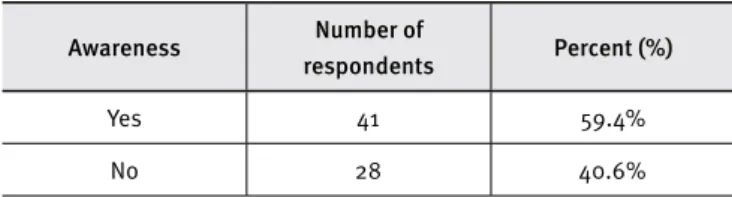
Statistical package for the social sciences (SPSS) is an IBM predictive analytical software and was used as the statistical tool to conduct the analysis based on its popularity (Hair, Black, Babin, Anderson, & Tatham, 2006). The results shown in Table 2 indicate that the majority (59%) of the respondents were aware of SPI and 41% were not. The reasons given by respondents for not being aware of SPI programs included simply not being aware of the concept, the size of the irm is small and does not need to utilize such concepts in software development, and others claimed that they have never studied the concept.
Table 2.
Awareness of software process improvement
programs
Awareness Number of
respondents Percent (%)
Yes 41 59.4%
No 28 40.6%
Further analysis shows that only 43% of the respondents used any form of SPI programs in software development, such that 57% did not use any SPI programs (see Table 3). This shows some respondents were aware of SPI, but were not using these programs in the development of software products. This discovery conirms the notion that the adoption rate of SPI is low (Sulayman, Urquhart, Mendes, & Seidel, 2012).
Table 3.
Use of SPI programs in software development
by respondents
Use of SPI Number of
respondents Percent (%)
Yes 30 43%
No 39 57%
However, based on the result that 59% of IS professionals were aware but only 43% use any form of an SPI program, greater efort through educational forums and training seminars targeting CIOs, project managers, analysts, developers, administrators, and practitioners is required to improve the awareness, adoption and use of SPI programs. Such training seminars could realize a secondary beneit of increasing Canada’s ranking in the Network Readiness Index, by improving Canada’s readiness to take advantage of their ICT infrastructure. These training seminars should also outline process assessment procedures, which can lead to capability determination and process improvement.
However, the focus of these seminars should be how to implement SPI programs. Herbsleb and Goldenson (1996) found that 67% of IS managers who have expressed a desire to embrace SPI are seeking guidance on how to implement such programs, rather than which SPI activities to implement. In addition, these seminars should emphasize the beneits of SPI programs, which include improved software quality, productivity, costs, and customer satisfaction.
Table 4.
Reasons for non-adoption of SPI programs
No. Reason
1 Time consuming 2 Lack of resources
3 Fear making SPI changes and having to deal with lengthy learning curve
As shown in Table 4, the reasons provided for the non-adoption of SPI programs include its implementation being time consuming, a lack of resources, and the fear of implementing SPI changes due to the diiculty employees have climbing the learning curve. These reasons are in alignment with the literature that states SPI implementation can be time consuming, costly, and disruptive (Pino et al., 2010). In addition, it could be argued that the irms that do not adopt SPI programs lack various resources to successfully implement such programs. The resources could be rare or, in some cases, diicult to imitate. This theory is in alignment with the RBV.
On the contrary, it could be argued that those irms that adopt SPI programs are driven by the mimetic and normative pressures within the industry. Late adopters of SPI programs can witness the beneits derived by the early adopters, such as improved software product quality, productivity, business growth, customer satisfaction, and reduced project cycle time and cost. Based on these beneits, SPI programs are adopted either directly or indirectly by late adopters.
As shown in Table 1, most respondents have been using SPI programs for one to two years (34%) followed by two to three years (26%). Most of the respondents belong to the information technology industry in organizations employing more than 51 but less than 250 employees (small irms).
have been assessed at Levels 1 through 3, with 63.3% assessed at Level 3 (Keller & Mack, 2013). Thus, hopefully, most Canadian irms are within the 63.3% Level 3 range. A possible barrier for why Canadian irms may be assessed at the Level 1 is this study’s inding that 34% of respondents have only been exposed to SPI programs for one to two years. This length of exposure can be used to consider SPI as an emerging concept that is not yet matured. Therefore, Canadian irms might require time to progress to more advanced practices typical of Levels 4 and 5.
Another barrier in this study could be most irms being classiied as medium-sized (51 to 250 employees) (Pino et al., 2008). Literature posits that SPI programs are designed mainly for large irms (Clarke & O’Connor, 2013), with small- and medium-sized irms inding the implementation process time consuming, disruptive, cumbersome, and costly (Niazi et al., 2010).
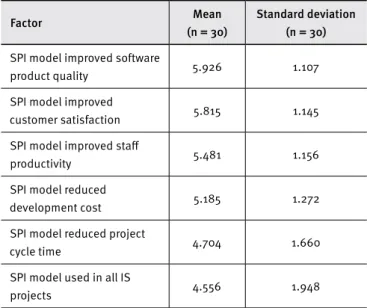
The mean scores (on a scale of 1 to 7, where 1 represents strongly disagree and 7 strongly agree) and the standard deviations for the scaled survey items regarding the beneits of SPI programs are shown in Table 5. The mean scores for the six beneits assessed were all above the mid-point, indicating that Canadian software development irms are achieving beneits through the adoption and use of SPI programs. The results show that software product quality is the main beneit, followed by customer satisfaction and staf productivity. These indings are consistent with prior studies in both developed and developing countries.
Table 5.
Benefits of SPI programs
Factor Mean
(n = 30)
Standard deviation (n = 30)
SPI model improved software
product quality 5.926 1.107 SPI model improved
customer satisfaction 5.815 1.145 SPI model improved staf
productivity 5.481 1.156 SPI model reduced
development cost 5.185 1.272 SPI model reduced project
cycle time 4.704 1.660 SPI model used in all IS
projects 4.556 1.948
CONCLUSION
The software development industry is especially competitive
(Iversen & Ngwentama, 2006). Hence, irms in this industry must
strive to increase the capability and maturity of their processes to produce higher-quality software products and be competitive in the global market. The indings in this study re-emphasize the importance of SPI programs as a means of realizing speciic operational beneits. These indings are in alignment with the literature, which states that SPI initiatives can improve product quality (Sanders and Richardson, 2007), improve productivity (Ferreira et al., 2008), and improve business value and customer satisfaction (Nikitina & Kajko-Mattsson, 2010).
IS project outcomes and irm’s competitiveness can be improved through SPI initiatives in the developmental process. However, and understanding of the factors that promote or hinder SPI adoption would be useful as there appear to be beneit in adopting a process focus and improving work practices in a relective manner.
The findings in this study might incite Canadian IS professionals to determine why some irms adopt SPI programs while others do not. An understanding of why irms adopt SPI programs can improve the acceptance of these programs
(Staples & Niazi, 2008). The theoretical underpinning of the RBV and institutional theory were used to explain the phenomenon in this study. Further research using these two theories could provide deeper insights into SPI adoption. In addition, future research could explore the possibility of a longitudinal study to assess the progress regarding SPI awareness and adoption in Canadian software development irms over time. It is believed that such adoption can lead to the production and delivery of high quality software products, which could possibly increase the competitiveness of irms.
One limitation of this study is the small sample size and the lack of generalizability of the results. Generally, a large sample size leads to more precise estimations of unknown parameters, in this case the adoption of SPI programs in Canadian software development irms. Hence, greater efort should be made in future studies to increase the sample size. However, the insights gained from this study might provoke future research and encourage deeper discussion on the adoption of SPI in an attempt to become more competitive in the Canadian software development industry.
REFERENCES
Barclay, C. (2008). Towards an integrated measurement of IS project performance: The project performance scorecard. Information Systems Frontiers, 10(3), 331-345. doi: 10.1007/s10796-008-9083-6 Bicego, A., & Kuvaja, P. (1996). Software process maturity and
certiication. Journal of Systems Architecture, 42(9), 611-620. Bilbao-Osorio, B., Dutta, S., & Lanvin, B. (2013). The global information
Carnegie Mellon. (2013). Published CMMI appraisal results of Canadian irms: Staged representation. CMMI Institute. “Retrieved from https://sas.cmmiinstitute.com/pars/pars.aspx
Casey, V., & Richardson, I. (2009). Implementation of global software development: A structured approach. Software Process Improvement and Practice, 14, 247-262. doi: 10.1002/spip.422
Chung-Kuang, H. (2012). Examining the efect of user satisfaction on system usage and individual performance with business intelligence systems: An empirical study of Taiwan’s electronic industry.
International Journal of Information Management, 32, 560-573. doi: doi:10.1016/j.jinfomgt.2012.03.001
Clarke, P., & O’Connor, R. V. (2012). The inluence of SPI on business success in software SMEs: An empirical study. The Journal of System and Software, 85, 2356-2367. doi: http://dx.doi.org/10.1016/j. jss.2012.05.024
Clarke, P., & O’Connor, R. V. (2013). An empirical examination of the extent of software process improvement in software SMEs. Journal of Software: Evolution and Process, 25(9), 981-998.
Coleman, G., & O’Connor, R. V. (2008). Investigating software process in practice: A grounded theory perspective. The Journal of Systems and Software, 81, 772-784. doi: 10.1016/j.jss.2007.07.027
DiMaggio, P., & Powell, W. W. (1983). The iron cage revisited: Institutional isomorphism and collective rationality in organizational ields.
American Sociological Review, 482, 147-160.
Dooley, K., Subra, A., & Anderson, J. (2001). Maturity and its impact on new product development project performance. Research in Engineering Design, 13(1), 23-29. doi:10.1007/s001630100003
Duggan, E. (2006). Tranquilizing the werewolf that attacks information systems quality. In M. Khosrow-Pour (Ed.), Advanced Topics in Information Resources Management, volume 5 (pp. 253-281). London, UK: Idea Group Inc.
Dutta, S., Bilbao-Osorio, B., & Geiger, T. (2012). The global information technology report 2012. World Economic Forum, 3-22.
Espinosa-Curiel, I. E., Rodriguez-Jacobo, J., Fernandez-Zepeda, J. A. (2013). A framework for evaluation and control of the factors that inluence the software process improvement in small organizations.
Journal of Software: Evolution and Process, 25, 393-406.
European Commission. (2005). The new SME deinition: User guide and model declaration. Enterprise and Industry Publications, 1-51. Ferreira, A. I. F., Santos, G., Cerqueira, R., Mononi, M., Barreto, A., &
Rocha, A. R. (2008). ROI of software process improvement at BL informatica: SPIdex is really worth it. Software Process: Improvement and Practice, 13, 311-318. doi: 10.1002/spip.392
Gladden, G.R. (1982). Stop the life-cycle, I want to get of. Software Engineering Notes, 7(2), 35-39.
Habra, N., Alexandre, S., Desharnais, J., Laporte, C. Y., & Renault, A. (2008). Initiating software process improvement in very small enterprises: Experience with a light assessment tool. Information and Software Technology, 50, 763-771. doi:10.1016/j.infsof.2007.08.004
Hair, J., Black, W. C., Babin, B. J., Anderson, R. E., & Thatham, R. L. (2006).
Multivariate data analysis. New Jersey, USA: Pearson-Prentice Hall.
Harter, D. E., Slaughter, S. A., & Krishnan, M. S. (1998). The life cycle efects of software quality: A longitudinal analysis. Paper presented at The International Conference on Information Systems, Helsinki, Finland. Retrieved from http://aisel.aisnet.org/icis1998/36/
Helgesson, Y. Y. L., Host, M., & Weyns, K. (2012). A review of methods for evaluation of maturity models for process improvement. Journal of Software Maintenance and Evolution: Research and Practice, 24, 436-454.
Herbsleb, J., & Goldenson, D. R. (1996). A systematic survey of CMM experience and results. Paper presented at the 18th International Conference on Software Engineering (ICSE), Berlin, Germany. Humphrey, W. (1989). Managing the software process. Reading, USA:
Addison-Wesley.
Humphrey, W., Kitson, D. H., & Gale, J. (1991). Comparison of U.S. and Japanese software process maturity. Software Engineering Institute, Carnegie Mellon University, CMU/SEI-91-TR-027, 38-49.
Ingalsbe, J. Shoemaker, D., & Javanovic, V. (2001). A metamodel for the capability maturity model for software. Paper presented at the Proceedings of the Seventh Americas Conference on Information Systems, Boston, USA.
Iversen, J., & Ngwentama, O. (2006). Problems in measuring efectiveness in software process improvement: A longitudinal study of organizational change at Danske Data. International Journal of Information Management, 26, 30-43. doi:10.1016/j. jinfomgt.2005.10.006
Kasunic, M. (2006). The state of software management practice: Results of 2006 survey. CMU/SEI, 2006-TR-009.
Keller, K., & Mack. B. (2013). Maturity proile reports. CMMI Institute, 1-26.
Krisnan, M. S., & Keller, M. I. (1999). Measuring process consistency: Implications for reducing software defects. IEEE Transactions on Software Engineering, 25(6), 769-781. doi: 10.1109/32.824401
Laporte, C. Y., & O’Connor, R. V. (2014). A systems process lifecycle standard for very small entities: Development and pilot trials. Paper presented at the 21st European Conference on Systems, Software and Services Process Improvement (EuroSPI), 425, 13-24.
Livari, J. (2005). An empirical test of the DeLone-McLean model of information system success. Database for Advances in Information Systems, 36(2), 8-27. doi: 10.1145/1066149.1066152
Markus, M. L., & Keil, M. (1994). If we build it they will come: Designing information systems that users want to use. Sloan Management Review, 35(4), 11-25.
Ngwenyama, O., & Norbjerg, J. (2010). Software process improvement with weak management support: An analysis of the dynamics of intra-organizational alliances in IS change initiatives. European Journal of Information Systems, 19, 303-319. doi: 10.1057/ejis.2010.18 Niazi, M. (2012). An exploratory study of software process improvement
implementation risks. Journal of Software: Evolution and Process, 24, 877-894. doi: 10.1002/smr.543
Niazi, M., Babar, M. A., & Verner, J. M. (2010). Software process improvement barriers: A cross-cultural comparison. Information and Software Technology, 52, 1204-1216. Doi: 10.1016/j. infsof.2010.06.005
Nikitina, N., & Kajko-Mattson, M. (2010). Impact of growing business on software processes. Paper presented at the 17th European Conference on Systems, Software and Services Process Improvement, Berlin, Germany.
Oktaba, J. (2006). MoProSoft: A software process model for small enterprises. Paper presented at the First International Research Workshop for Process Improvement in Small Settings, Carnegie Mellon University, Pittsburgh.
Paulk, M., Weber, C. V., Curtis, B., & Chrissis, M. B. (1995). The capability maturity model: Guidelines for improving the software process. Reading, USA: Addison Wesley Longman, Inc.
Paulk, M. C. (1998). Using the software CMM in small organizations.
Institute of Software Research, 5, 1-13. doi: 10.1007/978-3-540-69566-0_23
Penrose, E. (1959). The theory of the growth of the irm. New York, USA: Wiley.
Pino, F. J., Garcia, F., & Piattini, M. (2008). Software process improvement in small and medium software enterprises: A systematic review.
Software Quality Journal, 16(2), 237-261. doi: 10.1007/s11219-007-9038-z
Pino, F. J., Pardo, C., Garcia, F., & Piattini, M. (2010). Assessment methodology for software process improvement in small organizations. Information and Software Technology, 52, 1044-1061. doi:10.1016/j.infsof.2010.04.004
Sanders, M., & Richardson, I. (2007). Research into long-term improvements in small-to medium-sized organizations using SPICE as a framework for standards. Software Process: Improvement and Practice, 12(4), 351-359. doi: 10.1002/spip.319
Schwager, P. H., Byrd, T. A., & Turner, D. E. (2000). Information technology infrastructure capability’s impact on irm inancial performance: An exploratory study. Journal of Computer Information Systems, 98-105. doi:10.1080/08874417.2000.11647473
Scott, W. R. (2004). Institutional theory. In G. Ritzer (Ed.), Encyclopedia of social theory. Thousand Oaks, USA: Sage.
Serrano, M. A., Montes, O. C., & Cedillo, K. (2006).An experience on implementing the CMMI in a small organization using the team software process. Paper presented at the First International Research Workshop for Process Improvement in Small Settings, Carnegie Mellon University, Pittsburgh.
Silva, A. F. da, Wefort, E. F. J., Flores, E. D., & Silva, G. P. da. (2014). Earnings management and economic crises in the Brazilian capital market. RAE-Revista de Administração de Empresas, 54(3), 268-283. doi: http://dx.doi.org/10.1590/S0034-759020140303
Srinivasan, S., & Murthy, M. A. N. (2010). Process maturity model can help give a business an edge. SixSigma Newsletter, 1, 1-7.
Staples, M., & Niazi, M. (2008). Systematic review of organizational motivations for adopting CMM-based SPI. Information and Software Technology, 50, 605-620. doi:10.1016/j.infsof.2007.07.003
Sulayman, M., Urquhart, C., Mendes, E., & Seidel, S. (2012). Software process improvement success factors for small and medium web companies: A qualitative study. Information and Software Technology, 54, 479-500. doi: 10.1016/j.infsof.2011.12.007
Tan, M. (1996). Software quality practice in Singapore: Is it adequate for today’s global information systems? Journal of Global Information Management, 4(4), 23-32. doi: 10.4018/jgim.1996100103
Thomas, G., & Fernandez, W. (2008). Success in IT projects: A matter of deinition? International Journal of Project Management, 26(7), 733-744. doi: http://dx.doi.org/10.1016/j.jproman.2008.06.003
Turner. (2007). CMMI mentoring service. Retrieved from h t t p : / / w w w. tcg . co m / s e r vi ces - C M M I - m e n to r i ng- ove r tu re . html?OVRAW=elements%20