RENÊ BIROCHI [email protected]
Professor at Universidade Federal de Santa Catarina, Departamento de Ciências de Administração – Florianópolis – SC, Brazil
MARLEI POZZEBON [email protected]
Professor at HEC Montréal,
Department of International Business – Montréal – Québec, Canada and Fundação Getulio Vargas, Escola de Administração de Empresas de São Paulo – São Paulo – SP, Brazil
ARTICLES
Submitted 12.01.2014. Approved 10.27.2015
This article is co-authored by a member of RAE’s Scientiic Editorial Board and was evaluated by double blind review process with impartiality and independence. Scientiic Editors: Antonio Díaz Andrade and Nicolau Reinhard
IMPROVING FINANCIAL INCLUSION:
TOWARDS A CRITICAL FINANCIAL
EDUCATION FRAMEWORK
Aprimorando a inclusão financeira: Rumo a um quadro teórico de educação
financeira crítica
Mejoramiento de la inclusión financiera: Hacia un marco de educación
financiera crítica
ABSTRACT
Empirical research suggests that inancial inclusion initiatives – such as facilitating access to inan-cial resources or providing microcredit – are alone not enough to lower socioeconomic disparities. In this article, we adopt a critical stance as a guide for our empirical investigation. Our aim is to propose a inancial education framework, tailored to low-income micro-entrepreneurs, that embraces new information and communication technologies (ICTs) and seeks to improve inancial inclusion and social emancipation. This empirical study was conducted in an Amazonian municipality in Brazil where recent access to ICTs has brought about important and varied socioeconomic changes. Results show that ICT-supported and tailored critical inancial education can play a dual role: on the one hand, access to inancial education might decrease the efects of generative mechanisms on global/local tensions, triggered by standardized ICT applications; on the other hand, such access might increase inancial inclusion and social transformation through the integration of guiding principles into inan-cial education programs.
KEYWORDS | Financial education, inancial inclusion, Information and Communication Technology for Deve-lopment, social emancipation, empowerment.
RESUMO
Pesquisas empíricas sugerem que iniciativas de inclusão inanceira – tais como o acesso a recursos inan-ceiros ou o fornecimento de microcrédito – não são, por si sós, suicientes para reduzir as disparidades socioeconômicas. Neste artigo, adotamos uma abordagem crítica para guiar a nossa pesquisa empírica. Nosso objetivo é o de propor um quadro teórico para a educação inanceira orientada a microempreendedo-res de baixa renda, vinculado às novas tecnologias de informação e comunicação (TICs), com o propósito de ampliar a inclusão inanceira e a emancipação social. Este estudo empírico foi realizado em um município da Amazônia brasileira no qual o recente acesso às TICs resultou em signiicativas e divergentes transfor-mações socioeconômicas. Os resultados evidenciam que a educação inanceira crítica orientada por TICs pode desempenhar um duplo papel: por um lado, o acesso à educação inanceira pode reduzir os efeitos provocados por mecanismos geradores de tensões globais-locais, desencadeados pelo uso de aplicações padronizadas de TICs; por outro lado, tal acesso pode aumentar a inclusão social e a transformação social por meio da incorporação de princípios norteadores, integrados a programas de educação inanceira.
PALAVRAS-CHAVE| Educação inanceira, inclusão inanceira, Tecnologia da Informação e Comunicação para o Desenvolvimento, emancipação social, empoderamento.
RESUMEN
La investigación empírica sugiere que las iniciativas de inclusión inanciera —tales como la facilitación del acceso a recursos inancieros o la concesión de microcréditos— solas no son suicientes para reducir las dis-paridades socioeconómicas. En el presente trabajo, adoptamos una postura crítica como guía de nuestra investigación empírica. Nuestro objetivo es proponer un marco de educación inanciera, a la medida para microempresarios de bajos ingresos, que abarca las nuevas tecnologías de la información y la comunicación (TIC) y busca mejorar la inclusión inanciera y la emancipación social. El estudio empírico se llevó a cabo en un municipio amazónico Amazonas del Brasil, donde el reciente acceso a las TIC ha producido cambios socioe-conómicos importantes y variados. Los resultados muestran que la educación inanciera crítica a medida, respaldada por las TIC, puede desempeñar un doble papel: por un lado, el acceso a la educación inanciera podría disminuir los efectos de los mecanismos generadores de tensiones globales/locales, disparados por aplicaciones TIC normalizadas; por otro lado, este acceso podría aumentar la inclusión inanciera y la trans-formación social, a través de la integración de principios rectores en los programas de educación inanciera.
PALABRAS CLAVE | Educación inanciera, inclusión inanciera, y Tecnología de la Información y la Comunica-ción para el Desarrollo, emancipaComunica-ción social, empoderamiento.
INTRODUCTION
Financial inclusion of low-income micro-entrepreneurs living in less developed economic regions is a phenomenon that has been addressed by a number of scholars (Fernando, 2006; Fouillet, Guérin, Morvant-Roux, Roesch, & Servet, 2007; Mayoux, 2010; Parikh, 2006; Rhyne & Otero, 2006). Between 2011 and 2014, 700 million people worldwide became irst-time bank account holders with the number of the unbanked dropping in that period by 20% to 2 billion. This growth in account penetration represents 13% of the population in developing economies. Yet large opportunities remain to increase inancial inclusion, especially among women and the poor (Kunt, Klapper, Singer, & Oudheusden, 2015).
Worth noticing are branchless banking networks – commonly known as banking agents – which have enabled signiicant access to inancial services to low-income populations who live in remote locations (Diniz, Cernev, Gonzalez, & Albuquerque, 2012). Banking agents are ICT-enabled points of service installed by banks on a partnership basis with non-bank businesses such as supermarkets, pharmacies, grocery stores, post oices and other types of retail establishment across the Brazilian territory, many of which are located in previously underserved, low-income areas. In the context of Latin America, these branchless banking networks are managed by private banks, operated by retailers and fully supported by information and communication technologies (ICTs) (Mas, 2009). As banking agents’ networks, when supported by a reliable ICT-based infrastructure, seem able to help promote local economic development, these networks igure as more feasible alternatives for expanding banking services than conventional banks (Mettenhein, Diniz, & Gonzalez, 2014). Providing access to inancial services for low-income populations through banking agents’ networks enables social innovation through new technologies and the reduction of transaction and investment costs associated with bank branches (Faz & Moser, 2013).
In this context, Brazil provides an exemplary illustration of large-scale deployment of banking agents’ networks targeting financial access. The striking increase in financial services access points, which operate through banking agents across the country, is indicative that this initiative is an effective means of promoting broad access to financial services, potentially enabling the financial inclusion of low-income micro-entrepreneurs, who are a far from negligible segment in the Brazilian economy. On the contrary, they represent more than 90% of the new businesses launched in the last five years (SEBRAE, 2010) and, according to some authors, are priceless contributors to social innovation (Diniz et al., 2013;Yunus, Moingeon, & Lehmann-Ortega, 2010).
However, access to inancial resources seems to be a necessary but not suicient condition for the promotion of inancial inclusion of poor communities. Parallel to the growth of access to inancial services, it is recognized that educational activities are one of the most important components in the convergence between the emergence of new technologies and the practices of inancial inclusion (Diniz, Birochi, & Pozzebon, 2012;Xu & Zia, 2012). In this context, inancial education is an important tool in promoting empowerment of the poor (Mayoux, 2010). Purposeful educational approaches are required to promote signiicant social transformations. For instance, isolated intervention to encourage people to use new technology and devices and to take part in inancial processes will only produce limited results, if any. In other words, an instrumental approach to how mechanisms and processes work in the inancial system may be just an initial step in overcoming the information gap, and would not suice to promote new users’ empowerment. Therefore, to ensure that education has a lasting efect on social emancipation, developmental initiatives must be broader than just providing training programs based on inancial education.
In this article, we advance the argument that there is a need for an ICT-supportedinancial education framework tailored from a critical perspective to empower inancial services’ users and to overcome their socioeconomic exclusion. We argue that one avenue to overcome global/local tensions – often triggered by standardized top-down inancial education initiatives – is to combine ICT-based artifacts with a critical approach to provide tailored, customized inancial inclusion programs for low-income micro-entrepreneurs. We consider global as any processes or activities dependent of decisions taken by actors situated outside the local context. To achieve this, our empirical research seeks an answer to the following research question: what are the guiding principles of an ICT-supported inancial education framework that can help to improve inancial inclusion and social emancipation, particularly of low-income micro-entrepreneurs?
This article comprises ive sections: after this introduction, we present the theoretical background, the conceptual framework and the methodological design. Then we present and discuss our results and our conclusions.
THEORETICAL BACKGROUND
In this section, we present the main theoretical perspectives on inancial education, their concepts and main deinitions. We also discuss the use of ICTs for education in low-income communities.
Financial education
Currently, there is no single standard definition of the term financial education. Instead, there is a wide range of meanings and correlated terms. The terms financial education and financial literacy may be viewed as synonyms; they are both related to a modality of education targeting the understanding of products, services and financial processes, such as savings, credit and investments (OECD, 2006). These terms also aim to promote individuals’ financial skills and skill development in order to encourage behavioral change for better resource management.
The Organisation for Economic Co-operation and Development (OECD) and the National Endowment for Financial
Education (NEFE) deine inancial literacy as the ability to read, analyze, manage, and communicate about the personal inancial conditions that afect material well-being. In line with this deinition, we can relate inancial education to processes such as teaching how to operate a inancial calculator, calculations to estimate pensions, knowledge about investing in stock markets and credit and savings operations. It is also worth stressing that inancial education is generally not concerned with business management issues, such as running businesses, sales and marketing planning or teaching how to create a business plan
(Micro Insurance Agency, 2008). Overall, the literature has highlighted a positive correlation between inancial education for developing inancial skills and behavior change among underprivileged clients (Cole, Sampson, & Zia, 2009;Sabbaghi, Cavanagh, & Hipskind, 2013; Servon & Kaestner, 2008).
Financial education: Instrumental or
transformative
The literature on inancial education can be broadly divided into two major streams that we call instrumental and transformative or critical (Exhibit 1). Both aim at the mitigation and reduction of poverty, drawing on inancial education as a tool to enable the social inclusion of inancially disadvantaged individuals. However, the values and principles behind these streams are essentially difere
Exhibit 1.
Two inancial education streams
Financial education streams Major underpinnings Objectives Authors
Instrumental
Financial education should promote eiciency and efectiveness of the inancial system, through co-responsibility of the individuals (rights and liabilities). Individuals are consumers
Financial education should act as a tool to improve the overall eiciency of the inancial system, through training programs based on mastering of operational capabilities (knowledge about credit, debt, budget and negotiations)
Cole et al. (2009); Servon & Kaestner (2008); CGAP (2005)
Transformative or critical
Humanitarian and social approach. Individuals (low-income micro-entrepreneurs) have huge socioeconomic constraints. Improvements are achieved by strengthening individual capabilities
Financial education should aim at social-economic inclusion through strengthening of individual capabilities, targeting individual empowerment and social emancipation
Instrumental approaches are based on perspectives oriented towards maintaining the prevailing economic system
(Fernando, 2006). An example of an instrumental practice is the transferring of inancial management responsibility to underprivileged individuals, who should be jointly liable for the credit obtained, based on the premise that the inancial system is dependent on eicient resource management (Fouillet et al., 2007). In this context, inancial education is used as a tool to improve the overall eiciency of the inancial system. This current of thought conigures inancial education in terms of two complementary axes: individuals who perform consumer roles in inancial services and their counterparts, i.e., inancial service providers, including the various types of inancial institutions that supply and manage these resources.
For individuals, inancial education initiatives focus on aspects such as awareness of consumer protection laws and legal requirements for transparency and availability of information – e.g. disclosing the risks involved in transactions and means of preventing or adjusting them to the consumer’s proile (CGAP, 2005). Conversely, inancial institutions are interested in minimizing their inancial losses, increasing their proits and transferring the responsibility for potential inancial misuse and mismanagement to customers (Augsburg & Fouillet, 2010;Mayoux, 2010). The instrumental view of inancial education privileges the prevailing system to the detriment of the individual’s well-being. Its focus is instrumental due to its initiatives being based on knowledge acquisition for improved performance, eiciency and efectiveness. Thus, this modality of inancial education targets skill development and training, rather than education per se.
The second current – i.e. transformative inancial education – encompasses a set of alternative proposals, focused on humanitarian and social concerns, individual empowerment, social emancipation and the pursuit of freedom (Cabraal, 2011). Transformative inancial education sees the prevailing socioeconomic system as the cause of poverty (Landvogt, 2006). Improvements are achieved by strengthening individual capabilities. The aim is to transform individuals, as well as the dominant system, by empowering and potentially emancipating them. It seeks to incorporate inancial education as a means of transforming the socioeconomic conditions of poor individuals, thus acting as an instrument of poverty mitigation through development of individual capabilities (Cabraal, 2011). Some of these practices are based on concepts proposed by Sen (1999), who regards capability development as an important pathway to freedom. In this context, education, particularly inancial education, plays a key role in promoting individual freedom. In this article we highlight two transformative approaches, namely:
critical inancial capabilities education and inancial numeracy education.
Critical financial capabilities education
The irst approach, proposed by Landvogt (2006), is practice-based and is described as a bottom-up approach. It was inluenced by the academic work of Burkett (2003). Landvogt (2006) sought to integrate concepts derived from Amartya Sen’s and Paulo Freire’s studies. From Sen’s work (1999), the author incorporated the concept of individual capabilities in order to expand the concept of literacy, which is too closely associated with knowing how to read and write. Development is not restricted to issues related to economic growth; rather, it refers to expanding various capabilities that enable individuals to experience complete freedom. The author’s suggestion of the term inancial capabilities, rather than inancial education, is attributed to Sen’s work. Freire’s (1993) contribution is related to the critical dimension, which aims to challenge the prevailing system, as well as crucial elements of critical educational practice, such as critical thinking, problem-posing, debate and critical awareness. The author also borrows the term banking education from Freire to criticize prevailing inancial education, which, according to her, is a self-proclaimed knowledge bank
(Landvogt, 2006, p. 13) able to uniformly transfer its educational content, regardless of context. The author also claims that there is no need to propose new concepts based on the dominant practices in inancial education. Instead, it is more important to produce a critical approach from existing practices, one which takes into account the information provided by the local scenario to customize inancial education programs.
Exhibit 2.
REFLECT’s ten principles
Key principles Objectives Actions
Political process
To help people in the struggle to assert their rights, challenge injustice and change their position in society
It involves working “with” people rather than “for” them
Creating democratic spaces Everyone’s voice is given equal weight
This needs to be actively constructed, as it does not naturally exist. People everywhere are stratiied by gender, age, hierarchy, status, ability, etc.
Intensive and extensive process Intensity of contact on an ongoing basis Groups meet at least twice a week for at least 2 years
Grounded in existing experience/ knowledge
Respect for people’s existing knowledge and experience, without accepting people’s pre-existing opinions and prejudices without challenge
Give people control over that process and conidence in their own starting point - so that they can be critical and selective as they access new information and knowledge
Relection/action/relection REFLECT involves a continual cycle of relection and action.
Action may be in the public or private sphere; it may be collective or individual; small scale or large scale. Some actions may be very local and others may require linkages beyond the local level to national level mobilisation.
Participatory tools
A wide range of participatory tools is used to help create an open or democratic environment in which everyone is able to contribute
Visualization approaches and creative/ art-based processes: theatre, songs, dance, video, photography, etc
Power analysis
Multiple dimensions of power and stratiication are always the focus of relection and actions
Actions are oriented towards changing inequitable power relationships
Enhancing capacity to communicate
Strengthen people’s capacity to communicate by whatever means are most relevant to them
Learning new communication skills in a meaningful way
Coherence REFLECT is an approach that needs to be
used systematically
The same principles and processes apply to facilitators, trainers, managers or national coordinators as to participants at grassroots level
Self-organisation Promoting self-organisation
These principles seek to strengthen individual capacities, such as those proposed in Sen’s capability approach, which recommends collective mobilization and action. From this position, we emphasize the closeness of the capability approach as proposed by Sen with the principles proposed by Freire’s critical perspective.
To incorporate REFLECT principles (Exhibit 2), inancial education programs intend to show that individual actions are the result of problems posed and debated on the social and economic implications of using inancial products, processes and services. In other words, instead of concentrating solely on explanations regarding information about a certain inancial service or product (the what?), or even on how best to use these services (the how?), the critical approach of inancial education, guided by REFLECT principles, mainly focuses on raising questions on the hidden interests of these products and services and the potential unseen consequences for individuals and communities/social groups (the why?). This way, REFLECT helps empower and socially emancipate individuals, instead of being restricted to merely concentrate on access to inancial information, which is one of the characteristics of instrumental approaches.
Among these ten principles we highlight what Freire (1993) described as a social practice (praxis) resulting from a continuous process of critical relection and action (relection / action / relection).
Financial numeracy education
Numeracy is a complex, multifaceted, sophisticated construct that incorporates “the mathematics, cultural, social, emotional and personal aspects of each individual in a particular context”
(Maguire & O’Donoghue, 2003, p. 155). The sociologist Joel Best argues that numbers in the news “are socially constructed and that, accordingly, quantitative literacy education needs to include consideration of the social dynamics of numbers-use as well as the mathematics” (Vacher & Wallace, 2008, p. 1). In this sense, numeracy can be considered a construct of math practices aligned with the critical approaches of education, such as those proposed in the critical pedagogy of Freire, approaches intended to achieve the transformation of the individual through meaningful learning and critical relection.
According to Johnston and Maguire (2005, p. 59), inancial numeracy education should not be viewed as “a closed model, conined to local projects, but a policy proposal centered on a strategy for education and learning for economic and social development and transformation at the local level”. The authors, therefore, establish a link between the particularities
of the context, which are geared towards poverty alleviation and large-scale initiatives focused on the structural causes of this phenomenon. In this process, numeracy is an excellent tool for linking micro and macro levels. Since mathematical knowledge can be easily generalized, it may employ applied examples without losing its abstract quality, thus making it suitable to other contexts. Highlighted below are some summaries of inancial numeracy education:
• Financial education must encourage and promote
critical thinking, enabling individuals to identify prevailing interests through the analysis of structures and social and economic systems; one of its main goals is the empowerment of individuals;
• Financial education should relate to literacy, including activities focused on individuals’ way of life (their characteristics, needs, particularities of their lives and subsistence); knowledge must be meaningful and applied to the local context;
• Financial education must include dialogue/debate as an educational practice; community participative approaches – based on cooperative and supportive teaching practices, rather than on individual interests – must be promoted.
The use of ICTs in low-income communities
According to Rahman (2006), ICT artifacts and applications are one of the most important means of low-income communities’ empowerment. ICTs promote the dissemination of information and knowledge and mediate skills and capabilities acquisition. Access to technology is viewed as the beginning of a long process of digital inclusion that might lead to individual empowerment. Certain authors have, however, raised the issue of great importance being placed on access to ICTs by low-income populations before even determining the role played by information and knowledge exchange for local development (Adeya, 2002; Mansell & Wehn, 1998). According to Kinsley (1998, p. 23), “the efective use of information must become an integral part of all aspects of community development. The infrastructure may be global, but its applications and impacts may only be determined by local human conditions”.
As reported by Parker (2013), when ICTs are used as electronic beneit transfer, such as the program implemented in Andhra Pradesh in India, the results have been reported to be a great success. E-payments increase payment convenience for recipients who report a high level of trust in the ICTs’ system. Nevertheless, the program failed to take potential opportunities to empower poor women through access to new technologies such as mobile phones; and, most importantly, the “link to inancial inclusion fails because of poor information access”. In this sense, some inancial education programs that do not support the expansion of inancial inclusion for low-income micro-entrepreneurs, who use ICTs in their businesses, represent important gaps to be overcome.
Alternatively, beyond the use of electronic cards or mobile phones in poor communities, public telecenters have been developed through a set of government-fostered social innovation strategies that seek to promote social and digital inclusion for low-income populations (Mello, 2012;Pozzebon & Diniz, 2012). Despite the fact that social inclusion models based on telecenters have provided mixed results regarding sustainability (Best & Kumar, 2008), initiatives continue to proliferate, incorporating actions that interrelate access to ICTs with microinance (Hart & Christensen , 2012), supported, in some cases, by literacy education.
An example of an innovative inclusive model is provided by Grameen Telecom, a Grameen Bank initiative in Bangladesh, which launched the village phone, a project that offers telecommunication services to low income people, enabling poor women to act as mobile payphone operators and allowing poor individuals to access communications more easily (Hart & Christensen, 2012). Further examples of emergent business
models are those maintained by private companies such as N-Logue (Jhunjhunwala, Ramachandran, & Bandyopadhyay, 2004; Paul, 2004), called information kiosks, which provide access to information and communication technology for low income people in rural villages. This model focuses on business proximity to consumers, demand aggregation and entrepreneurial incubation (Sama & Casselman, 2013). In accordance with Sama and Casselman (2013), the authors Cecchini and Raina (2004, p. 73) go further to suggest that the success of these telecenters is increased due to “[…] community participation and ownership, as well as implementation of the project by grassroots-based organizations who have the appropriate incentives to work with marginalized groups”.
Analyses emphasizing the local context (Avgerou, 2008; Walsham, 1995), when studying the use and impact of ICTs in low-income communities, highlight the socioeconomic and cultural aspects in which information systems are embedded, accounting for local social and organizational structure. There is a profound interdependence between technology and the social context
(Orlikowski, 2000). Technology use is enacted by individuals in their contexts through constant interpretation, meaning attribution and appropriation of artifacts. Some authors believe that ICTs are deeply rooted in social and institutional structures that continue to perpetuate inequalities between socioeconomic elites and marginalized groups in society (Gigler, 2006, 2015; Gigler & Bailur, 2014; Mansell, 2004). According to them, socioeconomic structures of domination are reproduced in ICTs as an extension of current models of socioeconomic inequality, thereby acting as a kind of natural barrier to inclusion of excluded groups in the system. So, how can ICTs enable empowerment?
The proliferation of ICTs together with social, digital and inancial inclusion initiatives have been increasing expectations of ICTs as empowerment tools. However, access to ICTs should be complemented with services such as capacity building in the use of ICTs, delivery of local content, and access to government service (Gigler & Bailur, 2014; Madon, 2003). Merely giving access is neither a guarantee of the empowerment of poor communities nor of social transformation.
infrastructure (Mello, 2012). The initiative is supported by a web portal called “knowledge that changes”, which also ofers inancial literacy as one of the modalities of ICTs-mediated education.
Gigler’s analysis (2006) on the use of ICTs in low-income communities in Latin America outlines a few propositions aimed at overcoming the dichotomies between the uses of ICTs as tools of control versus the transformative power of ICTs. For the purposes of our paper, the most important propositions are: (a) capacity building activities: in order to promote meaningful use of ICTs locally, capacity buildingactivities and local content provided by intermediaries are both aspects of paramount importance that potentially afect ICT programs for skill strengthening, thus contributing to better quality of life; (b) local content development: lesson-learning and content sharing within the local community result in more relevant beneits, in which individuals learn from one another; and (c) integration of ICTs in pre-existing social structures of the community: the potential beneits of ICTs are larger when they are fully integrated “into other sectoral development programs as, for example, in education or health”. In his latest work, Gigler (2015, p. 34) suggests that for ICT projects to work “a quite complex process needs to take place for ICTs to have an impact on the lives of poor communities”. This process is made up of ive stages:
1. Information needs: assessing information needs, the existing information capital, systems and information ecology;
2. ICT uses: providing ICT access; enabling local uses of ICTs;
3. ICT capabilities: building capacity to use, appropriate and shape ICTs. Creating local and relevant content;
4. Informational capabilities: strengthening capabilities to access, process, and evaluate information through ICTs;
5. Human and social capabilities: the catalytic role of ICTs to strengthen human and social capabilities. Achieving local ownership, trust and sustainability.
Gigler (2006, 2015) based his assertions on Sen’s (1999)
conceptual framework of human development, in which the development of individual ICT capabilities gives individuals increased control over their choices. In this context, both information and ICTs may contribute to the empowerment of
underprivileged people. Hence, the use of technology may be viewed as a step towards the social emancipation of individuals. Therefore, technology may function as a catalytic agent promoting individual freedom.
From our literature review of ICTs in low-income communities, we point out that access to ICTs and information should merely be considered a irst step in the process of empowerment and social emancipation. To play a catalytic role in social transformation, ICTs must be integrated into building individuals’ capacity. To achieve this, ICTs should avoid standardizing content and applications, ICTs should tailor applications, and be guided by transformative educational practices. In this sense, tailored ICT applications should: encourage capacity building activities; be inserted in the local context through the development of local information contents; be integrated into pre-existing social structures of the community.
CONCEPTUAL FRAMEWORK
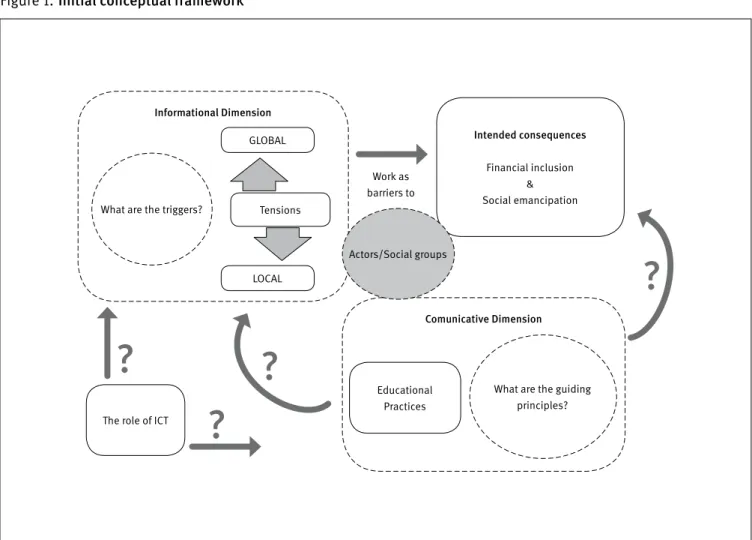
Although the literature reviews revealed several valuable frameworks that could guide our empirical activity, we decided to apply a conceptual framework recently proposed by Birochi (2011) since the framework itself was built as a result of a synthesis of a comprehensive literature review on critical inancial education and ICT-mediated education. The conceptual framework encompasses two main dimensions: informational dimension and communicative dimension (Figure 1). The concept of actors/ social groups is central to the framework and it refers to the linkages between individual actors and a set of people who share a common position in their community or society and who are willing to share a set of common assumptions and interests
(Pozzebon & Diniz, 2012). The framework shows that often global/ local tensions characterizing the informational dimension in remote territories work as barriers to achieving the intended consequences of microcredit programs, inancial inclusion and social emancipation. Likewise, the framework proposes that a communicative dimension might play a role in this process. Finally, the framework places ICTs as an important element, the particular role of which should be elucidated.
transformation. This reasoning is also applicable to broader cross-cultural inancial education literature, as global/local tensions or gaps are one way to analyze social phenomena where diferent contexts or diferent cultures are involved. At the heart of global/ local tensions we ind ICT artifacts, as their overwhelming presence, even in remote corners of the world, have been a source of disruption and also non-intended innovations (Castells, 1998). Although the right to information and knowledge is an important entitlement − its absence can contribute to poverty − this notion needs to be balanced against the broader context of existing social and economic inequalities, which may reinforce themselves through technology (Castells, 1997).
Figure 1.
Initial conceptual framework
What are the guiding principles? What are the triggers?
The role of ICT
Educational Practices
Intended consequences
Financial inclusion & Social emancipation Informational Dimension
Comunicative Dimension Actors/Social groups
?
?
?
?
GLOBALLOCAL Tensions
Work as barriers to
The communicative dimension seeks to identify a set of guiding principles that will guide educational practices involving low-income micro-entrepreneurs. This dimension will grow out of our critical perspective: we see educational practices as a tool for the social emancipation of social actors. To achieve this goal, we propose to investigate the characteristics of low-income micro-entrepreneurs regarding two main aspects: social processes and technological processes. This investigation seeks to understand how the various social restrictions imposed on individuals limit and determine their forms of social interaction. The low-income micro-entrepreneur is afected by social processes,
i.e., the interaction of low-income micro-entrepreneurs among themselves and with other groups, like unions and community associations. As a result of the systematic practice of dialogue, aimed at catalyzing critical relection on reality, the restrictions and limitations imposed by the dominant ideology are broken.
low-income micro-entrepreneur is also afected by technological processes, where local actors seek to overcome the limitations imposed by the local context to gain access to inancial services and/or education by technology means, or simply to gather any other type of information from outside the local context. In this process, it is imperative to undo the image of technology as a neutral and non-ideological instrument so as to permit the emergence of underlying factors which disclose the interests linking the technology to the dominant socioeconomic system. With this in mind, we need to look beyond technology and seek to understand the value of ICTs. In the context of our study, the investigation of these two processes will help us to better adapt the critical inancial education framework to low-income micro-entrepreneurs’ characteristics.
A review of diferent approaches to inancial education and the use of ICTs corroborate our initial determination to explore and propose a inancial education framework tailored to micro-entrepreneurs, using technological artifacts and based on a critical approach. We consider this represents an important gap in the literature, and therefore justiies the research line of inquiry guiding our empirical investigation: what are the guiding principles of an ICT-supported inancial education framework that can help to improve inancial inclusion and social emancipation, particularly of low-income micro-entrepreneurs? To answer to this research question, we conducted our empirical work in a small community in the Brazilian Amazon, where the introduction of inancial access through a banking agents’ network has brought about unprecedented socioeconomic changes.
METHODOLOGICAL DESIGN
The investigative approach used in our empirical research is consistent with the paradigm known as critical theory (Guba & Lincoln, 1994): reality is not a given, set concept but, rather, is built based on history by an ideology that concretizes it in necessary, rational and true facts. According to critical theory (Alvesson & Willmott, 2003), reality serves a speciic purpose: maintenance and reproduction of the prevailing system, based on various manifestations of power (economic, social and political) and aimed at asserting and legitimizing the supposedly objective and unbiased truth of reality. Critical theory seeks to lay bare the contradictions of the prevailing system by reinterpreting them in light of critical perspectives on historical phenomena (Prasad, 2005).
The epistemological aspects of science are addressed by critical theory from the perspective of the inseparable relationship
between the subject and the object of knowledge, in which the dialogical aspects between them prevail. Such dialogue is dialectic, as it leads to an ongoing process of questioning reality that uncovers contradictions and antagonisms. The process of critical thinking leads individuals to seek and to take action to transform their reality. Therefore, individual knowledge is related to transformation of reality. Through a dialectical movement of thought and action, individuals become aware of their reality and are motivated to overcome the oppressive conditions in which they ind themselves (Freire, 1993). Among the various research methods consistent with critical theory, we favor the method of in-depth case study (Stake, 2005).
Selected case: Municipality of Autazes
The selected case refers to the municipality of Autazes situated in the heart of the Amazon forest. Located some 96 kilometers from Manaus, capital of Amazonas State, Autazes can be reached by road in approximately three hours (depending on weather conditions) with an appropriate vehicle or by boat (a twelve-hour journey). The municipality has some 30,000 inhabitants, of whom some 16,000 live in the urban area. The region of Autazes comprises a total of 40 communities and covers approximately 7,600 square kilometers. It is important to note that the 14,000 people who live in the communities outside of the urban area (the largest being Novo Céu, with about 3,000 inhabitants) have no access to inancial services close to their homes and often need to travel many hours by boat to downtown Autazes for their banking needs.
had six businesses ofering correspondent banking services and one bank branch.
Banking correspondents faced two common problems with the technological platform, which consists of two devices connecting the terminals (point-of-sale devices) to the bank via the Internet and phone lines. Firstly, correspondents experienced regular diiculties in connecting to the network due to the region’s instable telephone and Internet systems. Secondly, high demand on paydays overloads the network, leading to indeinite downtime in the whole system. These technological problems were the main reasons why several users avoided banking transactions at these correspondents.
Microcredit in Autazes is provided by two public organizations: the Agência de Fomento do Estado do Amazonas (AFEAM [Agency for the Promotion of the State of Amazonas)], a non-bank inancial institution; and the Programa Nacional de Fortalecimento da Agricultura Familiar (PRONAF [National Program for Strengthening Family Agriculture]), which is federally supported through the Ministério do Desenvolvimento Agrário (Ministry of Agrarian Development) to provide inancial support to farmers and their families in both farming and non-farming activities. PRONAF’s microcredit allows farmers to expand into new farming and non-farming income-generating activities, as well as acquire machinery, equipment, seeds and inputs.
ICTs in Autazes are present in the public primary and high schools as well as in classes for youth and adult literacy. ICTs are also available through a public telecenter that ofers 20 computers connected to the internet, supported by coaches who act as facilitators for the users. The Centro de Mídias de
Educação do Amazonas (Amazonas Education Media Centre),
which manages the distance education program, is an Amazonas State Government initiative to expand and diversify public Amazonas State education through ICTs, using an internet network via satellite.
The city has several training programs for the micro-entrepreneur, programs managed by the federal government, unions and social movements. Among these are: training programs tailored to SEBRAE’s rural micro-entrepreneurs; a inancial inclusion program called Projovem Urbano (Urban Pro-Youth); a literacy program for artisanal ishermen called Pescando Letras (Fishing Letters); the national educational program related to agrarian reform called Programa Nacional de Educação na
Reforma Agrária (PRONERA); and the Jovem Saber (Youth
Knowledge) program, ofered by the Confederação Nacional dos Trabalhadores na Agricultura (CONTAG [National Confederation of Agriculture Workers]), a distance learning program for young rural workers, with a focus on professional training and union politics. Of these programs, the last two - PRONERA and Jovem Saber –
most closely relate to the pedagogical principles of Freire, since they are oriented towards empowerment and social emancipation. Despite this, none of the city’s programs include content related to inancial education. Although PRONERA and Jovem Saber integrate critical and emancipatory approaches, neither provides inancial training for micro-entrepreneurs.
The choice of Autazes as a case study was based on the municipality’s unique features, which help in understanding the phenomenon under study. Beyond sharing numerous characteristics with hundreds of typical Brazilian municipalities – such as a high level of agricultural and commercial activity – it enjoys growing access to inancial services and is located within a very particular geographical context: an isolated town, surrounded by rivers, in the Amazon rainforest. To some extent, this geographical context allows us to isolate certain socioeconomic phenomena, and, thus, better understand their impact on the perceptions of the social actors interviewed.
Data collection
Data were collected in two periods – December 2009 and June 2010 – using semi-structured interviews and ield notes based on non-participant observation, including records of observations, informal discussions and conversations. Information from secondary sources was also collected, such as documents, newspapers, magazines and websites.
Exhibit 3.
Respondents by social groups
Social group Respondents Characteristics Selection criteria
Low-income micro-entrepreneurs 13 Producers, traders and rural and urban service providers
Owners of small businesses or economic activities, with no employees
Teachers 9
Teachers and coordinators of public and distance learning courses for youngsters and adults
Experience teaching youngsters and adult low-income micro-entrepreneurs in classroom or distance learning
Unions 4
Oicers and employees of unions, associations or cooperatives of rural and urban workers
Union representatives, representatives of associations and/or cooperatives of workers
Public managers 6
Municipal civil servants, state and federal education programs for low-income micro-entrepreneurs; microcredit program managers
Government oicials working directly with programs targeted to low-income micro-entrepreneurs
Data analysis
Data analysis followed the basic coding techniques proposed by
Miles and Huberman (1994). These analytical techniques were steered by concepts in the conceptual framework on which the encoding process was based. The information obtained through audio recordings during the interviews was fully transcribed and coded using NVivo. To ensure respondents’ anonymity, all names have been changed.
We followed a deductive-inductive analytical strategy, where the conceptual framework worked as a sensitizing guide to the empirical investigation. The data collection was guided by the concepts and dimensions as proposed by the framework (the deductive part). At the same time we allowed for deviances, inconsistences and new elements which might emerge inductively from the analysis. Pre-existent themes (codes, labels) – inspired by the conceptual framework – as well as the emergent themes – those inspired by the empirical data – were subject to iterative techniques – de-contextualization, aggregation, reconceptualization, as suggested by Miles and Huberman (1994), leading to the development of a reined conceptual framework.
Prior to the coding process, Excel worksheets were created to join all the data collected from the interviews, with information such as the respondent’s proile, their role or position (e.g., driver, teacher, street vendor), address, duration of the interviews, among others. We enriched the database with the transcribed ield notes from observation and with secondary data, such as
documents and web sites. The interviews were compared in both within- and cross-group mode from the relevant social groups. In an initial phase, we codiied and compared data from interviewers taken from the same relevant social group (for instance, micro-entrepreneurs). The functionalities Tree Nodes and Case Nodes of NVivo provided support for this procedure. A hundred and forty codes were generated in this irst phase. In the second phase we compared data from diferent relevant social-groups – several codes were eliminated, others aggregated, others added – consolidating a small number of codes, according to the concepts and dimensions provided by the conceptual framework and also according to emergent concepts. The iterative analysis of the empirical data allowed the revision of the conceptual framework, the reinement and adjustments of the concepts and led to interesting insights.
Exhibit 4.
Triggers: Chain of evidence among open codes, selective codes and categories from empirical ield
Dimension Category (Triggers)
Informational dimension: Local vs. global tensions
Lack of inancial education and training programs for low-income micro-entrepreneurs
Lack of contextualized information
Selective Codes Open Codes
Indebtedness
Raising of payroll loan (a loan for which the payments are deducted directly from the client’s pay check) specially among retired individuals
Bureaucracy (oicialism)
Diiculty of getting access to credit for productive activities, since the beneiciaries could not provide the required collateral guarantees and the oicial documentation proving their capacity to pay back the loan
Lack of adequate credit policies
Private inancial agents seek to expand their credit portfolio at low risk; abundant ofer of additional inancial resources for a population which historically had diicult access to credit; inadequate inancial information structure for population
Lack of inancial information
Lack of operational knowledge (instrumental knowledge); lack of knowledge regarding the inancial system’s norms and rules)
Lack of contextualized information
Lack of synchronization between characteristics of the educational current programs and local needs of students
The same occurred with the guiding principles, as can be observed in the Exhibit 5.
Exhibit 5.
Guiding principles: Chain of evidence among open codes, selective codes and categories from literature review
Dimension Category (Guiding principles)
Communicative dimension: Transformative educational practices
Dialogue and debate
Critical thinking
Meaningful learning
Social practices
Selective codes Open codes
Dialogue and debate Simulated negotiations between peers and by understanding the role played by various actors in the social system
Critical thinking
Undo the dominant ideology; individuals and their social groups begin a process of reviewing established social truths, seeking to identify the gaps and issures in the hegemonic discourse
Meaningful learning Local context that shapes individual’s worldview; strength community bonds and ties
Social practices Constant process of critical relection (action/relection/ action); act on the world to transform the reality
Empowerment
Enhancing the capacity of poor people to inluence the state institutions that afect their lives, by strengthening their participation in political processes and local decision making
Problem-posing
Problem-posing attitude regarding various aspects that make up the dominant ideology; undo the impression that the world rests on immutable facts; emphasize the historicity of institutions and economic and social power, tensions and divergent interests among social groups; social action by social mediators (associations, unions, cooperatives)
Political action
In order to better illustrate the coding process that allowed us to achieve our results, we added Exhibits 4 and 5 to further illustrate the chain of evidences, in addition to Exhibits 6 and 7 that are integrated in the presentation of the results,.
RESULTS
In this section, following a brief description of the socioeconomic changes that occurred in the municipality of Autazes as a result of expanded local access to inancial services, we shall present our analysis and discuss the results pertaining to the informational and communicative dimensions, as deined in the conceptual framework.
Context: Access to financial services in
Autazes
Following the implementation of the irst banking agents, the economic boost brought about by access to inancial services has signiicantly transformed the economic conditions in Autazes. The local population began to perform inancial transactions in
local retail establishments, no longer needing to travel to the capital as they did before the start of banking agents operations. All economic sectors have since grown signiicantly. The access to inancial services enabled by banking agents also introduced new technological products, such as electronic banking cards, previously unknown to most of the local population. Hence, Autazes, which until 2002 had been relatively isolated from the main facets of economic progress, was exposed in a brief period to abundant bank credit and other modalities of inancial services. In short, the municipality faced a brand new reality without the information necessary to assist people in handling and understanding new processes and resources.
Informational dimension: Local
vs.
global tensions
During the empirical investigation process, two triggers were identiied in the use of ICT artifacts for low-income micro-entrepreneurs to access inancial services: the lack of inancial education and training programs for low-income micro-entrepreneurs and the lack of contextualized information. Exhibit 6 presents example quotations that illustrate the importance of those triggers.
Exhibit 6.
Quotations that corroborate the analysis of the informational dimension
Trigers Quotations
Lack of inancial education and training programs for low-income micro-entrepreneurs
“...we are aware that people should have more access to information about credit. That’s why I think we need, in addition to a course focused on the use of credit cards...also aimed at educating about credit itself.” [Baker]
Lack of contextualized information “... The kind of local education that is given is not discussed with local civil society... all contents came deined top down...” [Local coordinator of Jovem Saber program]
Lack of inancial education and training programs for low-income entrepreneurs: Several low-income micro-entrepreneurs mentioned a need for inancial training in the use of electronic cards in connection with their businesses. Even the most elementary forms of access to inancial resources require minimum instrumental knowledge to enable users to operate the technological artifact – i.e. users, in general, must be able to perform simple operations, such as entering their passwords. Functionally illiterate individuals, such as many artisanal ishermen of Autazes, struggle to perform this type of basic operation.
The lack of contextualized inancial education programs in support of microinance initiatives creates tensions between the local and global spheres. These tensions promote increased social exclusion of low-income communities, marked by insolvency legal proceedings and culminating in negative credit records.
In this context, the high rate of indebtedness among the low-income population is evidence of one of the perverse side efects of Autazes’ recent socioeconomic development. Therefore, inancial education has an important role to play in relieving socioeconomic tensions. Moreover, it must be part of a broader program, supported by public policies, to enable individuals to achieve social emancipation.
the capability to use technological devices is no guarantee of empowerment. Many of these models might leave customers unaware of potential connections to other inancial services that could make their lives easier, or unaware of alternatives.
Our analysis suggests that tailored ICT applications have the potential to enable local needs of low-income micro-entrepreneurs to be met. These applications might enable micro-entrepreneurs to form local networks in concert with programs of local productive development and other governmental initiatives. Those local networks should favor information and knowledge exchange – both local and non-local – through functionalities that allow dialogue and debate within and across those social groups. The ultimate goal is the development of a critical awareness of the role of entrepreneurship in local development. We did not encounter these conditions in Autazes, but grasped from our interviews that people are conscious of its need.
Lack of contextualized information: teachers working in a speciic governmental educational program for young adults emphasize the lack of synchronization between characteristics of the current program and local needs of students. For example, the federal government, which is responsible for the program, decided to promote technical sawmill expertise, though this activity rarely occurs in the Amazonian context. In this case, it would be reasonable to expect such specialization to be somehow correlated with forestry products and their respective context. Emphasis on local characteristics is essential to the success of any inancial education program: i.e., taking account of and meeting the demands of the local community.
We argue that highly standardized ICT applications work as barriers to empowerment and social transformation. The lack of it of ICTs to the contextual characteristics that shape local micro-entrepreneurs – with their speciic needs and interests – open spaces for uses of ICT that might potentially result in social exclusion and inequalities. In Autazes, we found a number of examples where microinance initiatives using highly standardized ICT applications – like point of sales (POS) and smart cards – are parts of inancial access programs which add no contextual information neither through those channels nor additional ones. Local interests and needs are not taken into consideration. Social groups formed by local micro-entrepreneurs, worker unions, local associations and cooperatives, are not listened to. These groups are unable to contribute to the building of those programs. Two concrete examples are the local public telecenter and existing ICT-based educational programs such as the Centro de Mídias de Educação do Amazonas. Both ofer an excellent technological infrastructure supported by technical experts, but each are standardized and not connected to any
strategy of social or inancial inclusion oriented towards micro-entrepreneurs.
Furthermore, signs of increased social exclusion are detectable by the characteristics of access to the resources available – i.e., access to inancial assets for businesses and access to and use of technological resources. Tensions between the local and global spheres are revealed when individuals attempt to access such resources, and at this point, the need for inancial education initiatives to overcome multiple tensions arises. Information asymmetries between players and the near absence of inancial education programs integrated with available inancial services are further factors in such tensions. Educational alternatives addressing issues beyond simple instrumental notions regarding the use of bank cards may also be part of the means of rising to these challenges. In this context, broad dissemination of information about the public resources available to citizens should be part of an action plan aimed at empowering local low-income micro-entrepreneurs. However, results will only be efective if the local context is taken into account in the process of designing a inancial education program.
Communicative dimension: Transformative
educational practices
From analysis of our interviews we recognized that from the many principles identiied in literature four elements seem crucial to enable a inancial education program to promote local development and social emancipation. Absence of these guiding principles prevents the program from achieving positive results. In Autazes we noticed their absence or, in some cases, we detected their presence in embryonic or non-purposeful form, i.e. simply as instrumental knowledge, as in the case of SEBRAE’s programs. These programs are not articulated or managed in a way which might promote positive outcomes. The four guiding principles are: dialogue and debate, critical thinking, meaningful learning and social practices (action/relection/action). It is no coincidence that all of those elements adhere to a transformative approach to inancial education. Exhibit 7 presents examples of quotations that illustrate the importance of those four elements.
which provide a good forum for dialogue and to debate their claims. We argue that such practices - dialogue and debate - are seminal social mechanisms which can act as a balance between individual needs and the interests of the social group to which the individual belongs. Dialogue and debate is a practice actors use to shape their own critical views of reality. They do this to undo the dominant ideology through the continuous exercise of critical relection shared within the social group. Dialogue can be practiced through debate, from simulated negotiations between peers and by understanding the role played by various actors in the social system, as well as other educational activities.
Exhibit 7.
Quotations that corroborate the analysis of the communicative dimension
Guiding principles Quotations
Dialogue and debate practices
“... they were ... people like that ... They did not know what they should demand ... They did not know their rights ... Today they are questioning... “[Local teacher]
Critical thinking practices
“There are no institutional instruments for the individual to acquire his own conscience. I call this ‘conscious education’. You are missing a conscious education that enables citizen participation so that it can exercise their social rights in full.” [Union of rural workers]
Meaningful learning practices
“... and they’re geared to do just that: work with the site, using, for example, in mathematics, quantities of manioc, quantities of pulp, etc. ...” [Local teacher]
Social practices (Action/ relection/action)
“... the Projovem – Saberes da Terra (Knowledge of the Earth) [Educational program targeted to the agricultural worker] is no longer limited to the classroom, but also to practice: learning by exercising agriculture” [Union of rural workers]
“School has a sort of connection with the community. Here, we have technological education, which facilitates the connection of the local community with the world through the Internet... They are also organizing themselves. The ways that they will get the inancial resources to make the community grow. So this is a bond of union. Mainly the parents-teachers association, to improve the unity of the people in search of a better education ... Everything is now revolving around the cooperatives, the exchange of knowledge: ish farming cooperative, agricultural cooperative, milk cooperative, etc.” [rural school teacher – distance learning education]
Despite this willingness for dialogue and debate between low-income micro-entrepreneurs, there are no social mechanisms to foster critical thinking of reality. We refer to educational and social mechanisms that promote dialogue as a practice by which actors build their own critical views of reality, through continuous exercise of critical relection shared with the social group. Critical thinking is a practice that seeks to ofer micro-entrepreneurs the opportunity to relect critically on their own economic and social status vis-à-vis the dominant ideology in the practices of banking correspondents of Autazes when dealing with microinance. How this disconnect is perceived provides an opportunity to undo the prevailing view.
Moreover, when local micro-entrepreneurs recognize local references from the content under discussion related to their daily lives, there is a deep sense of belonging to the learning process, which strengthens educational linkages and helps overcome constraints and barriers. Educational practice which brings non-local educational programs to a non-local community and transforms content into something meaningful in the local context is called meaningful learning. This strengthens community bonds and ties to education, which becomes the actors’ ally in their learning
process. Several teaching strategies are used, such as tailored games.
Various dynamics and actions can be implemented for microinance education, based on local reality, such as: the creation of units of measurements related to Amazonian fruits or other local produce; maps with reference places and to local activities; setting up local newspapers; and campaigns for newspapers to adopt the local language. SEBRAE employs such dynamics and creates games based on the examples above, these dynamics and games being appropriate to the local context.
In such a scenario, social practices occur as a constant process of critical relection (action, relection, action), which leads the individual to act on the world. This combination of action and relection is what Freire refers to as social practice or praxis: relecting and acting upon the world in order to transform it (Freire, 1993). Social practices constitute a constant exercise of citizenship, as we perceived, albeit in incipient form, among students of the Projovem Urbano program.
relection that Freire called social practice or praxis: relection and action upon the world in order to transform it (Freire, 1993). Social practices thus manifests as a constant exercise of citizenship, as we perceived, in an incipient way, among students of Projovem Urbano education program.
During this process of critical reflection and action, the awareness that public resources belong to the local community is acquired, which constitutes an important step towards empowerment. Local and non-local resources such as technological artifacts, ICT infrastructures, public funds for micro-entrepreneurs and public education programs, take on a new meaning for each one in the community. However, empowerment practices in Autazes are scattered and disjointed in education programs for low-income micro-entrepreneurs, without any dialogue among them, such as, for example, Projovem – Saberes da Terra, PRONERA and Jovem Saber programs. In this perspective, the notion of empowerment as choice and control of ones’ own life is still far from being fully realized in Autazes. According to the World Bank (2000, p. 39) “empowerment means enhancing the capacity of poor people to inluence the state institutions that afect their lives, by strengthening their participation in political processes and local decision making. And it means removing the barriers - political, legal, and socio-cultural - that work against particular groups, and building the assets of poor people to enable them to engage efectively in markets”.
In parallel with this, many public programs and initiatives were also identiied, as previously presented, that foster inancial inclusion, such as: digital inclusion programs; educational programs for capacity building of low-income micro-entrepreneurs; government programs for the promotion of local socioeconomic development; distance education programs to youth and adults; and educational programs ofered by unions and associations. Despite the diversity of oferings, programs do not have articulation between them, resulting in isolated actions, which overlap or do not meet the speciic needs of low-income micro-entrepreneurs. Moreover, none of these programs consider, at least, two seminal elements for the processes of inancial inclusion of low-income micro-entrepreneurs: inancial education principles and critical use of technological artifacts. In other words, given that the low-income micro-entrepreneurs make frequent use of ICT artifacts to carry out their microinance transactions, and that inancial education is needed to support them in their business, it becomes central to implement inancial education programs targeted at this proile, which makes use of ICT artifacts. In this sense, an ICT-supported inancial education program tailored from a critical perspective should act as a transversal axis between the above-mentioned initiatives, aimed at appropriation of the use of available resources, as well as the
socioeconomic transformation. In this precise sense, the critical approach should act as a critical instrument to the dominant system, to guide the two previous elements towards the social emancipation of the low-income micro-entrepreneurs.
DISCUSSION AND IMPLICATIONS FOR
FINANCIAL EDUCATION
A critical inancial education program must take account of the proile and socioeconomic conditions of low-income micro-entrepreneurs before addressing solutions aimed at developing speciic local skills. In tailoring programs to local low-income micro-entrepreneurs, the irst step must be a clear outline of the local context, as represented in its historical, social and economic aspects. Nevertheless, unless such inancial education strategies are capable of engendering tangible and concrete economic practices related to activities carried out by locals, they will not suice. These initiatives must simultaneously take account of both the local and the individual context, in order to understand characteristics, habits and customs. Hence, critical inancial education programs must connect educational processes to individuals’ way of life, recognizing the singularities of their needs and circumstances, as expressed by economic and subsistence activities (Kempson & Collard, 2012). Relationships between individuals and other social groups, as well as those within their own social group, promote or constrain their actions in ways that may also shed light on additional elements involved in this process. Meaningful learning is also considered a central aspect of
Freire’s critical pedagogy (1993). Accordingly, training programs provided by global providers or any actor outside the local context should strive to understand the speciicities of low-income micro-entrepreneurs so as to present more contextualized solutions (language, examples and dynamics). Understanding current habits and practices concerning educational process, local inancial services (Burkett & Sheehan, 2009; Cabraal, 2011), the ICTs available (Gigler, 2006) and the social mediation processes performed by groups during their social interactions, are important factors for successful achievement of these goals.