436
Review of Business Management., São Paulo, Vol. 18, No. 61, p. 436-456, Jul./Sept. 2016
REVISTA BRASILEIRA DE GESTÃO DE NEGÓCIOS ISSN 1806-4892
REVIEw Of BuSINESS MANAGEMENT e-ISSN 1983-0807 © FECAP
RBGN
Review of Business Management
DOI: 10.7819/rbgn.v18i61.2471
436
Received on 04/24/2015 Approved on 06/09/2016
Responsible editor:
Prof. Dr. Guilherme Shiraishi
Evaluation process: Double Blind Review
The advertising value of Twitter Ads:
a study among Mexican Millennials
Enrique Murillo¹
María Merino¹
¹ITAM, Department of Business Administration, Mexico City, Mexico
Adriana Núñez
Independent Business & IT Consultant, Mexico City, Mexico
Abstract
Purpose – his study set out to measure the perceived Advertising Value of Twitter ads on a large sample of Mexican Millennials.
Design/methodology/approach – An online survey was used to collect data among 630 university students. he hypothesized antecedents of Advertising Value were Informativeness, Entertainment, Irritation and Credibility. he model was estimated using Partial Least Squares.
Findings – Results indicate Informativeness and Entertainment were the strongest predictors, with Credibility in third place. In addition, Credibility displayed gender efects: it was signiicant for female respondents but not for males. Irritation failed to reach statistical signiicance in most subsamples, suggesting Twitter ads are more acceptable to Millennials than other advertising formats.
Originality/value – Millennials tend to dismiss traditional advertising formats. At the same time they are heavy users of Social Networking Sites. his research provides the irst empirical estimation of the Ducofe model of Advertising Value in the microblogging service Twitter, and the irst application of this robust model of web advertising to a Latin American sample. Our results have important implications for both regional and global brands targeting Millennials.
1
Introduction
Despite being ranked among the top destinations on the Internet, Social Networking sites (SNS) often struggle to generate revenues commensurate to their large operating costs. Typical revenue models used by SNS are advertising, subscription and transaction (Enders, Hungenberg, Denker, & Mauch,
2008). Among them, the advertising model, which includes text and banner ads, ailiate ads, and sponsorships, is the most commonly used by SNS (Enders et al., 2008; Nogueira-Cortimiglia, Ghezzi, & Renga, 2011). his model depends on a large user base, with monthly active users as the key metric, because most advertisers will require several million unique visitors to consider a particular SNS as a feasible option to invest their advertising budgets.
Twitter is among the most popular SNS; it claims 310 million monthly users, with 79% of them outside the US (Twitter, 2016). In Latin America, Brazil and Mexico have the largest number of users, expected to reach 27.7 and 23.5 million by 2016 (Emarketer, 2016a). Moreover, Twitter users in the region are mostly teenagers and young adults, which suggest Twitter advertising would be an attractive option for brands targeting Millennials.
However, companies have struggled to connect with the Millennial generation, because many of the traditional methods of advertising have proven ineffective at capturing their attention. Only 1% of Millennials surveyed in a recent study said that a compelling advertisement would increase their trust in a brand. Millennials believe that advertising is all spin and not authentic (Schawbel, 2015).
Therefore, it is imperative to better understand the opinions and attitudes of young Latin American consumers toward Twitter ads. In particular, establishing to what extent factors such as the perceived Credibility of the ad, or the Irritation attached to it, afect users’ attitudes toward Twitter advertising, and whether this should encourage or discourage brands from such
practices. his study provides a clear empirical answer to these questions using the model of Advertising Value proposed by Ducofe (1996). Our indings are thus relevant to global and regional brands targeting young consumers in Latin America.
2
Twitter Features and Ad Formats
he microblogging service Twitter was launched in 2006, and has grown to become one of the most popular SNS in the world. An independent forecast from Emarketer (2016b) estimated that worldwide active Twitter users, deined as those who enter their account at least monthly, will reach 291 million in 2016, with most of the growth coming from emerging markets.
Like other SNS, users can post status updates to their connections (called Followers in Twitter), and in turn can read the updates of the people or companies they are following. hese posts were originally limited to 140 plain-text characters, thereby allowing the service to operate over mobile phone networks as SMS messages. his native ability to run both over the Internet and cell-phone networks greatly contributed to Twitter’s rapid difusion.
438
Review of Business Management., São Paulo, Vol. 18, No. 61, p. 436-456, Jul./Sept. 2016 Enrique Murillo/ María Merino / Adriana Núñez
Like most other SNS, Twitter provides its service free to users, and relies on an advertising revenue model (Enders et al., 2008). Twitter began paid advertising in 2010, and has seen its ad revenues grow steadily, particularly in the mobile platform which currently comprises 90% of ad revenues (Emarketer, 2016c). However, Twitter has been careful to protect its user experience, and to avoid overloading users with ads (Copeland, 2012). Ad clutter on Twitter is perceived as lower than other popular Internet platforms, such as Google Search or Facebook (Tassi, 2013).
The rapid growth of SNS advertising budgets is strong justiication for researching consumer attitudes toward the ads they encounter on these platforms (Saxena & Khanna, 2013; Taylor, Lewin , & Strutton, 2011). Previous studies have examined advertising in SNS in general (Chandra, Goswami, & Chouhan, 2013; Saxena & Khanna, 2013; Taylor et al., 2011) or in Facebook, the current SNS leader (Dao, Le, Cheng, & Chen, 2014; Logan, Bright, & Gangadharbatla, 2012; Méndiz-Noguero, Victoria-Mas, & Arroyo-Almaraz, 2013). here are also numerous studies on the use of Twitter as a platform for engaging with consumers, in areas such as customer service (Coyle, Smith, & Platt,
2012; Sreenivasan, Lee, & Goh, 2012), brand engagement (Kwon & Sung, 2011; Li & Li, 2014; Logan, 2014; Sandoval-Almazán & Nava-Rogel, 2012), and electronic Word of Mouth (Jansen, Zhang, Sobel, & Chowdury, 2009; Kim, Sung, &
Kang, 2014; Zhang Jansen, & Chowdhury, 2011). hese studies fall under the rubric of engagement marketing, whereby companies publish branded content on their SNS, usually without any cost, in the hopes that their followers will engage with this content by “liking” it, adding a comment,
or in the best of cases forwarding it to their own social contacts (Henry & Harte, 2012).
he other use of Twitter as a marketing platform is targeted advertising, whereby Twitter places “promoted” posts in front of selected users and charges advertisers according to the actions users take. However, tech-savvy Millennials may recognize these posts as paid advertising, and may react to them unfavorably (Schawbel, 2015). his is where Ducofe (1996) robust model of Advertising Value can provide valuable insights, because it explicitly considers consumer irritation with ads as a predictor of perceived Advertising Value. However, a direct application of this model to Twitter ads has yet to be attempted. Given the growing popularity of Twitter in Latin America, and potential advertiser concerns about user irritation with ads, our study provides the irst estimation of Advertising Value for Twitter ads in a Latin American context, with Spanish-translated scales.
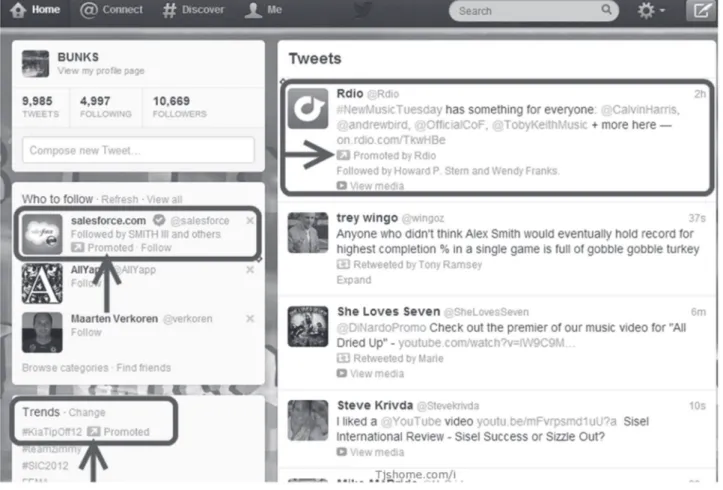
Figure 1. Twitter advertising formats. Source: www.serps-invaders.com.
Note. used with permission.
Next, there are Promoted Accounts, which appear on the Who to Follow section of the user’s homepage, again marked as Promoted. he Twitter algorithm analyzes the brand’s followers and determines other brands those users tend to follow. When it detects a user that follows those brands, but not the advertiser’s account, the algorithm recommends the advertiser’s Promoted Account to that user (Twitter, 2014b). The advertiser pays for the number of new followers it gains.
hird, there are Promoted Trends, which appear at the top of the Trending Topics list on Twitter and are also labeled as Promoted. hey are visible to all users of Twitter while they are being promoted (Twitte, 2014c).
With the exception of the “Promoted” label, these ad formats look just like as ordinary tweets, trends and suggested accounts. herefore, they display natively in the Twitter desktop and
mobile user interface, as well as the various Apps Twitter provides for all mobile operating systems: iPhone, Android, Blackberry, Windows, Symbian, etc. Given the growing importance of mobile advertising, this compatibility between desktop and mobile screens has become an important advantage for Twitter in the ongoing shift of digital advertising budgets toward mobile platforms (Emarketer, 2015; Koh, 2014).
3
Consumer Attitudes Toward SNS
Advertising
440
Review of Business Management., São Paulo, Vol. 18, No. 61, p. 436-456, Jul./Sept. 2016 Enrique Murillo/ María Merino / Adriana Núñez
worth or utility of advertising to consumers” (Ducofe, 1995, p. 1). his evaluation is conceived as a thoughtful “cognitive assessment of the extent to which advertising gives consumers what they want” (Ducofe, 1996, p. 24).
This model is based on the theory of media Uses and Gratifications (McQuail, 1983), which argues that media users expose themselves selectively to media based on their needs and gratification-seeking motives, and thus satisfy their utilitarian and/or hedonic
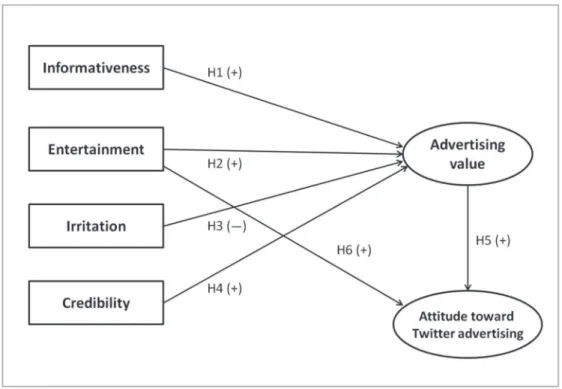
needs. Accordingly, Ducofe (1996) proposed Informativeness, Entertainment and Irritation as antecedents of Advertising Value, and proposed a positive association between Advertising Value and Attitude toward web advertising. Credibility was later included in the model as a fourth antecedent of Advertising Value, again in the context of cyberspace advertising (Brackett & Carr, 2001). Figure 2 displays the model and the associated hypotheses. Next, we provide construct deinition and formulate our hypotheses.
Figure 2. Advertising Value model.
Informativeness. Marketing theorists generally agree that the primary function of advertising is to convey information about products and services to allow consumers to make the best possible purchase decisions. If an ad provides useful, timely and relevant information consumers are more likely to perceive the ad as valuable. Hence our irst hypothesis:
H1: he perceived Informativeness of the Twitter ad is positively associated with its perceived Advertising Value.
in both ad copy and the multimedia material that Twitter currently allows. herefore, we propose:
H2: he perceived Entertainment of the Twitter ad is positively associated with its perceived Advertising Value.
Irritation. Consumers can be irritated by advertising tactics they ind annoying, ofensive or overly manipulative (Ducofe, 1996). he excessive amount of advertising that users ind on some sites, or ad clutter, can also be a source of irritation (Kim & Sundar, 2010). his leads to our third hypothesis:
H3:he perceived Irritation of the Twitter ad is negatively associated with its perceived Advertising Value.
Credibility. Brackett and Carr (2001) proposed Credibility as a valid extension to the Ducofe model, citing its prevalence in other models (Eighmey, 1997; MacKenzie & Lutz, 1989). In their study of web advertising value among college students, they found that using Credibility as an antecedent of Advertising Value increased the predictive power of the original model. herefore, we postulate:
H4: he perceived Credibility of the Twitter ad is positively associated with its perceived Advertising Value.
In Ducofe’s (1996) original formulation, Advertising Value positively inluenced Attitude toward web advertising, with an estimated
correlation of 0.70. Furthermore, he proposed that Entertainment also had a direct and positive efect on attitude toward web advertising because “both these constructs possess afective dimensions that are not captured by Advertising Value” (Ducofe, 1996, p. 30), the latter being conceived mainly as a cognitive construct. We capture these two hypothesized relationships as follows:
H5: he perceived value of the Twitter ad is positively associated with the Attitude toward Twitter advertising.
H6: he perceived Entertainment of the Twitter ad is positively associated with the Attitude toward Twitter advertising.
442
Review of Business Management., São Paulo, V
ol. 18, No. 61, p. 436-456, Jul./Sept. 2016
Enrique Murillo/ María Merino / Adriana Núñez
Table 1
Previous applications of Advertising Value model
Study Advertising format Survey/sample Method Predictors of
Advertising Value
Signif. Betas
Direct efect on Attitude toward
Advertising
Fit indices
Ducofe (1996) Banner ads Intercept survey in Manhattan business districts
n=318 age=32avg, 71% male Path analysis
Informativeness Entertainment Irritation 0.419 0.358 - 0.202 0.914 (AGFI)
Brackett & Carr (2001) Banner ads Paper surveyn = 421 University students, 53% male
General factorial Anal. of Variance Informativeness Entertainment Irritation Credibility Signiicant Signiicant Signiicant Signiicant Signiicant Signiicant not sig. Signiicant 0.556 0.488 (Adj R2)
Lin & Hung (2009) Sponsored search links
Online/paper survey n = 711
37.6% older than 25; 53% male PLS
Informativeness Entertainment Irritation Credibility 0.186 0.122 - 0.155 0.408 not sig. 0.196 - 0.212 0.18 0.684 (R2)
Sun et al. (2010) Banner ads Laboratory experimentn = 134 university students, 35% male
PLS InformativenessEntertainment Irritation 0.232 0.288 - 0.264 0.99 (AGFI)
Logan et al. (2012) Facebook ads Online surveyn = 259
female university students SEM
Informativeness Entertainment Irritation 0.52 0.41 - 0.40 -0.13 0.99 (AGFI)
Logan (2013) Online streaming TV advertising Professional online surveyn = 377
young adults (18-34), 55% male SEM
Informativeness Entertainment Irritation 0.34 0.61 0.51 - 0.82 (R2)
Xu et al. (2009)
Location based advertising (Opt-in SMS)
Laboratory experiment n = 82
university students, 50% male PLS
Informativeness Entertainment Irritation 0.324 0.442 - 0.153 0.627 (R2)
Haghirian et al. (2008) in mobile phonesOpt-in SMS
Paper survey
n = 164 Austrian university students,
49% male PLS
Informativeness Entertainment Irritation 0.354 0.400 not sig. 0.263 not sig.
not sig. n.a. Paper survey
n = 170 Japanese university students,
71% male PLS
Informativeness Entertainment Irritation 0.250 0.409 - 0.242 0.368 not sig.
not sig. n.a.
Liu et al. (2012) in mobile phonesOpt-in SMS
Paper survey
n = 164 Austrian university students,
49% male SEM
Infotainment Irritation Credibility 0.126 not sig. 0.122 0.94 (CFI) Paper survey
n = 170 Japanese university students, 71% male
SEM InfotainmentIrritation Credibility 0.112 - 0.085 0.116 0.94 (CFI)
Van-Tien Dao et al.
(2014) Facebook ads
Online survey n = not reported for FB model
Vietnamese university students PLS
4
Instrument Development and
Data Collection
Scales for Informativeness, Entertainment, Irritation and Advertising Value were adapted from Ducofe (1996) in order for respondents to evaluate Twitter ads. Following Bracket and Carr (2001), we based our scale for Credibility on the items proposed by MacKenzie and Lutz (1989). he measure for Attitude toward Twitter advertising was adapted from Alwitt and Prabhaker’s (1994) scale of attitudes toward TV advertising. Published scales were translated to Spanish by two native English speakers (none of the authors), and diferences were reconciled. Spanish scales were then translated back to English by a third English speaker. Original and translated scales are provided in Appendix.
he survey was built and posted online using Google Forms, which aforded the important advantage of displaying correctly in both desktop and smartphone. We reasoned many potential respondents would first see the invitation in their cell phone, and we wanted to make it very quick and easy for them to respond to the survey from their mobile. We piloted the survey with twelve graduate Marketing students, and their suggestions were used to reine some items and improve the invitation and the layout of the survey in desktop/mobile screens.
We recruited participants for the study using a snowball sample. We enrolled two sections of business students (55 total students) in a class exercise to measure the reach and their ability to mobilize their personal social networks. Students irst answered a brief survey with their name, age, gender, e-mail and number of Twitter followers and Facebook friends. Later, each student was given a personalized URL for an individual online copy of the Twitter survey created with Google Forms. Students were instructed to send their personalized URL through their personal social networks using whatever personal message they deemed most efective to viralize the invitation to take the survey among their irst-order contacts,
and the second order-contacts of their contacts. No class credit was awarded for participating. he process ran for ten days and students were then shown the results of their recruiting eforts (656 total surveys completed, with the top recruiter obtaining 85 surveys, and 17 recruiters obtaining 0).
In addition, three research assistants (from the same major and age group as the previous students), who worked with one of the authors, sent the survey URL to their own personal networks, and obtained 110 completed surveys. Finally, 30 additional surveys were answered by students participating in a separate paper survey on mobile search advertising who volunteered their Twitter handle and were sent the URL for the survey. In all, 796 surveys were illed online between October and November 2013.
Careful examination of captured surveys revealed some respondents answered more than one survey, probably because they received invitations from several friends. hese repetitions were discarded and only the irst survey (according to the timestamp) was retained. Some surveys were completed by users whose age and workplace indicated they were no longer university students, and these too were discarded because they did not it the target demographic for this research. We also discarded a few invalid surveys (n = 15) which had the same answer on all items. Given the socio-economic proile of our recruiters, the sample was heavily biased toward private university students, but the age and gender proile was appropriate for our study. A few (n = 12) students currently in high school also completed the survey and we retained their responses. In the end, 630 surveys were deemed usable.
444
Review of Business Management., São Paulo, Vol. 18, No. 61, p. 436-456, Jul./Sept. 2016 Enrique Murillo/ María Merino / Adriana Núñez
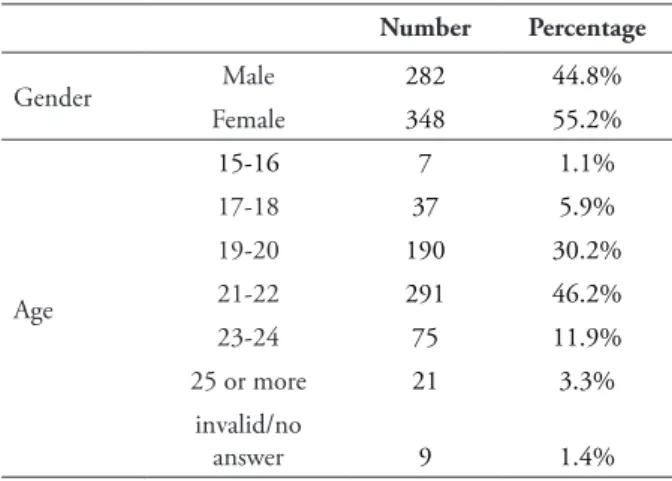
SNS in general, and of Twitter in particular, is heavily loaded toward teen and young adult users, as reported in a recent nationwide study in Mexico (Asociación Mexicana de Internet [AMIPCI], 2013) shown in Table 2. By comparison, inal sample characteristics are displayed in Table 3.
Table 2
Demographics of twitter versus Facebook users in Mexico
Twitter Facebook Percentage of internet
users who have opened an
account 69% 96%
Percentage accessing
through a smartphone 55% 56%
Female
Male 56%44% 55%45%
18-24 25-34 35-44 45-54 55+
48% 26% 14% 8% 4%
39% 26% 16% 13% 6%
Note. Source: Adapted from “Estudio de marketing digital y social media 2013”, by AMIPCI, 2013.
Table 3
Sample characteristics
Number Percentage
Gender Male 282 44.8%
Female 348 55.2%
Age
15-16 7 1.1%
17-18 37 5.9%
19-20 190 30.2%
21-22 291 46.2%
23-24 75 11.9%
25 or more 21 3.3%
invalid/no
answer 9 1.4%
5 Model Estimation
The hypothesized model was tested using the Partial Least Squares (PLS) method of structural equation modeling, which is suitable for exploratory research and is not subject to the normality assumption of covariance based SEM (Hair, Sarstedt, Ringle, & Mena, 2012). Estimation was carried out using SmartPLS version 2.0 (Ringle, Wende, & Will, 2005). We irst evaluated the measurement or outer model, which involves examining indicator reliability, internal consistency reliability, convergent validity and discriminant validity (Hair et al., 2012).
Table 4 shows the outer model loadings, Cronbach alphas and composite reliabilities. Item irr1 was discarded because its loading was well below the 0.70 threshold suggested by Hulland (1999). All other items had acceptable loadings (numbers shown in Table 4 are after removing item irr1). In addition, composite reliabilities for all scales are well above the suggested threshold of 0.70 (Bagozzi & Yi, 1988), indicating good internal consistency.
Table 4
Indicator loadings, scale Cronbach alphas and Composite reliabilities
Scale Indicator loading Cronbach alpha Composite reliability
Informativeness 0.7843 0.8741
inf1 0.8355
inf2 0.8549
inf3 0.8162
Entertainment 0.8494 0.9088
ent1 0.8594
ent2 0.8862
ent3 0.8842
Irritation 0.8434 0.9274
irr1* 0.5647
irr2 0.9283
irr3 0.9313
Credibility 0.7925 0.8756
cred1 0.8416
cred2 0.7950
cred3 0.8740
Advertising Value 0.8377 0.9023
adval1 0.8546
adval2 0.8781
adval3 0.8736
Attitude toward Twitter Advertising 0.7781 0.8712
atoat1 0.8121
atoat2 0.8449
atoat3 0.8395
Note. * his item was dropped from the analysis, loading < 0.70. Adapted from “Use of partial least squares (PLS) in strategic management research: A review of four recent studies”, by J. Hulland, 1999, Strategic Management Journal, 20, 195-204.
Table 5
Average variance extracted and inter-construct correlations
AVE INFORM ENTERT IRRIT CREDIB ADVALUE ATOAT
INFORM 0.6983 0.8356
ENTERT 0.7685 0.6713 0.8766
IRRIT 0.8646 -0.4484 -0.5485 0.9298
CREDIB 0.7014 0.6190 0.5972 -0.4758 0.8375
ADVALUE 0.7548 0.7797 0.7352 -0.4874 0.6164 0.8688
446
Review of Business Management., São Paulo, Vol. 18, No. 61, p. 436-456, Jul./Sept. 2016 Enrique Murillo/ María Merino / Adriana Núñez
The cross loadings of the indicators provide a complementary check for discriminant validity, this time at the indicator level (Henseler et al., 2009). he loading of each indicator should be greater than all of its cross-loadings, and this was indeed the case. In sum, the measurement model displays adequate indicator and internal consistency reliability, as well as convergent and discriminant validity.
Figure 3 displays hypothesized model estimation for the full sample. he R2 values
indicate that the hypothesized predictors explain
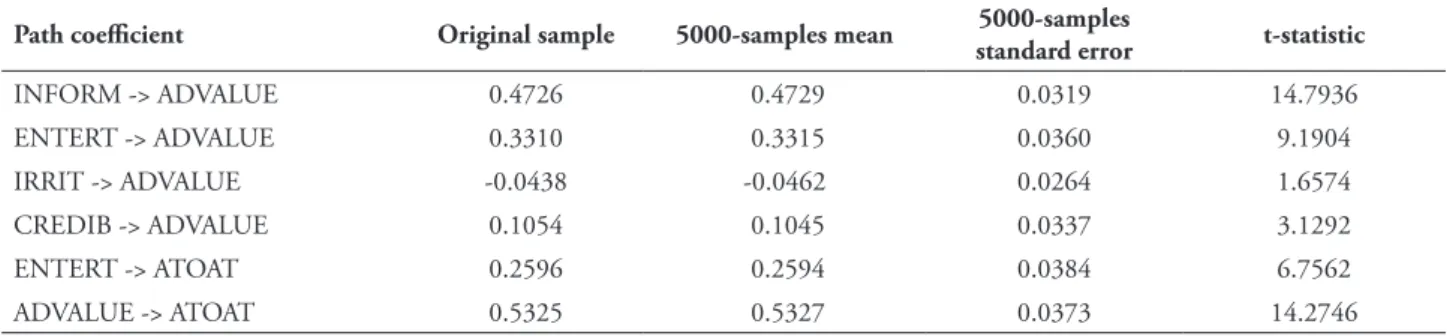
70% of the variance of Advertising Value and 55% of the variance of Attitude toward Twitter advertising. With the exception of the path for Irritation, all coeicients had the expected signs and were statistically signiicant. Because normality is not assumed for PLS studies, tests of signiicance rely on bootstrapping (Hair et al., 2012). he t-values for the path coeicients are shown in Table 6. In this case, all coeicients are signiicant at the 5% level (critical value 1.96 for two-tailed tests), with the exception of Irritation, which falls short of signiicance.
Table 6
Path coeicients for original sample (n = 630) and 5000 bootstraping samples
Path coeicient Original sample 5000-samples mean 5000-samples
standard error t-statistic
INFORM -> ADVALUE 0.4726 0.4729 0.0319 14.7936
ENTERT -> ADVALUE 0.3310 0.3315 0.0360 9.1904
IRRIT -> ADVALUE -0.0438 -0.0462 0.0264 1.6574
CREDIB -> ADVALUE 0.1054 0.1045 0.0337 3.1292
ENTERT -> ATOAT 0.2596 0.2594 0.0384 6.7562
ADVALUE -> ATOAT 0.5325 0.5327 0.0373 14.2746
Overall, the hypothesized model shows very good it to the Twitter survey data, and explains a substantial amount of the variance of the endogenous latent variables.
The results for the structural model estimation using the full sample are displayed on Table 7a as Model 1. hese results support all hypothesized relationships with their expected signs, except for the path coeicient of Irritation, which came out as non-signiicant (although signiicant at the 10% level, critical value 1.650).
The minimum sample size for PLS is ten times the largest number of structural paths directed at a particular latent construct in the structural model (Hair, Ringle, & Sarstedt, 2011). In this case, the maximum is four paths directed toward Advertising Value, hence requiring a minimum sample size of 40. herefore, with a sample large enough to support a more detailed
analysis, we decided to test the hypothesized model on a number of relevant subsamples. In every case we rechecked the outer model loadings, AVE, composite reliability, and the Fornell-Larcker criterion to make sure model reliability and validity remained acceptable despite the smaller subsample and/or diferent model speciication (such as Models 6, 7, 18 and 19 where Irritation was not included). hese test results are available as an Attachment Document. The survey asked respondents how often they clicked on Twitter ads, reported frequencies are shown in Table 8. Respondents are approximately evenly split between those who have never clicked on an ad (41%) and those who have (59%). We tested the basic model among these two subsamples. Results are displayed side by side on Table 7a as Models 2 and 3.
Table 7a
Model estimation for full sample, click and non-click, female and male subsamples
Model 1 Model 2 Model 3 Model 4 Model 5 Model 6 Model 7
Full sample n = 630
Click n = 372
No-click n = 258
Female n = 348
Male n = 282
Female click n = 203
Male click n = 169
INFORM → ADVAL (14.794)0.473** (9.044)0.420** (11.643)0.521** (11.448)0.502** (9.189)0.443** (7.495)0.467** (5.158)0.371** ENTERT → ADVAL (9.190)0.331** (7.694)0.381** (4.851)0.250** (6.134)0.292** (7.057)0.372** (5.504)0.331** (6.045)0.451** IRRIT → ADVAL (1.657)-0.044 (0.076)0.002 (2.285)-0.097* (1.401)-0.047 (1.072)-0.037 -- --CREDIB → ADVAL (3.129)0.105** (2.309)0.106* (2.451)0.124* (2.782)0.126** (1.799)0.084 (2.584)0.145** (0.893)0.042
R2 (ADVAL) 0.698 0.630 0.697 0.729 0.664 0.680 0.586
ENTERT → ATOAT (6.756)0.260** (4.352)0.255** (4.149)0.214** (5.209)0.265** (4.046)0.242** (2.611)0.192** (3.249)0.304** ADVAL → ATOAT 0.533**
(14.275)
0.444**
(7.803)
0.607**
(12.342)
0.525**
(10.931)
0.549**
(9.554)
0.499**
(7.064)
0.391**
(4.436)
R2 (ATOAT) 0.554 0.421 0.590 0.554 0.552 0.420 0.412
448
Review of Business Management., São Paulo, Vol. 18, No. 61, p. 436-456, Jul./Sept. 2016 Enrique Murillo/ María Merino / Adriana Núñez
Table 8
Do you frequently click on Twitter ads?
Female Male Total Percentage
I never have 145 113 258 41.0%
I have clicked a few times 177 142 319 50.6%
I click often 19 26 45 7.1%
I click (nearly) every time I log in 7 1 8 1.3%
Total 348 282 630 100.0%
For participants who have never clicked on a Twitter ad, the Irritation variable becomes signiicant with the expected negative efect on Advertising Value. By contrast, for participants who do click on ads, the path coefficient of Irritation drops nearly to zero, and the t-statistic remains non-signiicant.
Next we tested the model on the male and female subsamples, results are displayed on Table 7a as Models 4 and 5. In both cases, Irritation comes out as non-signiicant, which is the same result as Model 1. However, an interesting diference appears for Credibility. For female respondents, Credibility retains the signiicance it had in the full sample, whereas for male respondents Credibility fails the signiicance test.
To perform a more detailed analysis of participants who click on ads, for whom it is already established that Irritation is not signiicant, the sample is next split into female (Model 6) and male (Model 7) respondents who have clicked on Twitter ads. he results reveal that Credibility is signiicant for female respondents, but not for males, the same conclusion derived earlier from Models 4 and 5.
At this point, we questioned whether there would be signiicant diferences between users with low versus high levels of posting activity and between those who recently joined the SNS versus those who are more experienced. We did not measure these variables in our survey, but since over 90% of our survey respondents did provide their Twitter username, we complemented user
survey data with two statistics we obtained from their public proile: tenure and total number of tweets. We then split the sample on the median of these two variables and tested the basic model on these new subsamples. We examined irst whether users difered on account of their level of posting activity; the results are displayed on Table 7b as Model 8 and Model 11. For both subsamples there were important diferences with respect to the basic Model 1.
For respondents with the lower number of total tweets, the Irritation path coeicient became signiicant; whereas for those with the higher number of total tweets, both Irritation and Credibility became non-signiicant. Moreover, when the irst group is further partitioned into female and male subsamples (Models 9 and 10), Irritation became non-signiicant for males but signiicant for females, whereas Credibility became non-significant for both males and females. On the other subsample, among users with the higher number of tweets, the comparison between females and males (Models 12 and 13) yielded no gender diferences. hese results indicate that as both male and female users gain more experience with the Twitter platform, Irritation and Credibility become less important in their assessment of Advertising Value.
Table 7b
Model estimation low and high total tweets, female and males subsamples
Model 8 Model 9 Model 10 Model 11 Model12 Model13
Low tweets n = 282
Low tweets female n = 149
Low tweets male n = 133
High tweets n = 283
High tweets female n = 171
High tweets male n = 112
INFORM → ADVAL (9.567)0.463** (6.670)0.470** (6.854)0.458** (10.993)0.524** (9.719)0.571** (5.803)0.469** ENTERT → ADVAL (5.630)0.295** (3.535)0.281** (4.201)0.308** (6.789)0.337** (5.771)0.333** (4.234)0.347** IRRIT → ADVAL -0.112*
(2.501)
-0.148*
(2.321)
-0.067 (1.332)
0.016 (0.577)
-0.056 (1.270)
-0.013 (0.272)
CREDIB → ADVAL (2.075)0.106* (1.414)0.091 (1.921)0.131 (1.719)0.078 (1.643)0.095 (0.961)0.058
R2 (ADVAL) 0.671 0.667 0.680 0.710 0.772 0.617
ENTERT → ATOAT (4.986)0.300** (3.732)0.264** (3.206)0.328** (4.592)0.245** (3.388)0.265** (3.197)0.218** ADVAL → ATOAT (7.940)0.447** (7.854)0.516** (4.010)0.373** (11.114)0.572** (7.294)0.536** (9.489)0.629**
R2 (ATOAT) 0.477 0.525 0.419 0.595 0.577 0.631
Note. * signiicant 95%, ** signiicant 99% (two-tailed tests)
Table 7c
Model estimation for low and high tenure, female and male subsamples
Model 14 Model 15 Model 16 Model 17 Model 18 Model 19
Low tenure n = 264
Low tenure female n = 145
Low tenure male n = 119
High tenure n = 265
High tenure female n = 154
High tenure male n = 111
INFORM → ADVAL (11.169)0.489** (7.142)0.456** (8.035)0.520** (9.876)0.523** (9.936)0.608** (4.345)0.386** ENTERT → ADVAL 0.333**
(7.082)
0.366**
(5.690)
0.277**
(3.610)
0.327**
(5.797)
0.276**
(4.171)
0.420**
(5.244)
IRRIT → ADVAL (1.838)-0.081 (1.755)-0.086 (1.197)-0.075 (0.467)-0.015 -- --CREDIB → ADVAL (1.968)0.087* (2.334)0.110* (1.216)0.083 (0.721)0.028 (0.285)0.013 (1.279)0.086
R2 (ADVAL) 0.746 0.805 0.673 0.635 0.665 0.621
ENTERT → ATOAT (4.220)0.300** (2.915)0.310* (2.802)0.272** (4.702)0.251** (3.994)0.261** (2.434)0.222* ADVAL → ATOAT (6.610)0.446** (4.343)0.440** (5.174)0.465** (11.105)0.565** (8.927)0.559** (6.739)0.588**
R2 (ATOAT) 0.492 0.512 0.463 0.575 0.572 0.581
Note. * signiicant 95%, ** signiicant 99% (two-tailed tests)
Low tenure users did not signiicantly differ from the basic Model 1. However, for high tenure respondents, the path coeicient for Credibility became non-signiicant. When we further split each subsample into male and
450
Review of Business Management., São Paulo, Vol. 18, No. 61, p. 436-456, Jul./Sept. 2016 Enrique Murillo/ María Merino / Adriana Núñez
not detect any gender diferences (Models 18 and 19). Again, these results suggest that as Twitter users of both genders become more experienced, Irritation and Credibility lose their initial signiicance for assessing Advertising Value, and only Informativeness and Entertainment retain their relevance.
6
Conclusions
This research contributes to our understanding of perceptions of Advertising Value among users of SNS, where there are as yet few published studies (e.g. Dao et al., 2014; Hassan, Fatima, Akram, Abbas, & Hasnain, 2013; Logan et al., 2012; Saxena & Khanna, 2013). Specifically, we found that perceived Informativeness, Entertainment and Credibility signiicantly inluence perceptions of Advertising Value and Attitudes toward advertising in the Twitter platform. Four of our six research hypotheses were supported in all samples, one was supported in the full sample and some subsamples, and only one hypothesis received limited support. his shows the applicability of the Ducofe model on SNS and in a Latin American context.
he results from the main sample and various subsamples indicate that Informativeness has the strongest efect on Advertising Value for Twitter ads; only in two of the subsamples did it narrowly take second place to Entertainment. The magnitude of the Informativeness path estimates is consistent with the results from the study of web advertising by Ducofe (1996) and Brackett and Carr (2001), and the more recent study of Facebook ads by Logan et al. (2012), as shown in Table 1. Hence, Hypothesis 1 is strongly supported in all samples.
Entertainment had the second strongest efect on Advertising Value, with statistically signiicant efects in every sample. Furthermore, Entertainment was found to have a direct efect on Attitude toward Twitter advertising; the efect was substantial and signiicant across all subsamples. hus we ind strong support for both Hypothesis 2 and Hypothesis 6.
Credibility came in third for the size of its efect on Advertising Value. In addition, we found statistically signiicant gender efects for this predictor. Speciically, when the full sample was split into male and female respondents, Credibility was signiicant only among females. his inding was repeated when both the clicking subsample and the low-tenure subsample were split by gender: in both cases Credibility mattered to women but not to men. herefore, Hypothesis 4 receives qualiied support.
Lastly, Irritation came out as the weakest predictor of Advertising Value in this study, failing to reach the signiicance level in nearly all subsamples. A possible explanation would be that nearly half of our Millennial sample ind Twitter ads irritating and refrain from clicking on them; for this subsample (Model 3) Irritation came out as a signiicant predictor of Advertising Value. However, slightly over half of the sample are less annoyed by Twitter ads, have clicked on them at some point, and for these, the path estimate for Irritation came out as non-signiicant.
In every case where Irritation was signiicant, the magnitude of the path coeicient took fourth place after Informativeness, Entertainment and Credibility. We would argue that Twitter’s policy of protecting the user experience (Copeland, 2012), and placing relatively few ads in users’ newsfeed has resulted in Irritation not being a major concern for Millennial Twitter users. herefore, Hypothesis 3 receives only limited support. A summary of study conclusions regarding the research hypotheses is provided in Table 9.
be enhanced by increasing the personalization of messages the targeting options Twitter provides
(such as personal interests, keywords and behavioral targeting).
Table 9
Summary of hypotheses
Hypothesis Model conclusion
H1 - Informativeness (+) on AdValue Supported in all samples H2 - Entertainment (+) on AdValue Supported in all samples
H3 - Irritation (-) on AdValue Limited support: among non-clicking respondentsand among females with low total tweets
H4 - Credibility (+) on AdValue Supported in full sampleSupported also among female respondents, females who click on ads, and females with low tenure H5 - AdValue (+) on Attitude Supported in all samples
H6 - Entertainment (+) on Attitude Supported in all samples
Entertainment had the second strongest inluence on Advertising Value. Moreover, the direct efect of Entertainment on Attitude was signiicant and remarkably consistent across all subsamples. he implication is that writing witty, funny or entertaining promoted tweets positively inluences users’ assessment of Twitter ads and their general attitude toward Twitter advertising.
Irritation had a statistically signiicant efect only among respondents who reported never clicking on a Twitter ad, and users with low total tweets, although Model 9 showed it was really only a concern for female users. Hence, the majority of our Millennial sample did not take issue with Twitter ads, which suggests the platform provides an interesting opportunity to advertisers, particularly in light of recent industry reports of user fatigue with Facebook ads (Tassi, 2013) and some research studies where Irritation has been a signiicant antecedent of Advertising Value (Hassan et al., 2013). Another relevant inding is that as users gain more experience with Twitter, measured as both tenure and total posted tweets, Irritation becomes non-signiicant as a predictor of Advertising Value. his suggests that users’ initial concerns with advertising tend to diminish as they make more use of Twitter, presumably because of a positive user experience.
Finally, the study found that Credibility is signiicant only among females and users with
lower total tweets. he implication for advertisers, particularly those catering to women, is that writing copy that reinforces the Credibility of the promoted tweet (say by mentioning independent reviews or money-back guarantees) will make the ad more efective among female users. Given concerns about Millennial scepticism toward conventional advertising (Schawbel, 2015), this inding is welcome news for brands.
452
Review of Business Management., São Paulo, Vol. 18, No. 61, p. 436-456, Jul./Sept. 2016 Enrique Murillo/ María Merino / Adriana Núñez
our contacting behavior. Facing this restriction, we decided to invite respondents through their Twitter contacts, in efect a snowball sample, using our own students as recruiters.
Although precluded from using a probabilistic sample, a survey of university students is still relevant for this research. Millennials are a key segment for many brands, and industry surveys report that the age distribution of Twitter participants strongly favors teen and young adults (AMIPCI, 2013). Still, some caution must be exercised when generalizing results from this study.
First, for brands advertising in Mexico and Latin America, Twitter is among the largest and fastest-growing SNS. Second, the results of this study, and other industry reports (Tassi, 2013), suggest user irritation with ads is lower than on Facebook, the leading SNS. hird, by targeting Millennials this study contributes to our knowledge of a key demographic, not only in Mexico but around the world (Smith, 2011). Moore (2012, p. 436) has pointed out that “technology drives global homogeneity among worldwide population within the Millennial age group”. Fourth, this research extends results from previous studies of Internet advertising perceptions among Hispanic consumers, a key market segment in the U.S. (Korgaonkar, Silverblatt, & O’Leary, 2001).
Two important implications for the Twitter platform itself should be mentioned. First, we would argue that the company’s policy of protecting the user experience, and avoiding excessive advertising, could explain why 59% of users in our sample had clicked on ads at some point and did not have Irritation as a signiicant predictor of Advertising Value. It is very likely that our survey respondents had experience with Facebook ads, and were able to compare advertising clutter among both platforms.
Second, the fact that smartphone penetration is very high among our Millennial sample implies a positive outlook for mobile Twitter advertising, which has grown rapidly
in the last year and now makes up 90% of ad revenues (Emarketer, 2016c).
As for future research, the authors would welcome opportunities to extend and contrast these results with Spanish-speaking Millennial samples from other Latin American countries or even to develop and validate a Portuguese translation of the Ducofe scales. he fact that the survey can be delivered through Google Forms, in both desktop and smartphone screen sizes makes such studies fairly straightforward, and research on user perceptions of social media advertising is still in its infancy.
References
Alwitt, L. F., & Prabhaker, P. R. (1994). Identifying who dislikes television advertising: Not by demographics alone. Journal of Advertising Research, 34(6), 17-29.
Asociación Mexicana de Internet. (2013). Estudio de marketing digital y social media 2013. Retrieved from https://www.amipci.org.mx/es/estudios
Bagozzi, R. P., & Yi, Y. (1988). On the evaluation of structural equation models. Journal of the Academy of Marketing Science, 16(1), 74-94.
Blanco, C. F., Blasco, M. G., & Azorín, I. I. (2010). Entertainment and informativeness as precursory factors of successful mobile advertising messages. Communications of the
IBIMA, 2010(2010), 1-11
Brackett, L. K., & Carr, B. N. J. (2001). Cyberspace advertising vs. other media: Consumer vs. mature student attitudes. Journal of Advertising Research, 41(1), 23-32.
Chandra, B., Goswami, S., & Chouhan, V. (2013). Investigating attitude towards online advertising on social media: An empirical study. Management Insight, 8(1), 1-14.
Copeland, M. (2012). Dick Costolo doesn’t want you to worry about Twitter’s business. Retrieved from http://www.wired.com/2012/05/dick-costolo-twitter-business/
Coyle, J. R., Smith, T., & Platt, G. (2012). “I’m here to help” how companies’ microblog responses to consumer problems inluence brand perceptions. Journal of Research in Interactive
Marketing, 6(1), 27-41.
Dao, W. V-T., Le, A. N. H., Cheng, J. M.-S., & Chao, D. C. (2014). Social media advertising value: The case of transitional economies in Southeast Asia. International Journal of
Advertising, 33(2), 271-294.
Ducofe, R. H. (1995). How consumers assess the value of advertising. Journal of Current Issues & Research in Advertising, 17(1), 1-18.
Ducofe, R. H. (1996). Advertising Value and advertising on the web. Journal of Advertising Research, 36(1), 21-36.
Eighmey, J. (1997). Profiling user responses to commercial websites. Journal of Advertising Research 37(3), 59-66.
Emarketer. (2015). Mobile ad spend to top $100 billion worldwide in 2016, 51% of digital market. Retrieved from http://www.emarketer.com/ Article/Mobile-Ad-Spend-Top-100-Billion-Worldwide-2016-51-of-Digital-Market/1012299
Emarketer. (2016a). Twitter’s user base in Latin America Continues to grow. Retrieved from http:// www.emarketer.com/Article/Twitters-User-Base-Latin-America-Continues-Grow/1013924
Emarketer. (2016b). Twitter ad revenues expected to continue robust growth. Retrieved from http://www.emarketer.com/Article/Twitter- Ad-Revenues-Expected-Continue-Robust-Growth/1013571
Emarketer. (2016c). eMarketer growth outlook for Twitter. Retrieved from http://www.emarketer.
com/Article/eMarketer-Lowers-Growth-Outlook-Twitter/1013714
Enders, A., Hungenberg, H., Denker, H. P., & Mauch, S. (2008). he long tail of social networking: Revenue models of social networking sites. European
Management Journal, 26(3), 199-211.
Hair, J. F., Ringle, C. M., & Sarstedt, M. (2011). PLS-SEM: Indeed a silver bullet. he Journal of Marketing heory and Practice, 19(2), 139-152.
Hair, J. F., Sarstedt, M., Ringle, C. M., & Mena, J. A. (2012). An assessment of the use of partial least squares structural equation modeling in marketing research. Journal of the Academy of Marketing Science, 40(3), 414-433.
Haghirian, P., Madlberger, M., & Inoue, A. (2008, January). Mobile advertising in diferent stages of development: A cross-country comparison of consumer attitudes. Proceedings of the Annual Hawaii International Conference on System Sciences, Waikoloa, Hawaii, USA, 41.
Hassan, M. U., Fatima, S., Akram, A., Abbas, J., & Hasnain, A. (2013). Determinants of consumer attitude towards social-networking sites advertisement: Testing the mediating role of advertising value. Middle East Journal of Scientiic Research, 16(3), 319-330.
Henry, M., & Harte, B. (2012). A new model for assessing the value of social media activity. Journal of Brand Strategy, 1(3), 234-239.
Henseler, J., Ringle, C. M., & Sinkovics, R. R. (2009). he use of partial least squares path modeling in international marketing. Advances in International Marketing, 20(1), 277-319.
Hulland, J. (1999). Use of partial least squares (PLS) in strategic management research: A review of four recent studies. Strategic Management Journal, 20(2), 195-204.
454
Review of Business Management., São Paulo, Vol. 18, No. 61, p. 436-456, Jul./Sept. 2016 Enrique Murillo/ María Merino / Adriana Núñez
Jansen, B. J., Zhang, M., Sobel, K., & Chowdury, A. (2009). Twitter power: Tweets as electronic word of mouth. Journal of the American society for information science and technology, 60(11), 2169-2188.
Kim, N. Y., & Sundar, S. S. (2010). Relevance to the rescue: Can “Smart Ads” reduce negative response to online ad clutter? Journalism & Mass Communication Quarterly, 87(2), 346-362.
Kim, E., Sung, Y., & Kang, H. (2014). Brand followers’ retweeting behavior on Twitter: How brand relationships influence brand electronic word-of-mouth. Computers in Human Behavior, 37(1), 18-25.
Koh, Y. (2014). Twitter results silence naysayers. Retrieved from http://online.wsj.com/articles/ twitters-user-growth-picks-up-1406664889
Korgaonkar, P., Silverblatt, R., & O’Leary, B. (2001). Web advertising and Hispanics. Journal of Consumer Marketing, 18(2), 134-152.
Kwon, E. S., & Sung, Y. (2011). Follow me! Global marketers’ Twitter use. Journal of Interactive Advertising, 12(1), 4-16.
Li, Z., & Li, C. (2014). Twitter as a social actor: How consumers evaluate brands diferently on Twitter based on relationship norms. Computers
in Human Behavior, 39(1), 187-196.
Lin, F. H., & Hung, Y. F. (2009). he value of and attitude toward sponsored links for internet information searchers. Journal of Electronic Commerce Research, 10(4), 235-251.
Liu, C. L. E., Sinkovics, R. R., Pezderka, N., & Haghirian, P. (2012). Determinants of consumer perceptions toward mobile advertising: A comparison between Japan and Austria. Journal of Interactive Marketing, 26(1), 21-32.
Logan, K. (2013). And now a word from our sponsor: Do consumers perceive advertising on
traditional television and online streaming video diferently? Journal of Marketing Communications, 19(4), 258-276.
Logan, K. (2014). Why isn’t everyone doing it? A comparison of antecedents to following brands on Twitter and Facebook. Journal of Interactive Advertising, 14(2), 60-72.
Logan, K., Bright, L. F., Gangadharbatla, H. (2012). Facebook versus television: Advertising value perceptions among females. Journal of Research in Interactive Marketing, 6(3), 164-179.
MacKenzie, S. B., & Lutz, R. J. (1989). An empirical examination of the structural antecedents of attitude toward the ad in an advertising pretesting context. he Journal of Marketing, 53(2), 48-65.
McQuail, D. (1983). Mass Communication heory: An Introduction. London: Sage.
Méndiz-Noguero, A., Victoria-Mas, J. S., & Arroyo-Almaraz, I. (2013). La eficacia de la publicidad social en las redes sociales: Un experimento online con usuarios jóvenes. Razón y palabra, 18(82), 31-19.
Moore, M. (2012). Interactive media usage among millennial consumers. Journal of Consumer Marketing, 29(6), 436-444.
Nogueira-Cortimiglia, M., Ghezzi, A., & Renga, F. (2011). Social applications: Revenue models, delivery channels, and critical success factors-An exploratory study and evidence from the spanish-speaking market. Journal of heoretical and Applied Electronic Commerce Research, 6(2), 108-122.
Núñez, A. (2013). Análisis de mensajes en redes sociales para la detección de eventos de impacto (Unpublished Master’s thesis). Instituto Tecnológico Autónomo de México, Mexico City.
Ringle, C., Wende, S., & Will, A. (2005). Smart PLS 2.0 (Beta). Retrieved from www.smartpls.de
Sandoval-Almazán, R., & Nava-Rogel, R. M. (2012). Uso de Twitter en la empresa mexicana: Un modelo de análisis. Razón y palabra, 17(80), 43-28.
Saxena, A., & Khanna, U. (2013). Advertising on social network sites: A structural equation modelling approach. Vision: The Journal of Business Perspective, 17(1), 17-25.
Schawbel, D. (2015). 10 new indings about the millennial consumer. Retrieved from http://www. forbes.com/sites/danschawbel/2015/01/20/10-new-indings-about-the-millennial-consumer/
Smith, K. T. (2011). Digital marketing strategies that Millennials ind appealing, motivating, or just annoying. Journal of Strategic Marketing, 19(6), 489-499.
Sreenivasan, N. D., Lee, C. S., & Goh, H-L. D. (2012). Tweeting the friendly skies: Investigating information exchange among Twitter users about airlines. Program, 46(1), 21-42
Sun, Y., Lim, K. H., Jiang, C., Peng, J. Z., & Chen, X. (2010). Do males and females think in the same way? An empirical investigation on the gender diferences in Web advertising evaluation. Computers in Human Behavior, 26(6), 1614-1624.
Tassi, P. (2013). Facebook’s advertising is starting to spiral out of control. Retrieved from http://
www.forbes.com/sites/insertcoin/2013/07/01/ facebooks-advertising-is-starting-to-spiral-out-of-control/
Taylor, D. G., Lewin, J. E., & Strutton, D. (2011). Friends, fans, and followers: do ads work on social networks? Journal of Advertising Research, 51(1), 258-275.
Twitter. (2014a). What are promoted tweets? Retrieved from https://support.twitter.com/ articles/142101
Twitter. (2014b). What are promoted accounts? Retrieved from https://support.twitter.com/ articles/282154
Twitter. (2014c). What are promoted trends? Retrieved from https://support.twitter.com/ articles/282142
Twitter. (2016). About us. Retrieved from https:// about.twitter.com/company
Xu, H., Oh, L. B., & Teo, H. H. (2009). Perceived efectiveness of text vs. multimedia location-based advertising messaging. International Journal of Mobile Communications, 7(2), 154-177.
456
Review of Business Management., São Paulo, Vol. 18, No. 61, p. 436-456, Jul./Sept. 2016 Enrique Murillo/ María Merino / Adriana Núñez
Appendix: Original and Translated Scale Items for Measures
Twitter advertising… La publicidad en Twitter…
Informativeness (Ducofe, 1996)
is a good source of product information es una buena fuente de información de productos y servicios supplies relevant product/service information proporciona información relevante de productos y servicios provides timely information proporciona información oportuna
Entertainment (Ducofe, 1996)
is entertaining es entretenida
is enjoyable es agradable
is fun to use es divertida de usar
Irritation (Ducofe, 1996)
is too insistent* es demasiado insistente*
is annoying es molesta
is irritating es irritante
Credibility (Brackett & Carr, 2001; MacKenzie & Lutz, 1989)
is trustworthy es coniable
is believable / is credible es creíble
is convincing es convincente
Advertising Value (Ducofe, 1996)
is useful es útil
is valuable es valiosa
is important es importante
Attitude toward Twitter advertising (Alwitt & Prabhaker, 1994) helps me to ind products/services that match my
person-ality and interests me ayuda a encontrar productos y servicios que coinciden con mi personalidad e intereses helps me know which brands have the features I am
look-ing for
me ayuda a conocer qué marcas tienen las características que yo busco
is a good way to learn about what products/services are
available es una buena manera de enterarse de los productos y servicios disponibles *new item irr1, eventually discard
Supporting agencies:
he authors gratefully acknowledge the support of Asociación Mexicana de Cultura, A.C.
About the authors:
1. Enrique Murillo, PhD in Management, ITAM, Mexico City, Mexico. Email: [email protected] 2.María Merino, PhD in Marketing, ITAM, Mexico City, Mexico. Email: [email protected]
3.Adriana Núñez, MSc in Management, Independent Business & IT Consultant, Mexico City, Mexico Email: [email protected]
Contribution of each author:
Contribution Enrique Murillo María Merino Adriana Núñez
1. Deinition of research problem √ √ √
2. Development of hypotheses or research questions (empirical
studies) √ √
3. Development of theoretical propositions (theoretical work) √ √
4. heoretical foundation /Literature review √ √
5. Deinition of methodological procedures √ √ √
6. Data collection √ √
7. Statistical analysis √
8. Analysis and interpretation of data √ √
9. Critical revision of the manuscript √ √