Cop
yright
© ABE&M t
odos os dir
eit
os r
eser
vados
.
Lower quality of life in longstanding
mild primary hyperparathyroidism
Menor qualidade de vida em hiperparatireoidismo primário crônico leve
Andreia Veras1, Juliana Maia1, Patricia Mesquita1, Catia Eufrazino1,
Francisco Bandeira1
ABSTRACT
Objective: To describe the non-classical manifestations and quality of life in patients with pri-mary hyperparathyroidism (PHPT). Subjects and methods: We evaluated non-classical mani-festations and quality of life of 22 patients with PHPT using the SF-36 questionnaire according to the time since diagnosis. Results: In the scores of quality of life, a signiicant difference was found comparing the groups with previous and recent diagnosis of PHPT in terms of functional capacity (39 + 22.83 vs. 76.25 + 22.37; p= 0.001), limitation of physical aspects (30 + 38.73 vs. 75
+ 21.32; p= 0.006), general health (57.20 + 19.16 vs. 77.75 + 15.70; p = 0.012), and vitality (49.00 +
21.19 vs. 70.00 + 24.12; p= 0.044). Conclusion: We found a signiicant difference in quality of life
in relation to the time of the diagnosis of PHPT. Arq Bras Endocrinol Metab. 2013;57(2):139-43
Keywords
Primary hyperparathyroidism; non-classical manifestations; quality of life; depression
RESUMO
Objetivo: Descrever as manifestações não clássicas e a qualidade de vida em pacientes com hiperparatireoidismo primário (HPTP). Sujeitos e métodos: Avaliamos as manifestações não clássicas e a qualidade de vida em 22 pacientes com HPTP por meio do questionário SF-36, segundo o tempo desde o diagnóstico. Resultados: Nos escores de qualidade de vida, foi ob-servada uma diferença signiicativa na comparação dos grupos com diagnóstico anterior ou recente de HPTP em termos de capacidade funcional (39 + 22,83 vs. 76,25 + 22,37; p= 0,001), limitação de aspectos físicos (30 + 38,73 vs. 75 + 21,32; p= 0,006), estado geral de saúde (57,20 + 19,16 vs. 77,75 + 15,70; p= 0,012) e vitalidade (49,00 + 21,19 vs. 70,00 + 24,12; p= 0,044). Conclu-são: Observamos uma diferença signiicativa na qualidade de vida em relação ao tempo desde o diagnóstico do HPTP. Arq Bras Endocrinol Metab. 2013;57(2):139-43
Descritores
Hiperparatireoidismo primário; manifestações não clássicas; qualidade de vida; depressão
1 Division of Endocrinology and
Diabetes, Agamenon Magalhães Hospital, Brazilian Ministry of Health (MS/SUS), University of Pernambuco (UPE) Medical School, Recife, PE, Brazil Agamenon Magalhães Hospital (MS/SUS/UPE)
Correspondence to:
Juliana Maia
Division of Endocrinology, Agamenon Magalhães Hospital, University of Pernambuco Medical School Estrada do Arraial, 2723 52021-380 – Recife, PE, Brazil [email protected]
Received on Sept/12/2012 Accepted on Nov/26/2012
INTRODUCTION
I
n the past, primary hyperparathyroidism (PHPT) presented extreme manifestations of excess para thyroid hormone, including marked hypercalcemia, osteitis ibrosa cystica, advanced renal disease, and neu ropsychiatric disorders. However, the clinical presenta tion of hyperparathyroidism has dramatically changed partly due to the introduction of routine calcium serum measurements since 1970. Today, PHPT is more often presented as asymptomatic hypercalcemia (1).A less common presentation of asymptomatic PHPT is characterized by normal serum calcium levels and high levels of parathyroid hormone (PTH) in the absence of an apparent secondary cause of elevated le vels of PTH. This normocalcemic variant may represent an early manifestation of PHPT (2).
Cop
yright
© ABE&M t
odos os dir
eit
os r
eser
vados
.
tinal, neuropsychiatric systems, and glucose metabo lism (4,5).
Gastrointestinal symptoms include constipation, anorexia, nausea, vomiting, and abdominal pain. Pan creatitis and peptic ulcer disease are also associated with hypercalcemia. However, the pathophysiological mechanism of this association remains uncertain (4,6).
Despite the increasing evidence that PHPT may contribute to increased cardiovascular morbidity and mortality, the etiopathogenic mechanisms of this as sociation are still not completely understood. Various abnormalities have been found in conjunction with PHPT, including hypertension, premature atheroscle rosis, valve calciication, left ventricular hypertrophy, and arrhythmias (4,5).
The excess PTH secretion seems to be involved in the deterioration of the secretion and sensitivity to in sulin, resulting in a high frequency of worsening of glu cose tolerance and diabetes mellitus type 2 (5,7).
Recent descriptions of PHPT include examples of welldeined neurological and psychiatric syndromes, ranging from signs of muscular atrophy to complete psychosis.
However, these manifestations are not a typical pre sentation of the illness, and reports suggest that many patients with PHPT discover the disease in the course of biochemical screening, and present vague and non speciic symptoms (fatigue, weakness, lassitude, anxiety, and depression) (4).
Primary hyperparathyroidism is a frequent endo crine disorder in the elderly population (8). As life expectancy is increasing worldwide, the incidence and prevalence of PHPT is likely to continue to increase in this age group. Therefore, it is necessary to conduct further studies on PHPT and quality of life.
SUBJECTS AND METHODS
The study included patients newly diagnosed with PHPT and patients with previous diagnosis of PHPT who were followed up at our institute, totaling 22 patients.
Primary hyperparathyroidism was deined as hyper calcemia conirmed after two measurements (serum calcium > 10.3 mg/dL, albumincorrected in the pre sence of hypoalbuminemia), and intact PTH above 52.5 pg/mL, which corresponds to the 75th percen
tile after exclusion of severe bone diseases, other causes of hypercalcemia and elevated PTH, such as second ary hyperparathyroidism (chronic renal failure GFR
MDRD ≤ 60 mL/min/1.73 m2, rickets, osteomalacia,
and hepatobiliary diseases), benign familial hypercalce mia, cancer, use of thiazide diuretics and lithium (1,2). The patients were referred to the interviewer and answered a quality of life questionnaire, the Brazilian version of SF36. The questionnaire contains 36 items, 35 of them grouped into eight dimensions, and a last item that assesses changes in health over time. For each dimension, items are coded, aggregated, and trans formed into a scale from zero (worst state of health) to 100 (best state of health).
The nonclassical manifestations of PHPT evaluated were: high blood pressure (HBP), diabetes mellitus type 2 (DM2), pancreatitis and peptic ulcer (gastrointestinal disorder – GID), depression and cardiovascular disea ses (CVD), such as angina, acute myocardial infarction, and cardiac arrhythmias. The presence of these disor ders was assessed by means of medical records and the questionnaire.
The diagnosis of depression was assessed using a questionnaire speciic for depression, the Portuguese version of the “Structured Clinical Interview for DSM Disorders” (SCID).
Statistical analysis was performed with age, cal cium and PTH levels, and made up a subdivision of G1 for patients with previous diagnosis (10 patients, from whom 7 patients had been diagnosed more than 12 months before, and the other 3 patients had been diagnosed less than 12 months before), and G2, for the group of newly diagnosed patients (12 patients).
All patients signed an informed consent form. This study was approved by the Research Ethics Committee of the Agamenon Magalhães Hospital.
Statistical analysis
Data analysis was performed obtaining percentages of categorical variables and the mean and standard devia tion of numeric variables with Student’s t test.
Data were entered in EXCEL spreadsheets, calcu lated using the SPSS software (Statistical Package for the Social Sciences) version 15, and EPIINFO version 4.6 for DOS. The margin of error used for statistical decisions was 5.0%.
RESULTS
Cop
yright
© ABE&M t
odos os dir
eit
os r
eser
vados
.
There were no signiicant statistical differences bet ween the two groups in the evaluation of nonclassical manifestations of PHPT: 81.8% (18/22) were hy pertensive, 7 in G1 (patients with previous diagnosis of PHPT) and 11 in G2 (newly diagnosed patients); 36.4% (8/22) were diabetic, 3 in G1 and 5 in G2; 4.5% (1/22) had peptic ulcer in G1; 22.7% (5/22) had a diagnosis of depression, 3 in G1 and 2 in G2. None of the patients had angina, myocardial infarction, and cardiac arrhythmias.
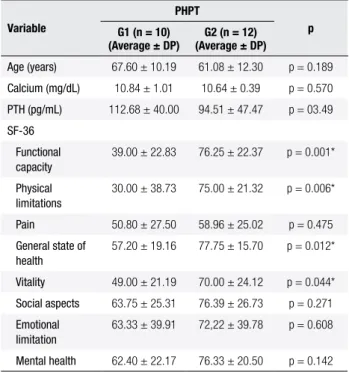
When G1 was compared with G2, mean age was 67.60 ± 10.19 vs. 61.08 ± 12.30, p = 0.189; serum calcium 10.84 ± 1.01 vs. 10.64 + 0.39, p= 0.570; and PTH 112.68 ± 40.00 vs. 94.51 ± 47.47, p= 0.349.
Average time since the diagnosis in months was 13.7 ± 5.66 in G1 patients. Statistical analysis of quality of life scores between G1 and G2 showed a signiicant difference in functional capacity (39 ± 22.83 vs. 76.25 ± 22.37; p= 0.001), limitation of physical aspects (30 ± 38.73 vs. 75 ± 21.32; p= 0.006), general health (57.20 ± 19.16 vs. 77.75 ± 15.70; p = 0.012), and vitality (49.00 ± 21.19 vs. 70.00 ± 24.12; p= 0.044).
Regarding pain, social aspects, limitation of emo tional aspects, and mental health, there were no statisti cal signiicant differences, as shown in table 2.
DISCUSSION
In the present study, a high prevalence of hypertension in patients with PHPT was found, and this inding is corroborated by others (9,10). Because of the relatively high incidence of hypertension in patients with PHPT, this possibility should be taken into account in the diagnostic investigation of hypertensive patients (10).
No history of cardiovascular disease among patients with PHPT was detected in our study. However, some studies show an increased cardiovascular risk in PHPT (11,12), as well as increased mortality, and fatal and nonfatal cardiovascular disease (13).
Studies have shown an increased prevalence of diabetes among patients with hyperparathyroidism (14,15). Earlier reports showed a prevalence of diabe-tes mellitus of about 8% in PHPT (16). In the pre sent study, a much higher prevalence of diabetes mellitus
type 2 was found in patients with PHPT, perhaps be cause it is not infrequent to ind high prevalence of glu cose disturbance in patients of the mean age described in this study.
Table 1. Baseline characteristics of the study population
Variable PHPT
(Average ± DP)
Age (years) 64.05 ± 11.61
Serum calcium (mg/dL) 10.73 ± 0.73
Serum PTH (pg/mL) 102.77 ± 44.18
SF-36
Functional capacity 59.32 ± 29.09
Physical limitation 54.55 ± 37.51
Pain 55.25 ± 25.87
General state of health 68.41 ± 19.90
Vitality 60.45 ± 24.73
Social aspects 70.64 ± 26.27
Emotional limitations 68.18 ± 39.14
Mental health 70.00 ± 21.93
Table 2. Age, serum calcium, serum PTH, and the scores of quality of life
according to a previous diagnosis of primary hyperparathyroidism (PHPT)
Variable
PHPT
p G1 (n = 10)
(Average ± DP)
G2 (n = 12) (Average ± DP)
Age (years) 67.60 ± 10.19 61.08 ± 12.30 p = 0.189
Calcium (mg/dL) 10.84 ± 1.01 10.64 ± 0.39 p = 0.570
PTH (pg/mL) 112.68 ± 40.00 94.51 ± 47.47 p = 03.49
SF-36
Functional capacity
39.00 ± 22.83 76.25 ± 22.37 p = 0.001*
Physical limitations
30.00 ± 38.73 75.00 ± 21.32 p = 0.006*
Pain 50.80 ± 27.50 58.96 ± 25.02 p = 0.475
General state of health
57.20 ± 19.16 77.75 ± 15.70 p = 0.012*
Vitality 49.00 ± 21.19 70.00 ± 24.12 p = 0.044*
Social aspects 63.75 ± 25.31 76.39 ± 26.73 p = 0.271
Emotional limitation
63.33 ± 39.91 72,22 ± 39.78 p = 0.608
Mental health 62.40 ± 22.17 76.33 ± 20.50 p = 0.142
G1: patients with a previous HPTP diagnosis; G2: patients recently diagnosed with HPTP.
Gardner and cols. found 14 patients with peptic ulcer disease (PUD) and one patient with acute pan creatitis in 100 patients who were analyzed in a retro spective study to determine the frequency of gastro intestinal symptoms in patients with PHPT (17). The incidence of pancreatitis in patients with PHPT varies from 1.5% to 12% (18).
Cop
yright
© ABE&M t
odos os dir
eit
os r
eser
vados
.
tine measurements of serum calcium. In addition, PUD has become less prevalent after the advent of proton pump inhibitors.
Peptic ulcer disease was present in 4.5% of patients in this study, a prevalence lower than that found in the literature, but below the expectation of reduction in PUD cases. In relation to pancreatitis, no case was found, possibly because of the small size of the study.
Hypercalcemia related to hyperparathyroidism has been associated with mild neurological alterations, in cluding personality changes and depression (1). This last disorder appears to be the most common neuropsy chiatric manifestation of PHPT. The degree of hyper calcemia can be correlated with levels of psychological change, but it does not occur in all cases (19).
In the present study, depression was diagnosed in two times more patients with hyperparathyroidism than reported in the literature, and without correlation with serum calcium levels.
A recent study presented in the Annual San Diego Meeting of the ASBMR, on the prevalence of depres sion in PHPT and sustained beneit of parathyroid ectomy, found that depressive symptoms are more common and severe in patients with PHPT than in those without the disease, and parathyroidectomy resulted in a signiicant improvement in depression indexes (20).
In the present study, statistical analysis of quality of life scores between the groups of previous (G1) and new (G2) diagnosis of PHPT showed a signiicant dif ference in functional capacity, limitation of physical as pects, general health, and vitality, indings that have not been described in literature so far.
A study assessed the quality of life using the SF36 questionnaire in 24 patients after parathyroidectomy. Worsening of eight domains was found before surgery compared with the national average, and after 6 months of surgery, there was a statistically signiicant improve ment in 6 of 8 domains (physical and social function, physical and emotional limitations, mental health, and energy) (21).
However, Bollerslev and cols., in a randomized and controlled trial investigating the effects of parathyroid ectomy compared with clinical followup of asymptom atic PHPT, found no beneit of surgical treatment on morbidity and quality of life (22).
Data on quality of life and many of the neuropsychi atric symptoms that may be associated with PHPT are dificult to be interpreted because many studies are ret
rospective and susceptible to bias (23). Although these symptoms may be dificult to interpret, there is increas ing evidence that patients with nonclassic symptoms of PHPT demonstrate measurable improvement after parathyroidectomy (24,25).
The present study has some limitations because it is a small series of cases without a control group and the exposure time to PHPT was evaluated by only ta king into account the time of diagnosis. Thus, it is not possible to determine the exact time of onset of this disease. A large longitudinal study with a control group would be necessary to prove it.
In conclusion, a signiicant difference was found in the domains functional capacity, limitations of physical as pects, general health, and vitality, when the group of new ly diagnosed patients with PHPT was evaluated in rela tion to the group with previous diagnosis. It is important to note that no similar data were found in the literature.
Although serum calcium and PTH levels were not signiicantly different between the two groups, their levels were higher in the group with previous diagno sis; therefore, the length of exposure to these metabolic changes may have favored poorer quality of life.
We conclude that PHPT has many facets, as evi denced by the controversies in the studies conducted to date. Further research is needed in the area.
Disclosure: no potential conlict of interest relevant to this article was reported.
REFERENCES
1. Green DE, Epstein S. Parathyroids, bone and mineral metabo-lism. Curr Opin Endocrinol Diabetes. 2006;13:503-8.
2. Bilezikian JP, Silverberg SJ. Asymptomatic primary hyperpara-thyroidism. N Engl J Med. 2004;350:1746-51.
3. Farford B, Presutti RJ, Moragham TJ. Nonsurgical management of primary hyperparathyroidism. Mayo Clin Proc. 2007;82(3):351-5. 4. Silverberg SJ. Non-classical target organs in primary
hyperpara-thyroidism. J Bone Min Res. 2003;17(Suppl 2):N117-25.
5. Mihai R, Wass JAH, Sadler GP. Asymptomatic hyperparathyroi-dism – need for multicentre studies. Clin Endocrinol (Oxf). 2008;68(2):155-64.
6. Oliveira UE, Ohe MN, Santos RO, Cervantes O, Abrahão M, La-zaretti-Castro M, et al. Analysis of the diagnostic presentation proile, patathyroidectomy indication and bone mineral density follow-up of Brasilian patients with primary hyperparathyroi-dism. Braz J Med Biol Res. 2007;40(4):519-26.
7. Procopio M, Borretta G. Derangement of glucose metabolism in hyperparathyroidism. J Endocrinol Invest. 2003;26:1136-42. 8. Kebebew E, Duh QY, Clark OH. Parathyroidectomy for primary
hyperparathyroidism in octogenarians and nonagenarians. Arch Surg. 2003;138:867-71.
Cop
yright
© ABE&M t
odos os dir
eit
os r
eser
vados
.
10. Ringe JD. Reversible hypertension in primary hyperparathyroi-dism – pre and postoperative blood pressure in 75 cases. Klin Wochenschr. 1984;62:465-9.
11. Andersson P, Rydberg E, Willenheimer R. Primary hyperparathyroi-dism and heart disease – review. Eur Heart J. 2004;25:1776-87. 12. Lundgren E, Lind L, Palmér M, Jakobsson S, Ljunghall S, Rastad
J. Increased cardiovascular mortality and normalized serum cal-cium in patients with mild hypercalcemia followed up for 25 year. Surgery. 2001;130:978-85.
13. Yu N, Donnan PT, Leese GP. A record linkage study of outcomes in patients with mild primary hyperparathyroidism: The Parathyroid Epidemiology and Audit Research Study (PEARS). Clin Endocri-nol (Oxf). 2011;75(2):169-76.
14. Cardenas MG, Vigil KJ, Talpos GB, Lee MW, Peterson E, Rao DS. Prevalence of type 2 diabetes mellitus in patients with primary hyperparathyroidism. Endocr Pract. 2008;14(1):69-75.
15. Han D, Trooskin S, Wang X. Prevalence of cardiovascular risk fac-tor in male and female patients with primary hyperparathyroi-dism. J Endocrinol Invest. 2012;35(6):548-52.
16. Taylor WH. The prevalence of diabetes mellitus in patients with hyperparathyroidism and among their relatives. Diabet Med. 1991;8:683-7.
17. Gardner EC Jr, Hersh T. Primary hyperparathyroidism and the gastrointestinal tract. South Med J. 1981;74(2):197-9.
18. Ebert EC. The parathyroids and the gut. J Clin Gastroenterol. 2010;44(7):479-82.
19. Geffken GR, Ward HE, Staab JP, Carmichael SL, Evans DL. Psychiatric morbidity in endocrine disorders. Psychiatr Clin North Am. 1998;21:473-89.
20. Espiritu R, Kearns A, Douglass KV, et al. Depression in primary hyperparathyroidism: prevalence and sustained beneit of para-thyroidectomy. J Bone Miner Res. 2011;26(Suppl. 1):S291 [Abstract]. 21. Leong KJ, Sam RC, Garnham AW. Health-related quality of life improvement following surgical treatment of primary hyperpara-thyroidism in a United Kingdom population. Surgeon. 2010;8(1):5-8. 22. Bollerslev J, Jansson S, Mollerup CL, Nordenström J, Lund-gren E, Tørring O, et al. Medical observation, compared with parathyroidectomy, for asymptomatic primary hyperparathyroi-dism: a prospective, randomized trial. J Clin Endocrinol Metab. 2007;92:1687-92.
23. Conroy S, Moulias S, Wassif WS. Primary hyperparathyroidism in the older person. Age Ageing. 2003;32:571-8.
24. Sheldon DG, Lee FT, Neil NJ, Ryan JA Jr. Surgical treatment of hyperparathyroidism improves health-related quality of life. Arch Surg. 2002;137:1022-6.