Abstract
At the beginning of the century, the acronym BRIC first appeared in a study produced by an economist at Goldman Sachs. Economic and financial inte-rest in BRICS resulted from the fact of them being seen as drivers of development. The purpose of this review is to analyze the extent to which what is being proposed at the Declarations of Heads of State and in the Declaration and Communiqué of Ministers of Health of BRICS can provide guidance to the potential of achieving a healthier world. With that in mind, the methodology of analysis of State-ments and Communiqué rose from the discussions at the Summit of Heads of State and Ministers of Health was adopted. In the first instance, the study focused on the potential for economic, social and environmental development, and in the second, on the future of health within the group addressed. The conclusion reached was that despite the prospect of continued economic growth of BRICS countries, coupled with plausible proposals for the health sector, strong investment by the countries in S&T and technology transfer within the group, research on the social and economic determinants that drive the occurrence of NCDs – there is the need and the opportunity for joint action of the BRICS in terms of the “diplomacy of health” reinforcing the whole process of sustainable development.
Keywords: BRICS; International Cooperation; Heal-th; Global HealHeal-th; Health Policy; Health Diplomacy; Sustainable Development.
Paulo Marchiori Buss
Master´s degree in Social Medicine. Full Member of the Brazilian National Academy of Medicine. Coordinator of Fiocruz Center for Global Health.
Address: Av. Brasil, 4.365, Manguinhos, Rio de Janeiro, RJ, Brazil. E-mail: [email protected].
José Roberto Ferreira
Medical Doctor. Doctor Honoris Causa of the University of Brasilia and the National School of Public Health/Fiocruz. Program Coor-dinator of the Fiocruz Center for Global Health.
Address: Av. Brasil, 4.365, Manguinhos, Rio de Janeiro, RJ, Brazil. E-mail: [email protected]
Claudia Hoirisch
Master´s degree in Business Management at the Brazilian School of Public and Business Administration, Getúlio Vargas Foundation (EBAPE/FGV). Researcher at Fiocruz Center for Global Health. Address: Av. Brasil, 4.365, Manguinhos, Rio de Janeiro, RJ, Brazil. E-mail: [email protected]
Resumo
No início do século, a sigla BRIC apareceu pela primeira vez em um estudo elaborado por um eco-nomista da Goldman Sachs. O interesse econômico e financeiro no BRICS resultou do fato de eles se-rem vistos como propulsores do desenvolvimento. O objetivo desta revisão é analisar em que medida o que está sendo proposto pelas Declarações de Chefes de Estado e na Declaração e no Comunicado Oficial dos Ministros da Saúde dos BRICS pode fornecer orientações para alcançar um mundo mais saudável. Com isso em mente, a metodologia de análise partiu das Declarações e do Comunicado resultado das discussões oriundas das Cúpulas de Chefes de Estado e de Ministros da Saúde. No pri-meiro caso, o estudo centrou-se sobre o potencial de desenvolvimento econômico, social e ambiental, e, no segundo, sobre o futuro da saúde no grupo abor-dado. A conclusão foi que, apesar da perspectiva de crescimento econômico contínuo dos países BRICS, juntamente com propostas plausíveis para o setor da saúde, forte investimento por parte dos países em C&T e de transferência de tecnologia dentro do grupo, pesquisa sobre os determinantes sociais e econômicos que impulsionam a ocorrência das doenças não transmissíveis, existe a necessidade e a oportunidade para a ação conjunta dos BRICS no que se denomina ‘diplomacia da saúde’ reforçando todo o processo de desenvolvimento sustentável. Palavras-chave: BRICS; Cooperação Internacional; Saúde; Saúde Global; Política de Saúde; Diplomacia da Saúde; Desenvolvimento Sustentável.
Introduction
As part of the global economy, at the beginning of this century, the acronym BRIC was used for the first time in a study entitled Building Better Glo-bal Economic BRICs (O’Neill, 2001)conducted by Goldman Sachs’ economist Jim O’Neill in 2001. The acronym, with the economic impact of the study, elicited the idea that came to embody the foreign policy of Brazil, Russia, India and China. Later, in 2006, the idea came to be applied, albeit informally, in the same grouping, establishing itself as a cate-gory of analysis in economic and financial sectors, highlighting in this potential articulation the size of their populations and their military and political power which led to them being acknowledged as emerging countries. South Africa was invited to join BRIC in 2010.
The economic and financial interest in BRICS resulted from the fact of them being seen as drivers of development, based on their contribution to the growth observed during the first decade of this century: in 2011, BRICS accounted for 19.8% of the world GDP (The World Bank, 2011).
The global economic and political importance of the member-countries of the group is accompanied by their leadership in the regions in which they are respectively located, which gives them an interest in the analysis of positions that they jointly establish for issues of an economic, political and social nature, as is the case of health.
As an exchange group, BRICS have been articu-lating themselves with relative informality, though ultimately what underlies the mechanism is the political will of the members.
On the other hand, over the past decade, coun-tries around the world have increasingly recogni-zed the importance of linking their foreign policy efforts and their work on global health. As BRICS has a degree of institutionalization that is becoming better defined, how the five countries enhance their interaction in health is the subject of this paper.
Methodology
(in April, 2011) shows that the five countries may be moving towards greater cooperation and new bases for engagement, and that “growth and deve-lopment are fundamental for confronting poverty and achieving the Millennium Development Goals” (Brasil, 2011). They enhance the value of solidarity and humanitarian assistance and recognize coope-ration as of mutual and equal benefit. The BRICS countries expressed “a firm commitment to streng-then dialogue and cooperation in the fields of social security […] and public health, including the fight against HIV/Aids” (Brasil, 2011), thereby indicating an area which could benefit from the development of cooperation between members of the group on matters connected with health. In Sanya, the five leaders proposed holding the first meeting of the MoH in China later in 2011.
In this review, the methodology of analysis adopted to understand the political commitments of the highest dignitaries of BRICS regarding deve-lopment and health over the coming years were the Declarations and Communiqué on the discussions held at BRICS’ Summits of Heads of State and Mi-nisters of Health. In the first instance, the focus was on potential economic, social and environmental development; in the second, the health situation in BRICS countries and the possibility of enhance he-alth systems and the contribution of them to achieve a healthier population.
Some may say that statements in international meetings tend to be highly sanitized and bland, and may be entirely unreliable as descriptions of reality or as predictors of action. For instance, the statements made by the MoH about tobacco control and mental health describe a very different reality than those of tobacco control in China (Li, 2012) or of mental health services in India (Shidhaye and Ker-mode, 2013). However, examples describe the BRICS countries´ influence, such as Brazil´s leading role in the negotiations that led to the Framework Con-vention on Tobacco Control, India, Brazil and South Africa´s involvement in issues around access to ARV drugs, to the dominant intellectual property rights regime and support for generic drug manufacture. Each of the BRICS engages individually in bi, tri and multilateral efforts to improve health. Little eviden-ce is found in literature to support the assertion that
the BRICS are influencing global health as a bloc, more common are examples of two or more BRICS countries supporting specific health initiatives (eg. Global Polio Eradication Initiative (GPEI), supported by India and Russia) (Harmer et al., 2013).
There is no guarantee that the political decla-rations will be put into practice — it will depend on the sensibility and good will of the BRICS authori-ties, now and in the future. Nevertheless, the most important aspect is that the statements represent a diplomatic development that could foster enhanced cooperation between these countries — BRICS coun-tries have some good examples in health politics, which can be exchanged within the group.
Prospects for development: summit
meetings of heads of State
From 2009 onwards, the periodic staging of Sum-mits of Heads of State and Government was formally established. Five Summits (Brasil, 2009, 2010, 2011, 2012, 2013)have been held to date, starting in 2009 and, thereafter, annual Summits have been scheduled: Yekaterinburg, Russia, 2009; Brasilia, Brazil, 2010; Sanya, China, 2011; New Delhi, India, 2012; and Durban, South Africa 2013. While this paper was being prepared, it was anticipated that the 6th BRICS Summit was going to take place in Brazil in 2014.
The agenda of these meetings has broadened significantly over the years to encompass current global topics such as economic and financial issues, energy and climate change, social problems and is-sues related to international cooperation, including the UN reform and Millennium and Sustainable Development Goals.
IMF and the WB should be selected through an open and merit-based process. The nature of the Bank can then shift from an institution that essentially mediates North-South cooperation to another that promotes equal partnership with all countries as a way to deal with development issues and to overcome the donor-recipient dichotomy.
In turn, BRICS proposed the setting up of a new Development Bank geared to the mobilization of funds for infrastructure projects in their countries and other developing countries and a fund called Contingent Reserve Arrangement (CRA)1 — to which
China will provide $41 billion, Brazil, Russia and India $18 billion each and South Africa $5 billion — to combat currency liquidity crises, which may lead to a lack of credit in the international market. Both proposals must be approved soon in the future, representing new guarantees for sustainable develo-pment of the whole group. Likewise, they called for the establishment of a multilateral trading system embodied in the World Trade Organization (WTO) for providing an open, equitable and non-discrimi-natory environment and urged all states to resist all forms of trade protectionism and fight disguised restrictions on trade. They further concurred on the need for a comprehensive and balanced outcome of the Doha Round of multilateral trade talks.
In the energy and climate change area, BRICS recognizes that Rio+20 was a unique opportunity for the international community to renew its high-level political commitment to supporting sustainable development and consider that it should be the main paradigm in environmental issues, as well as for economics and social inclusion. They set out to develop cleaner, more affordable and sustainable energy systems to meet the increasing demand of their economies and their people and respond to climate concerns. They support the diversification of their energy matrix by increasing the contribu-tion of renewable energy sources. The group also encourages, the cleaner, more efficient use of fossil fuels and other fuels. They undertake to promote sustainable development, the production and use of
biofuels. They encourage BRICS member countries to cooperate in training, R&D, consultancy services and technology transfer in the energy sector. BRICS countries emphasize that international cooperation in the development of safe nuclear energy for pea-ceful purposes should proceed under conditions of strict observance of relevant safety standards and conditions.
They are fully committed to fight against climate change and contribute to the global effort in dealing with climate change issues through sustainable and inclusive growth and not by capping development. In turn they emphasize that developed countries shall provide enhanced financial, technology and capacity building support for the preparation and implementation by developing countries of natio-nally appropriate mitigation actions.
In the social field BRICS discussed the need for technical cooperation among them and financial support to poor countries for the implementation of development policies and social protection for their populations. Also for combating poverty, so-cial exclusion and inequalities as decisive means to contribute to the achievement of sustainable social development, with social protection, full employment, and decent work policies and progra-ms, giving special attention to the most vulnerable groups. They underscored their firm commitment to broaden and enhance dialogue and cooperation in the fields of gender equality, youth and public health, including the fight against HIV/AIDS. They also reiterate their commitment to gather efforts with the international community in order to help rebuilding Haiti in alignment with the guidance of the Haitian government.
In science and education they highlighted the importance of engaging in fundamental research and development of advanced technologies, insis-ting on the pledge of developed countries to fulfill their commitment of 0.7% of GNP to international assistance and exert their best efforts to increase technology transfer arising from cutting-edge areas. In the BRICS Joint Statement on Global Food
Security, they highlighted the need for developed countries to provide financial and technological support for developing countries in the field of food production capacity. They also assessed the challen-ges and opportunities posed by the production and use of biofuels, in view of the frequent contradiction between the world’s food security needs and energy security.
The declarations of the Summits also refer to the Millennium Development Goals and post-2015 (Sus-tainable Development Goals), admitting that sustai-nable development should be the main paradigm for health strategies and, in this context, consider that the United Nations Conference on Sustainable Development (Rio+20) provides a unique opportunity for the international community to renew its com-mitment to support this development, representing a key benchmark to ensure sustainability.
In this context, it is worth remembering that the document that ensued from Rio+20 (UN, 2012) recognizes that “health is, simultaneously, a pre-condition for and an outcome and indicator of all three dimensions of sustainable development” (UN, 2012). The Rio document stresses that “action on the social and environmental determinants of health, both for the poor and the vulnerable and for the entire population, is important to create inclusive, equitable, economically productive and healthy societies” (UN, 2012).
That Rio+20 report (UN, 2012) mentions the need to strengthen health systems to provide equitable universal coverage; deal with HIV/AIDS, malaria, tuberculosis, influenza, polio and other communi-cable diseases; non-communicommuni-cable diseases (NCDs) — especially cancer, cardiovascular diseases, chronic respiratory diseases and diabetes; reduce air, water and chemical pollution; reduce maternal and child mortality and improve the health of women, youth and children; the right to use TRIPS flexibilities to protect public health and the Doha Declaration on the TRIPS Agreement and Public Health2; greater
cooperation at national and international level through training and development of the health workforce.
It stresses the role of the Rio Political
Declara-tion on Social Determinants of Health (WHO, 2011), which establishes that it is necessary to address current challenges, such as eradicating hunger and poverty; ensuring food and nutritional security; access to safe drinking water and sanitation; em-ployment and decent work and social security sche-mes; protecting the environments; and delivering equitable economic growth, through firm action on the social determinants of health to ensure inclusi-ve, equitable and healthy societies. Good health re-quires the existence of a universal, comprehensive, equitable, effective, responsive, accessible quality health system.
In the area of inter-BRICS cooperation, the coun-tries held some sectoral meetings to make progress in various fields of health and research, development and innovation.
They acknowledge that most of the BRICS countries face a number of similar public health challenges, including universal access to health services, access to health technologies, including medicines, rising costs and growing burden of both communicable and non-communicable diseases. Accordingly, it recommended that the meetings of the Health Ministers be institutionalized in order to overcome these common challenges more effectively. Taking into consideration that there is a large stock of knowledge, expertise, skills and best practices available in each country of the group and that can be shared, it was decided to promote Meetings of Senior Officials in S&T to encourage Research, Development and Innovation (R,D &I) in areas such as food, pharma, health and renewable energies, new energies, in addition to basic rese-arch; the meeting of the BRICS Working Group on access to medication was organized on the margins of the 29th Meeting of the Manager Committee of UNAIDS and the Meeting on Intellectual Property, on the margins of the General Assembly of WIPO. The exchange of knowledge among its institutions through joint projects, seminars and exchanges of scientists and university students between the countries was also encouraged.
Furthermore, the Action Plan stipulated consul-tation meetings between BRICS Senior Officials on
the margins of the relevant international forums related to the environment and climate change; the strengthening of sectoral cooperation of the new Development Bank and as a new area of cooperation to be exploited, it highlights energy within the scope of BRICS.
With respect to the ability to influence the gui-delines regarding global development, Rodrik (2013) argues that:
Their own development experience makes coun-tries like China, India, and Brazil resistant to market fundamentalism and natural advocates for institutional diversity and pragmatic experi-mentation. They can build on this experience to articulate a new global narrative that emphasizes the real economy over finance, policy diversity over harmonization, national policy space over external constraints and social inclusion over technocratic elitism.
The context and indicators
of development
Economic and social indicators are keys for health as they are able to express the deep root of the social determinants of health, the “cause of the causes” of health.
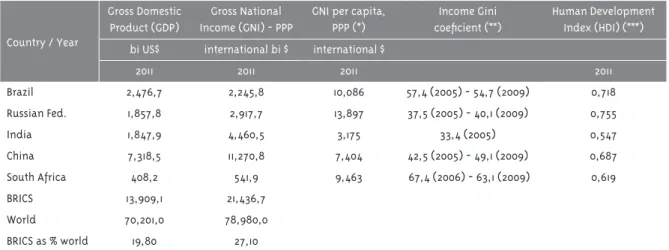
With 42% of the world population (UNDP, 2011), 7.8% of the world surface area (The World Bank, 2010), spread out across Asia, Africa, Europe and Latin America, which shows the transcontinental dimension of its integration, abundant natural re-sources and diversified economies at a sustainable rate of growth, it was natural that they were consi-dered a group with undisputed political and econo-mic weight, equivalent to 19.8% of nominal global GDP, with GDP totaling US$ 13.9 trillion (The World Bank, 2011) (Table 1). Considering the parity-power--purchase (PPP), this indicator reaches US$21.4 trillion, which represents 27.1% of the total (Table 1).
Table 1 - Socio-economic and income indicators of BRICS countries
Country / Year
Gross Domestic Product (GDP)
Gross National Income (GNI) - PPP
GNI per capita, PPP (*)
Income Gini coeficient (**)
Human Development Index (HDI) (***) bi US$ international bi $ international $
2011 2011 2011 2011
Brazil 2,476,7 2,245,8 10,086 57,4 (2005) - 54,7 (2009) 0,718 Russian Fed. 1,857,8 2,917,7 13,897 37,5 (2005) - 40,1 (2009) 0,755
India 1,847,9 4,460,5 3,175 33,4 (2005) 0,547
China 7,318,5 11,270,8 7,404 42,5 (2005) - 49,1 (2009) 0,687 South Africa 408,2 541,9 9,463 67,4 (2006) - 63,1 (2009) 0,619
BRICS 13,909,1 21,436,7
World 70,201,0 78,980,0
BRICS as % world 19,80 27,10
(*) Gross National Income converted to international dollars (I$) using purchasing power parity rates. An I$ has the same purchasing power over GNI as a U.S. dollar has in the United States.
(**) Measure of the deviation of the distribution of income or consumption among individuals or households within a country from a perfectly equal distribution. A value of 0 represents absolute equality, a value of 100 absolute inequality (all incomes are commanded by the richest person in the economy).
(***) Combines indicators of health (life expectancy at birth), education (mean years of schooling and expected years of schooling) and living standards (gross national income per capita).
The BRICS population is mostly urban, except in India and China, where it is balanced (The World Bank, 2011). About 30% of the population of Brazil, India and South Africa is below 15 years of age and nearly 20% of Russia’s population is aged over 60 (BRICS, 2011a). From what has been presented, the best indices of group members correspond to Brazil, Russia and China and the worst in India and South Africa, with very few exceptions in certain areas (Table 2).
The Gross National Income per capita (PPP) in Russia is 4.4 times higher than in India, which sho-ws how heterogeneous the group is. India had the lowest HDI of the group (Table 1) and has the lowest levels of public expenditure on health (WHO, 2013) and on education (The World Bank, 2013).
South Africa has the most unequal distribution of income and wealth in the group, but its indices have been improving. The second most unequal country in the group is Brazil and India is the most egalitarian among BRICS countries.
Prospects for health and science,
technology and innovation (STI):
meetings of BRICS ministers
Meetings of MoH
During the initial stage of forming BRICS, the broad-ening of the debate on the area of health had not yet arisen. However, during the course of the Summits of Heads of State, from a decision reached at the III Meeting in Sanya (Brasil, 2011) the Health Ministers began to organize periodic meetings, the first in Bei-jing (BRICS, 2011b) and the second in Delhi (BRICS, 2013). In addition to repeatedly addressing the same interests and commitments, these meetings comple-mented each other, covering a broad selection of themes which reflect a real development agenda in health, including the points listed below. As raised in both meetings, Health Ministers agreed to “promote BRICS as a forum of coordination, cooperation and consultation on relevant matters related to global public health” (BRICS, 2011, 2012).
The first meeting of the MoH decides to develop projects for health cooperation (South-South and triangular cooperation). Despite the existing
diver-sity, BRICS nations face a number of similar public health challenges, including inequality of access to health services and medicines, in the context of a poor provision of social protection which varies in different countries with respect to the most vulne-rable sectors of society. The declaration stressed the need for collaboration in order to strengthen health systems and to overcome the problems in access to quality medical products and other health techno-logies for the treatment of HIV/Aids, tuberculosis, viral hepatitis, malaria and other communicable and non-communicable diseases, extending the scope of ODM 4, 5, 6 and 8.
The promotion of innovation and access to health technologies were stressed, especially in the context of health costs and the rise in the double burden of communicable and non-communicable diseases. Among the communicable diseases, the main aspect was the development of capacity and infrastructure to reduce the prevalence and incidence of tubercu-losis through innovation with new drugs/vaccines, diagnostics and promotion of consortia of resear-chers to collaborate on clinical trials of drugs and vaccines. For combating HIV/AIDS, the use of new and innovative antiretroviral therapies (ART) and the simplification of the treatment regime, espe-cially in recent infections and HIV-TB co-infections were recommended. In the case of malaria and viral hepatitis, the use of diagnostic tools, R&D and ease of common access to health technologies developed in BRICS countries was encouraged.
They stated the need for research into the social and economic determinants leading to the occurrence of NCDs amongst the BRICS countries, and in particular to the commitment to the WHO Framework Convention on Tobacco Control and the WHO Comprehensive Mental Health Action Plan through sharing of innovations in the field of pro-motion, diagnosis and management, exchange of best practices and experiences.
They dedicated great attention to child survival through progressive reduction in maternal mortali-ty, infant mortalimortali-ty, neo-natal mortality and under-5 mortality, with the aim of achieving the MDGs.
for Medical Products and welcomed the proposal to establish a Global Health R&D Observatory, as well as the move on holding regional consultations to set up R&D demonstration projects. The Ministers urged that the entire process, including priority setting, should be driven by WHO Member States and based on public health needs, in particular those of developing countries, with the cost of R&D delinked from the final products. They encouraged basic research in the fields of nanotechnology, biotechnology, advanced materials science, energy efficiency technologies and renewable energy, and research on climate change etc., developing the flow of knowledge amongst their research institutions through joint projects, workshops and exchanges of young scientists. They included the use of In-formation and Communication Technologies (ICT) acknowledging the values of Telemedicine and the importance of traditional medicine, as well as the need for experience and knowledge sharing in all the spheres of health by means of establishing a BRICS network of technological cooperation.
They undertook to promote health for all, deve-loping mechanisms for planning and health sur-veillance systems with risk assessment tools and mitigation methods, referral systems, life course approaches, community empowerment, monitoring health impact assessments of all public policies at national and international levels.
They reiterated their commitment to work in conjunction with other developing countries, pro-moting South-South and triangular cooperation and including stakeholders from the public and private sectors to achieve inclusive global public health. They backed the United Nations General Assembly Resolution on universal health coverage, as well as the ongoing discussions on the process of WHO reform, to better respond to global challenges.
Lastly, they valued the support of the internatio-nal organizations, including in addition to the WHO and UNAIDS, the Global Fund to Fight AIDS, Tuber-culosis and Malaria, GAVI alliance and UNITAID International Drug Purchasing to increase access to medicines, vaccines and safe medical products.
They also reiterated the commitment to preserve and promote the provisions contained in the Doha Declaration on TRIPS and Public Health and of the Global Strategy and Plan of Action on Public Health, Innovation and Intellectual Property.
Ministerial meeting on science, technology and innovation
At the first ministerial meeting on ST&I held in Cape Town, in 2014, the BRICS countries adopted a declaration to strengthen cooperation in STI (BRICS, 2014); the memorandum of understanding on coope-ration in ST&I is expected to be signed in July 2014, in Fortaleza, Brazil.
As a first step towards implementing the objec-tives of the agreement each country would head one of the five thematic areas: climate change and natural disaster mitigation (Brazil); water resources and pollution treatment (Russia); geospatial techno-logy and its application (India); new and renewable energy and energy efficiency (China) and astronomy (South Africa). The ST&I for health agenda itself has been included in the agenda of MoH, but due to the influence on health of extra-sectorial dimensions, the above agenda of ST&I is expected to be critical also for health.
Health indicators and resources
The differences of the health related risk factors are marked between BRICS countries. Of the total of 911 million of the 10 leading causes of DALYs in the world, 423 million or 46.4% are from the BRICS countries3.
In 2010, the global estimated healthy life expec-tancy at birth (HALE) was 58.3 years for males and 61.8 for females (IHME, 2012) — however, Russia, India and South Africa were below these figures. Regarding the risk factors that lead to NCDs, Brazil, Russia and South Africa are above the global avera-ge of obesity in adult men’s 20+ years of aavera-ge. Other factors of concern are alcohol consumption among adults aged 15+ years of age in Russia and the high prevalence for current smoking among male adults aged 15+ years in Russia and China.
Table 2 - Healthy life expectancy at birth, leading causes of DALYs in BRICS, risk factors which can lead to non--communicable disease and some NCD indicators
Country / Year
Risk factors NCD
Estimated Healthy life expectancy (HALE)* at birth
10 leading causes of
DALYs**
Obese adults 20 y.o.+
Alcohol consumption
adults 15 y.o.+
Prevalence for current smoking adults 15 y.o. +
Cancer Cardiovascular
diseases and diabetes
Chronic respiratory
diseases
both sexes combined
in thousands
% litres of pure alcohol per person per
year
% deaths per 100,000 (M - F)
deaths per 100,000
(M - F)
deaths per 100,000
(M - F)
2010 2010 2008 2008 2009 2008 2008 2008
Brazil 63,8 21,749,6 16,5 10,1 22 136 - 95 304 - 226 54 - 32
Russian Federation
59,9 32,755,4 18,4 16,2 59 194 - 89 772 - 414 41 - 9
India 56,2 209,784,1 1,3 2,7 26 79 - 72 386 - 283 178 - 125
China 67,8 140,460,6 4,6 5,6 51 182 - 105 312 - 260 118 - 89
South Africa 51,0 18,518,9 23,2 10,2 24 207 - 124 328 - 315 87 - 44
* Healthy life expectancy (HALE). Average number of years that a person can expect to live in “full health” by taking into account years lived in less than full health due to disease and/or injury.
** Disability Adjusted Life Years (DALYs). The sum of years of potential life lost due to premature mortality and the years of productive life lost due to disability. Source: IHME, 2013; WHO, 2012, 2013.
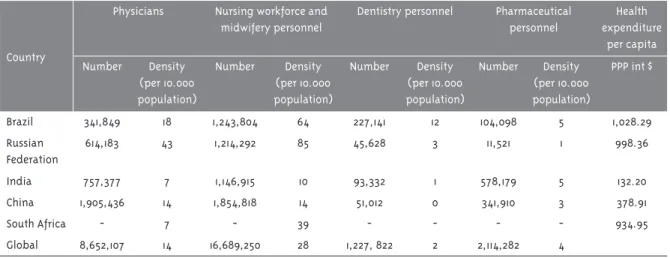
Table 3 - Human health resources and expenditures
Country
Physicians Nursing workforce and midwifery personnel
Dentistry personnel Pharmaceutical personnel
Health expenditure
per capita
Number Density (per 10.000 population)
Number Density (per 10.000 population)
Number Density (per 10.000 population)
Number Density (per 10.000 population)
PPP int $
Brazil 341,849 18 1,243,804 64 227,141 12 104,098 5 1,028.29
Russian Federation
614,183 43 1,214,292 85 45,628 3 11,521 1 998.36
India 757,377 7 1,146,915 10 93,332 1 578,179 5 132.20
China 1,905,436 14 1,854,818 14 51,012 0 341,910 3 378.91
South Africa - 7 - 39 - - - - 934.95
Global 8,652,107 14 16,689,250 28 1,227, 822 2 2,114,282 4
Obviously, the availability of qualified human resources is essential to ensure addressing health issues adequately, and in that respect great dispari-ties among the BRICS are also observed. Brazil and Russia have greater densities of doctors and nurses per 10,000 inhabitants (Table 3). Russia has signi-ficant values which are far lower in Brazil, where the situation is complicated by poor distribution of these professionals in relation to areas of high and low economic development. Following this pe-culiar situation Brazil recently launched the “Mais Médicos” program that aims to supply remote and poor territories with these professionals. The other countries have far smaller contingents, though in the case of China this limitation is compensated by the services of less qualified personnel, known as “barefoot doctors”. In the fields of dentistry and pharmaceutical personal, the limitation is far grea-ter, even in Russia. It is surprising, however, that in China where the health situation is relatively good: the per capita health expenditure is one of the lowest among the BRICS.
It is important to mention that although we have chosen to analyze data at country level, despite the fact that they are helpful, they hide in-country diffe-rences and inequities. For example the health spen-ding in South Africa is very significantly skewed towards the rich and over-serviced, with about 45 per cent of the spending occurring in the private sector that services a mere 15 per cent of the population (Ataguba and Akazili, 2010). Similar issues exist with the health workforce data.
In the period of India’s economic growth, ine-quity has increased (Balarajan et al., 2011; Baru et al., 2010). In South Africa for example the health statistics indicate that in spite of its growth and its spending on health, South African health statistics are worse than BRICS countries that have a lower percentage of GDP spent on health (The World Bank, 2012).
Excellent analysis on the health and health sys-tems situations in BRICS countries were recently published at the Lancet Collection on Global Health on Brazil (The Lancet, 2011a), China (The Lancet, 2012, 2013), India (The Lancet, 2011b) and South Africa (The Lancet, 2009).
The Heads of State insist on seeking to reduce the socio-economic differences existing among the BRICS countries. Likewise, the MoH insist on stri-ving to diminish the inequalities in health and foster equity in health. To achieve both of these goals, there must be an interchange of experiences in social and health policies, mechanisms and instruments among the BRICS countries.
Comments and conclusions
The Summits of Heads of State themselves have drawn attention to the diversity among the five countries in the BRICS group in terms of the degree of development, the geo-ecological, cultural and lifestyle situation, in addition to their differences in terms of language and location on four different continents. This diversity is also seen from the out-set in most of the indicators presented, with the best rates predominating in Brazil, Russia and China, in general, and the worst in India and South Africa, with some important exceptions.
The diversity among the BRICS countries ex-plains the length of time required to formally the group, which took almost a decade, as it only actually became established and gained momentum and con-tinuity after the annual presidential summits and periodical ministerial meetings started.
It is surprising, nevertheless, that despite the diversity it has been possible to reach a level of consensus, as has been observed in the debates of the Heads of State with great uniformity in the proposals and decisions reached. It can even be con-sidered that the relationship that can be established between them is a sign of complementary interests and capabilities and possible cooperation aimed at promoting sustainable development.
in-dicate adequate compliance with the commitments made at the summits and meetings analyzed here.
Considering the importance of enhancing the po-pulation in the coming years for which better socio--economic situation and better health systems are key, it sought specifically to explore the possibility of progress in the field of health, taking into account what is outlined at the Rio+20 Declaration that re-cognizes that better health is a “precondition for, an outcome of, and an indicator of all three dimensions of sustainable development” (WHO, 2011) which can give us some guidance as to the potential to attain healthier BRICS countries in the coming future.
In this context, the expected exchange in the in-dicated dimensions may influence the health sector, supporting the fields that correspond to it between the Millennium objectives, with clear goals to reach the unfinished agenda of these objectives and their possible expansion after 2015. This is when they will be renewed within the sphere of the United Nations, including those relating to infant and maternal mor-tality and the control of communicable diseases, HIV and AIDS, malaria, tuberculosis, etc. To these it will be added the NCDs, namely cardiovascular, chronic respiratory diseases, cancer, neurodegenerative, diabetes, etc.
For this, the current economic growth in BRICS countries ought to facilitate the strengthening of systems and resources for health, already evident today, by major investment in S&T, including R&D for production and innovation, particularly in the areas of vaccines, drugs and diagnostics. The same may occur in relation to social determinants of he-alth, and particularly to the energy matrix, in order to reduce carbon emissions by 2020, as pledged by China and India with reductions of up to 45% and 25% respectively to control environmental degrada-tion (King et al., 2011).
It is well known that inequity itself leads to ill--health. Bearing in mind the entire debate about what leads to sustainable development and what the preconditions are for health, even with the eco-nomic prospect of ecoeco-nomic growth and plausible proposals for the health sector, they need to put these collective commitments into action, begin to work collectively to exchange good practices and enhance the impact of their assistance programs.
Finally, in the field of common actions in health
diplomacy, it is recognized that over the past deca-de, countries around the world have increasingly recognizing the importance of linking their foreign policy efforts and their work on global health. Even proclaiming their determination to better integrate their health and diplomatic agendas, BRICS coun-tries have been stepping up their work on global health through their own official development assistance — as a bilateral donor, through its work in multilateral institutions, and by supporting overseas health-related research and innovations. As stated by Bliss (2011), how the BRICS countries choose to move forward on global health will depend in large part on their own histories of international interaction on health, on their continued financial growth, and on the extent to which engaging in fo-reign activities does not conflict with their domestic health and development priorities.
There is no doubt that in the next few years there will be the need and the opportunity for joint action of BRICS in terms of the “health diplomacy”. In the 2014-2015 biennial, the WHO began to implement, its General Program of Work 2014-2019 as a complex and challenging agenda. On the other hand, in the context of the United Nations, the Member-States will be defining the post-2015 Development Agenda, which requires a strong presence of health, as well as of other Sustainable Development Goals (SDG) and intersectoral actions capable of tackling the importance and complexity of human health in development. These are two fields and moments in which a joint manifestation of the BRICS may affirm their presence in the field of the diplomacy of global health.
References
ATAGUBA, J.; AKAZILI, J. Health care financing in South Africa: moving towards universal coverage. CME, Grahamstown, v. 28, n. 2, p. 74-78, 2010.
BALARAJAN, Y.; SELVARAJ, S.; SUBRAMANIAN, S. V. Health care and equity in India. The Lancet, London, v. 377, n. 9764, p. 505-515, 2011.
BLISS, K. Health Diplomacy of Foreign Governments. Washington, DC: CSIS, 2011. Available in: <http://csis.org/publication/health-diplomacy-foreign-governments>. Access in: 22 Apr. 2014.
BRASIL. Ministério das Relações Exteriores. Joint statement of the BRIC countries’ leaders. Brasília, DF, 2009. Available in: <http://www.itamaraty. gov.br/temas-mais-informacoes/saiba-mais-bric/ documentos-emitidos-pelos-chefes-de-estado-e- de-governo-pelos-chanceleres/i-bric-summit-joint-statement/>. Access in: 26 Feb. 2013.
BRASIL. Ministério das Relações Exteriores. BRIC – Brazil, Russia, India and China Grouping. Brasília, DF, 2010. Available in: <http://www. itamaraty.gov.br/temas-mais-informacoes/saiba- mais-bric/documentos-emitidos-pelos-chefes-de- estado-e-de-governo-pelos-chanceleres/ii-bric-summit-joint-statement/>. Access in: 22 Apr. 2013.
BRASIL. Ministério das Relações Exteriores. III BRICS Summit -Sanya Declaration. Brasília, DF, 2011. Available in: <http://www.itamaraty.gov. br/temas-mais-informacoes/saiba-mais-bric/ documentos-emitidos-pelos-chefes-de-estado-e-de- governo-pelos-chanceleres/iii-brics-summit-sanya-declaration-1/?searchterm=sanya%20declaration>. Access in: 13 Mar. 2013.
BRASIL. Ministério das Relações Exteriores. IV BRICS Summit -Delhi Declaration. Brasília, DF, 2012. Available in: < http://www.itamaraty.gov. br/sala-de-imprensa/notas-a-imprensa/quarta- cupula-dos-brics-nova-delhi-29-de-marco-de-2012- parceria-dos-brics-para-a-estabilidade-seguranca-e-prosperidade-declaracao-de-nova-delhi>. Access in: 4 Mar. 2013.
BRASIL. Ministério das Relações Exteriores. BRICS e África: parceria para o desenvolvimento, integração e industrialização - Declaração de e-Thekwini. Brasília, DF, 2013. Available in: <http://www.itamaraty.gov.br/sala-de-imprensa/ notas-a-imprensa/v-cupula-do-brics-durban-27-de-marco-de-2013-declaracao-de-ethekwini>. Access in: 5 Apr. 2013.
BRICS. First meeting of Heads of WHO Country Offices in BRICS. Brasilia, DF, 2011a. Available in: <http://apsredes.org/site2012/wp-content/ uploads/2012/04/First-meeting-of-Heads-of-WHO-Counntry-Offices-in-BRICS.pdf>. Access in: 11 Mar. 2013.
BRICS. Health Ministers’ Meeting: Beijing Declaration. Beijing, 2011b. Available in: <http:// www.brics.utoronto.ca/docs/110711-health.html>. Access in: 15 Mar. 2013.
BRICS. Health Ministers’ Communiqué. Delhi, 2013. Available in: <http://www.brics.utoronto.ca/ docs/130111-health.html>. Access in: 18 Mar. 2013.
BRICS. First BRICS Science, Technology and Innovation: Ministerial Meeting: Cape Town Declaration. Cape Town, 2014. Available in: <http:// www.brics5.co.za/assets/BRICS-STI-CAPE-TOWN-COMMUNIQUE-OF-10-FEBRUARY-2014.pdf>. Access in: 7 Mar. 2014.
HARMER, A. et al. BRICS without straw?: a systematic literature review of newly emerging economies’ influence in global health.
Globalization and Health, London, v. 9, n. 15, Unpaged, 2013.
IHME - INSTITUTE FOR HEALTH METRICS AND EVALUATION. Healthy life expectancy for 187 countries, 1990-2010: a systematic analysis for the Global Burden of Disease Study 2010. Seattle, 2012. Available in: <http:// www.healthmetricsandevaluation.org/gbd/ publications/healthy-life-expectancy-187- countries-1990-2010-systematic-analysis-global-bu>. Access in: 13 Aug. 2013.
IHME - INSTITUTE FOR HEALTH METRICS AND EVALUATION. GBD arrow diagram. Seattle, 2013. Available in: <http://www. healthmetricsandevaluation.org/gbd/
visualizations/gbd-arrow-diagram>. Access in: 24 Apr. 2014.
THE LANCET. London: The Lancet, v. 374, n. 9692, 2009. (Global Health Series - South Africa). Available in: <http://www.thelancet.com/series/ health-in-south-africa>. Access in: 22 Apr. 2014.
THE LANCET. London: The Lancet, v. 377, n. 9779, 2011a. (Global Health Series – Brazil). Available in: <http://www.thelancet.com/series/health-in-brazil>. Access in: 22 Apr. 2014.
THE LANCET. London: The Lancet, v. 377, n. 9761, 2011b. (Global Health Series – India). Available in: <http://www.thelancet.com/series/india-towards-universal-health-coverage>. Access in: 22 Apr. 2014.
THE LANCET. London: The Lancet, v. 379, n. 9818, 2012. (Global Health Series – China). Available in: <http://www.thelancet.com/themed-china>. Access in: 22 Apr. 2014.
THE LANCET. London: The Lancet, v. 381, n. 9882, 2013. (Global Health Series – China). Available in: <http://www.thelancet.com/themed/china-2013>. Access in: 22 Apr. 2014.
LI, C. The political mapping of China´s tobacco industry and anti-smoking campaign. Washington, DC: The John L. Thornton China Center at Brookings, 2012. Available in: <http:// www.brookings.edu/~/media/Research/Files/ Papers/2012/10/25%20china%20tobacco%20 li/25%20china%20tobacco%20li.pdf>. Access in: 22 Apr. 2014.
MSF - MÉDECINS SANS FRONTIÈRES. Help wanted: confronting the health care worker crisis to expand access to HIV/AIDS treatment: MSF experience in Southern Africa. Johannesburg, 2007. Available in: <http://www. doctorswithoutborders.org/sites/usa/files/
healthcare_worker_report_05-2007.pdf>. Access in: 24 Apr. 2014.
O’NEILL, J. Building better global economic BRICs. Global Economics, London, n. 66, p. 1-16, Nov. 2001. Available in: <http://www.
goldmansachs.com/our-thinking/archive/archive-pdfs/build-better-brics.pdf>. Access in: 22 Apr. 2014.
RODRIK, D. What the world need from BRICS. Prague: Project Syndicate, 2013. Available in: <http://www.project-syndicate.org/commentary/ the-brics-and-global-economic-leadership-by-dani-rodrik>. Access in: 29 Apr. 2013.
SHIDHAYE, R.; KERMODE, M. Stigma and discrimination as a barrier to mental health service utilization in India. International Health, Oxford, v. 5, n. 1, p. 6-8, 2013.
UN - UNITED NATIONS. Report of the United Nations Conference on Sustainable Development. New York: UN, 2012. Available in: <http://www.uncsd2012.org/content/
documents/814UNCSD%20REPORT%20final%20 revs.pdf>. Access in: 5 Mar. 2013.
UNDP - UNITED NATIONS DEVELOPMENT PROGRAMME. Human Development Report 2011: sustainability and equity: a better future for all. New York, 2011. Available in: <http://hdr.undp. org/sites/default/files/reports/271/hdr_2011_en_ complete.pdf>. Access in: 22 Apr. 2014.
WHO - WORLD HEALTH ORGANIZATION. Rio
Political Declaration on Social Determinants of Health. Geneva, 2011. Available in: <http://www. who.int/sdhconference/declaration/Rio_political_ declaration.pdf>. Access in: 6 Mar. 2013.
WHO - WORLD HEALTH ORGANIZATION. World health statistics 2012. Geneva, 2012. Available in: <http://apps.who.int/iris/
bitstream/10665/44844/1/9789241564441_eng. pdf>. Access in: 24 Apr. 2014.
WHO - WORLD HEALTH ORGANIZATION. Global
Health Observatory Data Repository. Geneva, 2013. Available in: <http://apps.who.int/gho/ data/?vid=710#>. Access in: 12 Mar. 2013.
THE WORLD BANK. Surface area. Washington, DC, 2010. Available in: <http://data.worldbank. org/indicator/AG.SRF.TOTL.K2>. Access in: 7 Mar. 2013.
THE WORLD BANK. Expenditure on health, public (% GDP). Washington, DC, 2012. Available in: <http://data.worldbank.org/indicator/SH.XPD. PUBL.ZS>. Access in: 22 Apr. 2014.
THE WORLD BANK. Public spending on education, total (% of GDP). Washington, DC, 2013. Available in: <http://data.worldbank.org/indicator/SE.XPD. TOTL.GD.ZS>. Access in: 13 Mar. 2013.