NEDD8 conjugation in
Schistosoma mansoni
: Genome analysis and expression pro
fi
les
Roberta V. Pereira
a, Matheus de S. Gomes
b, Roenick P. Olmo
a, Daniel M. Souza
a, Liana K. Jannotti-Passos
c,
Elio H. Baba
c, William Castro-Borges
a, Renata Guerra-Sá
a,⁎
aNúcleo de Pesquisas em Ciências Biológicas, Universidade Federal de Ouro Preto, Morro do Cruzeiro, Ouro Preto, MG, Brazil bInstituto de Genética e Bioquímica, Universidade Federal de Uberlândia Campus Avançado Patos de Minas, MG, Brazil cCentro de Pesquisas René Rachou, Fiocruz, Belo Horizonte, MG, Brazil
a b s t r a c t
a r t i c l e
i n f o
Article history: Received 27 June 2012
Received in revised form 18 December 2012 Accepted 22 December 2012
Available online 8 January 2013
Keywords: NEDD8 NEDDylation
Schistosomula development Differential expression
NEDD8 is an ubiquitin-like molecule that covalently binds to target proteins through an enzymatic cascade analogous to ubiquitylation. This modifier is known to bind to p53 and p73, as well as all Cullin family pro-teins, which are essential components of Skp1/Cul-1/F-box protein (SCF)-like Ub ligase complexes. Here, we focused on a genomic analysis of the genes involved in the NEDD8 conjugation pathway inSchistosoma mansoni. The results revealed seven genes related to NEDD8 conjugation that are conserved inSchistosoma japonicum, Caenorhabditis elegans, Drosophila melanogasterandHomo sapiens. We performed quantitative RT-PCR (qRT-PCR), which showed differential profiles forSmnedd8,Smapp1,Smuba3,Smube2f,Smdcn1,Smrbx andSmsenp8throughout the life cycle ofS. mansoni. Upregulation was observed in 3-day-old schistosomula and adult worms for all analysed genes. We also analysed the transcription levels of Cullin family members Smp63 and Smp73, and observed upregulation in early schistosomula, while cercariae and adult worms showed expression levels similar to one another. Taken together, these results suggest that the NEDDylation/ DeNEDDylation pathway controls important cellular regulators during worm development from cercariae to schistosomula and,finally, to adult.
© 2013 Elsevier Ireland Ltd. All rights reserved.
1. Introduction
Posttranslational modifications (PTMs), such as ubiquitylation and ubiquitin-like protein (Ubl) modifications, play critical roles in a vari-ety of cellular processes. The ubiquitin–proteasome pathway is one of the best-characterised systems involved in protein regulation in eukaryotes [1,2]. A number of small Ubls such as SUMO (Small ubiquitin modifier), NEDD8 (neural precursor cell-expressed develop-mentally downregulated-8) and ISG15 (interferon-induced ubiquitin-like modifier) have been found covalently attached to their targets in a manner similar to the ubiquitylation process. Among the Ubls, the NEDD8 protein has been found to be evolutionarily conserved in eu-karyotes and has the highest identity with the ubiquitin protein (59%) [3,4]. Studies have revealed that NEDD8 is essential for cell viability in fission yeast and is required for development processes in both mouse andDrosophila[5–7].
The NEDDylation pathway, analogous to the ubiquitin pathway, involves a set of enzymes working together to conjugate the NEDD8 protein to specific target proteins[8–10]. In thefirst step, the
NEDD8-specific E1 activating enzyme (APP-BP1/Uba3 heterodimer) activates the NEDD8 protein by adenylating the carboxyl terminal glycine residue. This is followed by the formation of a high-energy thioester bond with the catalytic cysteine residue of UBA3. In the next step, NEDD8 is transferred from the E1 enzyme to a catalytic cysteine residue of the NEDD8-specific E2 conjugation enzymes UBC12 (also known as UBE2M) or UBE2F, again using a thioester linkage. Finally, the activated NEDD8 on the E2 enzyme is subsequently transferred and conjugated to the E3 ligase substrates. The RING-finger protein ROC1, a subunit of the Cullin Ring Ligases (CRLs), interacts with UBC12, acting as the NEDD8 E3 ligase for Cullins. The most significant and best-studied substrates of NEDD8 are the Cullin proteins, which serve as scaffolds in E3 CRLs[11,12]. NEDD8 contains seven conserved lysine residues, similar to the ubiquitin protein. The NEDD8 residues K11, K22, K48 and K60 can allow NEDD8 to form chainsin vivo, whereas the NEDD8 residues K22 and K48 can be NEDDylatedin vitro, suggesting that chain for-mation of ubiquitin and ubiquitin-like proteins might be a general phenomenon for these modifications[13]. In addition, the NEDD8 modification is a dynamic and reversible process that is controlled by NEDD8-specific proteases that remove NEDD8 protein from dis-tinct targets. A specific activity of the NEDD8-specific protease has been reported to be associated with a metalloprotease motif in JAB1/CSN5, a subunit of the COP9 signalosome. The whole COP9 signalosome complex is required for CSN5 activity, as evidenced by the fact that the isolated protein did not display NEDD8 protease ⁎ Corresponding author at: Universidade Federal de Ouro Preto, Departamento de Ciências
Biológicas/Núcleo de Pesquisas em Ciências Biológicas, Instituto de Ciências Exatas e Biológicas, ICEB2, Sala 045, Campus Morro do Cruzeiro, 35400-000, Ouro Preto, MG, Brazil. Tel.: +55 31 35591697; fax: +55 31 35591680.
E-mail address:[email protected](R. Guerra-Sá).
1383-5769/$–see front matter © 2013 Elsevier Ireland Ltd. All rights reserved. http://dx.doi.org/10.1016/j.parint.2012.12.009
Contents lists available atSciVerse ScienceDirect
Parasitology International
activity[14,15]. NEDD8, similar to the UBL proteins, is synthesised as an inactive precursor and has to be processed by a NEDD8-specific protease (SENP8). This processing exposes the diglycine motif at the carboxyl-terminus, which is required for the conjugation process. SENP8 is a highly conserved and specific protease for NEDD8. Neither ubiquitin nor SUMO are utilised as SENP8 substrates, although both share COOH-terminal extensions[16].
Although the NEDDylation process shares similarities to the ubiquitylation process, the biological impact of this modification ap-pears to be different. Ubiquitylation has been shown to be involved in trafficking, signalling, endocytosis and proteasome-dependent proteol-ysis, whereas NEDDylation has been implicated in modulation of the biochemical activity of target proteins to affect their stabilities[17]. Recently, a set of NEDD8 target proteins have been identified, including pVHL, p53, BCA3, the EGF receptor and ribosomal proteins[18].
Previous investigations revealed the importance of ubiquitylation duringS. mansonidevelopment[19,20]and evidenced the complexity of the proteasome-dependent intracellular protein degradation in adult worms[21]. Subsequently, our group reported the existence of two SUMO paralogs and UBC9 inS. mansoni, confirming the impor-tance of these posttranslational protein modifications in this parasite [22,23]. In this work we aimed to investigate the importance of post-translational modifications in this parasite, focusing on the NEDDylation system. We analysed the conservation of the proteins predicted to be related to this pathway usingS. mansonidatabases. We then evaluated the gene expression of the components of the NEDD8 machinery, as well as the putative NEDD8 targets (Cullins, p63 and p73), using qRT-PCR at the cercariae, adult worm and mechanically transformed schistosomula (MTS) stages of development. The current study pro-vides for thefirst time information about the NEDDylation machinery in theS. mansoniparasite. Investigations involving posttranslational regulation may help to better understand the biology of the parasite, as well as its relationship with the host.
2. Materials and methods
2.1. Ethics statement
All experiments involving animals were authorised by the Ethical Committee for Animal Care of Federal University of Ouro Preto and were in accordance with the national and international regulations accepted for laboratory animal use and care.
2.2. Parasites
The LE strain was maintained by routine passage through
Biomphalaria glabratasnails and BALB/c mice. The infected snails were induced to shed cercariae under light exposure for 2 h and the cercariae were recovered by sedimentation on ice. Adult worm parasites were obtained by liver perfusion of mice after 50 days of infection. Mechani-cally transformed schistosomula (MTS) were prepared as described by Harrop and Wilson[24]. Briefly, cercariae were recovered and washed in RPMI 1640 medium (Invitrogen) before vortexing at maximum speed for 90 s and then were immediately cultured for 3.5h at 37 °C, 5% CO2. The recovered schistosomula were then washed with RPMI 1640 until no tails were detected. For subsequent incubations, the parasites were maintained in M169 medium supplemented with 10% FBS, 100μg/mL penicillin, 100μg/mL streptomycin and 5% Schneider's medium[25]at 37 °C on 5% CO2for 3.5 h, 1, 2, 3, 5 and 7 days.
2.3. Identification and computational analysis of the NEDDylation pathway and possible targets
The sequences forSmNEDD8,SmAPP1-UBA3,SmUBE2F,SmDCN1,
SmRBX,SmSENP8 and possible targets (SmCullins,Smp63 andSmp73) were retrieved through BLAST searches from theS. mansonigenome
database version 5.0, available at http://www.genedb.org/genedb/ smansoni/. Amino acid sequences from the orthologs in Drosophila melanogaster,Caenorhabditis elegansandHomo sapienswere used as queries. The BLASTp algorithm, underpinned by Pfam (v26.0), allowed detection of conserved protein domains or motifs from S. mansoni
sequences. Multiple alignments ofSmUBE2F andSmCullins were per-formed by ClustalX 2.0[26]. Phylogenetic analysis was conducted by MEGA 5[27]. A phylogenetic tree of these sequences was inferred using the Neighbor-Joining method[28]. The bootstrap consensus tree inferred from 1000 replicates was used to represent the evolutionary history of the taxa analysed. Branches corresponding to partitions reproduced in less than 50% of the bootstrap replicates are collapsed. The percentage of replicate trees in which the associated taxa clustered together in the bootstrap test (1000 replicates) is shown next to the branches. The tree was drawn to scale, with branch lengths in the same units as those of the evolutionary distances used to infer the phy-logenetic tree. All positions containing gaps and missing data were eliminated from the dataset.
2.4. Expression analysis of NEDDylation pathway components and possible targets
Total RNA from adult worms, cercariae and schistosomula were obtained using a combination of the Trizol reagent (GIBCO-BRL) and chloroform for extraction and then were on-column purified using the“SV total RNA Isolation System”(Promega, Belo Horizonte, Brazil). The preparation was treated with 3 different rounds of RNase-free DNase I (RQ1 DNase; Promega). RNA was quantified using a spectro-photometer and an aliquot containing 1 μg of total RNA reverse transcribed using an oligodT primer from the Thermoscript RT-PCR System (Invitrogen São Paulo, Brazil), as described by the manu-facturer. The efficiency of DNAse I treatment was evaluated by PCR amplification of the cDNA reaction mix without the addition of the Thermoscript enzyme.S. mansoni-specific primers were designed using the program GeneRunner®. The sequence accession numbers and their pair of primers are in the supplementary materials (Table S1). Reverse-transcribed cDNA samples were used as templates for PCR amplification using SYBR Green Master Mix UDG-ROX® (Invitrogen) and the 7300 Real Time PCR System (Applied Biosystems, Rio de Janeiro, Brazil). Specific primers forS. mansoniEIF4E were used as an endogenous control (GeneDB ID: Smp_001500) (forward 5′
TGTTCCAACCACGGTCTCG3′, reverse 5′TCGCCTTCCAATGCTTAGG3′)[29]. The efficiency of each pair of primers was evaluated according to the pro-tocol developed by the Applied Biosystems application (cDNA dilutions were 1:10, 1:100 and 1:1000). For all investigated transcripts three bio-logical replicates were performed. The gene expression was normalised to theSmEIF4E transcript using the Applied Biosystems 7300 software according to the 2−ΔCtmethod[30].
2.5. Statistical analysis
Statistical analysis was performed using the GraphPad Prism version 5.0 software package (Irvine, CA, USA). Normality of the data was established using one way analysis of variance (ANOVA). Tukey post tests were used to investigate significant differential expres-sion of transcripts throughout the investigated stages. In all cases, the differences were considered significant whenpvalues wereb0.05.
3. Results
3.1. NEDDylation pathway conservation in S. mansoni
Using both a homology-based method and de novo prediction on
S. mansonisequences deposited in the genome database, we were able to characterise the components of the NEDDylation machineryin silico. This analysis identified seven genes involved in the NEDDylation
mechanism in this parasite. These genes were the following:SmNEDD8 (GeneDB ID: Smp_130170), components of the E1 activation hetero-dimerSmAPP1 (GeneDB ID: Smp_087920) andSmUBA3 (GeneDB ID: Smp_151760), E2 conjugating enzymeSmUBE2F (GeneDB ID: Smp_ 027370), E3 ligasesSmDCN1 (GeneDB ID: Smp_105330) andSmRBX (GenBank ID: DQ466078.1) and protease SmSENP8 (GeneDB ID: Smp_121890). The number of genes found inS. mansonithat were relat-ed to the NEDDylation pathway was comparrelat-ed with the number of genes fromS. japonicum,C. elegans,D. melanogasterandH. sapiens. Our results demonstrate that theS. mansonigenes are very similar to those
found in the Protostome organismsC. elegansandD. melanogaster, and identical toS. japonicum, reinforcing that the NEDDylation pathway is conserved in these organisms.
The conserved domains of SmNEDD8, SmUBE2F and SmSENP8 were assigned in these enzymes and compared with their orthologs inD. melanogaster,C. elegansandH. sapiens(Fig. 1). The predicted
SmNEDD8 protein has 77 amino acid residues and contains a main domain, Rad60 (PF 11976). The predictedSmUBE2F protein has 186 amino acid residues and a UQ domain (PF 00179), characteristic of conjugation enzymes. Furthermore, SmUBE2F contains a critical
Cysteine residue at position117, similar to orthologous E2 conjuga-tion enzymes. The predicted proteinSmSENP8 has 216 amino acid residues and a conserved C-48 domain (PF 02902), which includes the enzyme active site residues histidine, aspartic acid and cysteine at the positions 102, 119 and 162, respectively (Fig. 1). Comparing
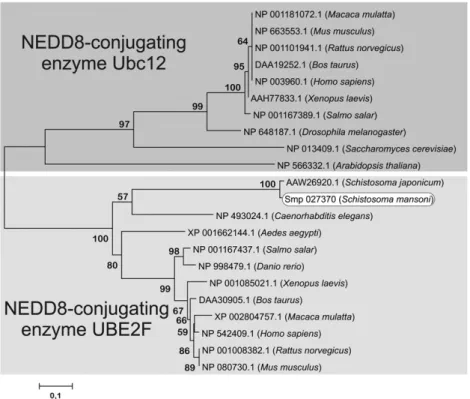
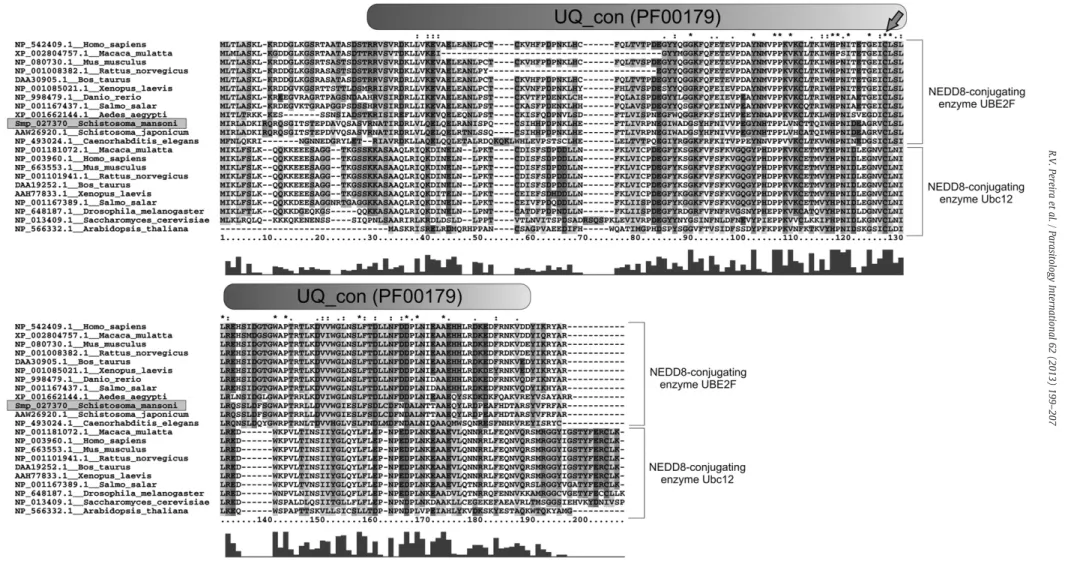
SmNEDD8 with its orthologs, we noticed that this protein was highly conserved with at least 74% identity when compared to the proteins fromD. melanogaster,C. elegansandH. sapiens(Fig. 2). The alignment of the proteins fromS. mansoni and S. japonicumdisplayed 100% identity, affirming the evolutionary conservation of this species (data not shown). The gene encoding the NEDD8 E2 conjugation enzyme has been found duplicated in several organisms (UBE2F and UBE2M or UBC12 isoforms). The phylogenetic analysis displayed that the NEDD8-E2 enzyme inS. mansoniis unique and has a higher homology with UBE2F orthologs than UBE2M orthologs (Fig. 3). The global alignment between E2-NEDD8 orthologs reinforced this conservation and the dif-ferences between the two E2 conjugation enzymes. The cysteine residue characteristic of the UQ_con domain is shown highlighted (Fig. 4).
3.2. NEDDylation machinery is differentially regulated in S. mansoni
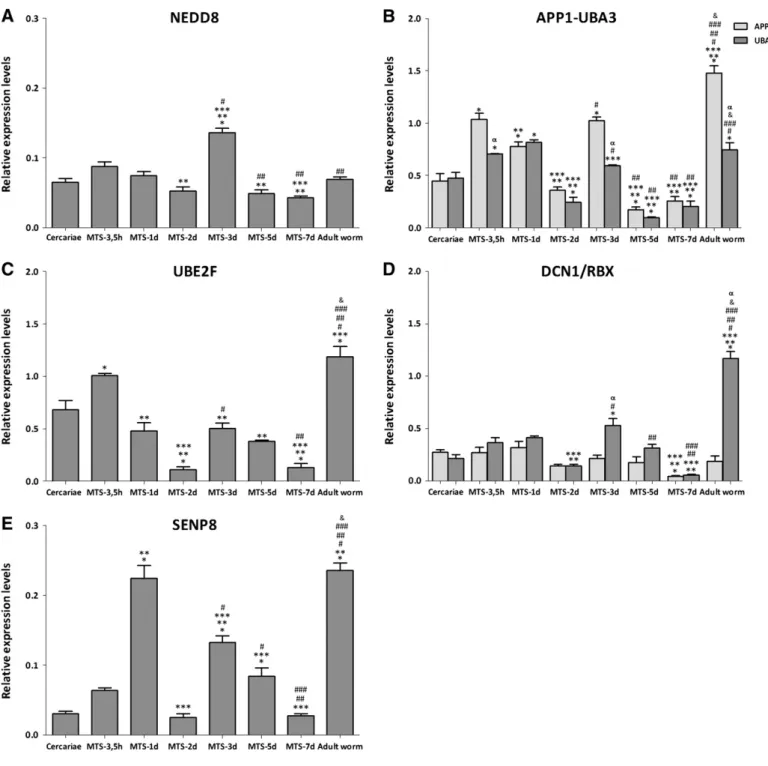
The gene expression of the NEDDylation pathway components was analysed using the qRT-PCR technique with three biological replicates. The results were expressed using RNA levels in relation to EIF4E, a constitutively expressed gene. Regarding the expression ofSmnedd8, we observed a 1.5-fold increase in MTS-3 d compared to the other developmental stages and similar levels when comparing
cercariae to adult worm (Fig. 5A). The expression of Smapp1 and
Smuba3subunits that form the NEDD8-activating E1 enzyme demon-strated no relevant changes among the subunits. Both components of the E1 heterodimer were upregulated at least 2-fold in MTS-3.5h, 1d, 3 days and adult worm (Fig. 5B). The conjugation enzyme UBE2F is the only enzyme able to conjugate NEDD8 inS. mansoni. While verify-ing the expression of this transcript in the parasite stages, we found an increase of 2-fold in MTS-3.5h in relation to other schistosomula and an increase of 1.5-fold in adult worm compared to cercariae (Fig. 5C). The expression of the E3 ligases (Smdcn1andSmrbx) was very similar in all stages, except in adult worms, where RBX was upregulated 2-fold compared to other developmental stages (Fig. 5D). The NEDD8-specific protease SENP8 has been found to be capable of both processing the inactive precursor of NEDD8 and freeing NEDD8 monomers from the substrates they are bound to[18]. There was a stage-specific expression pattern of this enzyme's transcript during the cercariae-schistosomula transition and a 3-fold increase in MTS-1d and adult worm compared to other evolutionary stages (Fig. 5E). Together, the results showed a higher expression of all NEDDylation machinery components in adult worm, suggesting that this modification pathway is important during this stage of the parasite cycle.
3.3. Cullins and tumour suppressor proteins (p63 and p73) are highly expressed in MTS-3.5h
We identifiedfive Cullins and their conserved domains inS. mansoni:
SmCullin1 (GeneDB ID: Smp_150270), SmCullin2 (GeneDB ID: Fig. 2.Global alignment ofSmNEDD8 and its orthologs, using the ClustalX 2.0 program and boxshade. Identical residues are shaded in black and similar residues in grey.
Fig. 3.Consensus phylogenetic tree based on the amino acid sequence ofSmUBE2F. The tree construction and bootstrap analysis were performed using ClustalX 2.0 and MEGA 5.0. To validate the consensus tree and reliability of the branches formed, a phylogenetic bootstrap test was used with 1000 replicates for each sequence, and reproduction of the branch in 50% of the runs considered the minimum for a reliable branch.
Fig. 4.CLUSTALX 2.0 multiple alignment of predicted amino acid sequences ofSmUBE2F, showing the putative conserved domain UQ_con (PF00179), obtained by using the Pfam algorithm.
203
Pereira
et
al.
/
Parasitology
Internation
al
62
(2013)
199
–
Smp_079740), SmCullin3 (GeneDB ID: Smp_117580), SmCullin4 (GeneDB ID: Smp_082850) andSmCullin5 (GeneDB ID: Smp_143030). The phylogenetic analysis indicated that the Cullins’sequences are con-served among their orthologs (Fig. 6). We analysed the expression levels of these Cullins in cercariae, adult worms, MTS-3.5h, 1, 2, 3, 5 and 7 days. In MTS-3.5h, the levels of these Cullins were upregulated approximately 3-fold when compared with other stages.Smcullin 2, 3, 4and 5were expressed at the same levels in cercariae and adult worm stages (Fig. 7A–E). RegardingSmcullin1, we verified upregulation of approximately 2-fold in cercariae in relation to adult worms.
Furthermore, we analysed the two tumour suppressor proteins
Smp63 (GeneDB ID: Smp_139530) and Smp73 (GeneDB ID: Smp_
136160.2), which have been found to be putative targets of the NEDD8 conjugation pathway (Fig. 7F). The p63 protein was char-acterised inS. mansoniand its expression was observed in adult worm [31]. In this article, this protein was denominated as p53. However, a recent study revealed that invertebrates do not have p53, only the orthologs p63 and p73[32]. Therefore, in this article we used p63 in-stead of p53. The p63 and p73 proteins had similar expression levels to one another at all analysed stages. Both proteins were upregulated in MTS-3.5h and MTS-5 d (2-3-fold) in relation to the other analysed stages.Smp63 transcript was 3-fold higher in adult worm in relation to cercariae, whereasSmp73 mRNA was found upregulated 2-fold in cercariae compared to adult worm.
Fig. 5.NEDDylation pathway components are differentially expressed throughout theS. mansonilife cycle. TheSmnedd8,Smapp1,Smuba3,Smube2f,Smdcn1,SmrbxandSmsenp8 mRNA expression levels were measured using quantitative RT-PCR based on three replicates for each of the following stages: adult worms, cercariae, MTS-3.5h, 1, 2, 3, 5, and 7 days. Expression levels were calibrated according to the comparative 2−ΔCtmethod, using the constitutively expressedSmEIF4E as an endogenous control (one-way variance
analysis followed by Tukey pairwise comparisonpb0.05). * Different from cercariae, ** different from MTS-3.5h, *** different from MTS-1d,#different from MTS-2d,##different
from MTS-3d,###different from MTS-5d andδdifferent from MTS-7d.tTests were performed to compare UBA3 to APP1 and RBX to DCN1 (αdifferent from APP1 or DCN1).
4. Discussion
Despite the advances in genome sequencing, transcriptome and proteome exploration, PTM in parasites is still poorly understood. This is a subject of fundamental importance because these pathways are involved in many cellular processes[18]. With regards to bio-chemical mechanisms, the NEDD8 pathway is similar to the PTM pro-cesses ubiquitylation and SUMOylation[33,34].
Our in silico analysis revealed that the number of predicted NEDDylation pathway components in theS. mansoni genome is in agreement with other invertebrate genomes, suggesting an impor-tant functional conservation among these organisms. Regarding theS. japonicumgenome, the number of enzymes involved in the NEDD8 conjugation process is the same as is found inS. mansoni, reinforcing the evolutive proximity between these species[35]. During this analysis the RBX protein was not found in the parasite EST database (http://www.genedb.org/genedb/smansoni/), despite the fact that this E3 ligase has been characterised in this helminth previously[36]. Fur-thermore, we have observed errors in the assembled genome sequence for a subunit of the E1 heterodimer (APP1), reinforcing the importance of re-annotating the putative proteins deposited in the genome data-base to increase data accuracy.
The NEDDylation pathway is conserved and essential for the viabil-ity of most model organisms, includingSchizosaccharomyces pombe,
C. elegans,Drosophila,Arabidopsisand mouse, supporting the hypothesis that NEDDylation is involved with important cellular processes in eu-karyotic cells[37,8,6,38,7,39]. Based on these data, we decided to eval-uate the conserved domains in predicted NEDD8 pathway components: NEDD8 (PF 11976), UBE2F (PF 00179) and SENP8 (PF 02902) (Fig. 1). Moreover, we analysed the conservation of E2 conjugation proteins by phylogenetic analysis and multiple sequence alignment. Two enzymes, UBC12 and UBE2F, have been previously identified as E2 conjugation proteins. By observing the phylogenetic tree, we have noted that the NEDD8-E2 from S. mansoniis unique and has higher identity with UBE2F than with UBE2M. In addition, they might share a common ancestral protein, suggesting that these proteins have been the result
of gene duplication events. Biochemical and structural analyses have indicated how plasticity of hydrophobic E1–E2 interactions and E1 con-formationalflexibility allow one E1 to charge multiple E2s[40]. The E2 proteins have displayed distinct functions, with UBE2M/RBX1 and UBE2F/RBX2 each targeting different Cullins. UBE2M and UBE2F pairs specifically regulate NEDDylation of Cullins 1–4 and Cullin 5, respec-tively, in an E2-RING-dependent manner[40]. This specific mechanism inS. mansoniis still unclear because the parasite has a unique E2 and E3 ligase RBX. Furthermore, we found enhanced expression ofSmube2f, a conjugation enzyme and partner of E1, at all examined developmental stages, and all components of the NEDDylation machinery were upregulated in the adult worm.
Recently it has been demonstrated that NEDDylation of Cullin targets is correlated with cell cycle progression. All the Cullin proteins are NEDDylated and involved in formation of various SCF complexes. The modification by NEDD8 induces a conformational change that in-hibits the interaction with the inhibitory protein CAND1 and activates the ubiquitin E3 ligase[18]. Accordingly, we analysed the members of the Cullin family (Cullins 1–5), the possible NEDDylation machinery targets. The conserved domains were characterised (Cullin: Pfam PF 00888 and Cullin-NEDD8: Pfam PF10557), confirming the presence offive Cullins in theS. mansonigenome, as well as their conservation. In addition, the expression profiles of these proteins during the tran-sition from cercariae to adult worms were evaluated. Cullins showed similar expression profiles among analysed stages. Comparative anal-yses showed thatSmcullin1 was the highest-expressed among the Cullins. Cullin1 is the most important among Cullins and has been shown to be involved in most E3ubiquitin ligase complexes[41], suggesting that most of the Cullin-RING ligases inS. mansonihave Cullin1 as their scaffold.
localisation, suggesting that NEDD8 can control protein function[43,44]. By analysing the expression profiles of these transcripts, we observed thatSmp73is highly expressed compared toSmp63in all parasite stages. Moreover, there was a 2-fold increase in p73 gene expression in cercariae levels compared to adult worms.
SENP8 has both hydrolase and isopeptidase activities, so this pro-tease might process the NEDD8 precursor and promote deconjugation of NEDDylated substrates. However, under physiological conditions SENP8 is not able to DeNEDDylate Cullins, the major substrates of NEDDylation pathway. This process is catalysed by the CSN-5 sub-unit of the Cop9 signalosome complex (CSN)[18]. CSN is able to DeNEDDylate monoNEDDylated Cul1 under physiological conditions,
but is not as efficient in deconjugating hyper- or polyNEDDylated Cul1. In contrast SENP8 is able to process hyper- but not mono-NEDDylated Cul1 and is able to activate the NEDD8 pro-protein [16]. HyperNEDDylated Cul1 is induced in the cell under non-physiological conditions, and thus may not represent a non-physiological target of either SENP8 or CSN-5. However, the ability of SENP8 to deconjugate hyperNEDDylated Cul1 likely derives from the ability of SENP8 to accommodate large leaving groups at the C terminus of NEDD8. Although, nothing is known about the nature of the interac-tions between the Cullin component of these substrates and SENP8 or CSN-5[45,46]. In the near future, this subunit of CSN will be inves-tigated in this parasite.
Fig. 7.Possible NEDDylation targets are differentially expressed throughout theS. mansonilife cycle. TheSmcullin1,Smcullin2,Smcullin3,Smcullin4,Smcullin5,Smp63andSmp73 mRNA expression levels were measured using quantitative RT-PCR based on three replicates, for each of the following stages: adult worms, cercariae, MTS-3.5h, 1, 2, 3, 5, and 7 days. Expression levels were calibrated according to the comparative 2−ΔCtmethod, using the constitutively expressedSmEIF4E as an endogenous control (one-way variance
analysis followed by Tukey pairwise comparisonpb0.05). * Different from cercariae, ** different from MTS-3.5h, *** different from MTS-1d,#different from MTS-2d,##different
from MTS-3d,###different from MTS-5d andδdifferent from MTS-7d.tTests were performed to compare p73 to p63 (αdifferent from p63).
In conclusion, we described that NEDDylation machinery and presumable substrates were differentially expressed inS. mansoni. Considering that the transformation from cercariae to schistosomula requires the adaptation of the parasite to different environments and subsequent large scale cellular differentiation and growth, our data reinforce that the NEDD8 pathway is involved in parasite devel-opment. Additional studies for the mechanisms of NEDD8 conjuga-tion inS. mansoni will provide further insights into the biological activities of this pathway and the role of NEDD8 conjugation as a rapid response to cercariae/schistosomula/adult worm development. Supplementary data to this article can be found online athttp:// dx.doi.org/10.1016/j.parint.2012.12.009.
Acknowledgments
The authors wish to thank the following transcriptome initiatives: São Paulo Transcriptome Consortium, Minas Gerais Genome Network, Wellcome Trust Genome Initiative (UK). This work was supported by the following Brazilian research agencies: FAPEMIG (Fundação de Amparo à Pesquisa do Estado de Minas Gerais, CBB 0558/09), NuBio UFOP (Núcleo de Bioinformática da Universidade Federal de Ouro Preto) and CNPq (Conselho Nacional de Desenvolvimento Científico e Tecnológico).
References
[1] Pickart CM, Eddins MJ. Ubiquitin: structures, functions, mechanisms. Biochimica et Biophysica Acta 2004;1695(1–3):55–72.
[2] Pickart CM, Fushman D. Polyubiquitin chains: polymeric protein signals. Current Opinion in Chemical Biology 2004;8(6):610–6.
[3] Schwartz DC, Hochstrasser M. A superfamily of protein tags: ubiquitin, SUMO and related modifiers. Trends in Biochemical Sciences 2003;28(6):321–8.
[4] Kitahara R, Yamaguchi Y, Sakata E, Kasuya T, Tanaka K, Kato K, et al. Evolutionally conserved intermediates between ubiquitin and NEDD8. Journal of Molecular Biology 2006;363:395–404.
[5] Osaka F, Saeki M, Katayama S, Aida N, Toh-E A, Kominami K, et al. Covalent mod-ifier NEDD8 is essential for SCF ubiquitin–ligase infission yeast. EMBO Journal 2000;13:3475–84.
[6] Tateishi K, Omata M, Tanaka K, Chiba T. The NEDD8 system is essential for cell cycle progression and morphogenetic pathway in mice. The Journal of Cell Biology 2001;155(4):571–9.
[7] Ou C, Lin Y, Chen Y, Chien C. Distinct protein degradation mechanisms mediated by Cul1 and Cul3 controlling Ci stability inDrosophilaeye development. Genes & Development 2002;18:2403–14.
[8] Osaka F, Kawasaki H, Aida N, Saeki M, Chiba T, Kawashima S, et al. A new NEDD8-ligating system for cullin-4A. Genes & Development 1998;12:2263–8. [9] Gong L, Yeh ET. Identification of the activating and conjugating enzymes of the
NEDD8 conjugation pathway. Journal of Biological Chemistry 1999;274:12036–42. [10] Kamura T, Conrad MN, Yan Q, Conaway RC, Conaway JW. The Rbx1 subunit of SCF
and VHL E3 ubiquitin ligase activates Rub1 modification of cullins Cdc53 and Cul2. Genes & Development 1999;13:2928–33.
[11] Hori T, Osaka F, Chiba T, Miyamoto C, Okabayashi K, Shimbara N, et al. Covalent modification of all members of human cullin family proteins by NEDD8. Oncogene 1999;18:6829–34.
[12] Ohki Y, Funatsu N, Konishi N, Chiba T. The mechanism of poly-NEDD8 chain formation in vitro. Biochemical and Biophysical Research Communications 2009;381:443–7. [13] Jones J, Wu K, Yang Y, Guerrero C, Nillegoda N, Pan Z, et al. A targeted proteomic
analysis of the ubiquitin-like modifier Nedd8 and associated proteins. Journal of Proteome Research 2008;7(3):1274–87.
[14] Lyapina S, Cope G, Shevchenko A, Serino G, Tsuge T, Zhou C, et al. Promotion of NEDD-CUL1 conjugate cleavage by COP9 signalosome. Science 2001;292:1382–5. [15] Cope GA, Suh GS, Aravind L, Schwarz SE, Zipursky SL, Koonin EV, et al. Role of predicted metalloprotease motif of Jab1/Csn5 in cleavage of Nedd8 from Cul1. Science 2002;298:608–11.
[16] Mendoza HM, Shen L, Botting C, Lewis A, Chen J, Ink B, et al. NEDP1, a highly con-served cysteine protease that deNEDDylates Cullins. The Journal of Biological Chemistry 2003;278(28):25637–43.
[17] Pan ZQ, Kentsis A, Dias DC, Yamoah K, Wu K. Nedd8 on cullin: building an ex-pressway to protein destruction. Oncogene 2004;23(11):1985–97.
[18] Rabut G, Peter M. Function and regulation of protein NEDDylation.‘Protein
modi-fications: beyond the usual suspects’review series. EMBO Reports 2008;9:969–76.
[19] Guerra-Sa R, Castro-Borges W, Evangelista EA, Kettelhut IC, Rodrigues V.Schistosoma mansoni: functional proteasomes are required for development in the vertebrate host. Experimental Parasitology 2005;109:228–36.
[20] Mathieson W, Castro-Borges W, Wilson RA. The proteasome-ubiquitin pathway in theSchistosoma mansoniegg has development- and morphology-specific charac-teristics. Molecular and Biochemical Parasitology 2011;175:118–25.
[21] Castro-Borges W, Cartwright J, Ashton PD, Braschi S, Guerra Sa R, Rodrigues V, et al. The 20S proteasome ofSchistosoma mansoni: a proteomic analysis. Proteo-mics 2007;7:1065–75.
[22] Cabral FJ, OSJr Pereira, Silva CS, Guerra-Sa R, Rodrigues V.Schistosoma mansoni encodes SMT3B and SMT3C molecules responsible for post-translational modifi -cation of cellular proteins. Parasitology International 2008;57:172–8.
[23] Pereira RV, Cabral FJ, Gomes MS, Baba EH, Jannotti-Passos LK, Carvalho O, et al. Molecular characterization of SUMO E2 conjugation enzyme: differential expres-sion profile inSchistosoma mansoni. Parasitology Research 2011;109(6):1537–46. [24] Harrop R, Wilson RA. Protein synthesis and release by cultured schistosomula of
Schistosoma mansoni. Parasitology 1993;107:265–74.
[25] Basch P, DiConza J. In vitro development ofSchistosoma mansonicercariae. Journal of Parasitology 1977;63:245–9.
[26] Larkin MA, Blackshields G, Brown NP, Chenna R, McGettigan PA, McWilliam H, et al. Clustal W and Clustal X version 2.0. Bioinformatics 2007;23:2947–8. [27] Kumar S, Tamura K, Nei M. MEGA3: integrated software for molecular
evolution-ary genetics analysis and sequence alignment. Briefings in Bioinformatics 2004;5: 150–63.
[28] Saitou N, Nei M. The neighbor-joining method: a new method for reconstructing phylogenetic trees. Molecular Biology and Evolution 1987;4:406–25.
[29] Liu S, Cai P, Hou N, Piao X, Wang H, Hung T, et al. Genome-wide identification and characterization of a panel of house-keeping genes inSchistosoma japonicum. Molecular and Biochemical Parasitology 2012;182(1–2):75–82.
[30] Livak KJ, Schmittgen TD. Analysis of relative gene expression data using real-time quantitative PCR and the 2(−Delta Delta C(T)) Method. Methods 2001;25:402–8.
[31] Tanaka H, Matsu-Ura T, Hirai H. The p53 expression and its developmental regu-lation in schistosomes. Memórias do Instituto Oswaldo Cruz 1992;87:71–3. [32] Rutkowski R, Hofmann K, Gartner A. Phylogeny and function of the invertebrate
p53 superfamily. Cold Spring Harbor Perspectives in Biology 2010;2(7):a001131. [33] Kerscher O, Felberbaum R, Hochstrasser M. Modification of proteins by ubiquitin and ubiquitin-like proteins. Annual Review of Cell and Developmental Biology 2006;22:159–80.
[34] Kirkin V, Dikic I. Role of ubiquitin- and Ubl-binding proteins in cell signaling. Current Opinion in Cell Biology 2007;19:199–205.
[35] Young ND, Jex AR, Li B, Liu S, Yang L, Xiong Z, et al. Whole-genome sequence of Schistosoma haematobium. Nature Genetics 2012;44(2):221–8.
[36] Santos DN, Aguiar PHN, Lobo FP, Mourão MM, Tambor JH, Valadão AF, et al. Schistosoma mansoni: heterologous complementation of a yeast null mutant by SmRbx, a protein similar to a RING box protein involved in ubiquitylation. Exper-imental Parasitology 2007;116:440–9.
[37] Jones D, Candido EP. The NED-8 conjugating system inCaenorhabditis elegansis required for embryogenesis and terminal differentiation of the hypodermis. Developmental Biology 2000;226:152–65.
[38] Kurz T, Pintard L, Willis JH, Hamill DR, Gonczy P, Peter M, et al. Cytoskeletal reg-ulation by the Nedd8 ubiquitin-like protein modification pathway. Science 2002;295:1294–8.
[39] Dharmasiri S, Dharmasiri N, Hellmann H, Estelle M. The RUB/Nedd8 conjugation pathway is required for early development inArabidopsis. EMBO Journal 2003;22: 1762–70.
[40] Huang DT, Ayrault O, Hunt HW, Taherbhoy AM, Duda DM, Scott DC, et al. E2-RING expansion of the NEDD8 cascade confers specificity to cullin modification. Molec-ular Cell 2009;33(4):483–95.
[41] Merlet J, Burger J, Gomes JE, Pintard L. Regulation of cullin-RING E3 ubiquitin-ligases by NEDDylation and dimerization. Cellular and Molecular Life Sciences 2009;66(11–12):1924–38.
[42] Abida WM, Nikolaev A, Zhao W, Zhang W, Gu W. FBXO11 promotes the NEDDylation of p53 and inhibits its transcriptional activity. Journal of Biological Chemistry 2007;282(3):1797–804.
[43] Carter S, Vousden KH. p53-Ubl fusions as models of ubiquitylation, sumoylation and NEDDylation of p53. Cell Cycle 2008;7(16):2519–28.
[44] Liu G, Xirodimas DP. NUB1 promotes cytoplasmic localization of p53 through coop-eration of the NEDD8 and ubiquitin pathways. Oncogene 2010;29(15):2252–61. [45] Gan-Erdene T, Nagamalleswari K, Yin L, Wu K, Pan ZQ, Wilkinson KD. Identifi
ca-tion and characterizaca-tion of DEN1, a deneddylase of the ULP family. Journal of Biological Chemistry 2003;278:28892–900.