www.revportpneumol.org
ORIGINAL
ARTICLE
Environmental
tobacco
smoke
exposure
at
home
and
smoking
prevalence
in
the
general
Portuguese
population----The
INAsma
study
夽
A.M.
Pereira
a,b,c,∗,
M.
Morais-Almeida
b,d,e,
A.
Sá
e
Sousa
b,
T.
Jacinto
b,c,f,
L.F.
Azevedo
b,f,
C.
Robalo
Cordeiro
g,h,
A.
Bugalho
de
Almeida
d,i,j,
J.A.
Fonseca
a,b,c,faServic¸odeImunoalergologia,CentroHospitalarSãoJoão,Porto,Portugal
bCentrodeInvestigac¸ãoemTecnologiaseSistemasdeInformac¸ãoemSaúde,UniversidadedoPorto,Porto,Portugal cCentrodeImunoalergologiaCUF(Porto),Porto,Portugal
dCentrodeImunoalergologiaCUF(Lisboa),Lisboa,Portugal
eSociedadePortuguesadeAlergologiaeImunologiaClínica,Lisboa,Portugal
fDepartamentodeCiênciasdaInformac¸ãoedaDecisãoemSaúde,FaculdadedeMedicina,UniversidadedoPorto,Porto,Portugal gSociedadePortuguesadePneumologia,Lisboa,Portugal
hDepartamentodePneumologia,CentroHospitalarUniversitáriodeCoimbraCoimbra,Coimbra,Portugal iClínicaUniversitáriadePneumologia,FaculdadedeMedicinadeLisboa,Lisboa,Portugal
jComissãodeAcompanhamentodoProgramaNacionaldeControlodaAsma,Lisboa,Portugal
Received17January2012;accepted3January2013
KEYWORDS Environmental
tobaccosmoke;
Smoking; Asthma;
Heartdisease;
Healthsurvey
Abstract
Background: Weaimedto:(1)estimatetheprevalenceofexposuretoenvironmentaltobacco smoke(ETS)athomeinthePortuguesepopulation;(2)estimatetobaccosmokingprevalencein Portugal;(3)identifysocialandpersonalcharacteristicsassociatedwithsmokingorexposure toETS.
Methods:Nationwide,cross-sectional,population-basedtelephonesurvey.Overall,6003 indi-vidualscompletedtheinterview.ETSexposureathomewasdefinedasexposuretoatleastone currentsmokerathome.Asmokerwasdefinedassomeonewith15yearsorolder,smokingat least1cigaretteperdayduringayear;acurrentsmoker(CS)smokedinthelastmonth.
Results:ExposuretoETSathomewasreportedby26.6%(95%CI25.5---27.7)oftheparticipants. Livinginhouseholdswith≥4persons(OR=2.31;95%CI[1.81---2.96]),beingacurrentsmoker
(OR=7.29;95%CI[5.74---9.26])orhavingcurrentasthma(OR=2.06;95%CI[1.45---2.94])were factorspositivelyassociatedwithETSexposure.Whenanalyzedbygender,theeffectofcurrent asthmawasonlyrelevanttofemales.
Abbreviations: BMI,Bodymassindex;CATI,computerassistedtelephoneinterview;CI,confidenceinterval;CS,currentsmoking;ECOS, EmCasaObservamosSaúde;ETS,EnvironmentalTobaccoSmoke;GA2LEN,GlobalAllergyandAsthmaEuropeanNetwork;INAsma,Portuguese NationalAsthmaSurvey;NUTS,NomenclatureofTerritorialUnitsforStatistics;OR,OddsRatio;ROC,Receiveroperatingcharacteristic;SD, StandardDeviation;SES,SocioEconomicStatus;WHO,WorldHealthOrganization.
夽 Pleasecitethisarticleas:Pereira,AM;Prevalênciadaexposic¸ãoaofumoambientaldotabacoemcasaedotabagismonapopulac¸ão
Portuguesa---oestudoINAsma.RevPortPneumol2013.http://dx.doi.org/10.1016/j.rppneu.2013.01.002. ∗Correspondingauthor.
E-mailaddress:[email protected](A.M.Pereira).
EnvironmentaltobaccosmokeexposureathomeandsmokingprevalenceinthegeneralPortuguesepopulation 115
Currently 19.0%(95%CI18.0---20.0)ofthePortuguesepopulationsmokestobaccoand17.2% (95%CI16.2---18.2)areex-smokers.CSprevalenceishigherinmalesthanfemales(26.5%vs. 12.2%,p<0.001).TheoddsofbeingaCSwerehigherformales,themoreeducated,andthose exposedtoETSathome.Whenanalyzedbygender,schooleducationonlyaffectedfemales.
Conclusion: ExposuretoETSathomewashigherthanpreviouslyreported.Children/adolescents andasthma patientsmay haveahigherriskofexposure.Thisreportendorses adecreasing trendintheprevalenceoftobaccosmokinginPortuguesemales,butatendencytoincreasein females.
© 2012SociedadePortuguesa dePneumologia. Publishedby Elsevier España,S.L. Allrights reserved.
PALAVRAS-CHAVE
Fumoambientaldo
tabaco; Tabagismo; Asma;
Doenc¸acardíaca;
Inquéritodesaúde
Prevalênciadaexposic¸ãoaofumoambientaldotabacoemcasaedotabagismona populac¸ãoPortuguesa---oestudoINAsma
Resumo
Introduc¸ão: Nesteestudo,pretendemos:(1)estimaraprevalência,napopulac¸ãoportuguesa, daexposic¸ãoaofumoambientaldotabacoemcasa;(2)estimaraprevalênciadetabagismo emPortugal;(3)identificarascaracterísticassociaisepessoaisassociadasaotabagismoouà exposic¸ãoaofumoambientaldotabaco.
Métodos: Estudotransversalconsistindonaaplicac¸ão,àpopulac¸ão,anívelnacional,de ques-tionáriotelefónico.Completaramaentrevista6003indivíduos.Aexposic¸ãoaofumoambiental dotabacoemcasafoidefinidacomoaexposic¸ão,emcasa,aofumodotabacode,pelomenos, um fumadoratual. Por fumadorentendeu-se um indivíduocom ≥15 anos quefumou, pelo
menos,umcigarropordiaduranteumperíododeumano;umfumadoratualfumounoúltimo mês.
Resultados: Referiramexposic¸ãoaofumoambientaldotabacoemcasa26,6%dosparticipantes (IC95%:25,5---27,7).Vivernumagregadofamiliarconstituídopor≥4pessoas(OR=2,31;IC95%:
[1,81---2,96]),serfumadoratual(OR=7,29;IC95%:[5,74---9,26])outerasmaatual(OR=2,06; IC95%:[1,45---2,94])associaram-sepositivamenteàexposic¸ãoaofumoambientaldotabaco. Naanáliseestratificadaporsexo,oefeitodaasmaatualmanteve-seapenasnasmulheres.
Atualmente,19,0%(IC95%:18,0---20,0)dapopulac¸ãoportuguesaéfumadorae17,2%(IC95%: 16,2---18,2)sãoex-fumadores.Aprevalênciadefumadoresatuaisémaiselevadanoshomens doquenasmulheres(26,5versus12,2%,p<0,001).Aprobabilidadedeserumfumadoratual foimaiornoshomens,naspessoasmaisinstruídasenosindivíduosexpostos,emcasa,aofumo ambientaldotabaco.Naanáliseestratificadaporsexo,oefeitodaescolaridademanteve-se apenasnasmulheres.
Conclusão:A exposic¸ão ao fumo ambiental do tabaco em casa foi mais elevada do que a anteriormentepublicada.Crianc¸as/adolescentesedoentescomasmapodemterumriscode exposic¸ãoambientalmaiselevado.Esteestudoapoiaumatendênciadecrescentedaprevalência detabagismonoshomensportugueses,masumatendênciacrescentenasmulheres.
© 2012SociedadePortuguesa dePneumologia. PublicadoporElsevier España,S.L.Todosos direitosreservados.
Background
Smokingisaleadingcauseofpreventablediseaseandearly
death.1,2 Itsnegativeeffectonthehealthofsmokers3and
nonsmokers4iswell-known.Worldwide,itisestimatedthat
aroundonethirdofthepopulationaged15orover5smokes
andonethird ofadultsand40% ofchildren6 areregularly
exposedtosecondhandtobaccosmoke.
Comprehensiveandevidence-basedtobaccocontrol pro-gramscansubstantiallyreducetobaccouse.7Theincrease
incigarette taxesandcomprehensive cleanair lawsseem to be the cornerstone of these strategies: each has the potentialto reduce smokingprevalence by10% or more.8
In 2003, the World Health Organization (WHO) created a
Framework Convention on Tobacco Control intending to implement multiple measures to reduce tobacco use and exposure to tobacco smoke; 172 countries ratified the convention,includingPortugal.9OnAugust14th,2007,the
Portuguese Parliament passed the law applying a partial bantotobaccouse;itenteredintoeffectonJanuary1st, 2008.10
In Portugal, the data is limited and discrepant on the prevalence of tobaccosmoking, especiallyafter the 2008 legislativebans.Twoseriesprovideddataonsmoking preva-lencebeforethelaw:onefromtheNationalHealthSurveys showing low and stable prevalence in the last decade11;
tendencyafter2002.12IntheNationalHealthSurveys,when
consideringgender-specificsmokingprevalence,atrendfor increasingprevalenceinfemaleandforagradualdecrease inmalewasshown.13 Recentstudies12,14,15 reported
smok-ingprevalenceafterthe2008law,butresultsdifferedmore than8%(from16.4to25.5%).
With the implementation of the new smoking bans in workandpublicplaces,therewereconcernsthatsmokingat home,andconsequentlyexposuretoenvironmentaltobacco smoke(ETS)athome,couldincrease.14 Inothercountries,
legislationrestrictingsmokingresultedinagreateradoption ofvoluntarybansonsmokingathome.16,17InPortugal,there
islittleinformationavailableontheprevalenceofexposure toETSathomeinthegeneralpopulationbeforeorafterthe law.12,15,18,19
The aims of this study were, in the Portuguese popu-lation,(1)toestimate theprevalence of exposure toETS athome,(2)toestimatetheprevalenceoftobacco smok-ing,and(3)toidentifysocialandpersonal characteristics associatedwithsmokingorbeingexposedtoETSathome.
Methods
Studydesign
ThePortugueseNationalAsthmaSurvey(INAsma,Inquérito Nacional sobre Asma) was a nationwide, cross-sectional population-basedtelephonesurveytargetingpeople ofall ages who were resident in Portugal and had a landline telephoneat home. The study design has been described in detail elsewhere.20 Briefly, to obtain a representative
sample of thegeneral population atwo-stage cluster and stratified sampling design was used,including two steps. First,we selected a simple randomsample of households within each municipality (stratum) using a list of land-linetelephonenumbers;overall,24,412telephonenumbers were selected. Second, within each selected household, oneeligiblehouseholdresidentwasrandomlyselectedand invited to participate in the study. We decided that the participant would be the last person celebrating his/her birthday;whentheselectedindividualwasyoungerthan15 yearsweinterviewedtheusualcaregiver.Individualsunable tounderstandspokenPortugueseorwithcognitiveor phys-icalconditionshamperingtheinterviewwereexcluded.Of theselected numbers,17,698 were contacted and11,695 excludedbased onexclusioncriteria(n=1569), refusal to participate(n=6028),noanswertothephonecall(n=3059) orwrongnumbers(n=1039).
ThestudywasapprovedbytheEthicsCommitteeof Cen-troHospitalarSãoJoão.
Allparticipantsgaveoralinformedconsent.
Instrumentsanddatacollection
TheINAsmawasprimarilydesignedtoestimatethe preva-lenceofasthmainthePortuguesepopulationandwasmainly basedontheGA2LENsurvey.21,22Ithad7questionsrelatedto
characterizationoftobaccosmoking,includingtobaccouse andcessationandETSexposure.Questionswereaskedabout currentasthmasymptomsandknowndiagnosisofasthmaor heartdisease.
Table1 Definitionsofthevariablesusedintheanalysis.
Variable Definition
Smoker Participantwith≥15yearsthat
smokedatleast1cigaretteperday (oracigar/week)duringayear22
Currentsmoker (CS)
Smokerthatsmokedinthelast month22
Ex-smoker Smokerthatstoppedsmokingatleast amonthbeforetheinterview22
Non- smokers/never-smokers
Participantwith≥15yearsreporting
neithersmokingnorex-smoking
Environmental tobacco smoke(ETS) exposureat home
Positiveanswertothequestion ‘‘Anyoneinyourhouseholdsmoke cigarettes/cigars?’’
Currentasthma Positiveanswertothequestion ‘‘Haveyoueverhadasthma?’’andat leastoneoutofthreeasthma symptomsinthelast12months: wheezing,nightawakeningwith dyspneaorhavingasthmaattack Self-reported
heartdisease
Positiveanswerto‘‘Doyouhaveyou aheartcondition?’’
Chronic bronchitis
Positiveanswerto‘‘Didyouhave phlegmwhencoughingforatleast 3monthsinthelastyear?’’and smoked>10pack-yearsandhave
≥40yearsold
Interviewswere conducted between Marchand May of 2010usingcomputer-assistedtelephoneinterview(CATI).
Thedefinitionsofthevariables(smokinganddisease sta-tuses)aredescribedinTable1.
Statisticalanalysis
Weightingprocedures
Aset ofweightingprocedureswereimplementedinorder tocorrectforsampleimbalancesandpartiallyadjust preva-lence estimates for non-response and non-coverage bias. Two types of weights were used: (1) weights adapted to the sampling design (stratification and two stage cluster sampling), adjusting for different probabilities of selec-tionamongrespondentsand(2)post-stratificationweights adjustingforimbalancesbetweenthesampleandthe2001 PortugueseNationalCensus,takingintoaccountpopulation distributionsbygeographicalregionofresidence,sexand5 yearsagecategories.
Variablecategorizationandanalysis
Municipalities wererecoded intoregions according tothe Portuguese NomenclatureofTerritorial Unitsfor Statistics (NUTSII) distribution. Body mass index (BMI) wasrecoded according tothe WHO classification.23 Socioeconomic
EnvironmentaltobaccosmokeexposureathomeandsmokingprevalenceinthegeneralPortuguesepopulation 117
threecategoriestakingintoaccountthePortugueseschool system.SchooleducationandBMIanalysiswasrestrictedto individualsof18yearsorolder.
Categoricalvariablesweredescribedusingabsolute fre-quencies, proportions and 95% confidence intervals ([95% CI]).ComparisonsofproportionsweretestedwithPearson Chi-Square.Continuousvariablesweredescribedusingmean andstandarddeviation(SD);comparisonsweretestedwith theindependentsamplest-test.Ap-valueof<0.05was con-sideredstatisticallysignificant.
Logisticregression
Univariate and multiple logistic regression models were developed using independent variables as risk factors for current smoking and exposure to ETS at home in adults (considering thoseliving withatleastone otherpersonin thehousehold);resultswerepresentedasoddsratios(OR) with[95%CI].Variablesusedinbothmodelsincluded gen-der,region,socioeconomicstatus (SES),schooleducation, body mass index (BMI), number of persons in the house-holdanddiseasestatuses(currentasthmaorheartdisease); exposuretoETSathomewasincludedinthemodelfor smok-ing;smokingstatus(currentsmokervs.never-smoker)was included in the model for exposure toETS; chronic bron-chitis could not be included. We also tested interactions between thevariables(2 by2) inboth models;the inter-actionbetweengender andschooleducationwasfoundto beimportantandwasincludedinthefinalmodelforboth smoking and ETS exposure. Gender-stratified models are alsopresented.Modelswereprogressivelyadjusted consid-eringtheirgoodness-of-fit(assessedbyHosmer---Lemeshow test) and predictive power (evaluated by ROC curve analysis).
StatisticalanalysiswasperformedusingSPSS® Statistics
version19(IBM,Chicago,Illinois,USA).
Results
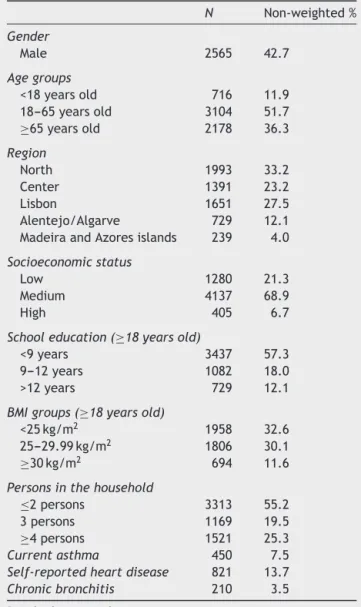
Thecharacteristicsofthe6003participantsaresummarized inTable2.
Exposuretoenvironmentaltobaccosmokeathome
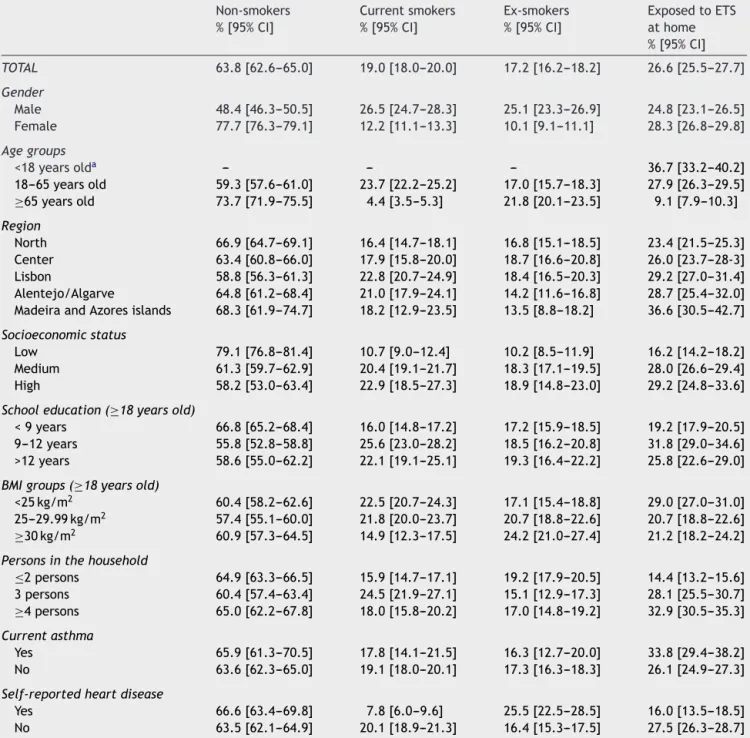
HomeETS exposure wasreportedby 26.6% of the partic-ipants (Table 3). More than half (53.2%) of the CS were exposedtoETSathomewhileonly14.1%oftheex-smokers and23.2%ofthenon-smokersreportedexposure(p<0.001). Children andyoung adults(<25 years old) werethe most exposed(39.0%vs.21.1%intheolderpopulation,p<0.001) (FigureS1).
TheprevalenceofexposuretoETSathomewashighest inthosewithasthma(33.8%vs. 26.6%inthegeneral pop-ulationvs.16.0%inthosewithself-reportedheartdisease) (Table3).
In the adjusted multiple logistic regression model for exposure to ETS at home, in adults (Table S3), having a higher number of persons in the household (OR=1.58 [1.22---2.04] for 3 personsin thehousehold and OR=2.31 [1.81---2.96] for ≥4 persons), being a current
smoker (OR=7.29 [5.74---9.26]) or having current asthma (OR=2.06 [1.45---2.94]) were factors positively associated
Table2 Characteristicsoftheparticipants(n=6003).
N Non-weighted%
Gender
Male 2565 42.7
Agegroups
<18yearsold 716 11.9
18---65yearsold 3104 51.7
≥65yearsold 2178 36.3
Region
North 1993 33.2
Center 1391 23.2
Lisbon 1651 27.5
Alentejo/Algarve 729 12.1
MadeiraandAzoresislands 239 4.0
Socioeconomicstatus
Low 1280 21.3
Medium 4137 68.9
High 405 6.7
Schooleducation(≥18yearsold)
<9years 3437 57.3
9---12years 1082 18.0
>12years 729 12.1
BMIgroups(≥18yearsold)
<25kg/m2 1958 32.6
25---29.99kg/m2 1806 30.1
≥30kg/m2 694 11.6 Personsinthehousehold
≤2persons 3313 55.2
3persons 1169 19.5
≥4persons 1521 25.3
Currentasthma 450 7.5
Self-reportedheartdisease 821 13.7
Chronicbronchitis 210 3.5
BMI:bodymassindex.
with ETS exposure. Being ≥65 years (vs. 18---64 years;
OR=0.65[0.49---0.88])decreasedtheoddsofbeingexposed.
The Hosmer---Lemeshow test revealed good calibration
(p=0.455)andthepredictivepowerwasgood(AUC=0.765).
Whenanalyzedbygender,theeffectofcurrentasthma
wasmaintained only for female; being a current smoker
presented the highest adjusted OR for both genders
(Table4).
Currentsmoking
NineteenpercentofthePortuguesepopulationwasCSand 17.2%wereex-smokers(Table3).Regardingindividualswith
≥18 years, 19.8% were CS. The highest proportion of CS
Table3 Weightedaveragerate(%)ofcurrentsmokers,non-smokers,ex-smokersandexposuretoenvironmentaltobaccosmoke (ETS)athomeaccordingtodemographiccharacteristicsanddiseasestatus.
Non-smokers %[95%CI]
Currentsmokers %[95%CI]
Ex-smokers %[95%CI]
ExposedtoETS athome %[95%CI]
TOTAL 63.8[62.6---65.0] 19.0[18.0---20.0] 17.2[16.2---18.2] 26.6[25.5---27.7]
Gender
Male 48.4[46.3---50.5] 26.5[24.7---28.3] 25.1[23.3---26.9] 24.8[23.1---26.5]
Female 77.7[76.3---79.1] 12.2[11.1---13.3] 10.1[9.1---11.1] 28.3[26.8---29.8]
Agegroups
<18yearsolda --- --- --- 36.7[33.2---40.2]
18---65yearsold 59.3[57.6---61.0] 23.7[22.2---25.2] 17.0[15.7---18.3] 27.9[26.3---29.5]
≥65yearsold 73.7[71.9---75.5] 4.4[3.5---5.3] 21.8[20.1---23.5] 9.1[7.9---10.3]
Region
North 66.9[64.7---69.1] 16.4[14.7---18.1] 16.8[15.1---18.5] 23.4[21.5---25.3] Center 63.4[60.8---66.0] 17.9[15.8---20.0] 18.7[16.6---20.8] 26.0[23.7---28-3] Lisbon 58.8[56.3---61.3] 22.8[20.7---24.9] 18.4[16.5---20.3] 29.2[27.0---31.4] Alentejo/Algarve 64.8[61.2---68.4] 21.0[17.9---24.1] 14.2[11.6---16.8] 28.7[25.4---32.0] MadeiraandAzoresislands 68.3[61.9---74.7] 18.2[12.9---23.5] 13.5[8.8---18.2] 36.6[30.5---42.7]
Socioeconomicstatus
Low 79.1[76.8---81.4] 10.7[9.0---12.4] 10.2[8.5---11.9] 16.2[14.2---18.2] Medium 61.3[59.7---62.9] 20.4[19.1---21.7] 18.3[17.1---19.5] 28.0[26.6---29.4] High 58.2[53.0---63.4] 22.9[18.5---27.3] 18.9[14.8---23.0] 29.2[24.8---33.6]
Schooleducation(≥18yearsold)
<9years 66.8[65.2---68.4] 16.0[14.8---17.2] 17.2[15.9---18.5] 19.2[17.9---20.5] 9---12years 55.8[52.8---58.8] 25.6[23.0---28.2] 18.5[16.2---20.8] 31.8[29.0---34.6] >12years 58.6[55.0---62.2] 22.1[19.1---25.1] 19.3[16.4---22.2] 25.8[22.6---29.0]
BMIgroups(≥18yearsold)
<25kg/m2 60.4[58.2---62.6] 22.5[20.7---24.3] 17.1[15.4---18.8] 29.0[27.0---31.0] 25---29.99kg/m2 57.4[55.1---60.0] 21.8[20.0---23.7] 20.7[18.8---22.6] 20.7[18.8---22.6]
≥30kg/m2 60.9[57.3---64.5] 14.9[12.3---17.5] 24.2[21.0---27.4] 21.2[18.2---24.2]
Personsinthehousehold
≤2persons 64.9[63.3---66.5] 15.9[14.7---17.1] 19.2[17.9---20.5] 14.4[13.2---15.6]
3persons 60.4[57.4---63.4] 24.5[21.9---27.1] 15.1[12.9---17.3] 28.1[25.5---30.7]
≥4persons 65.0[62.2---67.8] 18.0[15.8---20.2] 17.0[14.8---19.2] 32.9[30.5---35.3]
Currentasthma
Yes 65.9[61.3---70.5] 17.8[14.1---21.5] 16.3[12.7---20.0] 33.8[29.4---38.2] No 63.6[62.3---65.0] 19.1[18.0---20.1] 17.3[16.3---18.3] 26.1[24.9---27.3]
Self-reportedheartdisease
Yes 66.6[63.4---69.8] 7.8[6.0---9.6] 25.5[22.5---28.5] 16.0[13.5---18.5] No 63.5[62.1---64.9] 20.1[18.9---21.3] 16.4[15.3---17.5] 27.5[26.3---28.7]
95%CI:95%confidenceinterval;ETS:Environmentaltobaccosmoke;BMI:bodymassindex.
aFor non-smoking, smokingand ex-smokingthiscategory wouldonly includeparticipants agedbetween15 and17years old(not presented).
35---44 years age group was the only one with a higher proportionofCSthannever-smokers (39.6%vs. 38.9%);in women, the prevalence of CS wasalways lower than the never-smokers.
WefoundahigherprevalenceofCSinthosewithhigher SES;whenanalyzedbygenderthisassociationwaspresent onlyinfemales.
The mean(SD) starting age of smoking was17.2 (4.2) years(17.2(3.5)inmenvs.17.6(4.8)inwomen,p<0.001).
One in five (21.6%)started smokingbefore the age of 15 years.
Current smoking men, on average, smoked more
cigarettes per day than women (14.9 (13.2) vs. 10.6 (7.4),p<0.001). Almost 10%(7.9%) ofthe CSsmoked >20 cigarettes per day (10.7% of CS men,2.5% of CS women,
p<0.001).
EnvironmentaltobaccosmokeexposureathomeandsmokingprevalenceinthegeneralPortuguesepopulation 119
Table4 Oddsratio(OR)ofbeingexposedtoETSathome(foradultswithatleastoneotherpersoninthehousehold),stratified
bygender.
Factors Female(n=1561) Male(n=1140)
UnadjustedOR [95%CI]
AdjustedOR [95%CI]
UnadjustedOR [95%CI]
AdjustedOR [95%CI]
Agegroups
≥65yearsolda 0.45[0.36---0.58] 0.74[0.52---1.05] 0.18[0.12---0.26] 0.45[0.26---0.78]
Region 0.046b NI 0.047b NI
North 1 1
Center 0.92[0.70---1.21] 1.14[0.81---1.58]
Lisbon 1.16[0.89---1.51] 1.06[0.77---1.47]
Alentejo/Algarve 1.21[0.89---1.66] 1.74[1.18---2.55] MadeiraandAzoresislands 1.77[1.12---2.77] 1.66[0.84---3.25]
Socioeconomicstatus 0.030b 0.409b <0.001b 0.104b
Lower 1 1 1 1
Medium 1.26[0.97---1.64] 0.79[0.54---1.14] 2.77[1.66---4.62] 1.89[0.97---3.68] Upper 1.78[1.15---2.75] 0.88[0.47---1.68] 3.62[1.94---6.78] 2.52[1.03---6.16]
Schooleducation <0.001b 0.670b <0.001b 0.037b
<9years 1 1 1 1
9---12years 1.58[1.23---2.00] 0.91[0.65---1.26] 2.42[1.84---3.18] 1.62[1.12---2.34] >12years 1.47[1.12---1.92] 0.84[0.56---1.26] 1.88[1.32---2.68] 1.22[0.70---2.11]
BMIgroups 0.065b 0.744b <0.001b <0.001b
<25kg/m2 1 1 1 1
25---29.99kg/m2 0.75[0.59---0.96] 0.90[0.67---1.19] 0.50[0.38---0.65] 0.52[0.37---0.74]
≥30kg/m2 0.92[0.68---1.24] 0.97[0.68---1.40] 0.29[0.18---0.48] 0.52[0.28---0.98]
Personsinthehousehold <0.001b <0.001b <0.001b 0.002b
≤2persons 1 1 1 1
3persons 2.17[1.70---2.79] 2.07[1.50---2.87] 2.40[1.75---3.29] 1.00[0.65---1.54]
≥4persons 2.72[2.15---3.45] 2.57[1.88---3.51] 3.51[2.60---4.73] 1.87[1.23---2.84]
Currentasthma
Yes 1.84[1.33---2.56] 2.90[1.90---4.41] 0.79[0.45---1.39] 0.90[0.44---1.84]
Self-reportedheartdisease
Yes 0.57[0.41---0.79] 0.75[0.48---1.17] 0.50[0.31---0.78] 1.21[0.60---2.44]
Smokingstatus
Currentsmoker(vs.neversmoker) 7.75[5.69---10.56] 7.82[5.49---11.12] 6.81[5.06---9.16] 7.09[5.08---9.88]
Statisticallysignificantresultsarepresentedinbold.
ETS:environmentaltobaccosmoke;95%CI:95%confidenceinterval;BMI:bodymassindex;NI:notincluded a Reference:18---64yearsold.
b p-Valuefortrend.
(17.8% vs. 19.0%, respectively). Those with heart
dis-ease had the lowest CS prevalence (7.8%) and the
highest prevalence of ex-smokers (25.5% vs. 16.3% in those with asthma vs. 17.2 in the general population) (Table3).
In the adjusted multiple logistic regression model for CS in adults (Table S4), the odds of being a CS was higherfor themalegender, themoreeducated andthose exposed to ETS at home (OR=7.32 [5.93---9.17]). Being
≥65 years (OR=0.41 [0.31---0.54]) decreased the odds of
being CS. The Hosmer---Lemeshow test revealed good cal-ibration (p=0.760) and the predictive power was high (AUC=0.839).
Whenanalyzedbygender,theeffectofschooleducation wasmaintainedonlyforfemale(Table5).
Discussion
Ourstudy showedthat theprevalence ofexposure toETS at homein the generalPortuguese population was26.6%; childrenandyoungadultswerethemostexposed(39.0%). Theprevalenceoftobaccosmokinginthegeneralpopulation was19.0%.Havingcurrentasthmawaspositivelyassociated withexposuretoETS.
PrevalenceofexposuretoETSathome
Table5 Oddsratio(OR)ofbeingacurrentsmoker(vs.neversmoker)inadults,stratifiedbygender.
Agegroups
≥65yearsolda 0.10[0.07---0.15] 0.33[0.20---0.54] 0.34[0.25---0.44] 0.45[0.32---0.63]
Region <0.001b NI 0.129b NI
North 1 1
Center 1.02[0.68---1.50] 0.86[0.63---1.16]
Lisbon 2.13[1.52---2.98] 1.26[0.95---1.66]
Alentejo/Algarve 1.58[1.04---2.40] 1.27[0.87---1.84] MadeiraandAzoresislands 2.29[1.31---4.03] 1.07[0.54---2.14]
Socioeconomicstatus <0.001b 0.021b 0.002b 0.207b
Lower 1 1 1 1
Medium 10.84[6.03---19.50] 2.52[1.29---4.93] 1.90[1.32---2.72] 1.39[0.89---2.17] Upper 28.55[14.24---57.24] 2.94[1.25---6.88] 1.86[1.12---3.09] 1.03[0.51---2.08]
Schooleducation <0.001b <0.001b 0.011b 0.885b
<9years 1 1 1 1
9---12years 7.24[5.28---9.93] 3.22[2.21---4.70] 1.42[1.10---1.83] 0.96[0.70---1.30] >12years 8.70[6.25---12.10] 3.64[2.37---5.59] 1.39[1.01---1.90] 1.07[0.67---1.70]
BMIgroups <0.001b 0.138b 0.009b 0.048b
<25kg/m2 1 1 1 1
25to29.99kg/m2 0.41[0.30---0.56] 0.70[0.49---0.99] 0.91[0.71---1.15] 1.25[0.95---1.66]
≥30kg/m2 0.44[0.29---0.66] 0.84[0.53---1.34] 0.51[0.33---0.79] 0.73[0.45---1.18]
Personsinthehousehold <0.001b NI 0.017b NI
≤2persons 1 1
3persons 2.03[1.47---2.79] 1.47[1.12---1.93]
≥4persons 1.97[1.44---2.68] 1.23[0.93---1.62]
Currentasthma
Yes 0.88[0.54---1.41] 0.67[0.37---1.22] 0.86[0.53---1.40] 0.89[0.50---1.58]
Self-reportedheartdisease
Yes 0.27[0.16---0.45] 1.00[0.54---1.83] 0.75[0.50---1.11] 1.26[0.78---2.04]
ExposuretoETSathome
Exposed 10.14[7.74---13.28] 7.30[5.36---9.92] 7.91[5.93---10.55] 7.47[5.46---10.21]
Statisticallysignificantresultsarepresentedinbold.
95%CI:95%confidenceinterval;BMI:bodymassindex;ETS:environmentaltobaccosmoke;NI:notincluded. aReference:18---64yearsold.
b p-Valuefortrend.
compare: study questions anddefinitions of exposure are widely variable and most reports don’t present explicit dataon homeexposure.12,14,18,24 The National Health
Sur-vey2005---2006,14 for example, refers to the exposure to
ETS in closed spaces but not specifically at home. The Eurobarometerstudyheldin200618reportedthatthe
preva-lence of participants in whose homes smoking was not allowed was 29%, suggesting that about 71% of the pop-ulation was potentially exposed to ETS at home; in the Eurobarometer 332(from 2009),12 potential exposure was
reduced to 34% of the population. To the best of our knowledge, the definition used in our study is similar to onlyonerecentPortuguesereport,ECOS201015;thatstudy,
carried out in 2010, estimated that 15.7% of the Por-tuguesepopulationwasexposedinsidetheirhomes,which is much lowerthan the prevalence we report.There are some methodological differences that might explain this discrepancy: the ECOS2010 study collected data from a sample of Portuguese families willing to be periodically
contacted to answer health surveys (ECOS panel); only individuals with ≥18 years were asked to participate
and there was no random selection inside each house-hold.
Ourresults arein agreementwith other studies25---28 in
relation toa high prevalence of exposureamong children andadolescents.
Prevalenceofcurrenttobaccosmoking
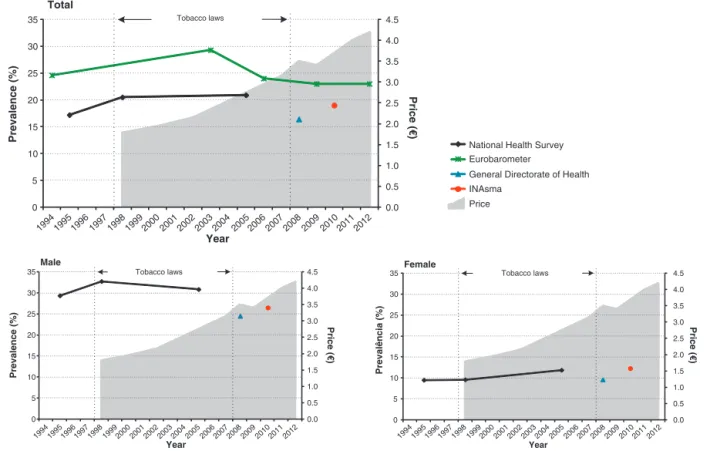
TheprevalenceoftobaccosmokinginPortugal,inthisstudy, was lower than in reports prior to the 2008 tobacco law (Fig.1).
Recent studies,12,14,15 conducted after the 2008
EnvironmentaltobaccosmokeexposureathomeandsmokingprevalenceinthegeneralPortuguesepopulation 121 0.0 0.5 0 5 1.0 1.5 2.0 2.5 3.0 3.5 4.0 4.5 10 15 20 25 30 35 Total 0.0 0.5 0
1994 1995 1996 1997 1998 1999 2000 2001 2002 2003 2004 2005 2006 2007 2008 2009 2010 2011 2012
1994 199519961997 1998 19992000 2001 2002 2003 2004 2005 200620072008 2009 20102011 2012 5 1.0 1.5 2.0 2.5 3.0 3.5 4.0 4.5 10 15 20 25 30 35 0.0 0.5 0 5 1.0 1.5 2.0 2.5 3.0 3.5 4.0 4.5 10 15 20 25 30 35
National Health Survey Eurobarometer
General Directorate of Health INAsma Price Price (€) Year Tobacco laws Prevalence (%)
Prevalence (%) Prevalência (%)
Price (€) Price (€)
Year
Year
Female Male
Tobacco laws Tobacco laws
1994 199519961997 1998 19992000 2001 2002 2003 2004 2005 200620072008 2009 20102011 2012
Figure1 Prevalenceoftobaccosmokinginthepopulationaged15yearsormoreinPortugal(datasince1994)andevolutionof tobaccoprice(packofpremiumbrand);stratificationbygenderisalsopresented.12,15,18,24
sizes.12,14,24 The slight decreasing tendency of the
preva-lence of smoking, shown in Fig. 1, does not seem to be directlyrelatedwiththeincreaseintobaccopriceormore restrictive smokingbans.The previously reported gender-specifictrends13arealsosupportedbythedataofthisstudy:
CSprevalenceinfemaleshasbeenrisinginthelast15years while,inmales,therewasagradualdecrease(Fig.1).
The higher CSprevalence in women withhigher SESis in agreementwithother datafor Portugal29---31 butdiffers
fromothercountries’.30---32Thisdiscrepancymayberelated
todifferencesinthestageofthesmokingepidemic,30,31but
theeconomiccapacitytopayforcigarettesmayalsohave astrongimpact.29
Those exposed to home ETS presented the highest adjustedORforsmoking.ThismaysuggestthatETSexposure isariskfactorforsmokinginitiation.25,33,34
PrevalenceofsmokingandETSexposurein individualswithasthmaorself-reportedheart disease
As far as we know, in Portugal, no other population-basedstudy hasestimatedthe prevalenceof smokingand homeexposure toETS in individualswithasthma orheart disease.
The lowsmokingprevalenceinsubjectswithheart dis-easesuggeststhattheseindividualshavesomeawarenessof theharmfulinfluenceoftobaccouseinheartpathologies.35
The consequences of smoking and ETS exposure
on asthmatics36---39 and the beneficial effects of a
smoke-free legislation (e.g. associated with a lower rate of hospitalizations for childhood asthma17) are
increas-inglyrecognized. In spite of this knowledge, we found a smokingprevalenceinasthmaticsthatissimilartothe gen-eral population; other population-based studies reported similar findings.39---45 To the best of our knowledge, the
onlyPortuguesestudy46 reportingaCSprevalencein
asth-matics was held in an asthma clinic; the prevalence was 8%. This low prevalence was explained by a possible selection bias in relation with regular follow-up by lung physicians.46
Severalreports found a prevalence of ETS exposure at homeinasthmaticssimilartothegeneralpopulation.41,47,48
Inour study,onthe contrary,ETS exposurewas higherin asthmatics;thisisinagreementwiththefindingsofLeech et al.,49 in Canada. In that study, it was suggested that
thishigherprevalence couldbeexplainedbyanincreased reportingrelatedtogreaterawareness ofsmokeexposure inasthmatics.49 However,wheninterpreting thesefindings
andconsideringthecross-sectionalnatureofourstudy,we cannotexcludethepossibilityofreversecausality(exposure toETSathomemaybeacauseofasthma)
Limitations
The sampling process, using landline telephone numbers, may be a limitation because of the increasing number of mobile-only households and resistance to telephone surveying50; it may also introduce a selection bias, with
However,the use of the mobile telephonenetwork as an alternative would not give a geographical stratification, wouldreducethecontrol ofthesamplingprocessandhas lower response rates.51 The fact that the only available
dataatthetimeofthedatacollectionwerefromthe2001 NationalCensusmaybeanotherlimitationbecause demo-graphicchangesinrecent yearscouldhaveinfluencedthe samplingmethods;howeverthedatafromthe2011Census necessary for the weightingprocedures had not yet been published.
Smoking/exposure status was self-reported which can lead tounderreporting of smokinghabits.52,53 The
defini-tionofcurrent smokingusedin thisstudy didnotinclude occasionalsmokersin CSorasan independentgroup;the inclusionofoccasionalsmokerswouldbeanaddedvaluefor thestudyanditsabsencemightleadtoanunder-estimation of the total current smoking prevalence. Moreover, only homeexposuretoETSwasquestionedlimitingthe compa-rabilitywithotherreports.
Thedefinitionofdiseasesusingquestionnaireshasbeen widelyused;however,severalcombinationsareaccepted. Theonewechosewasassociatedwithahigherspecificity andlowerasthmaprevalence.20
Repeatedpopulation surveysusingrepresentative, ran-domly selected samples of sufficiently large size, with similar questionnaires and definitions is the only way to providecomparableestimatesofsmokingandETSexposure prevalence.2 Methodstoimprovereporting accuracy(e.g.
cotininesaliva)arereservedfor smaller samplesandmay bepartofafuturestudy.
Inconclusion,exposuretoenvironmentaltobaccosmoke at home in Portugal is higher than in a previous report using the same definition. Our results suggest that chil-dren/adolescentsandasthmatics,butnotindividuals with heart disease, may be at higher risk for home expo-suretoenvironmentaltobaccosmoke.This studysupports a decreasing trend of the prevalence of tobacco smok-ing in Portuguese male, but a tendency to increase in female.
Ethical
disclosures
Protection of human and animal subjects. The authors
declarethatnoexperimentswereperformedonhumansor animalsforthisstudy.
Confidentialityofdata.Theauthorsdeclarethattheyhave
followedtheprotocolsoftheirworkcenteronthe publica-tionofpatientdataandthatallthepatientsincludedinthe studyreceivedsufficientinformationandgavetheirwritten informedconsenttoparticipateinthestudy.
Right to privacy and informed consent. The authors
declarethatnopatientdataappearinthisarticle.
Funding
The underlying research was funded by Sociedade Por-tuguesadeAlergologiaeImunologiaClínicaandSociedade PortuguesadePneumologia.
Conflicts
of
interest
The underlying research was funded by Sociedade Por-tuguesadeAlergologiaeImunologiaClínicaandSociedade PortuguesadePneumologia.
Acknowledgement
WethankProfessorLuísDelgadoforhisinputand coopera-tionwiththiswork.
Appendix
A.
Supplementary
data
Supplementarymaterialrelatedtothisarticlefound,inthe onlineversion,atdoi:10.1016/j.rppnen.2013.01.006.
References
1.EuropeanCommissionASPECTConsortium.Tobaccoor health intheEuropeanUnion:past,presentandfuture.Luxembourg: European Commission. Available at: http://ec.europa.eu/ health/phdeterminants/lifestyle/Tobacco/Documents/ tobacco fr en.pdf
2.World Health Organization. WHO Report on the Global Tobacco Epidemic, 2009: implementing smoke-free environ-ments.Geneva:WHO;2009.
3.USDepartmentofHealthandHumanServices.Thehealth con-sequencesofsmoking:areportofthesurgeongeneral.Atlanta: Centersfor Disease Control and Prevention,National Center forChronicDiseasePreventionandHealthPromotion,Officeon SmokingandHealth;2004.
4.USDepartmentofHealthandHumanServices.Thehealth con-sequencesofinvoluntaryexposuretotobaccosmoke:areport ofthesurgeongeneral.Atlanta:CentersforDiseaseControland Prevention,CoordinatingCenterforHealthPromotion,National CenterforChronicDiseasePreventionand HealthPromotion, OfficeonSmokingandHealth;2006.
5.Actiononsmokingandhealth(ASH-UK).Tobacco:globaltrends; 2007[updatedAugust2007;citedSeptember2011].Available ate:http://www.ash.org.uk/files/documents/ASH562.pdf 6.ObergM,JaakkolaMS,WoodwardA,PerugaA,Prüss-UstünA.
Worldwide burdenof disease from exposure to second-hand smoke: a retrospective analysisof data from 192 countries. Lancet.2011;377:139---46.
7.McClave AK, Whitney N, Thorne SL, Mariolis P, Dube SR, Engstrom M. Adult tobacco survey --- 19 states, 2003---2007. MMWRSurveillSumm.2010;59:1---75.
8.LevyDT,ChaloupkaF,GitchellJ.Theeffectsoftobaccocontrol policiesonsmokingrates:atobaccocontrolscorecard.JPublic HealthManagePract.2004;10:338---53.
9.World Health Organization. WHO framework convention on tobaccocontrol.Geneva:WHO;2003.
10.Assembleia da República. Lei n.◦ 37/2007 de 14 de agosto. Diário da República. 2007; 1.a série (156): 5277---85.
11.Instituto Nacional de Estatística, Instituto Nacional Doutor Ricardo Jorge. 4.◦ Inquérito Nacional de Saúde 2005/2006: Destaque.Lisboa;2009.
EnvironmentaltobaccosmokeexposureathomeandsmokingprevalenceinthegeneralPortuguesepopulation 123
13.PreciosoJ,CalheirosJ,PereiraD,CamposH,AntunesH,Rebelo L,etal.PrevalenceandsmokingtrendsinPortugalandEurope. ActaMedPort.2009;22:335---48.
14.INFOTABAC, Direc¸ão-Geral de Saúde. Avaliac¸ão Intercalar do Impacte da Nova Legislac¸ão de Prevenc¸ão do Tabag-ismo (Lei 37/2007, de 14 de agosto) [updated April 2010; citedFebruary2011].Availableat:http://www.dgs.pt/upload/ membro.id/ficheiros/i012662.pdf
15.Direc¸ão-GeraldaSaúde.Avaliac¸ãodaleidotabacoemPortugal 2008-2010.Infotabacrelatório:Primeiraavaliac¸ãodoimpacto daaplicac¸ãodaLeidoTabaco.Direc¸ão-GeraldeSaúde,Instituto NacionaldeSaúdeDoutorRicardoJorge[updatedApril2011; cited September 2011]. Available at: http://www.coppt.pt/ attachments/186 201103-i014123.pdf
16.AkhtarPC, Haw SJ,Currie DB, Zachary R, CurrieCE. Smok-ingrestrictionsinthehome andsecondhandsmokeexposure among primary schoolchildren before and after introduction oftheScottish smoke-freelegislation.TobControl.2009;18: 409---15.
17.MackayD,HawS,AyresJG,FischbacherC,PellJP.Smoke-free legislationandhospitalizationsforchildhoodasthma.NEnglJ Med.2010;363:1139---45.
18.TNS Opinion & Social. Special Eurobarometer 272c/Wave 66.2:attitudesofEuropeanstowardstobacco.Brussels: Euro-peanCommission [cited May 2011].Available at: http://ec. europa.eu/health/phdeterminants/lifestyle/Tobacco/ Documents/ebs272cen.pdf
19.Contreiras T, Nunes B, Branco MJ. Em Casa, pelo telefone, ObservamosSaúde:Descric¸ãoeavaliac¸ãodeumametodologia. InstitutoNacionaldeSúdeRicardoJorge[updated2003;cited September 2011]. Available at: http://www.insa.pt/sites/ INSA/Portugues/Publicacoes/Outros/Documents/Epidemiologia/ projecosecptosonsa.pdf
20.Sa-SousaA, Morais-Almeida M,Azevedo LF,CarvalhoR, Jac-intoT, Todo-Bom A, et al.Prevalence of asthmainPortugal ---thePortugueseNationalAsthmaSurvey.ClinTranslAllergy. 2012;2:15.
21.BurneyP,JarvisD.ProtocolfortheEuropeanCommunity Respi-ratoryHealthSurveyII.London;2002.
22.Burney PG, Luczynska C, Chinn S, Jarvis D. The European CommunityRespiratory Health Survey. Eur RespirJ. 1994;7: 954---60.
23.WorldHealthOrganization.Obesity:preventingandmanaging theglobalepidemic.Geneva:WHO;2000.
24.Machado A, Nicolau R, Matias Dias C. Tobacco con-sumption by the portuguese population. Data from the 2005---2006NationalHealthSurvey.RevPortPneumol.2009;15: 1005---27.
25.LacerdaAC,CardosoMF.SmokingamongPortugueseteenagers: assessingschool,peerand familyfactorsofvulnerabilityand protection.RevPortSaúdePública.2009;27:17---25.
26.ConstantC,SampaioI,NegreiroF,AguiarP,SilvaAM,Salgueiro M, et al. Environmental tobacco smoke (ETS) exposure and respiratorymorbidityinschoolagechildren.RevPortPneumol. 2011;17:20---6.
27.PreciosoJ,SamorinhaC,CalheirosJM,MacedoM,AntunesH, Campos H. Second hand smoke (SHS) exposure in children. Anevaluationofa preventativemeasure.RevPortPneumol. 2010;16:57---72.
28.Kum-NjiP,MeloyL,HerrodHG.Environmentaltobaccosmoke exposure:prevalenceandmechanismsofcausationofinfections inchildren.Pediatrics.2006;117:1745---54.
29.SantosAC,BarrosH. Smokingpatterns ina community sam-ple of Portuguese adults, 1999---2000. Prev Med. 2004;38: 114---9.
30.Cavelaars AE, Kunst AE, Geurts JJ, Crialesi R, Grötvedt L, HelmertU,etal.Educationaldifferencesinsmoking: interna-tionalcomparison.BrMedJ.2000;320:1102---7.
31.Huisman M, Kunst A, Mackenbach J. Educational inequal-ities in smoking among men and women aged 16 years and older in 11 European countries. Tob Control. 2005;14: 106---13.
32.SchaapMM,KunstAE,LeinsaluM,RegidorE,EspeltA,Ekholm O, etal.Femaleever-smoking, education,emancipationand economicdevelopmentin19Europeancountries.SocSciMed. 2009;68:1271---8.
33.VoorheesCC,YeC,Carter-PokrasO,MacPherson L,Kanamori M, Zhang G, et al. Peers, tobacco advertising, and sec-ondhand smoke exposure influences smoking initiation in diverse adolescents. Am J Health Promot. 2011;25: e1---11.
34.WangMP,HoSY,LamTH.Parentalsmoking,exposureto sec-ondhandsmokeathome,andsmokinginitiationamongyoung children.NicotineTobRes.2011;13:827---32.
35.Barnoya J, Glantz SA. Cardiovascular effects of second-hand smoke: nearly as large as smoking. Circulation. 2005;111:2684---98.
36.Vignoud L, Pin I, Boudier A, Pison C, Nadif R, Le Moual N, et al.Smoking andasthma: disentanglingtheirmutual influ-ences using a longitudinal approach. Respir Med. 2011;105: 1805---14.
37.ThomsonNC,ChaudhuriR,LivingstonE.Activecigarette smok-ingandasthma.ClinExpAllergy.2003;33:1471---5.
38.PietinalhoA,PelkonenA,RytiläP.Linkagebetweensmokingand asthma.Allergy.2009;64:1722---7.
39.SirouxV,PinI,Oryszcyn MP,LeMoualN,KauffmannF. Rela-tionships of active smoking to asthma and asthma severity in the EGEA study. Epidemiological study on the Genet-ics and Environment of Asthma. Eur Respir J. 2000;15: 470---7.
40.ThomsonNC,ChaudhuriR,LivingstonE.Asthmaandcigarette smoking.EurRespirJ.2004;24:822---33.
41.Silverman RA, Boudreaux ED, Woodruff PG, Clark S, Camargo CA. Cigarette smoking among asthmatic adults presenting to 64 emergency departments. Chest. 2003;123: 1472---9.
42.Turner MO,NoertjojoK, Vedal S, BaiT, Crump S,Fitzgerald JM.Riskfactorsfornearfatalasthma.Acase-controlstudyin hospitalizedpatientswithasthma.AmJRespirCritCareMed. 1998;157:1804---9.
43.Patel SN, Tsai CL,Boudreaux ED, KilgannonJH, Sullivan AF, Blumenthal D, et al. Multicenter study of cigarette smok-ingamongpatientspresentingto theemergency department withacute asthma. Ann Allergy Asthma Immunol. 2009;103: 121---7.
44.EisnerMD,YelinEH,TrupinL,BlancPD.Asthmaandsmoking statusinapopulation-basedstudyofCaliforniaadults.Public HealthRep.2001;116:148---57.
45.VozorisNT,StanbrookMB.Smokingprevalence,behaviours,and cessationamongindividualswithCOPDorasthma.RespirMed. 2011;105:477---84.
46.SeabraB,GuimarãesM,CarvalhoA,DuarteR.Thesmokingrate anditsrepercussionsonanasthmaticpopulationsample.Rev PortPneumol.2008;14:617---24.
47.YunS,ChanetsaF,KelseyA,ZhuB-P.Activeandpassivesmoking among asthmaticMissourians:implications for health educa-tion.PrevMed.2006;42:286---90.
48.GuptaD,AggarwalAN,ChaudhryK,ChhabraSK,D’SouzaGA, JindalSK,etal.Householdenvironmentaltobaccosmoke expo-sure,respiratorysymptomsandasthmainnon-smokeradults: amulticentricpopulationstudyfromIndia.IndianJChestDis AlliedSci.2006;48:31---6.
50.Boland M, Sweeney MR,Scallan E, Harrington M, Staines A. Emergingadvantagesanddrawbacksoftelephonesurveyingin publichealthresearchinIrelandandtheUK.BMCPublicHealth. 2006;6:208.
51.GrandeD,TaylorAW.Samplingandcoverageissuesoftelephone surveys used for collecting health information in Australia: resultsfromaface-to-facesurveyfrom1999to2008.BMCMed ResMethodol.2010;10:77.
52.Wells AJ, English PB, Posner SF, Wagenknecht LE, Perez-Stable EJ. Misclassification rates for current smokers mis-classified as nonsmokers. Am J Public Health. 1998;88: 1503---9.