Authors
Marcia Machado Cunha Ribeiro1 Melissa Luciana de Araújo2
Michele Pereira Netto1 Lucas Maciel Cunha3
1 Universidade José do
Rosário Vellano – UNIFENAS, Campus Belo Horizonte /MG
2 Centro Universitário
UNA, Campus Guajajaras, Belo Horizonte/MG 3 Universidade Federal
de Minas Gerais – UFMG
Submitted on: 09/12/2010. Approved on: 12/30/2010.
Corresponding author:
Márcia Machado Cunha Ribeiro
Rua Goitacázes nº1889, Bairro Barro Preto Belo Horizonte – MG – Brasil
CEP: 30190-052 E-mail:
[email protected]; [email protected]
This study was carried out at the Centro Nefrológico de Minas Gerais – CENEMGE.
The authors declare no conflict of interest.
ABSTRACT
Introduction: To assess the effects of the habit of having evening dinner on the di-etary macro- and micronutrient profile of chronic kidney failure patients on hemo-dialysis. Methods: Cross-sectional study carried out at a dialysis clinic at the city of Belo Horizonte, state of Minas Gerais. The study comprised 90 patients undergoing he-modialysis. Personal, clinical, and dietary (three-day food record) data were collected. The habit of having dinner was considered as having a complete evening meal, and the lack of that habit was considered as not having it or replacing it by a fast meal. The amounts of nutrient intake were estimated in the specific software Dietwin®. Results: The carbohydrate, thiamine, riboflavin, ascorbic acid, calcium, and selenium intake values showed no difference between the group having a complete evening meal and that not having it (p > 0.05). Both groups did not dif-fer in the following: body mass index, and energy, protein, lipid, niacin, pantothenic acid, pyridoxine, folic acid, cobalamin, po-tassium, phosphorus, zinc, and magnesium intake values (p < 0.05). Regarding nutrient adequacy, the complete evening meal group performed better than the other group, ex-cept for carbohydrates, lipids, pantothenic acid, ascorbic acid, potassium, calcium, and zinc (p < 0.05). None of the patients showed the adequate pyridoxine, folic acid, and se-lenium intake values. Few patients in both groups showed adequate energy, pantothen-ic acid, and zinc intake values. Conclusion:
The habit of having a complete evening meal influenced positively the micro and macro-nutrient intakes in chronic kidney failure pa-tients on hemodialysis.
Keywords: chronic kidney failure, minerals, nutritional assessment, vitamins, nutrition-al deficiencies.
[J Bras Nefrol 2011;33(1): 52-59]©Elsevier Editora Ltda.
Effects of customary dinner on dietetical profile of
patients undergoing hemodialisys
INTRODUCTION
Changes in the dietary pattern have been observed in several developing countries.1
In Brazil, the nutritional transition has changed the dietary intake profile, increas-ing the replacement of high-fiber foods rich in vitamins and minerals by industrialized products.2,3,4 The reduction in the ingestion
of foods that are usually part of the ma-jor Brazilian meals, along with the increase in the ingestion of French bread, indicate a tendency towards replacing evening din-ner by rapid meals.2 Such transformations
cause the appearance of new dietary pat-terns, and such dietary practices can affect the fulfillment of nutritional needs,3 and
generate several nutritional deficiencies. Malnutrition is one of the major de-terminants of morbidity and mortality in hemodialysis (HD) patients,5,6 being
asso-ciated with a reduced life expectancy and interfering with infectious and cardiovas-cular complications.7
Protein-energy wasting (PEW) in not the only form of malnutrition of chronic kidney failure (CKF) patients on HD, and can be accompanied by the deficiency of some micronutrients, such as vitamin B complex, vitamin C, iron, and zinc.8 During
dialysis, in addition to the catabolic action, amino acids, peptides, and water soluble vitamins are lost to the dialysate. The most commonly deficient water soluble vitamins that often require supplementation5 are
pyridoxine, and ascorbic and folic acids.9-10
According to the 2004 Resolution RDC 154, the nutrition professional becomes part of the minimum team required for the dialysis clinic functioning.11 The presence
Regarding CKF patients, several factors, such as strict dietary restrictions, use of medications that can in-terfere with nutrient absorption, insufficient dialysis, and constant concomitant illnesses, are responsible for metabolic, hormonal, and gastrointestinal disorders, and inadequate dietary intake. In addition, uremia, metabolic acidosis, anorexia, nauseas, vomiting, and nutrient loss to the dialysate are factors that interfere with and increase protein catabolism.5,6,12 There is
evi-dence that the nutritional status of kidney failure pa-tients begins to decrease when the glomerular filtration rate reduction is still modest.13
Because of the scarcity of studies on dietary pro-files and habits, and on their interferences with the mi-cronutrient intake of CKF adults on HD, the present study aimed at assessing the dietary behavior of those patients regarding their habit of having evening dinner and their macro- and micronutrient intakes.
MATERIAL AND METHODS
This is a cross-sectional study carried out in the first trimester of 2010 with HD patients of the CENEMGE (Centro Nefrológico de Minas Gerais) dialysis clinic, in the city of Belo Horizonte, state of Minas Gerais. The patients underwent dialysis three times a week, with four-hour sessions. This study was approved by the Committee on Ethics of the UNIFENAS (protocol number 04/2010). Of the 183 HD patients, 90 partici-pated in this study. Patients were randomly selected and later divided into two groups according to their habits of having evening dinner or not. Patients with the fol-lowing characteristics were excluded from the study: age lower than 18 years; neurological and psychiatric problems; deafness; muteness; visual impairment; se-vere heart, neoplastic, and pulmonary diseases; HD time shorter than three months; lack of well-defined dietary habits; and evident under- or overestimation of dietary intake.
Personal (age, sex) and socioeconomic (educational level, family income, marital status) data were collect-ed through direct interview with patients. The preser-vation of taste and smell was assessed through direct questions. Appetite was evaluated whether normal, increased, or decreased. Regarding the intestinal func-tion, patients were asked about its normality, and pres-ence of diarrhea or constipation. In addition, they were asked about the occurrence of nauseas, their dietary habits (evening dinner and meal frequency), and adher-ence to nutritional and clinical recommendations (un-derlying diseases and comorbidities). The interviewer was previously trained to avoid inducing answers.
Questions about the patients’ dietary habits al-lowed their division into groups depending on their habit of having evening dinner or not. The study considered dinner as a meal similar to the Brazilian lunch comprised by cereals, legumes, vegetables, and a protein preparation (meats, eggs). Thus, patients who did not have dinner were those who skipped din-ner or replaced it by rapid meals. Food intake was quantified by use of food habit questionnaires: two 24-hour food recalls, one on a HD day and another on a day without HD; and a food record of a week-end day. Data for the two food recalls were collected right before and during the dialysis session on dif-ferent days, and the food record was completed by patients or their families following previous instruc-tions. Those methods were associated to provide bet-ter knowledge about the patients’ dietary habits dur-ing the week. Food intake amounts were estimated by use of cooking measures illustrated on a photographic album14 presented to patients to ensure the food
in-take amount, and later converted into grams or mil-liliters. The Dietwin® nutrition software (version 8.0) was used for the dietary quantification of the food recalls, and Taco and Dietwin tables were used for nutritional information about foods according to the preparation ingested (raw or cooked). The results of the food recalls were compared with reference tables for CKF patients.15-16
The following biochemical parameters were as-sessed: pre- and postdialysis urea; creatinine; albumin (Bromcresol green);6 serum potassium; and serum
phosphorus. Dialysis adequacy was estimated through Kt/V (Daugirdas II).6 The anthropometric parameter
assessed was body mass index (BMI), calculated by dividing the individual’s weight by the square of his/ her height. Dry weight was used for that calculation, because the hydration status can significantly influ-ence that assessment.
The statistical analysis of the variables was per-formed by calculating 95% confidence intervals, frequencies, medians, and extreme values (minimum and maximum). The non-parametricity of quantita-tive variables was assessed by use of the Shapiro-Wilk
W test. In the inferential statistical analyses, Mann-Whitney test was used for comparing two experimen-tal groups.17 The proportions of patients’ groups were
also compared.18 The raw or transformed variables
with parametric distribution were compared by use of the Student t test, and those with a significance level
equal to or lower than 5% were considered differ-ent.17 The Stata software, version 10.0, was used for
RESULTS
Most patients were males (63.3% ± 10.0%). The age of most patients ranged from 46 to 75 years (68.9% ± 11.5%), and the mean age of the sample was 55.9 ± 14.7 years (range, from 19 to 87 years). Regarding the socioeconomic characteristics, most individuals were married or living in a stable union (68.9% ± 11.5%). Regarding the educational level, 62.2% (12.7%) of the individuals completed only the elementary school. Regarding the family income, most individuals had a low income (up to three minimum wages, 51.6% ± 14.4%). No significant differences (p < 0.05) were ob-served in the following variables: dialysis shift; sex; di-alysis time; frequency of comorbidities; and frequency of underlying diseases.
Regarding clinical signs and symptoms, most pa-tients showed no nausea (87.8% ± 6.8%), and had their taste (94.4% ± 4.8%), smell (94.4% ± 4.8%), and appetite (77.8% ± 8.6%) preserved. The intes-tinal function was normal in 83.3% ± 7.7% of the patients, although 14.4% ± 7.3% had constipation. The major underlying disease diagnosed was hyper-tensive nephrosclerosis (53.3% ± 10.4), followed by
diabetic nephropathy (22.2% ± 8.6%), glomerulopa-thies (11.1% ± 6.5%), and polycystic kidneys (6.7% ± 5.2%). In addition, the major comorbidities were sys-temic arterial hypertension (97.8% ± 3.1%), diabetes mellitus (30% ± 9.5%), and heart diseases (27.8% ± 9.3%).
When analyzing the dietary habits, most patients had four to five meals per day, were used to having eve-ning dinner, and ate their meals at home. Most claimed following nutritional guidance, which was provided at the beginning of treatment and then on a monthly basis, by use of printed material or orally by the nutri-tionist. Half of the patients (47) underwent potassium processing techniques. Personal choice was the major reason for not adhering to the nutritional recommen-dations (Table 1).
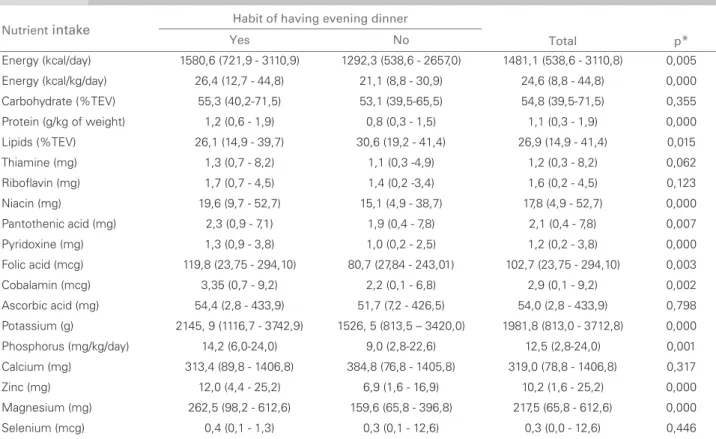
The intake values of several nutrients differed be-tween patients having evening dinner and those not having evening dinner, except for carbohydrate, thia-mine, riboflavin, ascorbic acid, calcium, and selenium (Table 2).
Nutrient adequacy percentages according to the habit of having evening dinner are shown in Table 3,
Variable N Frequency (%) 95 % CI1
Number of daily meals
≤ 3 21 23.3 14.4 - 32.2
4-5 50 55.6 45.1 - 66.0
> 6 19 21.1 12.5 - 29.7
Habit of having evening dinner
Yes 57 63.3 53.2 - 73.5
No 33 36.7 26.5 - 46.8
Meal site
Household 83 92.1 86.4 - 97.8
Outside household 7 7.9 2.2 - 13.6
Potassium processing
Yes 47 52.2 41.1 - 62.3
No 43 47.8 37.7 - 58.9
Follow the nutritional guidance
Yes 59 65.6 55.6 - 75.6
No 29 32.2 22.4 - 42.1
NI 2 2.2 0.0 - 5.3
Reason for not following the nutritional guidance
Economic reason 2 2.2 0.0 - 5.3
Eating out 3 3.3 0.0 - 7.1
The cook ignores the restrictions 1 1.1 0.0 - 3.3
Personal choice 26 28.9 19.4 - 38.4
Not applicable (the patient follows the guidance) 58 64.4 54.4 - 74.5
NI: Not informed. N: number of patients assessed. 1 CI: 95% confidence interval.
and indicate that patients who had evening dinner in-gested higher amounts of most nutrients as compared with those who did not have evening dinner.24
Anthropometric and biochemical data were as-sessed according to the habit of having evening din-ner, and only BMI showed statistical significance (p < 0.05) (Table 4).
DISCUSSION
Most patients assessed were males, similarly to the 2008 census19 and several other Brazilian studies.20-25 Adult
individuals and elderly predominated in this study, dif-ferently from the study by Cabral et al.20 and Freitas et al.,26 possibly due to the underlying disease prevalence.
The low educational level and income, as reported in other studies,20,21,25,26,27 can have influenced the
under-standing and adherence to the nutritional guidance provided to patients by the nutritionist, and can have contributed to the low dietary nutrient adequacy rate. The major underlying disease of the patients studied was hypertensive nephrosclerosis, followed by diabetic nephropathy, which are complications of adults and elderly, in accordance with the 2008 census19 and the
studies by Cardozo et al.,22 Batista et al.,24 and Morais
et al..28 Such frequencies differed from those of the
studies by Cabral et al.,20 Santos et al.,25 Freitas et al.,26
and Valenzuela et al.,27 in which the major etiology of
chronic kidney disease (CKD) was chronic glomerulo-nephritis, which usually affects younger populations. The mean BMI values found were similar to the results of Valenzuela et al.,27 but the groups were distinct,
and further studies are required for such comparison. Regarding the biochemical tests, this study found no significance between groups.
Regarding the dietary habits, a large part of the population studied had four to five meals per day, was used to having evening dinner, and ate their meals at home, suggesting that the family can have a great influence on the patients’ dietary habits. Thus, new studies should be conducted to assess that hypothesis. In this study, both groups of patients did not differ re-garding dialysis shift, sex, dialysis time, frequency of different comorbidities, and frequency of underlying diseases, possibly because the sample was randomly selected and patients were divided into groups later.
Differences in protein-calorie intake were ob-served between the groups of patients. The group of patients with the habit of having evening dinner
Nutrient intake Habit of having evening dinner
Total p*
Yes No
Energy (kcal/day) 1580,6 (721,9 - 3110,9) 1292,3 (538,6 - 2657,0) 1481,1 (538,6 - 3110,8) 0,005
Energy (kcal/kg/day) 26,4 (12,7 - 44,8) 21,1 (8,8 - 30,9) 24,6 (8,8 - 44,8) 0,000
Carbohydrate (%TEV) 55,3 (40,2-71,5) 53,1 (39,5-65,5) 54,8 (39,5-71,5) 0,355
Protein (g/kg of weight) 1,2 (0,6 - 1,9) 0,8 (0,3 - 1,5) 1,1 (0,3 - 1,9) 0,000
Lipids (%TEV) 26,1 (14,9 - 39,7) 30,6 (19,2 - 41,4) 26,9 (14,9 - 41,4) 0,015
Thiamine (mg) 1,3 (0,7 - 8,2) 1,1 (0,3 -4,9) 1,2 (0,3 - 8,2) 0,062
Riboflavin (mg) 1,7 (0,7 - 4,5) 1,4 (0,2 -3,4) 1,6 (0,2 - 4,5) 0,123
Niacin (mg) 19,6 (9,7 - 52,7) 15,1 (4,9 - 38,7) 17,8 (4,9 - 52,7) 0,000
Pantothenic acid (mg) 2,3 (0,9 - 7,1) 1,9 (0,4 - 7,8) 2,1 (0,4 - 7,8) 0,007
Pyridoxine (mg) 1,3 (0,9 - 3,8) 1,0 (0,2 - 2,5) 1,2 (0,2 - 3,8) 0,000
Folic acid (mcg) 119,8 (23,75 - 294,10) 80,7 (27,84 - 243,01) 102,7 (23,75 - 294,10) 0,003
Cobalamin (mcg) 3,35 (0,7 - 9,2) 2,2 (0,1 - 6,8) 2,9 (0,1 - 9,2) 0,002
Ascorbic acid (mg) 54,4 (2,8 - 433,9) 51,7 (7,2 - 426,5) 54,0 (2,8 - 433,9) 0,798
Potassium (g) 2145, 9 (1116,7 - 3742,9) 1526, 5 (813,5 – 3420,0) 1981,8 (813,0 - 3712,8) 0,000
Phosphorus (mg/kg/day) 14,2 (6,0-24,0) 9,0 (2,8-22,6) 12,5 (2,8-24,0) 0,001
Calcium (mg) 313,4 (89,8 - 1406,8) 384,8 (76,8 - 1405,8) 319,0 (78,8 - 1406,8) 0,317
Zinc (mg) 12,0 (4,4 - 25,2) 6,9 (1,6 - 16,9) 10,2 (1,6 - 25,2) 0,000
Magnesium (mg) 262,5 (98,2 - 612,6) 159,6 (65,8 - 396,8) 217,5 (65,8 - 612,6) 0,000
Selenium (mcg) 0,4 (0,1 - 1,3) 0,3 (0,1 - 12,6) 0,3 (0,0 - 12,6) 0,446
Expressed as median (minimum - maximum). * Mann-Whitney test (p < 0.05). TEV: total energy value.
Table 2 MEDIAN, MINIMUM, ANDMAXIMUMVALUESOFNUTRIENTINTAKEACCORDINGTOTHEHABITOFHAVING
EVENINGDINNEROFCHRONICKIDNEYFAILUREADULTSONHEMODIALYSIS - CEMENGE, CITYOF
Nutrient intake Parameter
Percentages of standard value (%) Habit of having evening dinner
p
Yes No
Energy ≥ 35 kcal/kg/day (< 60 years) and ≥ 30 kcal/kg/day (≥ 60 years) 19.3 6.06 0.085
Carbohydrates ≥ 50 % TEV 78.9 78.8 0.986
Protein ≥1.1 and ≤ 1.3 g/kg/day 66.7 36.4 0.005
Lipid ≥ 25 % TEV/day 59.6 78.8 0.063
Thiamine ≥ 1.1 mg/day 73.7 45.5 0.007
Riboflavin ≥ 1.1 mg/day 73.7 45.5 0.007
Niacin ≥ 14 mg/day 86.0 57.6 0.003
Pantothenic acid ≥ 5 mg/day 21.1 3.0 0.620
Pyridoxine ≥ 10 mg/day 0.0 0.0
-Folic acid ≥ 1 mg/day 0.0 0.0
-Cobalamin ≥ 2.4 mcg/day 68.4 45.5 0.032
Ascorbic acid ≥ 75 and ≤ 90 mg/day 70.2 30.3 0.426
Potassium ≤ 3200 mg/day 94.7 90.1 0.483
Phosphorus ≥ 10 and ≤ 17 mg/kg/day 26.3 12.1 0.112
Calcium ≤ 1000 mg/day 96.5 87.9 0.114
Zinc 15 mg/day 21.1 12.1 0.286
Magnesium ≥ 200 and ≤ 300 mg/day 70.2 33.3 0.001
Selenium ≥ 55 mg/day 0 0
-# Based on K/DOQI reference values15 and Kopple.16 TEV: total energy value.
Table 3 PERCENTAGESOFSTANDARDVALUEFORENERGY, MACRO- ANDMICRONUTRIENTSACCORDINGTOHABITOF
HAVINGEVENINGDINNEROFCHRONICKIDNEYFAILUREADULTSONHEMODIALYSIS. CEMENGE, CITYOF
BELO HORIZONTE, STATEOF MINAS GERAIS, 201026
Table 4 ANTHROPOMETRICANDBIOCHEMICALDATAACCORDINGTOTHEHABITOFHAVINGEVENINGDINNEROFCHRONIC KIDNEYFAILUREPATIENTSONHEMODIALYSIS. CEMENGE, CITYOF BELO HORIZONTE, STATEOF
MINAS GERAIS, 2010.
Variable
Habit of having evening dinner
p#
Yes No
Mean SD Mean SD
BMI* 23.12 0.47 25.75 0.72 0.002
Creatinine 8.79 0.29 8.64 0.46 0. 760
Pre-HD urea 149.32 3.87 151.58 5.54 0.733
Post-HD urea* 47.72 14.78 48.30 18.82 0.871
Kt/V 1.43 0.28 1.42 0.46 0.872
Serum potassium 5.13 0.10 4.97 0.11 0. 269
Serum phosphorus 5.48 0.18 5.96 0.27 0.177
Albumin 3.90 0.05 3.84 0.08 0.435
* Variable analyzed after logarithmic transformation (base 10) and measures shown without transformation. SD = standard deviation. # Mann-Whitney U test for analysis of serum phosphorus and albumin and Student t test for the remaining variables.
showed greater median values of protecalorie in-take. However, no difference was observed in the proportions of energetically adequate patients. Most patients were inadequate in both groups. However, BMI values were greater in patients without the
habit of having evening dinner, showing that energy intake should be assessed together with the patient’s body condition and adequacy rates (patients up to 60 years, 35 kcal/kg/day; and patients ≥ 60 years, ≥
The protein intake of approximately 30% of the patients with the habit of having evening dinner and of approximately 50% of those without that habit was below the 1.2 g/kg/day recommended by the NKF-K/ DOQI nutrition guidelines.15 Protein intake values
be-low the recommended ones are in accordance with the findings of several other studies,20,24,26-29
suggest-ing a negative nitrogen balance, which jeopardizes the nutritional status of HD patients. Slomowitz et al.30
have reported that some patients cannot maintain protein balance and lack of uremic toxicity with an energy intake of 25 to 35 kcal/kg/day and protein in-take of 1.1 g/kg/day, requiring a slightly greater pro-tein intake of 1.2 g/kg/day.
In the group of patients without the habit of hav-ing evenhav-ing dinner, lipid intake values were greater than those in the group of patients with that habit. In addition, the carbohydrate values were similar in both groups, suggesting that the rapid meals that usually replace dinner are richer in lipids and have lower pro-tein amounts. Similarities in carbohydrate adequacy have also been reported in other studies.21 Balanced
carbohydrate and lipid intakes are important to make up for the total calorie need and to prevent protein intake from being used as an energy source.10
Studies related to micronutrient intake in CKF pa-tients are scarce. Water-soluble vitamins are usually lost in the HD procedure, in the processing techniques for potassium removal, due to the interference of medi-cations in the absorption, excretion or metabolism of those vitamins.31 In addition, dietary restrictions with
low phosphorus and potassium contents can contrib-ute to the limitation of the ingestion of foods, such as fruits, vegetables, dairy products, meats, and other vitamin-rich foods.32 This study assessed the low
per-centage of standard value of those vitamins in the di-etary intake of patients, even in those with the habit of having evening dinner, and the inadequacy was worse in those without that habit.
Over half of the patients studied showed adequate values of vitamin intake (thiamine, riboflavin, and ni-acin). However, the percentage of standard value was greater in patients with the habit of having evening din-ner, suggesting that the higher intake of protein, cereals, legumes, and vegetables can contribute to those results. Allman et al.33 have reported that the deficiency of those
vitamins in HD patients is not common, maybe because of the high bioavailability of those nutrients in foods.
Regarding the pantothenic acid intake, a difference was observed between patients with the habit of hav-ing evenhav-ing dinner and those without it, although, in both groups, the proportion of patients with adequate
intake was low and similar. In the patients studied, such findings indicate low intake of food sources of that vitamin.35
In all patients studied, the pyridoxine and folic ac-id intakes were below those recommended.15 Allman et al.33 have suggested that dietary supplementation
and guidance are required for the adequacy of those values, because the pyridoxine and folic acid deficien-cy can jeopardize the metabolism of homodeficien-cysteine, creating more atherogenic risks,31 in addition to
ane-mia. They can also be associated with the metabolism of tryptophan, leading to depressive disorders, insom-nia, and irritability.35
In the present study, patients with the habit of having evening dinner showed higher values of ad-equate cobalamin intake when compared with the group without that habit. Adequate cobalamin in-take helps in the folic acid metabolism, and, thus, in the homocysteine metabolism, because the folic acid deficiency in this study and in other studies was rel-evant.33 According to Descombes et al.9, cobalamin
supplementation is not necessary, because its deficien-cy is uncommon in CKF patients. This suggests that an adequate dietary intake is sufficient to achieve the nutritional recommendations.
Regarding ascorbic acid intake, no difference was observed between groups. This is explained by the fact that ascorbic acid sources, such as citric fruits, are not common in the evening dinner.
Regarding the dietary mineral intake, most pa-tients showed no excessive potassium intake, cor-roborating the result of the study by Scapin et al.29
Although no difference was observed in the percent-age of standard value of the groups, individuals who have evening dinner are likely to have a higher intake of potassium source foods.
The phosphorus intake of most individuals did not exceed the recommended values, in accordance with that reported by Valenzuela et al.27 and Pinto et al. 34
Chronic kidney failure patients on HD need a hy-perproteic diet, and protein sources are usually rich in phosphorus. Dietary phosphorus restriction is important to guarantee the calcium and phosphorus homeostasis in bone mass maintenance, because HD is not an efficient method of removing that mineral. Calcium-rich foods are usually rich in phosphorus, thus, CKD patients on HD usually should not eat large amounts of such foods.6,16 In this study, the
et al.,24 Freitas et al.,26 Valenzuela et al.27 have
re-ported results similar to ours, with values below the recommended maximum limit.15,16
Selenium intake did not differ in the two groups of patients, and none of them achieved the minimum value recommended for healthy patients,35 which
was the parameter used because no selenium intake reference value was found in the literature for CKF patients on HD. Selenium intake is primarily associ-ated with protein-source intake,10 and the amount
of that mineral varies largely according to the soil type.35 It is worth noting that the Brazilian food
com-position tables lack the selenium reference values. Magnesium intake differed between the two groups of patients, suggesting a relationship with protein intake. In addition, the major magnesium sources are leafy vegetables, legumes, and nuts,35
which are also rich in potassium and moderately consumed by CKF patients on HD. The adequacy percentage differs between both groups, and the greatest values are found in patients with the habit of having evening dinner.
Similarly to that found in the present study, Cabral et al.36 have reported a low zinc intake in
CKF patients on HD. The habit of having evening dinner did not significantly influence the proportion of individuals with an adequate zinc intake. Mafra and Cozzolino,37 who obtained a mean zinc intake
of 6.3 mg/day, have reported that zinc intake was reduced mainly with a hipoprotein. Zinc deficiency in CKF patients on HD has been associated with ap-petite loss, and a reduction in taste and smell,6 which
were not observed in this study.
The results emphasize the need for a joint work of physicians and nutritionists, aiming at individu-ally assessing the possible vitamin and mineral sup-plementation, considering the patients’ food habits, to fulfill the intake needs according to the recom-mendations in the literature.15,16
The dietary studies still lack a gold standard method to assess food intake. The existing tools, such as food recall and record, are considered ef-ficient when properly applied,38 thus, such methods
are often used in research. Because the patient’s re-port can under- or overestimate dietary intake, those tools are subjected to bias. Thus, a good transcrip-tion of the patient’s report could minimize that tech-nical limitation.
It is worth noting that Brazilian food composi-tion tables lack complete informacomposi-tion about all nu-trients found in foods, an information extremely rel-evant for diet assessment.
CONCLUSION
In conclusion, the habit of having evening dinner influences positively the macro- and micronutrient intake of CKF patients on HD, because those pa-tients showed more adequate intake values of those nutrients according to specific recommendations for that population. The nutritionist, a member of a multidisciplinary team, can assess and individually correct the food intake of his/her patients. His/her action as a nutritional advisor can contribute to pro-mote changes in dietary habits, stimulating patients to recover the evening dinner habit. In addition, that professional along with the physician should plan the supplementation of possible nutritional deficien-cies observed. Individualized nutritional follow-up is paramount for the maintenance and recovery of the nutritional status, contributing to the patients’ bet-ter quality of life.
Brazilian studies on this subject are scarce. Thus, further studies are required to enhance the knowl-edge about the dietary behavior and its influence on the dietary macro- and micronutrient profile of CKF patients on HD.
REFERENCES
1. Popkin BM. The nutrition transition and obesity in the developing world. J Nutr 2001; 131:871-3.
2. Bleil SI. O padrão alimentar ocidental: considerações sobre a mudança de hábitos no Brasil. Núcleo de Estudo e Pesquisas em Alimentação da UNICAMP. Revista Cadernos de Debate 1998; 6:1-25.
3. Barreto SAJ, Cyrillo DC. Análise da composição dos gastos com alimentação no Município de São Paulo (Brasil) na década de 1990. Rev Saúde Pública 2001; 35:52-9.
4. Pinheiro KAPN. História dos hábitos alimentares oci-dentais. Universitas Ciências da Saúde 2005; 3:173-90. 5. Cuppari L, Avesani CM, Mendonça COG, Martini
LA, Monte VCM. Doenças Renais. In: CUPPARI, L. Guia de Nutrição: nutrição clínica no adulto (Guia de medicina ambulatorial e hospitalar). 2. ed. São Paulo: Manole, 2005; 10:189-220.
6. Martins C, Riella MC. Nutrição e Hemodiálise. In: Riella MC. Martins C. Nutrição e o Rim. Rio de janei-ro: Guanabara Koogan, 2001, pp 4.
7. Laville M, Fouque D. Nutritional aspects in hemodialy-sis. Kidney Inter 2000; 58:s133-s139.
8. Erten Y, Kayatas M. Zinc deficiency: prevalence and causes in hemodialysis patients and effect on cellular immune response. Transplant Proc 1998; 30:850-1. 9. Descombes E, Hanck AB, Fellay G. Water soluble
vi-tamins in chronic hemodialysis patients and need for supplementation. Kidney Int 1993; 43:1319-28. 10. Martins C. Vitaminas e oligoelementos na insuficiência
11. Agência Nacional de Vigilância Sanitária (Brasil). Resolução nº 154, de 15 de junho de 2004. Regulamento Técnico para o Funcionamento dos Serviços de Diálise. Diário Oficial da União, 17 de ju-nho de 2004.
12. Lombardo ME, Cusumano A. Diagnóstico, preven-ción y tratamiento de La desnutripreven-ción em hemodiáli-sis crônica. Rev Nefrol Dial y Transpl, Buenos Aires 1996; 40:15-26.
13. Mehrotra R, Kopple JD. Nutritional management of maintenance dialysis patients: why aren’t we doing better? Annu Rev Nutr 2001; 21:343-79.
14. Lopes RPS. Botelho RBA. Álbum Fotográfico de Porções Alimentares. Ed. Metha, 2008.
15. Clinical practice guidelines for nutrition in chronic renal failure. K/DOQI, National Kidney Foundation. Am J Kidney Dis 2000; 35:S1-S140.
16. Kalantar-Zadeh K, Kopple JD. Controle nutricional dos pacientes em hemodiálise de manutenção. In: kopple, JD; Massry, SG. Cuidados Nutricionais das Doenças Renais 2006; 25:391-422.
17. Sampaio IBM. Estatística Aplicada à Experimentação Animal. 2.ed. Belo Horizonte: FEPMVZ-Editora, 2002, 265 p. Ilust.
18. Nogueira MLG, Nunes LLC, Pinto D, Ribeiro AJF, Silva CQ, Siqueira AL. Introdução à Bioestatística. Departamento de Estatística do Instituto de Ciências Exatas da Universidade Federal de Minas Gerais, Belo Horizonte: 1997, pp 215.
19. Sesso R, Lopes AA, Thomé FS, Bevilacqua JL, Romão Jr JE, Lugon J. Relatório do Censo Brasileiro de Diálise, 2008. J.Bras.Nefrol 2008; 30(4):233-8. 20. Cabral PC, Diniz AS, Arruda KG. Avaliação
nutri-cional de pacientes em hemodiálise. Rev Nutr 2005; 18:29-40.
21. Koehnlein EA, Yamada AN, Giannasi ACB. Avaliação do estudo nutricional de pacientes em hemodiálise. Acta Sci Health Sci 2008; 30:65-71.
22. Cardozo MT, Vieira IO, Campanella LCA. Alterações nutricionais em pacientes renais crônicos em programa de hemodiálise. Rev Bras Nutr Clin 2006; 21:284-9. 23. Nerbass FB, Cuppari L, Avesani CM, Luz Filho HA.
Diminuição do fósforo sérico após intervenção nutri-cional em pacientes hiperfosfatêmicos em hemodiálise. J Bras Nefrol 2008; 30:288-93.
24. Batista T, Vieira IO, Azevedo LC. Avaliação nutricio-nal de pacientes mantidos em programa de hemodiáli-se crônica. J Bras Nefrol 2004; 3:113-20.
25. Santos PR, Coelho MR, Gomes NP, Josué EPJ. Associação de indicadores nutricionais com qualidade de vida em pacientes portadores de doença renal crôni-ca em hemodiálise. J Bras Nefrol 2006; 2:57-64. 26. Freitas ATVS, Vaz IMF, Fornés NS. Estado nutricional
de pacientes em hemodiálise no Hospital Universitário de Goiâna-GO. J Bras Nefrol 2009; 31:125-31. 27. Valenzuela RGV, Giffoni AG, Cuppari L, Canziani
MEF. Estado nutricional de pacientes com insuficiência renal crônica em hemodiálise no Amazonas. Rev Assoc Med Bras 2003; 49:72-8.
28. Morais AAC, Silva MAT, Faintuch J et al. Correlation of nutritional status and food intake in hemodialysis patients.Clinics 2005; 60:185-92.
29. Scapin G, Carvalho CZ, Rabito EI. Avaliação nutricio-nal de pacientes em hemodiálise: ingestão alimentar e composição corporal. Rev Nutrol 2008; 1:10-15. 30. Slomowitz LA, Monteon FJ, Grosvenor M et al. Effect
of energy intake on nutritional status in maintenance hemodialysis patients. Kidney Int 1989; 35:704-11. 31. Chazot C, Koople JD. Metabolismo e demanda de
vi-taminas nas doenças renais e na insuficiência renal. In: Kopple, JD; Massry, SG. Cuidados Nutricionais das Doenças Renais 2006; 20:281-320.
32. Kalantar-Zadeh K, Kopple JD, Deepak S et al. Food intake characteristics of hemodialysis patients as ob-stained by food frequency questionnaire. J Ren Nutr 2002; 12:17-31.
33. Allman MA, Truswell AS, Tiller DJ. Vitamin suplemen-tation of pacients receiving hemodialysis. Med J Aust 1989; 150:130-3.
34. Pinto DE, Ullmann LS, Burmeister MM, Antonello IC, Pizzato A. Associação entre ingestão energética, protéi-ca e de fósforo em pacientes portadores de doença re-nal crônica em tratamento hemodialítico. J Bras Nefrol 2009; 31:269-76.
35. Cozzolino SMF. Biodisponibilidade dos nutrientes. 3ªed.- Barueri, SP: Manole, 2009.
36. Cabral PC, Diniz AS. Alterações metabólicas e funcio-nais do zinco em pacientes com insuficiência renal crô-nica. Rev Bras Nutr Clin 2003; 18(1):31-6.
37. Mafra D, Cozzolino SMF. Anemia na insuficiência renal crônica e suas implicações na distribuição do zinco corpo-ral [Tese]. São Paulo: Universidade de São Paulo; 2001. 38. Fisberg RM, Martini LA, Slater B. Métodos de