Authors
José Luís Bevilacqua1 Jaelson Guilhem Gomes2
Vanderson Farley Brito Santos2
Maria Eugênia Fernandes Canziani3
1 Medical School
2 Instituto de Hemodiálise Sorocaba – IHS
3Division of Nephrology, Universidade Federal São Paulo – UNIFESP/EPM
Submitted on: 11/24/2010. Approved on: 01/07/2011.
Corresponding author: José Luís Bevilacqua Rua Eulália Silva, 454 Jardim Faculdade CEP: 18030-230 Sorocaba – SP – Brasil E-mail: [email protected]
This study was carried out at the Instituto de Hemo-diálise Sorocaba – IHS, state of São Paulo, Brazil.
The authors declare no conflict of interest.
A
BSTRACTIntroduction: The high incidence of pa-tients beginning dialysis treatment with venous catheters, as well as the grow-ing number of patients with permanent catheter access, has increased catheter- related blood infections and their conse-quences. Thus the search for substances with anticoagulant properties that also prevent catheter contamination is nec-essary. Objective: This study aimed at comparing heparin and trisodium citrate used as long-term catheter locking solu-tions regarding the occurrence of pyro-genic reaction, bacteremia, infection- related hospitalizations, thrombosis, and death. Methods: Retrospective study on the infection data from the Infection and Adverse Event Prevention Control Program registry, which included all he-modialysis patients using long-term cath-eters from April, 2006 to March, 2008. During the first 365 days, catheters were locked with heparin (Heparin group) and, during the following 365 days, with 46.7% trisodium citrate (Citrate group). Sixty-five patients were included in the study using 92 catheters. The groups were compared regarding the occurrence of pyrogenic reaction, bacteremia, hos-pitalization, catheter thrombosis, and death. Results: The catheter-related bac-teremia episodes were significantly lower and hospitalization time was significant-ly shorter in the Citrate group when com-pared with those in the Heparin group. A tendency towards a lower occurrence of access site infection-related hospitaliza-tion was observed in the Citrate group (p = 0.055), and no difference was ob-served in catheter thrombosis leading to dysfunction between groups. Bacteremia-free and hospitalization-Bacteremia-free times were
Comparison of trisodium citrate and heparin as
catheter-locking solution in hemodialysis patients
I
NTRODUCTIONThe increase in the incidence of stage V chronic kidney disease (CKD), special-ly that related to chronic degenerative diseases, has reached alarming figures worldwide in past years,1 and, in Brazil,
it has not been different.2 Most of those
patients initiate dialysis therapy with he-modialysis (HD) and a central venous catheter.3
Despite the initiatives implemented in recent years to reduce the use of cath-eters and prostheses, such as the Fistula First program,4 in the United States of
America, approximately 70% of the pa-tients initiate HD with a central venous catheter.5 In addition, in some regions
of the country, catheters represent up to 40% of the vascular accesses in patients undergoing HD. It is worth emphasizing that several studies have shown that the relative risk of death is up to 1.5 times higher and the relative risk of infection is 7.6 times higher in patients with central venous catheters as compared with those in patients with arteriovenous fistula.5,6
longer in the Citrate group. The occur-rence of bacteremia was associated with the presence of diabetes and heparin use. In multivariate analysis, being in the Heparin group was the only factor as-sociated with bacteremia. Conclusion: The use of 46.7% citrate solution effec-tively reduced bacteremia episodes and hospitalization in chronic kidney disease patients on hemodialysis with long-term catheters.
Keywords: renal dialysis, catheters, catheter-related infections, anticoagulant agents, citrates.
Infectious events are the second cause of death in HD patients.7 The infections of catheters used as
vascular access are severe and can become systemic with metastatic foci.8 Several alternatives have been
considered to minimize those risks, such as chemical substances to reduce the incidence of catheter-related infections when used as locking solutions in the inter-dialytic period.
Heparin has been used as a locking solution, espe-cially because of its anticlotting property. However, with the more often use of catheters and the occur-rence of infections, other substances, such as sodium citrate, alcohol, and EDTA have been used as locking solutions, alone or associated with antibiotics.9,10,11
This study aimed at comparing heparin and triso-dium citrate used as long-term catheter-locking solu-tions regarding the occurrence of pyrogenic reaction, bacteremia, infection-related hospitalizations, throm-bosis, and death.
M
ETHODThis is a retrospective study of infection- and cath-eter-related data recorded on the Infection and Adverse Event Control and Prevention Program (PCPIEA) monthly reports of a satellite HD unit (Instituto de Hemodiálise Sorocaba) from April 2006 to March 2008.
Data were grouped into the following two time periods: from April 1st, 2006, to March 31st, 2007, comprising the Heparin Group, in which a heparin solution (1,500 U/mL) was used as catheter lock at the end of the HD session; and from April 1st, 2007, to March 31st, 2008, comprising the Citrate Group, in which 46.7% trisodium citrate was used as cathe-ter lock. The cathecathe-ters were aseptically managed in all HD sessions, according to the HD service protocol. At the end of the sessions, the catheter was flushed with 0.9% saline solution, and, then, its lumen was filled with the exact volume of citrate or heparin solu-tion specified by the catheter’s manufacturer.
The population studied comprised 65 HD patients (aged 18 years and over) with long-term double-lumen catheter as HD vascular access. Of those, 31 (48%) were part of the Heparin Group, and 34 (52%) were part of the Citrate Group. Because this was a continu-ous study, 17 patients belonged to both groups.
Ninety-two catheters were used during the study, 49 in the Heparin Group and 43 in the Citrate Group. All catheters were Permcath® Quinton, of varied sizes
(36 to 40 cm) according to their insertion position and patient’s biotype, except for three catheters inserted in
the femoral vein, which were all Medcomp® 52-cm
split catheters. All catheters were implanted at the he-modynamic laboratory under fluoroscopy.
The following events were assessed: pyrogenic re-action; bacteremia; thrombosis or partial obstruction leading to low flow; hospitalization; and death.
Pyrogenic reaction was defined as the sudden and unexplained presence of at least two of the following symptoms/signs: fever, chills, shivering, sweating, hy-potension or tachycardia in a patient with a long-term double-lumen catheter, negative blood culture, and no other cause to justify the symptoms/signs.12 Episodes
occurring from the beginning of the HD session until six hours after its end were considered.
Catheter-related bacteremia was defined as blood stream infection identified by at least one positive blood culture collected from a peripheral vein in the presence of signs and symptoms, such as fever, chills and/or hypotension, with no evidence that the origi-nal infection site could be other than the catheter.13
During the study, blood cultures were all performed at the same Clinical Pathology Laboratory by using the triphasic hemobac system (Sistema Hemobac Trifásico®). Samples were collected at all episodes of
chills and shivering, regardless of the presence of fe-ver, from patients with long-term catheters.
Thrombosis was defined as the persistent inca-pacity to perform HD sessions through a long-term double-lumen catheter with blood flow equal to or greater than 200 mL/min. Prior to catheter removal, as a routine, low blood-flow catheters with evidence of neither folding nor bad positioning received recom-binant tissue plasminogen activator (rTPA), 2.5 mg in each catheter rod for one hour. Success in the ma-neuver was achieved with blood flow higher than 250 mL/min for at least two consecutive HD sessions.
Hospitalization was defined as any hospital ad-mission due to catheter-related infection.
S
TATISTICAL ANALYSISThe Wilk-Shapiro test was used to assess the dis-tribution of the variables, and those with a normal distribution were presented as mean ± standard deviation, while those with a non-normal distri-bution were presented as median and extremes. Categorical variables were presented in proportions and assessed by use of the Chi-square test. The two groups were compared by using the Student t test or Mann-Whitney test, when appropriate. Survival and event-free survival curves were estimated by use of the Kaplan-Meier method and compared with the log-rank test on univariate analysis. Logistic regres-sion was performed to identify the independent vari-ables associated with the occurrence of bacteremia. A p value < 0.05 was considered significant. The SPSS program for Windows (version 13; SPSS Inc, Chicago, IL) was used for all analyses.
R
ESULTSThe sample studied comprised 65 patients, most of whom were middle-aged women on HD for
approximately four years. A total of 92 catheters were used, and their insertion sites were as follows: 74 in the internal jugular vein; 13 in the subclavian vein; and five in the femoral vein. Fifty-five catheters were definitive, that is, patients with no other pos-sibility of access.
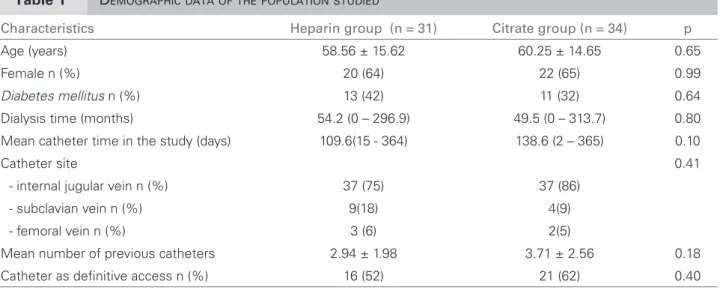
The demographic and clinical data of the Heparin and Citrate groups are shown in Table 1. No signifi-cant difference was observed between the groups. The 92 catheters, 49 in the Heparin Group and 43 in the Citrate Group, corresponded to a total of 5,102 catheters/day in the Heparin Group, and 5,693 cath-eters.day in the Citrate Group (p = 0.29).
The events observed in each group during the study are shown in Table 2. Of the pyrogenic reac-tions observed, 11 (65%) occurred in the Heparin Group and six (35%) in the Citrate Group. The pyrogenic index was 2.16 and 1.05 episodes/1,000 catheters.day for the Heparin and Citrate Groups, respectively (p = 0.23).
Eighteen episodes of catheter-related bacteremia occurred, 17 of which in the Heparin Group and only one in the Citrate Group. The bacteremia index
Characteristics Heparin group (n = 31) Citrate group (n = 34) p
Age (years) 58.56 ± 15.62 60.25 ± 14.65 0.65
Female n (%) 20 (64) 22 (65) 0.99
Diabetes mellitus n (%) 13 (42) 11 (32) 0.64
Dialysis time (months) 54.2 (0 – 296.9) 49.5 (0 – 313.7) 0.80
Mean catheter time in the study (days) 109.6(15 - 364) 138.6 (2 – 365) 0.10
Catheter site 0.41
- internal jugular vein n (%) 37 (75) 37 (86)
- subclavian vein n (%) 9(18) 4(9)
- femoral vein n (%) 3 (6) 2(5)
Mean number of previous catheters 2.94 ± 1.98 3.71 ± 2.56 0.18
Catheter as definitive access n (%) 16 (52) 21 (62) 0.40
Table 1 DEMOGRAPHICDATAOFTHEPOPULATIONSTUDIED
Table 2 ADVERSEEVENTSINTHEGROUPSTREATEDWITHHEPARINORCITRATE
Events Heparin group (n = 31) Citrate group (n = 34) p
Pyrogenic reactions 11 6 0.29
Bacteremias Gram positive (%) Gram negative (%)
17 4 (24) 13 (76)
1 1 (100)
0
< 0.001
Thromboses 4 3 0.83
Hospitalizations 12 4 0.05
Figure 1. Pyrogenic reaction-free time (A), bacteremia-free time (B), and hospitalization-bacteremia-free time (C). Comparison between the Citrate and Heparin groups.
1.0
1.0
1.0 0.8
0.8
0.8 0.6
0.6
0.6 0.4
0.4
0.4 0.2
0.2
0.2 0.0
0.0
0.0 0
0
0
100
100
100 200
200
200 300
300
300 400
400
400 days
days
days
Pyrogenic reaction-free
Bacteremia-free
Hospitalization-free
p = 0.093
A
B
C
Heparin group Citrate group
p < 0.001 Heparin group Citrate group
p = 0.023
Heparin group Citrate group
in the Heparin Group was 3.33 episodes/1,000 cath-eters.day, and in the Citrate Group it was 0.18 epi-sodes/1,000 catheters.day (p < 0.001). In the Heparin Group, 76.5% of the blood cultures showed Gram-negative microorganisms (Pseudomonas predomi-nated, followed by Acinetobacter and Serratia sp.). S.
aureus was identified in the only episode occurring in
the Citrate Group.
Bacteremia was associated with the presence of diabetes and with belonging to the Heparin Group (Table 3). In the multivariate regression analysis, be-longing to the Heparin Group was the only indepen-dent factor associated with the occurrence of bacte-remia (β coefficient = -3.06, 95% CI: 0.005 – 0.402; p = 0.005).
The number of thrombosed catheters requiring removal due to low flow (lower than 250 mL/min) problems was similar in both groups, as was throm-bolytic use (rTPA). A tendency towards a greater infection-related hospitalization rate was observed in the Heparin Group (p=0.055). The total number of hospitalizations was 204 beds.day, being higher in the Heparin Group (151 beds/day vs. 53 beds.day, p < 0.001; Heparin Group and Citrate Group, respec-tively). The occurrence of death did not significantly differ between the groups.
The event-free survival curves for pyrogenic reac-tion, bacteremia, and hospitalization of the Heparin and Citrate Groups are shown in Figure 1. The bacte-remia-free time was significantly longer in the Citrate Group (p < 0.001), as was the hospitalization-free time (p = 0.02).
During the study period, 4,316 post-hemodialysis catheter-lumen filling in the arterial and venous sides (catheter lock) were performed, 2,090 in the Heparin
Table 3 DEMOGRAPHICDATAOFTHEPOPULATIONSTUDIEDCOMPARINGPATIENTSWITHANDWITHOUTBACTEREMIA
Characteristics Bacteremia (n = 13) No bacteremia (n = 52) p
Age (years) 58.8 ± 13.8 59.6 ± 15.4 0.87
Female n (%) 7 (54) 35 (67) 0.36
Diabetes mellitus n (%) 8 (61) 16 (30) 0.04
Dialysis time (months) 27 (0 – 109) 19 (0 – 313) 0.56
Catheter time in the study (days) 112 (20 - 364) 85(2 – 365) 0.29
Catheter site 0.26
- internal jugular vein n (%) 10 (77%) 43 (83%)
- subclavian vein n (%) 3 (23%) 5 (10%)
- femoral vein n (%) 0(0) 4 ( 7%)
Mean number of previous catheters 2.6 ± 1.6 3.5 ± 2.4 0.21
Group and 2,226 in the Citrate Group. No abnor-No abnor-mal bleeding was detected. In the Citrate Group, one patient had arrhythmia with hypotension, and an-other, paresthesia of the lips and metallic taste in the mouth, which disappeared in up to one minute after interrupting the infusion.
D
ISCUSSIONThe results of this study show that the use of citrate as a venous catheter lock when compared with hepa-rin was associated with a lower occurrence of cath-eter-related bacteremia. In addition, patients using citrate spent less days hospitalized than those using heparin as catheter lock.
In the literature, the incidence of HD catheter-relat-ed bacteremia ranges from 1.6 to 5.5 episodes/1,000 catheters.day, and that variation is partially explained by the techniques used in catheter management, the use of different locking solutions, as well as of differ-ent concdiffer-entrations of such solutions. Citrate has been associated with a reduction in the incidence of bacte-remia due to its bactericidal effect at concentrations higher than 23%.14,15,16,17
Some studies, however, showed no difference regarding citrate or heparin use.18,19,20 One of such
studies, a randomized and controlled one, reported no citrate superiority over heparin; however, the au-thors attributed such result to the low occurrence of events in both groups (lower than 0.7 bacteremia epi-sodes/1,000 catheters.day).21 In the present study, the
incidence of bacteremia was significantly reduced in the Citrate Group, which did not occur with pyrogen-ic episodes, probably because the bacterpyrogen-icidal action of trisodium citrate is restricted to the catheter lumen.
Another relevant aspect of this study is the high incidence of Gram-negative bacteria in more than 75% of the blood cultures. An increase in the inci-dence of Gram-negative bacteremia has been report-ed in recent years, and most studies have reportreport-ed an incidence of up to 45%.22 The present study
empha-sizes that the dialysis units need to know the etiolog-ic agents of their population infections, because that information should guide the initial therapy, which is empirically practiced at each institution.
The number of hospitalization days was smaller in the Citrate Group, as was longer the hospitaliza-tion-free time. Despite literature reports indicating catheter-related infection as an important cause of hospitalization, no report about a reduction in hos-pitalization attributed to the use of any of the cathe-ter-locking solutions could be found.
Catheter dysfunction, in addition to its mechan-ical causes such as catheter folding and proximity of catheter tips to the vessel wall, is caused by the formation of a fibrin cap that eventually involves the entire catheter, exceeding its extremity and partially or totally hindering blood aspiration. No difference regarding thrombosis-related catheter dysfunction was found in the groups studied, in ac-cordance with most previously published studies.23
It is worth noting the low incidence of adverse effects of citrate use in the present study. In the United States of America, citrate is rarely used as a catheter-locking solution because of the FDA-issued warning after a fatal occurrence with citrate use.24 The adverse effects of high concentrations
of citrate seem to be related to the sudden drop in the calcium ion concentration, leading to severe cardiac arrhythmia.25 The use of a strict protocol
with two syringes filled with the exact volume of the arterial and venous lumen, according to the catheter manufacturer’s specification, and the slow infusion of the locking solution following a rapid infusion of 10 mL of saline solution in each lumen seem to be sufficient to prevent complications re-lated to that therapy. In addition, the most frequent symptoms, paresthesia and metallic taste, were rare in this study and disappeared in up to one minute after interrupting the locking-solution infusion. It is worth noting that the long-term effect of citrate use is yet to be assessed.
Although this is a retrospective study with se-quential analysis, which made some patients and catheters be part of both groups studied, it is the first Brazilian report on the experience with citrate use, and shows consistent differences between citrate and heparin used as HD catheter-locking solutions.
In conclusion, citrate use effectively reduced bacteremia episodes and hospitalizations of pa-tients with chronic kidney failure undergoing HD. Therefore, citrate catheter-locking solution seems to be a valuable tool that allows longer catheter survival, which is increasingly necessary in the management of HD patients.
A
CKNOWLEDGEMENTSR
EFERENCES1. Dor A, Pauly MV, Eichleay MA et al. End-stage renal disease and economic incentives: the International Study of Health Care Organization and Financing (ISHCOF). Int J Health Care Financing Econ 2008; 7:73-111. 2. Sesso R, Lopes AA, Thomé FA et al. Relatório do Censo
Brasileiro de Diálise. J Bras Nefrol 2008; 30:233-8. 3. US Renal Data System. USRDS 2010 Annual Data
Report: Atlas of Chronic Kidney Disease and End-Stage Renal Disease in the United States. Bethesda, MD: National Institutes of Health, National Institute of Diabetes and Digestive and Kidney Diseases, 2010. 4. Spergel MS. Has the Fistula First Breakthrough
Initiative Caused an Increase in Catheter Prevalence? Semin Dial 2008; 21:550-2.
5. Rayner HC, Pisoni RL. The Increasing Use of Hemodialysis Catheter: Evidence from the DOPPS on Its Significance and Ways to Reverse It. Semin Dial 2010; 23:6-10.
6. Beathard GA, Urbanes A. Infection Associated with Tunneled Hemodialysis Catheter. Semin Dial 2008; 21:528-38.
7. US Renal Data System. USRDS 2007 Annual Data Report: Atlas of Chronic Kidney Disease and End-Stage Renal Disease in the United States. Bethesda, MD: National Institutes of Health, National Institute of Diabetes and Digestive and Kidney Diseases, 2007. 8. Katneni R, Hedayati SS. Central venous
catheter-re-lated bacteremia in chronic hemodialysis patients: epi-demiology and evidence-based management. Nat Rev Nephrol 2007; 3:256-66.
9. Saxena AK, Panhotra BR. Haemodialysis catheter-re-lated bloodstream infections: current treatment options and strategies for prevention. Swiss Med Wkly 2005; 13:127-38.
10. Broom JK, O’Shea S, Govindarajulu S et al. Rationale and design of the HEALTHY-CATH trial: A ran-domised controlled trial of Heparin versus EthAnolLock THerapY for the prevention of Catheter Associated infecTion in Haemodialysis patients. BMC Nephrol 2009; 10:23-28.
11. Biernat JC, dos Santos F, dos Santos AMG et al.
Contaminação do Lúmen de Cateter de Hemodiálise: Prevenção e Tratamento com M-EDTA. J Bras Nefrol 2008; 30:105-12.
12. Association for the Advancement of Medical Instrumentation. AAMI Standards and Recommended Practices. Dialysis, Volume 3. Arlington, VA: 1998 Edition.
13. Centers for Disease Control and Prevention (CDC). Guidelines for prevention of intravascular catheter-re-lated infections. MMWR August 09, 2002; Vol 51, Nº RR-10. Avaiable from website: URL: http://www.cdc. gov/mmwr/preview/mmwrhtml/rr5110a1.htm.
14. Weijmer MC, van den Dorpel MA, van de Ven PJG
et al. Randomized, clinical trial comparison of triso-dium citrate 30% and heparin as catheter-locking solu-tion in hemodialysis patients. J Am Soc Nephrol 2005; 16:2769-77.
15. Ash S, Mankus RA, Sutton JM et al. Concentrate sodi-um citrate (23%) for catheterlock. Hemodial Int 2000; 4:22-31.
16. Winnett G, Nolan J, Miller M et al. Trisodium citrate 46.7% selectively and safely reduces staphylococcal catheter-related bacteraemia. Nephrol Dial Transplant 2008; 23:3592-8.
17. Pierce DA, Rocco MV. Trisodium citrate: an alterna-tive to unfractionated heparin for hemodialysis catheter dwells. Pharmacotherapy 2010; 30:1150-8.
18. Buturovic J, Ponikvar R, Kandus A et al. Filling hemo-dialysis catheters in the interdialytic period: Heparin versus citrate versus polygeline: a prospective random-ized study. Artif Organs 1998; 22:945-7.
19. Stas KJF, Vanwalleghem J, De Moor B et al. Trisodium citrate 30% vs. heparin 5% as catheter lock in the interdialytic period in twin or double-lumen dialysis catheters for intermittent haemodialysis. Nephrol Dial Transplant 2001; 16:1521-2.
20. Hendrickx L, Kuypers D, Evenepoel P et al. A compar-ative prospective study on the use of low concentrate citrate lock versus heparin lock in permanent dialysis catheters. Int J Artif Organs 2001; 24:208-11.
21. Power A, Duncan N, Singh SK et al. Sodium Citrate Versus Heparin Catheter Locks for Cuffed Central Venous Catheters: A Single-Center Randomized Controlled Trial. Am J Kidney Dis 2009; 53:1034-41. 22. Lafrance JP, Rahme E, Lelorier J et al. Vascular
Access-Related Infections: definitions, incidence rates, and risk factors. Am J Kidney Dis 2008; 52:982-93.
23. MacRae JM, Dojninovic I, Djurdjev O et al. Citrate 4%
versus Heparin and the Reduction of Thrombosis Study (CHARTS). Clin J Am Soc Nephrol 2008; 3:369-74. 24. US Food and Drug Administration: FDA issues
warn-ing on tricitrasol dialysis catheter anticoagulant. FDA Talk Paper T00-16. Rockville, MD, US Department of Health and Human Services, 2000.