hrombin activatable ibrinolysis inhibitor as a
bleeding predictor in liver transplantation: a pilot
observational study
Wagner Luis Nedel1, Edison Moraes Rodrigues
Filho2, Alessandro Comarú Pasqualotto1,2
1. Postgraduate Program in Hepatology, Universidade Federal de Ciências da Saúde - Porto Alegre (RS), Brazil.
2. Irmandade Santa Casa de Misericórdia de
Porto Alegre - Porto Alegre (RS), Brazil. of thrombin activatable ibrinolysis Objective: To correlate the levels
inhibitor in the immediate postoperative period and at 24 hours postoperatively with the volume of intraoperative bleeding.
Methods: Twenty-one patients
allocated immediately before (elective or emergency) liver transplantation were analyzed. Blood samples were collected for thrombin activatable ibrinolysis inhibitor analysis at three diferent time points: immediately before liver transplantation (preoperative thrombin activatable ibrinolysis inhibitor), immediately after the surgical procedure (immediate postoperative thrombin activatable ibrinolysis inhibitor), and 24 hours after surgery (thrombin activatable ibrinolysis inhibitor 24 hours after surgery). he primary outcome of the study was to correlate the preoperative and immediate postoperative levels of thrombin activatable ibrinolysis inhibitor with intraoperative blood loss.
Results: here was a correlation between the preoperative thrombin activatable ibrinolysis inhibitor levels and bleeding volume (ρ = -0.469; p = 0.05) but no correlation between the immediate postoperative thrombin activatable ibrinolysis inhibitor and bleeding volume (ρ = -0.062; p = 0.79). Conflicts of interest: None.
Submitted on February 22, 2016 Accepted on May 5, 2016
Corresponding author:
Wagner Luis Nedel Av. Francisco Trein, 596
CEP: 91350-200 - Porto Alegre (RS), Brasil E-mail: [email protected]
Responsible editor: Glauco Adrieno Westphal
hrombin activatable ibrinolysis inhibitor como preditor de
sangramento no transplante hepático: estudo piloto observacional
ABSTRACT
Keywords: Carboxipeptidase B2; Fibrinolysis; Liver transplantation; Hemorrhage; Fibrinogen; MELD
No variable included in the linear regression analysis (prehemoglobin, preibrinogen and preoperative thrombin activatable ibrinolysis inhibitor) was a bleeding predictor. here was a similar trend in the variation between the levels of thrombin activatable ibrinolysis inhibitor at the three diferent time points and ibrinogen levels. Patients who died within 6 months (14.3%) showed decreased preoperative and immediate postoperative levels of thrombin activatable ibrinolysis compared with survivors (preoperative: 1.3 ± 0.15 versus 2.55 ± 0.53, p = 0.06; immediate postoperative: 1.2 ± 0.15 versus 2.5 ± 0.42, p = 0.007).
Conclusion: here was a moderate correlation between preoperative thrombin activatable ibrinolysis inhibitor and intraoperative bleeding in liver transplantation patients, although the predictive role of this variable independent of other variables remains uncertain. Preoperative and immediate postoperative thrombin activatable ibrinolysis inhibitor levels may have a role in the survival prognosis of this population; however, this possibility requires conirmation in further studies with larger sample sizes.
INTRODUCTION
Blood product transfusion is a common event during orthotopic liver transplantation. It afects patient outcomes and the viability of the transplanted organ.(1) In most studies, blood product transfusion is associated with increased mortality rates, increased risk of infections, and graft dysfunction.(2) he main risk factors for bleeding and transfusion in liver transplantation are patient age, liver cirrhosis severity (evaluated using the model for end-stage liver disease [MELD]), preoperative hemoglobin level, anesthesia time, and preoperative ibrinogen levels.(3) At the time of graft perfusion, there is an overall reduction in prothrombotic factors and coagulation that is associated with concomitant tissue plasminogen activator (tPA) production and ibrinolysis. his reduction can potentially increase the risk of bleeding,(4) which is partly reversed by antiibrinolytic drugs.
hrombin-activatable ibrinolysis inhibitor (TAFI), also known as procarboxipeptidase B or U, is a liver protein that acts as a ibrinolysis inhibitor. It is converted into its active form (TAFIa) by the thrombin-thrombomodulin complex, which decreases plasmin production and suppresses the ibrinolytic cascade.(5) he serum levels of TAFI are substantially decreased in cirrhotic patients and can reach undetectable levels in patients with advanced hepatocellular disease(6) due to impaired synthesis.(7) Hyperibrinolysis is a common inding among cirrhotic patients and may contribute to the increased bleeding tendency among these patients, which is a TAFI-dependent mechanism.(8) Decreased TAFI levels are found in this population and have been identiied as signiicant mortality predictors(9) that are also related to cirrhosis severity.(8) However, the role of TAFI in perioperative bleeding assessment and management in liver transplant recipients has not yet been established, which is the main objective of this study.
METHODS
We studied 21 patients with liver cirrhosis of diferent etiologies who were undergoing perioperative management immediately before liver transplantation. Patients were admitted to the Hospital Dom Vicente Scherer, which has an 80-bed liver transplantation ward and is located in the south region of Brazil. Disease severity was evaluated using the MELD and Child-Pugh scores. Blood samples were collected for TAFI analysis using an enzyme-linked immunosorbent assay (ELISA; VisuLize TAFI antigen kit,
Ainity Biologicals, Inc., Ancaster, Canada). Blood was collected into trisodium citrate vials, pH 7.5, from the antecubital vein at three diferent time points: immediately before liver transplantation (PRE TAFI), immediately after the surgical procedure (IPO TAFI), and 24 hours after surgery (TAFI 24 hours PO). hese samples were analyzed according to the manufacturer’s instructions, and the results are expressed in absolute values. Plasma was separated via centrifugation at 2,000 g for 15 minutes. Routine laboratory tests, including hematology tests, were performed according to the local perioperative protocols on fresh plasma samples, whereas the TAFI tests were performed on samples stored at -80°C for a maximum of 8 months. he absolute values of TAFI are expressed as μg/ mL. Clinical characteristics and outcomes were analyzed via medical chart review.
his study was approved by the Research Ethics Committee of the institution (number 00796512.0.00005335), and the patients or their legal guardian signed an informed consent form. Exclusion criteria were age < 18 years, combined liver-kidney transplantation, liver retransplantation, and the use of vitamin K inhibitors, anticoagulants, or plasma transfusion up to 7 days before the surgical procedure. Primary outcome of the study was to correlate the PRE and IPO TAFI levels with intraoperative bleeding, deined as the volume measured by aspiration and using the cell saver system. Secondary outcomes were to correlate PRE TAFI levels with the diferent cirrhosis etiologies; to compare PRE TAFI levels with the presence of hepatocellular carcinoma or portal vein thrombosis; and to correlate TAFI levels with ibrinogen levels collected during the same period, the occurrence of shock 24 hours after transplantation, the need for surgical intervention within 48 hours of liver transplantation and the 6-month mortality rate.
Statistical analysis
preoperative ibrinogen level, PRE TAFI, IPO TAFI and anesthesia time. Correlations between diferent TAFI and ibrinogen level time points were compared using generalized linear model, and the variation in mean values was compared using the Z score at each time point (preoperative, postoperative, and 24 hours postoperatively) for both variables. All statistical analyses were performed using the Statistical Package for the Social Sciences (SPSS), version 17.0, and STATA, version 11.0.
RESULTS
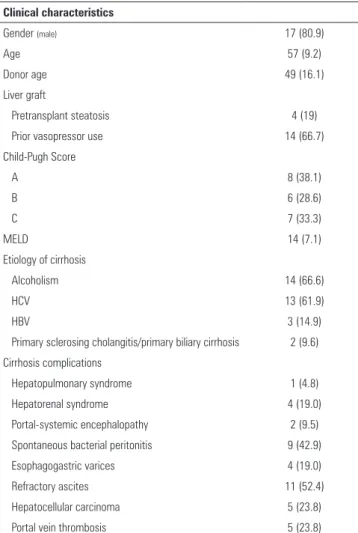
A total of 26 patients were evaluated, but two patients failed to meet the inclusion criteria (combined liver-kidney transplantation), and three did not sign the informed consent form. he baseline patient data are summarized in table 1, and the main perioperative characteristics are shown in table 2.
Table 1 - Clinical characteristics of the population
Clinical characteristics
Gender (male) 17 (80.9)
Age 57 (9.2)
Donor age 49 (16.1)
Liver graft
Pretransplant steatosis 4 (19)
Prior vasopressor use 14 (66.7)
Child-Pugh Score
A 8 (38.1)
B 6 (28.6)
C 7 (33.3)
MELD 14 (7.1)
Etiology of cirrhosis
Alcoholism 14 (66.6)
HCV 13 (61.9)
HBV 3 (14.9)
Primary sclerosing cholangitis/primary biliary cirrhosis 2 (9.6)
Cirrhosis complications
Hepatopulmonary syndrome 1 (4.8)
Hepatorenal syndrome 4 (19.0)
Portal-systemic encephalopathy 2 (9.5)
Spontaneous bacterial peritonitis 9 (42.9)
Esophagogastric varices 4 (19.0)
Refractory ascites 11 (52.4)
Hepatocellular carcinoma 5 (23.8)
Portal vein thrombosis 5 (23.8)
MELD - Model for End-Stage Liver Disease; HCV - hepatitis C virus; HBV - hepatitis B virus. Results are expressed as number (%) and median (standard deviation).
Table 2 - Perioperative data
Variable
SOFA score upon ICU admission 9 (2.0)
Total perioperative bleeding (mL) 3940 (2608)
Anesthetic time (minutes) 355 (132)
Warm ischemia time (minutes) 67 (25) Cold ischemia time (minutes) 407 (116)
Blood product transfusion
Platelet concentrate 6 (28.6)
Packed red blood cells 12 (57.1)
Prothrombin complex concentrate 2 (9.5)
Cryoprecipitate 7 (33.3)
Antifibrinolytic administration 10 (47.6)
SOFA - Sequential Organ Failure Assessment; ICU - intensive care unit. Results are expressed as median (standard deviation) or number (%).
here was no signiicant diference between the PRE TAFI serum levels according to the diferent cirrhosis etiologies: alcoholism (p = 0.73), hepatitis C virus (p = 0.12), hepatitis B virus (p = 0.61), primary biliary cirrhosis (p = 0.18) and primary sclerosing cholangitis (p = 0.09). Patients with a diagnosis of portal vein thrombosis had higher TAFI serum levels than those who did not develop this complication: 2.8 ± 0.39 versus 2.0 ± 0.64 (p = 0.028), respectively. Patients with hepatocellular carcinoma also had higher PRE TAFI serum levels than those who did not have the disease: 2.7 ± 0.53 versus2.0 ± 0.58 (p = 0.01).
TAFI levels varied over the three diferent time points in a manner that was not signiicantly diferent from the variation observed in ibrinogen during these three periods according to an analysis using the generalized linear model (Table 3). In the correlation analysis, the PRE TAFI levels showed correlations with the perioperative bleeding volume (ρ = -0.469; p = 0.05), the preoperative ibrinogen level (ρ = -0.603; p = 0.006) and the hemoglobin level (ρ = -0.630; p = 0.003) but not with the IPO TAFI levels (ρ = -0.062; p = 0.79). Linear regression showed that no variable included in the analysis was a signiicant predictor of perioperative bleeding after confounding variables were controlled (Table 4).
Table 3 - Correlation between thrombin activatable fibrinolysis inhibitor and fibrinogen at different collection times
Collection times Mean difference between TAFI and fibrinogen 95%CI p value
Preoperative 0.31 -0.12 - 0.76 0.16
Immediate postoperative 0.12 -0.44 - 0.20 0.46
24 hours after surgery 0.08 -0.34 - 0.51 0.70
TAFI - thrombin activatable fibrinolysis inhibitor; 95%CI - 95% confidence interval.
Table 4 - Risk factors predicting perioperative bleeding according to regression analysis
Mean ± SD Crude linear regression Adjusted linear regression
β (95%CI) p value β (95%CI) p value*
Pre TAFI 2.35 ± 0.67 -1.697.17 (-3.368.66 - -25.67) 0.047 -915.97 (-3.505.45 - 1.675.50) 0.463
Pre Fibr 187.10 ± 113.34 -12.35 (-22.50 - -2.21) 0.020 -4.99 (-17.73 - 7.75) 0.417
Pre Hb 12.25 ± 2.31 -684.08 (-1.112.98 - -255.18) 0.003 -348.78 (-1.009.79 - 312.21) 0.278
SD - standard deviation; 95%CI - 95% confidence interval; TAFI - thrombin activatable fibrinolysis inhibitor; Fibr - fibrinogen; Hb - hemoglobin. Sample size: 21 patients. * Control performed between all variables.
not correlated with the PRE TAFI levels (2.1 ± 0.70 in the transfusion group versus 2.45 ± 0.62 in the group without transfusion; p = 0.23) or the IPO TAFI levels (transfusion group 2.0 ± 0.69 versus2.45 ± 0.50; p = 0.43) or with the need for surgical reintervention within 48 hours (PRE TAFI, reintervention group: 2.1 ± 0.65 versus 2.45 ± 0.67; p = 0.36; IPO TAFI, reintervention group: 2.0 ± 0.80 versus2.45 ± 0.53; p = 0.39).
Within 6 months of follow-up, three patients died, for a total mortality rate of 14.3%. Patients who died had lower PRE TAFI (1.3 ± 0.15 versus 2.55 ± 0.53; p = 0.06, respectively) and IPO TAFI (1.2 ± 0.15 versus2.5 ± 0.42; p = 0.007, respectively) serum levels than survivors, but there was no signiicant diference in the TAFI 24 hours PO levels between the groups (3.0 ± 0.92 among the survivors versus2.8 ± 1.04 among the patients who died; p = 0.31).
here was no diference in the PRE TAFI and IPO TAFI levels between the patients who required transfusion in the irst 24 hours post-surgery and those who did not (PRE TAFI: 2.1 ± 0.7 versus 2.45 ± 0.62; p = 0.43; IPO TAFI: 2.0 ± 0.69 versus 2.45 ± 0.50; p = 0.23), between the patients who developed persistent shock within 24 hours postsurgery and those who did not (PRE TAFI 2.5 ± 0.44 versus 2.0 ± 0.69; p = 0.16; IPO TAFI: 2.1 ± 0.78 versus 2.45 ± 0.61; p = 0.36), or between the patients who required surgical reintervention within 48 hours postsurgery and those who did not (PRE TAFI: 2.1 ± 0.65 versus 2.45 ± 0.67; p = 0.39; IPO TAFI: 2.0 ± 0.80 versus 2.45 ± 0.53; p = 0.36).
DISCUSSION
his study reports key indings regarding TAFI among patients undergoing liver transplantation. he correlation between TAFI serum levels and the severity of chronic liver failure has been well described,(8,9) although this is the irst study to describe the variation in TAFI levels during the perioperative period and its correlation with diferent clinical outcomes. he relationship between the presence of portal vein thrombosis and increased TAFI levels must be highlighted. he literature suggests that a high TAFI level is a risk factor for venous thrombosis(6,10,11) and is a inding in patients who develop disease recurrence.(12) Patients with hepatocellular carcinoma may develop hypercoagulability, which causes decreased ibrinolytic activity during the intraoperative period of liver transplantation(13) Our inding of increased TAFI levels among this population may corroborate such data.
Fibrinogen, a ibrin precursor, plays a key role in clot stabilization, providing resistance to ibrinolytic action. Serum levels are decreased during preoperative period because ibrinogen hepatic synthesis, and its serum level variation during the surgical procedure is mainly because of the degree of ibrinolysis present.(1) he variation in TAFI levels at diferent time points follows the variation in ibrinogen levels, which corroborates such indings.
Currently, most studies fail to deine risk factors related to bleeding, including laboratory tests.(14,15) Few data reported in the literature suggest that MELD score, preoperative hemoglobin levels, preoperative ibrinogen serum levels, and anesthesia time are predictors of increased bleeding during transplantation.(3) Hemostatic abnormalities during the perioperative period of liver transplantation are multifactorial, and only a few laboratory tests are accurate predictors of this outcome. In this study, we found only a moderate correlation between PRE TAFI and bleeding volume, and this correlation was lower than the correlation between ibrinogen and preoperative hemoglobin levels. In an adjusted linear regression model, none of these changes were found to predict bleeding during liver transplantation, although the small sample size precludes deinitive conclusions.
his study has several limitations. First, this is merely a hypothesis-generating pilot study that addresses issues that should be further examined in a larger sample and with better methodological quality. Our results preclude making conclusive statements regarding mortality prediction in this population because data could not undergo multivariate analysis given the low incidence of deaths.
he failure to compare the role of TAFI as a bleeding predictor with thromboelastography, the preferred test for this purpose, is a key caveat of this study. hromboelastography enables the accurate and immediate determination of the etiology of bleeding (ibrinolysis,
mechanical causes or thrombocytopenia) in a dynamic assessment, thereby decreasing the need for blood product transfusion in liver transplantation.(16) Comparing TAFI levels and their variations (delta) among diferent time points with thromboelastography indings or other ibrinolysis markers (e.g., ibrinolysis time and clot lysis time) would more accurately establish the correlation between TAFI and the presence of ibrinolytic activation during the perioperative period.
CONCLUSION
hrombin activatable ibrinolysis inhibitor, particularly its preoperative levels but also its levels during the immediate postoperative period, may be a key tool for further understanding coagulopathy during liver transplantation, and it may have a role as a predictor of increased mortality rates in the liver transplant population. Further studies with a larger sample size that measure thrombin activatable ibrinolysis inhibitor levels beyond the irst 24 hours after surgery are needed to establish the role of thrombin activatable ibrinolysis inhibitor in pre-liver transplantation stratiication.
ACKNOWLEDGEMENTS
We would like to express our gratitude to the Postgraduate Support Program of the Universidade Federal
de Ciências da Saúde de Porto Alegre - Porto Alegre (RS),
Brazil.
Objetivo: Correlacionar os níveis de thrombin activatable ibrinolysis inhibitor no pós-operatório imediato e com 24 horas de pós-operatório com o volume de sangramento tansoperatório.
Métodos: Foram analisados vinte e um pacientes alocados imediatamente antes do transplante hepático (eletivo ou de urgência), com coleta de amostras sanguíneas para análise de thrombin activatable ibrinolysis inhibitor em três diferentes momentos: imediatamente antes do transplante hepático (thrombin activatable ibrinolysis inhibitor pré-operatório), imediatamente após o procedimento cirúrgico (thrombin activatable ibrinolysis inhibitor pós-operatório imediato) e após 24 horas do inal da cirurgia (thrombin activatable ibrinolysis inhibitor 24 horas pós-operatório). O principal desfecho do
estudo foi correlacionar os níveis de thrombin activatable ibrinolysis inhibitor pré-operatório e de thrombin activatable ibrinolysis inhibitor pós-operatório imediato com perda sanguínea no transoperatório.
Resultados: Houve correlação entre thrombin activatable ibrinolysis inhibitor pré-operatório e o volume de sangramento (ρ = -0,469; p = 0,05), mas não de thrombin activatable ibrinolysis inhibitor pós-operatório imediato (ρ = -0,062; p = 0,79). Em análise de regressão linear, nenhuma das variáveis incluídas (hemoglobina pré, ibrinogênio pré e thrombin activatable ibrinolysis inhibitor pré-operatório) se mostrou preditor de sangramento. Houve tendência semelhante na variação entre os níveis de thrombin activatable ibrinolysis inhibitor durante os três diferentes momentos e os níveis de ibrinogênio. Pacientes que evoluíram a óbito em até 6 meses (14,3%) apresentaram
Descritores: Carboxipeptidase B2; Fibrinólise; Transplante de fígado; Hemorragia; Fibrinogênio; MELD
REFERÊNCIAS
1. Sabate A, Dalmau A, Koo M, Aparicio I, Costa M, Contreras L. Coagulopathy management in liver transplantation. Transplant Proc. 2012;44(6):1523-5. 2. Senzolo M, Burra P, Cholongitas E, Burroughs K. New insights into
the coagulopathy of liver disease and liver transplantation. World J Gastroenterol. 2006;12(48):7725-36. Review.
3. Mangus RS, Kinsella SB, Nobari MM, Fridell JA, Vianna RM, Ward ES, et al. Predictors of blood product use in orthotopic liver transplantation using the piggyback hepatectomy technique. Transplant Proc. 2007;39(10):3207-13. 4. Wang Y, Liu Y, Han R, Zhu Z, Zhang Y, Wang X, et al. Hemostatic variation
during perioperative period of orthotopic liver transplantation without venovenous bypass. Thromb Res. 2008;122(2):161-6.
5. Watanabe R, Wada H, Watanabe Y, Sakakura M, Nakasaki T, Mori Y, et al. Activity and antigen levels of thrombin-activatable fibrinolysis inhibitor in plasma of patients with disseminated intravascular coagulation. Thromb Res. 2001;104(1):1-6.
6. Nesheim M. Thrombin and fibrinolysis. Chest. 2003;124(3 Suppl):33S-9S. 7. Lisman T, Leebeek FW, Mosnier LO, Bouma BN, Meijers JC, Janssen HL, et al. Thrombin-activatable fibrinolysis inhibitor deficiency in cirrhosis is not associa-ted with increased plasma fibrinolysis. Gastroenterology. 2001;121(1):131-9. 8. Colucci M, Binetti BM, Branca MG, Clerici C, Morelli A, Semeraro N, et al.
Deficiency of thrombin activatable fibrinolysis inhibitor in cirrhosis is asso-ciated with increased plasma fibrinolysis. Hepatology. 2003;38(1):230-7.
9. Gresele P, Binetti BM, Branca G, Clerici C, Asciutti S, Morelli A, et al. TAFI deficiency in liver cirrhosis: relation with plasma fibrinolysis and survival. Thromb Res. 2008;121(6):763-8.
10. Bajzar L. Thrombin activatable fibrinolysis inhibitor and an antifibrinolytic pathway. Arterioscler Thromb Vasc Biol. 2000;20(12):2511-8.
11. Foley JH, Kim PY, Mutch NJ, Gils A. Insights into thrombin activatable fibrinolysis inhibitor function and regulation. J Thromb Haemost 2013;11 Suppl 1:306-15.
12. Eichinger S, Schönauer V, Weltermann A, Minar E, Bialonczyk C, Hirschl M, et al. Thrombin-activatable fibrinolysis inhibitor and the risk for recurrent venous thromboembolism. Blood. 2004;103(10):3773-6.
13. Segal H, Cottam S, Potter D, Hunt BJ. Coagulation and fibrinolysis in primary biliary cirrhosis compared with other liver disease and during orthotopic liver transplantation. Hepatology. 1997;25(3):683-8.
14. Steib A, Freys G, Lehmann C, Meyer C, Mahoudeau G. Intraoperative blood losses and transfusion requirements during adult liver transplantation remain difficult to predict. Can J Anaesth. 2001;48(11):1075-9.
15. Massicotte L, Beaulieu D, Thibeault L, Roy JD, Marleau D, Lapointe R, et al. Coagulation defects do not predict blood product requirements during liver transplantation. Transplantation. 2008;85(7):956-62.
16. Rando K, Niemann CU, Taura P, Klinck J. Optimizing cost-effectiveness in perioperative care for liver transplantation: a model for low- to medium-income countries. Liver Transplant. 2011;17(11):1247-78.
níveis diminuídos de thrombin activatable ibrinolysis inhibitor pré-operatório e de thrombin activatable ibrinolysis inhibitor pós-operatório imediato, comparando-se aos sobreviventes (pré-operatório: 1,3 ± 0,15 versus 2,55 ± 0,53; p = 0,06; e pós-operatório imediato: 1,2 ± 0,15 versus 2,5 ± 0,42; p = 0,007).
Conclusão: Houve correlação moderada entre thrombin activatable ibrinolysis inhibitor pré-operatório e o sangramento transoperatório em transplante hepático, porém seu papel